Your ShelfYour Projects

Signs of the Times, Vol. 39, No. 26.

Our Lord and Master

Signs of the Times

Jul 9, 1912

Pacific Press Publishing Association · Mountain View, California · Jul 9, 1912

Our Lord and Master
JESUS saith unto him, I am the way, the truth, and the life: no man cometh unto the Father, but by Me."
"His dear Son: in whom we have redemption through His blood, even the forgiveness of sins: who is the image of the invisible God, the first-born of every creature: for by Him were all things created, that are in heaven, and that are in earth, visible and invisible, whether they be thrones, or dominions, or principalities, or powers: all things were created by Him and for Him: and He is before all things, and by Him all things consist."
"For He [the Father] hath made Him [the Son] to be sin for us, who knew no sin; that we might be made the righteousness of God in Him."
"Who gave Himself for us, that He might redeem us from all iniquity, and purify unto Himself a peculiar people, zealous of good works."
"But of Him are ye in Christ Jesus, who of God is made unto us wisdom, and righteousness, and sanctification, and redemption."
"When the Son of Man shall come in His glory, and all the holy angels with Him, then shall He sit upon the throne of His glory."
"And I saw heaven opened, and behold a white horse; and He that sat upon him was called Faithful and True, and in righteousness He doth judge and make war. His eyes were as a flame of fire, and on His head were many crowns; and He had a name written, that no man knew, but He Himself. And He was clothed in a vesture dipped in blood: and His name is called The Word of God. . . . And He hath on His vesture and on His thigh a name written, KING OF KINGS, AND LORD OF LORDS."

Question Corner

"IF YE WILL INQUIRE, INQUIRE YE."
This Inquirers' Department is conducted for the purpose of helping those who are studying the Bible. The answers are oftentimes only suggestive. They are never to be considered infallible, only as they agree with the infallible Word. The writer who may answer them does not consider that his opinion is infallible. He will simply give the best that he has, and plead with the inquirer to search the Word.
Such questions only will be answered as, to the editors, seem to minister to the good of the readers and to the mission of the paper. We can not answer repeatedly in the same volume questions upon the same scripture. The name and address must accompany question, not for publication, but as an evidence of good faith, and that answer may be made by letter if deemed advisable. No letters are answered which do not contain the name of the writer. It is well always to enclose stamp for reply.

3796 — Not the God of the Dead

Please explain the scripture, "I am the God of Abraham, and the God of Isaac, and the God of Jacob. God is not the God of the dead, but of the living." Matt. 22:32. M. E. G.
This scripture is sometimes used to prove the immortality of the soul, or the conscious state of the dead, but it proves neither. Our God is not asked the question, Do the dead live? He is not asked if the soul is conscious between death and the resurrection. That is not the question that is before Him at all. The question is, What will be in the resurrection? Whose wife will the woman be there? Those who pervert the text would make of our Lord a marvelous logician! They would have Him start out to prove a resurrection, and end by proving that there is no need of one. Our Lord did not reason thus. His answer is, "But as touching the resurrection of the dead, have ye not read that which was spoken unto you by God, saying, I am the God of Abraham, and the God of Isaac, and the God of Jacob? God is not the God of the dead, but of the living." Mark, in giving the same conversation, says, "But as touching the dead, that they are raised; have ye not read?" etc. And Luke says: "Now that the dead are raised, even Moses showed at the bush, when he calleth the Lord the God of Abraham, and the God of Isaac, and the God of Jacob. For He is not a God of the dead, but of the living: for all live unto Him." That is, in God's purpose they live. They are sleeping in the dust, but in the infinite purpose of God they will live again, and therefore He calls Himself the God of those devoted men, because in His purpose they do live. In other words, He calls things that are not as tho they were. Rom. 4:17.

3799 — Upon This Rock

Please explain Matt. 16:19.
Read thoroly the context. To the questionings in regard to Jesus, Peter had answered, "Thou art the Christ, the Son of the living God." Our Lord told him that this was not a matter of his own clear insight, or human wisdom, but that the Father had revealed it to him. Then He declares, "Thou art Peter"—that is, a stone; "and upon this rock"—this confession of Christ by Peter—God's church would be built, and the gates of hell should not prevail against it. Peter uses a similar figure in his first epistle, the second chapter, that "ye"—all Christians—are living stones, built on the great foundation-stone, Christ. Now to the scripture in question, "I will give unto thee the keys of the kingdom of heaven: and whatsoever thou shalt bind on earth shall be bound in heaven: and whatsoever thou shalt loose on earth shall be loosed in heaven." Now this did not mean that Peter arbitrarily, as a man, had a right to bind or to loose, only as God gave him the message. Peter was entrusted with the gospel message, as were all the other apostles. See John 20:23. That message which Peter bore to the world had all the power of binding or loosing men, as men related themselves to it. The sinners who accepted it, it released from the bonds of sin. Those who rejected it, even the righteous, were bound in sin. This was not a new conception of things to Peter. The same truth had been taught to Jeremiah of old. "See," said the
Lord to His prophet, "I have this day set thee over the nations and over the kingdoms, to root out, and to pull down, and to destroy, and to throw down, to build, and to plant." Jer. 1:10. As to how this should be done is told us clearly by Jeremiah himself, in chapter 18:7-10: "At what instant I shall speak concerning a nation, and concerning a kingdom, to pluck up, and to pull down, and to destroy it; if that nation, against whom I have pronounced, turn from their evil, I will repent of the evil that I thought to do unto them. And at what instant I shall speak concerning a nation, and concerning a kingdom, to build and to plant it; if it do evil in My sight, that it obey not My voice, then I will repent of the good, wherewith I said I would benefit them." Jeremiah was set over kingdoms to build and to plant, or to throw down, by the message which God Himself gave him. The message was bigger than the man; the word that he bore from the Infinite was bigger than the man who bore it. So it was with Peter; so with every other true minister of Christ.

3794 — How May We Know?

How may God's people reach the spot where they know they will be saved if they were to die? A Subscriber.
We know only by His Word. We know by faith, and faith lays hold of God's Word. Here is one passage of Scripture which ought to be an assurance to every soul: "If we confess our sins, He is faithful and just to forgive us our sins, and to cleanse us from all unrighteousness." 1 John 1:9. If we are cleansed from all unrighteousness, we certainly would be saved, if we should die the next moment. It does not depend upon our feelings. It does not depend upon our past condition. It does not depend upon the condition we are in when we come to God. The only hope of every sinner in this world, in any age or any time, is in the forgiveness of God assured by His Word—"if we confess our sins;" and the Spirit will always reprove us for our sins if we are sincere. God will graciously forgive them if they are sincerely repented of. If they are all laid at His feet in the name of Christ, we can take away, not the mourning of the lost, but the joy of the saved, and can praise Him for the salvation which He gives, and we can do that every day and all the time to the very last.

3795—If It Die

Please explain John 12:24, "Except a corn of wheat fall into the ground and die, it abideth alone: but if it die, it bringeth forth much fruit." Scientific men say that the act of germination is an act of life in death. A grain of wheat is composed of two seed-coats, an embryo (the baby), and a store of food, requiring only heat, air, and moisture to transform the food from starch to sugar, and set the germ growing. Inasmuch as the transformation of the starch is a process of digestion, and the fact that the baby pushes its way through the seed-coats distinctly shows movement, and as no dead thing is capable of either action, I should feel obliged if you would explain the text.
We may be helped in this by an expression in 1 Cor. 15:36, 37: "Thou fool, that which thou sowest is not quickened, except it die: and that which thou sowest, thou sowest not that body that shall be, but bare grain, it may chance of wheat, or some other grain: but God giveth it a body as it hath pleased Him, and to every seed his own body." The corn of wheat that falls into the ground dies. That grain of wheat will never exist again. It has perished. If it did not die, decay, it would remain alone, just simply one grain of wheat, to all eternity. But by dying, or yielding to the partial decay, it gives way for the germ that is within it to have life and grow and multiply. The lesson which our Lord would teach is this: The individual who stays by himself, shuts himself up to himself, will never win souls for God. Like the one talent buried in the earth, he remains alone—self-centered; but the individual that gives himself and his life to God, that life will result in other lives' being brought to God, in the multiplication of the seeds sown. It is to the individual that God refers, and He takes what is before men as a very obvious fact in this parable. Against that obvious fact there is no true science.
—★—

3797 — The Four Living Creatures

Will you please explain in the "Question Corner" what the symbols of Rev. 4:6-9 represent, the four living creatures?
These were much more fully explained about a year ago in the studies on the Revelation than we can explain here with the space at our disposal. In brief, it is the understanding of the writer that they represent companies of angels arranged in the form of these various creatures, not that they always take this form. That is indicated by their appearance in Eze. 1:10 and in Isaiah 6. They are among the agencies which God uses for doing His work in the world and in the universe. They are so perfectly disciplined, so wholly responsive to His Spirit, that they move in exact order, in whatever form they take. Sometimes we see singers arranged in the form of a cross; sometimes we see dancers arranged in the form of a serpent, and the dance is called a "serpentine dance." Sometimes we find soldiers and sailors arranged to represent various forms. For instance, on a British ship in a Chinese port a few years ago, sailors dressed in white were arranged on one side of a ship so as to make the inscription, "God Save the King." And so God's great angelic forces are arranged in the form of men and oxen and lions and eagles, which of themselves may be symbolical, the lion representing strength, the ox patience, the eagle glory, and the man wisdom. The four standards under which Israel pitched their camps were Judah, Ephraim, Dan, and Reuben, and tradition tells us that on these standards were respectively the lion, the ox, the eagle, and the man.

3798 — Women's Voting

Please explain 1 Tim. 2:11, 12. Do you think it right for women to vote? Please answer through the "Signs." W. N.
In brief, we think it just as right for women to vote as men. If the privilege of suffrage has been given them, they have the right to exercise it as do men. Evidently the object of the apostle in Timothy, as in 1 Corinthians, is to repress immodesty and undue forwardness that seem to have been manifested among some of the heathen women who had accepted Christ. Modesty is becoming in a woman at all times, and a proper decorum is far more winning and effective in God's work than arbitrary ruling.

3800 — The Perpetuity of God's Word

Please explain through the columns of your valuable paper the Scripture text, "Heaven and earth shall pass away, but My words shall not pass away," especially the first clause.
All that is meant by the expression "heaven and earth" is simply these present conditions which we now see,—the atmospheric heavens, pertaining to this earth, as in Rev. 6:14, "And the heaven departed as a scroll when it is rolled together." The earth itself will melt with fervent heat, and its cosmos, or arrangement, completely change. The things which to all human minds seem the most stable shall pass, but God's word shall stand forever. We have local illustrations of that in great earthquakes and in mighty conflagrations, before which human buildings melt like wax, but the word of God stands and will stand. The text does not refer to the heaven where God dwells, nor to the sidereal heavens.
Schedule for Week Ending July 20

Isaiah and Psalms Reading

Sunday | July 14 | Isaiah 56, 57 Monday | " 15 | " 58, 59 Tuesday | " 16 | Isaiah 60; Psalm 45 Wednesday | " 17 | Isaiah 61, 62 Thursday | " 18 | " 63, 64 Friday | " 19 | " 65, 66 Sabbath | " 20 | Psalms 69, 70
We close Isaiah with this week's reading, beginning with chapter 56, which points to our Lord's coming and to conditions in the last days; 57 and 58, the reform which shall take place among the Lord's children; 59, a sad and awful picture of conditions of things in the world and among those who profess His name, yet closing with a promise of deliverance to those who trust Him. The last chapters contain many incentives to God's children to consecrate themselves to Him, with the prophecy of what our Lord Himself would do when He came to this world. What a wonderful inspiration to the downcast and to the sinner is chapter 61, opening with the prediction of our Saviour, who is anointed to help all those who need help, and closing with the song of rejoicing by one who has accepted that help: "He hath clothed me with the garments of salvation, He hath covered me with the robe of righteousness, as a bridegroom decketh himself with a garland, and as a bride adorneth herself with her jewels." Isa. 66:22, 23 clearly shows that in the new earth all will be Sabbath-keepers.
Psalms 69 and 70 close our week's reading. God does not give us these psalms to taunt us. The very prayers that He has there inspired, we, when conditions demand it, can pray ourselves with assurance that they shall be heard. We can with the psalmist say, "Save me, O God; for the waters are come unto my soul," and we may know that He will hear; and we can say, also, as does that psalm, "My prayer is unto Thee, O Jehovah, in an acceptable time." What makes the 69th Psalm more precious is that this was the experience through which our Saviour passed. The psalm is prophetic of Him. And His children may know that the same triumph which He won was won for them.

The Greatest of All Heroes

The Saviour of Men
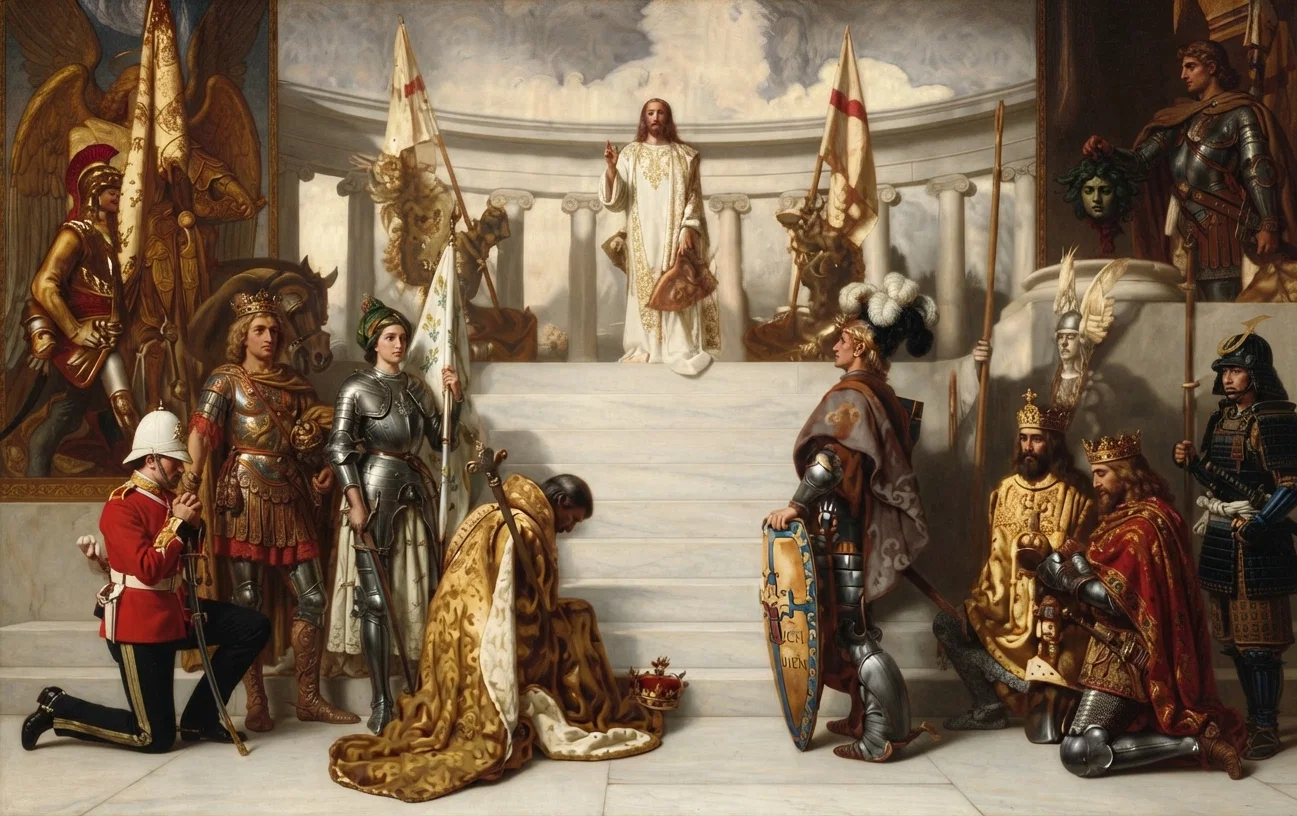
THE world has ever had and still has its heroes, its leaders, its demigods, to whom it has bowed in humble adoration or followed in faithful devotion. Some of them never dreamed of the homage which would be paid them. They simply did duty as they saw it, and became great. Generally their worth was not recognized during their life save by a few. Some of these heroes were men of blood, and built their road to fame over the bodies of slain humans, lighted by burning cities. Some of these heroes have rushed across the political sky like a brilliant meteor, and live now only in ancient chronicle or mythical lore.
Mr. Byam Shaw has portrayed in his great picture, "The Greatest of Heroes Is One," reproduced by permission on this page, the typical heroes of various ages and peoples. The picture will bear study.
BYAM SHAW'S GREAT ALLEGORICAL PICTURE, “THE GREATEST OF HEROES IS ONE”
In the center, at the head of the great white stairway, stands Jesus, the Christ, a truly commanding figure. On the one side bows in worship a mighty angel, on the other a mighty man. The rest are represented as honoring the Master, men of slaughter tho they have been. For instance the great Greek hero Perseus is represented in the ancient astronomical chart of the sky as a mighty warrior holding in one hand the dripping head of the Gorgon Medusa, that he has just slain, and in the other a drawn sword. Many a woman, unhonored and unknown, has done nobler and more blessed work than the beatified Maid of Orleans, who led the French armies to victory. Alexander slew his myriads in his world-conquering career. Sir Galahad lives in
Tennyson's ideal. The Black Prince was a great fighter, and so was Charlemagne, Siegfried, and others.
But the world's mighty heroes die. The empires they built have mostly fallen or are in decay. They were all creatures of frailty, and some of them were cruel beyond conception. At the most and best they helped the world only a little while; and many of the heroes of earth have been an unmitigated curse.
High above them all, stands Jesus, the Anointed of God. Him we present as worthy of all our homage, our devotion, our worship. He is more than hero, more than a mere performer of great deeds. He has more than courage and prowess and strength.
His earthly career is not His only claim. He preexisted as God's Fellow. In Him were created "all things" "in the heavens and upon the earth, things visible and things invisible, whether thrones or dominions orprincipalities or powers; all things have been created through Him, and unto Him; and He is before all things, and in Him all things consist." Col. 1:16, 17.
When sin entered God’s universe, our Hero stepped down from the eternal throne of the Godhead to the creature plane to demonstrate in humble serving that God is love, and to fight as we must if we win the battle of righteousness under the eternal principle of right, not for Himself, but for every creature of the universe. Through angelic nature to the human, the sinful human, even to the ignominious death of the cross, our Hero passed, demonstrating that God is love, and that righteousness might win glorious and eternal victories where sin was incarnate.
In His humiliation and death He took the place of those who deserved to die, that in Him they might live forever. Out of that death He rose triumphant, vindicating the government of Jehovah, and making it possible for the sons of Adam to achieve everlasting victory through Him.
Creator, voluntary vicarious Substitute for the sinner, Redeemer, Life-Giver, effective High Priest, He is coming again, our King. Then all His transcendent glory of character will shine forth in glory supernal, a glory which will be shared by all whom He has saved from sin and death through the eternal sacrifice of His infinite love.
This is the Hero that the SIGNS OF THE TIMES presents to its readers, that it will especially hold before them in the series of which this is the first number. He lived in the past; He lives to-day. He ever lives to intercede for, to help, to save, to glorify those who follow Him. What an ideal Hero is Jesus, the Christ! How it ought to appeal to every young man who admires and wishes to follow a true hero! We know Him, we commend Him — Jesus, the Way, the Truth, the Life.

The Meaning of July Fourth

THE Fourth of July is a national birthday. On that day in 1776 a new nation came into existence. While that nation was, in the providence of God, a product of the ages, it was wholly unlike anything that had existed throughout all ages.
And so the meaning of the Fourth of July intrinsically depends upon the meaning of that act, those circumstances, the motives and purposes, culminating on that day in the Declaration of Independence — throwing aside old responsibilities as unworthy, accepting new responsibilities as ennobling and full of hope.
Says the historian, if we “be asked to select from the annals of the world that period in which man appeared to the best advantage, we must, with little hesitation, name the last quarter of the eighteenth century. At no other epoch in the history of mankind has the human race emerged so rapidly from its old condition. It was an age in which tradition suffered, ancient tyrannies were startled from the throne, and the fallow ground, long soaked with the cold drippings of the Middle Ages, was torn up and turned to the sun and air with the terrible plow-share of radicalism. Long strides were made in the direction of the emancipation of mankind from the thralldom of the past. The time at last came when men perceived that it was better to fight and die than to endure any longer the domination of other men no better, no wiser, than themselves. That artificial reverence — that half worship — which prostrate man and society had shown to the powers by which they were governed, was replaced by a manly courage, a dignity, a defiance which went far to redeem the race from bondage, and to make future slavery impossible.”
For centuries man had blindly followed precedent. Unthinkingly he had done what his fathers before him had done, simply by force of their example. He accepted tradition as the law of right. Practise, if only old enough, was the rule of justice. Thus man for centuries, for all those weary years we call the Dark Ages, had ceased to think against or about custom, and his present was bound with more than chains of steel to all the unbearable, unthinkable past.
What caused such an intolerable condition of humanity? The question is natural, it arises logically, indited by a contrast between these times and those.
And what caused man to think, to see the illogical, to oppose the follies of tradition and practise? This question also is as natural as the other. But we can not answer it until we have considered the first.
And when we have answered the two, we will have grasped something of the meaning of the Fourth of July.
First the intolerable conditions of man and government brought the Dark Ages.
Monarchy, the form of government prevailing, was in those days a huge septipod. And if we consider each of these seven feet on which it stood for support, we find the following:
First, there was the king, a feudal chieftain on a grand and colossal scale. He was lifted immeasurably above his subjects. Below him by implication necessarily was a people without political rights, dependent for life and liberty upon the pleasure of the king. They were but peasants and serfs, whose property might be taken at will, and whose lives might be exposed in lawless, ambitious wars; whose bodies might be used or abused, and whose minds might be rightfully kept in the darkness of perpetual night.
Second, this monarchy was but the embodiment of ecclesiastical domination over secular society. The king was either the head of the church or its obedient servant. “The bishops, for their own good, told the monarch that his right to be king came down out of the skies; that he was by the will of Heaven born a prince; that his authority was by the grace of God, and that his person was sacred both by the fact of his royal birth, and by the manipulation of the priest on the day of coronation.” Thus the whole monarchial scheme was a devising of the church for the glory and prosperity of its functionaries to the absolute humiliation and beggary of the common people.
Third, another support to the established order of things was the graduated order of nobility, — dukes in touch with the king; marquises in touch with the dukes; knights in touch with the marquises; lords in touch with the knights; esquires in touch with the lords.
Fourth, as a support to the graduated order of the nobility, stood the principle of primogeniture. The royal blood must not be allowed to diffuse itself and spread into a multitude of vulgar kinsmen.
Fifth, to support primogeniture was the law of entails, by which properties should tend to concentrate in certain lines of descent, and thus be maintained in perpetual solidarity.
Sixth, the king was not to be hampered by constitutional limitations. Popular assemblies were hotbeds of sedition and impediments to government, a menace to civil authority. Ministers and parliaments existed merely to carry out the king’s will.
Seventh, the people existed for the king’s pleasure. Society was the king’s institution. The state was, in essential, the king’s property.
In all these seven propositions we see there is but one cardinal principle. A few individuals are to be glorified to the disadvantage of the many. The many exist to give pleasure and wealth to the few.
It was a scandalously selfish view of the world-order of government. And illogical and untrue to facts as it was, the church of the times — the Catholic Church — was the mighty cement that held the institutions of monarchy together.
It is true that in England the church was divorced in a measure from the pope of Rome. But it was merely a change of head; the system was essentially the same.
Then came a change. Printing from movable types, the dissemination of literature, the truth of the Bible that all humanity are brethren and equal in rights and privileges before God, shed a flood of light upon the world. Countless ones who would not accept the gospel salvation, accepted this great truth of human fraternity and equality, with the result that every principle of government was examined and tested by the most inexorable logic of the new light.
And so when King George of England, too autocratic for his time, sought to wreak his own stubborn will upon his American subjects, they in turn began to ask, “By what right, under what principle of law or justice?”
The old sentimentality of divine right of the king to live at the expense of the wealth, health, and lives of his subjects failed. The king could fume about his right to rule, and rail at the preposterous conduct of his subjects, who must be taught a lesson of loyalty and obedience.
The stubborn old king thought to succeed by the old order of events. But already in his own home kingdom of England a better view of government was prevailing. What King George sought to do against his American subjects, he did amidst great opposition on the part of his still loyal subjects in England.
It was therefore on the principle that all humanity has equal rights, privileges, and immunities before the law, that the Declaration of Independence was drafted and sent forth on that memorable day we still celebrate in these United States.
And by that battle fought and won we have learned that no minority, tho headed by the king, is right when it seeks to subject the majority to a condition of serfdom. And no majority can be right that does not give to the minority — nay, more, the individual — the rights that it claims for itself — the inalienable rights, to all alike, of life, liberty, and the pursuit of happiness.
And this is some token of the meaning that vitalized that first Fourth of July in seventeen hundred and seventy-six! So long as that day remains and these true principles prevail, that must still be the meaning of the Fourth of July.
God forbid that it should ever mean anything less!
And may our flag be draped in mourning folds, when the day becomes an idle celebration, whenever, in this glorious land, our meanest subjects lose any portion whatsoever of those equal rights,—“life, liberty, and the pursuit of happiness.”
Neither a majority nor a minority can, by the laws of the very foundation of this government, interfere with those “inalienable rights.”
For this is our blood-bought, immortal inheritance through the Declaration of Independence of 1776!
And this is the significance of that day which keeps it yearly in perpetual memorial!
L. A. R.

God’s Mighty Detector

IT is good to love and be loved. It is good to talk of love; “for love is of God,” and “God is love.”
It is good to cherish and to manifest properly feelings of kindness, forgiveness, sweetness, and kindred graces. Love bears these as legitimate fruit, tho not always manifest at first. They are confirmatory evidences of living connection with the divine Source of life and light and power; but they are by no means first or conclusive evidence.
The real test of love is doing duty under difficulties, duty demanding sacrifice. Spurious and egotistical affection has a selfish basis. It desires to shape its own policy, seek its own ways of expression, and endeavors to bring the divine Spirit even to its pleasures and forms.
King Saul had something of that nature. He liked to demonstrate. Contrary to law, he must offer the sacrifice. (See 1 Samuel 13.) He must show to the people his great victory for God over the Amalekites, and his kindness in the distribution of “the best of the sheep, and of the oxen, and of the fatlings, and the lambs, and all that was good.” But the king and subsequent ages were taught the lesson, “Behold, to obey is better than sacrifice, and to harken than the fat of rams.” (See 1 Samuel 15.)
The real test of love is duty, and duty to God is obedience. Listen to the wise man: “Fear God, and keep His commandments; for this is the whole duty of man.” Eccl. 12:13. And John, the apostle of love, echoes the same thought repeatedly. “My little children, let us not love in word, neither with the tongue; but in deed and truth.” 1 John 3:18. What are among the proofs by which we may know that we are Christ’s?—“We know that we have passed out of death into life, because we love the brethren.” Verse 14.
But how may we know that we love the brethren?—“Hereby we know that we love the children of God, when we love God and do His commandments.” 1 John 5:2.
And what is the love of God?—“For this is the love of God, that we keep His commandments; and His commandments are not grievous.” Verse 3.
This is God’s test of love for us. The first exercise of that love is preeminently Godward. “Thou shalt love the Lord thy God” is “the first commandment,” the great vital principle of character building; and we may count all other love spurious or perverted from a Christian view-point, which does not recognize this great fact.
Christ died to save men from sin, to win men to loving obedience to God, not in their way, but in God’s way; and he who knows Christ, knows that the way of God’s commandments—obedience to which is the expression of our love—is “not grievous.”

The Meaning of the Flag

In every city and town, in every village and hamlet, from public building and private residence the Stars and Stripes has been flung to the free breezes on the memorable Fourth. It has been cheered and saluted and affectionately called "Old Glory." The eyes of the old veterans have moistened as they have gazed upon its rippling beauty, and their voices have trembled suspiciously as they have recounted the struggles at Antietam, Lookout Mountain, Gettysburg, Richmond, or some other battle.
The flag is beautiful in design and in its blending of color.
"When Freedom from her mountain height Unfurled her standard to the air, She tore the azure robe of night, And set the stars of glory there. She mingled with its gorgeous dyes The milky baldric of the skies, And striped its pure celestial white With streakings of the morning light. Then from his mansion near the sun She called her eagle bearer down, And gave into his mighty hand The symbol of our chosen band."
Thus sang T. Buchanan Read.
But it is not of the colors or the beauty of their blending that we wish to speak. It is not the thirteen stripes for the thirteen original states, and the forty-eight stars for the present number, which suggest the great growth of the nation. These are fitting and proper. But the Stars and Stripes has a deeper meaning. The flag stands for equality, for civil and religious liberty, for freedom of conscience. The weary watchers of Europe’s lands of tyranny saw in it a beacon beckoning to a better day, a harbinger of hope to the oppressed. Standing for that, it is worthy of regard. Representing a government or state which stands for civil and religious liberty, it is worthy of honor. Standing for any government, it should be respected for government’s sake.
It said to the individual that the medieval tyranny of the Old World was cast off, and that civil freedom was born anew; the inalienable rights of man—life, liberty, and the pursuit of happiness—were recognized.
It said to the individual that priestly fetters, religious proscription, persecution for conscience’ sake, union of church and state, were in the past.
Since that first flag was flung to heaven’s free breezes, there have been foul blots upon its beauty. It has in many cases been used to protect and shield local tyranny and intolerance. There are those who would make it the symbol to the world of that to-day in the church-and-state régime, the Christian citizenship movement, which they are promoting, and saddest of all they are pushing it forward in the name of Him who preeminently stood for individual soul freedom. Mistaken, self-deceived they are who are doing this; so the intolerant and persecuting have ever been. The worst of it is they are deceiving others.
When that glorious banner, in which was swathed the new-born liberty of the West, is made to stand for tyranny and oppression of any sort, it becomes a symbol of oppression. They bring reproach upon it who demand that the child at school must salute it or the anarchist shall kiss it, both of which have been compelled in this "land of the free." In God’s providence the flag is designed to be neither fetish nor idol, but a symbol of that freedom and equality which, if conserved and guarded by the government, will in their own intrinsic worth and beauty win the respect and honor of all.
Wo worth the day when Columbia yields to the soothsayers who are luring her away from her basic ideals. When that time comes, the beautiful flag becomes at best a tricolored piece of bunting, at its worst a symbol of tyranny. May love for the principles of freedom stay the hands which would blemish its beauty.

Religious Liberty

"The religion, then, of every man must be left to the conviction and conscience of every man; and it is the right of every man to exercise it as these may indicate. This right is in itself an inalienable right."
Continue reading: Treasures of Hail
