Your ShelfYour Projects

Signs of the Times, Vol. 39, No. 29.

Question Corner

Signs of the Times

Jul 30, 1912

Pacific Press Publishing Association · Mountain View, California · Jul 30, 1912

Question Corner

"IF YE WILL INQUIRE, INQUIRE YE."

This Inquirers' Department is conducted for the purpose of helping those who are studying the Bible. The answers are oftentimes only suggestive. They are never to be considered infallible, only as they agree with the infallible Word. The writer who may answer them does not consider that his opinion is infallible. He will simply give the best that he has, and plead with the inquirer to search the Word. Such questions only will be answered as, to the editors, seem to minister to the good of the readers and to the mission of the paper. We can not answer repeatedly in the same volume questions upon the same scripture. The name and address must accompany question, not for publication, but as an evidence of good faith, and that answer may be made by letter if deemed advisable. No letters are answered which do not contain the name of the writer. It is well always to enclose stamp for reply.

3817.—What Shall Be Tithed?

Please give a fuller explanation of what should be tithed. Does it mean that only net profit should be tithed, and this applied to any business? What about living expenses of home, etc.? T.
The basic text of the tithing system is expressed in Lev. 27:30: "And all the tithe of the land, whether of the seed of the land, or of the fruit of the tree, is the Lord's: it is holy unto the Lord." The Jews had become very punctilious over this, until they made tithing, even as the Sabbath, almost a burden; and yet our Lord does not take away from them the obligation of tithing. He declares in Matthew the 23d chapter and 23d verse: "Wo unto you, scribes and Pharisees, hypocrites! for ye pay tithe of mint and anise and cummin, and have omitted the weightier matters of the law, judgment, mercy, and faith: these ought ye to have done, and not to leave the other undone." Yet there are modifications concerning this law which common sense and absolute justice and rectitude would recognize. For instance, here is a man who has possession of a farm worth $10,000. He has paid $5,000 on that farm, and some one holds a mortgage for the $5,000 unpaid. It seems clearly evident and just that from the income of that farm there should be taken the interest on that mortgage and paid to the one who holds the mortgage. He, of course, would tithe that part of the income of the farm. The man who worked the farm would tithe the income less the interest on that mortgage. If he were able to carry on that farm with his own labor and that of his own family, and the farm were paid for, he would tithe all the income. But if it were necessary for him to employ other labor, it would be manifestly proper for him to deduct from the income the amount paid for that extra labor. For instance, if he hired a man to run that farm, and paid him $100, he would not tithe that $100. It would be the duty of the man who did his part in the working of that farm to tithe that amount. We do not know why the same principle would not hold good in the working of a farm as does in the receiving of wages. For instance, in our publishing work here there is a certain wage per week paid to all the employees. They do not take out their living expenses and then tithe the balance. They tithe the wages just as they are received. That is the common custom among them. There is no rule, no demand, nothing of that kind. The only obligation resting upon them is the obligation which they owe to God, but the whole income is tithed. Therefore, to state it briefly, what is a man's own personal income ought to be tithed, whether it be received from wages, interest on money, the working of land, or the carrying on of any other kind of business. What expense is necessary in the working of that business, outside of himself or his own immediate family who live upon that income, should be deducted from the amount of the income before it is tithed.
This, in a brief way, covers the principle, and illustrations of that principle. We have not space to enter into it more fully in the "Question Corner." We would commend to our inquirer and others some good work on tithing. This can be secured by writing to the secretary of the California Conference, 2201 Telegraph Ave., Oakland, Cal.

3813 — Conditions and Promises

Kindly explain Eze. 16:60-63. K. L.
The 16th chapter of Ezekiel consists largely of God's reproof to His people, and His comparison of His people with other great, sinful cities and peoples. Yet after all, God's people in the last analysis consist of the remnant. While His professed people have sinned so grievously that they are cut off largely, yet the remnant will be saved. That is the assurance that is given us in various scriptures; and therefore God will remember His covenant with them, and that covenant will be sure with them, and He will establish an everlasting covenant, verse 60 declares; and verse 61, that all those who are truly ashamed of their sins, those who, of course, are so ashamed as to forsake their sins, will be received into that covenant, not in the covenant which men may make, but which God will make, and that turning from sin and yielding to the Lord will bring to them the knowledge of the Lord. This covenant is the new covenant named in Jeremiah 31 and in Heb. 8:8-10. Israel had been full of complaints against God in their backsliding, but in that restoration they will nevermore complain, will nevermore desire to depart, will nevermore have aught against God, or any controversy against Him, as set forth in Micah. They will be His, and His forever.
—★—

3814 — During the Thousand Years

Will you please explain Isa. 34:11-15? Does not the fire destroy all the animals that live at the coming of Christ, or are there animals on the earth at that time?
There seems to be no evidence, when our Lord shall come the second time, that all life on the earth will be destroyed. Human life will. There seems to be no question about that. Not only does Isaiah teach that, but Jer. 4:25 declares, "I beheld, and, lo, there was no man." See also Revelation 19. Of those left on the earth after the great wars which swept over the inhabitable part of the globe had wrought their work, it is said, "The remnant were slain with the sword of Him that sat upon the horse." That is, they will perish in the forthshining of Christ's presence. But there are beasts that remain. The fire is not, then, universal. It is kindled here and there, and the whole earth becomes a desolate wilderness. But Isaiah 34, which clearly seems to use Idumea as a type of that desolate condition, would indicate that there will be wild beasts and birds of prey which will inhabit the earth during that time. It is to these that the call goes forth to come and devour the carcasses of the men upon the earth. See Rev. 19:17, 18. Doubtless the multiplication of these beasts and birds will furnish food for the wicked when they come up at the end of the thousand years for the second resurrection. Then when the glory of God shall appear the second time, the whole sinful earth, with the exception of that place where the city stands, which has been made holy by the feet of the Son of God, will become one great lake of fire. The Scriptures do not say that the lake of fire will begin at the beginning of the thousand years, or at the beginning of the day of the Lord, but it will come in the day of the Lord. And so we read in 2 Peter 3:10, "But the day of the Lord will come as a thief in the night; in the which the heavens shall pass away with a great noise, and the elements shall melt with fervent heat, the earth also and the works that are therein shall be burned up."
—★—

3815 — The New Jerusalem

Is it true that the New Jerusalem comes down before the wicked are raised, and that the righteous will go out of the city after the wicked are raised, and mingle with them, after which the wicked will try to take the city? F. W. D.
We do not see anything in Scripture which would indicate this last. The principal scriptures which we have upon this are Revelation 20 and 21 and Zechariah 14. From Zech. 14:4 we would learn that our Lord Himself shall descend from heaven, and that His feet shall stand at that day upon the Mount of Olives, and the Mount of Olives shall be cleft and become a great plain, made holy by the touch of the Master of life. Upon this plain will Christ and the saints descend, forming the camp of the saints, and a little later the city itself will come down in the same place. That seems to be the evident teaching of these and other scriptures. See "The Great Day of the Lord," B.S.L., No. 65, price 3c. There is no scripture, so far as we know, which would indicate that there is any commingling of the righteous and the wicked.

3816—The 144,000

Please explain through the "Signs of the Times" Rev. 7:4 and 14:3, 4. Does the 4th verse of chapter 14 mean that they are only women who are to be saved?
The question of the 144,000 is an open question, and perhaps always will be. There is absolutely no authority, so far as we know, that states that there will be just the 144,000 saved and no more. That company may be a representative company. In all the numberings of Israel in the past, the people numbered were representative. This was true of the tribes, of the Levites, the 5,000 whom Jesus fed, of the 4,000. There were counted the men, besides women and children. This may be a representative company of that kind. We do not know. We are willing to leave the number with God. The expression "for they are virgins" means nothing more than that they are not guilty of spiritual fornication. That is, they are those who have given themselves wholly to God. They are not mixed up with the world. Spiritual fornication, in the light of the Scripture, means union with the world and professed union with God. See James 4:4. But this last company have come out from every union of that kind. They stand with God and His Word alone. The first expression in the verse indicates that the term "virgin" simply means that which is pure and clean. Do not worry over the number that is there given. Let our real study be on the characters which are described, those who have so thoroly embraced God's plan, so thoroly given themselves to Christ, so fully accepted of His grace, that they may have placed upon them God's authoritative stamp of character by His Holy Spirit, sealed with the seal of the living God, created anew in Christ Jesus.

3818 — How Long in the Sepulcher

If Christ was crucified on the sixth day, He was only in the tomb twenty-four hours, as He rose seventh-day evening. Matt. 28:1. A. J. F.
In the first place, parts of days are counted whole days, and the three days and three nights are reckoned from the time that Christ was apprehended by the officers, when Jesus said to them, "This is your hour, and the power of darkness." That included Thursday night, Friday, the Sabbath, and the night after the Sabbath, or what is really Sunday night, for in the Scripture the night precedes the day. It was not Sabbath evening when He arose. Read Matthew 27 with Matthew 28. There are no chapter divisions or even verse divisions in the original. "So they went and made the sepulcher sure, sealing the stone, and setting a watch, in the end of the Sabbath. As it began to dawn toward the first day of the week came Mary Magdalene and the other Mary to see the sepulcher." That is, the stone was sealed and a watch was set on the Sabbath day, but in the early morning they came, as recorded by Mark and Luke. This is altogether the most reasonable supposition in connection with these scriptures.
Schedule for the Week Ending August 10, 1912

This Week’s Prophetic Readings

We begin the week's reading with the last chapter of Joel, which very clearly points out the days in which we live, in its call for preparation to war. There is also clearly indicated in the prophecy the state of decision to which the world is brought, which will involve the multitudes of earth, after which comes the great judgment-day.
Micah and Habakkuk are also included in this week's readings. Micah wrote in about the year 750, and Habakkuk 625, before Christ. Micah was therefore contemporary with Isaiah, a prophet of Judah in the days of Jotham, Ahaz, and Hezekiah. But he prophesied not only regarding Judah, but Israel as well. He tells of the straitened condition to which Israel had been brought on account of their sins, predicts the coming of Christ, even to the very town in which He should be born, Bethlehem, and closes with the wonderful chapter on God's mercy and forgiveness, and the blessings which He would bestow upon His people if they would but return to Him. Light is thrown on Revelation 12.
There is one thought which we would impress upon the reader in the consideration of all these prophecies: doubtless the prophet gave very many more messages than are recorded, and brought home to Israel of old very many present duties, present reproofs, messages of present deliverance at that time. These would be of no particular benefit to us; therefore they are not left on record. God has left on record that which was not only of profit to them there, but which is preeminently a lesson for later days; so that "whatsoever things were written aforetime were written for our learning, that we through patience and comfort of the Scriptures might have hope."
We omit the prophecy of Nahum, not because it is not important, but in order to shorten our readings for the year. Habakkuk warns against Babylon, and closes with a psalm of wonderful majesty and beauty.
The week's reading closes with Psalms 76, 77, and 79, all of them psalms of Asaph.

Schedule for the Week Ending August 10, 1912

Schedule for the Week Ending August 10, 1912
Sunday August 4 Joel 3 Monday “ 5 Micah 1, 2 Tuesday “ 6 “ 3, 4 Wednesday “ 7 “ 5, 6 Thursday “ 8 “ 7 Friday “ 9 Habakkuk 1, 2 Sabbath “ 10 Psalms 76, 77, 79

EDITORIAL

The Homage of the Great

"GOD is no respecter of persons." He reveals Himself to the meek and to the lowly, to those who are willing to be taught and led, regardless of their station in life. There are more of the poor in the world than there are of the rich. There are more of the meek and humble and lowly among the poor. Their condition in this world fosters the humble spirit. Even so it was with the shepherds of Bethlehem to whom God's angels brought the blessed evangel.
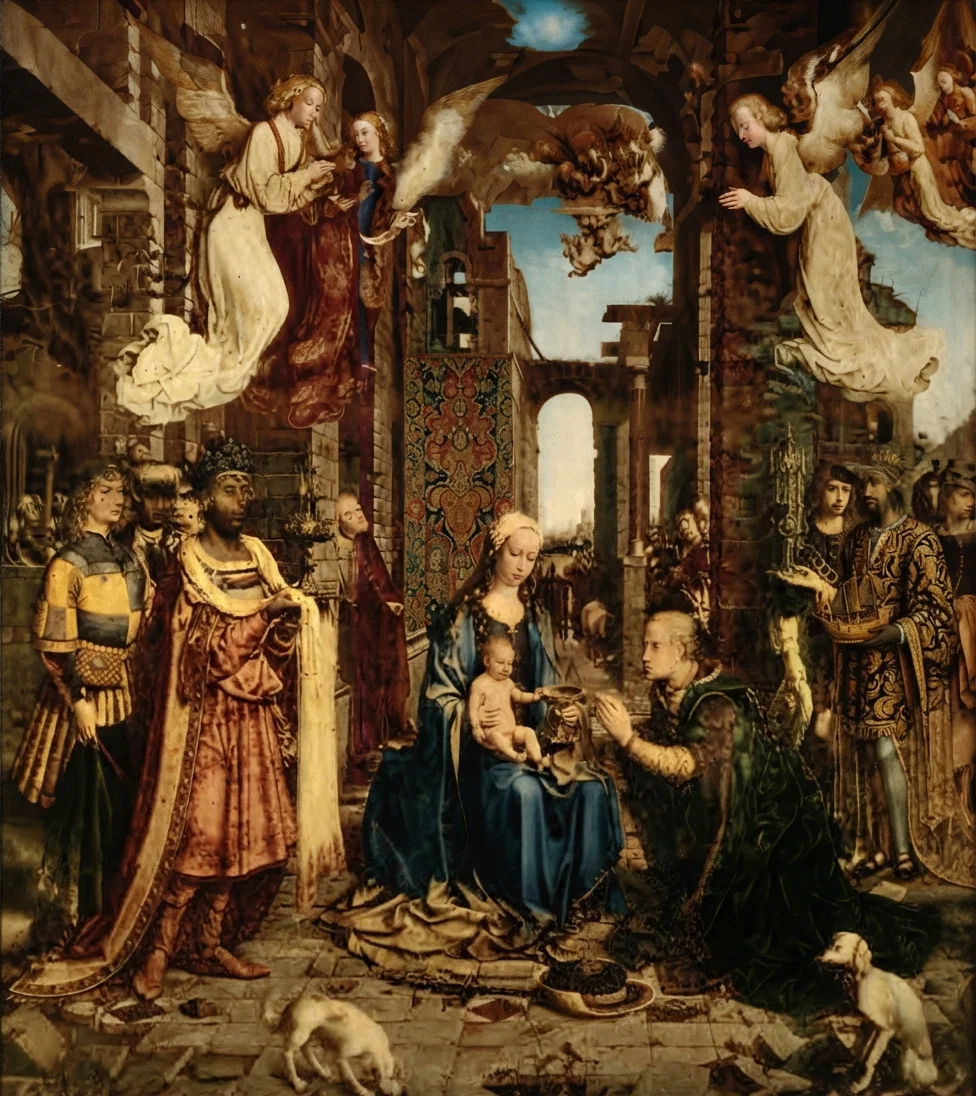
BUT as readily God reveals His truth to earth's great men if they are equally humble and teachable. This, too, is illustrated at the very beginning of the gospel narrative by the visit of the wise men to Bethlehem, as recorded in the second chapter of Matthew's Gospel: "Now when Jesus was born in Bethlehem of Judea in the days of Herod the king, behold, wise men from the East came to Jerusalem, saying, Where is He that is born King of the Jews? for we saw His star in the east, and are come to worship Him."
THESE wise men, or Magi, have ever had hung around them various and sundry traditions. They have been represented as kings from Asia, Africa, and Europe, and Ps. 72:10 is used in support of the tradition. Even their names are given in the traditionary romance. But it is more consonant with the Sacred Record to take them as Magi from the East, that is, from Persia, members of a very ancient religious cult dating back to Abraham, or even before that. The word "magi" signifies in Persian "the diviners." They were the established priesthood of the Persian, or Parthian, empire, in historical times, and were persons of the highest rank and consequence in the state. Their origin is attributed to Zardusht, or Zoroaster, but not Zoroaster the Second, the great reformer who flourished in the time of Darius Hystaspes.
ADORATION OF THE KINGS
THE earliest Magian religion seems not to have been idolatrous. The first eminent teacher, Zoroaster, consecrated in the mountains of Bactria a natural cave to Mithras, "the maker and father of all things." This Mithras the ancient Magi called "the hidden god," represented by the darkness of the cave. There are expressions in the Psalms which express the same thought. Mithras therefore originally had naught to do with sun-worship. In this cave was a sacred fire which was never allowed to go out, similar to that in the Jewish sanctuary. If it should go out it must not be rekindled by strange fire, nor was any other to be used in the sacrifices. They represented God as "the First, the Incorruptible, Eternal, Unmade, Indivisible, most unlike everything, the Leader or Author of all good, Uncribable, the Best of the good, the Wisest of the wise: He is also the Father of equitable law and justice, self-taught, perfect, and the only Inventor of the natural holy." See "Hales's Chronology," volume 4, pages 37, 38. They held that there was one eternal being, Yezdan, or, as sometimes stated, Ormuzd, the creator of light and darkness, and that he is alone, and has no associate. They believe in a malign deity called Arhiman, denoting the devil. These two powers will exist to the time of the consummation of all things. See Isa. 45:5-7, and the parable of the wheat and tares in Matthew 13.
IN view of these and other great truths held by them, in part at least, the Magian religion has been characterized as the oldest and noblest of all the ancient religions apart from the Bible. Balaam the ancient prophet was doubtless of the Magi, and at one time in his experience had living connection with the God of heaven and earth, the Jehovah of the Old Testament. See Num. 22:8-13, 18, 19. Balaam prophesied Israel's triumph in the defeat of her foes. He evidently refers to our Lord in the following (Num. 24:17-19): "I see Him, but not now; I behold Him, but not nigh: There shall come forth a star out of Jacob, And a scepter shall rise out of Israel, And out of Jacob shall one have dominion." It is a pity that the great Magian prophet yielded to his lust for gold, and perished among those he led astray. It is said of the second Zoroaster that he was taught by a Jewish prophet claimed to be Elijah, but more likely it was the prophet Daniel, who taught him the nature of the times of which he prophesied.
THE time when the Magi visited Jerusalem was subsequent to the birth of Jesus, as will be seen by comparing Matthew and Luke. It was after the occurrences connected with His presentation in the temple. Evidently Jesus did not remain long in the stable where He was born, for He was found in a house by the Magi. The star was not a sidereal body, nor a combinationof planets, as some would teach at the present time. It went before them, "it came and stood over where the young Child was." Matt. 2:9, 10. Hales thinks it was a meteor supernaturally guided and controlled. But what seems more and preeminently fitting is that it was the same company of angels, God's messengers, that appeared to the shepherds, shining with the glory of heaven, seeming to the Magi a low and brilliant star, the star that should "rise out of Jacob" prophesied of by one of their own number, and they followed it, and it led them to the "Word made flesh."
SEEKING the truth, instructed by the Jewish Scriptures, they first go to Jerusalem, the center of Jewish worship, and there inquire, but none know of the object of their inquiry. Their inquiries, however, stir the people, and the base and ambitious king calls an ecclesiastical council, but learns nothing save that the King is to be born in Bethlehem. He then inquires of the Magi, sends them to Bethlehem, and charges them to bring him word when the Child is found, that he may join with them in the worship. They pass on, and the star appears and leads them to the house. Devoutly humble, they are divinely illuminated. They have no doubt of God's leading, and they pour out their souls in adoration and truest worship, and lavish their largesses and costly, princely gifts upon the little Babe, gold and frankincense and myrrh. They have found Him, the eternal Logos, in the likeness of the flesh, they hail Him as the Saviour and King of the world, and they return to worship and to serve.
WARNED of God, the Magi did not return to the base and deceptive king. Herod's subsequent course showed that his expressed desire to worship was a wicked ruse. But it is worthy of note that among the converts on the Day of Pentecost were some, first mentioned, from the land of the Magi, Parthians, Medes, Elamites, and dwellers in Mesopotamia. Acts 2:9. The wise men had been missionaries. W.

The Power of Habit

THE amphitheater was crowded with people. The noise of applause sounded forth, but died down again into the chill of horror. Before their astonished gaze a man had shown his wonderful power over a huge boa-constrictor by commanding it to coil about him, rear its awful head above him, and then slowly unwind again. When the critical moment came that the huge monster should release his hold, he refused to obey the order of his trainer. Suddenly he seemed conscious of his power. He tightened his huge coils about the man, and crushed every bone in his body, while horror sat upon the faces of that great audience. What did it mean?
For something like twenty years the man had trained the serpent to do his bidding. When he began, it was a small, almost insignificant reptile; but with years it had grown, until long ago it was more than a match for the man, had it known its power. Unconscious of its strength, it continued to obey, until at last, in this fateful moment, conscious of its supremacy, it crushed the one who for so long had played with its might.
What an example it is of habit! Man indulges in some temptation. He does not feel that he has been weakened by it. The change is so slight that he argues with himself that there is no danger, no untoward effect; but the temptation breeds a habit, and the habit becomes a part of the very life. At last, too late, he finds he is no longer his own master. The cruel, relentless, mighty tyrant holds lordship over him. He has been mastered by his vice.
The Word speaks of the deceitfulness of sin. Sin appears harmless. The act in the first temptation seems but a trifle; the way of the right and the way of the wrong seem to run practically parallel, but they diverge. That which seemed so insignificant increases in power and in enormity until consciousness of it comes too late to bring relief.
A friend of mine stood at Rincon by the Rio Grande River. A man said to him: “Do you know there is an engine buried in that river? The bridge trestle broke on one side, and tipped it into the river. It sank, and has never been recovered.”
“Didn’t they try to get it?”
“Yes, they put down long iron bars; and the last they knew, the engine was sixteen feet below the surface of the water.”
The engine had been mastered by the grime and ooze and mud of the river. It was a fine piece of mechanism. It had been built for a great work. Now it was useless, mastered by mud.
So is man as he yields to temptation, as he acquires habits of vice and sin. Slowly, surely, day by day, he sinks deeper and deeper into the ooze and mire and mud of his evil habit. Intended to bear the image of God, endowed with capacity and talents and power whose expansiveness knows no limits, he slowly dwarfs and dwindles in these faculties, but worst of all, becomes a part of the evil that conquers him.
All this teaches us the importance of never yielding to the first temptation, of never going in the path that diverges from the straight way. But it teaches more than this.
There are those who now find themselves under the power of the tyrant of sin. It is too late to talk to them of not starting in the evil way, for they have already traveled that way, perhaps for years, and find themselves ever mastered by sin. Each day they are conscious of the fact that it will find them weaker than yesterday, and to-morrow they will sink deeper than they did to-day. But there is help for such.
Paul likened this condition to that of a man who had chained to him a dead body. Its loathsome presence and its poisonous contact was horrible. He cries out in his agony, “Who shall deliver me from this dead body?” The answer comes certain, sure, triumphant: “I thank God through Jesus Christ our Lord. . . . For the law of the Spirit of life in Christ Jesus hath made me free from the law of sin and death.”
There is hardly a person in this world but needs emancipation from at least one habit. Some who sit in high and apparently holy places, and are counted in the higher citizenship of the country, find themselves unable to control their lives in every particular. But these, like those in the lowlier walks of society, can find absolute victory over sin and evil and the power of wrong habits through the gospel and power of Jesus Christ.
It is useless for us to argue the truth of this. The real evidence is to be found in making a fair and conscientious test. It is a sure and certain way out of the bondage of sin and vice.
Test it out; try it. R.

Where Is Religious Liberty Found?

THE religious liberty numbers of the Signs of the Times have had a large circulation, especially in the state of California. Various responses have come to us, one of which we print, in part, in the following:
“I am a freethinker, having long ago left far behind all interest in any Christian denomination, but your fight for freedom in the matter of religion is my fight too. Sunday laws can do no one any good, they confer no true happiness on them or us. They can not tend to weld humanity in one, or unite them in one common brotherhood. Unite church and state? Never! Never! I have read a little church history, as well as the history of some other religions forced upon the people. The result is ever and always the same, persecution. Now if it be not a part of Christianity to domineer, to hate, to be a diablo to all others not of our set or of our faith, then I have not read history aright, or else all of those traits, the meanest I know of, have clung to the Christian people like barnacles to a ship for two thousand years. O, I tell you it won’t do! That which carries the seeds of discord, misery, pain, and death is in very bad company, to say the least. But you and I have shaken them off, those bad traits. But how about those germs, brother? I shook the whole Christian hide off, to make sure. Amen. L. F.”
Now just a few words with this candid reader, and all others like-minded. First, he says he is a freethinker. So are we — thinking with that glorious freedom of gospel liberty given us in Jesus Christ, thinking far out beyond this world with all its troubles and sorrows and pains and disappointments into that glorious world where there shall be no evil, for sin shall have been forever banished.
2. He is waging a fight for freedom, and so are we — not freedom for ourselves, but freedom for all. It is a fact that in the past, men have waged strong fights for freedom, but the fight has been for freedom for themselves. There never has been a time when the most persecuting body that the world ever knew did not believe in freedom for themselves. Rome believed in it when she was persecuting Protestants. John Calvin believed in freedom for himself when he was instrumental in putting to death Servetus. The Puritans believed in freedom for the Puritans when they put to death Quakers, whipped Baptists, and banished Roger Williams. That is not, however, true Christian freedom, for the man who really believes in the freedom that Christ taught believes in it not for himself, but for the other man as well.
3. Our friend says truly that Sunday laws are unproductive of happiness. They can do no one any good, can confer no true happiness on those who promote them, or those who suffer by them. They never make a community happier. They never bring any added religion into a community. In the very nature of the case they can not.
4. We are also agreed regarding a union of church and state. In the first place, the state ought not to be dominated by the church, or religious bodies of any kind, or in any way. And secondly, the church does not need the state, if she believes in her Master’s words, for He has promised all power for the promulgation of His gospel and the keeping alive of His truth in the earth. Therefore any union of church and state is perversive of the plan of Christ, and must work to the detriment of both church and state. Religion forced upon the people is, and can be, no true religion. The
better the religion, the worse becomes its perversion if forced upon the people. A religion that is mere form, like some of the great historic religions, can be forced upon the people with little effect one way or the other. But the perversion of the true religion forced upon any people invariably results in suffering and persecution. For the Christian religion is a religion of heart, of life, of motive; and affection can not be forced.
5. Persecution is no part of Christianity. It is a part of perversions of Christianity. True Christianity stands and must stand absolutely separate from the state. It was the very Author of Christianity who said, "Render to Cæsar the things that are Cæsar's, and to God the things that are God's." It was the Author of Christianity who said to His ardent disciple, "Put up again thy sword into his place: for all they that take the sword shall perish with the sword," and who declared that twelve legions of angels could fight for Him, but that was not God's plan. It was the Author of Christianity who said that "My kingdom is not of this world: if My kingdom were of this world, then would My servants fight, that I should not be delivered to the Jews: but now is My kingdom not from hence." It was the Author of Christianity who said, "If any man hear My words, and believe not, I judge him not: for I came not to judge the world, but to save the world." And then He tells us that all judgment of God is reserved not for man, but for the last day. "He that rejecteth Me, and receiveth not My words, hath one that judgeth him: the word that I have spoken, the same shall judge him in the last day." John 12:47, 48. It was Christianity's great apostle to the Gentiles who said, "Not for that we have dominion over your faith, but are helpers of your joy: for by faith ye stand;" who further said, "Knowing therefore the terror of the Lord, we persuade men."
And so we might continue to quote from the inspired words of the New Testament regarding Christianity, its authorship, and its authoritative promoters. Union of church and state, persecution for religious opinion, is no part of Christianity.
6. The name has been found in bad company. We never could conceive of a counterfeit without the genuine. Men never attempt to counterfeit a bad bill, or a spurious coin; their counterfeit is always of the true. The devil does not attempt to counterfeit false religions. He attempts to counterfeit and pervert that which is the very highest, clearest, purest, strongest, and best, Christianity. And all state religions have been perversions, or counterfeits, of the religion of the Lord Jesus Christ. Sad it is that this has come down through the centuries and been palmed off upon the world as the true religion of Jesus Christ, and thus the Master has been maligned and betrayed. God in His providence is working again by His Spirit and through His messengers to restore again that primitive religion which shall know no union with the world or with the state.
7. Our friend says that "you and I have shaken them off;" that is, all these seeds of discord and misery and death. Good! But he asks, "What about the germs?" He will find the germs of efforts to lord it over men's consciences everywhere, in everything, save one, and that is in genuine Christianity. Therefore we are Christians; therefore we
believe in the Christian religion; therefore we not only do not desire to shake it off, but do desire to cleave to it with all our hearts, for the only hope of the world lies in that, and it is because of that that we are pleading for religious liberty now, not for ourselves, but even for those who do not believe Christianity; and we would like to say to them, and to all others, that the very best way to do, and the only true way to do, and the only Christian way to do, is to leave every man with God, and let him answer himself at the great judgment-bar as to how he has met the responsibility which his Creator has placed upon him. We only wish that our correspondent, and every one else, could look upon the matter as do we. W.

The Rival Sabbaths

THE Bible plainly enjoins a weekly rest day. Every one who knows anything at all about the Bible is aware of this fact. This weekly rest day is called the Sabbath; and the Bible which enjoins it, plainly states that it occurs on the seventh day, which is the day of the week that the world commonly calls Saturday.
The record in the second chapter of Genesis shows that the Sabbath was instituted at the creation of this world. The seventh day of the first week in this earth's history was made the Sabbath of Jehovah, and every succeeding seventh day of each and every week since that time has been the Sabbath of the Infinite One.
During the wanderings of the children of Israel from Egypt to the promised land, miracles of God made it strikingly plain which day of the week was the Sabbath. For the Israelites in that time to try to keep any other than the seventh day, brought them into sore trouble. Then when God gave them His law while in these wanderings, He placed in that law a commandment concerning the Sabbath, that is so explicit as to leave no room for mistake or quibble.
We may diligently search God's Word from beginning to end, and we will find absolutely no mention of any other day as the weekly rest day of Jehovah. The seventh-day Sabbath has His authority in strong, clear language, but no other day has even the shadow of such authority.
The first day of the week is mentioned but once in all the Old Testament Scriptures, and that mention is in the first chapter of Genesis, where it is recorded that God did His first day's work of creation on that particular portion of time. Then God's example in the only recorded mention of the first day of the week in the Old Testament is that of work and not of rest. His example favors Sunday as a secular working-day, and not as a Sabbath.
If we closely and without bias will examine the eight times that the first day of the week, commonly called Sunday, is mentioned in the New Testament, we will find that it is a day of work there also, and not a day of rest. This may be surprising news to some, but it is the truth nevertheless.
When Christ was here upon earth as a teacher, He kept the seventh-day Sabbath, and frequently mentioned it. But there is absolutely no evidence that Christ ever so much as mentioned the first day of the week when He was here. Some people claim that Christ changed the Sabbath. How could He have changed it without even mentioning it?
The record shows that God and Christ observed and enjoined the seventh-day Sabbath, and all the Bible characters followed Them in this. Nowhere is it even intimated that a single one of them observed any other day. And on the other hand, all the mention that is made of their connection with the first day of the week is that they worked on that day the same as on any other secular day. With all the Bible examples for working on Sunday, and with all the Bible precept and example for keeping the seventh-day Sabbath, why should there be any question on the subject of the Sabbath?
The seventh-day Sabbath and the Sunday sabbath are the two great rivals before the world. One is of manifest divine origin; but where is the authority for the other? Since God did not institute the observance of Sunday, it must of necessity be of human origin. And being of human origin, it is not very surprising that we should find so many human beings that are so insistent to have human laws to bolster it up.
But the practical question for each to decide is, Which is the more reasonable,—to take that which is so plainly supported by divine authority, or to take that which has only the human ordinance back of it? This issue is now before the world in a very definite way, and soon every person will be called upon to decide it one way or the other.
T.

Consent Thou Not

If sinners entice thee, consent thou not.
Continue reading: Drugging and Drinking