Your ShelfYour Projects

Signs of the Times, Vol. 39, No. 34.

PROPHECY

Signs of the Times

Sep 3, 1912

Pacific Press Publishing Association · Mountain View, California · Sep 3, 1912

PROPHECY

W E did not follow cunningly devised fables, when we made known unto you the power and coming of our Lord Jesus Christ, but we were eye-witnesses of His majesty.
“For He received from God the Father honor and glory, when there was borne such a voice to Him by the Majestic Glory, This is My beloved Son, in whom I am well pleased:
“And this voice we ourselves heard borne out of heaven, when we were with Him in the holy mount.
“And we have the word of prophecy made more sure; whereunto ye do well that ye take heed, as unto a lamp shining in a dark place, until the day dawn, and the day-star arise in your hearts:
“Knowing this first, that no prophecy of Scripture is of private interpretation.
“For no prophecy ever came by the will of man: but men spake from God, being moved by the Holy Spirit.”

"IF YE WILL INQUIRE, INQUIRE YE."

This Inquirers' Department is conducted for the purpose of helping those who are studying the Bible. The answers are oftentimes only suggestive. They are never to be considered infallible, only as they agree with the infallible Word. The writer who may answer them does not consider that his opinion is infallible. He will simply give the best that he has, and plead with the inquirer to search the Word. Such questions only will be answered as, to the editors, seem to minister to the good of the readers and to the mission of the paper. We can not answer repeatedly in the same volume questions upon the same scripture. The name and address must accompany question, not for publication, but as an evidence of good faith, and that answer may be made by letter if deemed advisable. No letters are answered which do not contain the name of the writer. It is well always to enclose stamp for reply.

3841 — The Beast That Was and Is Not

Please explain Rev. 17:8-11.
W. B. R.
The understanding of this chapter involves a study of chapter 12, and to some extent of chapter 11. For this study we have not space in the "Question Corner." We will say in brief, however, that the beast with its seven heads represents the dynasties through which Satan has wrought against God's work in the past. The beast itself stands for church-and-state government over the great, dominating kingdoms of the world. The different heads represent different phases of that government. The beast becomes the beast of the head, while that particular head exists, for these heads are not contemporaneous, but successive. That is, they do not all exist at one time. One follows the other. The first of these heads was the Babylonian, under which the people of God went into captivity. Following that was the Medo-Persian, then the Grecian, then pagan Rome, then papal Rome, the fifth head, the fullest and worst union of church and state which the world ever knew. This fifth head is shown in verses 3 to 6, the government itself represented by the scarlet colored beast, the apostate church by the corrupt woman who sits upon it. This beast passed away, or in other words, this phase of the beast came to an end, when the power of the Papacy, through the state, was taken away in 1793-1798. Since that time the Papacy has had no general jurisdiction over the governments of Europe. Following that, however, there was a condition of things akin to the Papacy in some respects, yet so different as to constitute another head. Instead of having one general union of church and state, the different countries themselves set up their own national churches, and each formed the union of church and state in itself, yet all of them generally after the same pattern; and this constituted the sixth head of the beast power, an utterly unsatisfactory condition both to government and to church. But the prophet sees beyond this. He sees a restoration of the fifth head. "The beast that thou sawest," that is, during the wilderness state (compare with chapter 12:6), when apostasy was riding in triumph, and the church of God was hunted and torn and persecuted, is restored, making "the beast which thou sawest and is not" during the time of the sixth head. During the closing days of that sixth head, the seventh is about to come out of the abyss and to go into perdition. There is where we stand at the present time. The whole tendency of the world is toward a union of church and state, and that will be consummated under the Papacy. Then will be restored the fifth head. Just beyond that—lies perdition to everything connected with church-and-state government and identified with sin.
It has been predicted that the Papacy would never be restored. It has been predicted that we would never see a recrudescence of the Dark Ages, and therefore they that dwell on the earth shall wonder when they see the beast, how he "was, and is not, and shall come." It is only the wisdom of God which can interpret this, and the interpretation must come through the agreement with the Bible.
The seven heads are seven mountains, and these mountains represent seven kings. Not "there are seven kings," but "they are seven kings: five are fallen"—as beast powers—Babylon, Medo-Persia, Grecia, Rome pagan, Rome papal. "One is"—the mixed condition of Protestant and Catholic and governments in the old world; the other "is not yet come"—a restoration of the Papacy. "When he cometh, he must continue a little while." This same beast is also an eighth, that is, according to our understanding of the text.
Just previous to the time when the Papacy shall be developed again, there will be a socialistic organization developed as a hope of saving the people from calamity in this old world; but the earth is waxed old, calamity continues, and to save themselves the socialistic governments of Europe, or "the united states of Europe," will restore the Papacy, the two counted singly making eight, but the two last together forming one, making up the number of the heads as in Revelation 12 and 13, so that the very last head combining with the seventh head is an eighth, and is also one of the seven, because it is a restoration of one of the seven. This will give our inquirer some suggestions for further study in the matter.

3842 — Paying Tithe

Why do your people pay tithe, when Hebrews 7 teaches that it is not binding on the people of this day? Verse 12 says there was a change in the law; and was not tithing included in this?
The law of which Heb. 7:12 speaks is not the law of tithing, but the law of the priesthood, for it is the priesthood that is under discussion. The context clearly shows this. Note verse 11: "If there was perfection through the Levitical priesthood;" and then also verse 13, that Christ came of a different tribe. The law of the priesthood was that it was to come from the tribe of Levi, but Christ came from the tribe of Judah. The tithing antedated the law. Abraham paid tithes, and so also did Jacob. In fact, Hebrews 7 is confirmatory of the obligation of the tithe, for Christ is a priest after the order of Melchizedek, and in that sense we are living under the Melchizedek priesthood; but Abraham paid tithe to Melchizedek, and therefore the children of Abraham, or the children of faith, ought still to pay tithe. The simple fact is that tithing is an equitable arrangement which God has Himself given for the support of His gospel work. We know that there are those who object to it, and say that a Christian ought to pay all. And that is true, he ought to acknowledge that all he has belongs to God; but after he acknowledges that all he has belongs to God, certainly he would be willing to set aside a tenth, as the Lord has declared, for special support of the gospel ministry. We have the same objection regarding the Sabbath day. Some will tell us that they keep all days holy; but if they keep all days holy, they ought to be willing to keep one as God has Himself directed. But the man who contends that he keeps all days holy, generally keeps none sacred to the Lord. And he who contends that all that he has belongs to God, and consequently he doesn't need to pay tithe, usually pays very much less than a tithe for the support of the Lord's work. The whole history of the work of God shows, with hardly an exception, that those who have been faithful to God in paying tithe, by simple, glad faith, have always been blessed by it; and the church which has done this has ever prospered.

3843 — Baptism

Does God ever use the participle in giving a command? Is the word "baptizing" included in the commission? Please analyze or diagram this 19th verse of the 28th chapter of Matthew.
The participle is often used in the Greek. The Interlinear New Testament, by Hinds & Noble, gives the following literal rendering of the passage: "Going therefore, disciple all the nations, baptizing them to the name of the Father, and of the Son, and of the Holy Spirit; teaching them to observe all things whatsoever I commanded you." It is impossible to separate the participial clause from the main sentence. In the Revised Version there are two verbs, "go" and "make"—"Go ye therefore, and make disciples." The literal Greek implies that they are going, will go in the very nature of things, but "going, disciple all the nations," or make disciples of all the nations,—that is, from among all the nations,—and having made them, will baptize them into the name of the Father, and of the Son, and of the Holy Spirit. It is just as much a part of the command as teaching is. Baptizing them, teaching them, properly follow the making of disciples. Making disciples is the first thing, that is the essential thing, that is precedent to the baptizing; but having made disciples, baptize them. And the teaching is all-inclusive,—"teaching them to observe all things whatsoever I commanded you." We do not know that it needs more analysis than this. Mark 16:15 reads, in the Revised Version, "And He said unto them, Go ye into all the world, and preach the gospel to the whole creation." But the Interlinear Greek reads, "And He said to them, Having gone into all the world, proclaim the glad tidings of all the creation." There we have the participle "having gone," instead of "go" in our common English version. There will be found many cases of this kind in the Scripture. We have the command to the believer, "Repent, and be baptized every one of you." This must imply a corresponding duty on the part of Christ's servants who baptize.

3844 — Returning to God

Can an impure, unholy, and defiled soul return to God who gave it when the body dies? J. R.
We nowhere read of the soul returning to God. We do read that the spirit returns to God. Eccl. 12:7. It might be said of the soul, in one sense, that it returns to God. It depends on the definition which we give "soul." If by soul we mean person, certainly the person does not return to God defiled and unclean. If we mean simply life, why, it came from God as life, and it goes back to God as life. It could not be spoken of as defiled, in the abstract. That life God will give back at the resurrection, but we are nowhere told that that life has form, or character, or personality apart from the body. The scripture in Eccl. 12:7 seems to have reference to the ordinary, common life which man loses at dissolution, tho there are some who hold that it has reference to the higher life, that which God gives to His believing children. God does not in any wise count a man a double being, or a triple being. The normal man has body and soul and spirit, but it takes the three to make the man. When these are separated, death ensues, and the dust returns to the earth as it was, and the spirit goes back to God. It came from God as life; it goes back to God as life. It did not come from God a living, conscious entity, nor does it go back to God in that way. A simple understanding of the fundamentals will meet all these objections.

3845 — Withdraw Their Shining

In what sense, and at what time, do you think that the stars shall withdraw their shining, as expressed in Joel 3:15? D. W. C. M.
We do not know how this will be manifest. It seems clearly evident, however, that it is literal, that it comes at a time right in connection with the ushering in of the day of God. Clearly it seems to us that it does not refer to the dark day of May 19, 1780, foretold in Matthew 24 and Mark 13, or referred to in Joel 2:31. They are signs of His coming, but the darkening of the third chapter seems to have reference to the great cumulating events which usher in the day of God, which come right in connection with the close of probation. This seems taught in Isa. 13:9, 10: "Behold, the day of Jehovah cometh, cruel, with wrath and fierce anger. . . . For the stars of heaven and the constellations thereof shall not give their light; the sun shall be darkened in its going forth, and the moon shall not cause its light to shine. And I will punish the world for their evil," etc. The events predicted we understand are literal, the time right in connection with the ushering in of the day of God; but just how it will be brought about, or the manner of the manifestation, we do not know.
Schedule for the Week Ending September 14, 1912

Schedule for the Week Ending September 14, 1912

Sunday September 8 Matthew 22
Monday September 9 Matthew 23
Tuesday September 10 Matthew 24
Wednesday September 11 Matthew 25
Thursday September 12 Matthew 26
Friday September 13 Matthew 27
Sabbath September 14 Psalms 93, 94, 95, 96

The Last Days of Christ

Our readings extend from Matthew 22, the marvelous answers which Jesus gave to His captious critics who sought to cause Him in some way to stumble, to His death upon the cross, closing with Psalms 93 to 96. Of thrilling interest are these last days of our Lord's life on earth,—the woes upon the teachers and responsible men of the nation, which almost broke His heart; His prophecy of His coming and the end of the world; the lessons of warning; and the parables of the virgins and the talents. His last supper with His disciples, the farce of the trial through which He passed, the awful agony of Calvary, ought to impress upon the readers' hearts lessons which can never be forgotten. And the psalms for the Sabbath day ought to be joyful songs of praises in the hearts of the readers, for Christ died that we might see and enjoy and know all these blessings which the songs of Israel teach us.

EDITORIAL

"The Forerunner of Christ"

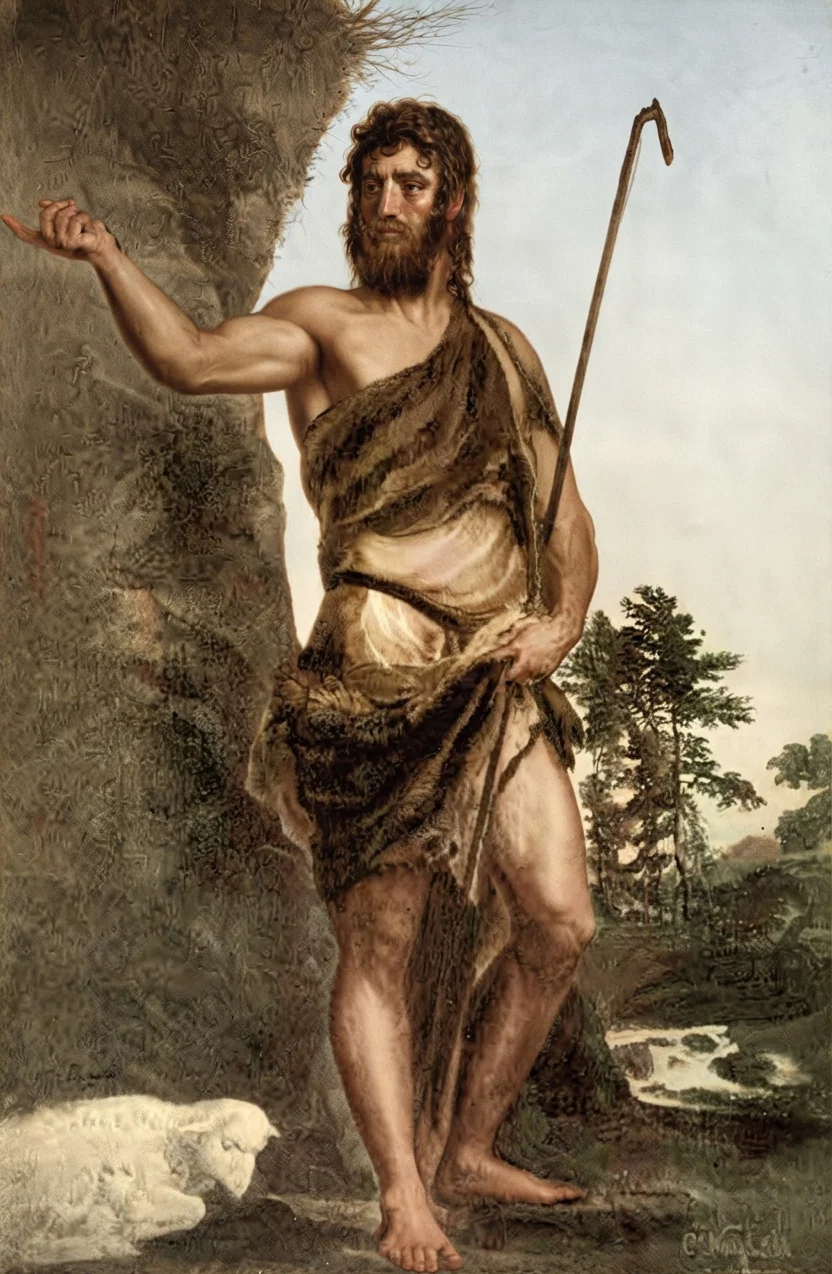
THE following is part of a story of a great reformer: "And in those days cometh John the Baptist, preaching in the wilderness of Judea, saying, Repent ye; for the kingdom of heaven is at hand. For this is he who was spoken of through Isaiah the prophet, saying, The voice of one crying in the wilderness, Make ye ready the way of the Lord, make His paths straight."
Titian "The voice of one crying in the wilderness, Make ye ready the way of the Lord, make His paths straight"
ONE of the most remarkable characters of the Scriptures is John the Baptist. He was not a great father, like Abraham; he was not a leader, a lawgiver and organizer, a learned author, like Moses; he was not a miracle worker, like Elijah or Elisha; he was neither warrior, nor poet, nor literary, like Joshua, or Isaiah, or David, or Ezekiel; he was not a maker of proverbs, like Solomon. He wrote no book, wrought no miracle; yet it is said of him by the Lord Jesus Christ, "Among them that are born of women there hath not arisen a greater than John the Baptist." In what did his greatness consist?
His greatness was not in his birth or education, humanly speaking. His father, Zacharias, of the course of Abijah, was a humble priest, with a humble wife, Elisabeth. Both were faithful, righteous, devoted, doing their simple duty, and becoming aged in the service of God. John was a child of their old age, foretold by God's angel, and a subject of prophecy at his birth. He was doubtless carefully reared, and taught by his parents in his early childhood, but in the later days of his youth his time was spent apart from man, in the solitudes. This one sentence tells the whole story of his early life: "And the child grew, and waxed strong in spirit, and was in the deserts till the day of his showing unto Israel."
Surely, according to modern ideas, an inadequate education for his work, whatever it might be.
BUT, first, like Elijah of old, he was trained of God. His early training, largely by his mother, like that of Jesus, was from the Scriptures, until he was saturated with their story and spirit. In the deserts of Judea, in mountain and plain, by river and sea, in storm and tempest, in sunshine and calm, under the open starry heavens, he had learned to know God, had communed with Him, had come to appreciate His unsearchable greatness and power.
HERE, too, he learned his mission. Mightier, man never knew. He was to be the herald, precursor, immediate messenger, of the Son of God to this world. "A prophet?" said Jesus. "Yea, I say unto you, and much more than a prophet. This is he, of whom it is written, Behold, I send My messenger before Thy face, who shall prepare Thy way before Thee." Some great men have small missions, and grow little; some little men have great missions, and grow great. John the Baptist had greater mission than prophet had ever before known.
MIGHTIER mission than to be the immediate messenger of the Son of God, mortal never had; but the man was worthy. He had the marvelous power to sink himself out of sight, and rejoice in the success of One whose glory utterly eclipsed his own. Power greater there could not be. It is the acme of Christian experience. The prophecy which went before called him Elijah. Jesus declared him to be Elijah; but when the committee from the Sanhedrin went out to interview him by the Jordan, and demanded who he was, "he confessed, and denied not; and he confessed, I am not the Christ. And they asked him, What then? Art thou Elijah? And he saith, I am not. Art thou the prophet? And he answered, No. They said therefore unto him, Who art thou? that we may give an answer to them that sent us. What sayest thou of thyself? He said, I am the voice of one crying in the wilderness, Make straight the way of the Lord, as said Isaiah the prophet."
JOHN did not do as did one priest of his day—the historian Josephus—give a long list of honorable ancestors. He might have done this, but he eliminates all reference to himself, all that would in the world's eyes bring distinction, or elevate him. "I am the voice of one crying in the wilderness,"—only a voice. More than six centuries had passed since Isaiah had uttered the prophecy. During all that time, it had been silent, unfulfilled. But when God's time came, the message found the man. The message was great; it was of God, eternal in its import, omnipotent in its effective operation. And the man, giving himself undividedly to the service of God, was made great in the mightiness of the message. So it ever is. All the power, all the authority, all the infallibility of the servant, lies in the message of God that he bears. All the power to forgive, or absolve, or curse, or cleanse, lies in the Word, not in the workman, only as the workman is the voice of the Word.
THIS means self-surrender; and John met this — met it so thoroly that he could rejoice in the sense of his own diminishment, because it redounded to the glory of the Master. His disciples were jealous for him; they wished to arouse his jealousy. They said, 'Rabbi, He that was with thee beyond the Jordan, to whom thou hast borne witness, behold, the same baptizeth, and all men come to Him.' What was the reply? 'John answered and said, A man can receive nothing, except it have been given him from heaven. Ye yourselves bear me witness, that I said, I am not the Christ, but, that I am sent before Him. He that hath the bride is the bridegroom: but the friend of the bridegroom, that standeth and heareth him, rejoiceth greatly because of the bridegroom's voice: this my joy therefore is made full. He must increase, but I must decrease.' Only those baptized of the Spirit of God could give true utterance to such sentiment. Knowing that he must decrease, knowing that all the power and influence that he had in Judea should fade out before the influence of Christ, even as the stars fade before the sun, yet in that very loss his joy was made full, made full because it exalted the Master whom he came to serve.
JESUS declared that 'if ye will receive it, this is Elijah, which was for to come.' The angel who foretold John's birth declared that he should have the spirit and power of Elijah. He fulfilled in part that prophecy found in the last verses of the Old Testament: 'Behold, I will send you Elijah the prophet before the coming of the great and dreadful day of the Lord.' Elijah was a type of the herald of the first advent, John the Baptist; he was also a type of those who should give God's last message to the world. How the characters of Elijah and John, and the messages which they bore, harmonize in spirit with the prophecies which the Lord has spoken concerning the days in which we live! Take, for instance, the great, positive part of the threefold message of Rev. 14: 6-14: 'And I saw another angel flying in mid-heaven, having eternal good tidings to proclaim unto them that dwell on the earth, and unto every nation and tribe and tongue and people; and he saith with a great voice, Fear God, and give Him glory; for the hour of His judgment is come: and worship Him that made the heaven and the earth and sea and fountains of waters.' And other prophecies which speak of that message, and the context of that which we have quoted, show that God's last great message is to close with all earthly glory in the dust, and the Lord alone exalted in that day. And therefore those who give that message to the world, heralding the second advent of our Lord, must, as did John the Baptist, so fully yield
themselves to Christ that His glory shall be first in everything, that they will rejoice in whatever may come to them, only so that His own cause may be advanced. The messenger is not greater than his message, in God's plan. God's message now is pregnant with all the mightiness and power and meaning of all past messages. He who will let it possess his soul, recognizing, appreciating his own utter insignificance and God's greatness, may not be counted great in the sight of man, but he will be great in the sight of God, and his reward may be safely left to the wisdom and love of his Master. W.

The Infinitude of Space

It is impossible for the human mind to put any limit to space. We run out into the unfathomable abyss as far as imagination will carry us; and when we have reached the utmost limit and imagination carries us no farther, we can not say to ourselves, "Here is the end;" for immediately the only barrier we can conceive is something like to a huge wall, and beyond this exists still untraced and immeasurable space. We can imagine as much beyond our limit as exists this side of that limit; and we can call this distance a unit, and multiply it by any factor that we are pleased to choose,—a thousand, a million, or a billion times, any number of times,—and still we can think of as much space beyond as that which we have covered by our multiplication.
Mathematically the human mind can find no limit to space. From this fact of mind, many argue that there can be no limit to space — that it extends out beyond forever, like eternity. But when we come to this decision, the mind is struck with the awful disclosure,—space without any limitation whatever! The mind grows dizzy with the thought; the heart is dumb with awe. Can it be so? Is there no limit to space?
We will suppose it is evening. Look yonder at the Milky Way. "A band, or irregular stream, of soft light is perceived, with stars at intervals dotting its surface. We get an opera-glass, and look through it. Behold, many more stars are visible, with the band of light still beyond. We get a small telescope, and look through that. Very many stars may be counted; and still the band of soft light shines beyond. We go to an observatory, where a large telescope may be found; and through its great tube countless stars gleam forth, hundreds and thousands of them, where first, with the naked eye, we saw only a few twinkling specks; yet still the band of light shines on behind, unchanged. Lastly, we go to America, and observe the Milky Way with the most powerful telescope yet made. A wondrous company of innumerable stars glitter; yet, still, beyond and behind, we have, as ever, the dim, soft light, not even now done away, not even now resolved wholly into stars."—Agnes Giberne.
Can we ever get to the end of it — this vast universe? Can we ever be able, no matter what our powers, to say, "This is the limit; we have seen everything in this direction"? Is there no limit to space? Have we no certain answer to this question?
"Suppose that one of the highest order of intelligences is endowed with a power of rapid motion superior to that of light (186,000 miles a second), and with a corresponding degree of intellectual energy; that he has been flying without intermission for six thousand years, and will continue the same rapid course for a thousand million years to come. It is highly probable, if not absolutely certain, that at the end of his vast tour, he would have advanced no farther than the 'suburbs of creation;' and that all the magnificent systems of material and intellectual beings he had surveyed during his rapid flight, and for such a length of ages, bear no more proportion to the whole empire of Omnipotence than the smallest grain of sand does to all the particles of matter contained in the ten thousand worlds."
"Were a seraph, in prosecuting the tour of creation in the manner now stated, ever to arrive at a limit beyond which no further displays of divinity could be perceived, the thought would overwhelm his faculties with unutterable emotions; he would feel that he had now, in some measure, comprehended all the plans and operations of Omnipotence, and that no further manifestations of the divine glory remained to be explored. But we may rest assured that this can never happen in the case of any created intelligence."
And now the brain, lost in the frightful sweep of its thought, fairly swims in its efforts to comprehend the infinite. But is this all true?—It seems true; it seems reasonable, and almost certain. But in answer to this question, have we naught but speculations, and reasonings, and almost certain probabilities? Is there no word from God?—Yes. Wondering and questioning, I turn to His Word, and read: "Thus saith the Lord; If heaven above can be measured, . . . I will also cast off all the seed of Israel for all that they have done, saith the Lord." Jer. 31: 37. Ah, my soul, that Word must be sure. "Saith the Lord" comes as the introduction, and "saith the Lord" follows as the close. "Thus saith the Lord; If heaven above can be measured, . . . I will also cast off all the seed of Israel for all that they have done, saith the Lord." "Saith the Lord," and "saith the Lord,"—surely this must be true!
And what is it that the Lord says?—He says that if heaven above can be measured,—not if you or somebody else can measure it; but if it can be measured, no matter how,—He will give Israel up, and thereby acknowledge that He has failed. If even His works can be measured by His creatures, then He acknowledges that He will no longer appear before them as God. He will give it all up. It will go on record that God has failed. But blessed be His name, He can not fail. He "never faileth." 1 Cor. 13: 8. "He shall not fail nor be discouraged." Isa. 42: 4. "Thus saith God the Lord, He that created the heavens, and stretched them out; . . . I the Lord have called thee in righteousness, and will hold thine hand, and will keep thee, . . . I am the Lord: that is My name: and My glory will I not give to another." Isa. 42: 5-8. Israel will not be cast off, and therefore the heavens can not be measured. One is as sure as the other, and each is as sure as God is true.
Space is immeasurable, and God has taken this fact as the everlasting foundation of one of His promises. Thus does He link HisWord and His works. And when you think of the awful infinitude of space, will it help you to realize the surety of His covenant? As you look out yonder into the abyss that reaches onward to the stars, yea, that stretches into an expanse as measureless as eternity, will your soul rise to the thought that thus there is no limit to all that He will do for your soul? God help us all to realize that forever and ever we shall be unable to see all that there is to see of His goodness, and of the “exceeding riches of His grace in His kindness toward us through Christ Jesus,” even as we see, and ever as we see, that there is no limit to the infinite fulness of His works.
May God’s promises be to us all this. And filled with thoughts of the majestic and stupendous power that upholds the soul who trusts in God, like Jeremiah when the truth was first revealed to him, may we say, "Ah Lord God! behold, Thou hast made the heaven and the earth by Thy great power and stretched out arm, and there is nothing too hard for Thee." Jer. 32: 17. R.

An Infallible Standard

It would seem that every reasonable man must recognize that God must have some immutable, infallible standard by which to try beliefs and acts, and that this standard must be of such purity as to be acknowledged by all, so unambiguous as to be readily understood, and given in such a way that its divine authority could not be questioned.
The necessity for such a standard is found in the fallibility, mutability, and inconsistency of man's mind and nature. Many men imagine as real that which does not really exist. Many elevate conscience as a guide, when conscience simply means an early education, warped, twisted, and perverted. Conscience is one of the most elastic, ductile, and pliable of the elements which make up man's moral nature. Of itself alone it is not to be depended upon. It would be like regulating a clock or chronometer by itself.
Many follow what they have come to believe to be the voice of God, but which in reality is the voice of the devil, or of a corrupted imagination controlled by the devil. They not only follow such a course themselves, but are determined that others also shall follow it. All along the ages are the marks of those who were a law unto themselves. No two of them agreed, and no one of them was consistent with himself. There is no way of testing such individuals in themselves; therefore there must be an immutable, infallible rule.
God has given just such an infallible, immutable rule in the Decalogue. Its purity is acknowledged by all. Its language is simple, straightforward, and unambiguous. It was spoken by the voice of the Creator of the heavens and the earth in the presence of marshaled thousands, and engraved by His own finger in the tables of enduring rock, thereby showing its importance, unchangeableness, and divine authorship. To that law—to its integrity, purity, all-comprehensiveness, and immutability—every Bible writer who has spoken upon it has borne faithful witness. It has been reserved to latter-day Christians and prophets to depart from the testimony and examples of Holy Writ, and from the testimony and example of our Lord Jesus Christ.
By them conscience is placed above the Word of God; feeling and "experience" are above faith in the Word; numbers count more than the testimony of the Bible; tradition is above the law of God. With one the church is the standard, with another conscience is the guide, with another it is something else. Certainly the infallible rule of God's law is demanded.
Take two examples of the law as the one and only standard of belief. In speaking of the manifestations of the work of the enemy, and of those who will seek information from familiar spirits, or the spirits of the dead, the prophet Isaiah (8:20) says: "To the law and to the testimony: if they speak not according to this word, it is because there is no light in them." Says our Lord (Matt. 7:20-23): "Wherefore by their fruits ye shall know them. Not every one that saith unto Me, Lord, Lord, shall enter into the kingdom of heaven; but he that doeth the will of My Father which is in heaven. Many will say to Me in that day, Lord, Lord, have we not prophesied in Thy name? and in Thy name have cast out devils? and in Thy name done many wonderful works? And then will I profess unto them, I never knew you: depart from Me, ye that work iniquity."
Twice the law is presented here as the standard; once as "the will of My Father" (see Ps. 40:8), and once in a negative sense, namely, God will not know those who work iniquity, or lawlessness, or lawbreaking. That prophet whose teaching would draw a soul away from God's law or Word is either wofully misunderstood or else is a false prophet. "Blessed are the undefiled in the way, who walk in the law of the Lord."
W.
Continue reading: And Yet They Do