Your ShelfYour Projects

Signs of the Times, Vol. 31, No. 37.

A SONG OF PRAISE

Signs of the Times

Sep 13, 1905

Pacific Press Publishing Company · Mountain View, Cal. · Sep 13, 1905

A SONG OF PRAISE

"Rejoice in Jehovah, O ye righteous; praise is comely for the upright. Give thanks unto Jehovah with the harp; sing praises unto Him with the psaltery of ten strings. Sing unto Him a new song; play skillfully with a loud noise. For the word of Jehovah is right; and all His work is done in faithfulness. He loveth righteousness and justice; the earth is full of the loving-kindness of Jehovah. By the word of Jehovah were the heavens made, and all the host of them by the breath of His mouth. He gathereth the waters of the sea together as a heap; He layeth up the deeps in storehouses. Let all the earth fear Jehovah; let all the inhabitants of the world stand in awe of Him. For He spake, and it was done; He commanded, and it stood fast. Jehovah bringeth the counsel of the nations to naught; He maketh the thoughts of the peoples to be of no effect. The counsel of Jehovah standeth fast forever, the thoughts of His heart to all generations. Blessed is the nation whose God is Jehovah, the people whom He hath chosen for His own inheritance. Jehovah looketh from heaven; He beholdeth all the sons of men. . . . Let Thy loving-kindness, O Jehovah, be upon us." Psalm 33.

POINTERS TO SUCCESS

IN

Missionary Book Canvassing.

BY E. R. PALMER.
THE PACIFIC PRESS has just issued a booklet of 72 pages with the above title, containing a systematic arrangement of helpful suggestions for our canvassers. The principles set forth cover every phase of canvassing, and are the fruit of long experience and observation in several countries and with many agents. It should be in the hands of every one entering the canvassing work.
Bound in heavy paper covers. Price 10 cents.
Address publishers of this paper.

The Sabbath and the Law

The Sabbath and the Law.—A treatise on the Sabbath, giving its Biblical and secular history for six thousand years. 190 pages. Price, 15 cents.

The Lord's Day the Test of the Ages

The Lord's Day the Test of the Ages.—This pamphlet deals with the Sabbath institution from Eden to Eden, treating the subject in the light of three dispensations, viz.: Patriarchal, Levitical, and Christian, showing its binding obligation in all. It is illustrated, and also contains several valuable charts. 124 pages. Price, 10 cents.
Address publishers of this paper.

SPECIAL TERMS.

1. One new yearly subscription and one renewal, or two new yearly subscriptions, sent at one time, $2.50.
2. Two new yearly subscriptions and one renewal, or three new yearly subscriptions, sent at one time, $3.25.
3. Three new yearly subscriptions and one renewal, or four new yearly subscriptions, sent at one time, $4.00. Sample copies sent on application.

TO OUR PATRONS.

Please be careful to write all names of persons and places plainly.
Send money by Post-office Money Order, Express Order, or Bank Draft on New York, Chicago, or San Francisco.
Orders and Drafts should be made payable to the Pacific Press Publishing Co.
Paper money or silver should be sent in a registered letter.
Registered mail is safe. Unregistered mail is at the risk of the sender.
Postage-stamps in five or ten cent denominations will be accepted for small amounts.
The address label on your paper will indicate the time to which your subscription is paid. In case of non-receipt of papers, or any other irregularity, please notify us immediately.
When subscriptions expire, no more papers are sent to the party except by special arrangement.
You are requested to watch the date on your label, and renew early, and save the loss of papers. We can not always furnish missing numbers.
When requesting change of address, be sure to give both old and new addresses.
Important.—If you order SIGNS, Our Little Friend, books, etc., at the same time, use a separate sheet of paper for each. If this request is complied with, it will materially assist in the prompt and accurate despatch of the business.
When writing to the editor, be sure to use a separate sheet of paper.

A Good Book to Read and to Sell

Would you know the meaning of the appalling loss of life and property by fire, flood, and storm?
The outcome of the gigantic struggle between Capital and Labor?
The significance of the Sodom-like condition of our cities?
And above all else would you so learn the lessons which these conditions teach, that they may be to you a "door of hope"—"heralds of the morning"?
If so, you will read with absorbing interest our new book entitled,—

Heralds of the Morning

As an indication of the success attending the work of its agents we give the following records. Name of the solicitors and the exact locality will be given on application:
Week ending Hours Orders Value
June 16 32 38 $67.00
June 23 31¼ 27 50.50
June 30 40 57 90.45
July 7 21¼ 16 31.25
July 14 40 24 58.15
July 21 39½ 31 55.45
July 28 39¼ 42 66.50
Aug. 4 38 25 51.45
Aug. 11 15½ 13 23.10
Aug. 18 32 40 60.00
Aug. 25 38½ 33 51.50
Total 367¼ 346 $605.35
Here is still another report of work done by a young man with little experience, and in very ordinary territory. His work is not quite so continuous as the one given above, as he was compelled to leave the field on account of other business at various times.
Week ending Hours Orders Value
June 9 31 19 $32.50
June 16 31½ 31 52.00
June 23 43 43 65.75
June 30 42½ 31 48.50
July 7 19 5 8.50
July 14 42 40 61.50
July 21 41½ 33 51.00
July 28 43 21 33.50
Aug. 4 45½ 39 62.50
Total 339 262 $415.75
During the above mentioned periods both men made small deliveries. We might mention other records even better than these but not so continuous. For example, one young lady with only a month's experience secured orders last week for $87.75 worth of this book. These successes we attribute to the fact that HERALDS OF THE MORNING treats upon events that are being talked about,—events that are forcing themselves upon the attention of every thinking person. If you have not read HERALDS OF THE MORNING, we suggest that you order one immediately. The price is only $1.50 post-paid.

XIX. THE HEALING POWER OF JESUS.

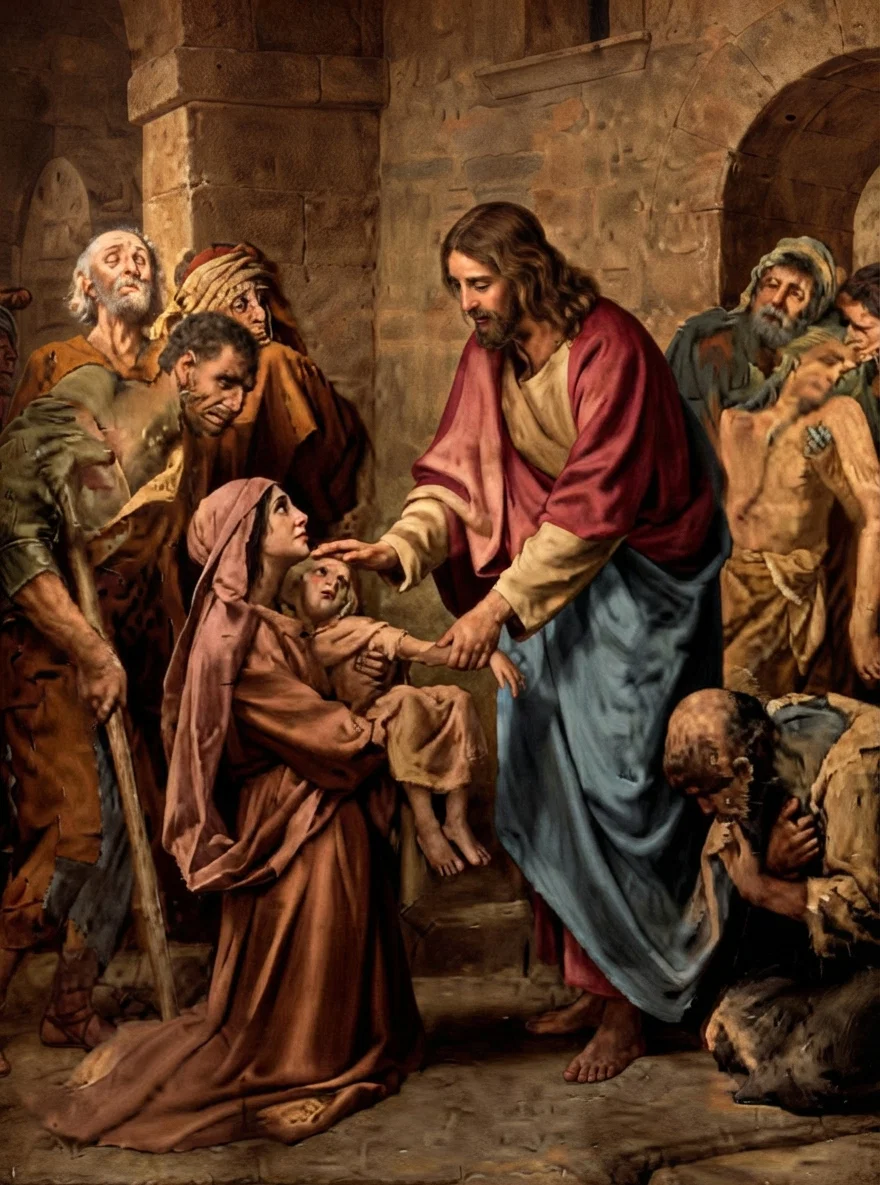
THERE was no question about it in His day. Tho men denied the source of power, they did not deny the miracles which He wrought. When the blind was made to see, the lame to walk, the deaf to hear, the dumb to speak, the palsied to leap and shout; when men saw the demons cast out, the leper cleansed, the bowed and crippled made straight and whole, the dead raised, they could no longer doubt. Jesus the mighty Healer was among them.
Jesus Healing the Sick.
Or such an occasion of healing the evangelist speaks: "And when the sun was setting, all they that had any sick with divers diseases brought them unto Him; and He laid His hands on every one of them, and healed them," "and cast out the spirits with His word, . . . that it might be fulfilled which was spoken by Isaiah the prophet, saying, Himself took our infirmities, and bare our diseases." There were no medicaments, no drug-taking, no mysterious formulae of occult mouthings, no general or specific progressive treatment, no sitting in the silences and becoming en rapport with one's "inner divinity" or with some pretender at a distance. "He spake," as "in the beginning," "and it was done." "He commanded, and it stood fast." The power of God was within Him and upon Him, and the soul open to receive it realized the benefit of His life-giving power.
THERE were prescriptions in the work of the Master, but only that faith might live and grow, never that power might be aided or supplemented. One he anointed with clay made from the dust and spittle; another was sent to wash in a certain pool; to a deaf man He put His fingers in his ears; another He touched; and others still, whether present or distant, He healed with a word. And in the word dwelt all the potency of the power of God.
WHY did He work these miracles? Why are they told to us? Not to advertise Himself, not merely to benefit humanity physically; but to reveal to that generation, with all its spirituality and conception of a godly life, dead and sunken in rites and ceremonies of Pharisaic formalism, that the God of Israel still existed, still was willing to dwell in mortal flesh, still was potent to overcome sin. And thus declares John the Beloved: "Many other signs therefore did Jesus in the presence of the disciples, which are not written in this book; but these are written that ye may believe that Jesus is the Christ, the Son of God; and that believing ye may have life in His name." John 20: 30, 31.
THESE miracles of physical healing were not His chief work nor main object. We have more record of His teaching than of His healing. The mighty miracles followed His teaching rather than preceded it, unless the circumstances were such as to demand the miracle, as, for instance, the bringing to life of the son of the widow of Nain. The record of healing in the second of these notes came after a Sabbath of teaching. He did not advertise Himself as the Healer. Not once in all His ministry did He say, "Come unto Me and be healed of your diseases." Nowhere is it recorded that He told any of His disciples to herald Him as the one who healed the body. One, indeed, He sent back to tell his friends how great things God had done for him, but that one was especially delivered from soul bondage. Lepers were told to show themselves to the priest, that they might comply with the law, and that the priests might know that there was power in God. But many times He expressly forbade the telling to any one of His mighty healings.
COMPARE the Master's work with that of the so-called divine-healers and faith-healers of to-day. Not the work of all would we contrast with His; there are noble exceptions, but these are not bruiting abroad their deeds. We believe in the healing power of God. We have seen those who were sick unto death healed by the power of God. We have seen those who have suffered many things from many physicians and were not the better, but rather the worse, healed at once in answer to the prayer of faith and the laying on of hands. But more than these is the healing of the soul from sin and sinning; and when the church of Jesus Christ will long for and appreciate this greatest of all miracles, the mighty power of God in the regeneration of the human soul and character, the lesser miracles will follow. But he who ignores the standard and requirements of God's word and law, and seeks for outward signs, will be deceived by "the spirits of demons working miracles" in order to deceive the world. Blessed is he who counts the righteousness of God first. He shall not be deceived.
"God will entrust to us higher responsibilities only as we faithfully perform those already waiting at our door, however little they may seem to us."

LAST-DAY MIRACLES.

THE picturing of Satan in hideous mein, as is the common way of representing him, has been the means of deceiving many well-meaning people. Because they know that his character, as the author of sin, is as black as any illustration can suggest, they easily imagine that his appearance and the appearance of everything he does is in harmony with his character. If this were true, he never could have deceived anybody, much less could he deceive any one under the light of truth as it shines out in God's Word. But he is represented in that Word as a deceiver, such a deceiver as leads men away from the truth by making falsehood appear as truth.
The Word of God represents Satan, under the symbol of the king of Tyrus, as "full of wisdom, and perfect in beauty." Of him it is further stated: "Thou hast been in Eden the garden of God. . . . Thou art the anointed cherub that covereth; . . . thou hast walked up and down in the midst of the stones of fire. Thou wast perfect in thy ways from the day that thou wast created, till iniquity was found in thee." Eze. 28:11-15.
Such was the beauty and wisdom of Satan before he was cast out of heaven. Of course he has lost in beauty as compared with the high standard of "perfect in beauty," but not so much as to hinder his being yet very attractive. His wisdom also has degenerated to shrewdness and cunning, but he is thus all the more able to deceive. So the apostle Paul, after referring to "false apostles, deceitful workers, transforming themselves into the apostles of Christ," says:
"And no marvel; for Satan himself is transformed into an angel of light. Therefore it is no great thing if his ministers also be transformed as the ministers of righteousness; whose end shall be according to their works." 2 Cor. 11:14, 15.
Christ Himself gives us solemn warning concerning miracle-workers in the last days. When questioned concerning the sign of His coming, and of the end of the world, He answered: "Take heed that no man deceive you. For many shall come in My name, saying, I am Christ; and shall deceive many." Matt. 24:3-5. Farther on He says: "There shall arise false christs, and false prophets, and shall show great signs and wonders; insomuch that, if it were possible, they shall deceive the very elect. Behold, I have told you before." Verses 24, 25.
Now there is nothing that so captivates the human mind, especially of those who are in any way physically afflicted, as the "miraculous" healing of the body. It was so in the time of Christ (Matt. 4:23-25; John 11:47, 48), and for that very reason Satan aims to do miracles in imitation of Christ, that he may the more effectually deceive the people; even, if it were possible, the elect. The elect are spared because they believe the Word of God. Those who do not accept the Word of truth in preference to miracles, will be given over to strong deception. Men will go to any instrumentality in order to be healed, and when they are healed they are easily made to believe that the healer was a servant of God. Once convinced of this delusion, they are almost hopelessly in the power of Satan.
Not accepting the Word of God, they believe that any miracle-working agent is of God, and are thus deluded. The delusion is not in the fact that a miracle has been wrought, but in believing that it must have been God that wrought it. That men will be deluded by actual signs and wonders, is shown in 2 Thess. 2:7-12 and Rev. 13:11-17. It would be far better to suffer affliction and die by disease than to be temporarily healed and lose one's soul. See Luke 9:23-25.
That many professed disciples of Christ, even the miracle-workers themselves, will be deceived by so-called "divine healing," and such-like wonders, is foretold in the Sermon on the Mount: "Many will say to Me in that day [of judgment], Lord, Lord, have we not prophesied in Thy name? and in Thy name have cast out devils? and in Thy name have done many wonderful works? And then I will profess unto them, I never knew you; depart from Me, ye that work iniquity."
But God will work miracles also, in His own time and way; how shall we know the true servant of God from the false? The Word gives us the true test: "To the law and to the testimony; if they speak not according to this Word, it is because there is no light in them." Isa. 8:20.
G.

MAN A FREE MORAL AGENT.

GOD made man with a free will. "Out of the ground the Lord God formed every beast of the field, and every fowl of the air; and brought them unto Adam to see what he would call them; and whatsoever Adam called every living creature, that was the name thereof." Gen. 2:19. That he was able to disobey God if he had a mind to do so, is shown by the fact that he did disobey.
After Adam's fall, the Lord placed a limit to the exercise of his will, for the purpose of limiting human life in sin, and, in course of time, bringing sin and death to an end. "Lest he put forth his hand, and take also of the tree of life, and eat, and live forever; therefore the Lord God sent him forth from the Garden of Eden, to till the ground from whence he was taken. So He drove out the man; and He placed at the east of the Garden of Eden cherubims, and a flaming sword which turned every way, to keep the way of the tree of life." Gen. 3:22-24.
The wisdom of cutting man off from the possibility of living forever in sin was demonstrated in the age before the Flood. During that period men lived to a great age, comparatively, and the longer they lived the worse they became. "And God saw that the wickedness of man was great in the earth, and that every imagination of the thoughts of his heart was only evil continually." Gen. 6:5.
But God did not attempt to forcibly or arbitrarily put a better mind in men. He did not in the beginning, nor after the Fall, nor after the general destruction by the Deluge, make man a mere machine without a will. The one remedy provided for a change in the situation, for a change in the course of every fallen man, was the Gospel of Jesus Christ. All the way through this Gospel is not a command, not an arbitrary application of a check on man's will; but it is an invitation, a merciful appeal, to the free will of the sinner.
To Solomon the Lord said: "And thou, Solomon My son, know thou the God of thy father, and serve Him with a perfect heart and with a willing mind; for the Lord searcheth all hearts, and understandeth all the imagination of the thoughts; if thou seek Him, He will be found of thee; but if thou forsake Him, He will cast thee out forever." 1 Chron. 28:9.
To Israel in the wilderness it was said: "I call heaven and earth to record this day against you, that I have set before you life and death, blessing and cursing; therefore choose life, that both thou and thy seed may live." Deut. 30:19.
To Jerusalem in the time of Christ's earthly mission, He said: "O Jerusalem, Jerusalem, thou that killest the prophets, and stonest them which are sent unto thee, how often would I have gathered thy children together, even as a hen gathereth her chickens under her wings, and ye would not!" Matt. 23:37. Israel was His chosen people, yet He did not compel them to choose His salvation. He wants only willing obedience. Nothing else will conduce to a peaceful kingdom.
The apostle Paul exhorts us to choose to be like-minded with Christ. He says, "Let this mind be in you, which was also in Christ Jesus. . . . Being found in fashion as a man, He humbled Himself, and became obedient unto death, even the death of the cross." This humiliation was voluntary; and all true humility, as all true obedience, is voluntary, the fruit of the Spirit's working upon a willing mind.
The last appeal in the written Word is to those who will accept the overtures of mercy. "The Spirit and the bride say, Come. And let him that heareth say, Come. And let him that is athirst come. And whosoever will, let him take the water of life freely." There is no hint of making men righteous by law. After accepting righteousness by faith, they become voluntarily obedient through faith. God works in such "both to will and to do of His good pleasure." Having yielded their wills to Him, He helps, or strengthens, them by His Spirit.
It is a true saying, "You can force a horse to the water, but you can not make him drink." So men may be forced to the place of worship, but they can not be compelled to love the Lord with all their heart, or to love their neighbors as themselves. You can compel them to hear the Word, but you can not compel them to imbibe its spirit. The water of life may be presented to their lips, but no law can enforce them to drink it. Belief in Christ can not be forced into the heart, and "he that believeth not the Son [voluntarily] shall not see life."
"The devils believe" (Mark 1:24; James 2:19) by force of outward evidence, but it does them no good. They become devils through refusing a voluntary heart service. Like all other intelligent creatures, they were not involuntary machines, without will or choice, but were free moral agents, and had followed the counsel of their own wills. The devils, who have passed their probation, are a standing testimony that God does not compel His creatures to be righteous. Their doom to destruction is irrevocably fixed (Matt. 8:29), as they have already been cast out of heaven. Luke 10:17, 18; Rev. 12:7-9.
G.

WALKING AS HE WALKED.

IT should be our own test upon our own discipleship. We are told in 1 John 2:6 that "He that saith he abideth in Him ought himself also so to walk, even as He walked." We can not escape it by saying that, while we are Christians, we have not yet reached the condition of abiding in Christ. The profession of Christianity is in itself a profession of abiding in Christ. One of Christ's last oral admonitions to His followers was, "Abide in Me, and I in you. As the branch can not bear fruit of itself, except it abide in the vine; no more can ye, except ye abide in Me." "If a man abide not in Me, he is cast forth as a branch, and is withered; and men gather them, and cast them into the fire, and they are burned." John 15:4, 6.
It would be impossible to state more clearly than is here stated the fact that the Christian must abide in Christ, and that he who does not has no part nor place with Him. Being a Christian, he abides with Christ necessarily. Having made the profession of Christianity, and therefore the profession of abiding in Christ, the duty is perfectly clear. It is to "walk even as He walked." The one who does not do this denies in his life the profession which his lips have made. He is therefore a living, walking contradiction. There is continual dispute between his life and his words, his profession and his deeds, and he is bound to become an unfruitful branch. The branch which should have borne grapes bears none, or bears wild grapes.
So it is true that the fruit-bearing Christian is the one who abides in Christ, the one who walks "even as He walked." How did He walk?—"He humbled Himself," laid aside His own glory, "emptied Himself," put aside His own will, allowed His own way to be swallowed up in the way of His Father. He said of Himself, "I came down from heaven, not to do Mine own will, but the will of Him that sent Me." John 6:38. Again: "I seek not Mine own will, but the will of the Father which hath sent Me." John 5:30. That His whole being was consecrated to the doing of that will is shown in His declaration: "My meat is to do the will of Him that sent Me, and to finish His work." John 4:34. No particle of self came into the ministry of Christ. That is how He walked; not doing His own will; not following after His own way; not seeking pleasure in the things which minister to the pleasure of the carnal heart; not "whiling away the time" in amusements. There were then, as there are now, plenty of opportunities for ministering to the sensuous and the frivolous in man; plenty of opportunity for making gain of a brother's need. But these were not the ways of Christ. He did not thus walk.
Not long since a Sunday-school superintendent in a large city issued an edict that each teacher in the school should pledge himself or herself to abstain absolutely from all such vices as theater-going, card-playing, dancing, and indulgence in intoxicating drinks. If they were unwilling to do this, he requested their resignations. Out of thirty-five teachers, thirty-one said that they indulged in one or more of these vices. They did not choose to abstain from this indulgence, and they did not wish to resign, as some of them had been teaching for many years. As this was true of all but four of his teachers, it was probably true of a like proportion of the church and Sunday-school at large. It certainly revealed a deplorable condition in that particular church; and yet many another church could have made no better showing. It is quite possible that the condition of some is even worse. We know that such conditions prevail in a great portion of the professed church of Christ to-day, especially in what are known as the fashionable churches.
Now, the question is, Are such professed Christians walking "even as He walked"? Were they not rather following after their own ways, their own wishes, their own carnal desires? Could it be said of such that their meat was to do the will of their Father in heaven, especially after their refusal to abandon such practises? Christ was never found walking in such ways. As they were not walking as He walked, they were not abiding in Him, and as they were not abiding in Him, it is certain that their lives were bearing no fruit for Him and His cause; and if our lives do not bear fruit, then we are to be cut off from Him and the reward that He has in store for those who are faithful to Him. He who has passed through the watery grave is supposed to have buried the "old man" of sin, and to have arisen to walk in newness of life. Anything else is a contradiction, a denial of the profession made. The true child of God must "walk in the light as He is in the light." Then he will have the true fellowship, and the sacrifice of Christ will avail in his behalf. Anything less than that is failure. Anything short of that will bring disappointment and death; and to the disappointment and death to which they go they take with them those who have patterned after their ways. There is a better way, and that is to "walk even as He walked."
S.

ANOTHER LAME SUNDAY ARGUMENT.

A certain doctor, whose writings on many topics are especially clear, has recently undertaken to sustain Sunday observance; and his efforts are a striking illustration of the weakness of human reasoning when the eye is closed to the plain Word of truth. Here is a specimen utterance:
Sometimes we are asked for a text that ordered the time of the Jewish Sabbath changed. Find the text that ordered the method of Sabbath-keeping changed to a fire-building day, then find the text that orders the penalty changed from stoning, and in close proximity to such texts you may find the text changing the time of Sabbath-keeping.
This is given for argument that Sabbath time has been changed; but no Sabbatarian could have given a clearer inference that proof for the change could not be found in the Scriptures. Even the doctor himself admits that there is no text for a change to a "fire-building day," or for the change of penalty from stoning for Sabbath-breaking; but how any change of manner of observance could prove a change of day must remain a question not answered by the doctor's illogical proposition. Those items of detail are not specifications contained in the Decalogue, which the Lord has declared unchangeable (Matt. 5:17, 18), but the time of the Sabbath and the general manner of its observance are specified in the unchangeable Decalogue.
The doctor's proposition is a clear admission that he had no answer to give to those who asked a reason for the change. And his other assumption that the apostles and apostolic fathers observed every seventh day from Pentecost, and that seventh day was Sunday, is equally futile when you come to ask for proof. Men will put up pretexts for Sunday observance, of a character that they themselves would scout as absurd in any other connection.
G.

Question Corner

1716.—A Matter of Tithing. Should a school-teacher, making $50.00 a month, and paying $10.00 board a month, pay tithe on $40.00 or $50.00?
On the $50.00. That is the income. Our own living comes out of the nine-tenths. The ancient Hebrew did not take from his increase his living; he first honored God. Prov. 3:9, 10.
1717.—What Is the Lord's Day? Rev. 1:10. What is the Lord's Day? Is it the same as "the day of the Lord" which draweth nigh?
The Lord's Day is not "the day of the Lord." The latter term is synonymous with the day of judgment, to be preceded by a warning, beginning when "the day of salvation" ends, and wrath unmixed with mercy begins. See 2 Peter 3:7, 10; Zeph. 1:14-18; 2:1-3; Rev. 22:11, 12; Isa. 11:6-10; 2:12-17; Joel 2:30, 31, et al. For fuller treatment, see tract "The Great Day of the Lord," price 5 cents. These texts will tell us what day is the Lord's Day: "The Sabbath, . . . My holy day" (Isa. 58:13); "the seventh day is the Sabbath of the Lord thy God" (Ex. 20:10); "the Son of Man is Lord also of the Sabbath day" (Mark 2:27). The Bible gives no other definition.
1718.—"Nowise Taste of Death, till." Matt. 16:28. Please explain Matt 16:28.
Thus the text reads: "Verily I say unto you, There are some of them that stand here, who shall in nowise taste of death, till they see the Son of Man coming in His kingdom." Read the parallel accounts in Mark 9:1; Luke 9:27, and the context. The vision of the Son of Man coming in His kingdom was given on the Mount of Transfiguration. In Christ's kingdom He will be glorified, and so He was on the mount. There will be the righteous dead, raised and glorified; these were represented on the mount by Moses. Jude 9. There will be the immortalized living saints; these were represented by Elijah, who was translated without dying. Peter, referring to this vision, declared that it was a representation of Christ's coming and majesty. 2 Peter 1:14-18.
1719.—What Christ Did on the First Day of the Week. I have been requested to write and ask you to print in the Signs all that Christ did on the "first day of the week."
We suppose our correspondent refers to the day He arose from the dead. Of course, we can only give what is recorded. Here at least is a partial list of the events: 1. He arose from the dead, folded His burial robes, etc., and laid them away. Mark 16:9; John 20:7. 2. Jesus appeared to Mary Magdalene. Mark 16:9-11; John 20:11-18. 3. He must have ascended to heaven shortly after this, as he allowed Himself to be touched later. Matt. 28:9. 4. He next appeared to the disciples on the way to Emmaus, journeyed with them to the place, and probably returned with them, unseen, to Jerusalem. Mark 16:12, 13; Luke 24:13-35. 5. He appeared to Peter. 1 Cor. 15:5. 6. Then, at the close of that day, He appeared to the eleven as they were gathered together, and upbraided them for their unbelief. We have other records of His meeting with His disciples, but the day is not named, nor can it be exactly known.

THE EXEMPTIONS FOR OBSERVERS OF ANOTHER DAY.
NOTHING more clearly establishes the religious character of Sunday legislation than the exemptions which are common to it in favor of persons who religiously observe another day of the week. Such exemptions of course show that the religious observance of one day of the week is the object and intent of the legislation. Upon a compilation of "the laws of the states of the union relating to the observance of the Sabbath," recently issued by the Massachusetts Bureau of Statistics of Labor, the American Hebrew of New York notes that "the laws exempting those persons from the provisions of the Sunday labor law who conscientiously believe the seventh day of the week to be the Sabbath, and who uniformly observe such day by refraining from labor, are quite general," and presents the following abstract of the exemptions:
In Connecticut no person who conscientiously believes that the seventh day of rest should be observed as the Sabbath, and actually refrains from secular business and labor on that day, is liable, provided he disturbs no other person while attending public worship.
In Indiana the Sunday law does not extend to those who conscientiously observe the seventh day of the week as the Sabbath. In Iowa the rule is the same as that in Indiana.
In Kentucky persons who are members of a religious society which observes as Sabbath any other day in the week than Sunday, if they observe as a Sabbath one day in each week, are not within the provisions of the Sunday law.
In Maine no person who conscientiously believes that the seventh day of the week ought to be observed as the Sabbath, and who actually refrain from labor on that day, is liable under the Sunday law.
In Massachusetts the Maine exception also applies; the same is true in Michigan.
In Minnesota it is sufficient defense to a prosecution for servile labor on the first day of the week that the defendant uniformly keeps another day of the week as holy time and does not labor on that day, and that the labor complained of was done in such manner as not to interrupt or disturb other persons observing the first day of the week as holy time.
In Missouri the law does not apply to a person who is a member of a religious society by whom any other day than the first day is observed as the Sabbath.
In Nebraska the law does not apply to persons who conscientiously observe the seventh day of the week.
In New Jersey every person who religiously observes the seventh day of the week as the Sabbath is exempt from observing Sunday, provided that the work or labor performed on Sunday be done in his or her dwelling-place or workshop, and that it does not disturb other persons in the observance of the first day of the week.
The New York law exempts those persons keeping a day of the week as holy time other than the first day of the week.
In Dakota any person keeping another day of the week rather than the first day is exempt from the provisions of the act. The same rule applies to Ohio.
In Rhode Island practically the same rule is enforced as in Dakota, but the exemption does not give the privilege of opening shops or stores on Sunday for the purpose of trade or merchandise.
In South Dakota the rule is the same as that of North Dakota.
In Texas a fine is imposed upon any person laboring or compelling others to labor on Sunday. It exempts among others people who conscientiously believe that the seventh day is the Sabbath and who observe such day.
In Virginia the law does not apply to those persons who observe the seventh day of the week.
In West Virginia the law does not apply to such persons as conscientiously believe the seventh day of the week ought to be observed as the Sabbath, provided that such persons refrain from secular business and labor on that day. In that state a fine is imposed upon any person laboring at any trade or calling or allowing others to labor on Sunday. The same rule applies in Wisconsin.
THE OUTLOOK
THE OUTLOOK
In all other states of the union the statutes do not make allowance for observers who keep Saturday. But the enforcement of the law is nowhere strict or uniform.
Continue reading: BUT WHAT OF THE FUTURE?