Your ShelfYour Projects

Signs of the Times, Vol. 38, No. 8.

Important Articles in This Number

Signs of the Times

Feb 21, 1911

Pacific Press Publishing Association · Mountain View, California · Feb 21, 1911

Important Articles in This Number

Man as Created . . . . 4
George W. Rine
The Permanence of Truth . . . 3
Mrs. E. G. White
"Change of the Sabbath" . . . 8
R. A. Underwood
God's Law of Liberty . . . 9
W. M. Healey
Closing of the Seals, Christ's Coming 6
Union of Methodist Bodies . . 10
Frank A. Coffin
The "Railroad over the Rockies" . 12
Emma H. Adams
For Conscience' Sake . . . 14
The Hope of His Coming (Bible Reading) . . . 9
(For full Table of Contents see last page)

"IF YE WILL INQUIRE, INQUIRE YE."

This Inquirers' Department is conducted for the purpose of helping those who are studying the Bible. The answers are oftentimes only suggestive. They are never to be considered infallible, only as they agree with the infallible Word. The writer who may answer them does not consider that his opinion is infallible. He will simply give the best that he has, and plead with the inquirer to search the Word. Such questions only will be answered as, to the editors, seem to minister to the good of the readers and to the mission of the paper. We can not answer repeatedly in the same volume questions upon the same scripture. The name and address must accompany question, not for publication, but as an evidence of good faith, and that answer may be made by letter if deemed advisable. No letters are answered which do not contain the name of the writer. It is well always to enclose stamp for reply.

3356.— Prohibiting the Manufacture of Alcohol

Is it right to petition Congress to enact laws that would totally forbid the manufacture of alcohol in any and all of its forms, regardless of object and purpose? P.
1. We do not see any reason for asking for so broad a prohibition. Alcohol is very useful in many of the arts, sciences, and industries, in which men do not use it internally. Denatured alcohol is used as both a fuel and power generator.
2. As to alcohol used in the manufacture of beverages, or beverages containing alcohol, habit-forming and intoxicating, that is another matter. Our correspondent seems to think that the natural rights of man are invaded in prohibition. Let us see:
a. Among the natural inalienable rights of man named in the Declaration of Independence are "life, liberty, and the pursuit of happiness." The object of government is to secure these rights to their subjects, and protect their subjects in the exercise and enjoyment of these rights.
b. These rights are mutual and equal. The rights of one do not contravene the rights of another. The one's rights end where the other's begin in all mutual matters. One has a perfect right to swing his hands about his own head and in contact with his own nose, but he may not thus treat his neighbor. One may keep his own field entirely fallow and barren, but he can not control his neighbor's. A woman may wear whatsoever shape hat—coal hod or peach basket—she pleases; but when she wears one so broad that it projects beyond her person and into the eyes of her neighbors, she is transcending her own rights and invading her neighbor's. A man might sow his field with noxious weeds if he could guarantee to keep them within his own boundary; but when the seeds begin to fly over the neighborhood, he has transcended his rights, and the sowing of that seed should be prohibited. The same principle holds good regarding various pests which trouble grains and fruits.
c. If a man could keep his attack of smallpox or of black measles to himself, it would be his right to go where he would and could; but when that liberty becomes a menace to the health and life of his neighbors and a burden upon the community, he is infringing the rights of others.
d. Does not the manufacture and sale of alcohol fall into the same category? Is not the thing itself a curse, a pest, a plague upon the community? Look upon the misery it causes, the wrecked homes, the worse than orphans and widows, the feeder of crime it is, and the cost upon the community in consequence of crime and pauperism. It were better to lose the use of alcohol in art and science than to allow it to continue its awful work of brutalizing manhood, of wrecking homes, corrupting politics, of fostering crime, of burdening government and communities with debt and dishonor, and the children of the drunkards with odium and disgrace. But the prohibition need not include denatured alcohol, alcohol for many purposes which could not be used in the manufacture of beverages.
e. But accursed as the whole business is, we do not believe that wholesale prohibition ought to be made immediately operative without some compensation to the man forced out of business, a business in which the licensing government has been a partner, and should be held particeps criminis in its wrong-doing. We believe the government and all its subjects would be great gainers if absolute prohibition could take place at once, and the dealers in the awful traffic be justly compensated for their loss in property, the liquid portion of which could be used and rendered as impossible of consumption as wood alcohol.
f. But there are other relationships of man with which government may not meddle, and that is his relations to God. These are above human legislation.

3357.— Consumed by His Glory

Please explain in Question Corner 2 Thess. 1:8; 2:8; and Rev. 20:5, 9. Are those who are to be consumed with the brightness of His coming, the wicked who are living at that time? S. T.
This is a large task, and we can reply but briefly.
1. The first passage (2 Thess. 1:8) doubtless refers primarily to our Lord's coming at the beginning of the 1000 years, but it includes in His just punishment upon the wicked their ultimate deserts. The apostle was writing to those who had suffered persecution; he points them forward to the time when God will justly recompense the wrongdoer. When Christ comes in all His glory, those who do not hold by faith His glory within, will perish at His presence in consequence. At the end of the thousand years, at the execution of the just judgment of God upon those identified with sin, in His glory the very earth will melt, and sin and sinners, those who have chosen sin instead of righteousness, will perish; the everlasting punishment will be everlasting destruction.
2. The second text refers to that great antagonistic system of the ages, having its last development in Great Babylon, the last masterpiece of Satan, "that Wicked," which deceives and rules the world. But all the glory of earth shall wither and perish in the forth-shining of the glory of Christ. All the armies of earth can not stand against the sword of His Word. All the pomp and glory of earth will shrivel and burn in the insurpassable glory of Christ.
3. Rev. 20:5, 9 relates first to the second resurrection, at the end of the 1000 years, the resurrection of the rest of the dead in contrast to the first resurrection of the "blessed and holy." After that resurrection the wicked, deceived and led by Satan, form into armies, and finally go up to the descended city of God (Zech. 14:4; Rev. 21:10) to take it. Again the insufferable glory of God appears; in other words, God only manifests Himself, and that glory sets on fire the very earth, it becomes a vast lake of fire, and the rebels against God and all good perish forever.

3354.— What Is Meant by a Creed?

You speak of "a human creed." What do you mean? And have Seventh-day Adventists a creed? F. L. M.
The Standard Dictionary defines a creed to be:
A formal summary of fundamental points of religious belief; an authoritative statement of doctrine on points held to be vital, usually representing the views of a religious body; a confession of faith.
Against a mere statement of one's belief we could find no fault; any one may express that. But when such a statement is drawn and elaborated by man and is made an authoritative standard to which all must subscribe, we have in it a human creed, which binds soul and mind, and prevents normal growth in an individual or a church. For God's Word is living and expansive; how can it be confined in the dry, dead forms of human words limited by the human understanding?
Yes, Seventh-day Adventists have a creed—the Bible. Should they forsake that fountain of truth, and hew out human cisterns, they will follow the way of all the past, dry up and die.

3355.— Falling Away

Is it possible for a child of God, one born again, to fall away? Jesus says of His sheep, "I give unto them eternal life; and they shall never perish, neither shall any man pluck them out of My hand." John 10:28. J. D. T.
When man is born the first time, it is entirely without his choice; but he must choose as to his second birth, and as to whether he shall maintain his life relationship with God. God does not do unnecessary things. His solemn warnings against backsliding and loss of eternal life are not idle words. They warn against real dangers. Read some of them: Matt. 24:12; John 15:5, 6; 1 Cor. 9:26, 27; 15:2; Heb. 3:14; Rev. 3:3, 5, 11. Of Saul it was said, by the prophet, that he should be "turned into another man," and "God gave him another heart." 1 Sam. 10:6, 9. Yet he became lifted up, followed his own way, and died for his sin. 1 Chron. 10:13, 14. Adam was once "the son of God." Luke 3:38. See Rom. 6:16. If the soul will cleave to Christ, not all the wickedness or power of demons or men can pluck him out of His hand; but God will not compel the soul to stay who desires to desert Him. "Under grace," or in the favor of God, is a condition which faith must choose, and in God work out an obedient heart. It means forgiveness of sin, and acceptance with God; but he who returns to his sin, and ignores the purpose of God's grace, is like the dog and the sow of which Peter speaks (2 Peter 2: 22), and by that very act places himself again "under law." "He that endureth to the end, the same shall be saved." Matt. 24: 13.

Israel’s Rebellion and Wilderness Wanderings

After the report of the unbelieving spies, poor, weary, travel-worn, Egypt-longing Israel rebelled, and determined to reject Moses and God and to turn back to Egypt. So rebellious were they that they sought to stone Joshua and Caleb for their brave, faithful words, and were only prevented by the manifestation of God's glory. As a result of their rebellion they were turned back in the wilderness to wander thirty-eight years more. Too late they repented their folly. The eleven days' journey from Sinai to the Promised Land unbelief extended to nearly forty years. The sin of Sabbath-breaking in chapter 15 was not ordinary; it was presumptuous sin. Chapter 16 records the awful rebellion under Korah. Then follow various laws and striking incidents, like Miriam's death, Edom's ungenerous actions, the death of Aaron, the fiery serpents and the remedy of faith, with various journeys and two wars.

Balak, Balaam, and Israel’s Sin

IN chapters 22 to 24 is the record of Satan's futile effort through Balak and gold-loving Balaam to defeat God's purpose. It resulted in bringing blessings instead of curses. Yet what a sad picture is chapter 25. The greatest weakness among God's children is the harboring of sin.

The Second Numbering of Israel

It is of interest to compare the second numbering of Israel with the first, and note the difference in the tribes. Various laws and ordinances, in which is valuable instruction, complete our reading for the week. A diversified reading it surely is, but of both interest and profit.

A Week in Numbers

OUR whole week lies in Numbers, chapters 14 to 32 inclusive, and a wonderfully interesting week it is.

Christ the Leader Then as Now

Truly this was a wonderful dispensation; and those who speak derisively of the old Jewish law and the Dark Ages, should remember that they are treading on holy ground. While we rejoice to-day that our Saviour has appeared on earth, and that the offering for sin typified in the ceremonial law has become a reality, we are not excusable in harboring feelings of disrespect for that period when Christ Himself was the Leader of His people. Those who do this, may not know what they are doing; but they are showing themselves ignorant both of the Scriptures and of the power of God. They show that they need divine enlightenment, a more intelligent knowledge of God and His Word.
The Christ typified in the rites and ceremonies of the Jewish law is the very same Christ that is revealed in the Gospel. The clouds that enshrouded His divine form have rolled back; the mists and shades have disappeared; and Jesus, the world’s Redeemer, stands revealed. He came just as the prophecies foretold that He would come. In His life and death, type met antitype, and the rites and ceremonies of the Jewish church found their fulfilment. He appeared among men, not as the Messiah that the Jews expected, a king coming in power and glory to conquer their enemies and to exalt their favored nation, but as a man of sorrows and acquainted with grief. He, the Majesty of Heaven, condescended to be our Friend, our Counselor, our Guide, our perfect Pattern, as well as our Redeemer. "He was wounded for our transgressions, He was bruised for our iniquities: the chastisement of our peace was upon Him; and with His stripes we are healed."

A Gradual Unfolding of the One Plan

God's work is the same in all time, altho there are different degrees of development, and different manifestations of His power to meet the wants of man in the different ages. Commencing with the fall, down through the patriarchal and Jewish ages, even to the present time, there has been a gradual unfolding of the purposes of God in the plan of redemption. Noah, Abraham, Isaac, Jacob, and Moses understood the Gospel through Christ; they looked for the salvation of the race through man's Substitute and Surety. These holy men of old held communion with the Saviour who was to come to our world in human flesh; and some of them talked with Christ and heavenly angels face to face, as a man talks with his friend.
Through the Sacred Record, we may hold converse with the patriarchs, and listen to Moses as he legislates for Israel. We hear too the warnings of the prophets as they look down through the ages, and reveal scenes that are to take place even down to the close of time. And as we see the events which they have foretold transpiring just as they predicted, we are brought into closer sympathy with these men of God, who spoke as they were moved by the Holy Ghost.
As time rolls on, and new truths are revealed, light is thrown on that which has been known from the beginning; we see new beauty and force in the Inspired Word, and we study its sacred pages with a deeper and more absorbing interest. We see the significance of the Jewish economy, and the character and purposes of God are made manifest in His dealings with His chosen people. How grand was the arrangement of God to preserve the knowledge of Himself, and of His law, which is the foundation of His government in heaven and upon earth. Altho darkness covered the earth, and gross darkness the people, the Lord would not leave Himself without a witness.
In the solemn service of the temple, the grand truths were typified which were to be revealed through successive generations. The cloud of incense bore upward the prayer of the contrite heart. The bleeding victim on the altar of sacrifice testified of a Redeemer to come, and from the holy of holies the visible token of the divine presence shone forth. Thus through age after age of idolatry and apostasy, the star of hope was kept shining in the darkened moral heavens, until the time came for the advent of the promised Messiah. Now, Christ, the true Sacrifice, has shed His blood for the remission of sins, and is presenting it before the Father in our behalf. But the increased light that shines upon our pathway should not tempt us to despise the beginning. Every additional ray of light that we receive gives us a clearer and more distinct understanding of the plan of redemption, which is the working out of the divine will in the salvation of man.
All the truths of revelation are of value to us; and in contemplating things of eternal interest, we shall gain true perceptions of the character of God. The cultivation of reverence for Him will affect the daily life.
The entire character will be elevated and transformed. The soul will be brought into harmony with Heaven. The believer will become Christlike, and will finally obtain an abundant entrance into the city of God.

The Permanence of Truth

By Mrs. E. G. White
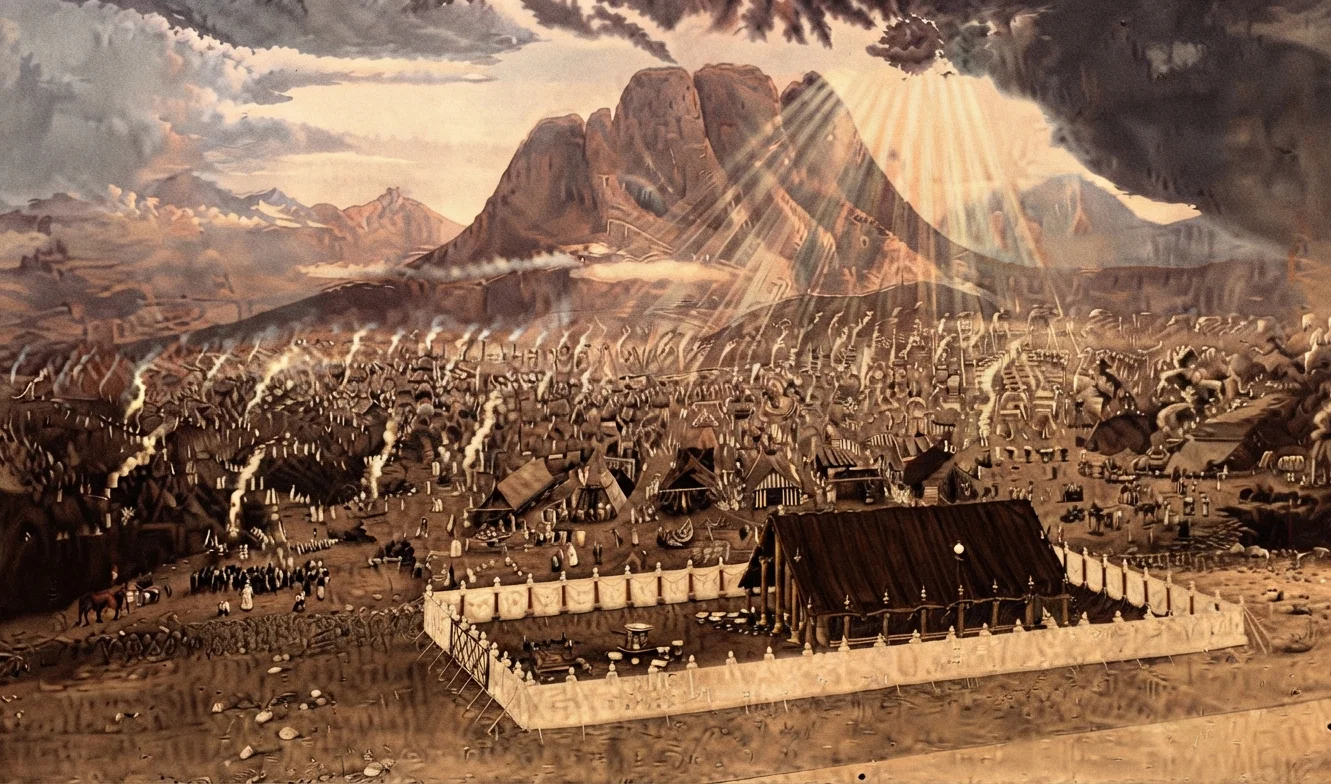
THE TABERNACLE AND ENCAMPMENT OF ISRAEL IN THE WILDERNESS
DURING all the wanderings of the children of Israel in the wilderness, Jesus, who was equal with the Father, was their Leader and Guide. Enshrouded in a pillar of cloud by day and a pillar of fire by night, His presence was ever with them. There were symbols and shadowy types pointing to a Saviour, who gave commands directly to Moses for the children of Israel, and who was set forth before them as the only channel of blessings. The sacrificial system was designed to typify the Saviour, who was to become the perfect offering for sinful man.
In the Jewish age, all the revealings of God to His people, everything relating to His worship, was closely connected with the sanctuary,—with the tabernacle in the wilderness, and afterward with the temple. Here God was worshiped; here the sacrificial offerings were presented before Him. Here was the breastplate of the high priest, set with precious stones, by which messages from Jehovah were received. Here, in the holy of holies, overshadowed by the wings of cherubim, dwelt the perpetual token of the presence of the Holy One, the Creator of the heavens and the earth. Here was the ark of the covenant, containing the tables of the law,—the ark which was to Israel the symbol of the divine presence, and the pledge of victory in battle. Idols could not stand before the sacred ark of God, and death was the penalty of a rash, irreverent touch or the glance of curiosity.
All through the pages of sacred history, where the dealings of God with His chosen people are recorded, there are burning traces of the great I AM. Never has He given to the sons of men more open manifestations of His power and glory than when He alone was acknowledged as Israel’s ruler, and gave the law to His people. Here was a scepter swayed by no human hand; and the stately goings forth of Israel’s invisible King were unspeakably grand and awful.

Man as Created

IN respect to both his bodily organization and mental endowment, man is the crowning work of creation. Shakespeare characterized him as "the paragon of animals." In not a few particulars does man surpass all other forms of animate life. "God made man upright," is the testimony of the wisest of men. This is true of both body and character. As he came from the hand of his Maker, man was morally innocent, pure, upright. Of all animal forms, man only was given an erect posture; that is, created physically upright (upstraight). This vertical posture gives him a commanding form, a beauty of figure, and a nobleness of aspect, which stamp him as the master of all the lower forms of animal creation. Throughout the domain of animate nature, nothing approaches him in external symmetry or in grace and beauty of feature. Think of the multiplex expression of the human eye, the charm of the human smile, the moral and intellectual expressiveness of his countenance — where else can these be found?
The hand belongs exclusively to man. As a distinguishing mark of the human frame, the hand is perhaps the most obvious and striking. It is so beautifully formed, has so nice a sensibility, responds so infallibly to every mandate of the will, and its actions are so potent, free, and yet so deft, that it seems instinct with inherent intelligence. Its very perfection often makes us insensible to its versatile uses.

The Dignity of Man

It will be observed that in approaching to the creation of man, the sacred narrative assumes a loftier tone and a more dignified style. The creative fiat now takes a marked change. Hitherto it had been said, "Let there be light," "Let the waters be gathered," "Let the earth bring forth," etc.; but now it is not said, Let there be man. Addressing the eternal Son, God said, "Let Us make man in Our image, after Our likeness." Man is then described as made and molded by the immediate hand of God, and animated by His breath. "And the Lord God formed man of the dust of the ground, and breathed into his nostrils the breath of life; and man became a living soul." And it is added, "So God created man in His own image, in the image of God created He him." This divine likeness and image applies to the whole man — body, soul, spirit. In his entirety man was fashioned in the similitude of his Maker — God.
Naturally, then, in his powers of thought, of reason, of invention, and in his capacity for education and training, man was created incomparably higher than the highest of the brutes, and only "a little lower than the angels." But the image of God is to be found primarily in man's moral powers and spiritual capacities. It is evinced in his capacity of resembling God in moral attributes; of being holy as He is holy; of loving Him with somewhat of the love wherewith He first loved us. This is plainly indicated in the words of the apostle, where he speaks of putting off "the old man with his deeds," and putting on "the new man, which is renewed in knowledge after the image of Him that created him." It is therefore in the capacity for, or in the possession of, true "knowledge," "righteousness," and "holiness," that the image of God essentially consists.

A Free Moral Agent—Life Conditional

Tho our first parents were created upright — innocent, holy — they were not created incapable of wrong-doing. God made Adam potentially but not actually perfect; potentially but not actually immortal. A free moral character apart from a free moral agent, is unthinkable. The power of volition, of choice, assuredly implies freedom of action — liberty to do right or to do wrong. "A moral automaton" is a misnomer; for morality or goodness is possible only in a being possessing the power to choose.
God, being all-wise, could not make the mistake of creating a race of intelligences unconditionally immortal; for in so doing He would run the risk of immortalizing sinners. It is in the clearest possible terms that the Scriptures declare man to have been created only conditionally immortal. The process by which God brought man into being is set forth in the following succinct fashion: "And the Lord God formed man of the dust of the ground, and breathed into his nostrils the breath of life; and man became a living soul." As a result of God's breathing into him the breath of life, man became simply a living soul, not an immortal soul. He was constituted a living soul, but not a ceaselessly living soul.
That this is true is shown to be absolutely certain by the fact that God, immediately after creating woman as the complement of man, placed man on probation by promising him perpetual life on condition of obedience. The terms of this probation are here adduced: "And the Lord God commanded the man, saying, Of every tree of the garden thou mayest freely eat: but of the tree of the knowledge of good and evil, thou shalt not eat of it: for in the day that thou eatest thereof THOU SHALT SURELY DIE." Gen. 2:16, 17. There is no ambiguity here. The threat of death is unqualified. Disobedience would unfailingly issue in death. But we must not fail to observe, too, that the terms of the probation carry with them the obvious implication that should Adam — the representative of the race — continue to obey his Maker until his loyalty and devotion should be fully tested and made eternally certain, he would be entrusted with endless life, or immortality. Just as certainly as God declared that man should die if he disobeyed, He also declared, by implication, that if he obeyed he should not die; that is, should live — live eternally if he obeyed eternally.

Death Not Life

But we all know the sad sequel. Adam did not prove equal to the crucial test. He ate of the forbidden fruit — disobeyed. He sinned, and "the wages of sin is death." "In the day that thou eatest thereof thou shalt surely die;" or, as the Hebrew actually expresses it, "dying thou shalt die." (See margin.) It is hardly possible to believe that Adam could have understood the language to mean anything but just what the words obviously imply. No one would ever have thought of injecting another meaning into this language, had it not been for the purpose of sustaining a dogma which the Bible does not teach. But when God Himself proceeds to interpret the meaning of these words, as He does immediately after the fall — "for dust thou art, and unto dust shalt thou return" — this certainly should be the end of all dispute with those who have genuine regard for the truth of God's Word.
But further, do we not have an exhibition of God's mercy, as well as of His justice, in dooming the sinner to death? God will not allow him to perpetuate a life of sin and misery. Hence the "Tree of Life," to which he had access hitherto, is now denied him; and for this very reason, as God explicitly tells us: "And now, lest he put forth his hand, and take also of the Tree of Life, and eat, and LIVE FOREVER," — he is driven from the garden, and cherubim are stationed to guard the Tree of Life against the sinner's approach. The tree is not destroyed. A new way of access is to be provided through an atoning Saviour, who will restore to the penitent sinner the life he forfeited by sin; and in Paradise restored, to which Christ will ultimately bring His ransomed people, they again will "have right to the Tree of Life."
In the lucid phrasing of a well-known writer, we have this pertinent thought:
God placed man under law, as an indispensable condition of his very existence. He was a subject of the divine government, and there can be no government without law. God might have created man without the power to transgress His law; He might have withheld the hand of Adam from touching the forbidden fruit; but in that case man would have been, not a free moral agent, but a mere automaton. Without freedom of choice, his obedience would not have been voluntary, but forced. There could have been no development of character. Such a course would have been contrary to God's plan in dealing with the inhabitants of other worlds. It would have been unworthy of man as an intelligent being.

Not Actually Immortal

That man was created, not actually, but only potentially, immortal, is clearly and forcefully attested by not a few statements of Holy Writ. In verse 7 of Romans 2, believers are said to "seek for glory and honor and immortality," "by patient continuance in well-doing." If man possessed original, inherent immortality, is it conceivable that the divine Spirit would represent the Christian as seeking for it? Certainly not. How utterly fatuous would it be for one to "seek" for what one already possesses! Not once throughout the range of the sacred Scriptures is immortality predicated of man, nor is the adjective "immortal" once used to qualify "man." But in Job 4:17 man is definitely referred to as "mortal." In like manner the apostle Paul speaks of universal man, distributively, as "this MORTAL." He proceeds to affirm, however, that at a given time, "at the last trump," when "the dead shall be raised incorruptible," "this mortal must PUT ON IMMORTALITY." Could even inspired language affirm more clearly and convincingly man's present mortality and the possibility of his future immortality through Christ?
Once more: in 1 Tim. 6:16 is recorded the clearest possible declaration that God "ONLY hath immortality, dwelling in the light which no man can approach unto." In truth, it is the distinctive mission of the Gospel to open a way by which man can ultimately attain immortality through Christ, who is "the resurrection and the life." For the divine Spirit expressly affirms that Christ has "brought life and IMMORTALITY TO LIGHT THROUGH THE GOSPEL." 2 Tim. 1:10.
We have now seen that divine revelation repeatedly characterizes man as mortal, but never as immortal. But, because man was made "in the image of God" (Gen. 1:26, 27), and since God is immortal, many honest thinkers infer that man must necessarily have been created immortal. Is the inference logically warrantable that because man was made in the image of God, he was necessarily endowed with all the attributes of God? Assuredly not. No one denies that God is omnipotent, that He is omniscient, that He is infallible, and so on. Now, if we infer that man is immortal because he was made in the image of God, we must, to be consistent, infer that he is omniscient, almighty, and that he existed from all eternity.
Surely no one could think of making conclusions so utterly untenable, if not blasphemously presumptuous.
More and more, men are coming to see that the hypothesis of human immortality has absolutely no standing-ground in the sacred Scriptures. Have we not shown, in fact, that it is in absolute conflict with the plain, positive testimony of Holy Writ? We have seen that the Spirit of God expressly characterizes man as mortal, and with equal definiteness declares that God only has immortality. If, as is commonly taught, immortality inheres in man, these testimonies of the divine Spirit could not be true. Many earnest, sincere people do not seem to be aware that Satan, whom Jesus branded as the father of lies, was the first to enunciate the dogma that man can not die and is therefore immortal. (See Gen. 3:4.) Every pagan religion the world has ever known has taught the satanic tradition of human deathlessness as its fundamental tenet. And are not all Christians agreed that every pagan religion has been fathered and fostered by Satan, the author of all error? Whom shall we believe, dear reader, pagan philosophers or inspired prophets — Satan or God?
Why not accept the inspired testimony of the "beloved disciple" John, "He that hath the Son hath life; and he that hath not the Son of God hath not life"?

Nature’s Offerings

By Dr. J. Fare
PRAISE to the Lord is voiced by Oceans wide; The sounding Seas their surging pæans sing; The babbling Brooklet, from the mountain’s side, Pours forth its tender song unto the King; The jocund Winds, around the crags aloft, Chant praises to the One who set them free; The swaying Trees do murmur, sweet and soft, And carol forth one constant lullaby; The rising Tempest swells its weird refrain, And sings in mighty tones unto the sky; The fleecy Clouds float ever on the strain Of music sweet — Eolian, on high. Thus ever with the mighty tones of praise, That flow and swell in grandeur of their might, The lowly and the meek their voices raise, An offering, to their God, of sweet delight.
Los Angeles, California.

Ignoring Our Record

It is not a man’s long record in right-doing, nor any firmly established habit, nor his finely tempered, well-disciplined will, that keeps him from going down before the onslaughts of temptation. There is power and helpfulness in all these things; but there is greater power in sin. Many a man of good record, good habit, and strong will, has collapsed in moral failure in spite of the costly accumulation of character-assets that he had been laying up. Above and beyond these frail and uncertain resources is the only sure Resource, Jesus Christ. For Christ is the only unfailing life-power in the world. And when sin, which is a death-power, attacks us, we are doomed unless we lay hold in confessed helplessness upon the only life-power, Christ, which is sufficient to resist.
There is warning here for those who find themselves relying in some confidence upon the fine record of victory which Christ has already given them. Even tho the record be from Him, it is not in the record that any strength lies, but only in Him. And there is comfort here for those who have no such record, or whose record, hitherto good, has suddenly been blackened and broken in failure. Our record is not our hope; only Christ is our hope. His omnipotence is equally at hand for the man of no record, the man of broken record, or the man of good record; and without conscious and confessed dependence upon Christ for each new minute of life each of these men is doomed. Christ would have us forget both the successes and the failures of yesterday, and live to-day only and wholly in Him.—Sunday School Times.
Continue reading: The Closing Seals