FIVE and a half million Methodists, now scattered in three denominational bodies, will be united when the federation is completed between the Methodist Episcopal, Methodist Episcopal South, and Methodist Protestant churches. The membership of the Methodist Episcopal Church is 3,485,983; of the Methodist Episcopal Church South, 1,817,732; and of the Methodist Protestant Church, 188,806; giving a total membership of 5,492,521 in all three churches.
A subcommittee of nine, three from each church body, met in Cincinnati, Ohio, January 19, and laid their plans for uniting the three bodies. A report is to be made at Chattanooga, Tennessee, May 17, to the joint commission of twenty-nine, which appointed the subcommittee. The joint commission was itself appointed by the general conferences of the three churches. It met last November, considered the feasibility of uniting the three churches, and appointed the subcommittee. The declaration made at that time reads:
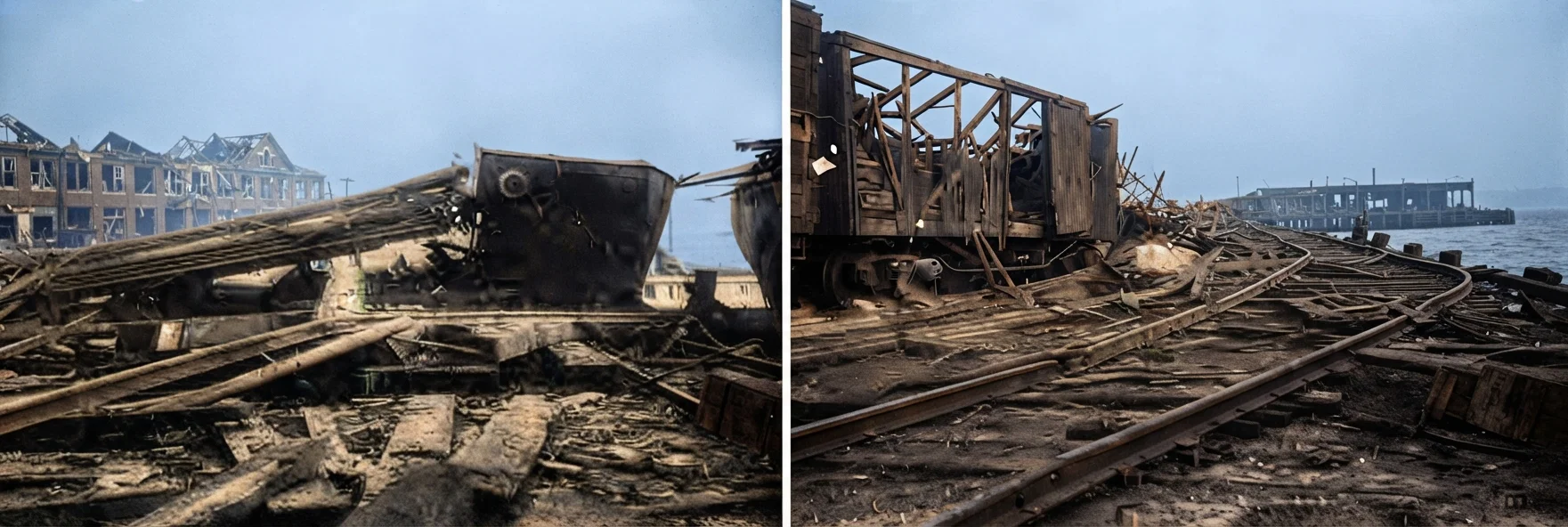
Photographs of some of the results of the fearful explosion of twenty-five tons of dynamite and ten tons of gelatin at Communipaw, near Jersey City, at a pier of the Jersey Central Railway, February 1, by which from thirty to fifty lives were lost and one thousand injured. Many of the bodies were blown to atoms. Two boats, one of which seems to have been unlicensed to carry explosives, were utterly destroyed. Many on the bay were greatly damaged, and passengers injured. Property loss will run into millions. Many persons in Manhattan, a mile away, were injured in the streets by falling glass. It was felt on Long Island, fifty miles from the scene of the explosion. Providentially, officials feel, there were few immigrants on Ellis Island when the explosion occurred, or many more would have been injured. Those there were greatly frightened, believing it to be an earthquake, as were thousands in New York City, where the great stone and cement structures rocked and swayed. One of the strange things is that a car-load of dynamite on the track close by did not explode, tho the car was wrecked and the boxes of dynamite scattered. Officials declare that the damage would have been beyond computation. The cause of the explosion is not known. Officials have been arrested, and diligent investigation will be made. But as in many instances of this kind, the criminally careless and those who knew were killed by the explosion. (Photographs by Transatlantic News Service Company.)
Resolved, That a joint committee of nine, three from each commission here represented, be appointed to consider the causes which produce friction and waste, and injure rather than promote the common cause — namely, the spreading of Scriptural holiness through these and other lands; and, if found practicable, to bring to this joint commission a plan for submission to the general conferences and people of the respective churches, said plan to provide for such unification through the reorganization of the Methodist churches concerned as shall insure unity of purpose, administration, evangelistic effort, and all other functions for which our Methodism has stood from the beginning.
It is recommended that this committee meet promptly for organization and the division of its preliminary labors among necessary subcommittees, each church to be represented in the membership of each subcommittee, and the chairman of each commission to have authority to designate another member of said joint committee to serve on any subcommittee in place of a member of said subcommittee who may be necessarily absent at any subcommittee meeting.
Bishop Earl Cranston, chairman of the subcommittee, said after the meeting at Cincinnati, that the committee of nine had found a workable plan upon which the three churches can be united.
Let us consider for a little the differences which now exist between the three churches, and a little of the history of the disagreement. The split in the Methodist Episcopal Church, which led to the formation of the Methodist Episcopal Church South, dates back to 1844, sixteen years before the breaking out of the Civil War. The underlying cause of the separation was a disagreement as to the right to hold slaves. Francis A. Harding, a member of the church, came into possession of a number of slaves, and about the same time Bishop James O. Andrew also became a slaveholder. Both men obtained the slaves either by inheritance or marriage.
The Methodists of the North insisted that Bishop Andrew should be retired. The Methodists of the South insisted that he should continue to hold his place, even tho he continued to hold slaves. The question then arose whether the general conference had the power to set aside the bishop without formal trial. Thus the construction of the constitution of the church was called in question, the Northern Methodists holding one view, and the Southern Methodists another. In 1845 the Methodist Episcopal Church South was organized. It has remained a separate organization ever since.
There is really not very much difference now, however, between the Methodists of the North and those of the South. The Methodists of the North, at the general conference of 1900, adopted a revised constitution. Before that time the constitution of the Northern and Southern Methodist churches was the same, the only difference being in its interpretation. But the revised constitution is to all intents and purposes the same as the old one, the only changes being in matters of church legislation. There are practically no changes in matters of faith.
A few instances of the changes will suffice. The Northern Methodist Church now has district superintendents in place of presiding elders, while the Southern church still retains the old term, "presiding elder." The Northern church body has extended the terms of the district superintendents to six years, while the presiding elders' terms in the Southern church are of four years' duration. The Northern Methodists have removed the five year limit formerly placed upon the pastoral term, while the Southern Methodists still retain a four year limit. This makes it impossible for a minister to remain as pastor of one church more than four years at one time, altho he may return to a charge after he has served at another place.
In both churches there was formerly a probationary period of six months. New members who were not sufficiently informed as to the tenets of the church, were put on six months' probation, at the end of which time, if they had acquainted themselves sufficiently with the church doctrines, they were received into the church. But the Northern Methodists have stricken off the limit, placing this in the discretion of the pastor and official board of each local church. The Southern Methodists have abolished the probationary period entirely.
There are more differences in church government between these two churches and the Methodist Protestant Church than there are between the Northern and Southern Methodists. The Methodist Protestant Church has no bishops.
The three commissions, appointed by the three bodies, who are working as a joint commission, are composed as follows:
Methodist Episcopal — Bishop Earl Cranston, chairman; Bishop J. M. Walden; Bishop L. B.11Wilson; Rev. J. F. Goucher, D.D.; Rev. G. A. Reeder, D.D.; Rev. W. W. Evans, D.D.; Mr. R. T. Miller; Mr. Hanford Crawford, secretary; Mr. J. A. Patten.
Methodist Protestant—Rev. T. H. Lewis, D.D., chairman; Rev. M. L. Jennings, D.D.; Rev. George Shaffer, D.D.; Rev. G. D. Helmick, D.D.; Rev. C. D. Sinkinson, D.D.; Mr. S. R. Harris; Mr. J. E. Peterson; Mr. W. N. Swift, secretary.
Methodist Episcopal South—Bishop A. W. Wilson, chairman; Bishop E. E. Hoss; Bishop Collins Denny; Rev. W. J. Young, D.D.; Rev. F. M. Thomas, D.D., secretary; Rev. C. M. Bishop, D.D.; Mr. M. L. Walton; President R. S. Hyer; and Mr. W. B. Stubbs.
At the meeting in Baltimore in November all the members of the joint commission were present except Dr. J. F. Goucher, who was absent in China.
Bishop Cranston expressed his views of the situation thus:
"First of all, I take it that we are God's men, solemnly chosen by other men of God to consider what God's wisdom and will may require of us and of them in our conduct of God's business so far as it is committed to us and to them. I see no escape from this identification of ourselves and our mission in this place at this time. It involves a tremendous test of our religious integrity, and demands of us the complete subordination of all considerations that are human in their origin and motive.
"If we are here simply as credentialed expert negotiators between three human institutions to test our wits against each other for the advantage of our respective principals, we want no prayers or sacraments in such an adventure. Diplomacy, wary, shrewd, mistrustful, but carefully veiled — that is our dependence in that case. That our people have sent us on such an errand, or that the men of this company would undertake such an errand, is unthinkable.
"Let us examine our credentials. Our commission is authorized to confer with reference to either federation or organic union, as may seem more desirable to other branches of Methodism concerned. Another commission is "directed to further, so far as is consistent and practicable, a closer relation" between the several Methodist bodies, and its principal, leaving the commission to interpret by facts in its own knowledge what may be "consistent and practicable." The third commission is "instructed to promote and complete, so far as may be possible, the reunion of Methodists in America."
"For my own church I am warranted in saying, after consultation with my colleagues, that we are ready to proceed under either head of our instructions; to confer as to either closer federation or organic union, as our brethren may desire; to meet all issues frankly and deal with them without reserve or diplomatic finesse, and to discuss all related questions in a spirit devoid of controversial feeling, so far as in us lies."
In passing the resolution to appoint a sub-committee of nine, the joint commission said:
"We are agreed that the churches represented by us are equally apostolic in faith and purpose, and having a common origin, the Methodist Episcopal Church, organized in 1784, they are joint heirs of the traditions and doctrinal standards of the fathers, and that they have proved their loyalty to the evangelical faith and spirit which characterized early Methodists."
Before the three bodies can be united, the question must be submitted to the State conferences, which meet annually. It must then be taken before the general conferences of the three bodies. The general conferences of the Methodist Episcopal and Methodist Protestant churches meet in May, 1912, and that of the Methodist Episcopal Church South in May, 1914. Thus it will be at least four years before the union is finally effected, unless a special conference is called, which is possible under the constitutions.
The Municipal Dance
A movement has been started in Milwaukee by which its promoters hope to eliminate evil from social recreation. It is styled "The Municipal Dance," and is held every Saturday night. The article describing it says: "One conspicuous and delightful feature of the 'Municipal Dance' is its democracy. It is everybody's night. A man in a dress suit would feel uncomfortable. . . . Policemen and detectives pass and mingle here and there to see that nobody exceeds the speed limit. All classes are represented; but the working class, the one chiefly designed to be benefited, is, of course, most numerous. The refreshments do not include alcoholic beverages. Every one is out of the hall by eleven-thirty." This offers a splendid opportunity for the roué and the harlot to ply their vocation. Moral and immoral are all on a level, and the level is the lower level of sensuous pleasure. Divine assistance is not promised to any one who makes the devil's field his battle-ground. We can not with safety adopt any of his devices in the moral warfare. "Can a man take fire in his bosom, and his clothes not be burned?" The modern dance is an inception of the devil, and was instituted by him to ensnare souls. Despite the motive of well-meaning promoters to reform the dance, those who participate in it by indulging its pleasures can do so only with danger of moral ruin.
Low-Necked Dresses Condemned
The pastor of the Congregational Church at Traer, Iowa, has caused considerable agitation in his locality by denouncing the wearing of low-necked dresses in public. Speaking of its immodesty, he says: "Such dress is not ladylike, it is not respectable, and should be branded as unfit for public appearance. This kind of dress makes work for virtue, uprightness, and purity doubly hard." His statements are worthy of earnest consideration by all young women, mothers, and fashion makers and venders who love purity and virtue.
The Telephone Trust Monopoly
It is said that Mr. J. P. Morgan, organizer or controller of a dozen or more trusts, purposes to merge all telephone lines he controls with the Bell company. This monopoly will include the Western Union Telegraph Company, and six of the larger transatlantic cables, and every channel of quick communication on land except the Telepost Automatic Telegraph lines and wireless. This will mean a raise of rates and the discharge of laborers. When will the trust control end?
Patent Canceled on Match Chemical
The patent on sesquisulfid, a chemical used in the manufacture of matches, and held by the Diamond Match Company, has been canceled. Sesquisulfid is considered a harmless substitute for white phosphorous, which is claimed to cause necrosis and other diseases. President Taft urged the owner of the patent and license to permit the cancellation of the patent in order to insure protection against unnecessary disease, and recommended in his annual message that a tax be placed on the manufacture of white phosphorous matches.
Bank Robberies in Kansas
Never in all history has the State of Kansas known so many bank robberies in so short a period. Within the last three months more than thirty banks have been robbed, over $100,000 taken; and not a bandit has yet been caught, as the clues are very vague and hard to follow. It is believed, however, that the bandits who once rode the same prairies horseback are now riding in automobiles.
The Moon Bill
The Moon bill before Congress proposes to raise the salary of the Chief Justice of the United States Supreme Court from $12,500 to $17,500; and of the Associate Justices from $12,000 to $17,000; and several other judges in proportion. At present a Justice of the Supreme Court of New York receives $4,500 a year more than the Federal Chief Justice.
International Sunday School Convention
The noted evangelist, Rev. J. Wilbur Chapman, who is now in the midst of a campaign in Toronto, will be at the International Sunday School Convention to be held at San Francisco, June 20-27, 1911, and will have charge of the special devotional features. The big convention will emphasize "Bible Study" and "Soul Winning."
Mouse Causes Electric Power Blackout
An inquisitive mouse nosing around the generator switches of an electric light and power company in Delaware, made contact with its body, short-circuiting the system and burning out connections, shutting off the current on all lines and leaving three towns in darkness until repairs could be made.
Pan-American Commercial Conference
The Pan-American Commercial Conference, one of the largest and most representative commercial gatherings the capital has ever seen, was held at Washington, February 13 to 18. Ninety-one commercial organizations and 296 firms and individuals accepted invitations to attend.
California Drug Sellers Bill
According to a bill introduced in the California Legislature every seller of drugs or herbs must be admitted to the practise of medicine, surgery, or osteopathy. The passage of such a bill would drive nearly every druggist in the State out of business.
Assassination Attempt in French Chamber
An attempt has been made in the French Chamber to assassinate M. Briand, Prime Minister and Minister of the Interior. The first shot did no damage; the second bullet hit M. Mirman, Director of the Assistance Publique. The assailant was captured.
California Forest Fires
Figures submitted by State Forester Homans of California show that nearly $1,000,000 in lumber was destroyed by fire in 1910. The forestry board is asking $200,000 of the Legislature to carry on the fight against fires in the next two years.
Sir Charles Dilke Dies
Sir Charles Dilke, a noted Englishman, died in his sixty-eighth year, January 26, at his home in London. He is author of a well-known work entitled "Greater Britain," and was an extensive traveler.
Peru-Ecuador Boundary Dispute at The Hague
In compliance with the suggestion presented by the mediating powers, the dispute regarding the boundary line between Peru and Ecuador will be submitted to The Hague peace tribunal.
Ptomain Poisoning from Shrimp Salad
Ten persons were stricken with ptomain poisoning in Alameda, California, after eating shrimp salad obtained at a delicatessen store. The board of health is making inspection.
Violent Eruptions of Mount Taal
Mt. Taal volcanic eruptions in the Philippines continue, and increase in violence. One thousand distinct shocks have been reported, and the death of scores of people.
Oil Burners Guard Against Forest Fires
Railroads running out of St. Paul are equipping locomotives which run through timbered country with oil-burners to guard against forest fire from coal sparks.
Photographs Sent by Telegraph
A French invention has been perfected by which a series of photographs can be telegraphed instantaneously, and faithfully reproduced miles away.
Storm Wrecks Vessels on Spanish Coast
Several vessels were wrecked in a terrific storm that swept the Spanish coast. The bodies of twenty-five sailors so far have washed ashore.
Insurgents Gaining Ground in Mexico
It is said that the insurgents are gaining ground in Mexico. They have won a few minor local victories of late.
The “Railroad over the Rockies”
By Emma H. Adams
The Spirit of the Dynamiter
THE windows of my room, in a hillside building, overlook a vast area of the great Pacific. They are a full block distant from the white beach upon which have dashed foam-crested waves ever since the Flood.
Next the building—to the west—lies a narrow, vacant lot, across which tramp scores of hasting feet from morning till night, every day.
Ten days ago, early in the forenoon, happening to glance out of one of the windows, I observed that a dozen or more little hillocks of earth had been deposited recently upon the western border of this morsel of real estate.
I observed also that, working among these tiny elevations, with striking zeal and purpose, were two lads, aged thirteen perhaps, shoveling, digging, spading, with an outfit of flat sticks, round sticks, small stones, broken pottery, discarded granite basins, etc.
All that day, except during a short respite at midday, they were absorbed in their labor, giving no heed to passers-by, disturbed by no fascinations of boy games, untempted by the prevailing—ofttimes wasteful—beach pastime named “fishing.”
Now the young laborers were upon their knees, using their hands with great speed, if not skill. Now they were erect, surveying their work, evidently making mental calculations as to future steps, or passing judgment upon those already taken. At five o'clock they withdrew from the field.
An early hour next morning found them again upon the scene, with coats off,—and throwing soil hither and thither with wonderful urgency, showing that they had an important purpose in mind.
The delving continued all that day with relentless application, and before nightfall the young fellows had worked their way well up among the cones of earth decorating the margin of the lot.
I then found myself curious to know what was the object of so much eager endeavor. It looked as tho they might have formed a trust “to control prices or to defeat competition” in some lawful pursuit, some worthy line of business, and were there working out personally their ungenerous scheme.
So, stepping down to the place, I inquired very kindly what was the purpose of so much vigorous and enthusiastic effort.
“Why,” replied one of the lads quickly, “we are building a railway from this seaport over the Rocky Mountains. See! I'm tunneling this high cone now. I'm almost through. We'll send a locomotive under it very soon. See! Over there is one of our station houses. And this is our roadway where we will lay our rails,” calling my attention to a long, narrow, climbing passage, less than a foot in width, which, with admirable skill, they had constructed along the ground slightly below the surface.
The following day at noon the “railroad over the Rocky Mountains” was ready for business and the builders retired to their homes to await patronage.
Singularly, on the succeeding day a still younger lad appeared alone upon the same attractive parcel of land, and began single-handed the construction of a railroad up the western slope of the Cascade Range.
Moving upon his knees chiefly, all day long, with speeding hands and utter absorption of mind, he opened up his roadbed, traced with wonderful skill its many curves, short and long, tunneled some hills, leveled others, threw frail bridges over thread-like streams, climbed cautiously around dangerous cliffs, and built out connecting lines to a side town or two along the route.
Two days of steady, speedy effort were spent before the enterprising boy attained the summit of the beautiful Cascade Range—the somewhat elevated edge of the sidewalk; but his task had been accomplished splendidly.
Repeatedly, while he was thus engaged, gentlemen, drawn by his unusual position and by his unique movements, stopped upon the pavement to inquire what he was doing. To them all he returned a civil reply and then urged forward his scheme.
Next day—all the juvenile railway builders being at home enjoying their midday meal—I observed a strange lad moving rapidly down the winding line to the Cascade Range, and with a swift, swinging movement of the feet, sweeping quantities of earth and debris upon the clear-cut track, completely obliterating the fine product of the little fellow, who, for two whole days, had wrought there so nobly, so strongly.
Then, glancing hastily around the neighborhood, to learn if he had been noticed, the intruder sped away into the town and out of sight.
Turning then to the line over the Rockies, I saw that he had there accomplished the same cruel, pitiless, inhuman result. Both miniature railway tracks were totally effaced.
Then flashed into mind this thought: In that lad dwells the spirit of the dynamiter. With him must have come into the world the disposition, the tendency, yes, the hunger, the craving to do evil to his fellow men; not openly, not when they stand by, able to protect their possessions; but when they sleep, when their minds are intent upon duty, when they are necessarily absent from their field of labor.
Now, what about the obligations, the responsibilities, of the father and mother of that boy? Must his alarming trait increase, strengthen, as he merges into manhood? Certainly it will, unless there be quick, firm, intelligent effort to expel the vicious germ now working unnoted at the foundation of his character. Then how evident is duty, how great, how imperative!
Suppose that, beginning now, they study seriously, earnestly, the mental and moral make-up of the lad, and by right training, judicious leading and safe example, eliminate the threatening element in his character, and in place thereof plant some stem of beauty, mold him into a helper of his comrades. What would be the fruit in the great eternity?
The changing of the characteristics of even one such criminally inclined boy might save a hundred useful lives, and shut the door against years of grief, pain, and endless struggle.
Be Kind to Others
By Niels Olson
By Niels Olson
BE kind to others, while you may.
You do not know how long you'll stay.
Life passes quickly in its flight
Into death's dark and silent night.
Be kind to others; do not wait
Until it is forever late.
Life's saddest hours will pass away.
O, help to make them bright to-day.
Speak kindly to thy friend to-day.
You do not know how long he'll stay.
'Twill help him bear life's weary strife,
And help you win a crown of life.
Three Forks, Montana.
Things to Forget
By The American
If you would increase your happiness and prolong your life, forget your neighbor's faults. Forget the temptations. Forget the fault-finding, and give little thought to the cause which provoked it. Forget the peculiarities of your friends, and only remember the good points which make you fond of them. Forget all personal quarrels or histories you may have heard by accident, and which, if repeated, would seem a thousand times worse than they are. Blot out as far as possible all the disagreeablenesses of life. They will come, but they will grow larger when you remember them; and the constant thought of acts of meanness, or, worse still, malice, will only tend to make you more familiar with them. Obliterate everything disagreeable from yesterday. Start out with a clean sheet for to-day; and write upon it for sweet memory's sake, only those things which are lovely and lovable.—The American.
Homely Eloquence
“The most useful eloquence is the homely eloquence that strikes fire on the anvil of the human heart.”
Questions and Answers
By Editor
A NEW BOOK
FREE
It isn't very often that we give something for nothing, but in order to increase greatly the circulation and usefulness of the weekly Signs of the Times we are actually offering to give a copy of this new book absolutely free. The book contains 256 pages and is handsomely bound in cloth. It answers hundreds of those questions which have perplexed Sabbath-school teachers, and other exponents and students of the Word.
Here is one of the Contents pages
viii
# CONTENTS
Meat-Eating and Romans 14; 202-Tobacco; 203-Remedy for Tobacco.
### SECTION XVI.—SATAN - - - - 201-206
204-Lucifer and Babylon; 205-Creation and Satan; 206-Can Satan Cure Sickness? 207-The Unclean Spirit; 208-Is the Devil a Separate Entity or a Principle?
### SECTION XVII.—TITHING - - - - 207-212
209-The Tithing System; 210-The Tithe and Debt; 211-A Question of Tithe; 212-Tithing Profits; 213-Tithes and Increase; 214-Tithing Teacher's Income; 215-Bazaars, Fairs, for Raising Money.
### SECTION XVIII.—SEVENTH-DAY ADVENTISTS - - - - 213-215
216-What of Seventh-Day Adventists? 217-"Hard Nuts for Seventh-Dayists;" 218-What Is Required? 1 Cor. 10:31.
### SECTION XIX.—MISCELLANEOUS - - - 216-248
219-Two Adams or One? 220-The Dominion to Whom? 221-The Garden of Eden; 222-"Thou Shalt Rule;" 223-Children of Ham; 224-Cain's Wife; 225-Origin of Races; 226-What Beast? 227-Pharaoh's Free Will; 228-Time of Egyptian Plagues; 229-Borrowing of the Egyptians; 230-Seeing God Face to Face; 231-Cruelty to Children, Num. 31:13-18; 2 Kings 10; 232-Instruments of God; 233-The Matter of Usury; 234-Jephthah's Daughter; 235-Does God Cause Earthquakes? 236-"Serve with Thy Sins;" 237-Increase of Light; 238-Child and Sinner of a Hundred Years, Isa. 65:20; 239-Taking an Oath; 240-A False Prophecy, Micah 4:5; 241-"On" or "in," in the Lord's Prayer; 242-False Religion; 243-Old Garments and Wine-Skins; 244-Smoking Flax; 245-"It Is a Gift;" 246-Take Up Serpents; 247-"Hate" and "Love;" 248-The Sin "Winked At;" 249-Mammon of Unrighteousness; 250-Who Judges? John 5:22; 251-Women in the Church; 252-Who Are the Branches? 253-"Every Eye Shall See Him;" 254-The Whole Family in Heaven and Earth; 255-"I" or "He," Rev. 13:1; 256-Priests in the New Earth; 257-The Bottomless Pit; 258-What Is the Meaning of Old Style and New Style? 259-Old and New Dispensations; 260-The Meaning of "Jew;" 261-Can a Child of God Be Lost? 262-Discoveries of Geology; 263-Will Solomon Be Saved? 264-The Holy Shekinah; 265-"God" in the Plural; 266-Was Peter a Catholic? 267-The Lord's Prayer; 268-Life-Insurance; 269-Why Men Shave; 270-The Morning of the Resurrection.
HOW OBTAINED
"Questions and Answers" will be sent free (postage prepaid) to new and old subscribers who subscribe to the weekly Signs of the Times for two years at the regular subscription price of $1.75 a year; or we will accept two subscriptions at $1.75 each, provided one or both are new subscribers.
The only other way in which the book may be obtained is with single yearly subscriptions to this same journal at $2.00.
If your subscription does not expire for some months, we will accept your renewal now, add the time to the unexpired subscription, and send you the book at once.
Some idea of our liberality may be seen when we explain that the book if sold alone would cost $1.25. We will not sell it at any price, however, as it was published exclusively as a premium to the Signs of the Times. Don't ask us to give a copy at club rates or on short-time subscriptions. We could not afford to do so.
Send orders through your tract society, taking care to make it clear that you wish the Signs premium "Questions and Answers."
Signs of the Times, Mountain View, Cal.
By Beholding We Are Changed
By J. O. Beard
By J. O. Beard
By beholding Thy face, blessed Saviour of men,
We are changed to reflect Thy pure image again.
'Tis by looking at Thee our vain hearts are subdued,
And we are, as we gaze, by Thy Spirit imbued.
Not the art of the painter can picture Thy face,
Nor the skill of the sculptor each lineament trace.
'Tis in vain feeble man uses all of his art;
He can never reveal Thee to one hungry heart.
But a fair, polished mirror, reflecting Thy face,
Is the Book of Thy truth, where Thy likeness we trace.
On the picture divine in deep rapture we gaze—
Lo, love kindles the flame, and our hearts are ablaze.
As the potter his clay, into forms that are rare,
So Thy Spirit molds us like Thine image so fair.
Then let us, dear Saviour, behold Thee with love,
Till like Thee we shall shine in Thy kingdom above.
Marshalltown, Iowa
Tuning a Bell
By Scientific American
"WHAT a beautiful tone that bell has!" is often heard. There are few, however, who know how a bell receives its joyful or solemn tones. All bells, after they are cast and finished, must go through a process of tuning, the same as any other musical instrument, before they respond with a clear, true tone. Every bell sounds five notes, which must blend together in order to produce perfect harmony. The tuning of a bell is done by means of shaving thin bits from various parts of the metal. It is as easy for an expert bell tuner to put a bell in tune, as it is for a piano tuner to adjust his instrument to perfect chords. At first thought it would seem that a bell would be ruined should the tuner shave off too much at the last tuning, of the fifth sound; but such is not the case. He would, however, be obliged to begin over, starting again with the first tone, and shaving the bell till it gave forth its harmonious sound at the fifth tone.—Scientific American.
Silence Is the Great Peacemaker
SILENCE is the great peacemaker.—Long-fellow.
Driving with Oil
I WANTED to drive an iron bar through a piece of timber. I bored a hole of the right size, but the bar was rusty, and the hole was rough. I made slow progress, and was beginning to split the wood. Then I thought of the oil-can. I oiled the bar; I poured oil into the hole; a few blows of the hammer sent the iron into its place. The oil had not diminished the size of the bar, or enlarged that of the hole. It had only relieved the friction. A few drops of oil were more effective than many blows of the hammer.
How slow some good people are to learn this. They are intensely in earnest, and even morbidly conscientious. Everybody ought to see it just as they do, and whoever does not is hammered at without mercy. Such zeal excites friction. Men will not appreciate the truth when they are repelled by the spirit in which it is presented. Let the reformer be careful to have plenty of oil. Let him speak the truth in love.—Rest and Reaping.
Christ Wants No Help from Cæsar
By Spurgeon
I am ashamed of some Christians because they have so much dependence on Parliament and the law of the land. Much good may Parliament ever do to true religion, except by mistake! As to getting the law of the land to touch our religion, we earnestly cry, "Hands off! leave us alone!" Your Sunday bills and all other forms of act-of-Parliament religion15seem to me to be all wrong. Give us a fair field and no favor, and our faith has no cause to fear. Christ wants no help from Cæsar. I should be afraid to borrow help from government; it would look to me as if I rested on an arm of flesh, instead of depending on the living God. Let the Lord's day be respected by all means, and may the day soon come when every shop shall be closed on the Sabbath, but let it be by the force of conviction, and not by the force of the policeman; let true religion triumph by the power of God in men's hearts, and not by the power of fines and imprisonments.—Spurgeon.
For Conscience' Sake
By Editor
The German Government "Run Up Against a Snag"
It would seem that Protestant Germany, the land of Luther, would be the last to prosecute for conscience' sake, the last to oppress men who were willing to suffer rather than disobey God. In the Oakland "Tribune" of February 4 is a despatch from the well-known publicist, Malcolm Clarke, dated Berlin, February 4. He says:
"The Kaiser and his army have run up against a snag in the person of a private soldier named Naumann, who, for religious reasons, will not do any work on Saturday, and who is in danger of spending the rest of his life in prison for his principles."
Naumann, who is an Adventist, declares that Saturday is the real Sabbath, and work on that day is sinful. When he became a soldier in 1907 he refused to obey orders between sunset Friday and sunset Saturday.
Minor punishments were absolutely without effect on him. He merely declared that his conscience forbade him to perform any kind of labor on the Sabbath.
Three months' imprisonment was followed by a further sentence of two years. That had no effect, and the punishment was increased to five years.
On appeal, the higher military court retried the case. Questioned by the presiding officer, Naumann declared that as a Christian his duty was to obey the religious law and refuse all work on the Sabbath.
"I was sworn in with a Christian oath," he said, "and therefore can not violate the commandments of God. One must regard God as the highest authority, and obey Him first."
One medical expert declared that he was sane, and the other that he was not. The court accepted the former view, and confirmed the sentence of five years' imprisonment, after which Naumann will be required to serve the remainder of his two years.
The heading to the article is "Soldier Defies Kaiser and Army." But he does not defy them. He does not in any way place himself against them. All the antagonism on his part is consequential, not objective, not of purpose. He has in mind but the one thing — doing duty; and the higher law of duty, to the Christian, is to do God's will as he sees and knows it. Such a man ought to be respected. Neither Germany, nor any other country on earth, has too many of him. But the struggle is not between Germany and Naumann; it is between Germany and God. She may condemn one private soldier; that of itself would be of little interest to a government; but when the principle of liberty and right is involved, woe be to that land whose government deliberately places itself on the side of tyranny.
May Naumann prove faithful. He is standing for principles which made the Reformation possible, and which in turn made Germany. If Germany repudiates those principles, she must abide the consequences; let our readers hope and pray that the soldier of God may stand fast.
It is strange, isn't it, friends, that a man should be imprisoned for seven years by a professedly Christian government for observing the same day that our Lord Jesus Christ observed? On which side think you the Master will stand?