THE Latin Union and the French-Swiss Conference held their meetings in Lausanne, from August 9 to 14; the Southern French Conference held its meeting in Saint-Hippolyte, from August 21 to 25; and the Spanish Mission held its meeting in Barcelona, from August 28 to September 1. Our different fields were well represented at the union meetings. We were especially glad to see quite a delegation from Italy. Although French Belgium, the canton of Tessin, and Algeria have recently been separated from the Latin Union Conference, that union still has a population of 100,000,000. During the three years since the Latin Union had its last meeting, 367 persons were admitted, with a net gain of 171; but during the last six months there were ninety-six admissions, with a net gain that brought the membership up to 1,159. The tithe has also increased in the three years from $9,000 to $12,500, and the gifts have nearly doubled. Spain now has a membership of about 100, Portugal 45, and Italy 80.
France is really divided into four portions. First comes the Latin Union District, which comprises Paris and its surroundings; then the Southern French Conference, the North French Mission, and the departments joining Switzerland which have been united with the French-Swiss Conference. There are, in all, about 300 Sabbath-keepers in that republic. We have now fourteen ordained ministers in the Latin Union, twenty-eight other gospel workers, and a number of nurses. The available gospel helpers are not more than fifty, or one to every two million persons.
The business of the union conference passed off harmoniously, and Elder L. P. Tieche was reelected union president. In the French-Swiss Conference one important decision was to change the name in accordance with the present territory. The best name found was the Leman Conference, Leman being the French name for Lake Geneva. Elder H. H. Dexter was again elected president of that conference.
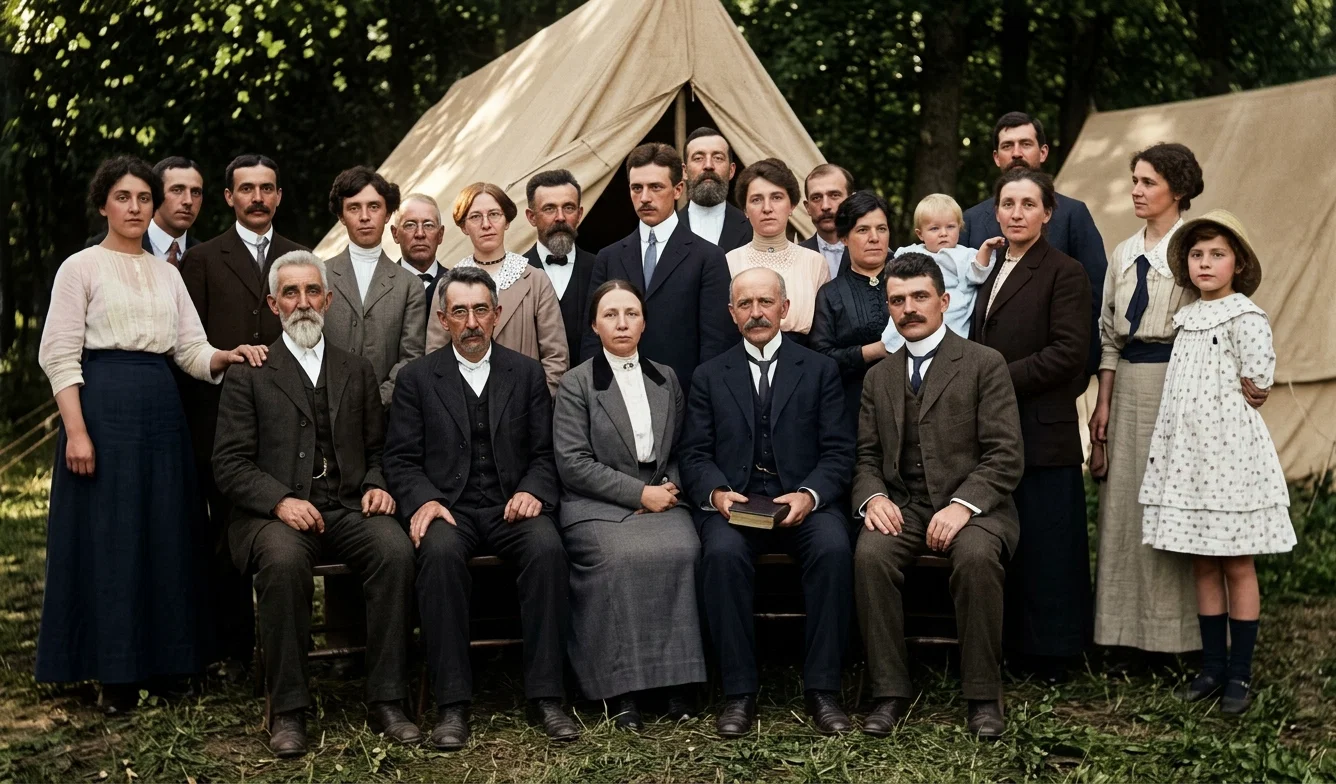
WORKERS AT THE SOUTH FRENCH MEETING
Though it was rather rainy and cold the latter part of the meeting, yet our people remained till its close. Brother Paul Meyer, who had labored with success in the Portuguese field, was ordained to the ministry. We were very glad of the liberal spirit shown by the people to bring up their gifts to ten cents a member. About $500 was raised at the meeting; and with what was collected last year, the Latin Union will be quite well up to the mark.
As to the institutions, the school is under the direction of Brother P. Steiner, and has good prospects of a fair attendance; while the sanitarium had the best year since its existence. In 1911 265 patients visited the sanitarium, while the first six months of this year we already have had 152. In view of the urgent needs, it was voted to erect a dwelling-house near the food factory, which would also serve for the book department; and a building containing a large stable and some dwellings will also be put up. The addition to the sanitarium was postponed for a year to give time for better study. Elders W. J. Fitzgerald and Guy Dail and the writer assisted during the meetings, and all appreciated the help thus rendered.
On our way to the meeting of the Southern French Conference, we spent two days in Gland considering the needs there. We found quite a good number of our people at Saint-Hippolyte, and there was quite a good attendance in the evening from the outside. Elder Tell Nussbaum, who has now settled in Lyons, was reelected president. Careful plans were laid for solid winter work in three different parts of the field.
We were pleased to see a good delegation of our farmers from the Tarn present. When the call was made for mission gifts, they responded very liberally, one brother giving $200. Besides the union president and the writer, Elder P. Steiner and Dr. L. E. Conradi assisted in the meetings.
After the meetings, we spent two days at Cette, Montpellier, and Aigues-Mortes on our way to Spain. At the latter place we visited the tower of Constance, where the Huguenots were imprisoned for so many years. In Barcelona we found about seventy of our one hundred Sabbath-keepers. The meetings were held in two different places, and the attendance from the outside was good in the evenings. We took further steps to organize the field by appointing a local committee of five. Two of the members of this committee are native Spaniards. It was also planned to organize a church at Barcelona, and to get the other companies well founded. Elder Walter Bond, who has thus far labored mostly in Barcelona, will now work for a number of months outside, dropping the burden of local church work on others. We hope that by another year he may be able to move his headquarters to Madrid. Elder F. Bond will work in Murcia and its vicinity.
Brother J. Brown is of good courage in the canvassing work. There were about seven workers employed for nearly ten months, and three others for a shorter period. Their total sales in books and papers amounted to about $3,000. With careful management, there is no question but that the canvassing work can be made self-sustaining in this field, though the earnings are not what one would expect in the States. Brother E.13Borle, as well as Brother P. Steiner, was with us at this meeting. We hope soon to have the book “Daniel and the Revelation” finished as our first large work printed in Spain.
On the whole, the prospects of the Latin Union are brighter than ever before. A number of young persons are now coming to the front, and the school is turning out some new workers, so we may, with the increase of workers, expect more rapid growth. There is no question but that the Latin Union is one of the hardest fields we have, and it takes a long time to lay a good foundation, and, above all, to secure good native workers who understand the people and their needs. But not only must the Latin Union be well supplied, but also the great French, Spanish, Portuguese, and Italian colonies; and the Lord is helping in that direction.
We had Brethren A. Guyot and Jose Abella, of Algeria, with us, and they gave favorable reports. Brother Abella is a Spaniard, but he has mastered the French, knows some English, and is now making good headway in the Arabic. Not only is the work going forward in Algeria, but we are also starting on the Portuguese West Coast, and now also in the isle of Mauritius, near Madagascar. Plans are being laid to enter these fields as soon as workers can be secured. Let us remember the work in the Latin Union in our prayers.
Tokio, Japan
By BENJ. P. HOFFMAN
BENJ. P. HOFFMAN
Arriving in Japan shortly before the funeral services of the late emperor, we were afforded an extraordinary introduction to our field. The thousands of loyal subjects who assembled to witness the procession furnished a good opportunity for a study of the people, not only their physical aspect, but also the religious phase of their life at a very special occasion. Time, money, and even the lives of some workmen had not been spared in making imposing preparations for the interment of Meiji Tenno, the emperor of the era of enlightenment.
Considered of divine origin, his spirit is worshiped as a supreme deity, and the manifestation of reverence and awe on this occasion was most impressive. The suicide of General Nogi is very indicative of the old sentiment of the Japanese mind. When the cannon gave the signal for the exit of the corpse of the emperor from the imperial palace, the noble general of Port Arthur and his wife ended their lives in a time-honored manner, that their spirits might accompany that of their beloved ruler, and be worshiped by their descendants.
The funeral and procession will be remembered as the most impressive combination of Old and New Japan ever to be witnessed. Modern military bands blended their mournful music with the wailing and chanting of Shinto priests and ritualists.
To us the day brought an increased realization of the difficult nature of the work that confronts us, and a sense of our need of a pentecostal experience daily.
We were glad to be welcomed to our field by a band of workers who are faithfully devoted to the work in spite of reverses and opposing circumstances. The first Sabbath here I had the privilege of speaking a few words, through an interpreter, to the Tokio church. We looked upon this little company, who have been brought out of heathenism to walk in the light of present truth, as a token that God still lives and works. But as our eyes follow the stretch of roofs under which millions dwell without the true light, this seems but a small beginning.
The study of a very difficult language is our first work now, and for this we need special grace and help from above. We are glad to be here as representatives of the eternal kingdom. May the prayers of all the friends in the home field be earnest in behalf of the work in Japan.
In Sumatra
By G. F. JONES
G. F. JONES
OUR mission station in Sumatra is at Padang, the chief city on the west coast. The work was begun there nearly eleven years ago by Elder R. W. Munson and family, who were there for about six years. On their departure for Australia, Elder G. A. Wantzlick and wife were sent there. They stayed about two years, then Brother B. Judge and wife and Sister T. Judge, Brother T. Roberts, and Tindek (a native worker who was trained in Singapore) followed. These faithful workers have all done their best, but judging from results, it is difficult to reach the people in this place with the third angel's message. The present mission house was bought by the Australasian Union Conference with the intention of making it our headquarters in Sumatra.
The brethren here have a day-school, which about sixty students attend; quite a number of these also attend the Sabbath-school, and a good work is done in giving them a religious education. Sister T. Judge has exerted a good influence through her missionary nursing, and has made many friends, while the evangelistic work has been carried on by Brother Judge and wife. When I visited Padang, there were six ready for baptism.
The west coast of Sumatra is very mountainous, while the east is flat and more prosperous. There are several busy towns along the coast which should be entered, but the worker before entering a place must get a special permit, which it often takes six months to secure; and even this gives him no liberty to labor in but the one city. It is as if a worker were given a parish in which to stay and labor, but were not permitted to do anything outside that limit. This makes progress exceedingly slow and difficult; and an aggressive tent effort carried on from city to city, as in the States, can not be thought of in Netherlands East India, under the present policy of the government on religious affairs. There is, however, one blessed privilege which the law still allows,—the liberty to sell books anywhere. So, with this open door, we must select and train faithful native workers to carry our message into the homes of the people, and in this way these workers can gain converts as they come in contact with inquiring minds.
In the mountainous districts in the interior of Sumatra are many heathen tribes whose religion is that of demon worship. Some of these tribes are cannibals, others are fanatical Mohammedans, while still others are open to conviction regarding the gospel. In certain districts many of these are now becoming Christians, but the real heathen is the most easily taught.
Selukwe Reserve Mission Site
FROM the South African Missionary more particulars regarding the Selukwe Mission Reserve are obtained, toward which our Sabbath-schools donated on the last Sabbath in June. Brethren T. J. Gibson and J. N. de Beer recently visited the new site, and report as follows:—
“We visited the Selukwe Mission site last week, and endeavored to obtain all the information possible about the place. The reserve is thickly settled by natives. From the mission site one gets a beautiful view of the surrounding country, and native kraals and lands can be seen in every direction. Mr. Myers, a farmer living about three and one-half miles from the site and several hundred feet lower, said that he had lived there for nearly three years, and neither he nor his family had had any fever. So it would seem that the place is fairly healthful.
“We tried to find out all we could about the agricultural advantages of the reserve. There are several good places for potato and vegetable growing—about five acres, I should say—and enough land for mealie growing. Mr. Myers, who has a trading station at the site, said that he raised fairly good mealie crops on the place. The natives around there also get some good crops. The site is admirably situated for a store, being on the only wagon road from Selukwe to the native chief’s kraal and the center of the native population; and if a store license can be secured, it would certainly be a good thing for the mission.
“The most suitable place to build is within four hundred yards of the spring, commanding a view of the country equal in extent to the Cape Flats as seen from the top of Wynberg Hill. Our site is in the open, and will get the sun, and every breeze that blows. The natives now know that we are to have this place, and have reserved it for us, their gardens approaching it on every side. There are fifty morgens (one hundred acres), which gives us sufficient land for mealies, potatoes, a vegetable garden, and a good orchard. We are now awaiting orders to move on.”
Love in the Home
By Carrie Knight
CARRIE KNIGHT
Chancing to glance out of the window the other morning, my attention was attracted to a small group of persons, three men and a woman, standing on the wharf just under my window. They were preparing to enter a boat tied along one side. One man, seemingly the oldest of the three, stepped into the boat, untied a bundle, and began fixing a seat in the rear end. He arranged coats, then patted and rearranged them until he succeeded in getting the seat to his idea of comfort; then he said something to the woman. The language was foreign to me, but my interest in the little crowd redoubled. Taking her hand, he slipped his arm about her waist as tenderly as a mother would handle a delicate child; he helped her to the seat, and as he drew a cover over her lap, tucking it carefully about her feet, I saw the love light shine in his eyes. Taking off his own overcoat, he placed it carefully to her back, patting her shoulder, and saying something that brought a happy sparkle into her eyes, and a bright color into the pale, sweet face. I said to myself, “That woman may wear calico; she may live in one of these fisherman’s shacks, but she is rich; rich in that one thing, which thousands of hearts in this selfish world would give all they possess to obtain, love.”
My thoughts fly to the home across the way. Crape is flying from the door this morning. Death entered last night, and took the wife and mother. Flowers are being carried in, and piled high upon the coffin. Flowers had been denied her in life; she had had no time to enjoy them even if she could have had them; she was too busy. Husband and children must be fed and clothed; the house must be kept tidy; and so she had worked on, no ray of love brightening her pathway. But listen! I can almost hear the cries of anguish as that husband, who has denied the little tokens of love to that wife now sleeping in death, realizes what the words “too late” mean. No use now to pile high the fragrant flowers; no use now to pat the white, still hand, and to whisper into deaf ears the tender, loving words so long withheld. It is too late. Living, her life was barren of all the small, loving acts that make life sweet, and now it is too late. There comes to my mind an unidentified poem I have read:—
“I know that deep within your heart of hearts,
You hold me shrined apart from common things,
And that my step, my voice, may bring to you
A gladness that no other presence brings.
“And yet through all the weary days
You never speak one word of tenderness;
You never stroke my hair, nor softly clasp my hand
Within your own in loving, mute caress.
“You think perhaps I should be all content
To know the loving place I hold
Within your heart, and so you do not dream
How much I long to hear the story told.
“You can not know when we two sit alone,
And tranquil thoughts within your soul are stirred,
My heart is crying like a tired child
For one fond look, one gentle, loving word.
“It may be when your eyes look into mine
You only say, ‘How dear she is to me!’
O, could I read it in your softened glance,
How radiant this plain old world would be!
“Perhaps sometime you breathe a secret prayer
That choicest blessings unto me be given;
But if you said aloud, ‘God bless you, dear,’
I would not ask a greater boon from heaven.
“What matter if our granaries are filled
With all the richest harvest’s golden store,
If we who own them can not enter in,
But famished stand before the close-barred door?”
Dear readers, let us be more tender and loving to our own, giving the flowers and the sweets now while they can be enjoyed, and not waiting until we must heap them upon coffins.
Astoria, Oregon.
The Noon-Hour Prayer
“Evening, and morning, and at noon, will I pray, and cry aloud: and he shall hear my voice.” “And the Lord turned the captivity of Job, when he prayed for his friends.”
OUR seasons of spiritual devotion should never degenerate into mere forms. On these occasions we hold communion with our truest and dearest Friend. We should enter the audience-chamber with joy. Shut in with him, we may tell him all our hearts’ desire. He will not upbraid us nor turn coldly aside. He will not betray to others the confidence that we repose in him. We may whisper into his ear the inmost secrets of our lives. We may tell him our desires and longings, and confess to him our weaknesses and failures. We may lay upon him our burden of grief and woe, tell him how hard it has been to bear the pain of body or the anguish of heart, and seek from him strength and power to enable us to bear the load that his providence permits to rest upon us.
Let us make our communion with God more than a hasty formal exercise. Let us make it rather a time of sweet communion, when with our hearts open to the divine influence we may let God speak to us through his Word and through the leadings of his Holy Spirit. From such communion and from such prayer seasons we shall go out refreshed, strengthened, and encouraged to bear bravely all that shall fall to us in the working out of his great purposes in our experience.
Let us remember the following requests as we bow before the throne of grace during the coming week:—
122. From far-away India one of our missionaries writes asking that we pray for the conversion of his two brothers and two sisters; also that, if it be God’s will, he may be healed of an affliction from which he has suffered for several years.
123. A sister in Oklahoma is burdened for her son’s wife, who is giving up the truth, and whose violent temper makes the home very unpleasant. Let us pray earnestly for this family.
124. A North Carolina brother desires15prayer for his three brothers. One has married an unbeliever and given up the truth, but the others have never been converted.
125. From California a burdened mother writes earnestly requesting prayer in behalf of her only son, a young man twenty-one years of age. He was reared in a Christian home, and was graduated from one of our Western schools, but has fallen into bad company, formed the habit of cigarette smoking, and apparently cares nothing for the truth. This sister also asks that we pray for the conversion of her only brother.
126. “I am afflicted with rheumatism, and for four years have been an invalid. Pray that I may be healed if it is God’s will. Also pray for my son who has given up the truth, that he may again take his stand with this people; and for my daughter, whose husband is not a Christian, that she may follow her Saviour faithfully in spite of opposing influences.” These requests come from a sister in Nebraska.
127. A Wisconsin sister requests prayer for the conversion of her three sons, who are moderate users of intoxicating liquor. They know the truth and respect it, but evil companions have led them astray.
128. A sister in Connecticut sends an earnest request for prayer that God will overrule in circumstances that seem especially trying, and open the way for her husband and herself to once more take an active part in this closing work.
129. A burdened mother in Florida asks the prayers of God’s people in behalf of her son who has gone astray, and who is the innocent victim of unjust accusation.
Answered Prayer
The following cheering note comes from Mrs. Josephine Clark, of Turners, Mo.:—
“I have been praying for my husband for seven years, with other faithful brethren and sisters, that he would be converted to the truth. I had almost despaired, but God had not ceased to work in his behalf. On September 14 he took his stand on all the principal points of the message. He is studying to know what the Lord would have him do. It is the first time he has ever made a profession, and he is forty-five years of age. I think this should be a great encouragement to many who have been praying long years for their loved ones. I praise the Lord for his goodness to us.”
Nobody Knows But Jesus
By C. E. GREY
C. E. GREY
Nobody knows all the burdens we bear,
Nobody knows but Jesus.
Nobody knows all our trials and care,
Nobody knows but Jesus.
Nobody knows all the struggles of life,
All of its conflicts, all of its strife,
All of its sorrows that pierce like a knife,
Nobody knows but Jesus.
Jesus, who came from his home in the sky—
Jesus, the loving Jesus—
For sinful creatures to bleed and to die,
Jesus, the loving Jesus;
He who in anguish of soul wept alone,
Bleeding and dying for sin to atone,
While in the garden the pale moonbeams shone,
Is still our loving Jesus.
Jesus, who fell ’neath the cruel cross,
Jesus, the sinless Jesus,
Infinite price paid for man's worthless dross,
Jesus, the sinless Jesus;
He who for sin gave his life on the tree
That he might save such a sinner as me,
And from death's band every captive set free,
This is the sinless Jesus.
Work and Recreation
By ARTHUR W. SPAULDING
Come, Let Us Live With Our Children—No. 5
Work and Recreation
ARTHUR W. SPAULDING
If we are to live with our children, then they must live with us. They and we must be in the same world. And that world, for every healthy man and woman, is a world of work. The most of us, instead of progressing, would be in damaging mischief if we did not have to work.
It is the business of God's people, to learn such self-control and self-impulsion that they can, in the new earth, be trusted with leisure for study and progress. And that lesson we have to teach our children.
Let our children work with us whenever possible. It is an easy thing to tell a boy to cultivate the garden, or a girl to wash dishes; but unless we work with them and teach them how, we shall find the best of them imperfect and blundering. The farmer or the gardener has the best chance to teach his children, letting them work with him in any job wherein they can be of help.
The lesson of responsibility is an important one. It is right for our children to feel some of the stern demands of life's necessities. They must be taught that he who will not work shall not eat. To teach this lesson, the father and the mother must themselves be consistently industrious. Give the children well-defined tasks, to be done at certain times: feeding the chickens, carrying in wood and water, washing dishes, sweeping and dusting, darning socks. Such of these tasks as permit must be done at a regular time; and it takes supervision and oftentimes, especially at the first, participation on the part of the parents to insure their being done promptly and well. Take the children with you into the garden, to prepare the ground, sow the seed, and cultivate the plants.
Do not ask too much of the child. That is a mistake that hard-working people often make. They overrate the ability and strength of the child, and set him to do too much; then when he gives out, he is either permitted to leave his work undone, or is forced unjustly to accomplish it. In the one case he grows slack and careless, in the other he is exhausted, and in both he learns to hate work. Suit the task to what you learn is the child's capacity for work. On the other hand, don't be too afraid to give him enough to do. A coddled child will never be master of himself or of circumstances. It is all right for the child to sweat and get roundly tired. Hard work is the corrective of many evils, physical and mental.
The chief secret of success in teaching the child to work is to rouse and feed his interest in the things he is doing. The garden is an excellent place for study of the appearance, the peculiarities, and the habits of growth of different plants, of insects, birds, and four-footed enemies and friends; and the reasons for the methods of culture used should be explained. There is an inexhaustible study in this work, and the children can be so taught that they would rather work in the garden, among the flowers and vegetables, than to occupy themselves with anything else. And so it can be in the care of animals, and in the house, if the furnishings, and therefore the work, be very simple.
But work with the children. When they have become fairly proficient in any one thing, they will take pride in the responsibility of doing it alone and submitting it for your inspection afterward. Inspection should not be neglected, for it is an incentive to good work, and is a means of teaching that God inspects all our work, our actions, and our thoughts.
It is to be emphasized that we must teach system. The family should work on a more or less elastic program. There should be a time to go to bed and a time to rise, a definite time for family worship and for meals. And in the doing of our work we must teach our children not to skip haphazard from one thing to another. Work where work is most needed, but begin at one end and finish clear through to the other. Feed and milk the cows at stated hours. Clear the kitchen, air and make the beds, and sweep, in a regular order every day. Make a study and devotional hour for every one, and adhere to it. It can be done, and it must be done if work and life are to be successful.
Now if you bring the child into your world, you must make some excursions into his. Play is the normal activity of the child, and how he does enjoy having papa and mama join him in it! You may be a little stiff in the joints and short of breath, but you can win back enough sprightliness to join in some romps. The romping games are better than the sedentary ones. Don't be a Puritan; it will not hurt your religion—it may make it more healthy—if you play blackman, or drop-the-handkerchief, or hide-and-seek, or a game of ball. But non-competitive games should be chosen rather than those that incite rivalry; for we can give our children no worse training than to strive to obtain the advantage of some one else.
Call your knowledge and experience into use in opening new channels of thought and expression to your children. Teach them to fly a kite, to whittle out a boat or a weather-vane, to make a water-wheel, to tie a dozen different kinds of knots, to knit and crochet, to make stools and steamers and Dutch boys in paper sloyd, and a hundred and one other things that you know. Remember your own childhood and what you liked to do, then teach your children. They will like games a thousand times better because they were learned from papa or mama; and what is more to the point, they will like you a thousand times better. It does your soul good to remember with what meek pride your little girl wore the daisy wreath you wove for her last Sabbath.
Plan outings now and then, quiet family picnics, or with a few friends. Do not let big crowds swallow your children often. A quiet day spent occasionally at the lakeside, or on the mountain-top, or in the woods, where the birds soar and sing, and the dragon-flies flash, the breezes blow, and the aspen leaves dance,—it will be worth your while; you can afford it. So, whether at work or at play, live with your children.
Hendersonville, N. C.
Florida Camp-Meeting
By G. B. Thompson
THE annual camp-meeting of the Florida Conference was held at Ocala, October 3-14. We had unmistakable evidence during the entire meeting that the Spirit of God was present to bless his people and guide in the work. The nineteenth session of the conference was held in connection with the camp-meeting; and although some perplexing questions arose, the utmost unity and brotherly love prevailed throughout the entire meeting.
The meeting was well located, being only a few blocks from the center of the town. For several weeks before the meeting, Elder C. B. Haynes, with other workers, had been holding a tent-meeting on the same ground. These meetings will continue after the camp-meeting, and the outlook is good for a company of Sabbath-keepers.
At this meeting Elder R. W. Parmele, who has faithfully served the conference as its president for five years, having accepted the presidency of the Louisiana Conference, was released; and Elder W. H. Heckman, president of the Eastern Pennsylvania Conference, was elected president. Brother Heckman was present during the meeting, and was most cordially welcomed by the people. He takes hold of the work with good courage. The Lord has blessed the labors of Brother and Sister Parmele in the conference, and they leave for their new field with the confidence and love of all.
The reports rendered by the various departments were of an encouraging character. The president reported that the membership of the conference had nearly doubled during the past five years, due in part to immigration. In 1908 the tithe was $6,163.13. In 1912 it was increased to $12,716.41. In 1908 the donations were $1,242.75. In 1911 they were $4,490.32. The Orlando sanitarium is enjoying a good patronage, and showed a gain in operating expenses during the year.
During the meeting the growth of the work and its needs in the regions beyond were considered, and met a most hearty response in the hearts of all. For the foreign work and the local conference and sanitarium, pledges and cash were received amounting to over five thousand dollars. Considering that it was not a large meeting, this was indeed a most liberal contribution. The Sabbath-school offerings were quite liberal. It was my privilege to see for the first time a crisp fifty-dollar bill in the Sabbath-school collection.
The attendance of our people was good. We were all glad to have with us during the entire meeting Elder George I. Butler and wife, both of whom are enjoying good health, and are full of courage and faith in the message. Brother Butler, though not far from fourscore years of age, and worn with many years of faithful service, maintains to a great degree his old-time vigor. He spoke several times during the meeting with freedom and power. He is planning as soon as he can sell his home to enter again into active pioneer work. Surely the zeal and example of this aged servant of God should be an inspiration to all.
A camp-meeting for the colored believers of Florida was held on the same date in another part of Ocala. Several laborers were present, and although the attendance was not large, a good meeting was reported. When the needs of the cause were presented, these brethren responded by pledging about $250.
In addition to the local laborers and those already mentioned, Elder C. B. Stephenson, the union conference president, A. J. Haysmer, Prof. H. M. Hiatt, and Brethren V. O. Cole, R. Hook, Jr., L. D. Randall, and the writer attended the meeting. A spirit of deep consecration was manifest, especially in the Sabbath services. Seven or eight were baptized.
Many expressions of renewed confidence in the message were heard during the meeting. Men may fall by the way, but the great advent movement that God is leading, moves on. How thankful we should be for a part in this great work! Our dear brethren and sisters who have so nobly stood by the work of God returned home with good courage and renewed determination to be more faithful. Surely the cause of God was never more encouraging in Florida.
G. B. THOMPSON.
West Pennsylvania Conference
By W. F. SCHWARTZ
FOLLOWING the camp-meeting, I met with the Altoona church in quarterly meeting, after an absence of fourteen weeks. There was a large attendance, and a good spirit was manifested in bringing in the tithe, which amounted to $69.85. One thousand Signs were also spoken for, to be used to help raise our portion for foreign missions. In this place a few are keeping the Sabbath who have not united with us.
The following week, I met with the Johnstown church, and was associated in labor with the president of the conference. The meetings were well attended, and the ordinances of the Lord’s house were celebrated. The tithe and contributions of the church for this last quarter amounted to $217.90, an increase over that of each of the two preceding quarters. Four new members have been added to this church, and a few others are keeping the Sabbath. The public interest in attending the evening gatherings was good. Six hundred fifty Signs were ordered for use in the foreign mission campaign.
From Johnstown I went to Clearfield to17hold a quarterly meeting, which was well attended. None of our ministers have visited this district for five months. The members of this company are of good courage, and are doing all they can to uphold the light and carry the burdens that are placed upon them. This last quarter their tithe and contributions amounted to $63.63, and they paid on the church mortgage and interest $42.92. In view of the faithfulness of these few, what ought to be done by large companies and by those enjoying greater blessing!
From this place, I went to Dubois, in answer to a call, and found one who had accepted the truth at Hillsdale, and a brother and sister who had moved from Philipsburg, and had let the light shine forth by giving Bible readings in their own home. These had been the means of leading a few families into the truth. While there, I organized a Sabbath-school of twelve members, seven of whom are adults. This field is ripe for a good tent effort, and two portions of this city could be worked to good advantage with a tent, which was not taken into consideration when the camp-meeting and tent effort were held here seven years ago. I held a few public meetings, and a good interest was manifested. A further effort will be made here soon.
On my way to Coudersport, I spent a day at Philipsburg, finding two who are still faithful in tithes and offerings. The Coudersport company is wide awake in the things of God; and if more churches would make an effort to go to camp-meeting, they would get the same zeal and spirit for the work of God. The quarterly meeting was well attended; and at the evening service some were present who had never been in the church before. On Monday, Brother Shaw assisted me in a baptismal service, when an aged man was baptized. A few others are expecting to go forward in the same ordinance. In all these places, there are some who are interested in the message, and there is a great work to be done.
W. F. SCHWARTZ.
His Invitation
A YOUNG man who had got into the habit of spending all his evenings away from home was asked by his father if he had any engagement for Thanksgiving evening. The young man had nothing in particular.
“Well, I’d like to have you go somewhere with me,” replied his father.
“Where shall I meet you?”
“Father suggested the Columbia Hotel, at half past seven, and I was there,” the boy goes on to tell. “When he appeared, he said he wanted me to call with him on a lady; ‘one I knew quite well when I was a young man,’ he explained.
“We went out and started straight for home.
“ ‘She is staying at our house,’ he said.
“ ‘I thought it strange that he should have made the appointment for the Columbia under those circumstances, but said nothing.
“Well, we went in, and I was formally introduced to my mother and sister.
“The situation struck me as funny, and I started to laugh. My mother and sister shook hands with me, and my mother said she remembered me as a boy, but hadn’t seen much of me lately. Then she invited me to be seated.
“It wasn’t a bit funny then, although I can laugh over it now. I sat down, and she told me one or two anecdotes of my boyhood, at which we all laughed for a while. Then we played games for a while, and enjoyed some light refreshments that mother had prepared. When I finally retired, I was invited to call again. I went up-stairs doing a good deal of thinking.”—Selected.
Evil Days Ahead
By EDW. J. URQUHART
EDW. J. URQUHART
What means this clamoring on freemen's soil
For laws that would debase this glorious land,
The land in which we live, for which we toil,
For which our fathers bled in purpose grand?
What laws, you say? I mean the laws that would
Bring back again the days of blood and tears,
Tear down the Constitution that has stood
Steadfast amid the tempests of the years;
Those laws that would unite the church and state,
And take away the conscience of man
And make him a machine, for such the fate
Of every heart that yields to such a plan.
The bloody records of the past attest
That persecution follows such a course,
And plainly do they say, “God’s way is best.”
Persuasion comes of God; of Satan are force.