Your ShelfYour Projects

Signs of the Times, Vol. 31, No. 50.

A GOOD TIME
Earlier text: THE KINGDOM OF GOD

OUR WORK AND WORKERS.

A SESSION of the Southwestern Union Conference will be held at Keene, Texas, Feb. 9-11, 1906.
THE baptism of three persons at Mill Creek, Wis., is noted in the Reporter by Brother F. F. Petersen.
THE Wisconsin Conference Committee has decided to erect a school building at Clearwater Lake.
A CHURCH of eight members was recently organized at Estella, I. T. Brethren A. Nelson and E. L. Maxwell conducted the organization services.
THE office of the Georgia Conference, and Tract and Missionary Department, is located at 613 E. Fair Street, Atlanta. M. L. Woodall, secretary and treasurer.
REPORTING to the Recorder, Brother Wm. W. Simpson tells of very successful meetings in San Diego, Cal., and notes that at a recent meeting there were sixty new Sabbath-keepers.
OWING to continued ill health, Brother W. B. White, president of Pacific Union Conference, has removed to Southern California, where he will engage in outdoor labor for a time.
THE Minnesota Worker notes an awakening in the matter of home canvassing for our 40 per cent. books. It is a good work, and an excellent way to gain an experience in carrying the truth to the people. Get a catalog of these books and try it.
AT the recent meeting of the Central New England Conference, the following officers were chosen: President, A. E. Place; secretary and treasurer, H. B. Tucker; secretary Sabbath-school Department, Mrs. L. S. Wheeler; missionary secretary, and general canvassing agent, H. C. Wilcox; executive committee, A. E. Place, L. S. Wheeler, F. Griggs, D. M. Hull, P. P. Lane. Brother H. C. Hartwell was ordained to the Gospel ministry.
AT Salamanca, N. Y., where Dr. W. F. Crafts, of the Church-and-State Bureau, Washington, D. C., was recently lecturing, the audience was well supplied with the tract, "The Seal of God and the Mark of the Beast." Such is the proper way to meet this class of so-called "reformers." Nothing so effectively offsets error as the silent truth. Mr. Crafts was boasting of the great political power of his bureau; and, as a covert auxiliary to Rome's growing influence in the government, it is apparently second to none.
A LETTER from Brother Delmar Baker, son of Brother G. A. Baker, long connected with the SIGNS office, gives an encouraging account of the work in Great Britain. He and his wife are graduate nurses, and are at present connected at the sanitarium at Leicester. He notes that the work is very encouraging in North England Conference, of which Brother E. E. Andross is president. The conference has become self-supporting. Of former Californians now laboring in the Britain, mention is made that A. S. Marchus is at Nottingham, J. H. Parsons at Newcastle, J. S. McCord at Hastings, on the south coast, and Brother Gautereau at Southampton. The last-named brother had been canvassing in North Scotland for about two years, and had been very successful, but returns to the work of the ministry. Brother and Sister Baker are about to take a further educational course, preparatory for some more distant foreign work.

WANTED FOR MISSIONARY WORK.

(Always prepay postage.)
SIGNS, Watchman, Life Boat, and tracts. Address, J. J. Jobe, 73 East 11th Street, North Portland, Ore.
MILLENNIAL TEXT-BOOK.—Every known reference; over 500 arranged according to events, adapted for instant reference or profound Bible study; result of 12 years search. Mailed for 10 one-cent stamps or a dime. Eugene A. Brown, Phoenix, Ariz.

STOCKHOLDERS' MEETING.

NOTICE is hereby given that the fifth Annual Meeting of the Stockholders of the Southern Publishing Association, will be held Tuesday Jan. 9, 1906, at 10 A.M., at the office of the Association, Nashville, Tenn., to elect a board of directors for the ensuing year, and to transact such other business as is connected with the Association. CHAS. S. POTTS, Secretary.
Nashville, Nov. 22, 1905.

THE "MODERN" DUPLICATOR

Costs $2.75 to $6.75 according to size
The NEW Method of duplicating, or printing, Letters, Music, Drawings, Lessons, etc. We are spending $100,000 to tell you about it. "Write Now" for illustrated catalog. Durkin, Reaves & Co., Mfgrs., 339 Fifth Ave., Pittsburg, Pa.

SUNSET MAGAZINE

DESCRIBES

California

Not only California, but all the great West, is truthfully described in the beautifully illustrated pages of this virile Western monthly. Its fine half-tones make you SEE the country, while its descriptive and industrial articles TELL YOU EXACTLY what is to be found there. It is

"Opportunity"

in visible form, for it shows the wonderful chances for success now open in the new West for wide-awake people.
If your news dealer doesn't carry SUNSET, send us his name and address and write for sample copy.
HOME OFFICE: 431 California St. San Francisco, California.

Northfield Hymnal

See IT It's WORTH Seeing Using # Northfield Hymnal BY GEO. C. STEBBINS # ITS SALE DOES GOOD 5 Cents ROYALTY Paid "The Northfield School" on every copy sold Cloth Bound, $25 per 100; 80c. post-paid Returnable Samples mailed to "Earnest Inquirers" Published by the publishers of the famous "Gospel Hymns," THE BIGLOW & MAIN CO., New York or Chicago.

IMPORTANT TO TRAVELERS

The SUNSET-PIEDMONT AIR LINE announce the opening of their through line via New Orleans. Personally conducted cars, San Francisco to Washington, D. C., via Coast Line and Los Angeles, tri-weekly. Tickets at lowest rates to Washington, Baltimore, Philadelphia, New York, New England, and all Eastern points. Through the Old South. Quick time. Best service. Write Phil K. Gordon, 633 Market St., San Francisco, for full information.

The Atonement

THE ATONEMENT.—An examination of the remedial system in the light of nature and revelation. By J. H. Waggoner. This work is a critical and exhaustive treatise on the plan of salvation as revealed in the Scriptures, showing its harmony with the principles of justice and mercy, its consistency with reason, and its final results as affecting the destiny of the human race. Third edition, revised and enlarged, 368 pp. Cloth. Sent post-paid for 90 cents.
Address PUBLISHERS OF THIS PAPER.

EDUCATION IN THE HOME. NO. 28.

YES; what do you want to sing, Billy?'' echoed Mattie. ''If you don't mind,'' said Billy, blushing at his own boldness, ''I'd like to hear that song about the pilgrim again,—the one the preacher folks sung so long ago in the old log schoolhouse, that grandma told us about. I was telling my grandmother of it the other night. I'd like to learn it.'' ''You're like me, Billy,'' smiled grandma, ''I never get tired of hearing that hymn.'' And so Elsie seated herself at the organ, and all joined in singing— ''Mark that pilgrim lowly bending.'' This was followed by other selections, until finally Brother Hartman suggested that the study of the evening be continued.
''Suppose you read the narrative found in 1 Samuel 28, Josie, that we may see exactly what the inspired writer has to say concerning one of the saddest mistakes ever committed by that reckless monarch, King Saul.'' Carefully and slowly Miss Josie read the chapter, from the third to the twenty-first verse, while Mr. Jones followed her closely, with his finger upon the text. ''That's the place, Mr. Hartman,'' he repeated nervously, ''and if that isn't a vindication of Spiritualism, then I don't know. I've not much use for the doctrine, tho it seems to me that this rather sets the seal of truth on these manifestations—that is, that it seems to favor the idea of possible communication with the dead.'' ''I fear you misapprehend me, neighbor,'' replied Brother Hartman. ''It is not that we disbelieve in the power of Spiritualism to perform wonders,—I think we have already made it perfectly plain that we do not consider it a mere sleight-of-hand deception. The deception consists in assuming to materialize spirits of the dead, while the fact is that it is evil angels who assume the form of the departed. But we will ask Beth to give us a short synopsis of the whole story; after which we will study it more closely.'' Little Beth was always pleased whenever she was accounted able to take an active part in the study; and she responded promptly: ''Once there was a great king by the name of Saul. He used to be good, but finally he got to be so bad that the Lord would not answer him any more. One day the Philistines came to fight with his people. This made King Saul very much afraid, and he trembled. So he went to an old woman who was a witch. Grandma says that means that the woman was a medium. The woman lived in Endor. But Saul had, before this, commanded the witches to leave the country, because God was so displeased with them He did not want them to be near His own people, grandma says. Well, Saul told the witch he wanted to see Samuel, who was dead. So when she saw something that looked like Samuel, Saul said that he wanted to know what he would better do with those Philistines. The familiar spirit told him that the king's army would be beaten, and that the king and his sons would be with him on the morrow,—I 'pose that meant they would die.'' With a sigh of satisfaction, Beth resumed her seat on the ottoman at grandma's knee.
''You've done very well, for a little girl,'' commented her father. ''Now let us study closely to see if this spirit which appeared to the witch was the departed spirit of the prophet Samuel, or whether it was a lying spirit—the spirit of a devil—or evil angel.'' ''But, Mr. Hartman,'' interrupted Mr. Jones, ''does'nt it say that Saul perceived that it was Samuel?'' ''Certainly he perceived that the description the witch gave was a very good description of Samuel. But we have found by our past study that Satan has power to transform himself into an angel of light. So in this instance, he simply personified Samuel. My proof?—Certainly; Mr. Jones, please read verse eight, last clause:'' ''And he said, I pray thee, divine unto me by the familiar spirit, and bring him up whom I shall name unto thee.'' ''So this was a witch; she had a familiar spirit, and was divining by it. Now, Mr. Jones, could that have been done by the power of God? Please read Lev. 19:31.'' ''Regard not them that have familiar spirits, neither seek after wizards to be defiled by them.'' ''Well,'' interrupted Billy, with a smile, ''I'm thinking God didn't have much to do with that old witch, nor with King Saul, either.'' ''No,'' said Walter, ''I guess you are right, Billy.'' ''But we have still more proof that God could have had nothing to do with this affair,—and if not God, surely there remains but one conclusion,—it must have been done by wonder-working demons. In Deut. 18:9-15 we learn that it was because of these very things that God drove out the wicked inhabitants of the land from before His people, and He there expressly declares that these shall not be found among His people Israel. Mrs. Grey, does King Saul think for a moment that this revelation was from God? verse six, last clause.'' ''I think he must have known it was not,—at least he says so:—'The Philistines make war against me, and God is departed from me, and answereth me no more, neither by prophets nor by dreams.'' ''Well, then, we have Saul's plain acknowledgment that the prophets of God would not answer him. Beth, was Samuel God's prophet?'' ''O yes, papa, from the time he was a little boy.'' ''Of course; well, then, this appearance could not have been Samuel.'' ''Don't you think, father,'' asked Mattie, ''that it looked rather guilty in Saul to go sneaking off to see the witch in the dead of night?'' ''It does look a little that way,'' smiled Mrs. Wilber. ''But we are not done yet, Mr. Jones,'' continued Brother Hartman. ''If it was the immortal spirit of that good man Samuel, where do you think it would have come directly from?'' ''Why, from heaven, I suppose,'' faltered Mr. Jones. ''But this spirit did not come down at all,'' interrupted Mrs. Grey, ''it comes up,—verse 14: 'and she said, an old man cometh up.'' ''And, further,'' remarked Elsie, ''we must remember that Samuel was buried away off at Rama, some sixty miles from Endor, so it could n't have been even Samuel's body.'' ''There is one point more, father,'' said John. ''No one has mentioned that this spirit told Saul a falsehood!'' ''A falsehood!'' exclaimed Mr. Jones. ''Is that possible?'' (To be continued.)

THANKSGIVING.

BY MRS. SUSAN BIRDSALL ROBERTS.
We will not sing of the "beautiful snow" As it kisses the lips of the sea; We will not sing of the coming spring, As she gaily trips o'er the lea, Of the flowers of May, and the roundelay Of the bee or the robin's wing.
A song more meet for the flying feet Bound for eternity's shore; A song of praise in grateful lays, While the heart leaps up to adore The hand above that drops in love The manna for all our store.
We will sing of the glorious sun that shines On this beautiful world of ours; 'Twas given to ripen the corn and grain Not less than to color the flowers. We'll sing of the blessed timely rain That gladdens the earth with its showers.
We'll sing of the blessings we never can count, That pencil nor tongue can portray; The blessings of health, of home and its wealth, The smiles and the loves of to-day. These seldom we prize till they fade from our eyes, Let us prize them while we may.
Elmira, N. Y.

THE BREAD OF THE BOERS.

ABOUT every district in the Transvaal boasts its mill, and sometimes more than one, invariably doing a good business. Going to mill in South Africa reminds one somewhat of the same process as it used to be followed in New England. Time is not of much importance in the Transvaal, and the Boer who wishes to have a load of mealies ground takes them to the mill, outspans, and then calmly waits until all is ready for his return homeward.
It is baking day once a week in the South African household, and the bread is generally baked in a large outside oven, made of clay taken from anthills. These ovens are a feature of every homestead. A fire is made in the oven, and the opening in the front is closed with a stone wrapped in sacking. When the oven is sufficiently hot the fire is raked out, the bread put inside, and the door once more blocked. Again comes a reminder of New England and the old brick ovens from which came baked beans and bread of rye and Indian meal.
In Africa the bread is left to bake until the oven is cold; it is then drawn forth ready for use. The loaves are made of mealie meal, Kaffir beer having been employed instead of yeast. While fresh, the bread is extremely appetizing, but a peculiar feature is the rapidity with which it hardens. Before a week has passed, it is of the consistency of stone. Physicians declare it would be better for the teeth of Americans and Europeans if they ate more hard bread, and in South Africa you certainly must have strong grinders to eat the bread. Whether or not such eating produces teeth of the required strength is a question each must decide for himself.—Home and Abroad.

Work and Destiny

"It is the work we do or do not do that tells with tremendous power upon our lives and destinies."

LONDON'S NEW STREET.

WHAT is designated as the most important municipal improvement in London since the construction of Regent Street in 1820 has been completed by the opening of a new thoroughfare connecting the Strand with Holborn.
This new street is three-quarters of a mile long, and it has cost $30,000,000. It wipes out a slum neighborhood and incidently puts fifty-one liquor shops out of business. The cutting of a new street through our own Five Points extirpated haunts of vice which once made that quarter of the city notorious.
The sum spent illustrates the enormous outlay required for the physical reconstruction of a large city. The statement that two-thirds of the expenditure will be recovered by the sale of building sites throws light on the English method of laying out streets through congested districts. Following Joseph Chamberlain's precedent with Corporation Street in Birmingham, the authorities condemn a strip of land sufficiently wide to allow for building sites on either side of the projected thoroughfare, and by the sale of these materially reduce the expense.—N. Y. World.

MOTHERS' DEPARTMENT

"When I call to remembrance the unfeigned faith that is in thee, which dwelt first in thy grandmother Lois, and thy mother Eunice; and I am persuaded in thee also." 2 Tim. 1:5.

THE HOME INFLUENCE.

Its Effect upon the Salvation of Our Children.

BY MRS. MARY C. HANSON.
WE often hear men and women speak of what home influence has done for them. Some give it credit for their success in life; while others trace their failures back to the influence of their early training.
By the influence of the home we may lead our children to love and obey their Creator, and to shun the evil of the world. It is of the greatest importance to know how so to conduct ourselves in our home that our daily life may be a gathering, rather than a scattering, one.
When a family has been established, a new government has been set up. An altar should be erected, around which all the members of the family should be gathered every day. The children should be taught to pray, the need of prayer, how to pray, and the proper attitude in prayer. It will be a source of strength and comfort for them in after years to have daily communion with their Maker, pleading for protection from the snares of Satan, and strength and wisdom to do God's will.
Experience has taught us that the human mind learns what it sees and hears. Therefore our daily life and conversation should be of a nature that will lead the young minds in the paths of nobility and truth. In order for this to be the case, we must guard against speaking of our neighbor's faults, especially in the presence of our children. Satan is constantly seeking to fill our minds with criticism and faultfinding. It was this medium that lead Lucifer to instigate the rebellion in heaven which resulted in the loss of his home and his place as covering cherub; and that same spirit, if cherished in our hearts, will forever bar heaven's portals against us and deprive us of our inheritance on the new earth.
If parents are always kind and polite to each other as well as to their children, the young minds will soon catch the same spirit. Still we should guard carefully lest the love for our children lead us to indulge them. A Christian mother once said: "The so-called tenderness, the coaxing and indulgence, used towards young children by parents and guardians, is the worst evil that can come upon them. Firmness, decision, positive requirements, are essential in every family." We should be firm in dealing with our children. They should be taught to respect their parents and superiors and show respect for other people's rights. A child who has been taught these principles at home, will easily learn to respect God and His Word. If the people of Bethel had not neglected this part of their children's education they would not have been visited by that awful judgment spoken of in 2 Kings 2.
Children who are taught to obey their parents will find it much easier to serve the Lord and obey His commandments than those who have been allowed to grow up always having their own way. A home where love, order and, obedience are found, is a place where angels desire to dwell. The influence of such a home will follow our children through life.
Fathers, mothers, we have been intrusted with a most solemn work. Let us guard well our words and deeds, so that when our little ones shall have grown to manhood and womanhood, they may look back to the days which were spent at home as a strength in after life, when temptations have grown harder; and at last, when gathered around the great white throne, they can thank God for the lessons He taught them through their earthly parents.

A CHILD'S PHILOSOPHY.

ON a lovely day in the commencement of spring, a young lady, who had been anxiously watching for weeks by the sick-bed of her mother, went out to take a little exercise and enjoy the fresh air, for her heart was full of anxiety. After strolling some distance, she came to a rope-walk, and, being familiar with the place, she entered. At the end of the building she saw a little boy turning a large wheel. Thinking this too laborious employment for such a mere child, she said to him, as she approached, "Who sent you to this place?"
"Nobody, ma'am; I came myself."
"Do you get pay for your labor?"
"Indeed I do. I get ninepence a day."
"What do you do with the money?"
"O, mother gets it all."
"You give nothing to father, then?"
"I have no father, ma'am."
"Do you like this kind of work?"
"O, well enough, ma'am; but if I did not like it I would still do it, that I might get the money for mother."
"How long do you work in the day?"
"From nine till twelve in the morning, and from two till five in the afternoon."
"How old are you?"
"Almost nine."
"Do you get tired of turning this great wheel?"
"Yes, sometimes, ma'am."
"And what do you do then?"
"Why, ma'am, I take the other hand."
The lady gave him a piece of money.
"Is this for mother, ma'am?" asked the well-pleased urchin.
"No, no; it's for yourself, because you are a good little boy."
"Thank you, kindly, ma'am," returned he smiling; "mother will be so proud and so happy."
The young lady departed, and returned home, strengthened in her devotion to duty, and instructed in true practical philosophy by the words and example of a child.
"The next time duty seems hard to me," she said to herself, "I will imitate this little boy, and take the other hand."—Selected.

THE CONVERSION OF CHILDREN.

I BELIEVE in the conversion of children. I believe that upon them—and likeliest upon them—that birth from above may fall. I believe that quickest of all the little child will adjust itself to this demand of the Lord Jesus for the new birth. More than that, I believe that so easily may a little child be moulded, so facile is a little child to a rightly directing touch, that a child may even unconsciously meet this demand of the Lord Jesus, and almost from earliest consciousness, yielding its childhood to Christ as Lord and Master, grow up in Christ. Rightly asks another, "What authority have you from the Scriptures to tell your child, or by any sign to show him, that you do not expect him truly to love and obey God until he has spent whole years in hatred and wrong?" Nay, seek to turn the child Godward at the earliest moment, and so forestall and prevent the years of inundating wrong.—Wayland Hoyt.

MOTHER.

THE silvery hairs are weaving A crown above her brow, But surely mother never seemed One-half so sweet as now!
The love-light beams from out her eyes As clear, as sweet and true, As when, with youthful beauty crowned, Life bloomed for her all new.
No thought of self doth ever cast A cloudlet o'er the light That shines afar from out her soul, So steadfast, pure, and bright.
Her love illumes the darkest hour, Smooths all the rugged way, Makes lighter every burden, Cheers through each weary day.
More precious than the rarest gem In all the world could be; More sweet than honor, fame, and praise, Is mother's love to me. —Selected.

NOT LOVE, BUT SELFISHNESS.

THERE are many parents who desire their children to ever be with them, to ever be at home. Openings may present themselves for the child's good; opportunity for a broader, deeper, better education than the child could obtain at home; opportunity for becoming surrounded by better religious influences may be presented; a place may be offered him for doing active service in the cause of God. But these openings would take him away from home, for a time at least, and the parents object. They admit that it would be better for the child, but O! they love him so that they can not bear to have him away from them. So the child remains, petted, idle, selfish, indolent, ignorant, an easy prey to the tempter, and the parents mourn over his sad course, and wonder why the child whom they so loved should thus develop character.
The fact is, they did not love the child for the child's good, but for their own pleasure. Their love was a selfish love. The child's ways pleased them; his presence was cheering to them. They loved him just as the child loves his plaything. They love him for themselves. True love for an individual seeks that individual's highest good. The true lover of God seeks the honor and glory of God. He eliminates self. He seeks the good of self only as this good will enable him to glorify God. So if parents really love their children, they will seek the highest good of the child, even though it sacrifices their own feelings. The right way, the true way, is always the better way, and that which will ever work for the greatest good of all concerned. Is it selfishness or love which rules us?

FAMILY PRAYERS.

THERE is one mark of a household in which God is known and loved which is too often wanting in our day; I mean the practise of family prayer. Depend upon it, the worth of a practise of that kind can only be measured by its effects during a long period of time; and family prayers, tho occupying only a few minutes, do make a great difference in any household at the end of the year. How, indeed, can it be otherwise, when each morning, and perhaps each evening too, all the members of the family—the old and the young, the parents and the children, the master and the servants—meet on a footing of perfect equality before the Eternal, in whose presence each is as nothing, yet to whom each is so infinitely dear that he has redeemed by His blood each and all of them? How must not the bad spirits that are the enemies of pure, bright family life, flee away—the spirits of envy and pride and untruthfulness and sloth, and the whole tribe of evil thoughts—and make way for His presence in the hearts of old and young alike, who, as he brings us one by one nearer to the true end of our existence, so does he alone make us to be "of one mind in a house" here, within the narrow presence of each home circle, and hereafter in that countless family of all nations and tongues, which shall dwell with Him, the universal Parent of all eternity?—Canon Liddon.

An Immoral Fashion.

There are women who would raise hands in horror at decollette dresses in general display, yet countenance the "open-work" stocking and the diaphonous waists and sleeves, which reveal as much of the person as possible with something thinner than a heartless apology between. The whole tendency is to the flesh, and to the corruption which is its inevitable fruit.

The Federated Council of Churches.

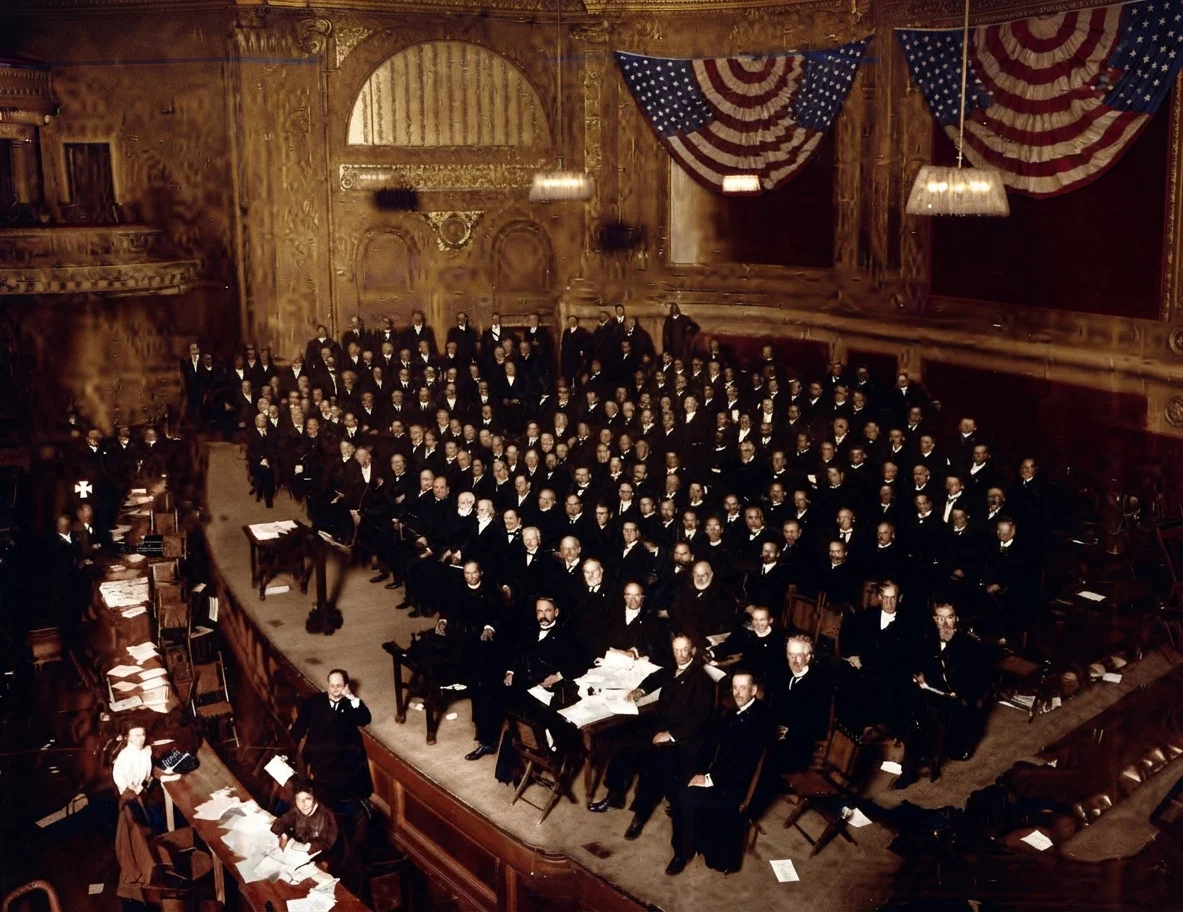
On our first page will be found a photograph of the delegates to the Inter-Church Conference on Federation held in Carnegie Hall, New York City, November 15 to 21. The delegates are seated on the platform for the one purpose of having their photograph taken. In our Outlook Department will be found a report of the first two days' proceedings, by our special correspondent, and also portraits of some of the leading men. We again appeal to our readers to give these papers beginning with this number just as large a circulation among the thinking classes as possible. We are well aware that the daily papers are making very little note of it. It is hailed by them as an omen of good, but the religious papers are seeing in it very much more; as expressed by the New York Independent, of November 23: "It was a great meeting, great in its representation;" "great in the purpose it had in view, to federate the Christian bodies in this country as far as possible into a single force for all good things;" "great in the harmony of its members;" "great in the influence which the now federated force of its constituent churches will have for the wellbeing of our country;" and then the editor tells us that we must understand that "This is a federation for influence and combined power; it is not a federation against any Christians who have not taken part in it; particularly it is not a federation to attack or in any way discredit the Christian work done by the Catholic Church in this country. . . . No word was spoken on its platform attacking the Catholic Church, while words of commendation were spoken of spiritual fellowship and kindly goodwill." Other papers are talking along the same line. It is a movement worthy of the most earnest study. Our readers can not afford to do otherwise than to study it most earnestly. If it is good they certainly want a part in it; if it has within it seeds of evil, they ought to know and be prepared for it.

A Plumbing Combine in Toronto

What the New York "World" calls a "unique combine" has been unearthed in Toronto. It seems to have been in existence for some time. It was the union of the Master Plumbers and Steam Fitters' Association. The crown attorney has instituted proceedings against the combine. The indictment charges that they have unlawfully, fraudulently, and deceitfully conspired, combined, and agreed together by false and fraudulent pretenses and means to defraud persons requiring plumbing and steam fitting work done by them, by agreeing in-secret at what price the work shall be done, and cause to be delivered to such persons by plumbers, members of the association, false and fraudulent tenders for doing such work. It is alleged that over half a million dollars annually has been paid by the citizens as a direct overcharge, and five per cent. "rake-off" of this goes to each member of the association. But this is among the last-day conspiracies of which God has told us in His Word.

Mine Explosion Near Diamondville

In a mine explosion December 2 near Diamondville, Wyoming, eighteen men lost their lives.

Notes Concerning Seed Wheat

The College of Agriculture, University of California, Berkeley, has issued Circular No. 16, entitled "Notes Concerning Seed Wheat." We have not space for an extended review of this circular; that, in fact, is not the object of our journal, but it seems so clearly instructive that we would advise those raising wheat to send for it to Mr. E. J. Wickson, Acting Director, Berkeley, California.

Socialist Zeal and Circulation

As indicative of the interest of Socialists in Socialism, the Appeal to Reason informs us that of their special trust edition 3,047,200 copies have been sold. That certainly is zeal that is worthy of the best of causes, but if Socialists could circulate that number of papers in the interests of Socialism, there surely ought to be a million copies of the SIGNS OF THE TIMES circulated, which contains matters of so much greater importance.

Football Fatalities

Football.—At this writing full reports have not come in of the football fatalities this year, but up to Thanksgiving Day, nineteen had been killed in the United States and one hundred thirty-seven seriously injured, during the year, and among them a woman player. Nearly all of these deaths resulted from undue violence in the playing of the game. Add to this two seriously injured that are reported December 1, of which, one, a young man in Connecticut, received spinal injuries, the other, a sixteen year old lad of Alameda, California, was brutally bruised and kicked until he is paralyzed. If prize-fighting resulted in as many fatalities as football, there is not a state in the union but what would have prohibited it.

Children for Gold

Children for Gold.—A striking article which comes home to the heart is that of Juliet Wilbor Tompkins in the December issue of Success. Its title is "Turning Lives into Dollars." It is a brief rehearsal of the conditions in the sweatshops of our great cities, and it ought to stir those who read it. But will it do it effectually enough so as to amount to anything? She goes on to say that it is utterly impossible to regulate it by overseers or officials, because when they visit the tenements the work is put out of the way; the children are playing. And there are thousands and thousands of these tenements where work especially on clothing of all kinds is done under the most wretched conditions of squalor and filth and disease. Her proposition is the abolition of all work of that kind in tenements.

Tuberculosis Exposition

A Tuberculosis Exposition is on in New York City. Its object is to make it a school. Its promoters believe that 99 per cent. of the deaths caused by this fearful plague could be prevented if the people knew how to kill or avoid it. New York City has reduced its yearly toll over 20 per cent. in ten years. It is stated that there are over four hundred deaths a day from this disease in the United States alone. In 1904, 150,000 fell victims, one in every 500. One of the great plagues of India is snakes; 21,800 were killed in 1904, one in every 10,000 of the population; and the government puts a bounty on dead snakes. Why should not the government do more for the crushing out of the great white plague? This exposition is designed to teach the people how to teach themselves in case they are affected. In a few visits one can know just what to do for himself and family. It certainly is a good thing.

Russia Unsettled

Russia.—The latest news on the great Russian question is that matters are still as unsettled as ever. In the battle at Sebastopol between the mutinous sailors and the loyal army nearly five thousand were killed or seriously wounded, and damage to the extent of $5,000,000 is reported. Disaffection, it is said, is rapidly extending to the army, even to the regiments near the person of the czar. Bodies of troops especially selected by Gen. Trepoff to guard the czar and his family, are among the disaffected ones. There has been no open sedition among them, but many have been arrested for sentiments which they have uttered. Poor Russia is reaping the seeds of her sowing, and yet it would seem as tho her people ought at least to give the new plan presented by the czar a fair trial. It is reported that the Zemstvo Congress recognized the Socialistic organizations as the strongest, and that has given many wavering elements cause to join the Socialists, altho these openly proclaim that the capitalists will be abolished as soon as the government is displaced. A large merchant declared to a St. Petersburg correspondent that he pays fifty dollars weekly to the strike leaders, who give him a permanent guard of workmen. Count DeWitte is also losing confidence as it daily grows more evident that he has not the necessary power from the czar. The correspondent declared in a few days a crisis must decide whether the autocracy will be resurrected, while the Socialists hope to spread a general strike all over Russia, except in Poland. Moscow is reported to be burning, and the czar wounded in a personal combat with Duke Vladimir. Up to midnight of December 2 all Russia, except Warsaw, was cut off from all telegraphic communication with the rest of the world. The situation grows hourly worse. Events can not be stayed, and new bloodshed is unavoidable, since both the reactionists and Socialists alike wish it. Just what the end will be is problematical.

Distress of Nations.

Again and again we are hearing from different sources of great distress in London among the working men. What a sidelight it throws on the prosperity of the present time. Great corporations are prospering, governments find sufficient funds to put millions and millions in warships and other munitions of warfare, while thousands of men in the great cities are out of work. In America it is said that of the large army of tramps the great majority do not want work, but that is not the case in England. The men there are constantly demanding work. The London Standard says that "Great Britain with all its prosperity, with signs on almost every side of wealth and the free enjoyment of its varied industries, its enterprise, its gigantic speculations, its merchant navy trading and trafficking to the utmost ends of the world, has nevertheless the canker of a desperate poverty eating into its very heart." In a parade November 20 there were over five thousand unemployed men. Red flags were seen, and banners bearing these devices, "Curse your charities; we want work," and "there is a limit to human endurance." Parliament is endeavoring to do something to assuage or mollify conditions, but the case looks almost hopeless. Truly we are in the time of which the Lord spoke, "distress of nations with perplexity." Following this we may expect in greater degree, until such relief is given, a repetition of the scenes enacted in 1885, when for two days West London with all its wealth cringed and cowered before the maddened mob.
Delegates to the "Inter-Church Conference on Federation," in Carnegie Hall, New York City, Nov. 15-21, 1905. They are seated on the large platform, by invitation, in order to get a better photograph. The SIGNS' special representative is directly under the white cross on the extreme left, at a reporter's table.
THE HOME
THE HOME

You have reached the end of this edition.

Signs of the Times · Dec 13, 1905