Your ShelfYour Projects

Signs of the Times, Vol. 26, No. 31.

PRESENT TRUTH

Signs of the Times

Aug 1, 1900

Pacific Press Publishing Company · Oakland, California · Aug 1, 1900

"PRESENT TRUTH."
THE term is Biblical. The apostle Peter desired that the people of God should "be established in the present truth." 2 Peter 1:12. The Greek expression literally means the truth that is present with you.
AND, really, this is all the truth that we have to do with. God has given us the present, the one eternal now. "Behold, now is the acceptable time; behold, now is the day of salvation." "To-day if ye will hear His voice, harden not your hearts." We can not bring back the time once spent. We can not bring the time of to-morrow into to-day. If the soul is cleansed at all, it must be in the now. If the victory is ever gained, it must be in the now. The crucifixion must be a present crucifixion, the death to sin, a present death. The newness of life must be a present possession. No glories of the future shall be ours unless we have their earnest here and now.
GOD gives us lessons of the past, not as mere history of events, not to entertain us, not merely to instruct us intellectually, but as lessons for the present time. They are given to instruct us now, to warn us now, to strengthen and encourage us now by the present truth which is in all His past history. His Spirit has said that "whatsoever things were written aforetime were written for our learning, that we through patience and comfort of the Scriptures might have hope." Rom. 15:4. Of God's dealings with His people we are told: "Now all these things happened unto them for ensamples [margin, "types"]; and they are written for our admonition, upon whom the ends of the world are come." 1 Cor. 10:11.
"Noah, a Preacher of Righteousness."
GOD, in His wisdom and goodness, tells us of the sure end awaiting the sin-lover and finally impenitent. He does this that we may know the end of sin and all identified with it, that we may now be admonished and persuaded to separate from it forever. He portrays before us the sure reward of the righteous, the glorious inheritance, and the transcendent beauties of the sinless state, that faith may now grasp it and hope be revived and encouraged. All that the Lord has said concerning past, future, and present are to us the now.
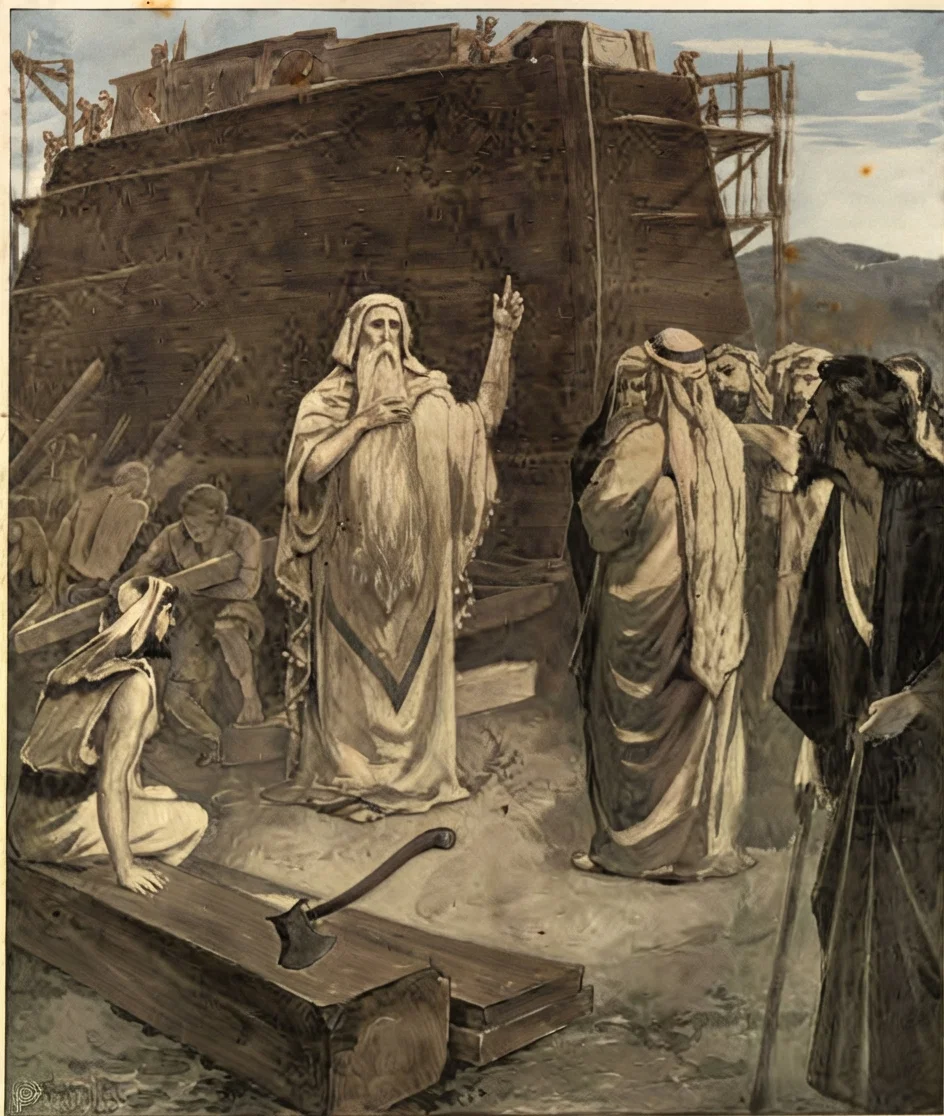
SUCH is the lesson which our illustration suggests. It is an imaginary antediluvian scene. Noah standing by the unfinished ark and preaching to the people. For over a millennium and a half after Adam's fall the world had gone on in ever-increasing wickedness. The long-lived race sought out devices to sin, and hardened their heart, until few indeed resisted the oncoming and increasing flood of iniquity. God faithfully warned them by those patriarchs true to Him. Enoch prophesied of the sure destruction to come. For three hundred years he lived his blameless life before them, witnessing to God's power to save from sin. But notwithstanding all this light, men hardened their heart against God till every imagination of the heart became corrupted, and there was no remedy save the destruction of sin and those identified with it. The flood-tide of sin must be washed out with a flood-tide of waters. He that spoke division between water and land in the beginning of earth's history (Gen. 1:9, 10), would now unspeak it, and convince the world that all power was in Him, that He was the Ruler of heaven and earth. Righteousness would maintain God's order, arrangement, kosmos; but sin on the part of earth's kingdom—brought disintegration and destruction, and "the world [kosmos, arrangement] that then was, being overflowed with water, perished." 2 Peter 3:6. What the arrangement was before the flood we do not wholly know; but we do know that much of what are continents now were then submerged, and much of what was land then is now in the bed of the great sea.
BUT God's goodness would not let the flood come upon men unwarned. "Jehovah said: My Spirit shall never pronounce judgment on men unwarned. They are but flesh. Their days shall therefore yet be one hundred and twenty years." Gen. 6:3. (Boothroyd). He found one righteous man to whom He could intrust His message of present truth for that generation, that people. "Noah was a just man and upright in his generations, and Noah walked with God;" and "Noah found grace in the eyes of the Lord." Gen. 6:9, 8 (margin). What made Noah righteous is the only thing through which any can be made righteous; he "believed in the Lord; and He counted it to him for righteousness" (Gen. 5:6), and he "became heir of the righteousness which is by faith" (Heb. 11:7). He not only was made righteous, but he was "a preacher of righteousness." 2 Peter 2:5. He preached the truth that was with him and in him; that the only salvation from impending judgment was "the righteousness of God by faith." He proclaimed this message not in his own wisdom or might; but the Angel of the covenant, the Christ of God, was with him by His Spirit. 1 Peter 3:18-20. By his faith he was justified and saved; and by that faith "he condemned the world" (Heb. 11:7); for the fact that he believed and was saved was a proof that every other soul could have believed and been saved, "for God is no respecter of persons."
His faith was a faith that worked. He did not work to get faith; he worked because he had faith. "By faith Noah, being warned of God of things not seen as yet, moved with fear, prepared an ark." Heb. 11:7. His building was, in his life, a fruit of his faith. To others it was a proof that he believed what he preached.
His was a righteousness of principle, the fruit of a faith based on God's Word. There were wise and mighty and renowned men in those days, whose mothers were daughters of the church; men who did not believe in a coming flood; men who scoffed at Noah and ridiculed his ideas of science; who could have said, and doubtless did say: "The earth is as it has always been; it will stand forever as it has always stood. How foolish it is to build an ark, a boat, a ship, on dry ground." And they laughed him to scorn. But the old patriarch knew God. He knew that He who spoke a world into existence could speak it out of existence; that God had said it and would perform it; and he builded on, prayed on, preached on. Doubtless he employed carpenters and workmen, who laughed at the builder behind his back. Some of them, like Methuselah, died in the faith before the flood came. Others were like the staging used in building the ark; they perished in the flood in the sight of the haven of safety, the door of which opened only to faith. Doubtless some of those who died, professed the faith of Abel and Enoch. These patriarchs did not believe in a flood; why should they? And so they rejected the present truth for them.

Its Lessons.

THE flood has its lessons for us. Let us in faith study some of them.
1. The long-suffering mercy of God which warns and waits, warns and waits, for the soul's repentance. How eagerly He watches! How gladly He welcomes home to His heart of love the wanderer!
2. God's mighty power to restrain such wickedness as would ruin the very universe, is shown. God withdraws His sustaining hand, which has preserved men that they might repent, and permits them to perish in the sin they have chosen. Yet in all the cataclysms of the elements He is able to preserve those who trust in Him.
3. God sends warning of coming perils at all times. No judgment will find men unwarned. The Son of God, by His Spirit "lighteth every man that cometh into the world." John 1:9. "Surely the Lord God will do nothing, but He revealeth His secret unto His servants the prophets." "We have also a more sure word of prophecy; whereunto ye do well that ye take heed, as unto a light that shineth in a dark place, until the day dawn, and the day-star arise in your hearts." 2 Peter 1:19. Was a deluge to come?—God warns the world through Noah. Had Sodom and Gomorrah reached the limit of divine forbearance?—God warns them through Abraham and Lot. Had Egypt reached the culmination of her wickedness, and must the oppressed go free?—The Lord sends Moses and Aaron. Was wicked Nineveh doomed?—Jonah is sent. Was the love of God to be manifested in Christ the Lord?—John the Baptist went before.
In "a little while" Jesus Christ is about to come again. In the face of such Gospel light as the world has never seen, the sons of men, not a few of which are professed children of the light, have yielded to sins innumerable. Among the worst sins is that of blinding men's eyes to the Word of God. "Higher criticism" and on down has clothed it, in the eyes of the people, in the garb of fallible humanity. Hoary pagan tradition and "science falsely so called" are exalted on thrones above it; and it no longer speaks with authority to the people. In it is the law of God, but "the man of sin" in the church has torn from God's Ten Words His holy day, and substituted another in its place. The Word still speaks as always, but men heed it not. They count God as themselves. Numerous lines of prophecy and special signs precursor the great day of wrath and deliverance, but the prophecy is counted as a book that is sealed or as a fancy of the mind. The wisdom of the world either relegates it to the past or counts it as naught, and the great world goes on in blindness, because it trusts not to God, but to the "multitude of its mighty men." Yet as surely as the flood came, so surely will the end come upon this age in a great final cataclysm of war and famine and fire, the destruction of sin and sinners, and the eternal salvation of the people of God.
4. To give His last warning message to the world God will choose the humble, the believing, the righteous, even as He did in the time of the Deluge. He would be glad to take the learned and the great of earth; but He can not use them. Either they would take all the glory to themselves, or men would give to them all the glory and become followers of men instead of Christ. So the Lord chooses the weak, the feeble, the humble, the meek,—those who will give Him the glory, and through them He declares to the world His message of present truth, epitomized in Rev. 14:6-14. To reject God's message of present truth in Noah's day meant the loss of salvation; to reject His message now, in the light of all the ages, means not less. Men went on in Noah's day, all absorbed in the pursuits of life, heedless of the message, and died. Jesus says: "For as in the days that were before the flood they were eating and drinking, marrying and giving in marriage, until the day that Noe entered into the ark, and knew not until the flood came, and took them all away; so shall also the coming of the Son of man be." Matt. 24:38, 39. Men scoffed at the old farmer as he builded his ark; there will come also "in the last days scoffers, walking after their own lusts, and saying, Where is the promise of His coming? for since the fathers fell asleep, all things continue as they were from the beginning of the creation." 2 Peter 3:3, 4. They mocked and died in Noah's days; so shall it be in the last days. In the light of the above prophecy, the very mockers are themselves a promise of His coming.
5. The ark was the refuge for Noah; but neither he nor his family would have found place there, if Noah had not first found refuge in Christ. When there comes upon the land the last great fourfold judgments that sweep the earth with the besom of destruction the righteousness and relationship of no man, not even a Noah, Daniel or Job, will save a single soul; "they shall but deliver their own souls by their righteousness." Eze. 14:12-21. There is but one covering then, the righteousness of God by faith of Jesus Christ. There is but one refuge, the great Jehovah. "I will say of the Lord, He is my refuge and my fortress; my God; in Him will I trust. . . . Because thou hast made the Lord, which is my refuge, even the Most High, thy habitation; there shall no evil befall thee, neither shall any plague come nigh thy dwelling." Ps. 91:2-10.
How NECESSARY it is, in the light of these lessons, to know God's message for this time, and to "be established in the present truth"!

GOD'S PROMISES.

WHAT precious promises we find in God's Word! When we surrender ourselves completely to the Lord's will, He says: "And in that day ye shall ask Me nothing. Verily, verily, I say unto you, Whatsoever ye shall ask the Father in My name, He will give it you. Hitherto have ye asked nothing in My name; ask, and ye shall receive, that your joy may be full." John 16:23, 24.
Dear brother, or sister, have you asked the Saviour to hear your prayers, and, not receiving an immediate answer, have you felt as tho the heavenly Father was not keeping His promise? First be sure the prayer is not for something frivolous, or something for which you would be ashamed to ask the Saviour if He were face to face with you. Then be sure you ask it in the proper spirit, fully surrendering your heart at the same time, and with the feeling that you are willing to resign yourself if He does not see fit to grant it, or, in other words, saying, Thy will, not mine, be done.
Dear ones, do you know the joy of following the Saviour? He is faithful to His promises. My life has been so much happier since I have given my heart into His keeping without reserve, and have paid my tithes faithfully. He has opened the windows of heaven and poured out His blessing on me, as He promises in Mal. 3:10. Now you who are hesitating and faint at heart, try Him. What He has done for me, He will do for you, if you will only let Him. But He can not do anything for you unless you submit yourselves to Him wholly.
MRS. W. P. SCHUSTER.

Pleasure, Happiness, and Longevity

"PLEASURE shortens life; happiness prolongs it. Take care of your living, and your dying will take care of itself."

THE RIVER OF LIFE

THE TREE BY THE RIVER.

“IN the midst of the street of it, and on either side of the river, was there the tree of life, which bare twelve manner of fruits, and yielded her fruit every month; and the leaves of the tree were for the healing of the nations.” Rev. 22:2.
It has been made plain, we trust, that, in a spiritual sense, the river of life is in the earth to-day, flowing constantly from the throne, and that all are invited to partake of its waters. If the river is here, it is reasonable to believe that in the same sense the tree of life is here also, for the tree grows by the river. What, then, is the present significance of the tree of life? This is the theme for this paper.
Already we have seen that Christians who know God for themselves, having had a personal experience in divine things, are called “trees of righteousness, the planting of the Lord.” Of such a Christian, David speaks thus, “He shall be like a tree planted by the rivers of water, that bringeth forth his fruit in his season; his leaf also shall not wither; and whatsoever he doeth shall prosper.” And the prophet Jeremiah is still more explicit: “Cursed be the man that trusteth in man, and maketh flesh his arm, and whose heart departeth from the Lord. For he shall be like the heath in the desert.” This describes all who depend upon human mediation, all who do not come into the primary circuit of blessing, all who seek their supply of living water from others. Then he describes those who come to God for themselves: “Blessed is the man that trusteth in the Lord, and whose hope the Lord is. For he shall be as a tree planted by the waters, and that spreadeth out her roots by the river, and shall not see when heat cometh, but her leaf shall be green; and shall not be careful in the year of drought, neither shall cease from yielding fruit.” Every thoughtful mind must recognize a very striking likeness between this picture of a living, growing Christian, and John’s description of the tree of life growing by the river of life.
But some one may object, and say that the Bible does not call the Christian a tree of life, but only a tree planted by the river. The reply is, that it is clear, from all that has been said, that this river by which the tree is planted, is the river of life. And if so, this tree living by its living waters, and sending them forth through the leaves to bless others, must be a tree of life. In the Bible, righteousness and life are interchangeable terms. Spiritual life is righteousness, and righteousness is spiritual life. So, when the Christian is called a tree of righteousness, he is called a tree of life. Again, God made everything bear fruit “after its kind.” The final fruit of anything is another thing like itself. But, says the Scripture, “The fruit of the righteous is a tree of life.” Prov. 11:30. If the fruit of the righteous is a tree of life, the righteous man himself must be a tree of life in order to yield such fruit.
But, it may be said, there are many righteous men, and the tree of life is one. Here is the deepest, sweetest mystery of all. May the dear Lord give us the spirit of wisdom and revelation in the knowledge of Him, that our hearts may behold its glory.
Ezekiel saw a vision of this same river of life flowing from the sanctuary, and he saw the trees of life growing by the banks of the river. He did not see, as did John, that these trees are one. Ezekiel said, “Behold, at the bank of the river were very many trees on the one side, and on the other.” And once more: “By the river upon the bank thereof, on this side and on that side, shall grow all trees for meat, whose leaf shall not fade, neither shall the fruit thereof be consumed; it shall bring forth new fruit according to his months, because their waters they issued out of the sanctuary; and the fruit thereof shall be for meat, and the leaf thereof for medicine.”
This is a beautiful figure. Christ the crucified, is the smitten Rock from which the living waters gush out. From the throne in the sanctuary, the river of spiritual life flows out into the whole universe, down even into this sinful world, which else were a moral desert. Every real Christian is a tree growing by the banks of this river, and rooted into its waters; a tree thus enabled to bear fruit constantly, not being “careful in the year of drought;” a tree, every rootlet of which is taking up the living water, hurrying it up through root and body and branch, to the leaves that send it out into the air, to come down again in showers to heal the barrenness of life’s desert; a tree whose fruit is so sweet that men, feeding upon it, may find God, and so become themselves trees of righteousness rooted into life’s river.
Ah, this is splendid! but there is something better even than this. After Ezekiel wrote, and before John wrote, Christ lived His matchless life of love incarnate. He identified Himself with all humanity, making it one in Him. He was “not ashamed to call them brethren,” saying, “Inasmuch as ye have done it unto one of the least of these My brethren, ye have done it unto Me.” He said: “I and My Father are one.” “Believest thou not that I am in the Father, and the Father in Me?” “I will pray the Father, and He shall give you another Comforter, that He may abide with you forever; even the Spirit of truth.” “When He, the Spirit of truth, is come, He will guide you into all truth.” “At that day ye shall know that I am in My Father, and ye in Me, and I in you.” “I am the vine, ye are the branches.” “Sanctify them through Thy truth; Thy Word is truth; . . . that they all may be one; as Thou, Father, art in Me, and I in Thee, that they also may be one in us; that the world may believe that Thou hast sent Me, . . . and hast loved them, as Thou hast loved Me.” Paul also pictured the church as the body of Christ,—one body, with Christ its head.
After all this glorious teaching of the wonderful unity there is for us in the Spirit, is it a wonder that when that Spirit spoke again of the tree of life, it was presented to John as one tree, growing on either side of the river? It would seem, however, that this was a conception so grand that even Inspiration could lift humanity to it only by degrees,—perhaps never fully, had not Christ lived and taught this unity in the flesh.
Now let us study the figure as John saw it. He saw a river flowing from the throne, and “on either side of the river, was there the tree of life, which bare twelve manner of fruits, and yielded her fruit every month; and the leaves of the tree were for the healing of the nations.” Nature presents an image of this tree as it was here revealed by the Spirit. The original trunk of the banyan tree puts out branches, which, drooping to the earth, take root, and become new trunks putting out in like manner more branches to again take root. Thus the tree sometimes covers acres, and spanning rivers, becomes a forest in itself. It is one tree, and yet there are many trees. All are united to the same original trunk; all are rooted into the same living water which courses through every root and trunk and branch and leaf of it all. What a glorious figure of the church of Christ, as it stands revealed by the Spirit in this age! Christ incarnate is the original trunk. When He was here in the flesh, He was as dependent upon the living water as are we. He said, “I can of Mine own self do nothing.” He is the original trunk, and every true Christian becomes a new tree, united through this trunk with every other Christian, and all rooted alike into the same unfailing supply of spiritual power. So the tree is one, one life coursing through it all.
The fruit of such a tree will be the fruits of the Spirit, for the water of this river by which the tree lives, is the Spirit. These fruits will be borne constantly, and will ripen continually, unhindered by any drought. These fruits are love, joy, peace, long-suffering, gentleness, goodness, faith, meekness, temperance, patience, courage, and hope,—twelve manner of fruits. He who sows this fruit as seed, will surely, as his reward, see growing other Christians, other life-trees, rooted into the same water, and united to the same trunk. The leaves of such a tree will all exhale the living water to come down in showers of blessings, thus healing the sin-sick nations, making earth’s moral desert blossom as the rose. What Christian does not look forward with longing unspeakable for the realization of this ideal? Jesus longed for it, and prayed for it when He prayed, “Sanctify them through Thy truth; . . . that they all may be one.” It will be realized, for that prayer will be answered, and He will have a church “not having spot, or wrinkle, or any such thing.”
Why do we fall so far short of realizing this ideal now?—It is because we are not all rooted into the living water, and are not all united fully to the original trunk. We are too far from Christ, and therefore too far from each other. For these reasons we are not one. The branches of the banyan tree not only root into the ground, but when two branches approach and touch, especially if they be bruised so that the sap oozes out, they will unite and grow together. Perhaps, therefore, when we are bruised by the persecution that is before us, the living water will flow out and we shall unite, and become one. How greatly our intuitions need quickening by the Spirit, ere this can fully be! Brothers in the same church now pass by, day after day and week after week, each unconscious of the other’s burden, and yet each is heart-full, and each is hungry for a word of cheer and courage. This would not be so if we could really know each other, and meet heart to heart, instead of only face to face.In every face is written a life’s history, with its comedy and tragedy, its power and its pathos. Almost any face would cause us to pause and grow tender rather than critical, could we only truly read it. But, alas! this writing is in the hieroglyphics of the heart, and in this age of hot competition and business strife, it has become an unknown tongue. But fellowship of suffering under persecution, and mutual communion of the Spirit, will translate into living language these hieroglyphics. Our intuitions will be so quickened, and our hearts so tendered, that we shall be one with Christ, and one with each other. There will be a community of joy, and a community of sorrow. Then they that fear the Lord shall speak often one to the other, and the Lord will harken and hear it, and pronounce them His. Thus the tree shall be one, with fruit-bearing branches and healing leaves.
But because the river of life, and the tree of life, in a spiritual sense, are in the world to-day, we must not disbelieve in the literal river and the literal tree in the Paradise of God. Who does not recall some river of his childhood, a stream, perhaps, flowing through the woodland, on whose banks he sported in early years, dear to him now by the memory of the past? So when Paradise is restored, with the literal river and the literal tree, and the ransomed of the Lord, from every nation and every tongue, are gathered home, that river and that tree will speak to them of all their triumphs in Christ during this child-life down here. When we reach that place, and see that river and that tree, it will not be new and strange there, but the heart will know its home. And Christ will be all, and in all.

"MY WITNESSES." NO. 3.

"And ye shall be hated of all men for My name's sake," the Saviour continued; "but he that endureth to the end shall be saved." Sell not your faith to Satan, even tho by so doing you may save your life. You will lose your soul.
"But when they persecute you in this city, flee ye into another; for verily I say unto you, Ye shall not have gone over the cities of Israel, till the Son of man be come."
The disciples were not to expose themselves unnecessarily to persecution and death. Christ on one occasion left Judea because He knew that if He remained, His life would be cut short by the hatred of the priests and rulers before His work was done.
"The disciple is not above his master, nor the servant above his lord. It is enough for the disciple that he be as his master, and the servant as his lord. If they have called the master of the house Beelzebub, how much more shall they call them of his household? Fear them not therefore; for there is nothing covered, that shall not be revealed; and hid, that shall not be known. What I tell you in darkness, that speak ye in light; and what ye hear in the ear, that preach ye upon the housetops." Always be ready to give to others the light you have received. Avow your principles of action; scorn concealment. Unfurl your colors; for you are a spectacle to the world, to angels, and to men. Shun not responsibility. You can not serve God and Baal. God desires His sons and daughters to stand bravely for the right, that the world may know where they will be found in the time of trial.
"And fear not them which kill the body, but are not able to kill the soul; but rather fear Him which is able to destroy both soul and body in hell." Christ has purchased the entire being, mind, soul, and body. The price of man's redemption has been paid, and all he has and is should be sprinkled with the blood of Christ, dedicated to God; for it belongs to Him. Our motto should be, "I am not my own; for I have been bought with a price."
Jesus came to this world to be our substitute and surety. He is our atoning Sacrifice; for He has offered Himself in our behalf. With unutterable love He seeks to draw all men to Him. God has given Him the priceless gifts of heaven to dispense to men. To-day He stands before God as the Advocate of the human race, pleading for the beings He has redeemed.
Shall we who have received so much through the suffering of the Son of God fear the consequence of freely acknowledging our faith? Shall we who have tasted the power of the world to come become discouraged and faint-hearted because we are threatened with danger? Christ accepted us in our weakness and unworthiness. Shall we shrink from the trials which accepting Him brings to us? He says to us, "Fear not them which kill the body." He pledges Himself to give us help, saying: "I am He that liveth, and was dead; and, behold, I am alive forevermore." "Because I live, ye shall live also." When brought to the trial of your faith, look at your sinless Sacrifice. "It is Christ that died, yea rather, that is risen again, who is even at the right hand of God, who also maketh intercession for us." "Are not two sparrows sold for a farthing? and one of them shall not fall on the ground without your Father. But the very hairs of your head are all numbered. Fear ye not therefore, ye are of more value than many sparrows."
God understands Satan's ability to deceive and discourage. Through Christ he has declared his power to save. Christ is bound by the covenant of promise to intercede for all who come to God through Him. He knows that Satan tries to make men feel that God is a stern judge. He knows that the enemy hides from human beings the Father's love and mercy, trying to make them think that they are too sinful to ask for pity. Therefore in the simplest language the Saviour assures us that God is full of mercy and compassion, and that He, our Saviour, is touched with the feeling of our infirmities, having been in all points tempted like as we, are yet without sin. Fully acquainted with the temptations and devices of the enemy, He presents before His children what they may expect, assuring them at the same time that He will help them bear whatever may come. He knows our difficulties. He understands our distresses. Not a sigh is heard, nor a throb of anguish felt, but the pang vibrates in the heart of Christ. With tender sympathy for our weakness, He points us to the care God has for the little sparrow which flits from bough to bough, and tells us that not one of these tiny birds falls to the ground without the knowledge of the Father: "Fear ye not therefore, ye are of more value than many sparrows."
"Whosoever therefore shall confess Me before men, him will I confess also before My Father which is in heaven. But whosoever shall deny Me before men, him will I also deny before My Father which is in heaven."
As the disciples listened to these words, they were deeply impressed, and in their hearts they said: "I will live for the Master. No earthly consideration shall induce me to disown my Redeemer."
As we look upon the cross of Calvary, shall we not remember that for us Christ engaged in conflict with the powers of darkness? He endured the penalty of sin in our behalf. He was wounded for our transgressions, and bruised for our iniquities. It pleased the Lord to bruise Him and to put Him to grief, that He might compass the redemption of the human race.
Shall we deny our Redeemer? You say, No, I will never deny Christ. But remember that there are many ways in which you may deny Him. Saul, the first king of Israel, denied the Lord by disobeying His commands. He failed to obey the first law of God's kingdom,—the law of self-government. He set up his own will as better than the Lord's will. His life was a failure because he denied God. The apostles, on returning from their missionary journey, "gathered themselves unto Jesus, and told Him all things, both what they had done, and what they had taught." They did not hide their mistakes, but laid all before Him for His inspection. Every disciple as he came was welcomed by the Master. The good Shepherd knew how to give the needed encouragement. The disciples were weary, but they were so glad to be once more in the presence of their Lord that they forgot their weariness.
How many burdens we might lay off if we would do as the disciples did,—take all our troubles, large and small, to Jesus. He has invited us to do this. Let us encourage the habit of intimate communion with Jesus. Thus we shall learn to know Him better, and His divine presence will bring us relief and assurance. We shall be drawn to Him as to a loving friend. As we tell Him our sorrows and perplexities, our mistakes and errors, He will speak peace and comfort to our hearts. He says: "Let him take hold of My strength, that he may make peace with Me; and he shall make peace with Me." "Come unto Me, all ye that labor and are heavy laden, and I will give you rest. Take My yoke upon you, and learn of Me; for I am meek and lowly in heart; and ye shall find rest unto your souls."
MRS. E. G. WHITE.

WHY USEFUL MEN DIE.

It is as instrumentalities that God uses men for the accomplishment of His purpose. No man can escape this by lowering his standards, or his character, or even by disowning God. Ahasuerus and Haman play their part in God's providence as well as do Esther and Mordecai. We often wonder why God suddenly calls away a faithful servant from this world when he appears to be working so effectively. But if there were no other reason, it is reason enough that God's work depends upon no one man alone. Our vision is so circumscribed that the removals by death astonish us. If our view were larger, we should see that the divine plan is too all-embracing to rest upon one life for its continuance. If a "useful man" were sure to live on indefinitely because of his usefulness, how much smaller our views of God and eternity would become! And then how much smaller we too should become!—S. S. Times.

LISTENING TO GOD.

A FRIEND of mine told me that he called one day upon a brother clergyman, who had been ill in bed for six months. He said to this man: "I expect that God Almighty had a good many things to say to you, but you were too busy to listen, and so He had to put you on your back, that you might be able to give Him time."
When he was going out the thought struck him, "I too am a busy man, and God Almighty may have to put me on my back, that He may tell me all He wishes."
So he resolved that each night he would sit quietly in his study, not reading, not writing, but opening his heart, that God's Spirit might impress upon him what He designed to teach, and criticize the life of the previous day.—Rev. F. B. Meyer, D.D.
Continue reading: The Prophecy