A LITTLE child expressed the wish that his father might be with him as he said his evening prayer before retiring; but he half sighed, "He hasn't time." It is a sad thought, isn't it, that men have no time to give to the most important, most sacred, most far-reaching things of life?
The greatest thought, Daniel Webster said, that ever impressed him, was man's personal responsibility to God.
Yet how little time do the busy men and women give to the awful truth, which enters into every act of life, whatever the choice of the man may be; "for we must all stand before the judgment-seat of Christ;" for "every one shall give account of himself to God." And the decision which will then be rendered is for eternity.
That destiny depends on character, all that truly makes a man of worth, even among his fellows.
Think of it! With the twenty-four hours of the day at one's disposal, and no time for the things of eternal import, no time for the most important minutes in that child's day—its bedtime hour, the very time when thoughts of God's goodness and love most impress the little heart, and bring the father or mother nearer with God.
O friend, however busy you may be, you have time for the most important things—the things of God and life and eternity.
Not to take time, to squander the time needed on anything of lesser importance, is robbing you of your best, your most priceless opportunities, is robbing others, is robbing God. Can you afford it?
"She Will Come"
A Little Thought for Mothers
A LADY went out one afternoon, leaving her little boy at his grandma's and saying she would call for him when she returned home, which she expected would be by six o'clock. The time passed till it was nearly six, and his grandma said perhaps his mother was not coming for him that night.
"Yes, she will," replied the boy.
Six o'clock came, and grandma said, "Well, I guess your mother will not come for you to-night."
"I know she will," said the boy confidently, and he watched patiently for her.
It was getting toward his bedtime, and grandma was pretty sure his mother would not come, and he would stay all night with her.
"Well, I know she will come," was still his confident reply.
"Why, what makes you so positive?" asked his grandmother.
"Because," said the boy, "she said if she was not here by six o'clock, she would certainly come, and MY MOTHER NEVER TOLD A LIE."
In a few minutes the mother came and took him home.
Mother, what would your child testify?
India In 1909
(From Our Own Correspondent)
English Rule — New Political Reforms — Bomb Outrages — The New Press Act — Religious Matters — New Theology and Christianity — Movements within Hinduism.
SOME conditions developed very rapidly in India during 1909. In so far as India is concerned, the educational system of the West has been leavening the ideals of the East for more than a half century. While it is true that even at the present moment this educational system does not touch the great mass of India's millions, still that portion of the community which has always ruled, which the great masses have always followed, has been reached and transformed through it. In every large center in India there are universities and high schools numbering their students by the tens of thousands.
English rule in its beginnings in some features was necessarily modeled after Oriental ideas. However, the handful of Europeans which has been scattered throughout India all these years, well-nigh swallowed up in the great multitudes, have dispensed justice with as unbiased a mind as could be expected under the circumstances, and the British RAJ has brought such peace to this assembly of nations and warring communities as had been unknown to them for many centuries. To the unbiased student of history, the rapid extension and firm hold British rule has taken in India can never cease to be a matter for thoughtful study. Earthly governments must necessarily reflect some of the weaknesses of those who govern, and hence we must expect to find some flaws in that system by which this assembly of nations has been governed. Nevertheless the stories of oppression and misrule, assiduously circulated by those who have their own selfish purposes to serve, are not to be believed.
New Political Reforms
England herself has been one of the first to recognize that through that system of education for which she was responsible and for which she has spent much time and money, such a change had come over the ideals of the most influential portion of the Indian community that political reforms were necessary. Some of her most able statesmen threw all their powers into the effort to change the situation for the better. The enormity and responsibility of their tack can only be known to those who have studied the situation in the Orient on the ground. Most fortunately for India, this crisis in Indian affairs has found at the helm two clear-headed, conscientious men, of rival parties 'tis true, still working together in perfect harmony. These two men are Lord Morley, of Blackburn, the Liberal; plain John Morley, the historian and writer on political economics; and the Earl of Minto, the Conservative, an experienced proconsul whose recent past was governor-general of Canada.
These two men had scarcely more than drafted their proposals for reform, when suddenly India was shocked by a series of
Bomb Outrages
which have revealed a quite widespread anarchical conspiracy.
Ever since the mutiny of 1857, the native population have been forbidden the possession of firearms. This has been England's safety. But these outrages have revealed the startling fact that some of India's bright youth have gone to European anarchistic centers and there learned the secrets of bomb-making. The ingredients which make up these deadly weapons are simple and easily procurable. For the most part those who have been caught red-handed in this nefarious work are young men scarcely out of their teens. But it seems very evident that back of these young men are older men, with selfish aims, who, while having the wisdom to keep themselves out of the clutches of the law, fill these young men with false ideas of patriotism, and devotion to what they are taught as duty.
Until the last few months these outrages were confined chiefly to Bengal. But near the close of the year, while Earl and Lady Minto were riding in an open carriage through the crowded streets of Ahmed-Abas, a city of Western India, a bomb was thrown at their carriage which fortunately failed to explode at the moment. In December, Mr. A. Jackson of the Indian civil service, a man who had spent many years in India, who was perhaps one of the best Mahrati and Sanskrit scholars in India, who was dearly beloved by the people, who had made a point in his lifetime to be a special friend of the Brahmins, was wickedly shot to death near Bombay, by a Brahmin, while attending a pan supari party given by the native population in his honor. The investigations following this crime have revealed the fact that the misguided youthful criminal was but a tool in the hands of quite a large band of conspirators, who are now undergoing trial in the Bombay courts.
Lord Morley and Earl Minto wisely decided that these outrages should not delay them in introducing the reforms formulated before the outrages began. Accordingly, late last year writs were issued for the election of representatives for the various legislative councils in India, as also for a few select men for the viceroy's council, the supreme council for11India. While it is true that this is representative government in a very modified form, the government having the power of disqualifying any man <em></em>brought forward who is not acceptable to them, and also having the power to appoint a sufficient number of members to ensure the passing of urgent measures, the principle of representation being based on communities rather than the will of each individual, still representatives of the people of India for the first time have the privilege of making their votes felt in the legislative councils of this great empire. In the electorate it is generally conceded that the Mohammedans have the advantage of the Hindus. Almost all of the sedition so far has been confined to the Hindus. In this great forward movement England is striving to rule India according to the wishes of the best classes of Indian society.
The New Press Act
It is worthy of note that the very first act of this new supreme council, containing for the first time representatives of the people who could vote, was the passing practically unanimously of a stringent press act. All parties recognize that the power of the press is being used with startling success in spreading the seeds of sedition and anarchy. This is particularly true of a certain class of vernacular papers. The new press act requires every press established hereafter, to make a large cash deposit. If convicted of issuing seditious matter, this deposit is forfeited and a much larger one required. The second conviction forfeits the second deposit, and the government confiscates the press. The powers of evil have not been slow to bend the wonderful possibilities wrapped up in the press to the work of scattering broadcast seeds of evil. We are years behind with the good seed, and will never be able to do what might have been done some years ago.
(Concluded next week)
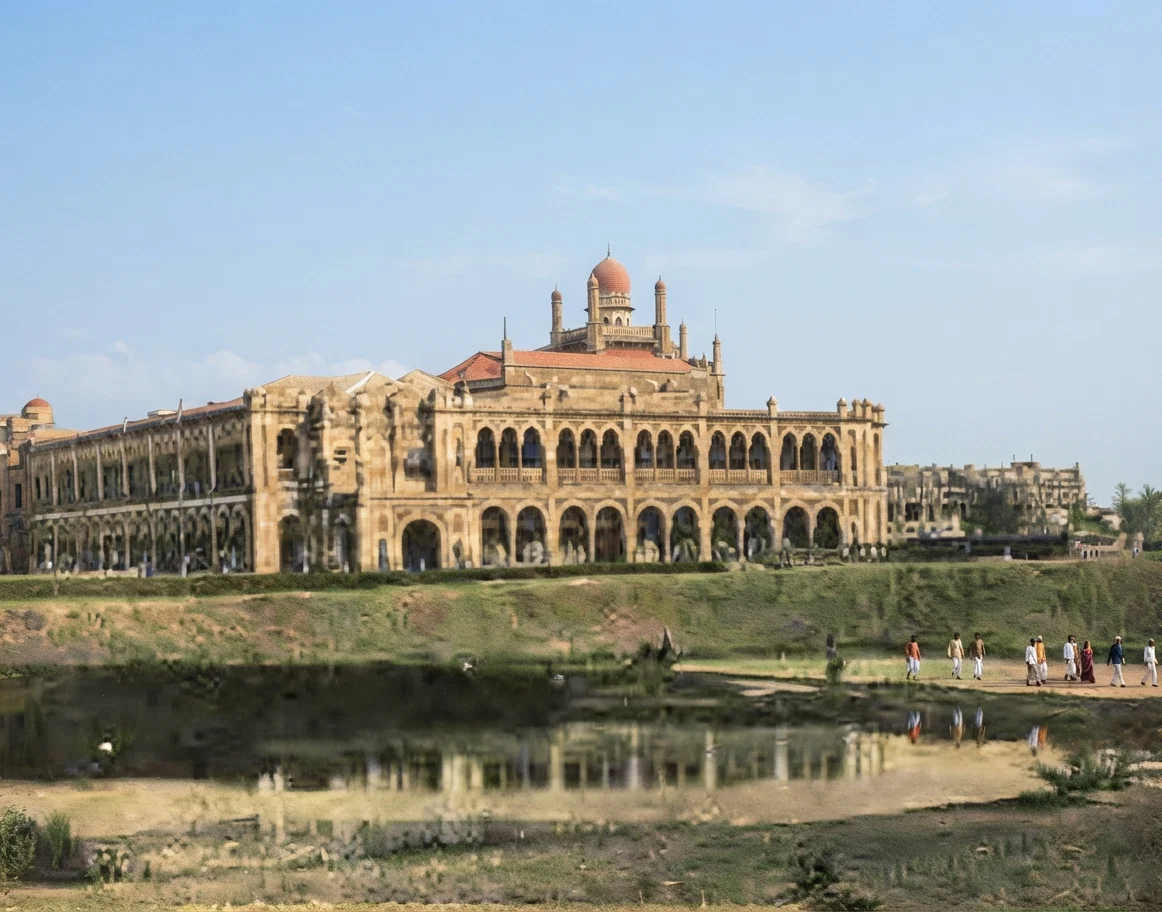
Board of Revenue Building, Madras
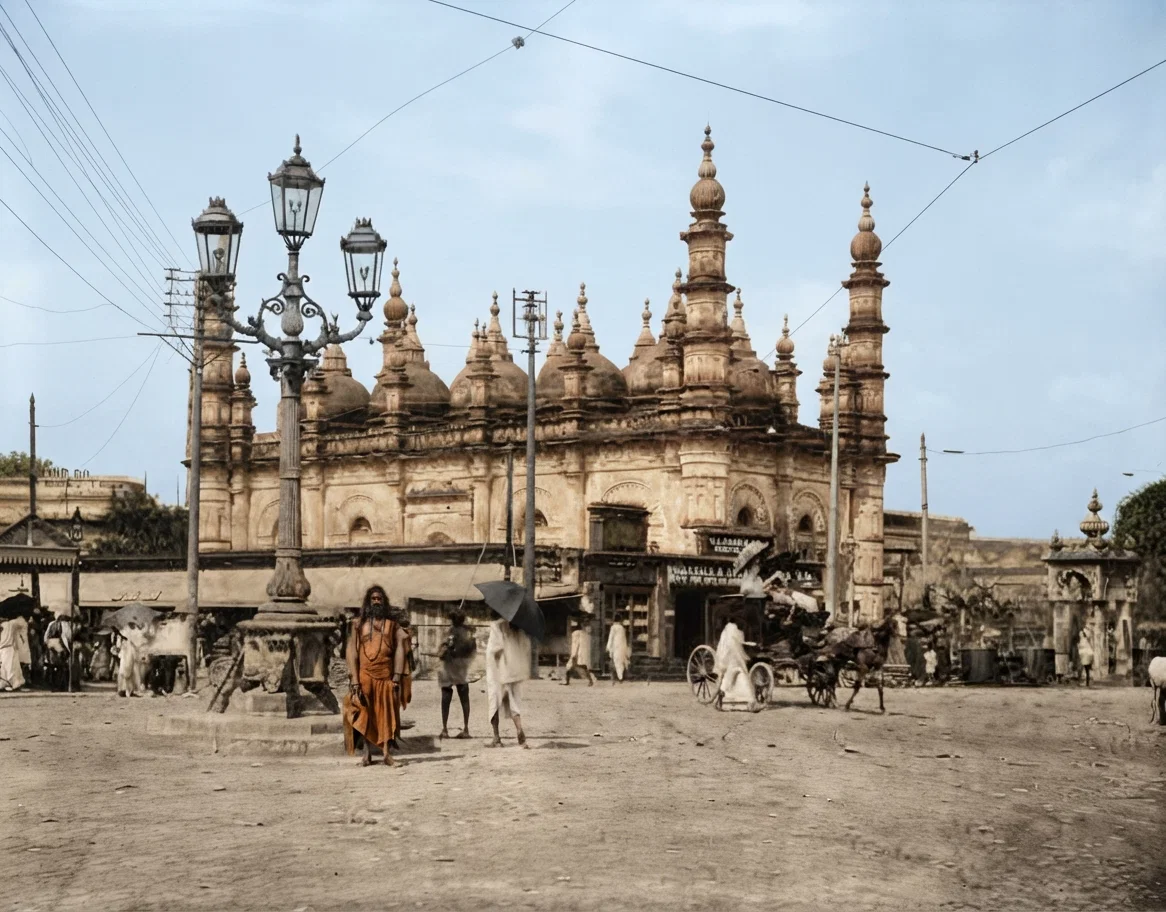
Prince Golam Mohamed mosque, Calcutta. The ancient mosque and the modern electric trains and lights make a rare combination of old and new.
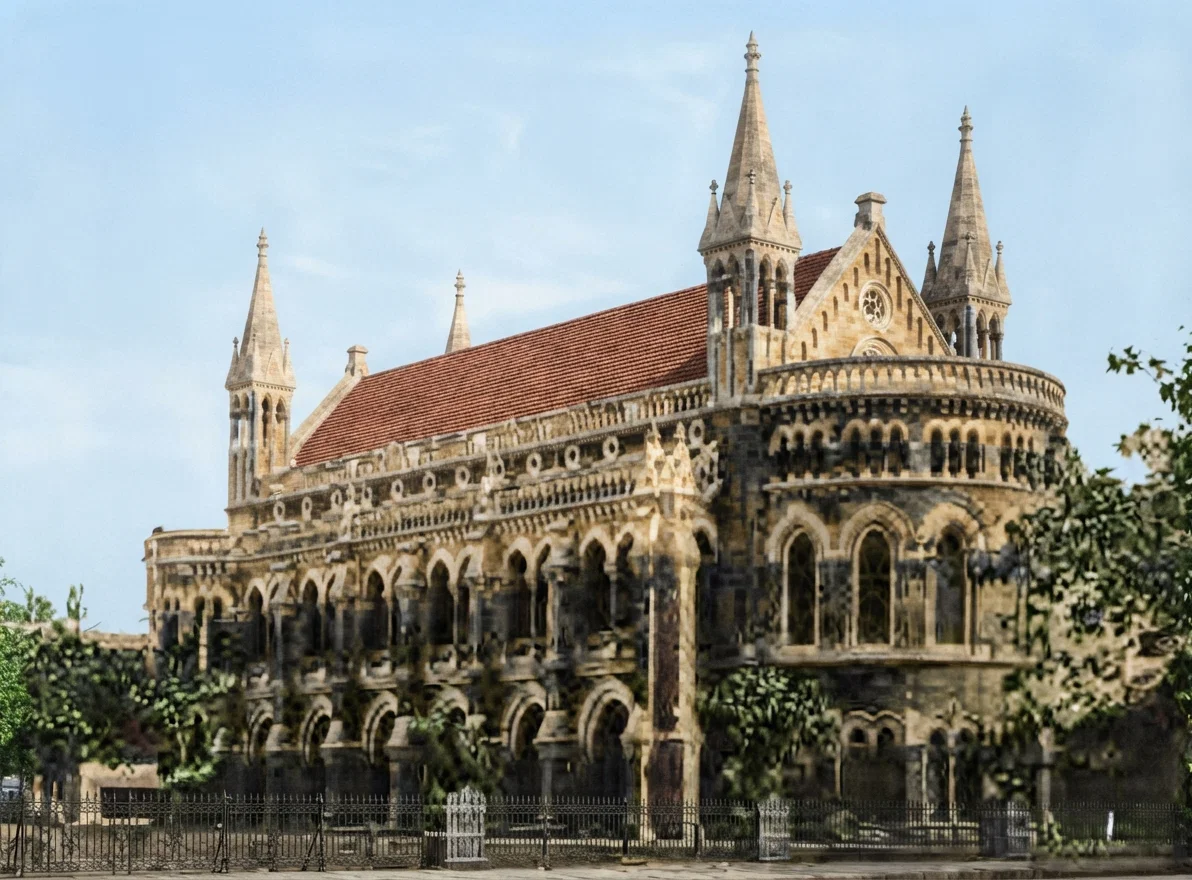
University Hall, Bombay
A New Archeological Find
By Editor
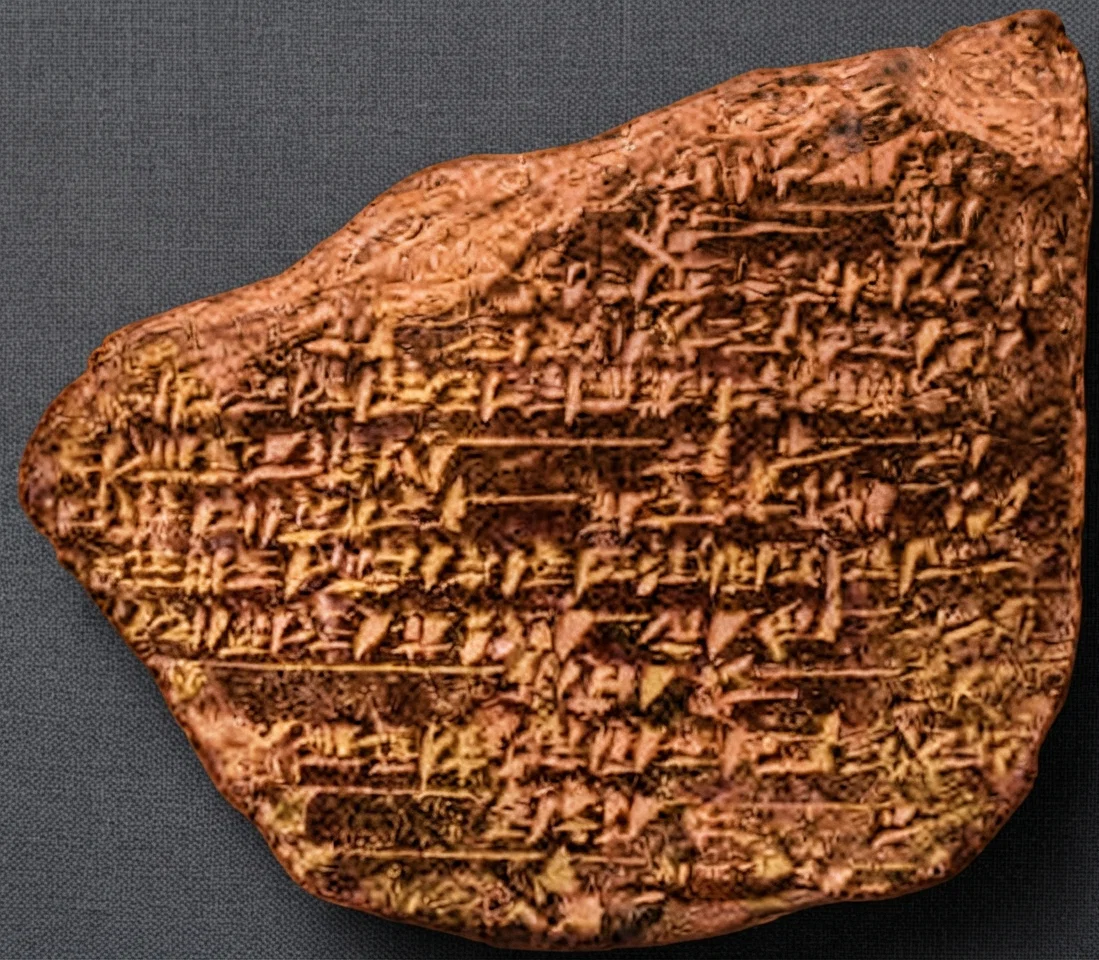
Not long ago Prof. Herman Hilprecht gave to the world, in a lecture before a woman's club in Philadelphia, the translation of a new tablet found at Nippur. His translations and statements have been subject to a great deal of criticism. We give the following as Dr. Hilprecht's translation:
"[I declare unto] thee that the confines of heaven I will loosen, a deluge I will make, and it shall sweep away all men together; but thou [the Babylonian Noah] seek life before the deluge cometh forth; for to all living beings, as many as there are I will bring overthrow, destruction, annihilation. Build a great ship and Total height shall be its structure. It shall be a houseboat carrying what has been saved of life. With a strong deck cover it. The ship which thou shalt make, into it bring the beasts of the field, the birds of heaven, and the creeping things, two of everything instead of a number and the family *"
The words enclosed in brackets are supplied words. It is these emendations and also some of its translations which are especially attacked by the Higher Critics. The age of the tablet is said to be somewhere about 2,100 years before Christ, because it is in a Semitic dialect. If this be so, it is one of the oldest records that we have outside of the Scriptures. But the great age of the tablet is also denied.
The Christian Advocate, after thorough review of what has been said on both sides, sums up the matter in the following judicial way:
"The Babylonian Deluge Tablet discovered by Professor Hilprecht is clearly of great importance and is undoubtedly a fragment of a larger tablet. The following reservations are necessary: (1) The translation of its words is in some particulars doubtful, tho in the main almost certainly correct. The additions which Professor Hilprecht has made are, on the other hand, extremely doubtful. He has added in brackets phrases which can not properly be drawn from the words of the tablet. They may be correct, but from various authorities, some of the highest grade, we learn that presumption is always against extensive additions to the translation of any ancient text, and in previous cases duplicates have several times shown that proposed additions were wrong, especially of the duplicate creation tablets, which have in several cases shown emendations to be wrong.
The Nippur Deluge Tablet (Courtesy “The Scientific American”)
"The date of the tablet which Professor Hilprecht has translated is absolutely uncertain. The only evidences for its date are the general appearance of the tablet and its paleography, and these are too uncertain in so small a fragment."
The Vatican Roosevelt Incident
By Editor
THE discussion which Mr. Roosevelt deprecated continues over his affair with the Vatican. Our readers are more or less acquainted with it through the daily press. It is not needful to give the whole correspondence. The matter of difficulty arose over the conditions placed upon Mr. Roosevelt if he were to have an interview with the pope. The words are: "The holy father will be delighted to grant an audience to Mr. Roosevelt on April 5, and hopes that nothing will arise to prevent it such as the much regretted incident which made the reception of Mr. Fairbanks impossible." The Methodists seem to have a coterie of very zealous evangelists in Rome. Mr. Fairbanks is a Methodist, and he visited the Methodists. The Vatican feels special antagonism toward the Methodists because of their methods. Mr. Fairbanks having visited the Methodists, the pope would not receive him.
Feeling that Mr. Roosevelt in his open way might do the same thing, and thus place the Vatican in an inconsistent position if the pope received him, the conditions were laid down by the Vatican. Mr. Roosevelt recognized the right of the pope to receive whom he wished, but stated that "I in my turn must decline to make any stipulations or submit to any conditions which in any way limit my freedom of conduct." A very proper thing for a free man of any country to do. For this he has received laudations from lovers of freedom all over the world, many Catholics in America endorsing it. Mr. Roosevelt, however, shortly after that wired to The Outlook expressing himself very emphatically as wishing the Americans to feel that while he acted in the only way possible for an American to act, he wants it understood that he has nothing against Roman Catholicism in any way. And the editor of The Outlook declares that "an ex-president of the United States could not visit Rome and fail to ask for an audience with a pope without a palpable slight to the holy father." Mr. O'Laughlin, an American Catholic in Rome, who endeavored to arrange the interview, declares that even Catholics close to the Vatican are beginning to understand that Mr. Roosevelt's attitude in connection with the audience with the pope has no relation with them or their religion, while his later utterances have shown the Methodists that they have no right to make capital of his actions as against the Catholics. What may grow out of it is uncertain. Some of the Methodists have come out very strongly in their utterances against Roman Catholicism, but Bishop David H. Moore of the Methodist Episcopal Church declares, as quoted by the Literary Digest of April 16, that "true Roman Catholicism can never be in conflict with true Methodist Episcopalianism, and vice versa."
That to our mind is about the strangest utterance of all. If that be true, we wonder what reason the Methodist Church has for existence, or why they send missionaries to Rome, or to Catholic countries. Certainly if there is any place on the face of the earth that ought to reflect true Roman Catholicism it is right in the city of Rome itself, under the very shadow of the Vatican. And presumably the Methodist Episcopal Church send missionaries there who represent true Methodist Episcopalianism. Somehow or other things are mixed in Bishop Moore's mind or in Rome. Logically there can be no harmony between true Protestantism and true Catholicism. The one is a religion of tradition; the other is a religion of the Word. Mr. Roosevelt does right in standing for absolute religious equality, utterly apart from the particular religion professed. Roman Catholics are consistent with their faith in absolutely refusing to fellowship other religions. Protestantism ought to stand so close to the Word of God that it also could see the inconsistency of union or harmony between Protestantism and Roman Catholicism.
Ex-President Theodore Roosevelt
A Congressman for Peace
By Editor
A Congressman for Peace.—Representative Bartholdt of Missouri is pushing through Congress a joint resolution for the creation of an international federation, which will appoint a commission to consist of five members, to be appointed by the President of the United States, in order to bring about the organization of an international court, this court to determine by decree all controversies between nations, and to be able to enforce the execution of its decrees by arms, controlled solely by it. That sounds good, but it can never be effective in this belligerent old world.
The New York "World," in a news item from Atlanta, March 31, quotes an invitation sent out by a Christian church as follows: "Dear Brother: You are cordially invited to attend a prize fight at Western Heights Baptist Church Monday night, April 4, at 8 o'clock. Be sure to bring this card for admittance." The item needs no comment. God has given us one way of attracting men, and that is the lifting up of Jesus Christ.
Our correspondent at Omaha, Nebraska, Mr. L. A. Spring, writes that Lincoln is now the largest city in the United States having no saloon by its own volition or choice. Monday, March 7, there was a second election over the liquor question, and an increased majority was given for a dry town. Good. We wish that every city in the land would follow Lincoln's example.
Shiloh: the Man of Sorrows
By Mrs. L. D. Avery-Stuttle
Copyright, 1910, Pacific Press Publishing Association
By Mrs. L. D. Avery-Stuttle
Chapter IX. On the Way to Jerusalem
HE year of Rome 761 has dawned. The sweet wild flowers of spring are once again covering the hills and valleys of that sacred land given so long ago to be the inheritance of the sons of Israel, the chosen of God.
Cæsar Augustus still rules at Rome. Archelaus, the cruel son of a despot father, has had rather a short-lived reign over Judea, and been driven into exile as the natural reward of cruelty toward his long-suffering subjects.
Coponius is governor of Judea; and Herod Antipas, of Galilee; while the notorious Annas occupies the position of high priest at Jerusalem.
In a humble home in the secluded village of Nazareth of Galilee, there is great anticipation in the heart of a young Lad who has but recently arrived at the dignity of His twelfth year.
It is the season of the Passover at Jerusalem, and the pious families of Nazareth are preparing to attend. There is subdued bustle of excitement and preparation in the home of the carpenter Joseph of Nazareth. It is the first Passover of the Lad; for such is the law among the Jews, that no male may attend this festival until he is twelve years old, at which time the privileges of manhood become his.
With what anticipation the Lad looks forward to His first sight of the holy temple, and of the sacred city of His fathers!
The journey is a long one—about eighty miles! a vast distance in the eyes of a lad whose short life has been entirely confined to the quiet hills and valleys of his native Nazareth.
At last the preparations are complete; the company is ready; the procession is formed. Slowly winding over the narrow pathway leading southward toward Jerusalem—always southward—in as straight a line as possible, the caravan moves on its way. Others join them as they proceed. In fancy we can picture the cavalcade making their pious pilgrimage. The old and feeble are mounted upon donkeys or horses, and the young men walk sedately by their side, staff in hand, while the still younger march joyously by the side of their elders.
Crossing the river Kishon, and leaving Nain on their left, they are joined by many pilgrims from the great plain of Esdraelon. One by one they pass the historic places made sacred by events which form a part of their history as a nation. Here King Saul hurried to consult the woman of Endor, when the Lord had forsaken him. There in that tower sat Jezebel, the wicked queen; and here in the streets tumbled the vain woman, to be devoured by the dogs of Jezreel.
A little at the right, rising in lonely grandeur, are the mountains of blessing and of cursing. There lies Dothan, in the vicinity of which Joseph found and ministered to his envious brethren. And it was upon these hills that the armies of heaven encamped when they came to rescue the prophet of God from the Assyrians; and here, on the direct road, and a mile and a half from the ancient Shechem, is the famous well of Jacob.
Finally, on the evening of the third and last night of their journey, the cavalcade reach Beeroth, only about ten miles to the north from Jerusalem.
The setting sun is gilding the mountains of Benjamin and the farther hills of Judea, and the night birds are calling to their fellows, as the white tents of the pilgrims are pitched close by the springs of Beeroth. Anticipation is at its height, for on the morrow the fair walls of the city of David will burst upon the view of the devoted pilgrims.
As they seat themselves upon the ground to partake of their frugal meal, a young Lad wanders off toward the hills alone. Accustomed from earliest childhood to solitude, and to seeking the quiet of the mountains for meditation and prayer, His absence occasions no solicitude to His parents. But there is one whose envious eyes never leave the Lad, and who with dogged persistence follows His every movement,—Shaphan,—the rabbi of Nazareth; and on this night he follows after Him at a distance.
With spirit rapt in holy meditation, the Lad climbs the mountainside. Here He pauses to lift a wounded bird from the ground and tenderly replace it in the nest; again, He stoops to moisten His lips with the cool waters of the mountain spring, and anon breaks out into songs of prayer and praise. The soft voice is eloquent with feeling, the hands are clasped, and the earnest eyes raised heavenward:
'Make a joyful noise unto God, all ye lands: sing forth the honor of His name: make His praise glorious. Say unto God, How terrible art Thou in Thy works! through the greatness of Thy power shall Thine enemies submit themselves unto Thee. . . . Come and see the works of God: He is terrible in His doing toward the children of men. . . . He ruleth by His power forever; His eyes behold the nations: let not the rebellious exalt themselves. . . . For Thou, O God, hast proved us: Thou hast tried us, as silver is tried.' Then the wonderful voice trembles with emotion as He continues:
'Thou broughtest us into the net; Thou laidst affliction upon our loins. Thou hast caused men to ride over our heads; we went through fire and through water: but'—and the voice rings with triumph—'but Thou broughtest us out into a wealthy place. . . . Blessed be God, which hath not turned away My prayer, nor His mercy from Me.'
Now the Lad has reached the summit of the hilltop. The full round moon has risen, and pours her pale glory over valley and mountain. At His feet lie the white tents of the pilgrims, and the quiet town of Beeroth,—the same which centuries ago was the birthplace of Nahari, one of David's mighty men. At the south, just out of the line of vision, lies Zion, the beautiful—the city of the King.
Now the feet of the young Lad pause, and the catlike tread behind Him ceases also, as the Child drops upon His knees and offers up a prayer to Heaven, and the angels of glory cease the music of their harps to listen.
At the close of the prayer, there sounds a faint moan from the deep shadows cast by the overhanging rocks:
'In the name of the God of Israel, help, or I die!'
The wounded man had recovered from his death-like swoon in time to listen to that wonderful prayer. In an instant the Lad is by the side of the sufferer, and is supporting the massive head in His arms, while from behind a bunch of cactus a little in the rear, peer the evil eyes of Shaphan, the rabbi.
'See, Boy, I am starving; canst Thou help me?' At once His own frugal supper of parched corn and unleavened cakes is in the trembling hand of the half-famished man.
'Art thou athirst?' questions the Child, in a voice of tenderest sympathy.
'Nay, the spring is hard by, but verily I have eaten nothing for three whole days—not since the accursed Roman legions wounded me.'
'Stay; I will bring thee help!' cries the Child, springing to His feet as if to hasten back to the encampment. 'Surely the carpenter of Nazareth leaveth no man to perish alone.'
'Hold; Thou hast brought me food, Lad; it is enough. Why should the Jew deliver me into the hands of the Roman? Marcus, the centurion, I fear continually. Verily he hath pursued me from the mountains of Moab, and hath wounded me sore. But already Thy bread strengtheneth me, and I shall soon be far hence toward Galilee. But stay, Lad; who art Thou? and what is Thy name? Who knoweth but some day even Barabbas may do Thee a kindness?'
But the Child was gone.
(To be continued)
The Christ
By George E. Tack
By George E. Tack
Not this a King whose fierce, despotic rule
Binds shackles on the minds and limbs of men;
Not this a stealthy pontiff, in whose den
Are found the victims of a hatred cruel.
Nay, this is He whose love was given when
From world to world the mournful tidings rang
That man had fallen, ere Hope sweetly sang
Of life and bliss beyond Sin's blinded ken.
Forth from His hand stream radiant beams of light,
For there's the hiding of His wondrous power;
His eyes are tender with immortal love;
His face is fairer than the lilies white,
And low we bow, and hail, with throngs above,
David's Lord and Son, Love's immortal flower.
TRACT
By Editor
Sample Case
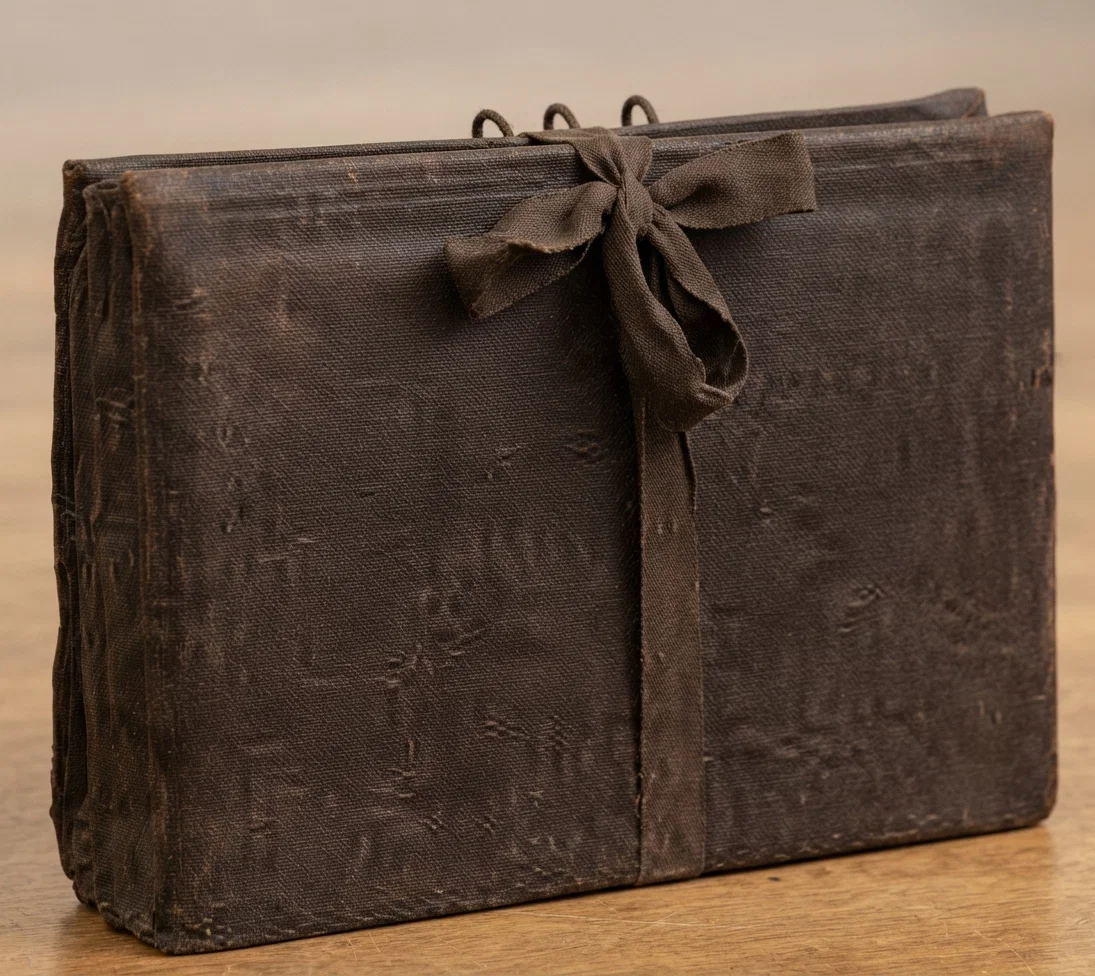
One of the neatest little sample cases for tracts we have ever seen has recently been devised for the benefit of church librarians, missionary workers, and, in fact, any one who wishes to have a complete list of Gospel tracts for ready reference. It consists of heavy cloth covers, 19 x 26 inches in size, with pockets as shown in the accompanying picture.
In each of these pockets is a file of tracts and pamphlets topically arranged. Holes are punched in the back of these publications and a string run through them and through a stiff piece of cardboard at the back. This makes a regular file of tract samples for instant reference. There are three loops at the top by which the case may be hung to the wall. Or it may be folded as shown in the cut. The price is $2.00, postpaid, but a special rate of $1.00 postpaid is made to librarians purchasing for the use of the church. As this is considerably less than cost, only one case can be furnished to any church at this rate.
Address your state tract society, or the manufacturers,
Pacific Press Publishing
Association
Mountain View, California
Man’s Nature and Future Destiny
By Uriah Smith
Here and Hereafter, or Man's Nature and Destiny. By Uriah Smith. This work is a thorough canvass of the great questions of a future existence, and the nature of man in the present life. Every text in the Bible which has any possible bearing upon these points is taken up and carefully explained. Cloth, 357 pp., $1.00. Address this office.
Every Day Dishes
"What Shall We Eat?" is still a vexing question for the housewife. "Every Day Dishes," by Mrs. E. E. Kellogg, will help settle the question. It contains a large number of recipes beside a fund of information concerning the value of different foods. 206 pages. Price, post-paid, 75 cents. Address this office.
"What Shall I Speak?"
How often the young mind wrestles with this problem.
How often parents have searched for a "piece" which they would care to have their little boy or girl commit to memory.
Why not possess a book of selections which have been compiled with special reference to use in Christian homes, in church schools, Sabbath-schools, and missionary and temperance societies?
SELECTIONS FOR OUR LITTLE FOLKS is just such a book. For children below the 6th grade. Neatly bound in cloth at 60 cents, post-paid.
Address your State Tract Society, or
Pacific Press Publishing Assn., Mountain View, Cal.