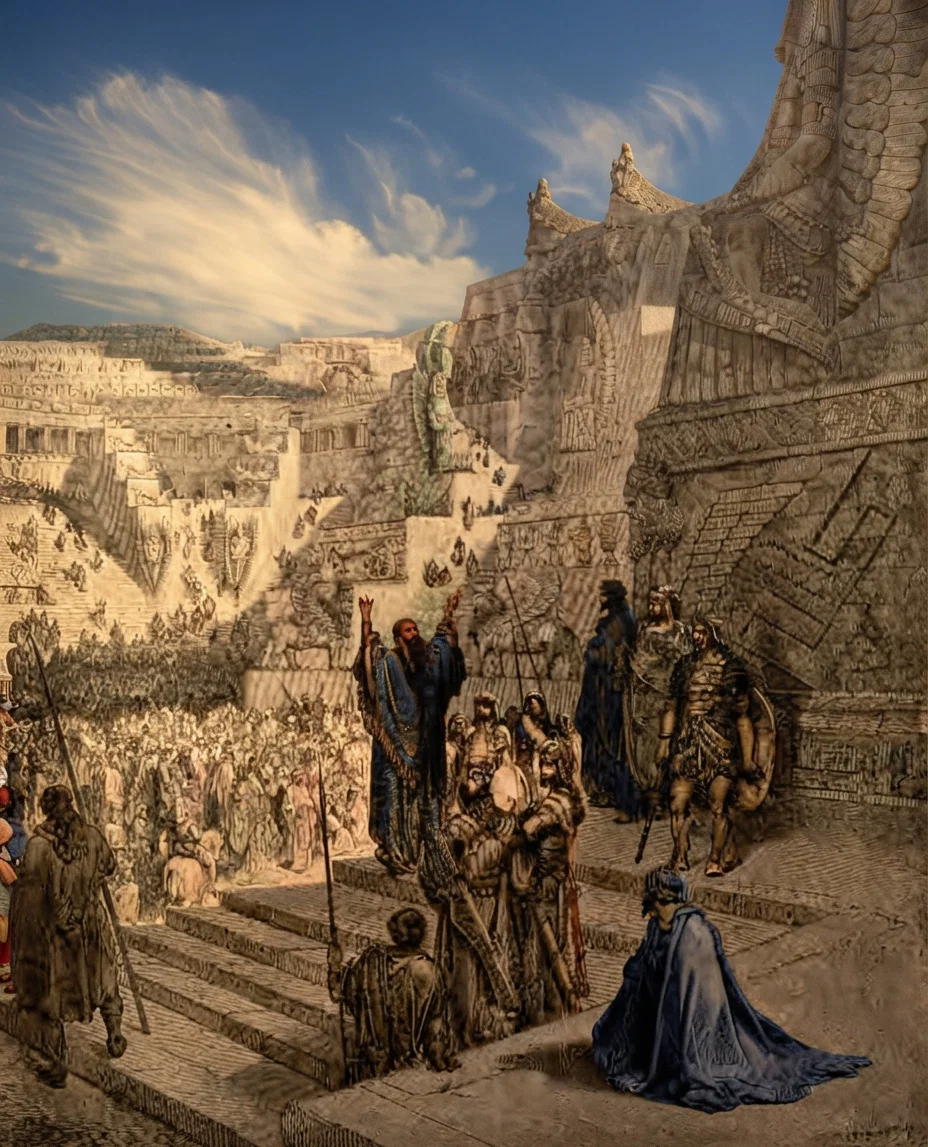
WHEN Cyrus issued his remarkable decree giving God's people the opportunity to return to Jerusalem, every loyal soul among the Israelites responded with vigor and enthusiasm. Whenever God calls a people, He makes response entirely dependent upon free will. He wishes no forced obedience; and those whose hearts loved God and their native land, were ready at once to return, even tho it meant hardship and the exercise of faith.
We read: "Then rose up the chief of the fathers of Judah and Benjamin, and the priests, and the Levites, with all them whose spirit God had raised, to go up to build the house of the Lord which is in Jerusalem. And all they that were about them strengthened their hands with vessels of silver, with gold, with goods, and with beasts, and with precious things, beside all that was willingly offered." It was not a decree in which all the Jews would be compelled to return to Jerusalem, but rather an opportunity for those who wished to go, for those who longed to see the desolate house of God restored. It was a time when men could choose for themselves, whether they would remain in Babylon to acquire wealth and to live in ease and comfort, or be real pioneers and go back to the ruins of that holy city and undergo hardships, sacrifice, and the loss of many comforts and enjoyments that were now theirs. But God would have only the willing-hearted. He would have only those who were truly His children; not those who were called Israel, but those who at heart were Israel.
God was at work upon the hearts of men, as the Scripture says: "All them whose spirit God had raised, to go up to build the house of the Lord." God was working upon the hearts of men; and those who were in touch with Him, whose lives were yielded over to Him, felt a marvelous impulse, a great quickening of the Holy Spirit, to give all they were and all they could do to accomplish the great purposes which heaven had in restoring the temple and the city, and preparing a place for the coming of the Messiah in the future days.
And God's Spirit was at work upon the heart of Cyrus. He brought forth the vessels of the house of God that Nebuchadnezzar had brought from Jerusalem. These sacred vessels which had been put away in the house of the Babylonian gods, even these vessels "did Cyrus king of Persia bring forth by the hand of Mithredath the treasurer, and numbered them unto Sheshbazzar, the prince of Judah." It was a goodly treasure, and a great encouragement to those who had undertaken the task of restoring the temple worship in their beloved and sacred city of Jerusalem.
Seventy years had elapsed since the Jews had been taken captive by Nebuchadnezzar and carried away from their native land. Almost two generations had passed away, and in all probability there were very few then living who remembered seeing the land of their fathers. Notwithstanding the fact that the youth now grown up to maturity had never seen their native country, a great host of them were eager to return. They collected in one vast assembly, with all the treasures which they were allowed to take, and the stores of provisions and baggage, along with horses and mules and other beasts of burden with which to transport them.
Going up to Jerusalem under the decree of Cyrus. Ezra 1:1-3
When assembled for the march, a very exact census was taken and it was found that the number was 49,697.
In the train were some seven or eight hundred horses, about 250 mules, and about 500 camels. The greater portion of their baggage and stores was carried by asses, of which they had nearly seven thousand. Jacob Abbott, in his life of Cyrus the Great, well remarks: "The march of this peaceful multitude of families — men, women, and children together — burdened as they went, not with arms and ammunition for conquest and destruction, but with food and implements for honest industry, and stores of
provisions and utensils for the peaceful purposes of social life, as it was, in its bearings and results, one of the grandest events of history, so it must have presented, in its progress, one of the most extraordinary spectacles that the world has ever seen." — Page 194.
The number of Jews who, Ezra says, returned at this time, seems very small as compared with what we might expect. And it is a sad fact to chronicle that from this time on we will find in general the Persian nation, the people of the world, more willing to further the work of restoration than were God's people themselves.
Some reliable writers inform us, indeed, that excepting the priests and Levites, those who returned from the captivity were largely inferior mentally and physically. So kindly were the Jews treated in Babylon that not one half of them chose to return to their native country. They had come to respect the land of exile more highly than they did the holy land of Palestine.
But even so God makes the call only for those who choose to return. He thus allows those who love their pleasure and ease more than they love Him and His plans, to remain behind. Only those who love Him enough to sacrifice their homes and associates, need come.
(To be continued)
Wise Counsel
By Bishop Knox-Little
LET no enthusiasm for humanity, no vague, wild desire for human progress, no passion for fame, even of the noblest sort, lead you into places where you do not belong. As you reverence your own mind, as you would save it, if you knew how, from the blighting touch of those who do not know and can not teach, so do you beware of defacing another soul by a careless or a selfish touch. As you reverence the divine possibilities within your own soul, so I entreat you to bow yourselves humbly in the presence of those possibilities in others. Put from you all arrogance and affectation, all spurious humility, every form of vain and foolish show. Be content to do the thing you can do, doing it always with your might. Then every increase of your personal power will be an addition to the public wealth, then the progressive perfection of your own life will be a benefaction to your fellow men.
— Bishop Knox-Little.
Love Your Enemies
Christ says, "Love your enemies, bless them that curse you, do good to them that hate you."
Understanding the Old Testament
By Emma Hildreth Adams
By Emma Hildreth Adams
A FEW evenings since, during a most interesting conversation on the study of the Bible, held in the presence of the writer, there fell from the lips of an aged person present these words:
"I know little about the Old Testament. I can not understand it."
The candid utterance included the whole vast field of diverse, deeply stirring, highly instructive, and vastly important matters embraced in the older portion of the divine WORD.
It revealed instantly that the individual could have made little effort to understand the wonderfully attractive book, since by far the greater part thereof—however varied and exalted its themes, however marvelous its portrayals of human life and action, however skilful and charming its paintings of scenic nature, however authoritative its proclamations of the decrees, statutes, and will of Him whose Word the unrivaled collection is—is expressed in terms clear, unaffected, and exact, yet full of force, power, and life.
It is safe to assert that Christians who neglect, slight, or evade a careful, earnest, plentiful study of the Old Testament Scriptures, deprive themselves of a bountiful source of needed knowledge; shut the door to fountains of the most elevated wisdom; turn away from storehouses filled with food remarkably adapted to mental, moral, and spiritual unfolding; rob themselves of opportunity to know God in many striking, beautiful aspects of His character.
The very variety of its component books, all written by master hands, adds to its charm, its broad usefulness.
Some of them portray marvelous events which have transpired upon this, the most distinguished of all the planets of our system. Some of them furnish the world with poetry most uplifting, rich in finest imagery, replete with the spirit of ideal worship. Some of them sound out to all the earth—not human thoughts, not human words—but thoughts, messages, warnings, advice, from Him by whose incomprehensible might the wondrous universe is held safe, steadfast, in its amazing career.
No sincere, reverent student of the books of Exodus, Leviticus, Numbers, and Deuteronomy can think long and sensibly over the oftentimes highly dramatic scenes, the deeds of greatness, the words of might, the touching experiences, the equitable laws, which fill their pages, without himself gaining in moral stamina, in intellectual force, in closeness with God. He would understand, feel, and live out their truths and teachings.
Indeed, the total fruit of study in the Pentateuch should be the straightening up of character, habits, life, in the reader.
The Historical Books
All the historical books of the Old Testament pay affluent interest for attentive reading and study. All through their faithful, powerful pages beams the sure lesson that "WHATSOEVER a man soweth, that shall he also reap;" that sowing to the flesh, he "shall of the flesh reap corruption;" but sowing to the Spirit, he "shall of the Spirit reap LIFE EVERLASTING."
Especially do these books set forth great rewards for unpurchasable fidelity to public trusts, for rectitude, for marked uprightness in the discharge of all civic duties.
On the other hand, they set forth in tremendous terms the ruin, disaster, punishment, ever due to inordinate greed, to corrupt scheming for official position, to lack of integrity in service either to the people or to the divine Ruler.
Many such cases stand out in meridian sunlight, and any heedful reader may comprehend their full intent, their great value.
Certainly it would result to the vast advantage of our nation if its thousands of public servants were to adopt as models in official life Moses, Joshua, Hezekiah, Nehemiah, and other highly tested servants of God and the people. The history, testing, example of these men are luminous, eloquent. He who runs may learn the lessons their lives teach, tho they be garnered in the Old Testament.
In Personal Habits
Another thing: Students of the widely neglected book might acquire, from its respectful reading, fine orderliness of personal habits. They would learn that God delights in exquisite personal cleanliness. His often repeated charge to Aaron, the priests, the Levites, and the children of Israel, to "wash" and "make themselves clean," would work irresistibly for the excellent practise of self tidiness; would aid largely in the allied work of moral and spiritual refining.
The Poetical Books
But suppose we journey forward to the books of Job, the Psalms, Proverbs, and Ecclesiastes. We shall find them all gemmed with Oriental imagery, full of antique symbolism, curious types, and quaint figures of human speech. Nevertheless their pages are heaped high with diamond wisdom, filled with radiant common sense—in words of God and words of men, crowded with lucid expressions of faith, love, devotion, and worship.
Yet all are expressed in language so clear, so appropriate, that every simple, honest reader may readily grasp their deep teaching, their lofty meaning. With their deft brushes the beautiful words paint upon receptive, hungry hearts results for eternity, effects enduring "as the springs of the sea," established as the constant fruitage of trees, as the perpetual blooming of flowers.
No mortal need fail to attain eternal life because none of these Scriptures point the way thereto definitely—namely, through strong faith in and loving obedience to God; for their pages glisten with vivid references to that supreme subject.
The Prophets
Furthermore, completing the amazing literary stores of the Old Testament, we have the prophets—majors and minors—sixteen in number. Some of them wrote and prophesied before the long captivity in Babylon. Some of them held office during that period, others after its termination, sending their wonderful foretellings down through the centuries to the cutting off of time; uttering their clarion warnings against apostasy and sin; entreating God's people to practise uprightness of life; predicting a second radical punishment of the earth and of defiant men thereon; promising, picturing, sometimes in joyful language, sometimes in sad, plaintive words, the coming of the "Man of Sorrows;" cheering the faithful, the meek, with a pledge of new heavens and a new earth.
Some of their predictions were curtained by language destined to conceal their real purport until their long distant fulfilment was due. And some of their messages and prophecies were so draped with figures of speech, that their full intent could be discerned, perhaps, only by devout study, and by persons versed in the tongue in which they were written or uttered.
And yet, the far greater proportion of the pages of these prophetic books can be readily understood by a careful, heedful reader. God means His total Word shall be understood, and great blessing accrues to him who devotes time and effort to delving for its marvelous treasures.
The Old Testament, scarcely less than the later volume, is a guide to an ideal life, and will prove a bright light, a strong help in any soul's ever-growing conflict with evil.
Reading the Bible Through
By Stephen Nelson Haskell
WHEN we read the Bible through by course, and read so often as not to lose the connection, remembering what we read, we will find that the Spirit of God will soon open our understanding, so that we want to study here and there. We will remember that yesterday we read a text that will throw light on this; and this will throw light on something else; and so in that way we will go back and forth through the Bible. Therefore, I say, men can not read the Bible carefully and critically through by course and not study it by subjects as well. And7when you have done this, you will have something in your heart that you can give to others with whom you come in contact. But unless you do this, you will fail to see and partake of the righteousness of our Lord Jesus Christ.
I want to read you the text that gave me an understanding of the doctrine of the righteousness of our Lord Jesus Christ, some four years ago. It is in the Old Testament. The text struck me with such force that I had to get down on my knees and cry; but God let that light into my soul. The text is the twentieth verse of the fiftieth chapter of Jeremiah.
It is God's promise to rebellious, sinful Israel because they sought Him. It reads: "In those days, and in that time, saith the Lord, the iniquity of Israel shall be sought for, and there shall be none; and the sins of Judah, and they shall not be found."
Somebody will go around and try to find Israel's iniquity; but "there shall be none; and the sins of Judah, and they shall not be found." I praise God. When He forgives sins, He forgives sins; He does not hold them over our head everlastingly, but just forgives, and sets us free. . . . How did I find it? I found it by reading my Bible through, of course; by reading it carefully, verse by verse; and taking the connection as I read it, it struck me with such force as I never felt before in all my life. I have great faith in reading the Bible through by course.—S. N. Haskell.
True Freedom
By James Russell Lowell
Is TRUE freedom but to break
Fetters for our own dear sake,
And with leathern hearts, forget
That we owe mankind a debt?
No; true freedom is to share
All the chains our brothers wear,
And, with heart and hand, to be
Earnest to make others free
They are slaves who fear to speak
For the fallen and the weak;
They are slaves who will not choose
Hatred, scoffing, and abuse,
Rather than in silence shrink
From the truth they needs must think;
They are slaves who dare not be
In the right with two or three.
—James Russell Lowell.
The Lord and the Sun
By F. W. Bishop
"THE Lord He is God." Ps. 100:3. The sun is a god also.
We are told to "worship the Lord in the beauty of holiness." Ps. 29:2. We are forbidden by the Lord to worship the sun. Deut. 4:15, 19.
The Lord is in heaven. Matt. 6:9. The sun is also in the heaven.
No man can see the Lord. 1 John 4:12. Every man can see the sun.
Many people worship God. Many people worship the sun.
God set apart the seventh day of the week, or the Sabbath, as a day of rest and worship. Ex. 20:8, 11. Men, not God, set apart the first day of the week, or Sunday, as a day of rest and worship.
The seventh day, or Sabbath, is a sign between God and His people. Ex. 31:17. The first day, or Sunday, observed contrary to God's revealed will, is a sign between the sun and those who worship it.
The sign of God is written on the forehead, or in the mind, of His people. This sign of the sun-god is also written on the forehead, or on the hand, of those who worship it. It is called by John the mark of the beast. Rev. 13:16, 17. Choosing the law and institution of man instead of the law and institution of God constitute beast worship.
The Lord says, "Blessed is the man that . . . keepeth the Sabbath." Isa. 56:2. But those who receive the mark of the beast will drink of the wine of the wrath of God. Rev. 14:9, 10.
Some people keep the commandments of God and have the testimony of Jesus Christ. Rev. 14:12. Other people keep the commandments of men. Titus 1:14. They profess that they know God, but in works they deny Him, being abominable and disobedient. Verse 16.
Now is the time to choose whom you will serve. "No man can serve two masters. . . . Ye can not serve God and mammon." Matt. 6:24.
Pua, Chile. F. W. BISHOP.
The Fulness of Privilege
By Ellen G. White
By Mrs. E. G. White
Paul, in his letter to the Colossians, sets forth the rich blessings granted to the children of God. He says: We "do not cease to pray for you, and to desire that ye might be filled with the knowledge of His will in all wisdom and spiritual understanding; that ye might walk worthy of the Lord unto all pleasing, being fruitful in every good work, and increasing in the knowledge of God; strengthened with all might, according to His glorious power, unto all patience and long-suffering with joyfulness."
Again he writes of his desire that the brethren at Ephesus might come to understand the height of the Christian's privilege. He opens before them, in the most comprehensive language, the marvelous power and knowledge that they might possess as sons and daughters of the Most High. It was theirs "to be strengthened with might by His Spirit in the inner man," to be "rooted and grounded in love," to "comprehend with all saints what is the breadth, and length, and depth, and height; and to know the love of Christ, which passeth knowledge." But the prayer of the apostle reaches the climax of privilege when he prays that "ye might be filled with all the fulness of God."
Here are revealed the heights of attainment that we may reach through faith in the promises of our heavenly Father, when we fulfil His requirements. Through the merits of Christ, we have access to the throne of infinite power. "He that spared not His own Son, but delivered Him up for us all, how shall He not with Him also freely give us all things?" The Father gave His Spirit without measure to His Son, and we also may partake of its fulness.
Gaining a Wonderful Rest
By Guy A. Jamieson
WHEN we have come really to know Christ, we will have come into a spirit that will make such radical changes in our way of thinking of our work, our life, our responsibility, that we will come into that rest which He alone can offer. If we have come to Him, we will find our yoke easy, our burden light.—Rev. Guy A. Jamieson.
"Let There Be Light"
By Delwin Rees Buckner
(Based on a Spanish Poem)
By Delwin Rees Buckner
WHERE hast thou gone, blind Night, within whose ears
Ride fears, by which the human heart is torn?
The pale, sad, pensive moon — where hast thou borne
Her and the train of countless silent stars?
Behold the sun! High heaven's dome he gilds,
And clothes the universe with hues divine,
Within whose light the painted flowerets shine,
The living green of meadows and of hills.
The sun behold, at whose first blazing spark
Chaotic earth aroused from sleep profound —
A slumber passed within thy lap, O Night;
Began upon its axis then to mark
The hour-winged days — revolving round and round —
The evening, darkness, and the morning, light.
Ambato, Ecuador.
Daily Bettering Our Best
SOME men are content if they do not fall behind their fellows; others, if they do not fall behind themselves. But there are some who are not content unless they are surpassing both others and themselves, and becoming ever better men, superior to conventional standards and to their own best attainments. Edward Bowen, of Harrow, was such a man. It was said of him: "The desire to make good better, and better best, was with him an instinct." "He found his happiness in habitual self-sacrifice. At all times he was insistent upon self-sacrifice even in the smallest things. 'Never take the corner seat in a railway carriage, when other people are in the compartment.'"
"He did not wish to be known or remembered by men; but he wished to serve and to be loved by many friends. Above all, thought he, to serve; since to serve was the duty—to be loved, only the reward." "I don't know how it is, sir," a boy said about him, "but if Mr. Bowen teaches a lesson, he makes you work twice as hard as other masters, but you like it twice as much, and you learn far more." It is the man who is becoming better himself who sacrifices himself. The stationary man preserves himself. And it is the man who sacrifices himself who can persuade others to sacrifice their old selves and to become better men.—The Christian Herald.
Hidden Gems
By Rainsford
"WHAT dirty, dreadful, disgusting stuff," exclaims a man, regarding that peculiarly unpleasant compound, the mud of London streets. "Hold, my friend," says Ruskin. "Not so dreadful after all. What are the elements of this mud?—First, there is sand; but when its particles are crystallized according to the law of its nature, what is nicer than clean white sand? And when that which enters into it is arranged according to a still higher law, we have the matchless opal. What else have we in this mud?—Clay. And the materials of clay, when the particles are arranged according to their higher laws, make the brilliant sapphire. What other ingredients enter into the London mud?—Soot. And soot in its crystallized perfection forms the diamond. There is but one other—water. And water, when distilled according to the higher law of its nature, forms the dewdrop resting in exquisite perfection in the heart of the rose." So in the muddy, lost soul of man is hidden the image of his Creator; and God will do His best to find His opals, His sapphires, His diamonds and dewdrops.—Rainsford.
The Honest Business Man
A BUSY man is one who is full of business — busy-ness.
If he is an INTELLIGENT business man, his business will be systematized so as to enable him to accomplish most in the shortest time with the facilities at hand. If he has himself been educated in, or permitted to form, habits of disorderliness, untidiness, shiftlessness, carelessness, he will resolutely set about changing these elements of weakness to every successful business, into their opposites, and will make his work an example and school to observers, employees, and associates. Many a customer who likes the grocer personally, does not trade with him after having once visited his place of business. Grocers are not alone in the importance of this principle.
An HONEST business man will not follow a DIShonest business, will not use dishonest methods, will not ally himself or identify himself with dishonest men, firms, or associations. Honesty with him will be a PRINCIPLE vitalizing his business rather than a POLICY for gain, an expedient for the time.
The HONEST business man will be just and upright. His word is as good as his bond. While he may be generous to his friends, he will be at least just to his enemies and competitors. He will not skimp weights or measures. He asks a full price; he will render a full pound.
He will regard the principles laid down in the Old Scriptures: “Ye shall do no unrighteousness in judgment: thou shalt not respect the person of the poor, nor honor the person of the mighty; but in righteousness shalt thou judge thy neighbor.” “To have respect of persons is not good: for for a piece of bread that man will transgress.” “Ye shall do no unrighteousness in judgment, in meteyard, in weight, or in measure. Just balances, just weights, a just ephah, and a just hin, shall ye have.” Lev. 19:15; Prov. 28:21; Lev. 19:35, 36. There will be no elevated bottom in the berry basket or the bushel basket, no short weights in selling or long in buying. There will be no mixing of fresh and stale to fill orders obtained by fresh samples. Old hens will not be sold for spring broilers. There will be no waiting for the government inspector to adjust scales; better than this is a good conscience.
Imprinting the Bible
By Dwight Lyman Moody
You can not read the Bible as you do other books. I visited Mr. Prang’s chromo establishment in Boston, and saw the process of printing a picture of some public man. The first stone made hardly an impression on the paper. The second stone showed no sign of change; the third no sign. The fifth and sixth showed only outlines of a man’s head. The tenth, the man’s face, chin, nose, and forehead appeared. The fifteenth and twentieth looked like a dim picture. The twenty-eighth impression stood forth as natural as life. It looked as tho it would speak to you. So, carefully and prayerfully read the Word of God—read the same chapter again and again—and the twenty-eighth time Christ Jesus will shine forth.—Moody.
Our Bible Reading
The Holy Scriptures
Their Inspiration
1. In what had the disciple Timothy been instructed?
"From a child thou hast known THE HOLY SCRIPTURES, which are able to make thee wise unto salvation through faith which is in Christ Jesus." 2 Tim. 3:15.
NOTE.—Timothy had a Jewish mother and grandmother, both of them devout souls with faith in God. 2 Tim. 1:5. They had faithfully instructed Timothy in the Old Testament Scriptures, the canon of which in their day was identical with ours.
2. What does the apostle say of these Scriptures?
"All SCRIPTURE is given BY INSPIRATION OF GOD [literally, God-breathed], and is profitable for doctrine, for reproof, for correction, for instruction in righteousness." 2 Tim. 3:16.
NOTE.—The statement is not that the mind is illuminated, or that the thought is inspired, but the scripture, the writing, the word is inspired.
3. Whose are the words thus uttered?
"The Spirit of the Lord spake by me, and HIS WORD was in my tongue." 2 Sam. 23:2. "Hear the WORD of the LORD" (Isa. 1:10); "The word which came to Jeremiah from the Lord" (Jer. 18:1); "The word of the Lord came expressly unto Ezekiel the priest" (Eze. 1:3); "The word of the Lord that came to Joel" (Joel 1:1).
NOTE.—These examples might be greatly multiplied. Over and over are we assured that the messages of the prophets are not merely their word, but "the word of Jehovah." They were but the instruments of God through which He gave His messages to the people, even as a master musician expresses himself through various instruments, the sounds always characteristic of the instrument, yet the music that of the master.
4. By what power were these men moved to speak?
"Holy men of God spake as they were moved by THE HOLY SPIRIT." 2 Peter 1:21.
5. Whose Spirit was this that moved the prophets?
"The SPIRIT OF CHRIST which was in them did signify." 1 Peter 1:11. See context.
6. Did the prophets themselves, or any, apart from Deity, understand all that was given through inspiration?
"And I heard, but I UNDERSTOOD NOT. . . . The words are shut up and sealed till the time of the end." Dan. 12:8, 9. See 1 Peter 1:10.
"Which things ANGELS DESIRE to look into." 1 Peter 1:12.
NOTE.—The very fact that the prophets themselves did not understand their own writings is clear evidence that they wrote the words of God rather than their own ideas or conceptions of His truth.
7. How did Jesus regard these early writings?
"THE SCRIPTURE CAN NOT BE BROKEN." John 10:35.
"If ye believed Moses, ye would believe Me; for he wrote of Me. But if ye believe NOT HIS WRITINGS, how shall ye believe My words?" John 5:46, 47.
NOTE.—Three times Jesus meets the attacks of the devil by words from the books of Moses, all from Deuteronomy. See Matt. 4:3-10. The Higher Critics have cataloged Genesis as fable, as parable; but the traditions of nations, written and oral, confirm the story of the Deluge; the stone libraries of the Orient have shown that Genesis 14 with its lists of kings is historical, and the Higher Critics have been discomfited. When the nation of the Jews would not receive Jesus, the children witnessed to His divinity. Unbelief wished Jesus to rebuke them, but He replied, "If these should hold their peace, the stones would immediately cry out." The stone books of heathen nations are witnessing to the inspiration of the Old Testament Scriptures.
Influence of the Bible
ROBERT AITKIN, a bookseller, was called upon by a gentleman, who confessed himself to be an infidel, for Paine’s “Age of Reason.” Not having it, Mr. Aitkin told him he would give him a better book if he would engage to read it. He assented, and evinced surprise when a Bible was put in his hand, but said his word was passed and he would keep it. After a time he returned to thank the bookseller, saying the book had made him what he was not before—a happy man.
The Bible, Our Chart
By Henry Ward Beecher
THE Bible is God’s chart for you to steer by, to keep you from the bottom of the sea, and to show you where the harbor is, and how to reach it without running on rocks or bars.—H. W. Beecher.
The Bible Against Popular Opinions
THE Bible alone of all the books in the world, instead of uttering the opinions of the successive ages that produced it, has been the antagonist of these opinions.—Stuart Robinson.
Studies for Busy Business Men
By Editor
THIS page in part or in whole will be given to short, comprehensive studies for busy business men to whom this paper may come. We ask them to take a little time in its reading. This page can be carefully read in ten minutes. May it not be worth your while, my busy business man, to spend that amount of time upon it? Reading it, many of you will wish to read all in the paper.
I shall not deal with commercial principles, true or false, only incidentally. Technical and trade magazines are sufficient in this field. I wish to deal with the higher, stronger, greater, more far-reaching principles and truths which make for character—with the principles of the Old Book which our fathers and mothers believed; by which they tried to live, and in the hope of which they died. I hope to help you to see, or see more clearly, that it is a Book upon which we may depend; that its propositions are worth consideration; that its claims are highly reasonable; that its schemes are worth taking stock in; that its promises of fruition will mature at their face value with compound interest.
OUR lesson begins with the 27th chapter of 1 Kings, and closes with the 20th chapter of 2 Kings. We will not take the time or the space to go over this lesson in detail. Our Band readers will gather the lessons as they go over the wonderfully interesting chapters. They will take note of this—that the books of Kings are much fuller in the history of Israel than in the history of Judah, while Chronicles, which follow, are much fuller in the history of Judah than that of Israel.
NOTWITHSTANDING the awful wickedness manifest in Israel among its rulers and its people, note that God has not forsaken them; that He sends His prophets again and again with warnings; that these prophets go right to the very fountainhead of wickedness, the kings, and warn the kings of the sure doom that is to follow; yet sin is so strong and so deceptive that these kings walk in the way of the other kings whose fearful example and awful end was a part of the history of their realm.
THIS lesson brings us to the translation of Elijah to heaven. At one time, in his discouragement the great prophet asked that he might die; but God honors him by not answering the prayer of discouragement. He does not pass through the grave; the chariots of God are sent to take him to heaven without tasting death. He in that way is a type of those who will be translated when Christ comes, and as such type appeared on the Mount of Transfiguration with Moses. See Matthew 17.
FOLLOWING Elijah was the faithful Elisha, who labored for his beloved Israel all his life, and yet is forced to see the constant downward tendency of kingdom and people.
CHAPTER 17 brings us to the end of the ten-tribed kingdom, when the king of Assyria sweeps down upon them, takes all the leaders and the principal ones of the people, and scatters them in various provinces of his realm. Some of these, we learn in later scriptures, returned unto Judah, doubtless some of each one of the tribes, so that God's people were represented in the remnant which were left in Judah. From that time on, the books of Kings deal of course with Judah, the 20th chapter closing with the account of Hezekiah's sickness, his prayer, his healing, and the wonderful miracle which God wrought for him, and the great mistake which he made in showing the Babylonian representatives the riches of his kingdom rather than recounting to them the riches of God's grace. It was a wonderful opportunity which Hezekiah had of giving the Gospel to Babylon. He missed it, and then his seed had to give that same message in captivity.
The Second Coming of Christ
By Editor
THERE is no doctrine held in Christendom which is more abundantly Bible sustained than that of the second coming of Christ. By prophet of Old Testament, by our Lord Himself, by evangelist and apostle, is repeated the thought that He will come again.
The Son of God came to this world once. He "was made flesh, and dwelt among us." His first coming was a literal coming: He was the Man Christ Jesus. He lived among men. He ate, drank, walked, slept, talked, as did other men. He preached the Gospel, healed the sick, raised the dead, forgave sins, gave hope and life to the despondent and dying.
"This same Jesus," His messengers declared, "shall so come in like manner" as He went away. Acts 1:9-11. Said He to the sorrowing disciples, "I will come again, and receive you unto Myself." John 14:3. That promise, that assurance, is still held at its face value by many. They believe Christ Jesus when He promises He will come again.
That coming is important. When it occurs, the earth will be depopulated, the righteous, sleeping in death or waking, will be rewarded; and not till then. Then will be finished His work for the redemption of men. Then men will by their own decisions for eternal weal and wo place themselves where Infinite Justice shall declare: "He that is unjust, let him be unjust still: . . . and he that is righteous, let him be righteous still. . . . And, behold, I come quickly; and My reward is with Me, to give every man according as His work shall be." Rev. 22:11, 12.
It would logically be expected by every Bible believer that the devil would do all in his power to blind men not alone as to the event of Christ's coming, but as to the time of His advent also. Consequently we hear it said, and by good men also, that Christ's coming is at death; that it is by the outpouring of His Spirit; that it is in the great enlightenment of the present day; that it is in Modern Spiritualism; that it is in Christian Science; that it is a secret coming. We are told that there are various signs which will precede that coming, chief among which are miraculous manifestations, such as speaking with tongues, the appearance of some literal "Elijah," and the return and conversion of the Jews.
In short studies these will be taken up in the future, each one considered, and the Bible teaching set forth in its simplicity so far as we are able. We believe these studies will be profitable.
England's Drink Bill
THE London Times of April 1 gives the drink bill of the United Kingdom during 1909 at £155,162,485 ($775,000,000). There was a decrease on spirits and beer, but an increase of £93,000 on wine, with an increased consumption of 103,744 gallons.
One reason for the decrease has been the increase in price; that probably has had more to do with it than the spread of temperance sentiment. If the heavier taxes were taken off from spirits and beer, there would no doubt be increased consumption; but think of it — $775,000,000 for drink! If that money could have been used in road building, how much blessing it would have brought to the unemployed in England! Poverty dire and persistent has been increasing; great armies of men we saw not many months ago marching in London who had had no work for weeks. The only benefit that has been derived from the vast amount expended, has been in supporting a few publicans and distillers and brewers. But it has impoverished thousands. It would seem that the common sense of mankind from a purely economical basis would abolish the liquor traffic, and abolish it forever.