WHILE the white slave traffic, that living menace to innocent and beautiful girlhood, reaches its evil tentacles into the cities and towns and even the villages of the land, it is the country girl who leaves home and goes to work in a city, who is in the gravest danger. A thousand nets are spread for her unwary feet; pitfalls of which she does not dream lie in her path.
Earnest-hearted Christian men and women who see the dangers to girlhood everywhere are raising their voices in warning and protest to girls and to their parents and guardians on this subject. Edwin W. Sims, United States district attorney of Chicago, says:—
“The recent examination of more than two hundred white slaves by the office of the United States district attorney at Chicago has brought to light the fact that literally thousands of innocent girls from the country districts are every year entrapped into a life of hopeless slavery and degradation because parents in the country do not understand conditions as they exist, and how to protect their daughters from the white slave traders, who have reduced the art of ruining girls to a national system.”
In view of what he has learned in the recent investigation and prosecution of this traffic, Mr. Sims says, further:—
“I can say in all sincerity that if I lived in the country, and had a young daughter, I would go to any length of hardship and privation myself rather than allow her to go to the city. . . . But if circumstances should seem to compel a change from the country to the city, then the only safe way is to go with her to the city; but even this last has its disadvantages from the fact that, in that case, the parents would themselves be unfamiliar with the usages and pitfalls of metropolitan life, and would not be able to protect their daughter as carefully as if they had spent their own lives in the city.”
And again: “Do not trust any man who pretends to take an interest in your girl, if that interest involves her leaving her own roof. Keep her with you. She is far safer in the country than in the big city, but if go to the city she must, then go with her yourself; if that is impossible, place her with some woman who is your friend, not hers; no girl can safely go to a great city to make her own way who is not under the eye of a trustworthy woman who knows the ways and dangers of city life.”
Miss Florence Dedrich, of Chicago, a rescue worker for the Moody church, has gained through her long experience in working for girls, a true knowledge of many of the dangers that beset the country girl. She contrasts the country girl and the city girl thus:—
“The country girl is more open to the enticements of city life, being more truthful, perfectly innocent, and unsuspecting of those whose business it is to seek their prey from girls of this class. The city girl has had it drilled into her from the time she could walk that she must regard people with distrust, not speaking to strangers anywhere, accepting nothing from any one, and making confidants only of her own people.”
Enumerating the dangers that lie in the path of the country girl, the same worker says:—
“The dangers begin the moment a girl leaves the protection of home and mother. One of these dangers is the fact that there are watchers, or agents, either men or women, at our steamboat landings, railroad stations, everywhere, who seek attractive girls evidently unused to city ways, try to make their acquaintance by using inducements and deception of every conceivable kind, by offers of helpfulness, and by showing every kindness.
“Girls are offered refreshments, either to eat or drink. Many are secured in this way, and realize, when too late, that the refreshing drink was drugged.
“After coming to the city, homesickness may overtake a girl, and, even if warnings have been given, she may forget them, throw off restraint, and pour out her heart freely to those of whom she knows nothing; and in this unguarded moment the mischief is done.
“Another danger still, and a very serious one, is our lodging-houses, many of which are houses of shame, hidden from public eye.
“Rooming in one place and taking meals in another is a great danger, and one which should be guarded against.
“Without a moment’s hesitation I would say, after much investigation, that one curse of our land is the five-cent theaters. More harm is done right here in one night than could be undone in years.
“Ice-cream parlors and fruit stores, in many cases combined, run largely by foreigners, are where scores of girls have taken their first step downward.
“There are restaurants selling wines and liquors, where many young girls go as waitresses, which hold dangers for every girl.
“The amusement parks are now becoming a serious menace to our young people. Advertisements are another temptation in store for the country girl.
“One of the most fascinating allurements of city life to many a young girl is the dance hall.
“Many girls have a great desire and ambition to work in a store in the city. I would never allow a girl to do it unless I knew beyond a shadow of a doubt that she possessed great strength of character. A serious cause for the downfall of many girls is the small wages which so-called Christians are paying—barely enough for mere existence.”
Much more might be written on the subject, but enough has been presented to show that the danger to girls, even in this country, is a very real one. One of the saddest features of the whole sad business is the extreme youth of many of the girls who are led or forced into a life of slavery worse than death. Before they can have any idea of life or its possibilities, or any faintest comprehension of what a life of sin means, they are enticed and seduced into the dens of vice. One man, whose heart was not entirely dead to feelings of humanity, found his little victim weeping because her doll had not been brought with her, as promised; and, taking pity on her, rescued her from the life she was about to enter. Another child of tender years, not so fortunate, bewailed the loss of her Teddy bear.
This terrible vice and its evil effects may seem very remote from your child in her sheltered home. But the only safety for any girl lies in vigilance, in warning, and in shunning the places of temptation and downfall.
Takoma Park, D. C.
The Sagging Sisterhood
AGE has been defined as simply a condition of the tissues. Sagging is even more simple—it is a habit of the tissues. Like age, it may begin young, or be indefinitely deferred by its would-not-be subject. Some women’s mouths sag at seventeen, while some are firm and sweet at seventy. Wrinkles and will are intimately connected. The will to be droopy and discontented is a mental make-up pencil, drawing telltale lines around the nose and mouth, and furrowing the forehead before the first gray hair comes hastening to its aid.
Also the mind may sag at any age—and frequently does sag by twenty-five.7
The sagging sisterhood contains many feeble young novices, though it is recruited most largely, perhaps, by those in the thirties. The Rubicon, for many women, seems to come there. They halt, demur, and give up. Once they used to take to caps. Now they often take to semi-invalidism and overeating. Mental flabbiness grows on them, never to be shaken off. In any car, in any restaurant, in any department store, the saggers may be observed in force—so much so, that to look over a car-seat full of women, and see one middle-aged face whose mouth turns up instead of down at the corners, is an encouraging surprise.
Nevertheless, sagging is unnecessary at any age. It is a foolish habit. The health specialists who first started out to preach the gospel of keeping the chest well up and the head held high were experts. They struck straight at the root of half of the invalidism of a droopy woman—her habit of letting herself sag, of sitting in a heap, of standing in a way that is relaxed and ungraceful.
They have cured hundreds,—let us hope they will cure their ten thousands,—but there are hundreds more every day who need their invigorating advice. To pull up the chest, lift the head, draw in the chin, step out, and keep going, is good doctrine, profitable for all and positively life-saving for some. When it becomes habit not to droop, but to stand lithely erect, years and ailments will roll off the straightened shoulders with an alacrity that seems miraculous.
Poise means power; sag means weakness. A careful examination of one’s mouth in the glass, and a definite resolve to pull up its corners therewith, may mean the reinvigoration of a home, the rebuilding of household ideals that had relaxed almost beyond repair. The habit of keeping at one’s best is the most constructive of habits. One’s level best soon turns out to be a rising level, then foothills, then peaks one held as beyond endeavor. The sagging sisterhood dwell forever in the valley. It would be sad—if they couldn’t help it. But they can!—Harper’s Bazar.
When Visiting the Sick
MEMBERS of a family circle often have strange ideas of entertaining the invalid. Reports are brought to her room of domestic difficulties of all kinds, from “cook’s rank extravagance over butter,” and anticipated trouble with the nursery maid, to “Archie’s growing more careless every day, and really, dear, Charlie is causing great anxiety. Your father looks so worried and troubled, and Meta and Annie are so snappy to the boys at dinner. You are not down-stairs, but safely out of it; so it can’t worry you to know.” But, O! it does; and another gray cloud comes over the already dreary outlook on life. Home appears to be a place of bickering and petty troubles, and there seems no object in trying to get well.
The ideal visitor is bright, but not unfeeling ; cheerful, but not flippant; sympathetic, and still hopeful. She comes prettily dressed and seldom empty-handed—no small attraction for the visited; for no one knows so well as those who have experienced the dreariness of a bed-ridden life how keenly welcomed is anything absolutely unexpected. A few flowers, a new paper, the loan of a book, some home-made dainty,—all seem doubly delightful because unlooked for.
The ideal visitor does not fidget; she does not bump against the bed; she sits facing the invalid, so causing no strain of eyes or position. She does not leave the burden of conversation to the patient; she has something to say, and says it brightly and interestingly. She can gratify the poor derelict with gracious little speeches; tell how her old friends miss her, how glad every one is of news of her. If a little bit of praise creeps in, such as, “I don’t know how you keep so patient and cheerful, and look so dainty always,” will not the praise be forgiven when balanced against the warm glow of pleasure that fills the heart of the invalid?—New York Post.
The Master's Touch
By S. D. Gordon
One morning a number of years ago in London a group of people had gathered in a small auction shop for an advertised sale of fine old antiques and curios. The auctioneer brought out an old, blackened, dirty-looking violin. He said: “Ladies and gentlemen, here is a remarkable old instrument I have the great privilege of offering to you. It is a genuine Cremona, made by Antonius Stradivarius himself. It is very rare, and worth its weight in gold. What am I bid?” The people present looked at it critically, and some doubted the accuracy of the auctioneer's statements. They saw that it did not have the Stradivarius name cut in it, though he explained that some of the earlier “Strads” did not bear the name, and some that had the name cut in were not genuine. He assured them that this instrument was genuine. Still the buyers doubted and criticized, as buyers have always done. Five guineas was bid, but no more. The auctioneer pleaded and perspired. “It is ridiculous to think of selling such a rare violin for so small a sum,” he said. But the bidding seemed hopelessly stuck there.
Meanwhile a man had entered the shop from the street. He was very tall and very slender, with very black hair, middle-aged, and wore a velvet coat. He walked to the counter with a peculiar sidewise step, and, without noticing anybody in the shop, picked up the violin, and was at once absorbed in it. He dusted it tenderly with his handkerchief, changed the tension of the strings, and held it to his ear lingeringly, as if hearing something. Then, putting the end of it up in position, he reached for the bow, while the murmur ran through the little audience, “Paganini.” The bow seemed hardly to have touched the strings when such a soft, exquisite note came out as filled the shop and held the people spellbound. As he played, the listeners laughed for very delight, and then wept for the fullness of their emotion. The men's hats were off, and they all stood in rapt reverence, as if in a place of worship. He played upon their emotions as he played upon the old, soiled, begrimed violin.
By and by he stopped. And as they were released from the spell of the music, the people began clamoring for the violin. “Fifty guineas,” “sixty,” “seventy,” “eighty,” they bid in hot haste. At last it was knocked down to the famous player himself for one hundred guineas, and that evening he held a vast audience of thousands breathless under the spell of the music he drew from the old, dirty, blackened, despised violin.
It was despised until the master player took possession. Its worth was not known. The master's touch revealed the rare value, and brought out the hidden harmonies. He gave the doubted little instrument its true place of high honor before the multitude. May I say, softly, that some of us have been despising the worth of the man within? We have been bidding five guineas when the real value is immeasurably above that, because of the Maker. Do not let us be underbidding God's workmanship.
The violin needed dusting and readjusting of its strings before the music came. Shall we not each of us yield this rarest instrument, his own creation, to the Master's hand? There will be some changes needed, no doubt, as the Master Player takes hold. And then will go singing out of our persons and our lives the rarest music of God, which will enthrall and bring all within earshot to the Master Musician.—S. D. Gordon, in “Quiet Talks on Service.”
Why Find Fault With the World
“DON’T you get awfully tired of people who are always croaking?” A frog in a big, damp, malarial pond is expected to make all the fuss he can in protest of his surroundings. But a man! destined for a crown, and born that he may be educated for the court of a King! placed in an emerald world with a hither side of opaline shadow, and a fine dust of diamonds to set it sparkling when winter days are flying; with ten million singing birds to make it musical, and twice ten million flowers to make it sweet; with countless stars to light it up with fiery splendor, and white, new moons to wrap it round with mystery; with other souls within it to love and make happy, and the hand of God to uphold it on its rushing way among the countless worlds that crowd its path,—what right has man to find fault with such a world? When the woodtick shall gain a hearing, as he complains that the grand century-old oak is unfit to shelter him, or the bluebird be harkened to when he murmurs that the horizon is off color, and does not match his wings, then it will be time for man to find fault with the appointments of the magnificent sphere on which he lives.”
Burma, the Land of Pagodas
By R. R. COOK
R. R. COOK
Burma is a part of British India, and also a part of the great India mission field. It lies east of India, and is separated from it by the Bay of Bengal and a little strip of country known as Assam. Its people, however, are of the Mongolian race, and are much more like the Chinese than like the Indians. Their religion is Buddhism; and scattered over all Burma are their beautiful golden pagodas, placed, when possible, on hilltops or mountain peaks.
The country is traversed by a number of large rivers, which have their source in the hills along the borders of China in the north, and empty into the Bay of Bengal in the south. These river valleys, as well as the uplands, are very fertile.
It is harvest time; and as I travel down from the north, I see great piles of beautiful rice waiting to be taken to Rangoon, one of the greatest rice-exporting cities in the world. This beautiful scene of harvest and prosperity causes me to ask the question, How has the work of God prospered in Burma during the year? What has the harvest of the Lord been? What advancement has the third angel's message made in this great land of heathenism? And we can say with thankful hearts that it has made some advancement, that it has marched a little farther into the enemy's lines—not so far as we had hoped, but we are on the move, and the enemy is forced to retreat before us.
Seventeen persons have been baptized during the year, and there are others who expect to take this step soon. The tithe has much more than doubled during this time. The Sabbath-school offerings have increased, and other offerings have been very encouraging. In a number of instances, interested ones have begun paying tithes and offering before they accepted other points of truth. These things indicate that the people of Burma are taking hold of the truth with confidence and consecration.
Many interesting experiences come to us in our work here. Some who were connected with the government telegraph system in Rangoon began to keep the Sabbath; and as one after another stepped out, it caused quite a stir in that department, until at last the decree went forth that the next one who became a Seventh-day Adventist would be discharged on twenty-four hours' notice.
Our faith and courage have been strengthened as we have seen young men, and also heads of families, step out to obey God, not knowing what the future held in store for them, or where they would be able to secure a position. This means much in this country, where positions are hard to get, even by those who are willing to work seven days in the week. But we have seen the wonderful working of God in behalf of these believers, and not one has suffered in consequence.
Kemmendine.
The Work in Fiji
By J. E. FULTON
J. E. FULTON
In May we held a general meeting, calling together our brethren and sisters from the different islands and districts in Fiji. A month or two before this they were visited by a very severe and disastrous hurricane, and we feared that many would be kept from attending. While this was the case to some extent, we were gratified to see, at the first meeting, many who had come from the different islands and districts, so that we really had a larger meeting than on any previous occasion. Like our camp-meetings and conferences in more civilized countries, our general meetings in Fiji have been of great benefit to our brethren. Some made a real sacrifice to attend, and the Lord did not disappoint them.
On the Sabbath we had a revival service, and many were cheered. Some gave their hearts to God for the first time, and others who had been somewhat on the background, had their spiritual strength revived. Seventeen were baptized at the close of the meeting. Some of these had been waiting for baptism for some time, as no ordained minister had been with them since Brother C. H. Parker left for his new field of labor.
Although the work received some set-back on account of the hurricane, we are pleased to note that in a most remarkable manner the Lord has protected the interests of the workers in this field. Some damage was done, but not so much as was at first thought. Our mission schooner arrived the night of the hurricane, with Brother and Sister B. J. Cady, who had on board all their household effects. As it was late when they arrived, their goods were not removed. During the night the hurricane came on, and the boat was wrecked. Brother Cady and his wife lost very heavily, and all the workers sympathized deeply with them in this trying experience. The boat was not so badly damaged as we at first thought, and by the repairs made by Brother Whippy, a boat builder, the schooner was made seaworthy, and was used at the time of our council meeting.
At the training-school at Buresala, Fiji, we have now about forty young persons who are under training, all making good progress. This is very encouraging. The Lord has certainly led in the establishment of the work there, and we expect to see good results. In fact, we already see the benefit from our school in some who have left there to connect with the work in the different native towns. One young man from the school is now laboring in New Guinea, and another man and his wife are under appointment to join the work in that field soon. In connection with the school we have a printing-office. Here tracts and a little monthly paper are printed, and at the present time an edition of “Early Writings,” which we have translated into the Fijian language, is in press. This we believe will be a great blessing to our native brethren. Last year a small book on physiology, in the native language, was translated and published, and the greater portion of this edition has been sold. A few copies have been reserved for our students in the Buresala school, who use it as a text-book.
There are many encouraging things in connection with our work in Fiji.
Burwood, Australia.
Costa Rica
By H. LOUIE MIGNOT
H. LOUIE MIGNOT
WE are indeed living in a grand yet awful time. We are living amid the perils of the last days, and the end of all earthly things is just before us. The unmistakable signs that point to the great and terrible day of the Lord are fulfilling in rapid succession on every hand through the length and breadth of the earth.9As a result of these signs and wonders, the hearts of the sons of men are failing them for fear. Says the prophet Isaiah, “Thou shalt be visited of the Lord of hosts with thunder, and with earthquake, and great noise, with storm and tempest, and the flame of devouring fire.” Isa. 29:6. These visitations are called judgments; and the same prophet declared that when they are in the land, its inhabitants will learn righteousness. The earthquake is one of these signs.
While many cities of the nations have been visited by earthquakes, Costa Rica had until recently escaped. But the time of her visitation has come. Cartago, the birthplace of this republic, was laid in complete ruins by a shock of earthquake, which lasted twenty-two seconds, on the evening of May 4. The destruction of the city is complete; it is a wonder to every beholder. The city lies eighty-nine and one-half miles west of Puerto Limon, and twelve and one-half miles east of San Jose. It had between ten and eleven thousand inhabitants.
Among the general ruins are eight church buildings; an unfinished cathedral, with walls five feet thick, which had been under construction for thirty years; the large edifices belonging to the government, and many school buildings and colleges; also the peace temple that was erected by Mr. Carnegie.
The death list may run up to a thousand. Many bodies are still in the ruins. Six days after the disaster a number were taken out alive. As I walked over the ruins of the city, I thought of the general ruin of all the cities, as described by the prophets in Jer. 4:26, 27; Zeph. 3:6; Rev. 16:17-20.
The wounded from Cartago were taken to San Jose, where they are being cared for by doctors and nurses. Brother and Sister J. B. Stuyvesant have been able to assist in this work, and they find it an opportune time to present the truths of the third angel’s message.
The sudden destruction of Cartago ought to put into our hearts as a people more zeal and determination to send workers into the many unworked cities to give the warning message. It is time for us to heed the voice of God in the Testimonies, which urge us to labor earnestly in the cities for souls for whom Jesus has died. In these Spanish republics there are scores of other cities that need to hear God’s message of love and mercy.
Cristobal, Canal Zone.
Maranatha Mission
By W. S. HYATT
W. S. HYATT
SABBATH, May 14, was a good day for us here. After Sabbath-school we had a discourse on baptism and its importance, and then all went to a pool of water near by, where four of our young people were baptized. These baptisms are the result of the faithful labors of Brother and Sister F. B. Armitage. They sowed the seed, and we reaped the harvest. Four others requested baptism, but it was thought best to postpone it for a short time.
The new buildings that Elder Armitage erected have been completed, and are now occupied. We are thankful that we have two good, substantial dormitories for our students, besides a commodious dining-room and kitchen.
At present our time is occupied gathering the crops, building fences, etc., and the mission workers are busy with their varied duties. All are happy and cheerful and enjoy their work.
The native work in Grahamstown is slowly taking root, and a number are now keeping the Sabbath. I have assisted in the work all I could, having spent but two Sabbaths at the mission since the camp-meeting. We are confident that the message will triumph gloriously erelong, and we hope that Kafirland will have many representatives among the one hundred forty-four thousand.
Kenilworth, South Africa.
Chekiang Province, China
By O. J. FISHER
O. J. FISHER
It was voted by the China mission committee that I should locate a station in the Shanghai district, so in February I started out to seek a suitable place for our work. Traveling in jinrikishas and on trains and boats, none of them heated, I felt the cold keenly, after living in Southern California. I found a promising location in the growing city of Kashing, in the Chekiang province, with good railroad service. Kashing has a population of about 150,000.
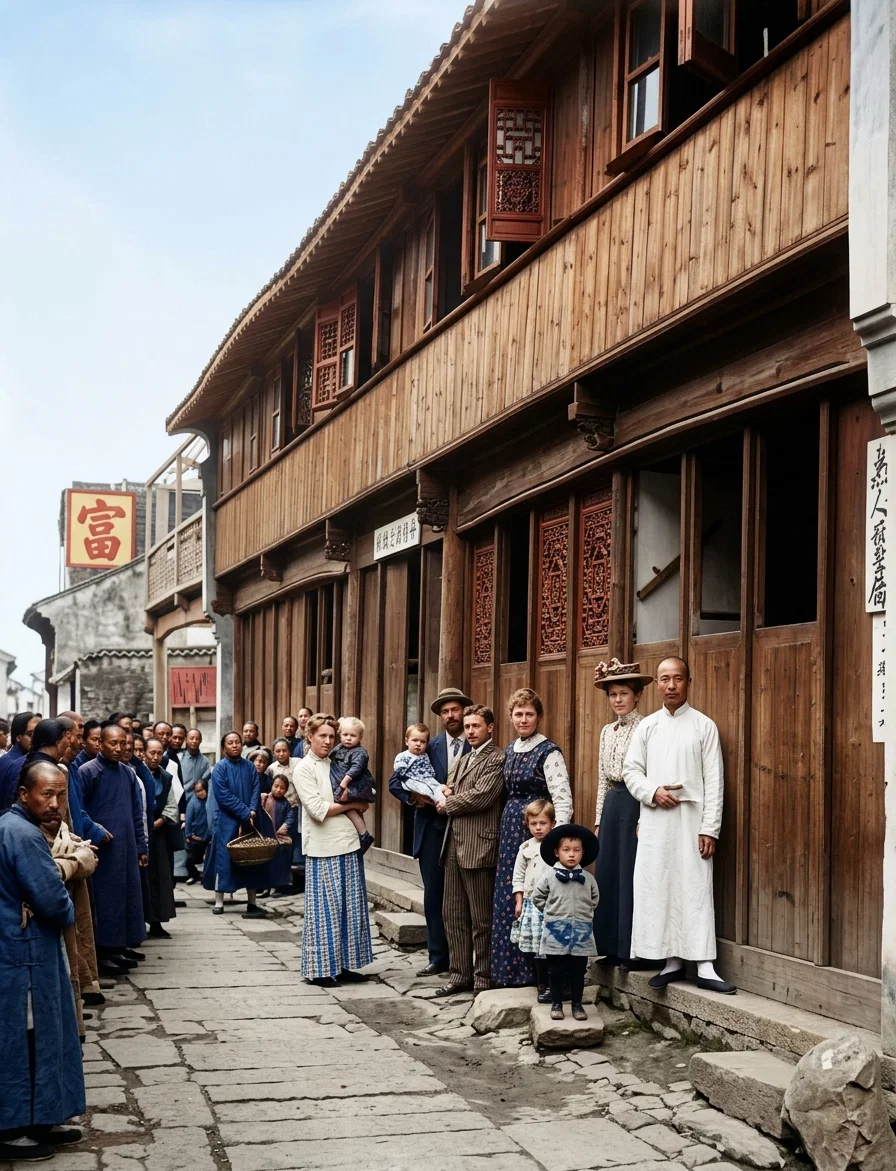
We fully believe that God directed in obtaining the present location, as it is in the best part of the city, and on the main street. The Chinese house is new, no one ever having lived in it before. This is a great consideration in China, as many of the old houses have been the shelter for almost innumerable diseases. The rent is very reasonable. The house is what is called a five-rafter house, and has ten rooms, five up-stairs and five below. The accompanying picture will give an idea of its outside appearance. Even though the house was new, I spent many days getting it ready to live in.
THE NEW CHEKIANG MISSION STATION, CHINA
Repairs, which were made by the crude methods of the Chinese, took time, as the green timber must first be converted into lumber. After a month and a half we were able to move in.
The workers assigned to this station were Sister B. Miller, who is a nurse, my wife and myself, and a native colporteur.
Moving from the boat outside the city wall, to our house, which is inside the wall, was surely an interesting sight. All our furniture was carried on bamboo poles by coolies. After getting settled, the next thing was to entertain the guests who flocked to us by the hundreds, or to know if we were the new gods, who came to heal and teach men to be good. From the first day we have never felt that we made a mistake in locating here.
We have opened a dispensary, and this work occupies much of Sister Miller’s time. God has blessed in the work. A number of serious cases have recovered, and some of these are now our best friends. They are so grateful that they wish to worship us; and thus we have opportunity to point them to the true God. I have spent some time in the dispensary, and find that there are many honest souls among these people. I do enjoy laboring for them, and have learned to love them. We are happy to be here and have a part in this work.
The people are eager to hear the truth, and have so earnestly requested us to hold meetings that we felt the necessity of opening a chapel where we could invite them to come and hear the truth. Our first service was well attended by a fine class of people.
One man has already come out of heathenism, and is worshiping the true God. We have morning worship for the Chinese in our chapel, and he attends regularly.
There is a great work to be done in China, which will call for more means and more workers. We have but three laborers in the Shanghai district, two of whom are spending their time largely in studying the language; and there are thirty millions of people speaking the Shanghai dialect to be warned. The Lord is blessing my wife and myself in our study of the language, but we wish we could do more in warning the people. When one sees the amount of work to be done in this generation, it fills the heart with an intense desire to do more.
We are of good courage, and are in better health than when we came, and can say that we are glad to be here in the Master’s service. Pray for the speedy advancement of the message in this needy field.
Shanghai.
Life’s Little Things
By Sir H. Davy
LIFE is made up not of great sacrifices or duties, but of little things, in which smiles and kindness, and small obligations given habitually, are what win and preserve the heart and secure comfort. — Sir H. Davy.