Your ShelfYour Projects

Signs of the Times, Vol. 26, No. 17.

THERE THEY CRUCIFIED HIM

Signs of the Times

Apr 25, 1900

Pacific Press Publishing Company · OAKLAND, CALIFORNIA · Apr 25, 1900

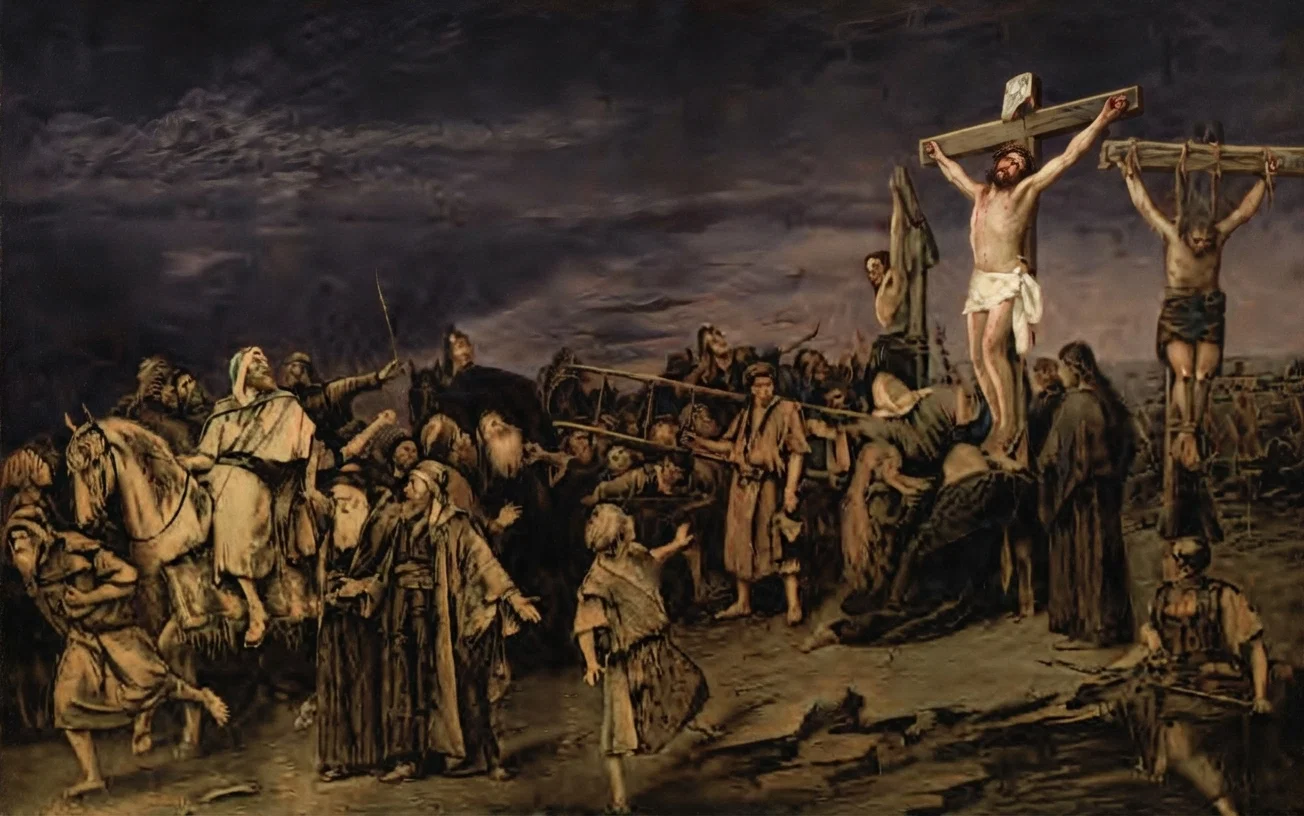
"THERE THEY CRUCIFIED HIM."

By Llewellyn A. Morrison, Toronto, Canada.
WHERE rough Golgotha's ramparts rise Without the "city gateway," I stand, beneath the Syrian skies, And, lo! there cometh straightway A throng, who lead a virgin's Son— Their hate-tipped tongues deride Him— Thorn-crown'd, cross-burdened, and undone; And "there they crucified Him." They strip, and spike Him to the wood, While traitors taunt and chide Him, 'Mid oaths and curses, tears and blood; And "there they crucified Him." I marvel when I hear Him pray, With pleading gaze above them; For as I listen He doth say, He does so truly love them, "Forgive them, Father, they forget." I wonder at the awful scene,— The pregnant passions swaying, The darksome deeds that so demean, Still fouler lust bewraying. I see the soldier stern and cold, The boaster who denied Him, The low-browed ruffian, bad and bold; And "there they crucified Him." I hear them cry, "Away with Him," And gnash their teeth upon Him, While vicious villains, gaunt and grim, Exude their vileness on Him. Those murderers beside Him, Unheeding still, refuse Him yet; And "there they crucified Him." The day shrank into night at noon, Appal'd at human blindness; The dead sprang free from death's long swoon, Thrill'd by His loving-kindness; All heaven shone out, in Him revealed— Nor hate, nor hell could hide Him; The vail was rent and love unsealed, Yet, still, "they crucified Him."

"CHANGED INTO THE SAME IMAGE."

THE Lord would have His chosen workers like their Pattern, who came to reveal God by living His law. Those who bear the vessels of the Lord are to be clean, their characters untainted, their influence uncorrupted, their names registered in the Lamb's book of life, men and women who are recognized in the heavenly courts as laborers together with God. The apostle Paul exhorts us: "Do all things without murmurings and disputings; that ye may be blameless and harmless, the sons of God, without rebuke, in the midst of a crooked and perverse nation, among whom ye shine as lights in the world; holding forth the Word of life; that I may rejoice in the day of Christ, that I have not run in vain, neither labored in vain." Unless those who believe the truth realize their obligations as followers of Christ, unless they understand the high principles which should be brought into their work, their light will not shine amid the moral darkness of the world. The true Christian will do all in his power to rise to the highest achievements. He will live in unity with his fellow-men, and will be a convincing argument to the world in favor of the grace of Christ.
The Saviour says, "He that will come after Me, let him deny himself, and take up his cross daily, and follow Me." He who will commence at the lowest round of the ladder and ascend, keeping heaven always in view, will become rich in heavenly treasure. God's Word is to him a mine of wealth. By bringing earnestness and self-denial into his ministry, he is making provision for an eternal reward. Those who follow Christ in self-denial will bear the fruit the Saviour bore, and even when their life shall close, the seed scattered by the trees of the Lord's planting will be multiplied to the praise and glory of His name. Men and women who will live the faith in its purity, and consecrate their powers to the development of Christian character, will be a power for good; for the true goodness of unselfish deeds will shine out in their lives.
"Whatsoever ye do in word or deed, do all in the name of the Lord Jesus, giving thanks to God and the Father by Him." God calls upon those who have talents to act their part in preparing a people to stand in the great day of the Lord. His workers are to be clad in all the armor of God. To be converted one day under the Holy Spirit's working is not enough. Let the Spirit of God cleanse the soul temple day by day. Let Jesus in. He invites you to receive Him. Covetousness and the other evils that dominate your lives are not such precious traits that you should be unwilling to part with them. I know that we have not risen to the height of our possibilities; for self is cherished as tho it were pure, untarnished gold. There are heights which we have not reached,—heights which, if we do not reach, we shall be "found wanting."
Let us pray more, and eat the words of life. Unless there is a deeper work of grace in mind and heart, unless we reveal true Christian charity, we can never see the face of God. Deny self, and take upon you Christ's yoke. Then the Lord will greatly bless you. The judgments of God are in the land. He is sending them upon men by land and by sea. While time still lasts, cease from cherishing pride and self-indulgence. Seek the Lord while He may be found; call upon Him while He is near. Humble the heart before God, and pray that He will reveal Himself.
Through His inspired apostle, Christ has shown us what the character will be when imbued with the love of Christ. "Charity suffereth long, and is kind; charity envieth not; charity vaunteth not itself, is not puffed up, doth not behave itself unseemly, seeketh not her own, is not easily provoked, thinketh no evil; rejoiceth not in iniquity, but rejoiceth in the truth; beareth all things, believeth all things, hopeth all things, endureth all things." This example is given us that we may know the heights we may reach in and through Christ. The standard He presents is perfection, and through His merits we may attain to this. We come short because we are content to look at earthly things rather than at heavenly.
What others may do, what others may say, what others may think of you, will not change God's thoughts toward you. He that doeth righteousness is righteous, and the opinion of men will not change His character. You have a heaven to win. Christ gave His own life that you might obtain the peace and rest and love of God. Keep looking to Jesus, who loves you, and whom you are to love. Invite the heavenly Guest to abide with you.
We have no excuse for remaining in spiritual weakness and poverty. God's Word declares: "Grace and peace be multiplied unto you through the knowledge of God, and of Jesus our Lord, according as His divine power hath given unto us all things that pertain unto life and godliness, through the knowledge of Him that hath called us to glory and virtue; whereby are given unto us exceeding great and precious promises; that by these ye might be partakers of the divine nature, having escaped the corruption that is in the world through lust." Every provision has been made, and it rests wholly with us whether we will believe the words of God.
We must have a knowledge of God by living experience. If we follow on to know the Lord, we shall know that His goings forth are prepared as the morning. Christ calls upon us to be filled with all the fulness of God. Then we can truly represent the perfection of the Christian religion. "Whosoever drinketh of the water that I shall give him," the Saviour declares, "shall never thirst; but the water that I shall give him shall be in him a well of water springing up into everlasting life." Christ wants us to be co-laborers with Him. When we are emptied of self, He will give us His grace to impart to others. The two olive branches, which through the two golden pipes empty the golden oil out of themselves, will surely supply the cleansed vessels with light and comfort and hope and love for those who are in need. We must render God more than fitful service. But we can do this only by learning of Jesus, cherishing His meekness and lowliness of heart. Let us hide ourselves in God. Let us have confidence in Him. Let us abide in Christ. Then we all "with open face beholding as in a glass the glory of the Lord, are changed into the same image from glory to glory,"—from character to character. God does not expect impossibilities from you or me. Beholding Him, we may be changed into His image.
Let the spirit be cleansed from all earthliness, all unholy, uncharitable thoughts. Let the words be clean, sanctified, vivifying, and refreshing to all. Be not easily provoked. Let the praise of God be in your hearts and upon your lips, that no evil thing may truthfully be said of you. God says you may govern yourself. He has provided the aid of the Holy Spirit, that you may put on Christ, and build up a pure, beautiful structure, in which God can delight. Sit in serious, earnest judgment on your defects. Look to Jesus. He gave His life a sacrifice for your sins, that He might present you pure and spotless before the heavenly universe. "As many as received Him, to them gave He power to become the sons of God, even to them that believe on His name; which were born, not of blood, nor of the will of the flesh, nor of the will of man, but of God. And the Word was made flesh, and dwelt among us, . . . full of grace and truth. . . . And of His fulness have all we received, and grace for grace."
Mrs. E. G. WHITE.

'THE TIME IS AT HAND.'

CHRISTIANS, Israelites indeed, citizens of the heavenly kingdom, have no time to engage in the political affairs of this sinful world. Their Master says, "Follow Me," and the one who does that will have no time for political conflicts or controversies.
Jesus Christ was the busiest Man in the world during His ministry, and His time was all occupied in doing the will of the Father which sent Him. Yet He did not in any way concern Himself with the manipulation or the consideration of political matters. Then it was not the Father's will that He should do so; and the servant who steps aside to engage in these worldly conflicts, or to endeavor to reform in a political way the evils of this world's governments, is not following Christ, and, therefore, is not doing the Father's will.
"Jesus Christ came into the world to save sinners" (1 Tim. 1:15), and not to regulate their civil affairs, either public or private (Matt. 22:15-22; John 18:36, 37; Luke 12:13, 14; 10:40-42). That He had not time for anything but the work which the Father sent Him to do is manifest from the fact that His legitimate work crowded upon Him even on the Sabbath day. John 5:10-17. Yet He said, "I must work the works of Him that sent Me, while it is day; the night cometh, when no man can work." Chapter 9:4.
The work that He was sent to do was constantly pressing upon Him, so much so that at times He and His apostles had not time to eat; and when they attempted to take a day's recreation, the multitudes followed them and demanded their attention. Mark 6:30-44. But He finished the work that He was sent to do without doing any political work at all; therefore, aside from the fact that He had not time for it, we have this evidence that it was no part of His work.
In emphasis of this principle we have the further fact that He sent His disciples to labor just as He had. "As Thou [the Father] hath sent Me [the Son] into the world, even so have I also sent them [the disciples] into the world." John 17:18. The commission (Matt. 28:18-20; Mark 16:15-18) limits their work to the line in which the Master worked. The apostle Paul said to the Ephesians, "I have not shunned to declare unto you all the counsel of God" (Acts 20:27), but he had said nothing about political duties. He, like the Master, finished his work (2 Tim. 4:7) without taking any part in politics or attempting any political reformation. Furthermore, His last advice to Timothy, and through him to other ministers, was, "Preach the Word."
Now if, in the time of Christ's earthly ministry, His time was necessarily all absorbed in the work the Father sent Him to do, because the time was coming when no man could work, how much nearer is that time now! And how much greater need for the people of God to give themselves exclusively to the work which the Master has commissioned them to do,—the work of saving individual souls, who may have a place in His kingdom when He comes to destroy (not to reform) all earthly governments, and to establish His own. "The time is at hand."
G.

SHOULD CHRISTIANS PAY TITHES?

THE word "tithe" means the one-tenth part. "All the tenth in Israel" was given by God to the Levites "for an inheritance." Num. 18:21. It was given to support the Levitical priesthood, who ministered in the tabernacle and in the temple during the old dispensation.
The tithes were given of fruit and of seed (Lev. 27:30) and of all things (2 Chron. 31:5). We are told by the wise man to "honor the Lord with thy substance, and with the first-fruits of all thine increase." Prov. 3:9.
The law to support the ministers of the sanctuary or temple on earth is explicit and was well understood by the Hebrews. When the types and shadows were fulfilled, and the vail of the temple was rent in twain, and the necessity for the continuation of the Levitical priesthood ceased, did the necessity of paying tithes cease also? It was certainly no longer obligatory to support by tithes an ecclesiastical function that God had clearly indicated had fulfilled its purpose.
The Gospel era gave a new message to the world. Messengers were to go "into all the world, and preach the Gospel to every creature." Mark 16:15. Does God want the ministers of the Gospel to be supported by tithes, as He directed the maintenance of the priests officiating in the earthly sanctuary?

The Two Tabernacles or Temples.

The Scriptures speak of two tabernacles or temples, one in heaven and the other on earth. The tabernacle built by Moses was a pattern of the true tabernacle in heaven. "And thou shalt rear up the tabernacle according to the fashion thereof which was showed thee in the mount." Ex. 26:30. When it was no longer necessary for the tabernacle to be moved from place to place, the Lord gave David the plans and specifications of a permanent temple, to be erected in Jerusalem by his son Solomon, "All this, said David, the Lord made me understand in writing by His hand upon me, even all the works of this pattern." 1 Chron. 28:19. This shows that both the tabernacle built by Moses and the temple built by Solomon, after the pattern given them by God, were direct representations in design and furnishings of the true temple in heaven—"a greater and more perfect tabernacle, not made with hands." Heb. 9:11. "The true tabernacle, which the Lord pitched, and not man." Heb. 8:2.

The Two Priesthoods.

As there are two tabernacles, so there are also two priestly orders. The one is the Levitical priesthood, that was ordained to officiate in the tabernacle and in the temple on earth. Num. 1:50. The other is the priesthood "after the order of Melchisedec."
Christ is our High Priest. "We have such an High Priest, who is set on the right hand of the throne of the Majesty in the heavens." Heb. 8:1. "Christ being come a High Priest of good things to come." Heb. 9:11.

Christ and Melchisedec.

Melchisedec was not Christ, but he was a priest-king, a type of Christ, our High Priest in the courts of heaven. "For that after the similitude of Melchisedec there ariseth another priest." Heb. 7:15. Note the parallel. The word Melchisedec means "king of righteousness." "Being by interpretation king of righteousness." Heb. 7:2.
Isaiah, in speaking of Christ, says, "Behold, a King shall reign in righteousness." Isa. 32:1. "And this is His name whereby He shall be called, THE LORD OUR RIGHTEOUSNESS." Jer. 23:6. Melchisedec was king of Salem. Heb. 7:1. Salem in Hebrew means "peace," "king of Salem, which is, king of peace." Heb. 7:2.
Christ is "the Lord of Peace." 2 Thess. 3:16. He guides "our feet into the way of peace." Luke 1:79. His name shall be called "The Prince of Peace." Isa. 9:6.
Melchisedec was "priest of the most high God." Heb. 7:1. "By so much was Jesus made a surety of a better testament." "The Lord sware and will not repent, Thou art a Priest forever after the order of Melchisedec." Heb. 7:22, 21.

Tithes to Melchisedec and to Christ.

Abraham paid tithes to Melchisedec when he returned from the slaughter of the kings; and by that act "Levi also, who receiveth tithes, paid tithes in Abraham" (Heb. 7:9), thus showing that the Levitical priesthood who received tithes from their brethren, actually paid tithes with their brethren, in the person of their father Abraham, to Melchisedec, who represented Christ as priest. It is evident, therefore, that the tithing system did not originate with the establishment of the Levitical priesthood. Gen. 14:20; 28:22.
Did the obligation for paying tithes cease when that priestly order had finished its mission in the tabernacle and temple on earth? The fact of Abraham, as the father of the blessed, paying tithes to Melchisedec, the representative of Christ, plainly shows that it is the obligation of every Christian to do as his father Abraham did.
By paying tithes to help support the ministry the Christian declares his faith in the fact that Christ died, arose from the dead, ascended into heaven, and is now officiating as his high priest in the presence of God. By being Christians we are reckoned as children of Abraham. "And if ye be Christ's, then are ye Abraham's seed, and heirs according to the promise." Gal. 3:29. When we accept Christ as our Saviour, we are then the children of Abraham. Abraham paid tithes to the one who represented the priestly office that Christ was to fill. We, his children, should pay tithes to Christ as our high priest. As the church, the body of Christ, is the immediate recipient of the tithes, God considers that they are paid to Him, and if we fail to pay an honest tithe, we are guilty of tithe-stealing; stealing not from man but from God. "Will a man rob God? Yet ye have robbed ME. But ye say, Wherein have we robbed Thee? [Answer] In tithes and offerings." Mal. 3:8.

The Reward.

"Bring ye all the tithes into the storehouse, that there may be meat in Mine house, and prove Me now herewith, saith the Lord of hosts, if I will not open you the windows of heaven, and pour you out a blessing, that there shall not be room enough to receive it." Mal. 3:10.
Is not this promise good enough and large enough for every follower of Christ to pay to Him an honest tithe and to give liberal offerings? CYRUS SIMMONS.

THE FALL OF SATAN.

WE are now prepared to follow Lucifer in the execution of his rebellious designs. Notice with what secrecy he begins his work. Not with the open frankness of an honest purpose did Lucifer say, "I will ascend into heaven, I will exalt my throne above the stars of God; . . . I will be like the Most High" (Isa. 14:13, 14), but secretly, in his heart, with that subtlety with which wickedness has ever sought to disguise its ugly deformity and cover up its baleful results.
Said Jesus: "Verily, verily, I say unto you, He that entereth not by the door into the sheepfold, but climbeth up [ascendeth] some other way, the same is a thief and a robber. But he that entereth in by the door is the shepherd of the sheep. . . . The thief cometh not, but to steal, and to kill, and to destroy; I am come that they might have life, and that they might have it more abundantly. I am the good Shepherd; the good Shepherd giveth His life for the sheep." John 10:1-11.
There are two ways. One is Christ, the way of self-denial, which leadeth unto life, and few there be that find it. The other is the "broad" way of self-exaltation and self-pleasing, which leadeth unto destruction. This is the other "way" which Lucifer in the beginning opened up. Thus he became the thief and robber, to kill the subjects of God's government, and to destroy the peace and harmony they possessed in blissful innocence.
"I will exalt my throne above the stars of God." This was the first step in Lucifer's scheme of self-exaltation. As has already appeared, Lucifer himself was one of the stars of God; hence the stars here symbolize the angels. Lucifer then aspired to rule (exalt his throne above) the angels. We have already seen that jealousy of Christ was the prime motive in instigating Lucifer to rebellion. The command of the angels of God had been bestowed upon Christ; for in 1 Thess. 4:16 we read that "the Lord Himself shall descend from heaven with a shout, with the voice of the Archangel, and with the trump of God; and the dead in Christ shall rise first." And in John 5:25 it is said that the dead are raised by "the voice of the Son of God." It is clear, then, that the Archangel is the Son of God. This honor Lucifer coveted, and he resolved to gain it.
There are other and more important motives which prompted this ambition on the part of Lucifer; these will be noticed later. "I will sit also upon the mount of the congregation ["assembly," Leeser's translation], in the sides of the North ["in the uttermost part of the North," R.V., "in the farthest end of the North," Leeser's translation]." Isa. 14:13.
And when Lucifer should realize this he would be "like the Most High." Let us stop here to study this step in Lucifer's program, that we may better appreciate the blind, frenzied zeal which was inspiring the covering cherub, and which was destined to cast him from the heights of heaven down, hopelessly down to hell, the uttermost sides of the pit. Verses 12, 15.
What is the congregation over which Lucifer would rule, and what the mount on which he aspired to sit? These questions are easily answered. Obviously, the "assembly" is the great host of God's children, "the general assembly and church of the first-born, which are written in heaven." Heb. 12:23.
Now as to the "mount" of the assembly, which, it will be remembered, was situated "on the sides of the North." In Ps. 48:1, 2 the following testimony occurs: "Great is the Lord, and greatly to be praised in the city of our God, in the mountain of His holiness. Beautiful for situation, the joy of the whole earth, is Mount Zion, on the sides of the North, the city of the great King." What mountain is located "on the sides of the North"? Answer—Mount Zion, the mountain of His holiness, the city of our God. To this seat of supreme exaltation, therefore, Lucifer aspired to rise.
But this is not all. Mount Zion, in the scripture just quoted is declared to be "the joy of the whole earth." When will this be realized?—"For, behold, I create new heavens and a new earth. . . . But be ye glad and rejoice forever [unto all eternity, Leeser's translation] in that which I create; for, behold, I create Jerusalem a rejoicing, and her people a joy. And I will rejoice in Jerusalem, and joy in My people." Isa. 65:17-19. From this, then, it appears that Lucifer's scheme comprehended not merely the rule of the church for a little time here in this world, but "unto all eternity" in the world to come.
Amazing as it may appear, it was, therefore, Lucifer's bold project to secure for himself the allegiance of the angels in heaven, and the church of Christ on the earth, and, lastly, to dislodge from His throne the Ruler of the universe, and to possess for himself the sacred precincts of the holy city, the Jerusalem of Jehovah, and make it the center of his usurped authority "unto all eternity."
Mount, or mountain, is a well-known symbol in the Scriptures representing power. To sit on the mount of the assembly would be to be exalted as the Ruler of the assembly. Let this point, then, be carefully noticed. Before Lucifer could hope to occupy that seat of supreme honor, which was beautiful for exaltation, the joy of the whole earth, the heavenly Jerusalem, the mother of us (the church) all, he must first be recognized as the head of the church here in the earth.
Again, we have seen that God was to make known to the universe through the church His manifold wisdom. To defeat this plan, Lucifer must in some way get control of the church here in the earth. This, therefore, was the great objective point in Lucifer's whole scheme—the essential feature of his mysterious program, to the accomplishment of which all his "traffic" was to be directed.
An additional reason for Lucifer's design to control the angels will now be appreciated. It was God's plan that angels should be "ministering spirits, sent forth to minister for them who shall be heirs of salvation." Heb. 1:14. This was the channel of communication between earth and heaven. These were God's messengers, by whom He would send supplies of heavenly grace to His trusting children on the earth.
If Lucifer could induce them to join him in rebellion, he could hope not only to intercept the communication between earth and heaven, thus cutting off the supplies of grace that God would send His children, leaving the church here in the earth weak, deprived of spiritual, heavenly companionship, an easy prey to his deceptive arts, but, by getting control of the angels, he would make them his agents in his own nefarious scheme, working through them to draw away the church from Christ, and thus subvert the whole government of God.
H. C. GILES.
[The next article in this series is "One-third of the Angels Join Lucifer in His Rebellion."]

REDEMPTION.

GOD so loved the world, that He gave His only-begotten Son, "a ransom for all," "that whosoever believeth in Him should not perish, but have everlasting life."
All need redemption, for all have sinned. Before sin entered, Adam was a free man. By yielding to sin he became a bond-servant, and all his children, the human family, with him were sold under sin.
But God in His great love for those alienated from Him, provided redemption for them all. None are passed by. All are sold; all are purchased back.
The price paid is the highest that can be given. "Forasmuch as ye know that ye were not redeemed with corruptible things, as silver and gold; . . . but with the precious blood of Christ." Man sold out for a moment of pleasure, but it took all that heaven could give to buy him again and restore him to his former estate. The high price paid is God's valuation of that which man sold for nothing.
But none need remain in bondage to sin. There is deliverance for all. Christ "gave Himself for us, that He might redeem us from all iniquity." It is not a partial redemption; it is complete, from all iniquity. "Sin shall not have dominion over you."
Freedom from sin is not all there is for the redeemed. "God sent forth His Son, . . . to redeem them that were under the law, that we might receive the adoption of sons." "Behold, what manner of love the Father hath bestowed upon us, that we should be called the sons of God." "If a son, then an heir of God." Precious privilege, dearly bought, yet how little esteemed of men!
"Christ hath redeemed us; . . . that we might receive the promise of the Spirit through faith," "that the righteousness of the law might be fulfilled in us, who walk not after the flesh, but after the Spirit." The life of Christ was a living example of the fulfilling of the righteousness of the law. We are redeemed that we might receive the promise of the Spirit, and thus be able to live just as Christ lived. "Thou wast slain, and hast redeemed us to God by Thy blood," "that we should be holy and without blame before Him in love; . . . to the praise of the glory of His grace."
"Behold, now is the accepted time; behold, now is the day of salvation." Now is the time to open the heart's door to Him "who of God is made unto us wisdom, and righteousness, and sanctification, and redemption." "Behold, I [the Redeemer from all iniquity] stand at the door, and knock; if any man hear My voice, and open the door, I will come in to him." Rev. 3:20.
It is not that we need to cry to God to redeem us—that He has already done so far as His part is concerned—but we need to seek Him most earnestly for hearts that are willing to receive all that He is more than willing to give to us.
With outstretched hands, God pleads with His sin-burdened, wandering children, "Return unto Me; for I have redeemed thee." With unwearied patience He calls, "Come unto Me;" "I have redeemed thee; . . . thou art Mine."
But all do not accept of redemption at the hands of God. They choose rather to continue in bondage to sin. Of such the Infinite Heart of love and pity has said: "Ye will not come to Me, that ye might have life." "How often would I have gathered thy children together, . . . and ye would not!"
"To-day if ye will hear His voice, harden not your hearts," but come to Him who has bought you with a price. Ask, and receive of Him that which He would give you, eternal redemption. Then, in gladness of heart, you can sing:—
"Redeemed, how I love to proclaim it! Redeemed by the blood of the Lamb; Redeemed through His infinite mercy; His child, and forever, I am." J. LOUISA IRELAND.

THE GOD OF LOVE.

'Not for your sakes, O house of Israel, . . . but for Mine own name's sake.' The love of God is self-originated. In it, as in all His acts, He is His own motive, as His name, 'I am that I am,' proclaims. It is inseparable from His being, and flows forth before, and independent of, anything in the creature which could draw it out. Men's love is attracted by their perception or their imagination of something lovable in its objects. It is like a well, where there has to be much work of the pump handle before the gush comes. God's love is like an artesian well, or a fountain springing up from unknown depths in obedience to its own impulse. All that we can say is: 'Thou art God. It is Thy nature and property to be merciful.'
'God loved the people.' The bed-rock is the spontaneous, unalterable, inexhaustible, ever-active, fervent love of God, like that with which a mother clasps her child to her maternal breast. The fair flower of this great thought came through Judaism. Let no man say that the God of love is unknown to the Old Testament.—Alex. McLaren, D.D. in Christian Commonwealth.

THE HOME OF THE SAVED.

THERE'S a beautiful haven, a home of delight, Where sorrows ne'er enter, nor shadows of night, But all things are perfect, resplendent in light, In that beautiful home of the saved. Rev. 21:25.
There's a beautiful river by faith I see, Whose sweet, crystal waters flow boundless and free, 'Neath the evergreen boughs of that life-giving tree, In that beautiful home of the saved. Rev. 22:1.
There are beautiful mansions awaiting us there, The great Master Builder has gone to prepare. In the grandeur of earth there is naught to compare With that beautiful home of the saved. John 14:3.
The redeemed of the Lord in their garments of white Shall join in glad anthems with angels of light, And the praise of their Maker, their chiefest delight, In that beautiful home of the saved. Rev. 7:9.
From loftiest mountain, or verdure-clad plain, I hear the sweet echo, repeat the refrain; For this blood-purchased land will forever remain The beautiful home of the saved. Isa. 66:22.
Spokane Wash. MRS. E. R. LEWIS.

The Signs of the Times

4 (260) THE SIGNS OF THE TIMES Vol. 26, No. 17.

The Zulus’ Astonishing Travel Speed

“The rate at which the Zulus can travel upon an emergency is astonishing. Some will go as many as fifty miles in six hours; eight miles an hour is an ordinary pace.”

Seek for God as for Gold

“SEEK for God as keenly as you seek for gold and you will soon find Him.”

Faith Takes Everlasting Life

"FAITH is the hand wherewith we take everlasting life."
Continue reading: THE DYING THIEF