Your ShelfYour Projects

Signs of the Times, Vol. 27, No. 31.

RECEIVING THE BLESSING

Signs of the Times

Jul 31, 1901

Pacific Press Publishing Company · Oakland, California · Jul 31, 1901

RECEIVING THE BLESSING.
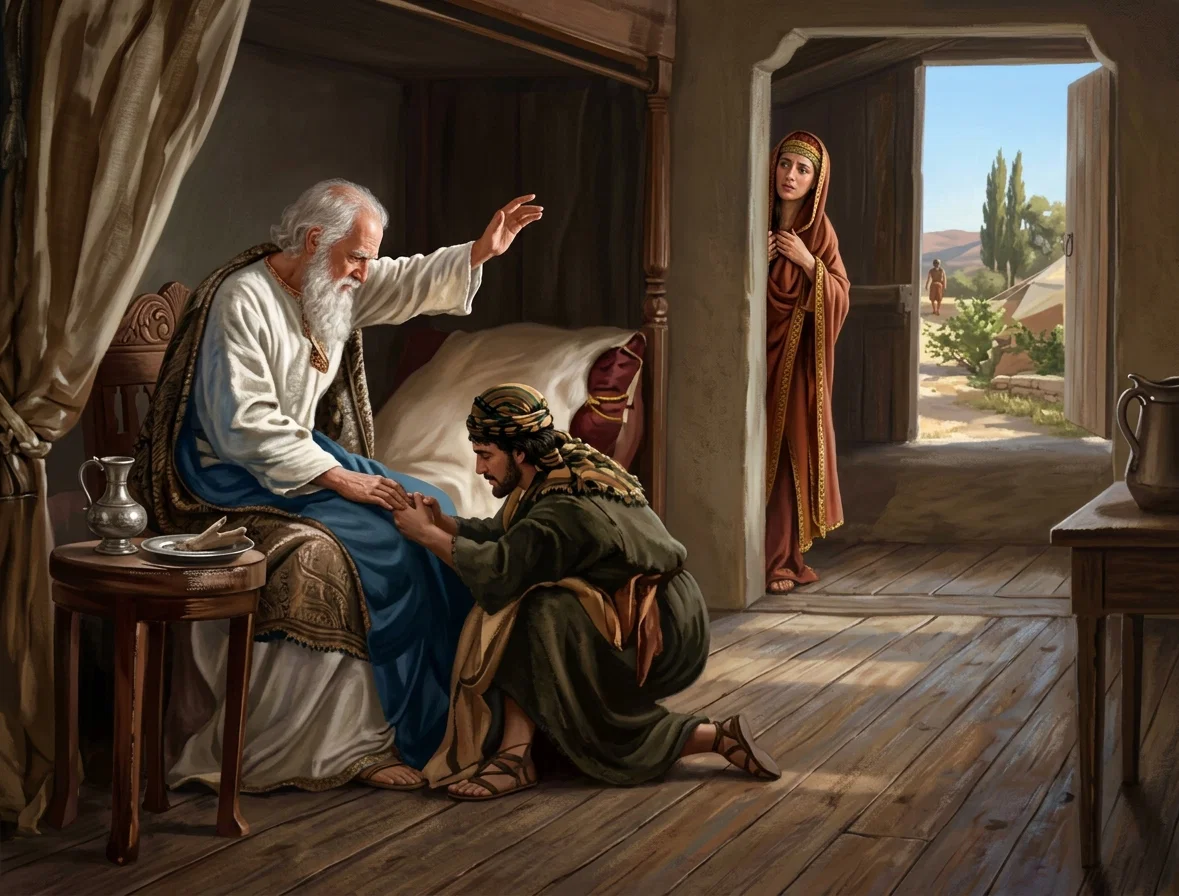
THE story of Jacob receiving the blessing from his father, Isaac, is one of the most interesting and instructive portions of sacred history. The record of it is found in the twenty-seventh chapter of Genesis.
WHILE the twenty-seventh chapter of Genesis gives the account of the manner in which Jacob obtained the blessing from his father, it is necessary to read several succeeding chapters and compare them with other portions of the Scriptures, in order to get a view of the whole subject.
THE outline of the story is this: The Lord had foretold that Jacob would be a prince in Israel, and inherit the blessing that Heaven had decreed upon his grandfather Abraham and his father, Isaac. But when Isaac had reached the time when he knew he must soon die, he was arranging to pronounce the blessing upon Esau, the brother of Jacob, rather than upon the one to whom the Lord had given the promise. Rebecca, the mother of Jacob, determined that this would never do, so she urged Jacob into practising a gross deception upon his father. By that means the blessing was given to Jacob while his brother Esau was in the fields hunting. When Esau returned, and learned what had been done, he was so enraged at his brother that he resolved to kill him. Rebecca found this out, and helped Jacob to flee to her father's people in a distant country. In that place he had to remain for many long years, and pass through many bitter experiences.
IF that mother had let the Lord alone in the work He had planned, the blessing would have come to her son just as God had promised. But when she became nervous, and feared that the Lord might need a little human ingenuity to help Him out, she brought upon herself the sad experience of being wholly separated from the son who was such a comfort to her, and plunged that son into many difficulties, hardships, and distresses. When the Lord promises a thing, it is well for us to know that He will perform it at the proper time. We should not become impatient, or uneasy, but quietly wait on the Lord. When we get ready to receive His blessings, He will very promptly bestow them.
JACOB was the supplanter. His name signified that, and his character was true to the meaning of his name. And while he was Jacob, that is the supplanter, he was ever in difficulty because of his sharp and deceptive practises. God could love the man while he was in that condition; but He could not give him his new name, and pour upon him the blessing that Heaven had designed.
WHEN Jacob, with his family, in after years decided to return andcomfort his father in his closing years, he found that the anger of his brother Esau was still burning. For when Jacob was yet at quite a distance from the old home place, he learned that Esau was coming to meet him with a band of four hundred armed men, determined still to take his life. Then it was that Jacob began as never before in his whole life to wrestle for a change of heart. He clung to the Angel, the Prince of Peace, for the blessing that the hand of God alone could bestow; He made full surrender. The change of heart came, and with that change there came the blessing from Heaven. A new name was given to the converted patriarch. “Thy name shall be called no more ‘Jacob, but Israel [that is, a prince of God]; for as a prince hast thou ‘power with God and with men, and hast prevailed.” Gen. 32:28. The rough and cunning hand of the supplanter was gone. The persuasive powers of love had taken possession of his soul, and he had power with men then, because he had power with God. Then when he met his brother Esau, he found him also friendly. He had no use for an army with which to meet the army of his angry brother.
THIS conversion was real and absolute. It made a heavenly prince out of a supplanting, scheming son of earth. And now Esau no longer sees the supplanter Jacob, for he is gone. The supplanter has been divinely transformed, and is another character. This changing of Jacob, the supplanter, to the prince of God, the prevailer, took away all the ground for Esau’s quarrel. He whose heart was consuming with the fires of murderous anger at the man Jacob, was transformed by the tender emotions of love when he met instead the humble, kind, and truly noble prince of God.
WHEN Jacob was converted and received his new name, his troubles over his personal sins were gone, and he could now devote a heart made full of heavenly tenderness to the work of helping and uplifting others. This blessing that came to Jacob through the night of wrestling, followed by the morning of surrender, is in store for every one of us. Will we make the full surrender to God, and then receive His full and complete blessing? T.

A PERFECT LAW.

GOD, the great governor of the universe, has put everything under law. The tiny flower and the towering oak, the grain of sand and the mighty ocean, sunshine and shower, wind and rain, all obey nature’s laws. But man has been placed under a higher law. He has been given an intellect to see, and a conscience to feel, the powerful claims of God’s great moral law, the expression of what He desires His children to be.
God has made known His will so plainly that none need err. He desires all to have a correct understanding of His law, to feel the power of its principles; for their eternal interests are here involved. He who has an understanding of the far-reaching claims of God’s law can understand something of the heinousness of sin. And the more exalted his ideas of God’s requirements, the greater will be his gratitude for the pardon granted him.
God’s law reaches the feelings and motives, as well as the outward acts. It reveals the secrets of the heart, flashing light upon things before buried in darkness. God knows every thought, every purpose, every plan, every motive. The books of heaven record the sins that would have been committed had there been opportunity. God will bring every work into judgment, with every secret thing. By His law He measures the character of every man. As the artist transfers to the canvas the features of the face, so the features of each individual character are transferred to the books of heaven. God has a perfect photograph of every man’s character, and this photograph He compares with His law. He reveals to man the defects that mar his life, and calls upon him to repent and turn from sin.
There are those who say, “Give me Christ, but I want nothing ‘of the law.” They talk of the grace of Christ, but they know not the meaning of grace; for God does not use His grace to make void the law. Satan has confused their minds, leading them to look upon the law as a yoke of bondage, a hindrance to spirituality. They talk of faith, but they know not the meaning of the word; for faith is never found apart from truth. The peace which they boast their faith gives them is but self-righteous confidence. Let no one claim that he has been accepted by Christ, and is living without sin, while at the same time he is, like Lucifer, waging war against God’s law, aiding the enemy in the very work which he commenced in heaven and is carrying forward on this earth.
Thousands to-day are transgressing God’s law, advocating the ideas which for ages Satan has been manufacturing. Like the proud Pharisees, they are ignorant both of the Scriptures and of the power of God. Wrapped in the darkness of unbelief, they refuse to search the Scriptures for themselves. They accept fables in the place of truth. They claim God’s promises while they break His precepts. In the last great day they will say to Christ, “Lord, Lord, have we ‘not prophesied in Thy name, and in Thy name cast out devils, and in ‘Thy name done many wonderful works?” But Christ will answer, “I never knew you; depart from Me.”
The natural heart rebels against the requirements of God’s law. It was the law against which Satan fought in heaven, and those who are controlled by him will hate its principles. But let them remember that when they cast reproach at the law, they cast reproach at Him with whom the law originated. He who while trampling on the law of God claims that Christ has forgiven his sins, knows not of what he is talking. John declares that sin is the transgression of the law. If there were no law, there would be no sin. Those who claim to love Christ, while at the same time they refuse to obey Him, are like fountains which send forth impure water. Professing to follow Christ, they do the work of the adversary. Their faith is dead; for it is unsupported by good works. They can no more be saved by their faith than can the fallen angels, who believe and tremble, by their faith.
For the highest good of His creatures, God has given a perfect law, a law that demands perfect obedience. God compels no one to obey this law. He leaves men free to decide whether they will obey and receive the reward of obedience, or disobey and receive the punishment of transgression.
Let us study God’s law in connection with the work of Christ. Man broke the law. Christ came to this earth to make an atonement for transgression. His atonement was complete in every part. As He hung on the cross, He could say, “It is finished.” The demands of justice were satisfied. The way to the throne of grace was opened for every sinner.
The law stands firm, and justice sternly points the sinner to its holy precepts. It is not the province of the law to save the sinner, but to condemn, not to pardon, but to convict. It can not be changed to meet man in his fallen condition. Then how is God’s justice to be satisfied and His favor obtained? Not by works; “for by the deeds ‘of the law there shall no flesh be justified in His sight.” In his own strength the sinner can not meet the demands of God. He must go for help to the One who paid the ransom for him. It is impossible for him of himself to keep the law. But Christ can give him strength to do this. The Saviour came to this world and in human flesh lived a life of perfect obedience, that the sinner might stand before God justified and accepted.
Christ is our hope. Those who trust in Him are cleansed. The grace of Christ and the government of God walk together in perfect harmony. When Jesus became man’s substitute, mercy and truth met together, and righteousness and peace kissed each other. The cross of Calvary bears witness to the high claims of God’s law. Christ did not die to encourage man in rebellion against God, but to provide a way whereby he might keep the whole law. His garment of spotless righteousness clothes the repenting, believing sinner. He is made unto us wisdom and righteousness and sanctification and redemption.
MRS. E. G. WHITE.

PUT AWAY THAT WICKED PERSON.

THE crime of the church to-day is treating sins such as deserve expulsion “from the kingdom of grace and glory” as tho they were faults, and paying no attention whatsoever to faults; and it is on account of the almost universal complicity in this crime that the number of worthy men increases, who decline to associate with churches which retain among their members so many that in business and social and political life they have ascertained to be unworthy of confidence, until there are communities where the average morality outside of the church is higher than that within.—Christian Work.

The Needle of the Law and Gospel Consolation

A Scotch preacher once said: “You never saw a woman sewing without a needle. She would make but poor speed if she only sewed with a thread. So I think when we are dealing wi’ poor sinners we maun aye put in the needle of the law first; for the fact is the’re sleepin’ sound, and they need to be wakened up wi’ something sharp. But when we’ve got the needle of the law fairly in, we may draw as lang a thread as we like o’ Gospel consolation after it.”

FROM REPUBLIC TO MONARCHY.

We have seen that in the abandonment of her constitution by the republic of Rome in the government of her new foreign possessions, her new system “necessitated the appointment ‘of governors, whose position was absolutely incompatible . . . ‘with the Roman constitution.” And all people have seen this course identically followed to date in the course of the republic of the United States.
We have seen that under the new systems adopted by the republic of Rome in the government of her new possessions and tributary subjects, the Roman “governor appeared there in the position of a ‘king;” and that in maintenance of the theory and the new system adopted, it was essential that the governor should in practise “actually ‘hold toward the new subject peoples exactly the attitude, as well as ‘the position, of a king.” And tho the governing party in the State thought to keep the constitution intact at home while abandoning it abroad, they and all soon found that the constitution at home was giving way in their hands; and that as certainly as the new systems were continued, the constitution must be abandoned at home as well as abroad. And the new system was continued,—with “not the letter, ‘but the practise of the existing constitution” wholly changed: a few men in power in the State, “usurping in substance the government, ‘and remodeling the constitution according to their own views.”
The process through which this all occurred in the republic of Rome is interesting; and, in view of the fact that Rome’s course up to the point of open repudiation of her constitution and fundamental principle has already been covered in the “progress” of the republic of the United States, is also vastly important.
When the Roman appointee went out from home to the place of his governorship, he went as a republican—the representative of the republic; but when he reached the place of his governorship, “he ‘appeared there in the position of a king;’ and he maintained there the air and circumstance of king. This he was obliged to do, under the theory, and according to the system, adopted for the government of the new possessions and tributary subjects. “But it was not practicable for any length of time to be at once REPUBLICAN and KING.”—Mommsen.
And, since it was not practicable for any length of time to be at once republican and king; and since in that place he appeared, and according to the theory and system under which he was there, he must appear there “in the position of a king;” it was inevitable that the republican must vanish, and only the king remain. Accordingly “the governors ruled virtually as sovereign. . . . This emancipation of the supreme administrative officials from the central authority ‘was more than HAZARDOUS. The Roman governor, placed at the ‘head of the armies of the State, and in possession of considerable ‘financial resources; subject to but a lax judicial control, and practically ‘independent of the supreme administration; and impelled by a sort of ‘necessity to separate the interests of himself and of the people whom he ‘governed, from those of the Roman community, and to treat them as ‘conflicting; far more resembled a Persian satrap than one of the commissioners of the Roman Senate at the time of the Samnite wars.’”—Mommsen.
As another inevitable consequence, this occupying the position, and playing the part of “satrap,” of “sovereign,” of “king,” “demoralized the Roman ruling class with fearful rapidity. Haughtiness and ‘arrogance toward the provincials were so natural in the circumstances ‘as scarcely to form matter of reproach against the individual magistrate.”—Mommsen. It actually developed in them, as their abiding character, the very spirit and disposition of “satrap,” “sovereign,” and “king.”
This would have been bad enough in its results upon the governors themselves, and the tributary subjects whom they governed, if the colonies had been the only field of the exercise of it, and if only the governors had remained permanently in those fields. But when, as was the fact, the term of the governors was short, and the rotation in the office was comparatively rapid; and when these governors returned home, and, as was also the fact, carried with them this same haughtiness and arrogance, this same spirit and disposition of “satrap,” “sovereign,” and “king;” then the evil was even far worse, for thus it was extended to the government and people at home. He who had developed the abiding spirit and disposition of “satrap,” “sovereign,” and “king” abroad, remained in spirit and disposition, in haughtiness and arrogance, “satrap,” “sovereign,” and “king,” at home when he returned home. When he returned to Italy, he held toward the people of the home government the same attitude of superiority, and the same air of sovereignty, that he had held toward the tributary subjects abroad. For “the man who had just conducted a legalized ‘military tyranny abroad, could with difficulty find his way back to ‘the common civic level which distinguished between those who com- ‘manded and those who obeyed, but not between masters and slaves.”—Mommsen.
Thus the refusal of the republic of Rome to extend her constitution abroad, destroyed the constitution at home: her refusal to extend republican principles to peoples abroad, subverted republican principles at home: her adoption of the principle of monarchy abroad, dragged her into monarchy at home. Thus it was that “punishment followed ‘in the steps of wrong,’ that the ‘demoralization of the Roman ruling class’ followed ‘with fearful rapidity,’ and the government which they themselves were conducting gave way in their own hands. And they saw that the government was giving way under their own hands; and they tried various schemes to save it. These attempts “very clearly evince the anxiety felt by the more far-seeing of the ‘Roman statesmen as to the fruits of the seed sown. But diagnosis ‘is not cure.’ All their remedies were merely aimed at results, while the great cause was left untouched. Therefore, “the internal government of the nobility continued to follow the direction once given ‘to it; and the decay of the administration and of the financial system ‘—the precursor of future revolutions and usurpations—steadily pursued its course, if not unnoticed, yet unchecked.”—Mommsen.
They themselves finally recognized that the government was going fatally wrong; but then the tide had become too strong: they could not stem it. When they had taken the first step, they would not turn back; and now they had taken so many further steps that they could not turn back. They then consoled themselves that “destiny” was upon them, resigned to “destiny” their own intelligent responsibility, and dully allowed the government to drift on to what all the world knows was the greatest civil despotism that the world ever saw; this next, through a union with the apostate church, developing a religious despotism; and next the Roman government finding herself engulfed in the greatest ruin that ever befell an empire.
Such was the course of the republic of Rome from the point—the appointment of governors whose position was absolutely incompatible with the constitution, and who appeared in the position of a king—to which, in less than four swift years, the republic of the United States has step by step followed her.
Will this republic now turn back? Will the republic of the United States, even now, learn the “one lesson which history clearly ‘teaches—that free nations can not govern subject provinces: if they ‘are unable or unwilling to admit their dependencies to share their ‘own constitution, the constitution itself will fall in pieces from mere ‘incompetence for its duties’?
Will the republic of the United States learn this lesson and turn back? or will she too resign to “destiny” intelligent responsibility, and inevitably drift steadily downward to civil despotism, and religious despotism, and awful ruin?
Daily events are daily answering these questions, and are loudly declaring that the course of the republic of Rome, having been already followed so far and so exactly, will be followed to the end by the republic of the United States.
“For these reasons the fall of the Roman republic is exceptionally instructive to us.” Will the people of the American republic be instructed?
ALONZO T. JONES.
Ancient History Which Is Also Modern

BE FILLED.

Not a taste, not an occasional touch, but a fulness!
The privilege of each and every believer is to drink in, not a scant supply, but to be filled. And when we obey the divine injunction, then follows the glorious overflow.
“The world and the devil are too strong for a Christian life ‘hampered, and hindered, and limited by carnality.’” Be cleansed; be filled.
David speaks of his cup running over. Jesus tells us that out of our inmost parts shall flow rivers of living water. Therefore, to be filled is not a selfish thing, seeing we are filled for a purpose.
Be filled, and it will be easy for you to rejoice. The great needjust at present is happy, bright jubilant Christians, therefore be filled.
The Israelites were making good headway on their march toward the Promised Land, when all at once they suffered a sad reverse. We read in Numbers 14, they lifted up their voices and murmured, and for so doing they were sent back into the wilderness. Be filled, and the murmuring spirit will take its flight. Be filled, and you will rejoice evermore. Be filled, and you will pray without ceasing. Be filled, and you will in everything give thanks. O reader, be filled! Be filled!! Be filled!!!—Christian Worker.

THE DISAPPOINTMENT OF 1844.

In predicting the end of the world in 1844, the leaders in that message made the mistake of resting in the idea that the sanctuary to be cleansed at the end of the 2300 years was the earth itself. It was therefore believed that the cleansing to take place would be the purification of the earth by fire, preparatory to the coming of Christ to reign among His saints. Looking back, we may see what they failed to note, namely, that inasmuch as the angel representing that message was “clothed with a cloud,” the message must also be one purposely enshrouded in somewhat of a mystery. Rev. 10:1, 3, 4.
This mystery, too, was destined to lead its promoters into bitter disappointment, because even this was foreshadowed by the experience of the revelator, who typified the people to receive and give out the message. The message itself was represented as being absorbed through eating a “little book,” from which the partially obscured angel proclaimed the word. The prophet was, however, told beforehand that while eating the book it would be sweet to the taste, but as soon as it was eaten it would be bitter in the stomach. Verses 9, 10.
The meaning of this symbolism is plain, when we examine other scriptures carrying the same expression. Another prophet was shown the roll of a book, and was told, “Eat this roll, and go speak unto ‘the house of Israel.’” Eze. 3:1. In verse 3, the command was put in a little different form, as follows: “Son of man, cause thy belly to ‘eat, and fill thy bowels with this roll that I give thee. Then did I ‘eat it; and it was in my mouth as honey for sweetness.” From this it is evident that to eat a book, in the prophetic sense, is to take in its contents, so that one is filled with its sentiment, and so prepared to open his mouth to proclaim it to others. This thought is fully sustained by the expression of another, “Thy words were found, and I ‘did eat them.’” Jer. 15:16.
So in the days leading up to 1844. Those who proclaimed that time message, had become filled with its spirit. It was so sweet to them that they joyfully and confidingly rehearsed it in the ears of all. Accompanying their exultant proclamation, the people prayed long and earnestly, “Come, Lord Jesus, and come quickly.” But the set day came and went without revealing the personal presence of Him whom their longing eyes waited to see. Nothing was then left but again to take up the burden of life’s cares, and to endure the taunts of a scoffing world. Captain Bates of Fairhaven, Mass., who was then prominent in proclaiming the close of time, and who invested a fortune in that work, had even permitted his larder to become exhausted. The day following the disappointment he went forth from his home to purchase a few pence worth of provisions, and met men who had formerly bowed with respect before him. But on that occasion they only sneeringly said, “Well, Captain, I thought you were going up yesterday.” Even street urchins followed at his heels shouting in chorus, “Why ‘didn’t you go up yesterday?’” In telling of this experience many years later, the good old man said to the writer, “You can never know ‘the bitterness of that disappointment. The thought that we again had ‘to take up the routine of life in a sinful world, when we had been so ‘certain of release from these things to dwell with the Lord in glory, ‘the picture was so changed, that it was hard for us to be reconciled.’”
But this was a test to that people, as was the disappointment of the immediate disciples of Christ who expected Him, at His first advent, to take the throne of David and commence His promised reign. Some then went back to their old ways, to be reprovingly recalled by their divine Master. John 21:3–18; Acts 1:6. So in 1844. Some who had been zealous in proclaiming the soon coming of the Lord, went back to the ways of the world, repudiating their former experience, while others held on to what light they had, believing that God would in time reveal to them their whereabouts, and the reason for apparent delay in the closing of the world’s history.
Had not the eyes of the people then been holden by some mystic power, they surely would have seen that the message they so earnestly proclaimed was not the closing one to earth’s inhabitants; for after pointing out the bitterness of the disappointment to be met, the angel plainly said in Rev. 10:11, “Thou must prophesy again before many ‘peoples, and nations, and tongues, and kings.’” This doubtless referred to the three messages of Revelation 14, which were to be the key-note of the everlasting Gospel from that time to the end. These three messages (Rev. 14:6–12) are so closely related that they form one great three-fold message, and wherever one is proclaimed, the others must also be published. So, then, when the angel of Revelation 10 proclaimed that time (the 2300 days of Dan. 8:14) should be no longer, and the event came to which these days of “time” reached, namely, the cleansing of the sanctuary or the investigative judgment, it was meet for another angel to follow, proclaiming that the hour of judgment was really come, with a call for people to turn from false worship to the service of Him who created heaven and earth, the sea, and the fountains of waters. Such a reform was sure to develop a people who would recognize the rule of heaven, by keeping the commandments of God and the faith of Jesus. Rev. 14:12. It is the message to be given by this prophesying again, which fits a people actually to stand without fault before Him who comes quickly, wearing a golden crown, and holding in His hand a sickle, the symbol of authority, to reap earth’s final harvest of those prepared to meet the Master, and dwell eternally in the kingdom of God. Rev. 14:14, 15.
J. O. CORLISS.

PRAY, PRAY!

1. To WHOM shall we pray?
“Lord, hear my voice; let Thine ears be attentive to the voice of my supplications.” Ps. 130:2.
2. When shall we begin to pray?
“My voice shalt Thou hear in the morning, O Lord; in the morning will I direct my prayer unto Thee.” Ps. 5:3.
3. How often shall we pray?
“Pray without ceasing.” 1 Thess. 5:17. “Men ought always to pray, and not to faint.” Luke 18:1.
4. How shall we pray, and for what?
“Be careful for nothing; but in everything by prayer and supplication with thanksgiving let your requests be made known unto God.” Phil. 4:6. “Ask in faith, nothing wavering.” James 1:6.
5. What will be the sure result?
“And the peace of God, which passeth all understanding, shall keep your hearts and minds through Christ Jesus.” Phil. 4:7.

THE FAMED BLUE LAWS.

The blue laws of Connecticut were so-called because they were printed on blue-tinted paper. These are some of them:—
No one shall be a freeman, or have a vote, unless he is converted and a member of one of the churches allowed in the dominion.
No dissenter from the essential worship of this dominion shall be allowed to give a vote for electing magistrates or any other officer.
No food or shelter shall be offered to a heretic.
No one shall cross the river on the Sabbath but an authorized clergyman.
No one shall travel, cook victuals, make beds, sweep houses, cut hair, or shave on the Sabbath day.
No one shall kiss his or her children on the Sabbath, or feast days.
The Sabbath shall begin at sunset Saturday.
Whoever wears clothes trimmed with gold, silver, or bone-lace above one shilling a yard, shall be presented by the grand juror, and the selectmen shall tax the estate £300.
Whoever brings cards or dice into the dominion shall be fined £5.
No one shall eat mince-pie, dance, play cards, or play any instrument of music except the drum, trumpet, or jews-harp.
No man shall court a maid in person or by letter without obtaining the consent of her parents. £5 for the first offense, £10 for the second, and for the third imprisonment during the pleasure of the court.

QUESTIONS FOR CHRISTIANS.

Does your milkman know that you are a Christian?
Does your newsboy suspect that you belong to the church?
Has your washerwoman discovered that she is toiling for a child of God?
If you had to go to heaven on the testimony of your dressmaker, could you do it?
Have your wife and children gained anything by your joining the church?
What kind of church would yours be, if the members were all just like you?—Chimes.

THE CRY OF “PEACE, PEACE, WHEN THERE IS NO PEACE.”
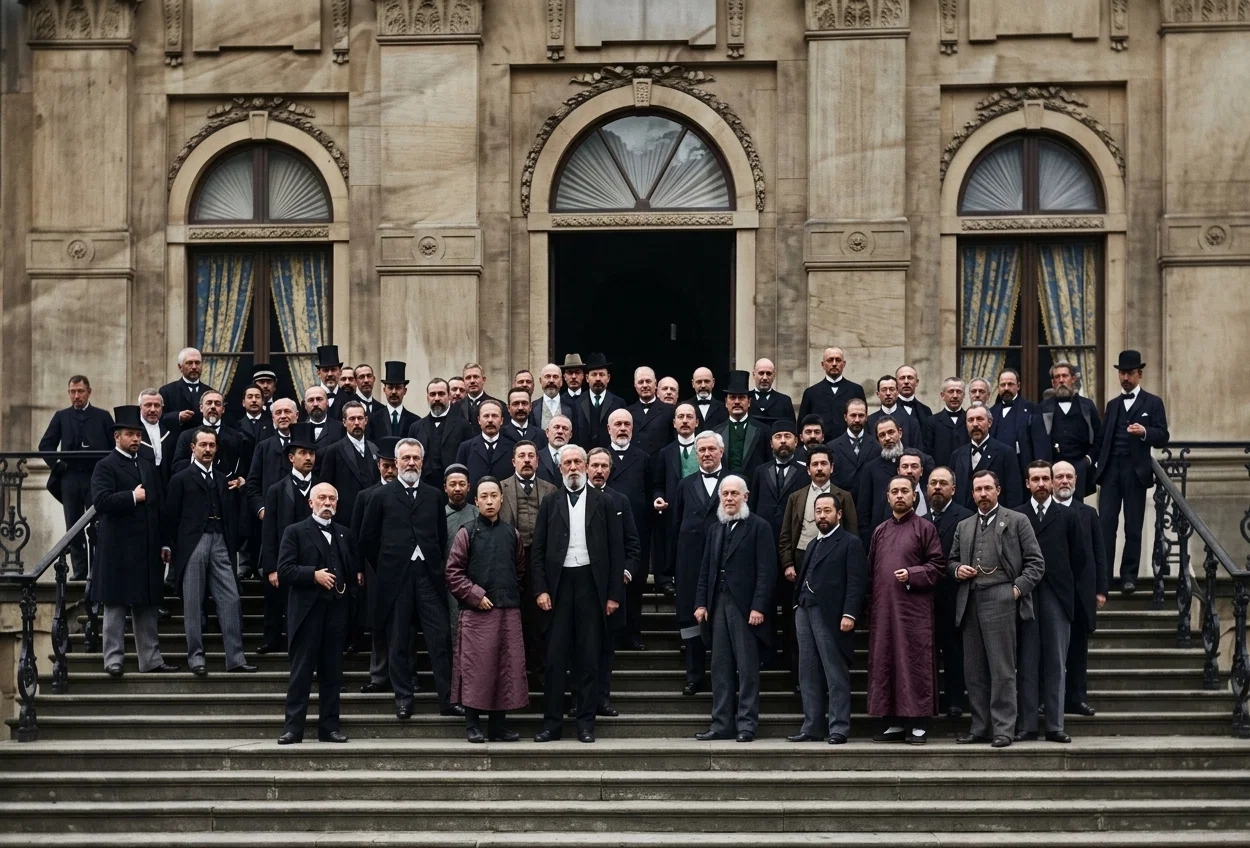
The calling of the Peace Congress at the Hague, the response to that call in the sending of representatives, by all the great nations of the earth, were hailed by many in all the earth as the glorious beginning of better times; by some as the dawning of the millennium of peace when the war-drums would be muffled and the battle-flags be furled in the Parliament of Man, the Federation of the World. Institutes or regulations were drawn up, committees were appointed, and it was hoped by many that all future troubles would be settled by arbitration.
But how futile were these hopes. Two of the great nations whose representatives contributed greatly to the results obtained, went forward with their wars of subjugation. To great, fair-play-loving England the little Boer republics must submit, even tho the price be paid that would stagger humanity. And America, liberty born and bred, must pursue her way of “benevolent assimilation” among the natives of far-off islands, who for years have been fighting for liberty, even tho she strew every wave of the broad reaches of the Pacific with her own dead, and slay thousands of those who never thought her harm till she demanded their subjection.
England faces a deficit in her South African War of more than $275,000,000. She has added to her national debt the vast sum of $300,000,000. Expenses of the present year are estimated at $938,000,000. The loss of life can not be measured by dollars either to England or the little Boer republics. Following these wars came the fearful massacres in China, with all the powers of Europe engaged. The barbarity and cruelty of this struggle, in many cases, will not bear description. The cruelty of the heathen Chinese has been equaled or exceeded by “Christian” Europe.
Members of the Peace Conference at the Hague. From a Photograph by A. van der Grient, Hague. (R. Groote & Co., Amsterdam, Publishers.)
And the great preparation for war still goes on. Men talk of peace, and declare that it is soon coming, right in the face of the expenditure of millions for slaughter weapons. But these very things are what the “more sure word of prophecy” declares will be manifest in the last days. God’s seer declares that “many people,” and “many nations,” shall proclaim peace. Isa. 2:3-5; Micah 4:2-5. But the Arbiter of nations declares that these peace-proclaimers “are soothsayers like the Philistines, and they please themselves ‘in the children of strangers.’” Isa. 2:6.
On the other hand, the same inspired Word declares what will come:—
“Proclaim ye this among the Gentiles: Prepare war, wake up the mighty men, let all the men of war draw near; let them come up: beat your plowshares into swords, and your pruning-hooks into spears; let the weak say, I am strong. Assemble yourselves, and come, all ye heathen [nations], and gather yourselves together round about; thither cause thy mighty ones to come down, O Lord. Let the heathen [nations] be wakened, and come up to the Valley of Jehoshaphat; for there will I sit to judge all the heathen round about. Put ye in the sickle; for the harvest is ripe; come, get you down; for the press is full, the fats overflow; for their wickedness is great. Multitudes, multitudes in the valley of decision; for the day of the Lord is near in the valley of decision.” Joel 3:9-14.
We see it all. The divine pencil, 2,700 years ago, limned the picture that we now see portrayed in life. The nations are preparing war, weak and strong. They are coming up to the great battle of Armageddon. The spirits of demons are stirring up the nations to war (Rev. 16:13); and just beyond lies the great day of God, and the harvest, which is “the end of the world,” or age (Matt. 13:39; Rev. 14:14, 15). And God has told us much more. “Seek ye out of the Book of the Lord, and read.” “O earth, earth, earth, hear the Word ‘of the Lord.’” Be not deceived by the solacing cry of “Peace, peace;” “for when they shall say, Peace and safety; then sudden destruction cometh upon them, . . . and they shall not escape.” 1 Thess. 5:3.
Continue reading: PERILS IMMINENT AND OMINOUS