[All questions to this department will be answered which to the editors will seem to minister to the good of the readers and to the mission of the paper. The same question can not be answered repeatedly in the same volume. The name and address must accompany question, not for publication, but as an evidence of good faith, and that answer may be made by letter if deemed advisable. It is well always to enclose a stamp for reply.]
2442.—Guilty of the Death of Christ.
Some of us who believe in Christ as the Saviour and Son of God claim that the historical part of the Jewish contention is true; not that the Jews did not kill Christ, but that the Romans are the guilty ones and not the Jews. Will you give a review of the facts in your Inquirers' Department?
This department does not admit of an extended review of so large a subject. It is true that the Jews did not at that time have the power to execute the death sentence, but they did declare before Pilate, "We have a law, and by our law He ought to die." It is true that by the demands which they made and the pressure which they brought to bear upon Pilate, he was constrained to deliver Jesus to be crucified. Pilate's career had not been the best. He was afraid that he might be accused to Cæsar and deposed, and perhaps slain. They said to him that Jesus was guilty of sedition against the Roman government; they declared that He had made Himself a king and was therefore plotting against Cæsar. This Pilate knew was not true, for he himself repeatedly declared, "I find no crime in Him," "nothing worthy of death." But they said, "If thou let this Man go, thou art not Cæsar's friend." Therefore Pilate delivered Him to be crucified. But the leaders of the Jews were guilty, and so the apostle declared, "Ye by the hand of lawless men did crucify and slay." Acts 2:23. "Whom ye delivered up, and denied before the face of Pilate, when he had determined to release Him. But ye denied the Holy and Righteous One, and asked for a murderer to be granted unto you, and killed the Prince of Life." Acts 3:13-15. It seems to us that this settles where the guilt of the crime belongs.
The Scriptures certainly indicate that a time of persecution lies before the people of God. See Rev. 12:17. But we are also promised that the Lord will save His people out of it. See Rev. 15:2, 3.
2443.—What Is Required of Gentiles?
From Acts 15:20-29 and Acts 21:25, it would seem that there is not very much required of the Gentiles. Will you please explain.
There is required of the Gentiles just what is required of every soul on the earth, if he would be saved, and that is faith in the Lord Jesus Christ. See Acts 16:31. That is not mere nominal assent to the truths of the Gospel, but such a yielding of the heart to God that He can cleanse it of sin and place there His own life of righteousness. Therefore "with the heart man believeth unto righteousness." Rom. 10:10. Apart from such faith there is no salvation. But that faith means a "faith which worketh by love." Gal. 5:6. And the love means the keeping of all the commandments of God. 1 John 5:3. The question in Acts 15 was a question of justification. Some of the Jewish converts felt that it was necessary for the Christian Gentile converts to keep the ceremonial laws. It was not a question as to the keeping of the moral law, the Ten Commandments; that was not the question which was raised at all. It was not a question as to whether they should steal or not, whether they should kill or not, whether they should worship idols or not, whether they should keep the Sabbath or not. There was no question as to that; the real question was as to whether they should keep the ceremonies and laws of the Jews for justification. These four necessary things spoken of among the ceremonies of the Jews had a moral bearing. And so they were to abstain from things offered to idols, lest their ceremonies should be polluted; from blood because of the grossness of eating blood, the feeding upon the life of creatures; from things strangled, that is, meat in which the blood had coagulated; and from fornication, which was, of course, a moral question as well as a part of the local law of the Jews. These things were very common among the Gentiles, and not considered by them as sin; but the apostles told them that these must be refrained from. It is to the Roman Church that the apostle Paul declares that faith establishes the law of God, that is, the moral law. Rom. 3:31.
2444.—Mohammedan Holy Day.
When, how, and by whom, was the Friday sabbath set apart? As the Mohammedans accept the Old Testament, why did they not also accept the seventh-day Sabbath, or Saturday?
It has been truly said that Mohammedanism consists of a great truth and a great lie. The great truth is that God is one; the great falsehood is that Mohammed is His prophet. The Mohammedans accept a great many things that are told in the Old Testament, but above the Old Testament are the teachings of Mohammed. They do not keep all of Friday as a holy day, only about an hour of it, in commemoration of the creation of Adam on that day. Evidently they did that so as to keep themselves distinct from the Christians on the one side and the Jews on the other, against whom they were very bitter. No one is required to abstain from labor except at the hour of midday prayer. A male who absents himself three times in succession is said to have renounced the faith. Just the date of setting apart the day we can not at this time inform our querist. Perhaps some of our readers can give date and authority.
2445.—For Whom Did He Pray?—The prayer of our Saviour on the cross, "Father, forgive them, for they know not what they do," was not for His followers, but for those who crucified Him. Tho it may seem otherwise, they certainly did not understand what they were doing. They were blinded by sin. They supposed they were killing a mere man and one who was really a criminal. Read the words of Jesus with those of Peter in Acts 3:17: "And now, brethren, I know that in ignorance ye did it, as did also your rulers." Also the words of Paul, 1 Cor. 2:8: "Which none of the rulers of this world hath known: for had they known it, they would not have crucified the Lord of glory." Jesus' prayer expressed the wonderful mercy of God. God's forgiveness waits for all sinners, and for the Jews, if they will only turn to Him as individuals.
2446.—Women in the Church.—E. P. T.—One of the reasons why so many churches are blessed and prospered, in which the work is nearly all done by women, is that God works by every one whose heart and life are yielded to Him. He is no respecter of persons. He is just as willing to work by women as by men, and vice versa. There would probably be more men in the church if there were a great deal more strong, straightforward, vigorous, manly preaching. The texts to which you refer, 1 Cor. 14:34, 35; 11:3; 1 Tim. 2:11; Eph. 5:22; Col. 3:18, etc., we have not time to discuss at length. Certainly this we do know, that God has used women, that He has abundantly blessed them. In Old Testament times we may instance such cases as those of Miriam and Deborah and Huldah, while in New Testament times we have the noble women who followed Christ, the four daughters of Philip the evangelist, Phebe, and Priscilla. In the promise of the Spirit there is no discrimination made, as recorded in Acts 2, also in Joel 2; for the promise is that the Spirit shall be poured out upon all flesh, "and your sons and your daughters shall prophesy." Simply because we do not fully understand one or two texts of the New Testament is no reason why we should forbid women to speak. The same epistle which says, "Let your women keep silence in the church," also gives instruction, in the eleventh chapter, as to how women who prophesy, or talk, should dress, and how they should comport themselves. The last two passages cited above tell the wives to be in subjection to their own husbands. This is certainly a proper thing, used in a proper way. The husband ought to be a strong, faithful man of God upon whom the wife can lean, to whom she can look for help; but it is not for the husband to demand subjection. The husband should love the wife as Christ loves the church, but it is not for the husband to demand love. Let each strive to do his own part and there will be no trouble over any of these scriptures. So we would say to our sister, still witness for Christ, speak in meeting and bear testimony to God's love whenever the Spirit prompts you to speak, even as all Christians should speak, in lowliness and humility.
2447.—B. B. No. 925.—Fire on the Sabbath.—The command to kindle no fire throughout their habitations on the Sabbath day refers, without any question it seems to us, to the wilderness wanderings of Israel. They were passing through a very warm country and they needed no fire save for the cooking of food, and that was not to be done on the Sabbath. Therefore the instruction which God gave them to kindle no fires throughout their habitations on the Sabbath. We may be assured that He who justified His disciples in rubbing out wheat to eat on the Sabbath day, who ministered to the sick and healed them on that day, would not bring suffering to His children by forbidding fire on that day if it were necessary to life and comfort.
2448.—Fairs, Dinners, etc.
Do the Seventh-day Adventists have dinners, fairs, and socials to raise money for the church? Do they pass around the contribution box to every one every time they have church?
Replying to the first question, Seventh-day Adventists do not have dinners, fairs, and socials to raise money for the church. They believe, as is taught by devoted souls in various denominations, that the service of Christ is worthy of our support, in and of itself, without endeavoring to give toward it by something which costs us nothing, or ministers to sensuous pleasure. The ministry among Seventh-day Adventists is paid from the tithe, bestowed voluntarily by every member who so desires, and nearly all pay tithe. The church services and work are supported by voluntary contributions; and voluntary contributions are given to missions. On every Sabbath day every one is given the privilege of making an offering to the Lord if he so desires, but not every time any services are held. This is the regular weekly service, in harmony with the scripture, "Ascribe unto Jehovah the glory due unto His name: bring an offering, and come into His courts. O worship Jehovah in holy array." Ps. 96:8, 9. But all this is a free-will offering.
—M. M.—According to that scripture it is proper to sell certain foods to unbelievers which the people themselves could not eat. They do this knowingly, openly; there is no deception in it in any way. The one who buys knows the character of the food he is buying, and the animals from which it came; so from that view-point it is legitimate. From the esthetic and the personally moral point of view it is more questionable. It is not for us to condemn any one for such a course as that, and yet on the other hand it certainly would be better if we were not dealing in such things as that. It is anything but a nice occupation to raise hogs, and the tendency must be to lower rather than to raise normal conscience and true Christian standard. The writer would have nothing to do with it.
2450.—B. B. No. 234.—Seeing God's Face.—For harmony of such scriptures as Gen. 32:30; Ex. 24:11; 33:20; John 1:18; see editorial, "God's Presence, and Sin," page 8, in SIGNS of March 18.
Christ the Teacher and Healer
By Mrs. E. G. White
By Mrs. E. G. White.
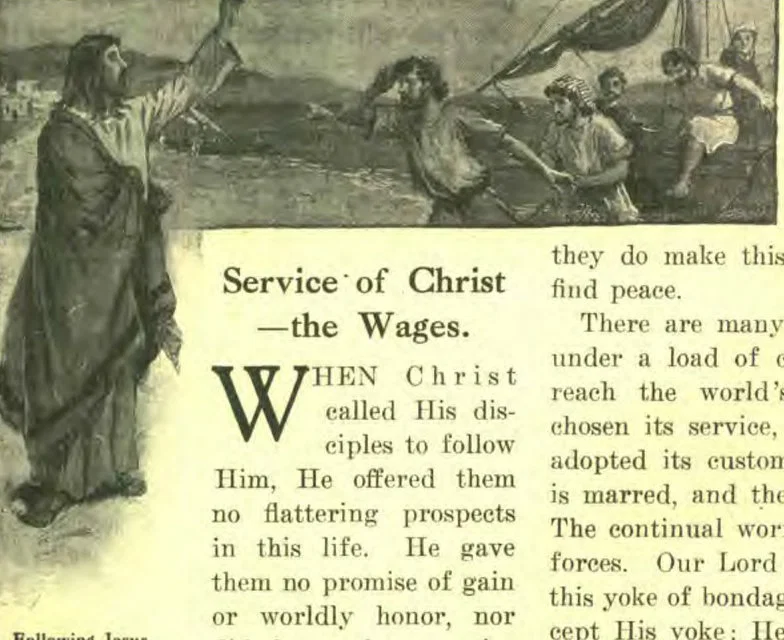
Service of Christ— the Wages.
WHEN Christ called His disciples to follow Him, He offered them no flattering prospects in this life. He gave them no promise of gain or worldly honor, nor did they make any stipulation as to what they should receive. To Matthew as he sat at the receipt of custom, the Saviour said, "Follow Me. And he left all, rose up, and followed Him." Matthew did not, before rendering service, wait to demand a certain salary, equal to the amount received in his former occupation. Without question or hesitation he followed Jesus. It was enough for him that he was to be with the Saviour, that he might hear His words and unite with Him in His work.
So it was with the disciples previously called. When Jesus bade Peter and his companions follow Him, immediately they left their boats and nets. Some of these disciples had friends dependent on them for support; but when they received the Saviour's invitation, they did not hesitate, and inquire, "How shall I live, and sustain my family?" They were obedient to the call; and when afterward Jesus asked them, "When I sent you without purse, and scrip, and shoes, lacked ye anything?" they could answer, "Nothing."
To-day the Saviour calls us, as He called Matthew and John and Peter, to His work. If our hearts are touched by His love, the question of compensation will not be uppermost in our minds. We shall rejoice to be coworkers with Christ, and we shall not fear to trust His care. If we make God our strength, we shall have clear perceptions of duty, unselfish aspirations; our life will be actuated by a noble purpose, which will raise us above sordid motives.
God Will Provide.
Many who profess to be Christ's followers have anxious, troubled hearts, because they are afraid to trust themselves with God. They do not make a complete surrender to Him; for they shrink from the consequences that such a surrender may involve. Unless they do make this surrender, they can not find peace.
There are many whose hearts are aching under a load of care because they seek to reach the world's standard. They have chosen its service, accepted its perplexities, adopted its customs. Thus their character is marred, and their life made a weariness. The continual worry is wearing out the life forces. Our Lord desires them to lay aside this yoke of bondage. He invites them to accept His yoke; He says, "My yoke is easy, and My burden is light." Worry is blind, and can not discern the future; but Jesus sees the end from the beginning. In every difficulty He has His way prepared to bring relief. "No good thing will He withhold from them that walk uprightly."
Our heavenly Father has a thousand ways to provide for us of which we know nothing. Those who accept the one principle of making the service of God supreme will find perplexities vanish, and a plain path before their feet.
Encouraging Faith.
The faithful discharge of to-day's duties is the best preparation for to-morrow's trials. Do not gather together all to-morrow's liabilities and cares and add them to the burden of to-day. "Sufficient unto the day is the evil thereof."
Let us be hopeful and courageous. Despondency in God's service is sinful and unreasonable. He knows our every necessity. To the omnipotence of the King of Kings our covenant-keeping God unites the gentleness and care of the tender shepherd. His power is absolute, and it is the pledge of the sure fulfilment of His promises to all who trust in Him. He has means for the removal of every difficulty, that those who serve Him and respect the means He employs may be sustained. His love is as far above all other love as the heavens are above the earth. He watches over His children with a love that is measureless and everlasting.
In the darkest days, when appearances seem most forbidding, have faith in God. He is working out His will, doing all things well in behalf of His people. The strength of those who love and serve Him will be renewed day by day.
Said the tried apostle Paul: "He said unto me, My grace is sufficient for thee; for My strength is made perfect in weakness. Most gladly therefore will I rather glory in my infirmities, that the power of Christ may rest upon me. Therefore I take pleasure in infirmities, in reproaches, in necessities, in persecutions, in distresses for Christ's sake; for when I am weak, then am I strong."
True Greatness.
Not by their wealth, their education, or their position, does God estimate men. He estimates them by their purity of motive and their beauty of character. He looks to see how much of His Spirit they possess, and how much of His likeness their life reveals. To be great in God's kingdom is to be as a little child in humility, in simplicity of faith, and in purity of love.
"Ye know," Christ said, "that the rulers of the Gentiles lord it over them, and their great ones exercise authority over them. Not so shall it be among you; but whosoever would become great among you shall be your minister."
Of all the gifts that heaven can bestow upon men, fellowship with Christ in His sufferings is the most weighty trust and the highest honor. Not Enoch who was translated to heaven, not Elijah who ascended in a chariot of fire, was greater or more honored than John the Baptist, who perished alone in the dungeon at the hand of Herod. "Unto you it is given in the behalf of Christ, not only to believe on Him, but also to suffer for His sake."
The Breadth of the Law.
By J. C. Stevens
THE psalmist prayed, "Open Thou mine eyes, that I may behold wondrous things out of Thy law." Ps. 119:18. Again he said, "I have seen an end of all perfection; but Thy commandment is exceeding broad." Ps. 119:96.
The law is exceeding broad. Wondrous things it contains, but the eyes must be opened, anointed with eye-salve, for these things to be seen. The law is spiritual, and spiritual things are spiritually discerned.
The first commandment, "Thou shalt have no other gods before Me," calls for Gospel consecration. It calls for that suggested in Christ's words, "So likewise, whosoever he be of you that forsaketh not all that he hath, he can not be My disciple." Luke 14:33.
In answer to the lawyer, Jesus said, "Thou shalt love the Lord thy God with all thy heart, and with all thy soul, and with all thy mind. This is the first and great commandment." Matt. 22:37, 38. It is love Him with all, all, all! This leaves no room for any kind of an idol. That which we allow to stand between us and God, that which hinders us in doing God's will, that is an idol.
It is therefore evident that the one who keeps the first commandment is one with God. In this experience Christ's words are fulfilled when He said, "If a man love Me, he will keep My words; and My Father will love him, and We will come unto him, and make Our abode with him." John 14:23. And again, "That they all may be one; as Thou, Father, art in Me, and I in Thee, that they also may be one in Us." John 17:21.
Now the person who has this experience is the one who keeps God's law.
The Gospel of Christ is a provision to meet the broad demands of the law. The law is exceeding broad, but no broader than the Gospel. He who accepts the Gospel in truth will thru that meet the demands of the law. Jesus says, "Behold, I stand at the door, and knock; if any man hear My voice, and open the door, I will come in to him, and will sup with him, and he with Me." Rev. 3:20.
Surely if Christ abides within us, since He was one with the Father, we will be one with Him; and while He abides within, He will in us fulfil the law tho exceeding broad. Rom. 8:1-4.
The provision to keep the first, is the provision to keep all. God's law is a unit. Paul speaks of the whole law as "the commandment." Rom. 7:10-13. It is one commandment, for our sakes drawn out to ten. Its precepts are so linked that James could say, "For whosoever shall keep the whole law, and yet offend in one point, he is guilty of all." James 2:10.
Now to be one with God is to know Him, and this is life eternal. Jesus said to the rich young man, "If thou wilt enter into life, keep the commandments." Matt. 19:17. This man's idol was his riches. It was this that stood between him and God, and prevented him from knowing God, and, of course, from keeping God's commandments.
To know God is peace—a peace that passeth all understanding. "Acquaint now thyself with Him, and be at peace." Job 22:21. And, "Great peace have they which love Thy law, and nothing shall offend them." Ps. 119:165. Again, "O that thou hadst harkened to My commandments! then had thy peace been as a river, and thy righteousness as the waves of the sea." Isa. 48:18.
J. C. STEVENS.
The Land of Promise.
By Neils O. Olsen
GOD once promised to Abraham a land that he and his seed should have as an everlasting possession. Gen. 17:8.
Have Abraham and his seed yet received that land of promise? If they have not, they will surely receive it, as God's promises are true.
The Bible records of Abraham tell us that he lived as a stranger in tents all the days of his life. The promise was surely not fulfilled while he lived. The children of Israel did receive that land which was promised to them on earth, but they did not keep it as an everlasting possession. Because of disobedience to God they were scattered and their possessions taken from them. The land that they received can not possibly be the same which was promised to Abraham, since it was taken from them.
Abraham was faithful to his God. He trusted in Him, and was sure that all His promises would come true. He believed God, and it was imputed unto him for righteousness, and he was called the friend of God. James 2:23. In Gal. 3:7, those that have faith are called the children of Abraham. This must surely mean the faithful of all ages—those that have faith in God and His promises, those that believe in Jesus as their Saviour. So the seed of Abraham, as mentioned in Gen. 17:8, must surely mean the righteous and faithful of all times. And the promise given to them has surely not been fulfilled yet.
Will the promise be fulfilled? Will the faithful servants of God receive the land which they should have as an everlasting possession?—They certainly will. God’s promises will not fail. They can not fail. They have never failed. Abraham still sleeps in the dust. He has yet to receive the reward of his righteousness. So have also the faithful of all the ages ever after. If we are faithful to God and believe in His promises, we will surely enter into that land of promise also.
When Jesus shall come the second time to gather His loved ones home, the promise given to Abraham long ago will surely be fulfilled. What a blessing it will be to meet God’s servants of all the ages! How joyful it will be to see them all, and to speak with them face to face! And how joyful it will be to meet our Saviour, who walked the thorny way that led to Calvary!
Are we getting ready for this event? Are we preparing ourselves to pass over the Jordan, and to go in and possess the land promised to Abraham and his seed? Are we helping others to prepare? The time is surely near at hand. God is telling us in His word to get ready. He has given us signs by which we may know that the time for the fulfilment of the promise is near.
Do we long for the day when this promise shall come true? Do we long to see our Redeemer? We certainly should. Do we long to enter into that land of promise? Do we long to gather flowers by its glittering brooklets which never run dry? We certainly should. We are too near the eternal home to stop and look back. We are too near the promised land to give up the journey. We are too near the end to give up the struggle for that which is right. We must yet a little while be faithful and we will surely enter into that beautiful land of promise—to the land that flows with milk and honey, to the land of peace and rest. Abraham looked forward to that day when the promise should be fulfilled. He looked forward in faith to the time when the earth should be made new and given to him and his seed as an everlasting possession. We are nearer that time than he was.
God gave the children of Israel a command to get ready to pass over the Jordan and to enter into the promised land. He is giving us the same command to-day. Do we heed His command? Delay is surely dangerous. If we are not ready when the final signal is given, those who are ready will pass over and we will be left behind. God is selecting a people that will be ready when Jesus comes. If we shall be among them, we must be faithful here in this world of sin and wo.
When the struggle here is ended, what a joyful time it will be when we shall come home!5In that beautiful land we shall rest from all the worry and sorrow we have had here. I long for that day. How sweet it will be to drink of the water which flows in the river of life; and to eat of the fruits of the tree of life. How blessed it will be to meet our Saviour, and the loved ones, and the faithful of all the ages, in the land of promise!
NELLS O. OLSEN.
Give.
By Flora E. Warren
SINCE God first oped His treasure-house above,—
Poured countless blessings from His throne of love;
Since on this earth unnumbered blessings came,
God's laws of giving still remain the same.
No life in heaven but a life which gives,
And from the living throne again receives;
No life in earth but that designed to be
A giving and receiving ministry.
Learn but the ways of God, and thou shalt find
His laws of giving for all human kind;
Search thru all Nature with the greatest care,
Thou'll find God's laws of giving written there.
The beams of light from the eternal throne
Light many million suns besides our own;
A million suns send light, and life, and love,
And forth roll songs of praise to God above.
The gentle rain and snow from heaven fall,
Preparing bread and seed for one and all.
What heart will not send forth a song of praise,
Who knows the magnitude of all God's ways?
Then ope the storehouse, and thou shalt behold
Rich, priceless treasures,—worth far more than gold;
All these—if thou wilt give to all that's told—
Thou shalt receive,—more than a hundredfold.
Give to the stranger, outcast, and the vile;
Give to the sick, and dying; and the while
Give with a cheerful heart, and God above
Will love the one who gives because of love.
Give to the weak, the erring, and the wild;
Give to the widow, and the orphan child;
Give to the poor and needy—thou shalt see
True peace and comfort flowing back to thee.
Give of thy bread—nor from thy store withhold,
For it shall sure return, as Christ hath told.
Give but a cup of water in Christ's name,—
He shall refill and give thee back the same.
To him with scanty garment give thy cloak,
And blessings on thy head and his invoke.
Give freely—of thy comfort, smiles, and love,
As Christ gave when He left the courts above.
Give all thy tithes, and offerings; God will give
Far greater than thy soul and barns receive.
Make all thy life a gift—and that to bless;
Receive eternal life and righteousness.
FLORA E. WARREN.
Spiritualization.
By T. E. Bowen
NOT spiritualism in the sense in which this word is commonly used, but spiritualization. This wicked thing is undermining the faith of thousands, even those who think they are following Christ. Ministers preach it. Religious journals give up their columns to articles which are little less than atheistic in their nature, so fearful are they that some sentiment shall be expressed bordering on "literalism," as it is termed. Thus the devil is robbing people of the very life of true Christianity.
Is there no real heaven? Have we no real God? Shall the weary pilgrim vainly strive for a "country" that turns out at last to be only nothing?—Far from it. God does not thus deceive His children. In His word, He holds out to us that which is real, tangible, a reward, as Peter expresses it, that "fadeth not away," "eternal in the heavens." This is the "better country" toward which our fathers in faith journeyed, and upon which their eyes rested as they closed them in the sleep of death, and that which to them will become their literal home when they shall awake at the "resurrection of the just."
Literalisms.
In a recent issue of a very prominent religious journal, there appeared an article entitled "The Literalisms of the Mosaic Narrative," and the references made to Moses, seeing the Lord, and the giving of the law, were such as to well-nigh destroy the faith of the reader in any narrative given us anywhere in the Bible. A few sentences we quote:
"These literalisms—'the elders saw the God of Israel,' 'God spoke with Moses face to face as a man speaketh unto his friend,' 'the two tables of stone written with the finger of God'—often puzzle the reader. He thinks of other scriptures which declare God to be a Spirit, to be immortal, invisible, whom no man hath seen or can see."
Seek for the Harmony.
Then, instead of studying to find the harmony in these seemingly contradictory statements, the writer goes on to attempt to explain:
"It is evident that these literalisms are simply the strong expression of spiritual ideas of divine help or accomplishment which God does by His spiritual power and presence. God spoke with Moses face to face—that is, Moses was in intimate communion with God spiritually."
Then as to the giving of the law, we quote further.
"The commandments were written with the finger of God on the two tables of stone—that is, the commandments so completely came in the thought of Moses, thru his intimate communion with God in the mount, that they may be said to have come from God, and to be written with the finger of God, tho at the same time cut in the tables by the hand of Moses."
How such teaching can pass for religious food is simply incomprehensible! If believed, it would certainly be effective in robbing earth of any real connection in any definite way to heaven. Why believe that God came down at all upon Sinai, if we do not take as true the Bible description of the events which took place at this time?
It is very easy to trace back to the origin of such sentiments. Lucifer, in order to command the homage and worship of men, must keep God out of sight, must cover up this law, lest men pay their allegiance to their Creator. So he frames such delusions to deceive.
But did Moses see God?—The Bible says so:
"And he [Moses] said, I beseech Thee, show me Thy glory." "And He [the Lord] said, Thou canst not see My face: for there shall no man see Me, and live. And the Lord said, Behold, there is a place by Me, and thou shalt stand upon a rock; and it shall come to pass, while My glory passeth by, that I will put thee in the cleft of the rock, and will cover thee with My hand while I pass by: and I will take away Mine hand, and thou shalt see My back parts; but My face shall not be seen." Ex. 33: 18-23.
But who was talking with Moses as a friend talks with his friend—the Father or the Son? This point made clear, and harmony is made in all these scriptures which seem contradictory. Jesus Himself said of the Father, when contending with the Pharisees, "And the Father Himself, which hath sent Me, hath borne witness of Me. Ye have neither heard His voice at any time, nor seen His shape." John 5:37. Who then spoke the law and talked with Moses upon Sinai?—Evidently Christ, the Son. And He is God. His glory and brightness and person are in the express image of the Father. See Heb. 1:1-3. It was Christ who led the children of Israel thru the wilderness. "And did all drink the same spiritual drink: for they drank of that spiritual Rock that followed [or went with] them: and that Rock was Christ." 1 Cor. 10:4. Thus
Moses saw in the mount the Son of God, thru whom the Father has wrought out His purposes for man.
The Law the Work of God.
As to the law being the work of God, not of Moses, we read:
"And He [the Lord] gave unto Moses, when He had made an end of communing with him upon Mount Sinai, two tables of testimony, tables of stone, written with the finger of God." Ex. 31:18. "And Moses turned, and went down from the mount, and the two tables of the testimony were in his HAND [not altogether in his mind, in this spiritual sense]: the tables were written on both sides; on the one side and on the other were they written. AND THE TABLES WERE THE WORK OF GOD, AND THE WRITING WAS THE WRITING OF GOD, GRAVEN UPON THE TABLES." Ex. 32:15, 16.
What plainer language could be used to say that the work upon the two tables of stone (literal stone; for Moses threw them down, and broke them), was the work of God, and not of Moses? How much more rational and sensible it is to believe this simple narrative than that it all meant something else, not mentioned in the Bible! God is a spiritual being, but that does not imply that He is not a substantial being; for the quotations just cited tell us He has a "face," "back parts," and a "hand." Angels are ministering spirits, and they have bodies as well. God will have spiritual men and women prepared to meet Him when He comes, and they will have bodies which are to be changed in a moment, in the twinkling of an eye—changed from mortality to immortality; for "thus saith the Lord." 1 Cor. 15:51-53. The Lord also says, "So also is the resurrection of the dead. It is sown in corruption; it is raised in incorruption: it is sown in dishonor; it is raised in glory: it is sown in weakness; it is raised in power: it is sown a natural body; it is raised a spiritual body. There is a natural body and there is a spiritual body." 1 Cor. 15:42-44.
Let us not throw away all this that goes to make up for us a sure hope for a life that we can at least to some extent understand and look forward to with joy, for something intangible, unreal, and which is not held out to the child of God in the Bible. The one is living faith, the other mere folly and presumption. T. E. BOWEN.
Man's Weakness; God's Strength.
By Ella M. Robinson
Know thou, vain heart, how little thou dost know!
How oft the feet of Prudence are beguiled
From paths of right, forbidden ways to go!
Nor know their danger, even as a child
Lost in the wild!
O trembling one, e'en tho thou can'st not see
The path, fear not. If thou hast turned aside,
Then learn to seek for wisdom full and free:
Thou canst not wander if a heavenly Guide
Is by thy side.
Self-trusting one, thy power to will is small.
Why build sand towers against temptation's day?
Thy resolutions seem a mighty wall
Against the waves of sin. Beneath the spray
They drift away.
Weak, wavering one, look up, thy God lives still.
By His decree the feeble, shifting sands
Stand firm as rock to carry out His will.
'Tis not their strength that forms the ocean bands,
But His commands.
Tremble, proud, fearless one, canst thou defy,
Alone, unaided, all the powers of hell—
One-third of all the angel host on high,
Who chose to follow Lucifer, and fell
From heaven to hell?
Discouraged one, look up, thy God is Might.
Tho 'gainst thee all the hosts of hell combine,
They quail before the messengers of light
That hasten to thy side, with strength divine,—
And victory's thine.
ELLA M. ROBINSON.
The Value of Prayer
THE value of prayer in quieting the brain has been discovered by many a mental specialist. Dr. Hyslop said the other day to an audience of physicians that, as one whose whole life had been concerned with the sufferings of the mind, he would state that of all the hygienic measures to counteract disturbed sleep, depression of spirits, and all the miserable sequels of a distressed mind, he would undoubtedly give the first place to the simple habit of prayer.—The Christian Worker.
The Secret of Long Life
CLARA BARTON, of the Red Cross organization, gives a splendid secret for long life in the following words: “Eliminate yourself in everything. Lay no stress on your personal self.” This is truly not only the law of long life, but the truest recipe for happiness.