THERE is a strong wave of prohibition sweeping over the country. Numerous states have declared for prohibition, and in many other states county after county has voted the liquor traffic out by means of the Local Option laws. Men who make a business of manufacturing and dispensing liquors are greatly alarmed and are doing all they can to keep their business from being overthrown. An instance of their frantic efforts is the following, that is being displayed as a large poster in many of the saloon windows and elsewhere thruout the states where the agitation is on:
FARMERS AND WORKINGMEN, ATTENTION!
THE FOLLOWING FIGURES WILL INTEREST YOU
Do you know that the brewers, maltsters, and distillers of the United States used in their products during the last year farm produce to the value of upward of
ONE HUNDRED AND TEN MILLIONS OF DOLLARS!
including corn, barley, rye, oats, hay, and other grains of various kinds?
If the market for the barley fields of California, Minnesota, Wisconsin, and Missouri, is destroyed, those states will offer greater competition to the farmers who raise wheat and oats. If the farmers of Pennsylvania, Michigan, Illinois, and the other rye and corn producing states can't find buyers for corn, it will mean additional competition for you.
Farmers and workingmen! Can you afford to allow the prohibition fanatic to destroy the market for your grain and labor?
Brewers and distillers furnish a livelihood for upward of two and one-half millions of people, and they buy annually in lumber, cooperage, building supplies, engines, boilers, glass, and other manufactured goods, averaging a value of $150,000,000, and they pay in license, revenue, and other state, county, and city taxes, one-third of all taxes paid in the United States.
Farmers! Can you longer afford to allow stump speakers, who pay no taxes, and who are employed by city organizations who pay no taxes, to add to your burdens by compelling you to maintain public institutions that are now supported by the business concerns that these interlopers are trying to kill?
An attempt is being made thruout the country to build up a political party power at the expense of the farmer and workingman.
Farmers! Do you intend to permit these crafty fanatics to rob you of the market for your grain and load you up with additional taxes which you can not afford to pay?
Every farmer, every workingman, and every man in the United States should now assert his right and use every effort to suppress this growing evil of prohibition and hypocritical humbug, which if allowed to prevail will create a financial crisis such as the world has never seen.
The foregoing arguments are the old stock "reasons" that have been offered by the liquor traffic all the years. Let it be granted that one hundred and ten million dollars' worth of grains are bought by the brewers and distillers each year. But what is the use they make of it after buying it?—They manufacture from it a commodity which has been the worst curse of all the ages. They manufacture from it a commodity that robs innocent children and helpless women of the necessary food and clothing in order that the husbands and fathers may wreck their manhood in the debaucheries of drunkenness. They manufacture from these grains that are one of the best material gifts of Heaven, a commodity that builds up and inflames the worst brute passions and instincts. They manufacture from these grains a commodity that puts men and women under worse chains of slavery, suffering, and degradation, than was ever the lot of the worst slave who was ever driven under the lash of the most cruel taskmaster. They manufacture from these grains a commodity that fills jails, penitentiaries, and insane asylums with unhappy and distressed wretches of humanity, who should provoke the pity of all mankind. They manufacture from these grains a commodity that sends a vast army of over a hundred thousand souls into drunkards' graves every year. But why continue the list? The curse that has been brought into the world thru strong drink presents an array of items that is too long to enumerate.
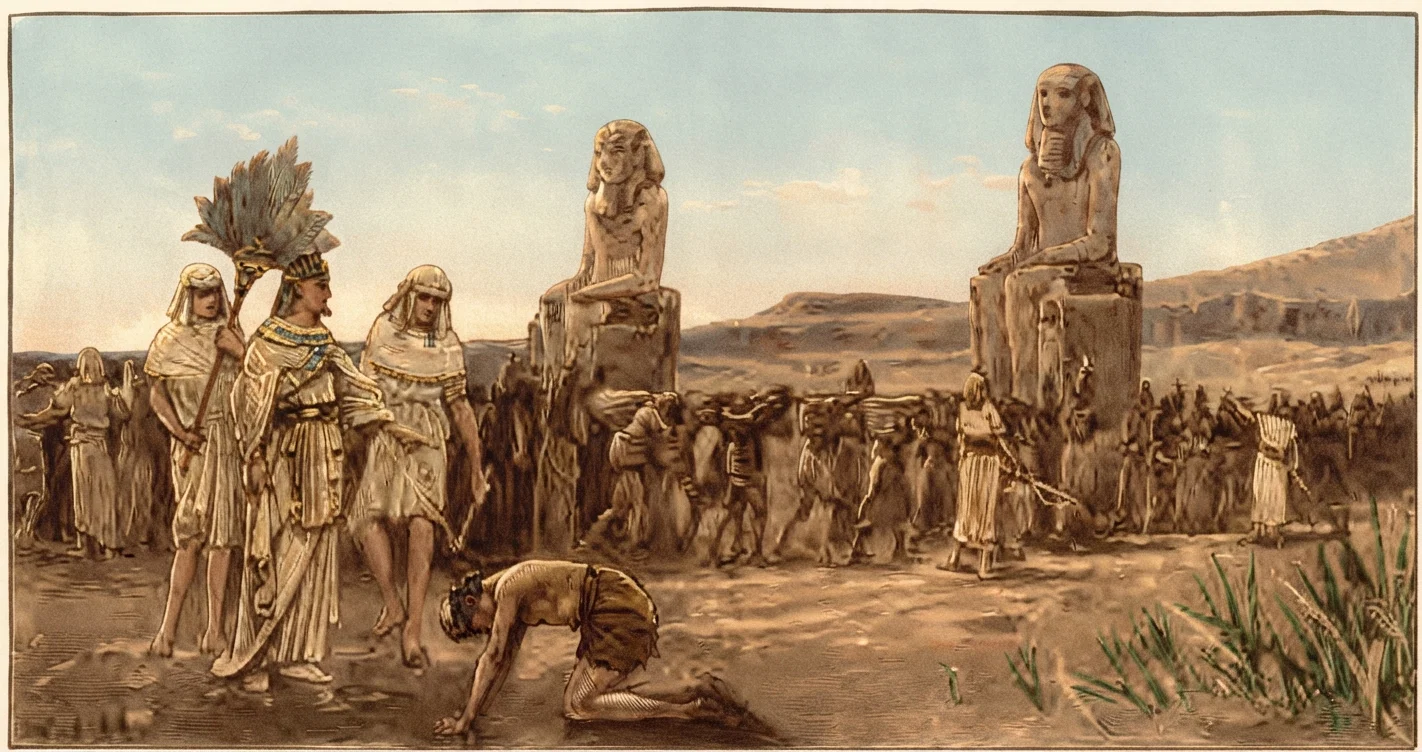
Children of Israel under Taskmasters in Egypt. But Those Who Are Slaves to the Demon Alcohol Are under Worse Bondage than Egypt Ever Knew.
The actual cost to every state and community where the dispensing of liquors is freely allowed almost invariably far exceeds the revenue that is derived from it. And in this estimate of mere dollars and cents no account is taken of the valuable human lives that are wrecked and ruined year by year. The farmer can well afford to lose the market that the brewers and distillers offer for his grain. All this grain is needed to feed the half-starving wives and children of those who are now being ground beneath the curse of rum. This liquor market for the farmer's grains is purchased at too great a price in human lives, and at too great a cost of the bitterest of human suffering.
It is suggested that if this "growing evil of prohibition" is not suppressed it will precipitate a "financial crisis such as the world has never seen." The danger of such a thing is imaginary rather than real. If the manufacture and sale of liquor were entirely swept out of the country, it would give many people who are now in the clutches of poverty a chance to save money, and when people are saving money, the chances are the very best to have money panics avoided altogether.
But why should money considerations come into questions of this kind? Are men to be debauched and debased, and homes ruined in order that a certain class of citizens may have a market for their products, and so that another class may be able to dispose of what they manufacture from these products? Are not men to be considered? Are not the suffering and indescribable miseries occasioned by strong drink to be taken into account?
The decree of the Almighty is, "Wo unto him that giveth his neighbor drink, that puttest thy bottle to him, and makest him drunken also, that thou mayest look on their nakedness!" Hab. 2: 15. This language from the Lord's Book is plain and unequivocal. And every one who dispenses liquors will have to repent of his evil or he will meet this statement in the eternal judgment. No one can afford to jeopardize the eternal salvation of those to whom he sells the liquor, neither can he afford to load himself with guilt that will consign him to ruin in the judgment day. And in this time, when all the prophecies show that the end of all things is at hand and that every individual is about to be called before the great tribunal of the universe, men should tremble to be found in the occupation of dispensing the death-dealing curse of strong drink.
In times of great calamity when men feel that they are powerless and that eternity is staring them in the face, they do not find money of any value. The only thing that can stand then is character. And so it will be in the great judgment hour when every one will be required to give an account of the deeds of this life. Men, while bent on money-getting, will often make light of the thought of being brought before the bar of the Eternal. But the grand, glorious, and awful day is just before us, and we should build our foundations of character now if we would stand in that time. T.
Prohibition and Sunday Laws.
By T.
WHY is it that we always find lurking in the prohibition movement such a strong sentiment in favor of Sunday laws? Why is it that prohibition, which is in itself one of the greatest blessings that could come to the whole country, has so many political and semi-political questions continually mixed with it by the majority of its leading advocates? If we could have prohibition put before the whole country on its merits, it should carry the support of all who are now advocating it, and would gather a vast army besides among those who fear the outcome of these political and purely religious measures that are so generally linked with it.11
From the standpoint of economy pure and simple, the state has sufficient grounds to abolish the liquor traffic, instead of licensing it. From the standpoint of debauchery of its citizens, the state has more than sufficient grounds for the abolishing of the liquor traffic. And among other things that might be mentioned, the state has sufficient grounds for abolishing the traffic because of the miseries and sufferings that strong drink thrusts upon the unfortunate members of the drunkard's family.
But when the question of Sunday observance, for instance, is brought into the campaign for prohibition, there are a great many strong temperance advocates who are cut off from the work because they can not indorse this religious legislation. For, deny the fact as you may, it still remains the truth that Sunday is purely and solely a religious institution. And it is impossible to put it rightfully on any other ground.
There is a good deal of talk about a "civil Sunday," and of compelling people by law to rest on that day. But a man's time is his own, and he has an inalienable right to spend it as he chooses, so long as he does not interfere with the equal right of another individual to spend his time as he chooses. The tyranny that would be brought in by laws that regulate how a man may spend his God-given time would be incalculable. It is a system of paternalism that is altogether wrong. Wherever it has been attempted, it has worked hardship and suffering. And temperance reforms as well as all other reforms should be free from such things that will in the end work oppression.
We have no sympathy with the so-called "personal liberty" idea, which means the untrammeled liberty to degrade and debauch mankind. But the question of the observance of a day of rest or the non-observance of the day is a question, not between man and his fellow man, but between man and his God.
All of the history of Sunday observance and all the sentiment that clusters around that day are essentially religious. You take the religious sentiment away from the day and no one would think of such a thing as compelling people to rest on that day. And hence laws can not be enacted in regard to Sunday without bringing in the religious idea.
It is often said that history repeats itself. Then let it ever be remembered that the apostasy that led up to the Dark Ages had as one of its main pillars the Sunday law of Constantine. Constantine's Sunday law and his state religion combined were not able to prevent the superstitions and the ignorance and the subserviency that made those Dark Ages a possibility. Indeed, the mental and moral slavery that was brought about by having the individual tied up at every turn with some sort of law or state-enforced ceremony was the direct result of that church-and-state system. We need to be devotedly on our guard that we do not go over the same ground in this very twentieth century of unparalleled progress and great enlightenment. T.
Graft Investigations.
By T.
CHICAGO is now having a "graft investigation," and it is said that the mouths of important witnesses are being sealed because of mysterious threats of death that are coming to them. The investigations involve the city water bureau, and when witnesses were brought before the Civil Service Board, no promises of immunity could induce them to repeat the things they had told the superintendent of the bureau. The boldness in crime is getting to be something terrible. Our cities seem to be held in the grasp of men who are sufficiently numerous to defy justice before the courts.
The graft investigations in Chicago are being held up and thwarted by threats of death to the witnesses who had started in on a course of generally informing on what they knew to be going on. But in San Francisco, whose grafting has become world famous, it is different. The ablest attorneys have been working on the graft cases there for considerably over a year, and have secured several convictions. But these convictions have to be fought for again in one court after another, and on one technicality after another until it begins to look as tho no indictments against those accused of the worst kind of corruption and dishonesty can be made to stand. The evidence of guilt is not contested so much. But first one technical point and then another is brought up, and month after month drags by, and nothing definite is accomplished.
These grafters have so entrenched themselves that when they are touched anywhere there is always some big business interest that will be made to suffer financially, and so they have the powerful support of this business concern or that to bring influences to bear to keep them from meeting the justice that properly belongs to them. These conditions are producing a grave danger in these times, and men should seriously consider what the outcome of it must surely be. T.
When the Gospel Is Rejected
It seems paradoxical to say that while the Gospel goes to all the world, men grow worse and worse, but it is true. It must be in the last days that the Gospel goes to all the world, for "this Gospel of the kingdom shall be preached in all the world for a witness unto all nations; and then shall the end come." Matt. 24: 14. "This know also, that in the last days perilous times shall come. For men shall be lovers of their own selves," etc. (2 Tim. 3:1, 2), and "evil men and seducers shall wax worse and worse, deceiving and being deceived" (verse 13). Why then is it that men become worse under the preaching of the Gospel? Why did the antediluvians become worse under the message proclaimed by Noah? Why did the Jews become more and more desperate under the preaching of Christ? The reason is clear: God's overtures of mercy were, and are, and will be, rejected by the masses, and the rejection of the Gospel makes men worse than they were before. And the very worst of all classes is composed of those who have a form of godliness but deny the power thereof. See verses 2 to 9 of the chapter last cited. The power of the Gospel is denied when men seek the power of human law and human influence to enforce the Gospel.
The Spread of Temperance.
THE first prohibitory law was that of Maine, 1851. In 1870 persons living under prohibition numbered about 4,000,000. In 1908 persons living under absolute prohibition of state, city, town, or county, foot up 33,000,000. There are six "dry" states—Alabama, Georgia, Kansas, Maine, Oklahoma, and North Dakota. Kentucky has 97 "dry" counties out of 119; North Carolina has "dried" 99 per cent of her territory; South Carolina, 50 per cent; Tennessee has but three places where drink can be legally sold. Massachusetts is about 50 per cent "dry," while 62 per cent of the people of New Hampshire are under prohibition. In Maryland, Virginia, Mississippi, and Delaware the fight for prohibition is being made in earnest.—Springfield Republican.
The Inconsistency of Sunday Laws
A recent "Independent" has an article entitled "Legal Exceptions to Morality," which by concrete examples shows the utter inconsistencies not only in laws, but in people. One instance cited to show the absurdity of exceptions is a law in Kentucky, permitting gambling on race-courses, but forbidding it outside those grounds. Inside, gamblers are protected by the police; outside, gamblers doing the same thing are criminals. But this is just the morality of the Sunday law, only worse. Here is a perfectly legitimate, honorable business for six days in the week, but the Sunday law makes it criminal on the one day. In the language of the Independent, regarding the gambling law, "nothing can be more absurd than such a law."
Another Victim of Anarchy
By Editor
Another Victim of Anarchy.—The news despatches of April 12 bring the account of the assassination of Count Andreas Potocki, governor of the Austro-Polish province of Galicia, by an anarchist. The Count was giving an audience to a delegation of students when one of them fired three shots at him from a revolver, every bullet taking effect. A number of peasants were waiting outside for an audience with Count Potocki, and when the assassin was being led past them, he said, "I have done this for you." It is the spirit of hatred that leads men to think that they can better their condition by teaching the doctrine of murder. A very badly misgoverned country is a much better place to be in than a country where there is no government at all. Above all things, deliver us from the terrors and the uncertainties of anarchy.
Great Fire in Chelsea
A very destructive fire swept away a large part of the city of Chelsea, a suburb of Boston, on Sunday, April 12. Chelsea is a suburb of 40,000, but has its own local government. Formerly it was principally a residence place, and some very fine homes were located there. But in recent years a large number of factories have been established and many of the former fine residences were turned into apartment houses for the workers in these factories. Insurance officials from hasty calculations place the loss at from $7,500,000 to $10,000,000. The total that the insurance companies will have to pay is figured at about $5,000,000. Four persons are known to have lost their lives in the fire, and fifty persons were injured. 1,500 families, comprising about 10,000 people, were rendered homeless. A forty-five mile an hour gale was blowing while the fire was raging. A relief committee was promptly formed, and every effort is being put forth to care for the homeless victims of the great disaster.
Large Good Sense.
By Editor
Notwithstanding all the criticisms against the chief magistrate of this country, he shows his large good sense generally in times of crisis. There are great questions before this country from the governmental standpoint. Among them is the conservation of the natural resources of the country, its lands, its water supply, its timber. President Roosevelt has called a council of all the governors of the states, the members of the Supreme Court, the Cabinet officers, and members of the Inland Waterways Commission; and in addition to all these has invited ex-President Grover Cleveland, W. J. Bryan, Andrew Carnegie, James H. Hill, and John Mitchell. These men are representative men of more than ordinary intelligence and ability; tho they differ with the President politically, he appreciates their worth in counsel on matters which ought to rise above mere partisanship. Every large-souled man will approve the President's action.
If Moses Came Down Today
By Editor
"Puck," of March 11, has a striking cartoon, entitled, "If Moses Came Down To-day." Moses is represented as a grand old patriarch, holding in his left hand two tables of stone, with the other pointing to the commandments, while before him are a crowd of frightened, angered, cowering, enraged men, some of them prominent financiers and grafters, well known to all the country, and responding to the sentiments of the Decalogue with the chorus, "Dangerous, Socialistic, Un-American doctrines!" There is much truth in the striking picture. But what will it be when the "heavens shall declare" God's "righteousness" in that very Decalogue, and all men shall be brought to judgment?
Strike in Pensacola
A strike is in progress in Pensacola, Fla., and Governor Broward has ordered every command of the state militia to proceed there at once. It was in the orders that each man be supplied with twenty rounds of multiple ball cartridges. The Gatling gun detachment was also ordered out along with the rest. It is stated that no serious rioting has occurred as yet, but these measures are taken to prevent a general outbreak that is threatened.
Threatening Letters to Public Officials
The efforts that the government is putting forth to suppress and drive anarchy from this country are causing many threatening letters to be sent to members of the President's cabinet, and other prominent men throuout the country. It has made it necessary for these persons to be closely guarded by special secret service men so that bodily harm may not come to them.
Cooper Medical College Trust
Cooper Medical College Trust, founded by Dr. Levi Cooper Lane, is to be turned over to the trustees of Stanford University, to become an integral part of that institution. This includes Lane Hospital.
Experiences in China.
By Mrs. Ida Pilquist
It might be of interest to friends at home to hear something of our work from the very beginnings of our mission in Honan, Central China. Therefore I will mention some of the most striking features of the Lord's wonderful dealings in the past.
We joined the mission in January, 1903, and were at that time the only Seventh-day Adventist missionaries in Central China. We were stationed in San-li-tien, Sin Yang Cheo, and began at once to do what our hands found to do for this people for whom we had been praying and working for years. Prayer-meetings and Bible studies were held every night with a small company who for the first time had the privilege of hearing the truth already so dear to us. Our feeble efforts in the small beginning were blessed by the Lord in bringing the truth of His soon coming to some of the hearers, and a marked change was taking place in their hearts.
Our language teacher, Mr. Chai, B.A., really rejoiced in the new light brought to view, and every meeting found him taking down the Bible texts in order to be able to study the precious truth for himself, as well as to present it to others. He always remembered our gatherings at San-li-tien as the happiest time in all his life, and reckoned his conversion from those days.
A young pupil, Uang, fourteen years of age, was supported by Mr. Chai, and attended our day school. He became much interested and was among the first who accepted the truth in that place. He is now a bright young man supported by Brother Skoglund, of College View, Neb.
Another man, Mr. Ch'en, who later became a valued helper of Dr. Miller in the printing-office, was converted during our stay in San-li-tien. He lived in the city and had to cross the river (without bridge) before reaching our meeting hall. At the time he suffered not a little persecution from his wife, who afterward told me that she was very much opposed to religion. Many a night she shut him out by locking the door, till the neighbors interfered in his behalf and pleaded with her to let him in. Her proud spirit raged bitterly against him, but he bore it all patiently and prayed for her. Tho he had to endure poverty and trials, still we never heard him complain.
From the very first we felt the need of a hymn-book fitted to the doctrine we were proclaiming. Altho the Chinese in this part of China are not gifted musically, still they are great lovers of song and music. Early in the spring the same year Brother and Sister J. N. Anderson visited us, and many important questions concerning the new mission field were taken into consideration.
We made up our minds not to delay getting out a hymn-book, but at our own expense had the type carved on wooden blocks, and printed a few hundred copies from the manuscript already collected by Mr. Pilquist and the Chinese teacher. Several copies were presented to our printing-offices and friends at home, and one to Dr. Miller, who had in mind to come to China before long. The glad news received from him assured us of God's blessing upon our undertaking, and the result was the first printing-press, given to the China mission by a printing company in Chicago.
Chinese Female Blind Musicians.
Dr. Miller went to see the printing company and told them the very slow progress in printing Chinese matter where each character must be carved before it goes to press. Thru these simple means the Lord moved their hearts to offer the first printing-press given to our work in China.
During Elder J. N. Anderson's stay he baptized five men who had been brought into the truth and fellowship with God.
Itinerating and Scripture distribution, as well as station work, including a boys' school, meetings, and house-to-house visiting among women and children, were our active experiences in the small beginning of the Honan Mission.
Other missions had for many years been established, both in the city and in the village in which we lived, and tho many calls came from places without missionaries, we decided to move farther north to Sin-t'sai-hsien, one hundred miles from Sin-yang. In the autumn of the same year we started on our four days' journey to Sin-t'sai, but sickness (malaria fever) overtook me on the road and made it impossible for us to reach our destination as soon as we had expected, and then much work had to be done in cleaning and making our abode more sanitary. Only a few days after reaching the place, my husband was called to go all the way down to Hankow to meet the first party of new missionaries coming out from America. He was loath to leave under the unfavorable circumstances, but committed us to the Lord's care, and went.
Attack after attack of the malaria fever made me weaker day by day and laid the foundation for quick consumption which a few months later brought me very near the grave. After Mr. Pilquist's departure, little Ellen, four years old, took sick with dysentery and sometimes in the night when the fever troubled me greatly I had to call on Hannah, six years old, to help sister along. One evening Hannah saw my distress and came to my bedside asking me if she should read something from the precious word of God, and with stammering tongue she read the comforting words: "Let not your heart be troubled; ye believe in God, believe also in Me," etc.
By the Lord's help little Ellen was restored to health soon, but then Hannah came down with typhoid. Some time after Hannah had recovered from her sickness, I was broken down with quick consumption from which the Lord ("a very present help in trouble") most wonderfully delivered and healed me. During the same time my husband suffered greatly.
The wife of Mr. Ch'en, spoken of before, was with me at that time helping in the household. Her heart was greatly touched by seeing how the Lord worked for us, His deserted children in the interior of China. A remarkable change took place in her from that time, and her husband had the joy of seeing her converted and brought to the Light of life, and join him in the blessed truth. Heaven rejoices over one sinner who becomes a child of God, and we, too, rejoiced in His saving grace.
In the autumn of 1903 we had the joy of welcoming the doctors and nurses, six of the first workers joining us in Honan. Now we were a large family living together in rather small accommodations. For the winter it was all right, but how could we manage for the hot season? As we saw the need, my husband and I decided to make13Lo-Shan-Hsien our future home, and again he had to endure the hardship of securing a place in that city, sixty miles south from Sin-T'sai. Many tedious journeys had to be taken with no other conveyance than heavy Chinese carts. By the Lord's providential guidance, he secured a nice, airy place, inside the north gate.
After the long rainy season he came back and helped us to move, after eight months' stay at Sin-T'sai. We enjoyed a pleasant journey, partly on boats and partly on rafts down the river to Lo-Shan. During our eight months' stay at Sin-T'sai, evangelic work had been done both among men and women by the native helpers and by ourselves. To some extent the interest had been raised and therefore they felt sorry when they heard of our leaving them so soon.
The first of June, 1904, we moved into our new home at Lo-Shan, a small hsien city with populous surroundings forty miles from Sin Yang Cheo. King stands for capital city, Fu, next in rank, Cheo, second, and Hsien, third. One of our inquirers, Mr. Ch'en, in Lo-Shan, had heard the Gospel while we lived in Sin-yang, and was lately baptized and engaged as evangelist in this place. Mr. Ch'ai who had his home here, and several other friends, welcomed us to stay and teach them the word of God.
From the first our meeting hall was crowded with hearers who eagerly wanted to know our purposes in coming to them. They had heard so many peculiar things about foreigners and therefore were curious to know the truth and see for themselves. Especially did the women and children come at first, more from curiosity than anything else, and the opportunity to tell the old, old story, so new to them, was precious. I need not say that their queer ideas must leave place for better understanding about foreigners, who neither dig out heart or eyes to make medicine of, but teach them how to obtain salvation thru Jesus Christ.
Each Sabbath found us busy in proclaiming the Gospel to both men and women. The precious seed had to be sown in prayer and in hope that it might bear fruit in due season.
The work among the women goes on slowly because they live a secluded, ignorant life indoors, not knowing anything of the outer world, and very few of them are able to read.
When God Does Not Speak
By Christian Worker
GOD answers prayer, sometimes, when hearts are weak,
He gives the very gifts believers seek.
But often faith must learn a deeper rest,
And trust God's silence when He does not speak;
For He, whose name is Love, will send the best.
Stars may burn out, nor mountain walls endure,
But God is true, His promises are sure,
To those who seek.
—Christian Worker.
"Sealskin"
By Editor
It is not often that we select any one Bible and give it the prominence we are giving the one here shown, but our judgment on many years' experience in the Bible business is that it is worthy of it.
Actual Size 6⅛ x 4¾ x ⅝.
It is printed on the celebrated Oxford India paper.
It is only ⅝ of an inch thick.
The type is clear-faced minion.
The chapter titles are in figures.
It contains references and twelve maps.
It is bound in genuine sealskin and is kid-lined.
It is sewn with silk and has silk head-bands and marker.
It is guaranteed to be absolutely perfect in every respect or your money will be promptly returned.
It is the lightest, thinnest, most beautiful, as well as the most durably-bound, Bible published.
In ordering, call for "Sealskin." It will be sent with charges prepaid, on receipt of $4.50.
Pacific Press Publishing Company
Mountain View, California
285 Salmon St.
Portland, Ore.
1109 East 12th St.
Kansas City, Mo.
Sin and Death
By Gipsy Smith
SIN builds your hospitals, and sin builds the cities of the dead; sin is the undertaker at every funeral, and sin is the spade that digs the grave; and if sin could climb in the steps and get thru the gates of life and take up its abode on God's fair fields of light, they would have to build a graveyard in glory.—Gipsy Smith.
Wanted: The Best and Ablest
By Alexander Mackay
“It is not those who have no ties to bind them at home, and who have no sacrifices to make, whom we want abroad. We want the best and the ablest, and those who can be least spared at home, to come out here.”
Comfort and Rest
By E. May Barton
O WEARY, worn pilgrim, on life's rugged highway,
So long you have wandered while seeking a goal
Of glittering wealth, but there's many a byway,—
Come, find a sure haven, the "home of the soul."
O man of the world, how'er sated with pleasure,
Till nothing can satisfy, naught can bring rest;
Of earth's vain allurements you've tried in full measure,
Come, turn to the Scriptures, the hope of the blest.
O, wanderer, come, without Christ do not languish,
Tho dark be the past, to His love all resign,
Nor faint by the way with a heart full of anguish,
But claim the sweet promise of Jesus as thine.
There's joy in believing the plan of salvation,
There's comfort and rest in the thought of a home
Where sin can not enter, where all occupation
Is service of love for a Christ that is come.
E. MAY BARTON.