Your ShelfYour Projects

Signs of the Times, Vol. 34, No. 18.

Springtime

Signs of the Times

Apr 29, 1908

Pacific Press Publishing Company · Mountain View, California · Apr 29, 1908

Springtime

By Flora E. Warren
Out in the grassy meadows, Out where the gay robins sing, Gladly the voices of Nature Herald the coming of Spring.
Gentle as whisp'ring breezes; Softly as sunbeams at play; Gay as the smiling blossoms, Cometh the Springtime away.
Hark to the praises telling "Sweet is the Name that we sing;" Joyful the chorus is swelling: "Sweeter the love that we bring." Sweetly the breath of roses Tells of His presence so near; Gladly we welcome the Springtime, Time of rejoicing and cheer.

With Our Inquirers

"If ye will inquire, inquire ye."
[All questions to this department will be answered which to the editors will seem to minister to the good of the readers and to the mission of the paper. The same question can not be answered repeatedly in the same volume. The name and address must accompany question, not for publication, but as an evidence of good faith, and that answer may be made by letter if deemed advisable. It is well always to enclose a stamp for reply.]

2482.—Marrying Outside the Church.

Why do Gospel ministers marry believers in the church with outsiders when it is so strictly forbidden in the Bible? How can those who profess to be God's chosen people, keeping His commandments, unite with outsiders in marriage? That was the first sin of God's people in the Jewish nation of old.
The question which our inquirer propounds is capable of various answers. The ministers may not see the wrong of doing it. They may not understand the Scriptures. Let us hope that this may be the case with those who thus do. They may do it from the low motive that is put forth by some of those who sell intoxicating drinks, that if they do not do it, somebody else will. They may persuade themselves that in some way it will turn out for good, and that the converted one may win the unconverted. They do not wish to run the risk of offending friends. All these excuses to us seem to be utterly insufficient. We do not see how any instruction in principle could be stronger than that laid down in 2 Cor. 6:14-18. And then we have all the instruction given to God's people in the days of old, with the concrete examples recorded. One of these things will invariably happen if a church-member, a true Christian, marries an outsider, one who is not converted, or one who is wedded to false religious theories that he is not willing to follow God's word; first, the unbeliever will be converted; secondly, the Christian will give up his faith; thirdly, there will be divisions and trouble, and at the very least a large lack of confidence in each other, tending to misery and unhappiness between them; or, fourthly, one of them will die and the separation will be eternal.
Now the first of these results sometimes follows, but it is very rare indeed, so rare that he who follows the practise of uniting in marriage those of religious faith with those of no faith, or those who are adherents to absolutely different views, take immense risk in becoming party to the union. One of the three last is almost bound to follow. Taking the probable ultimate result into consideration, the problem of rearing children in an atmosphere of religious difference or of religious indifference, and the many sad consequences of such marriages almost everywhere in evidence, we do not see how a Christian minister could officiate at such ceremony or give countenance to it whatever. We are not in this saying that persons of one creed are better than those of another, but where there are decided differences of conviction over the matter of religion,—which ought to be the highest of all considerations in the human life,—those convictions and differences would better be settled before persons unite in marriage. To act otherwise is to act contrary to God's word and to place oneself outside of the blessings assured in His promises.

2484.—What Is the First Church?

Catholics claim that they were the first church. Is that true?
Looking at it from a Biblical point of view, it certainly is not true. The word "church" comes from the Greek word ekklesia. The very root meaning of the word is those "regularly called out," those who heed God's regular call, come out from the world, and join with Him. This carries us back to righteous Abel and our first parents who turned from sin and turned to God; and from that time to the present time God has had His called-out ones in all ages. At different times His church has apostatized, yet God has invariably called out the remnant from apostasy.
This was true in the days of Elijah, and Paul refers to it in Romans 11. In the days of Babylon they went into apostasy, but the Lord still called out His remnant, even out from among His own people, and after the captivity, out from Babylon. When we reach the first advent of our Saviour, His church was again in apostasy, yet the Lord called out the remnant again, and the remnant then was composed of those who followed the Lord Jesus Christ; that remnant of that day composed the organized church of the Lord.
The only true test of the church is as to whether it follows God's call, heeds God's word, and abides with Him. Of course Roman Catholics claim that their church was the apostolic church. In order to prove that, they would also have to prove that they had been in harmony with God's call, His holy word, from that time to the present time. The real test would be as to whether some of these remnants which have been called out from that church are not the true church. We have not space in this department to enter upon a discussion of this at this time. If you can secure a copy of a little tract of your tract society, of Apples of Gold Library, entitled, "The True Church," it will give you more light upon the question than we are able to give in this department. In the year to come the SIGNS OF THE TIMES will have a series of articles on the true and the false church.

The Two Covenants

2481.—The Two Covenants.
Will you please explain Gal. 4:24, 25
By reading the connection we see that the apostle gives us an illustration of the two covenants. He uses for this illustration the two sons of Abraham; one of them was the son of a handmaid, or a bondwoman, the other was the son of a free woman. The son of Hagar the bondwoman represented the old covenant at Sinai; the second, Isaac, the son of Sarah the free woman, represented the new covenant. The one stands for Jerusalem which now is, depending upon the old covenant; the other, for Jerusalem which is above, which is free, the mother of us all. If you will read the histories of the birth of Ishmael and Isaac you will have these facts set before you: First, Ishmael was the natural child of the flesh; secondly, he was a part of a scheme of purely human wisdom in fulfilling God's work; thirdly, that plan of human interfering and scheming could in no wise glorify God, and therefore Ishmael could not be a child of promise, a child of His grace. In the case of Isaac: First, he was a miraculous child. According to nature, he could not have been begotten by Abraham or born of Sarah; it was the power of God which brought this about. Secondly, it was not of human scheming, the plan was all of God. Thirdly, he was therefore the child of promise, in the fullest sense, and for his birth and existence all the power and all the glory belonged to God.
So the two covenants. The covenant at Sinai, trusted to as a covenant of salvation, had within it no power to save. It was man's declaration in response to God, "We will do, we will perform," and we will work all this, that, and the other thing. They were bound to fail; for it was wholly of human scheming, human planning, human power. All those who enter upon such a covenant as that, depending upon themselves, enter upon a covenant of bondage, and are as Ishmael was, children of bondage. The new covenant rests on better promises, even the creative power of God in His Gospel by which hearts are changed, souls recreated, and men and women born anew into the kingdom of God. And those who are thus born anew are just as truly miraculous children of God as was Isaac, and so are the children of Isaac, the children of promise.

Hating and Loving

2483.—Hating and Loving. Luke 14:26.
Will you kindly explain Luke 14:26?
The passage reads: "If any man cometh unto Me, and hateth not his own father, and mother, and wife, and children, and brethren, and sisters, yea, and his own life also, he can not be My disciple." Hate is sometimes used in the Scriptures in the sense of loving less. See Matt. 10: 37, "He that loveth father or mother more than Me is not worthy of Me." So we read in another place, "Jacob have I loved, but Esau have I hated," not meaning such hatred as is held by human beings, which would lead one to wish ill of a person or do ill toward him. So the world hates. The Lord was certainly willing to save Esau. God desires that men shall love Him supremely, more than father, mother, brother or sister, son or daughter, or the very climax of all selfishness, the love of himself;—all must yield to the love of God. This, however, does not mean that a man should love these relatives less than he did before, for the man who really loves God loves his relatives more than he possibly could love them if he did not love God. But love to God comes first. To Him we owe life, and all the faculties which permit us to love, and all the good things which this life gives. We would have no love for anything were it not that He has placed these affections in our being. Therefore He has the right to demand—and in this only lies the great happiness of all concerned—our supreme love.

2485.—Esau a Murderer.

Was not Esau a murderer at heart from the time he said he would kill Jacob as soon as the days of mourning for Isaac were ended, or until he went out to meet him on his return, with four hundred armed men?
H. S.
If he really hated his brother during that time, according to 1 John 3: 15, he was a murderer at heart. "Whosoever hateth his brother is a murderer: and ye know that no murderer hath eternal life abiding in him." He showed when he started out with the armed men that his object was revenge against Jacob. Jacob himself felt this to be the case, and not until God came to him at the brook Jabbok did Jacob have the courage to go forward. Then God turned the heart of Esau toward his brother.

2486.—Seeing and Not Seeing God.

Please harmonize Ex. 33:11, 20 and Ex. 24:9-11.
A close reading of the scriptures is all that is necessary to a true understanding. Ex. 33:11 declares that Jehovah spake unto Moses "face to face." That does not necessarily mean that Moses saw God. There are many blind men who speak face to face with each other. The thought in that is that the Lord did not speak to Moses as He did to other prophets, in visions and dreams, but talked with him as to a friend. Verse 20 declares that Moses could not look upon God's face; that is, he could not look upon Him in His glory, that glory was so great it would consume Moses in his mortal form. So in Ex. 24:9-11 it declares that the elders of Israel saw God, but it does not say that they saw His face.

2487.—What Is Abolished?

What was the law abolished? Is that law identical with sin and death?
If our querists will read the tract, “What Is ‘Done Away’ in Christ?” Bible Students Library No. 149, we are sure it will help them to settle the great principles of the question. The price of the tract is 1½ cents each; single copies 2 cents by mail. Address this office.

2488.—Great Slaughter.

Why was there so much slaughter on the part of Joshua and the children of Israel? Were all those people who were slain thoroly wicked? B. B. No. 387.
Evidently this was the case. See question 2473 in the Signs of April 22.

Christ the Teacher and Healer

By Mrs. E. G. White
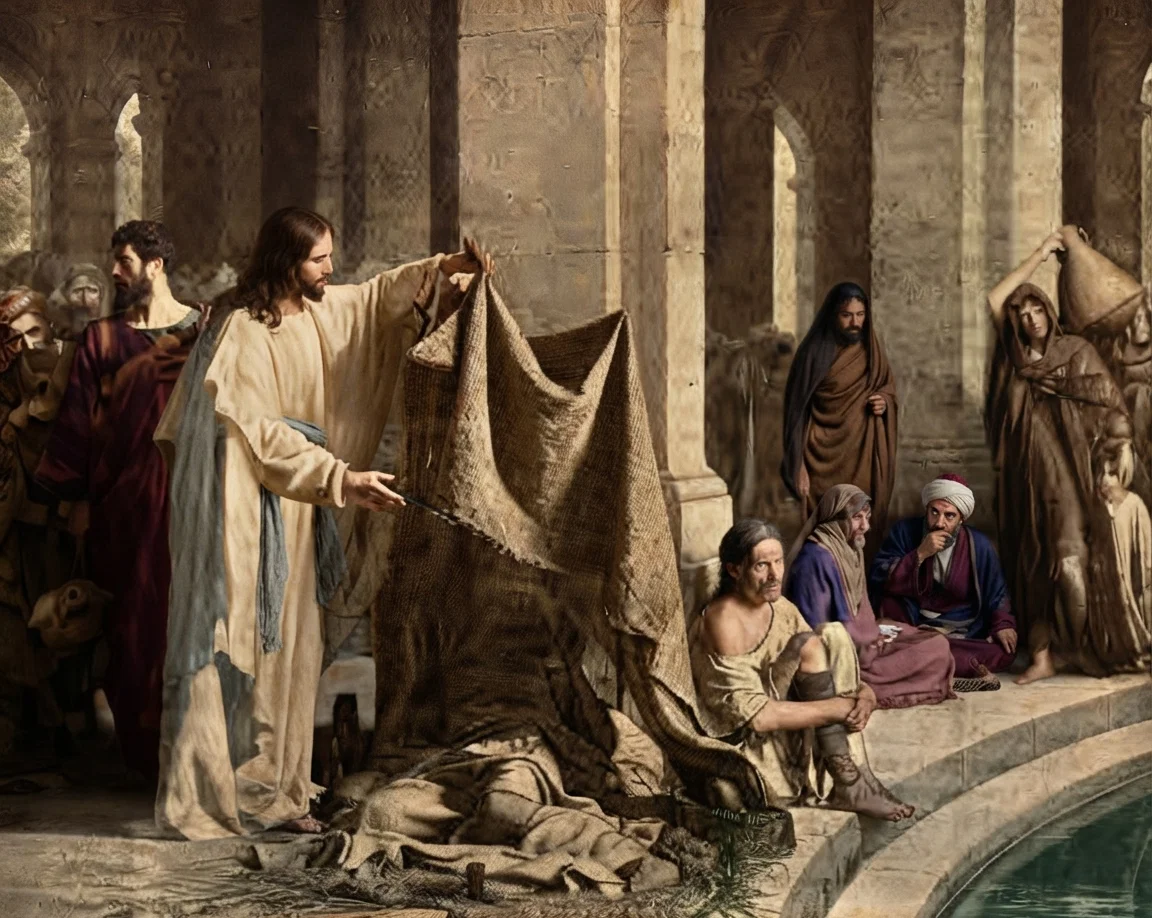
And a certain man was there, which had an infirmity thirty and eight years. . . . Jesus saith unto him, Rise, take up thy bed, and walk. And immediately the man was made whole. John 5:5-9.

Teaching and Healing.

WHEN Christ sent out the twelve disciples on their first missionary tour, He bade them, "As ye go, preach, saying, The kingdom of heaven is at hand. Heal the sick, cleanse the lepers, raise the dead, cast out devils: freely ye have received, freely give."
To the seventy sent forth later He said: "Into whatsoever city ye enter, . . . heal the sick that are therein, and say unto them, The kingdom of God is come nigh unto you." The presence and power of Christ was with them, "and the seventy returned again with joy, saying, Lord, even the devils are subject unto us thru Thy name."
After Christ's ascension, the same work was continued. The scenes of His own ministry were repeated. "Out of the cities round about" there came a multitude "unto Jerusalem, bringing sick folks, and them which were vexed with unclean spirits, and they were healed every one."
And the disciples "went forth, and preached everywhere, the Lord working with them." "Philip went down to the city of Samaria, and preached Christ unto them. And the people with one accord gave heed unto those things which Philip spake. . . . For unclean spirits . . . came out of many that were possessed with them; and many taken with palsies, and that were lame, were healed. And there was great joy in that city."

Work of the Disciples.

Luke, the writer of the gospel that bears his name, was a medical missionary. In the Scriptures he is called "the beloved physician." The apostle Paul heard of his skill as a physician, and sought him out as one to whom the Lord had entrusted a special work. He secured his cooperation, and for some time Luke accompanied him in his travels from place to place. After a time, Paul left Luke at Philippi, in Macedonia. Here he continued to labor for several years, both as a physician, and as a teacher of the Gospel. In his work as a physician, he ministered to the sick, and then prayed for the healing power of God to rest upon the afflicted ones. Thus the way was opened for the Gospel message. Luke's success as a physician gained for him many opportunities for preaching Christ among the heathen. It is the divine plan that we shall work as the disciples worked. Physical healing is bound up with the Gospel commission. In the work of the Gospel, teaching and healing are never to be separated.
The work of the disciples was to spread a knowledge of the Gospel. To them was committed the work of proclaiming to all the world the good news that Christ brought to men. That work they accomplished for the people of their time. To every nation under heaven the Gospel was carried in a single generation.
The giving of the Gospel to the world is the work that God has committed to those who bear His name. For earth's sin and misery the Gospel is the only antidote. To make known to all mankind the message of the grace of God is the first work of those who know its healing power.

Need of the Gospel.

When Christ sent forth the disciples with the Gospel message, faith in God and His word had well-nigh departed from the world. Among the Jewish people, who professed to have a knowledge of Jehovah, His word had been set aside for tradition and human speculation. Selfish ambition, love of ostentation, greed of gain, absorbed men's thoughts. As reverence for God departed, so also departed compassion toward men. Selfishness was the ruling principle, and Satan worked his will in the misery and degradation of mankind.
Satanic agencies took possession of men. The bodies of human beings, made for the dwelling-place of God, became the habitation of demons. The senses, the nerves, the organs of men were worked by supernatural agencies in the indulgence of the vilest lust. The very stamp of demons was impressedupon the countenances of men. Human faces reflected the expression of the legions of evil with which men were possessed.
What is the condition in the world to-day? Is not faith in the Bible as effectually destroyed by "higher criticism" and speculation of to-day as it was by tradition and rabbinism in the days of Christ? Have not greed and ambition and love of pleasure as strong a hold on men's hearts now as they had then? In the professedly Christian world, even in the professed churches of Christ, how few are governed by Christian principles! In business, social, domestic, even religious circles, how few make the teachings of Christ the rule of daily living! Is it not true that "justice standeth afar off; . . . equity can not enter; . . . and he that departeth from evil maketh himself a prey"?
We are living in the midst of an "epidemic of crime," at which thoughtful, God-fearing men everywhere stand aghast. The corruption that prevails, it is beyond the power of the human pen to describe. Every day brings fresh revelations of political strife, bribery, and fraud. Every day brings its heart-sickening record of violence and lawlessness, of indifference to human suffering, of brutal, fiendish destruction of human life. Every day testifies to the increase of insanity, murder, and suicide. Who can doubt that Satanic agencies are at work among men with increasing activity to distract and corrupt the mind, and defile and destroy the body?
And while the world is filled with these evils, the Gospel is too often presented in so indifferent a manner as to make but little impression upon the consciences or the lives of men. Everywhere there are hearts crying out for something which they have not. They long for a power that will give them mastery over sin, a power that will deliver them from the bondage of evil, a power that will give health and life and peace. Many who once knew the power of God's word have dwelt where there is no recognition of God, and they long for the divine presence.
The world needs to-day what it needed nineteen hundred years ago—a revelation of Christ. A great work of reform is demanded, and it is only thru the grace of Christ that the work of restoration, physical, mental, and spiritual, can be accomplished.

A Root of Evil.

"I KNEW a widow of limited means who was remarkable for her liberality to benevolent objects. But a sad change came to her in an unexpected legacy which made her wealthy, and then her contributions began to fall below the amount of her straitened finances. Once she volunteered; now she gives only when importuned, and then in as meager a manner as if the fountains of gratitude had dried up.
"Once when asked by her pastor to help a cause dear to her heart in her comparative poverty, and to which she then gave a guinea, now she proffered a shilling. Her pastor called her attention to the surprising and ominous change. 'Ah!' she said, 'when day by day I looked to God for my bread, I had enough and to spare; now I have to look to my ample income, and I am all the time haunted with the fear of losing it and coming to want. I had the guinea heart when I had the shilling means; now I have the guinea means and the shilling heart.'
"It is a fearful risk to heart and soul to become suddenly rich. This is one of the reasons why God lets many of His best children acquire wealth so slowly, so that it may not be a snare to them, may not chill their benevolence; that, when wealth comes, the fever of ambitious grasping may be cooled, and that benevolence may overtake avarice."
Now, the only way to avoid this peril is to cultivate two habits, and let them grow side by side—the habit of economy and the habit of charity. If one's economy grows steadily and alone, it will tend to dry up his charity; if one's charity grows steadily, it will dry up his means, unless balanced by the other virtue of economy. Therefore let both grow together; then our giving will increase just in proportion to our getting.
—A. J. Gordon, D.D.

The Law before Sinai.

THE children of Israel in the land of Egypt were at first honored, but when a king that knew not Joseph arose, they were oppressed. Before many years had passed, the former guests in the land were the servants, in abject slavery to the idolatrous Egyptians. Being a strong people, the descendants of Abraham carried their customs and laws with them, the Sabbath with the rest: But the heartless taskmasters could not allow their slaves to be idle, not even on their Sabbath, so the tasks were increased and the people were compelled to labor on that day. When Moses came to lead the Israelites from the land of oppression, he found no Sabbath observed.
Evidently his first work was to re-establish this institution, for when he and Aaron came before the king, word had already preceded them that the children of Israel were keeping their old Sabbath. This is shown by his refusal to allow them to go into the wilderness a three-days' journey: "Wherefore do ye, Moses and Aaron, loose the people from their works? get you unto your burdens. And Pharaoh said, Behold, the people of the land are now many, and ye make them rest from their burdens." Ex. 5:4, 5. Moses would not assume authority to hinder the work of the children of Israel in anything but in a matter relating to God's will concerning them. Pharaoh also spoke of the interruption of their work not as stopping but as a rest.
Thru David the Lord shows that He delivered His people that they might keep the Sabbath and observe all His statutes. "For He remembered His holy word, and Abraham His servant. And He brought forth His people with joy, and His chosen with singing. And He gave them the lands of the nations; and they took the labor of the peoples in possession; that they might keep His statutes, and observe His laws." Ps. 105:42-45. Now it is evident that the Sabbath commandment is the only one they could not keep, even in captivity; they could worship the true God, make no idols, refrain from taking the name of the Lord in vain; in fact they would have no difficulty in keeping any of the commandments, except that of the Sabbath. Then their masters set them tasks and required that they be performed on the Sabbath as on other days.
That the keeping of the law was God's object in leading His people from Egypt is clearly shown by one of the very first miracles performed in their behalf. Without doubt they knew the law; this is the test He made: "Behold, I will rain bread from heaven for you; and the people shall go out and gather a day's portion every day, that I may prove them, whether they will walk in My law or not." Wherein lay the test of the law?—In the observance of the Sabbath. By a threefold manifestation was the character of God and His law shown; first, a double portion of the manna fell on the day before the Sabbath; secondly, tho ordinarily it would not keep longer than a day, the extra portion gathered on the preparation day was sweet and good for the Sabbath; and thirdly, none fell on the Sabbath day.
However, some went out to gather manna on the Sabbath. The Lord was displeased with them, and to Moses He said: "How long refuse ye to keep My commandments and My laws?" This alone is evidence that the law existed before Sinai. Further evidence is found in Moses' answer to his father-in-law, when Jethro remonstrated with him for attending to all the details of judging the people: "The people come unto me to inquire of God, . . . and I make them know the statutes of God, and His laws." Ex. 18:15, 16. This work of Moses was in accordance with the instruction of Jehovah, who, in the language of David, "established a testimony in Jacob, and appointed a law in Israel, which He commanded our fathers, that they should make them known to their children . . . that they might set their hope in God, and not forget the works of God, but keep His commandments." Ps. 78:5-7.
Clearly the Sabbath was not instituted to commemorate the deliverance from Egypt, for already it was a part of the law of God, well established and known to His people. Indeed, there is no difficulty at all in locating the time when it was first observed, and by whom. "And on the seventh day [of creation] God finished His work which He had made; and He rested on the seventh day from all His work which He had made. And God blessed the seventh day, and hallowed it; because that in it He rested from all His work which God had created and made." Gen. 2:2, 3. Instituted by the Creator of the world, on the seventh day of this world'shistory, established as a lasting memorial of that creative week, given to man—such is the account, which is neither disputed nor altered by so much as a word in all the Bible, for the very simple and adequate reason that the Bible is the word of God, and that word is "truth," and truth is eternal.

Christ's Universal Reign.

Hasten, Lord, the glorious time, When, beneath Messiah's sway, Every nation, every clime, Shall the Gospel call obey.
Mightiest kings His power shall own; Heathen tribes His name adore; Satan and his host o'erthrown Bound in chains shall hurt no more.
Then shall wars and tumults cease, Then be banished grief and pain; Righteousness and joy and peace, Undisturbed, shall ever reign. —Anon.

Were the Christians of Past Centuries Sealed without the Sabbath?

By A. Delos Westcott
(Continued from Last Week.)
EVERYTHING that Christ did, He did for us. He was baptized for those, like the thief on the cross, who were unable to be baptized for themselves. He kept the Sabbath for the Sabbath-breakers. He was sanctified that we might be sanctified. John 10:36; 17:19; 1 Cor. 1:30. By observing the true Sabbath, He had the sign of sanctification, "the seal of the living God;" "For Him hath God the Father sealed." See John 6:27; Eze. 20:12. As our High Priest, He is "One who can have compassion on the ignorant, and on them that are out of the way." During the past centuries of ignorance and superstition, many did not understand the nature and mode of baptism. Thousands never heard anything concerning the seal of God. They only knew what they were told by their religious teachers, but they earnestly desired to do God's will. For such persons Christ was baptized, and for them He was sealed. Their baptism, therefore, and their sealing were exactly like Christ's. Nay, Christ's baptism and His sealing were theirs.
"The times of this ignorance God winked at; but now commandeth all men everywhere to repent." Acts 17:30. There are times in earth's history when God ceases to excuse ignorance, when He sends special light and warning, and calls upon all men everywhere to repent. Such a time came when Noah was sent to warn the world of the coming flood. Such a time came when Christ and His disciples preached the Gospel in power "to every creature which is under heaven." Col. 1:23. Said Christ, "This is the condemnation, that light is come into the world, and men loved darkness rather than light, because their deeds were evil. For every one that doeth evil hateth the light, neither cometh to the light, lest his deeds should be reproved. But he that doeth truth cometh to the light, that his deeds may be made manifest, that they are wrought in God." A person who prefers popular error to unpopular truth has no proper claims to honesty or loyalty to God. To reject truth is to reject its Author.
Again Christ said, "If I had not come and spoken unto them, they had not had sin; but now they have no cloak for their sin." Noah was sent of God to pull off the cloak of ignorance, that the people might be brought to a knowledge of their sins. John the Baptist was sent to begin the work of pulling off the cloak. It was continued by Christ and His disciples with wonderful success. During the Dark Ages, the people became so closely wrapped in the cloak of ignorance that the light of God's word was almost entirely shut out. Once more God raised up men to pull off the cloak. But the work was not completed. A great deal was accomplished, but reforms were still left for succeeding generations.
God's last message of reform to this world is recorded in Rev. 14:6-12. The next event is the second coming of Christ and the end of the world. It is distinctly stated that this Threefold Message is "the everlasting Gospel," and that it is to be preached "unto them that dwell on the earth, and to every nation, and kindred, and tongue, and people." Who of those professing to believe the Bible will dare to say that the message is of little importance, or that it was not intended for them?
The message begins with the announcement of the judgment, which must be readily recognized as pertaining to the Gospel. When Paul preached the Gospel, "he reasoned of righteousness, temperance, and judgment to come." Acts 24:25. In view of the impending judgment, the message calls upon men to "fear God, and give glory to Him; . . . and worship Him that made heaven, and earth, and the sea, and the fountains of waters." The last part of verse 7 is almost identical with the closing words of the fourth commandment, and suggests to our minds that just as our national independence is celebrated by the appropriate observance of the Fourth of July, so God's work of creation is celebrated by the observance of His sign, or memorial, the seventh day. See Ex. 20:8-11; 31:16, 17. "Fear God, and give glory to Him" suggests the exhortation, "Fear God, and keep His commandments;" and in Rev. 14:12 we read of the people who receive this Threefold Message, "Here are they that keep the commandments of God, and the faith of Jesus." Will not the faith of Jesus lead us to do just as Jesus did? He feared God, and glorified Him by keeping His commandments. See Heb. 5:7, 8; John 17:4; 15:10; 4:34; Ps. 40:7, 8.
The second part of the message proclaims the fall of Babylon. Babel-builders named their work Bab-il, "the gate of God"—just what every church, or religious body, professes to be. But the people who coined the word had fallen into corruption and error, so that their creed was a confused mixture of error and truth. Their Bab-il, their "gate of God," was Babylon, confusion. Such an organization could not be the "gate of God;" it was only "confusion," "a mixture." From that day to this, any people who were confused and disagreed in their understanding of truth are classed in the Bible under the name of Babylon. Why are there hundreds of creeds in the world to-day? Is it not because they can not agree on what constitutes truth? If they were taught by the "Spirit of Truth," would He not teach all alike? Will the Holy Spirit enter one home and tell them that the seventh day is the true Bible Sabbath? then enter another home and say that the first day, or Sunday, is the day to be observed? Is God the author of hundreds of contradictory creeds? "God is not the author of confusion." 1 Cor. 14:33. Jesus prayed that His followers might all be one, and Paul speaks about "the unity of the faith." He says, "I beseech you, brethren, by the name of our Lord Jesus Christ, that ye all speak the same thing, and that there be no divisions among you; but that ye be perfectly joined together in the same mind and the same judgment." 1 Cor. 1:10. The apostles did not hesitate to say, "We have the mind of Christ," and, "If any man have not the Spirit of Christ, he is none of His." Surely Babylon is a flourishing organization to-day, and will be until the end of the world. Many of the Lord's people are in Babylon, but He is calling them out. Rev. 18:1-5.
(Concluded Next Week.)

Greater Things.

“THOU shalt see greater things Than these,” the Saviour said. Still, down the ages rings The Voice that wakes the dead The Voice of Him who ever lives, Who to His own all power gives.
Not shortened is His hand, Not heavy is His ear, His purposes still stand, His help is ever near. “Canst thou believe? All things are thine,” Eternal is the word divine.
Then, On! in faith and trust; He knows His people’s need; He can thru feeble dust His work maintain and speed Until her day of toil is past, And glorious stands His church at last. —T. L. Clemens.

Steadfast in Duty

Set yourself steadfastly to those duties which have the least attractive exterior; it matters not whether God’s holy will be fulfilled in great or small matters. Be patient with yourself and your own failings; never be in a hurry; and do not yield to longings after that which is impossible to you. My dear sister, go on steadily and quietly; if our dear Lord means for you to run, He will “strengthen your heart.”

Prayer in Uneasiness

On every occasion of uneasiness, we should retire to prayer, that we may give place to the grace and light of God.—John Wesley.
Continue reading: That They May Be One in Us