Your ShelfYour Projects

Signs of the Times, Vol. 39, No. 37.

Question Corner

Signs of the Times

Sep 24, 1912

Pacific Press Publishing Association · Mountain View, California · Sep 24, 1912

Question Corner

"IF YE WILL INQUIRE, INQUIRE YE."
This Inquirers' Department is conducted for the purpose of helping those who are studying the Bible. The answers are oftentimes only suggestive. They are never to be considered infallible, only as they agree with the infallible Word. The writer who may answer them does not consider that his opinion is infallible. He will simply give the best that he has, and plead with the inquirer to search the Word. Such questions only will be answered as, to the editors, seem to minister to the good of the readers and to the mission of the paper. We can not answer repeatedly in the same volume questions upon the same scripture. The name and address must accompany question, not for publication, but as an evidence of good faith, and that answer may be made by letter if deemed advisable. No letters are answered which do not contain the name of the writer. It is well always to enclose stamp for reply.

3860 — The Tithe and the Promise

Is Mal. 3:10, 11 to be taken literally? If so, why are not all tithe payers wealthy?
J. H. D.
We know no reason why we should not expect God's blessing upon us in a temporal way, altho the greatest of all blessings are spiritual. But the scripture does not promise wealth. It does promise great blessings, if we will bring "the whole tithe" (A.R.V.) and cease to rob Him in offerings also. The sin which God charges against His people is robbery in tithes and offerings. If they will cease this robbery, and recognize their duty to Him, He will come into their life, enlarge their heart and life, and make it overflow with blessings. If we are good stewards, He will enlarge our stewardship, give enlargement of heart and life, and if for our good, bring temporal blessings. The blessings of God are given with "all wisdom and prudence," and He gives us no more than we can use to His glory and for our good.

3861 — In the Bosom of the Father

Did Jesus mean that He was in the bosom of the Father, also, when He was here on the earth? and shall we understand that Jesus could be in two places at the same time? John 1:18; 3:13.
A. K.
Our Lord simply meant that He was in all things in absolute oneness with His Father, that there was living connection and life-bond between Them, so that while He personally was in the earth, yet He was as truly at one with the purposes and work of the Father as if He had been present in heaven; and in fact He was there represented absolutely by the Father, even as the Father was represented here upon this earth by Him. It is not a difficult thing for a mother to say concerning her child who may be thousands of miles distant, that "he is in my heart continually;" and thus Jesus, by His living connection with the Father, by His doing of the Father's work, and by His absolute oneness, was still in purpose and affection in the bosom of His Father.

3862 — Some Questions from a Catholic

  1. What is the numerical strength of Seventh-day Adventists?
  2. Do you believe that no one will be saved that has not been baptized by immersion?
  3. Do you believe that it is wrong and is sin to eat meat? If so, how do you explain Christ's use of meat, and God's commandment, "All the beasts of the field . . . shall be to you for meat"?
  4. Is it not true that the Seventh-day Baptists and the Seventh-day Adventists are fast dying out, a deceasing?
  5. In what do the two last named denominations differ?
  6. Do you believe that all people who observe Sunday as the sabbath in contradistinction to Saturday will go to hell?
  7. Why are Adventists so bitter against Catholics, calling them harlots, and the church "the beast"?
Remember that the Bible is a fiddle upon which almost any tune can be played, and that every one believes his religion is right, and if so, all the others must be obviously wrong.
C. J. B.
  1. In round numbers, somewhat over 100,000 in the world.
  2. The only water baptism there is is immersion. As to the question of salvation, it depends on light and conscience. If one sins against conscious light, he must be condemned. Our Lord states the true principle: "If I had not come and spoken unto them, they had not had sin: but now they have no excuse for their sin." John 15:22. "The eyes of Jehovah run to and fro throughout the whole earth, to show Himself strong in the behalf of them whose heart is perfect toward Him." 2 Chron. 16:9. Sometimes the intellect is inferior to the heart. There are times of ignorance when God seems to wink at sin, but it is because the people do not have the light.
  3. No; we do not believe that it is sin to eat meat unless it is eaten not of faith, for "whatsoever is not of faith is sin." Rom. 14:23. There have been times (as immediately after the Deluge), there doubtless will be times, when all that men can get to eat to sustain life is flesh food. And God suffers it. But the animal kingdom is becoming more and more diseased, and it is becoming more and more evident that flesh foods are increasingly unwholesome and disease-breeding. We opine that the vast majority of flesh eaters eat meat because they like it, and not because it is the best food. The true Christian rule is, "Whether therefore ye eat, or drink, or whatsoever ye do, do all to the glory of God." 1 Cor. 10:31. We can not believe it is to God's glory to eat corrupt flesh foods when we can find food so much better.
  4. About thirty years ago the Seventh-day Adventists numbered about eight thousand; now about one hundred thousand. About fifty years ago an aggregation of a single copy of each one of their publications could be purchased for thirty-five cents; to-day such an aggregation in cheapest binding would cost more than $550. At that time they had one very small printing-office; now they have thirty-seven publishing houses in the world. They now have missions in almost every country of the world. Many illustrations of their growth might be given. Surely simple statistical reports do not look like "a deceasing." To God be all the glory. Seventh-day Baptists have not increased so rapidly.
  5. Chiefly regarding prophetic interpretation, immortality and life through Jesus Christ alone, our Lord's priesthood, and this world's future. This department is too limited to discuss in detail or at length the differences.
  6. No, no more than we believe that honest men who have passed counterfeit bills should go to jail. See answer to question 3. We believe that many Roman Catholics will be saved, not because of their error or because of their church, but in spite of it.
  7. Seventh-day Adventists are not bitter against Catholics. We have naught against men or women of any denomination. We would feed or help a Catholic in need as soon as we would any other person. But we do not believe in the Roman Catholicism, the corrupt ecclesiasticism, of the centuries. We believe that union with the world on the part of the Christian is spiritual fornication, and we do not see why it would not be the same with the church. Any apostate, world-joined church is a harlot, whether it be Catholic or Protestant. But the church is not the "beast" power of prophecy. The beast is a symbol of the union of church and state.
Men play tunes upon a fiddle by an oscillating and variable bow, and by picking the strings. It is by the manipulation of the bow of traditionalism upon the strings of truth, by the picking of those strings of truth by the fingers of prejudice, love of self, skepticism, Higher Criticism, and apostasy, that the many discordant tunes are produced. The Bible is its own interpreter; and to the heart open to receive and the purpose to do God's will, the Bible tells the one great story, and reveals the same great Master, working harmony throughout God's universe. Eliminate the human creed makers and the human doubters, there will be no trouble over the unity and power of the church. It will take neither anathema nor law to hold it together.

3863 — The Prohibition Platform

What do you think of that plank of the Prohibition platform of "one day's rest in seven?"
W. N. K.
We do not know just what is said in the plank, as we have seen no complete report of it. If it means a definite Sunday law, it certainly is wrong. If it demands the simple right of one day's rest in seven, regardless of the day, that may be a proper thing. We would prefer to see it before comment. As to voting for any particular man, the "Signs of the Times" has no advice to give. "Every one must be responsible for his own mistakes."

3864 — Service in the Heavenly Tabernacle

Was there any service performed in the heavenly tabernacle of which the earthly was a type before Christ's coming to this earth?
There certainly was no such service performed for sin in the heavenly sanctuary, as there was after Christ came to this earth, for Christ ministered His own blood, and His blood was not shed until He came to this earth, and we are expressly told in Heb. 9:15, "And for this cause He [Christ] is the Mediator of the new covenant, that a death having taken place for the redemption of the transgressions that were under the first covenant, they that have been called may receive the promise of the eternal inheritance." We may settle these facts: that God is ever merciful, "the same yesterday, and to-day, and forever;" that He had mercy to the one who sought Him, in ancient times, just as He has now; that it was not absolutely necessary that some one should be seated upon a throne, or that some one should be standing before an altar, for the soul to obtain mercy. All those ceremonies had their instructive lessons, and those lessons were ever to bring before the people that sin was sin, and that sin demanded death, but that God was merciful, and would give life for death, righteousness for sin.

3865 — Supremacy of Turkey

What were the circumstances connected with Turkey's losing her supremacy August 11, 1840?
J. C. S.
Turkey was at war with one of her provinces, Egypt; and Mehemet Ali, the pasha of Egypt, was in a fair way to conquer Turkey, when that nation appealed to the powers, Great Britain, Austria, Prussia, and Russia. These powers took the case into their own hands, and Mehemet Ali was ordered to cease hostilities. Turkey had not power to conquer her own vassal, and her suzerainty was practically yielded to the powers in the year 1840. The messenger landed in Egypt August 11, 1840, but he did not place the ultimatum in the hands of Mehemet till August 20.

3866 — Different Names

Can Gen. 26:34; 28:9; and 36:2, 3, be made to harmonize? The names of the persons seem to me to be mixed up a good deal.
A. K.
Gen. 26:34 declares that Esau took to wife Judith the daughter of Beeri the Hittite, and Basemath the daughter of Elon the Hittite; 28:9 simply says that Esau took another wife besides these before named, Mahalath the daughter of Ishmael Abraham's son, the sister of Nebaioth; 36:2, 3 gives other names of the wives of Esau. The "Companion Bible" has this suggestion to offer on these names,—that Judith had a second name, Oholibamah, and Beeri also had another name, Anah; and that the Hivite tribe was a branch of the Hittite tribe, "Hittite" being the general term. Basemath also had a second name, Adah; the name "Basemath" was dropped to avoid confusion with the daughter of Ishmael. In chapter 26 we have general history, but in 36 precise genealogy. Regarding Ishmael's daughter, she seemed to have two names also, Mahalath, and a second name, Basemath. It was not uncommon for them to have more than one name, and that simple fact meets all these. The "Companion Bible" suggests that the additional name of Beeri means "the spring finder."
OUR BIBLE BAND
OUR BIBLE BAND

Schedule for Week Ending October 5, 1912

Sunday September 29 John 12
Monday " 30 " 13
Tuesday October 1 " 14
Wednesday " 2 " 15
Thursday " 3 " 16
Friday " 4 " 17
Sabbath " 5 " 18
Our whole week's reading lies in John, chapters 12 to 18, inclusive. We know of no more instructive week than this. Chapter 12, the anointing of Jesus, the riding into Jerusalem, God's voice witnessing to the blessedness of Jesus' choice to suffer, the liberty which our Lord grants to men, even to reject His sayings; chapter 13, the marvelous lesson of humility and service taught us by our Lord; chapters 14, 15, 16, the wonderful words of instruction and promises of the Comforter; chapter 17, the prayer of Jesus, not only for His disciples then, but for those who now live,—all that would believe on those He sent; and chapter 18, the beginning of the trials and persecution of our Master before the high priest and Pilate, and Pilate's effort to release Him. As we read these chapters, let our imagination grasp the scene, so that the great events may come before us in living pictures, impressing not only the sense of the ear, but of the eye as well. And read them with the prayer that the Spirit of God may impress them upon our heart as we read, and make them living lessons in our own life.

EDITORIAL

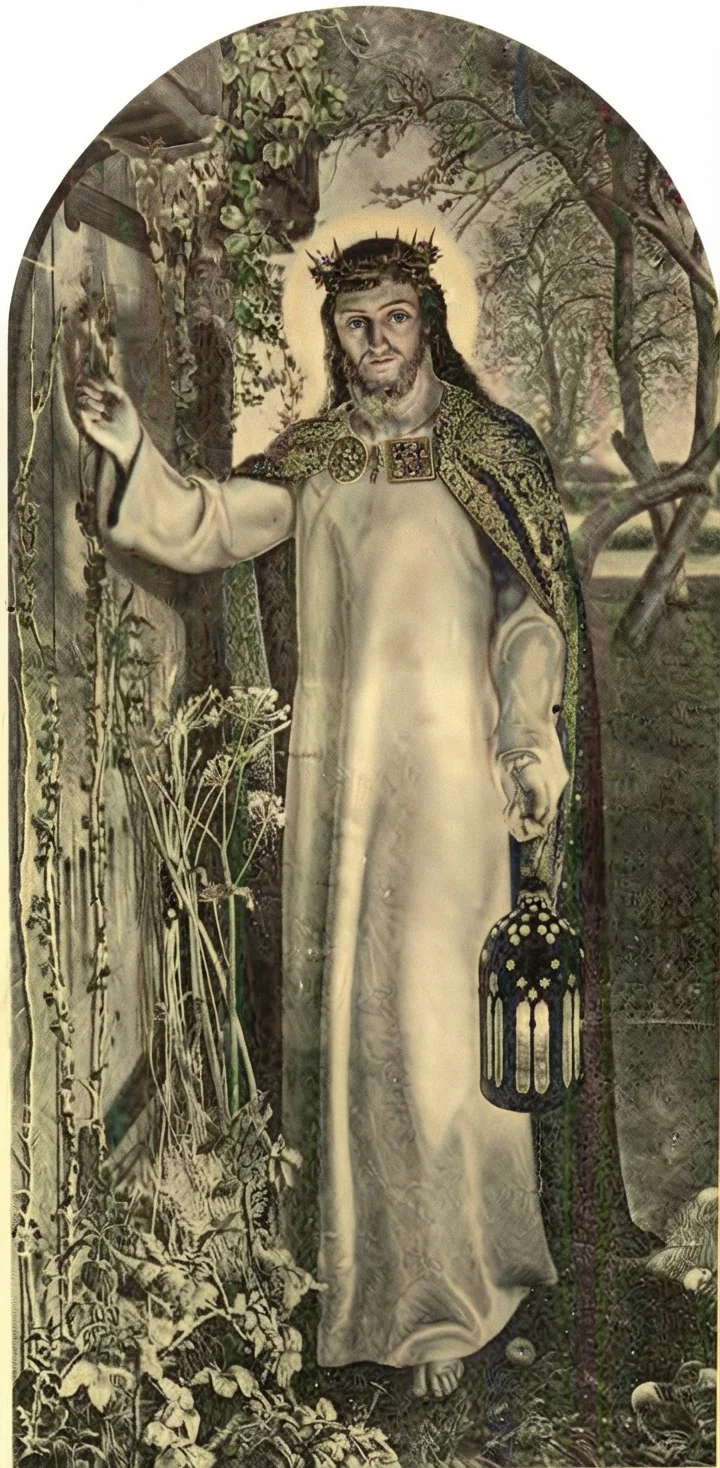
He Is Knocking at Your Door

If any man hear My voice, and open the door, I will come in to him.
THE mighty Creator, who made all things that are in the universe, is the One who is also the Captain of our salvation. And it is none other than this mighty Personage who says continually to each one of us, "Behold, I stand at the door, and knock: if any man hear My voice, and open the door, I will come in to him, and will sup with him, and he with Me." Rev. 3:20.
"Behold, I"—that is, the Mighty One, the Infinite One—am standing at the door of your heart, and am knocking. "Behold, I," who am the Creator of all things, the One who guides every world that circles in the infinite depths of space—even "I," who am the King of Eternity, am standing before you, knocking for admittance into your life.
Men are usually too busy in trying to get on in this life to take into account that there is such a Mighty One, such a great Personage, who is seeking to become their most intimate Friend and Helper. He says, "If any man hear My voice, and open the door, I will come in to him, and will sup with him, and he with Me." O, the soul-satisfying blessedness of this promise! Think of the intimacy, and close, warm friendship that it suggests. Not only will I come in, says the Master, but having been admitted, I will sup with you, and you with Me.
Meditate for a moment on what it signifies to enter into such intimate relations. You are to "sup" with the Master. No more confidential friendship could be suggested. And then to think that this great character is the One who is making the advance! He is the One who is knocking for admission into our lives, not that He may get some personal benefit in a selfish way, but that He may help us by giving us the joys of all His infinite creation. And as we allow Him to help us in this way, He gets joy out of it; but it is the joy of seeing us happy instead of miserable.
Take another view of the matter: In asking us to let Him come into our lives, He is really asking us to come in contact with all His mighty works of creation. He is asking us to become acquainted with Him as Creator as well as Redeemer. To show that He wishes us to sense and keep in mind His power as Creator, He has given us the Sabbath to memorialize His creative power, and through the Sabbath He gives us one seventh of our time to meditate on the infinitude of His works and to revel in the joys of His matchless power.
Let us stand beneath the open sky of a clear night and behold the multitude of stars.
Each star is a world of some sort, and many of them are hundreds of times as large as the earth on which we dwell. Let us stand and gaze at world after world, until we have viewed every one that we can see with the naked eye, and then let us take the telescope for a still further view. With the aid of this instrument, we will find hundreds of thousands of other worlds where before we saw nothing but empty space. And having viewed all this, let us turn to the sublime language of Job and learn that "lo, these are but the outskirts of His ways: and how small a whisper do we hear of Him! But the thunder of His power ["mighty deeds," margin] who can understand?" Job 26:14.
Having taken this view, let us seek to realize that we are now in contact with the "One that inhabiteth eternity." We are taking a finite, limited, imperfect, mortal view of His immense domain. Then let us stop long enough to drink in the blessedness of the joy that the One who is the mighty Creator is the same One who asks us to let Him be our Guest. Let us hear Him again while He says, "Behold, I"—this Infinite One, this mighty Creator—"stand at the door, and knock: if any man hear My voice, and open the door, I will come in to him, and will sup with him, and he with Me."
Note a further blessedness of the invitation: It says, "If any man hear My voice, and open the door, I will come in." This wonderful Master is too great to be narrow and exclusive in His invitations and His affections. For altho He says of Himself that He is "the high and lofty One that inhabiteth eternity," and that His "name is Holy," and that He dwells "in the high and holy place," yet He is "with him also that is of a contrite and humble spirit, to revive the spirit of the humble, and to revive the heart of the contrite." Isa. 57:15.
The power of His presence is so great that any individual who will permit Him to come in will have his life insensibly ennobled and uplifted. And therefore the Lord can safely give the invitation to "any man;" for even tho the man may be degraded and sinful—even tho his life may be such that he will be overpowered with shame when he hears the knock of the refined and righteous Master—yet does this Lord entreat that He may be permitted to enter and become the honored Guest. The very influence of His presence, and the application of His sacred life-blood, are to make the man all over. He is not to remain the defiled sinner that he now is, but he is to be changed by the mighty power of this infinite Creator.
If we are tempted to doubt His power, then He bids us go out on another starry night to take an additional view of His innumerable array of worlds; then in the confidential manner that no one can describe, but that every one understands who has come in contact with the Master, this Lord of Creation breathes into our very soul the assurance, "All power is given unto Me in heaven and in earth." Matt. 28:18.
But you will hear some one say that this great Creator is too mighty to stoop to notice a little, finite man. Do not get such a misunderstanding. Because He is so mighty, because He is absolutely infinite, therefore He can and does have the ability to notice each and every one. And, besides, this is the one revolted planet. This is the one place where things have gone wrong, and man is in sin and rebellion against the righteous laws that God has made to govern the universe. And for that very reason, the infinite God is giving more of His time and attention to this one planet and the beings upon it than to all His universe besides. We should expect that such would be the case. And because the Lord isgiving so much of His time and His omnipotent powers to this revolted planet, we find such statements as this in His Word: “The eyes of Jehovah run to and fro throughout the whole earth, to show Himself strong in the behalf of them whose heart is perfect toward Him.” 2 Chron. 16:9.
You are ready to say, perhaps, that it sounds well to talk of such close intimacy with the Creator of all things, but you fail to find the evidence that it is so. Come right up close to the text already quoted, and see that the evidence is in the very words themselves. It may seem strange to hear the assertion that the words contain the evidence of their own authenticity. But Infinite Power is able to put life into His words so that the very words themselves speak to the innermost heart. If such power and such life were not in the very words, we might well doubt them.
But let us hear these words again: “Behold, I stand at the door, and knock: if any man hear My voice, and open the door, I will come in to him, and will sup with him, and he with Me.” He says “Behold.” “Just look, and you will see. Just think for a moment on your own experiences, and you will realize that I have followed you all your life. You have repulsed Me again and again,” the Master is saying to you, “but I have ever remained knocking for entrance. You have tried to talk infidelity; you have written infidelity; you have listened to infidelity; you have laughed loudly at the puns that infidelity has tried to make against My name. In all these ways you have tried to drown the sound of My knocking. But you can never forget the times when I have stepped up to your side when you were standing in quiet before the open grave; never can you forget when I have spoken to you when in the face of awful calamity; never can you erase the fact that there has ever been with you the quiet voice which no one else could hear, but which has been as distinct to you as the ringing of bells in the depths of your own soul.”
This wonderful Master loves us, and hence He follows us ever. He wishes that we may spend eternity with Him, and is urgent in His invitations and entreaties. How can men find it in their hearts to turn from One who is so gracious, and so great! T.

Life Is Short, and Much to Do

It is said of one of the great inventors of this time, that on a certain occasion he was walking to dinner with one of his associates, and neither of them was saying anything. They were simply walking along thinking. Suddenly the inventor broke into a run, saying as he did so, "There is an immense amount to be done, and life is very short."
The inventor in question, sad to say, believes that there is no almighty God, the infinite Creator of all things. He has expressed himself as believing that when death comes to man, it ends everything for him; that when his breath leaves his body, he is nothing more than a lump of clay, that will never be revived by a resurrection, and that there is absolutely no life for man beyond the tomb.
This inventor has delved deeply into useful sciences all his life. He has been in continual touch with the mighty forces of creation, and yet he has shut himself away from recognizing the Creator. How sad it is that such a life should contain such a void! To make no mention of the life that is beyond, what indescribable joys, even in this life, is this man shutting away from himself!
But still this same man, with no hope after death, can feel the weight of the value of time. "There is an immense amount to be done, and life is very short." Every true Christian feels this same impulse of the value of time, only he feels it to an intensified degree. The trouble, however, is that there are so many who do not allow Christianity, with its mighty power, really to take hold of the life. And hence there is a vast army who merely make a profession, and who only count in the census, but who really know nothing about the Christ of the living God. All who actually know the Master, will realize that time is very short, and that there is an immense amount to be done. T.

The Bible and Agnosticism

“Worship Him that made heaven and earth.” Rev. 14:7.
THE religious knowledge of which the Sabbath is a memorial, and the religion of which it is the sign, take their root in the all-embracing and ever-enduring principle of God as the Creator and upholder of the universe. And the scientific knowledge of which the Sabbath is also the memorial, and the science of which it is the sign, take their root in the selfsame principle that God is the special Creator and preserver of heaven and earth.
Between that religious knowledge and that scientific knowledge, and between that religion and that science, there is no difference save in the matter of their interpretation; for tho the knowledge of religion must come in most part from revelation, and the knowledge of science in the main from the material creation, yet the two are but different aspects of harmonious truth. They weave and interweave, being bound together by the great unity of God, and by His oneness with all who are and all that is in harmony with Him.
But not all who have the knowledge of religion, believe literally and uncompromisingly the first verse of the first chapter of Genesis; and many who have large scientific knowledge — in fact the greater portion of those who have such knowledge — deny the literal and plain interpretation of this first portion of the Bible. The doubts of both these classes come from listening to the cavilings of those who deny to our world the large supernatural working of the Creator.
“Through faith we understand that the worlds were framed by the word of God.” “Through faith we understand.” Many seem to think that some things must be understood by looking with the eyes, by hearing with the ears, by feeling with the hands, by juggling test-tubes and manipulating balances, and by ransacking the brain; but the Word declares that this truth of creation is not thus understood. It is apprehended by faith alone. “Through faith we understand.”
This is because creation is too large for the unassisted mind of man. We know only that which comes within our narrow range of experience. We are prone to read all other things in the light of that experience. But there are no processes in existence to-day that can give any large light upon the mighty process of the creative work.
There are no forces now, no methods of growth, no forms of development, that can build a world, give it never so many eons, provided, of course, it start where this world started; namely, with darkness and a formless void.
But He who built the universe has described to us the process in so far as we can receive it. We are not left to guess at the matter; we are not left to meager theories, inadequate hypotheses, and subtle speculations. We are told in language plain and clear of the wonderful work of that wonderful time when earth began.
And now “through faith we understand that the worlds were framed by the word of God.” But not all men have faith. Not all men through faith understand. Such men have chosen to call themselves agnostics, which is the Greek word for one who knows not, for whom the Latin word is “infidel.”
Agnosticism is the science of knowing what not to know, or at least of knowing what it will be best, for argument’s sake, not to know. It points out not only the unknown, but also that which is unknowable.
Now it appears to us that, if a thing is unknown to an agnostic, it is very unwise and very much against his don’t-know creed to claim so much as to know that anything he doesn’t know is unknowable. But this is just what some of them claim. Spencer has told us, for example, that “the power which the universe manifests to us is utterly unscrutable.”
How does he know that it is unscrutable? If a thing is wholly unknown to a man, he is in complete ignorance of it. And being in this dense ignorance, he can assert only that it is unknown. He can not logically say that it is unknowable even to himself; for he knows not what moment the light may pierce the gloom. And to say that in the absolute sense it is unknowable to all, is for a philosopher to commit philosophical suicide.
God is knowable. More than that: God is known by His works. Rightly contemplated, material things reveal their Maker: (Rom. 1:20.)
If the agnostic would stick to his creed of “I don’t know,” he would be at least consistent with that creed; but when he tells us that he knows that things can not be known, he gets outside his creed, and makes himself ridiculous.
The agnostic knows too much. He is hardly consistent. He knows just what to know and what not to know in order to pass in certain quarters as a great and learned man. When, for instance, the believer in the Bible teaches the doctrine of special creation, our agnostic smiles, looks superior, and reminds his Christian acquaintance that all knowledge of the past must come to us by assuming that nothing has been produced by causes different in kind from those to which they now owe their origin. “Geology,” says Agnostic Huxley, the first of the genus, “could tell us nothing except for the assumption that, millions of years ago, water, heat, gravitation, friction, animal and vegetable life, caused effects of the same kind as they now cause. Nay, even physical astronomy . . . is founded upon the same assumption.”
Thus the agnostic thinks he puts a damper on the enthusiasm of the Christian. He argues that “all things continue as they were from the beginning of the creation.” That is, he argues that way when he is fighting the Christian doctrine of a special creation.
But when he is arguing for the evolutionary hypothesis and spontaneous generation he talks quite differently. We have just read Huxley’s words that science is founded on the assumption that what is now always has been. Now let us put with it other words of Huxley. This will be a case of Huxley versus Huxley; and One of authority once said, “A house divided against itself can not stand.”
This agnostic first of all admits that the doctrine of life only from antecedent life is victorious all along the whole line at the present day. Admitting that spontaneous generation is impossible in nature now, he says: “If it were given me to look beyond the abyss of geologically recorded time to the still more remote period when the earth was passing through physical and chemical conditions which it can no more see again than a man may recall his infancy, I should expect”—what? That everything was produced by causes in the same way that they are to-day?—By no means. “I should expect to be,” he says, “a witness of the evolution of living protoplasm from not living matter, under forms of great simplicity.”
Now what do you think of that? Thus agnostics believe in something that does not now take place; they admit it can not and doubtless never can take place; and furthermore they admit that they have no evidence that it ever did take place. And yet, without past, present, or future evidence of spontaneous generation, “because they need it in their business,” they declare their belief in it. After such profession of faith on their part, I am sure they have no ground for taunting the Christian because of credulity.
Huxley, after stating this preposterous belief of his, admits he has no reason to call it anything but philosophic faith. Faith, mind you. And this from a man who thinks about faith in this fashion: “The man of science has learned to believe in justification, not by faith, but by verification.” “Skepticism is the highest of duties; blind faith the one unpardonable sin.”—“Methods and Results,” pages 40, 41.
Thus is knowledge justified of her children, and consistency found to be a jewel.
But as the Word says, when men argue that all things continue as they were from the beginning of creation, they are willingly ignorant of the fact that there have been mighty cataclysms, and nature has not taken an even course. And these modern scientists know that if there has been no change at any time, and if the conditions that now exist always existed, there could be no origin to this world. Nothing originates now. There is no new thing under the sun. And to argue for no change is to argue for the eternity of the world.
But every man, be he scientist or religionist, believes in a beginning. The Christian points back to the special creation of this world by the almighty fiat of God. The agnostic points back to the living evolving from the not-living “under forms of great simplicity.” Look on the two views, and take your choice.
Hidden from the wise and prudent and revealed to babes! Thus it seemed good in the sight of God. The agnostic, while in name he denies knowledge, in profession claims all knowledge, a knowledge beyond his fellows. He not only knows all that is known, but he knows also all the things that can’t be known. These he has most conveniently labeled, and put away on the shelf, where they won’t bother or distress him.
The promoters of fresh scientific ideas have established the fact “that minds as yet untrained are more accessible to new truths than those occupied, encumbered, glutted with fixed ideas.”
The Word of God, rightly tested, has in its own words the proof of its heavenly origin. Huxley, who seemed to know so much of how this world did and did not come into existence, admits that his theory of evolution will not account for the religion of the Bible. Quoting the words of Micah, “And what doth the Lord require of thee, but to do justly, and to love mercy, and to walk humbly with thy God?” he says: “If any so-called religion takes away from this great saying of Micah, I think it wantonly mutilates; while, if it adds thereto, I think it obscures the perfect ideal of religion. But what extent of knowledge, what acuteness of scientific criticism, can touch this, if any one possessed of knowledge, or acuteness, could be absurd enough to make the attempt? Will the progress of research prove that justice is worthless and mercy hateful; will it ever soften the bitter contrast between our actions and our aspirations; or show us the bounds of the universe, and bid us say, Go to, now we comprehend the infinite?”—“Science and Hebrew Tradition,” pages 161, 162.
If the Bible, according to Huxley’s notion, holds false science, it certainly holds, in his opinion, “the perfect ideal of religion,” which can not be in any way improved. If a bramble-tree can not produce grapes, whence came these life-giving clusters of the vine of truth?
After all the criticisms, arguments, speculations, theories, and conjectures, are in and safely cared for, “I take again my old Bible, and I say to it: Just as thou art, I love thee, thou who dost weep with all our tears and shout aloud with our joys! It is sweet to read thee after the fashion of the ignorant, so great thou art in thy anonymity and thy eternity! Thy authors and thy origin are of small account; the human soul has brought thee forth in suffering and in hope; thou makest the measure of its mercy and its nobility. And I love in thee all those who have drunk at thy sources, reposed in thy shade, and laid their heads upon thee for the last sleep.”
Can that which is thus so true to all the highest and best there is in the soul of man and the world, be false and untrue in all its supernatural aspects? And when it comes to this “last sleep,” is it the natural or the supernatural of the Word that gives us hope?
The agnostic trumpets his ignorance. He confesses his spiritual numbness. And the Christian never misses the mark farther than when he refuses this testimony of the agnostic. When the agnostic tells us he is deaf, blind, dumb, torpid, and dead to the spiritual world, we must believe him. It is the Word of God Himself. “The natural man receiveth not the things of the Spirit of God: . . . neither can he know them, because they are spiritually discerned.” “Except a man be born of water and the Spirit,” “he can not see the kingdom.” “The nescience of the agnostic philosophy is the proof from experience that to be carnally minded is death.”
A deaf man knows not the world of music; a blind man knows not the beauties of light; and the natural man knows not the things of the Spirit of God. They are discerned only by the spiritual sense.
The agnostic may not be a monster, but he is a dwarf. He can not be anything else and be an agnostic. Plants are not the only things that can be dwarfed. You can dwarf a soul, if you keep it out of its true life element. For a time it may have a name to live; but like a plant shut away from the light, its sickly pallor shows the awful inroads of disease and degeneration.
While living outwardly a life above reproach, it is nevertheless a case of arrested life and growth. Having a name to live, it steadily approaches death. With Ruskin, we do not wonder at what men suffer, but we wonder at what they lose.
Against the idea of a natural religion and a natural science, we put the idea of a supernatural religion and a supernatural science. And this mighty supernature is revealed in that special creation when God spoke the word, and all things both natural and spiritual stood up before Him.
Opposed to agnosticism is the clear understanding which comes through not blind, but intelligent faith. And the great bulwark against this know-nothingness of agnosticism is the Sabbath truth of the work and rest of God. It stands to remind us of the supernatural working of creation, that still works as at the first to make man, as well as all things ultimately, even as God declared them at the first to be, “good;” yea, very good.
Continue reading: The World’s Moral Decline