Congress Enacts a Law Closing Post-Offices on Sunday
From Our Washington Correspondent
SATURDAY, August 24, 1912, near the close of its recent session, Congress reversed its long record of over one hundred years, and enacted a law prohibiting the opening of first- and second-class post-offices on Sunday. The law, which was agreed to by the conference report and approved by the President on this day, reads:
"That hereafter post-offices of the first and second classes shall not be open on Sundays for the purpose of delivering mail to the general public, but this provision shall not prevent the prompt delivery of special delivery mail."
Movement Began in 1811
The agitation for the closing of the mails in the United States on Sunday began in 1811, and, as the records show, was of distinctly religious origin and character. The earliest mention of this agitation in Congress appears to be the following from the record of the proceedings of Friday, January 4, 1811:
"Mr. Findley presented a petition from the Synod of Pittsburg, in the State of Pennsylvania, praying that the laws and regulations for the government of the Post-office Establishment may be so altered or amended as to prohibit mail-stages and post-riders from traveling, and post-offices being kept open, on Sunday."—"Annals of Congress," page 487.
Friday, January 25, 1811, a petition from "sundry inhabitants of Philadelphia" was likewise presented, in which Congress was asked to amend the postal laws so as to "prohibit the delivery of letters, papers, and packets on the first day of the week, commonly called the Lord's day," upon the ground that the handling of the mails on Sunday had "a tendency to justify every species of breach of the laws made for the strict observance of the first day of the week, as set apart by the command of God for His more immediate service."
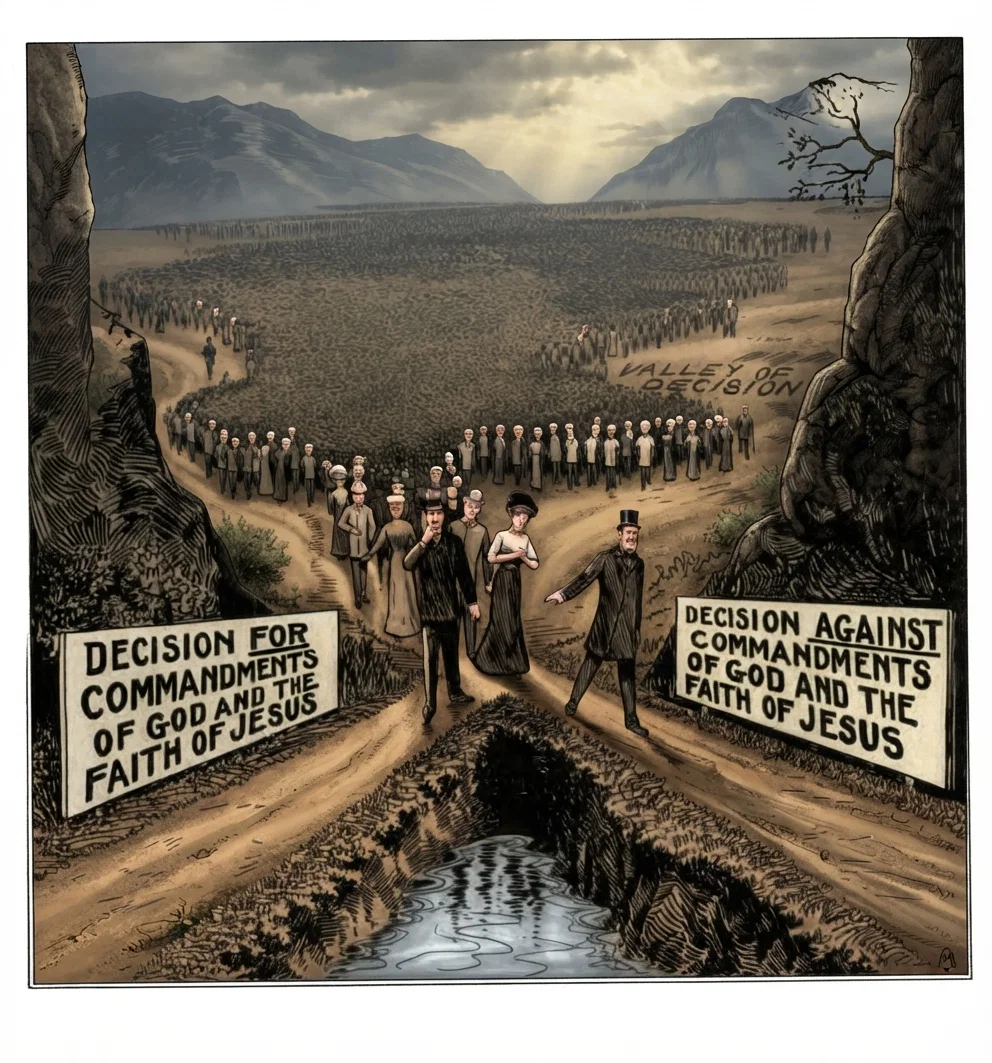
Multitudes, multitudes in the valley of decision: for the day of the Lord is near in the valley of decision.
It requires no astute mind to discover the character and object of such petitions. They were religious and for religious ends upon the face of them.
Congress Refused to Act
January 3, 1812, the committee in the House on post-offices and post-roads presented a report on these and other like petitions, refusing to recommend "any alterations in the law regulating the Post-office Establishment," and closing with the following significant suggestion:
"Resolved, That the petitioners have leave to withdraw their petitions."
And the record says, "The resolution was concurred in."
This was in 1812, and was the first of a series of adverse reports adopted by Congress upon this subject.
The Agitation Renewed in 1815
After the close of the war of 1812, the agitation for the closing of the mails by law on Sunday broke out again in 1815; but Congress once more refused to act, and through the adoption of another report upon the subject, declared it inexpedient to "pass any laws on the subject-matter of the petitions" which had been sent in.
The Great Agitation of 1828-1830
Then came the great agitation of 1828-1830, in which Congress was besieged with hundreds of petitions sent in by religious bodies from more than twenty states, and which called forth those masterly famous Sunday Mail Reports presented by Col. Richard M. Johnson, and adopted by Congress (the Senate in 1829, and the House in 1830), the sound, cogent, and convincing arguments of which not only put the matter to rest for many years, but drew forth from various state legislatures and numerous bodies of citizens throughout the country expressions of highest approval. As a sample of the latter, the following from a memorial to Congress in 1831, from citizens of Windham County, Vermont, may be cited:
"Your memorialists consider the proposed law as inconsistent with those principles, and a clear deviation from the established course of government which reason dictates, and the experience of more than fifty years has sanctioned by the happiest results. They are not, indeed, insensible of the many artful pretexts by which the petitioners have endeavored to conceal their object, for the purpose of escaping from the odium which would justly attach to any request for the legal confirmation of a religious tenet. And while your memorialists condemn the pious fraud which would deceive and mislead the public mind in order to aggrandize a sect, they do not fail to recognize in that fraud a reluctant tribute to the truth of those principles for which they are contending. But, stripped of the disguise in which it is enveloped, and reduced to a plain and intelligible proposition, the request of the petitioners amounts, in the opinion of your memorialists, to nothing less than a prayer to your honorable bodies to incorporate a sectarian dogma into the statutes of the land."—"American State Papers," pages 305, 306.
Both reports adopted by Congress as the result of this wide-spread agitation, opposed the legislation called for, upon the ground that it would be religious legislation, and therefore unconstitutional; that it would establish a dangerous precedent; and that it would constitute "a legislative decision of a religious controversy, in which even Christians themselves are at issue." The Senate report said:
"Our government is a civil, and not a religious institution. . . . Should Congress in legislative capacity adopt the sentiment, it would establish the principle that the legislature is a proper tribunal to determine what are the laws of God. It would involve a legislative decision on a religious controversy, and on a point in which good citizens may honestly differ in opinion, without disturbing the peace of society or endangering its liberties. If this principle is once introduced, it will be impossible to define its bounds."—Ibid., page 237.
The Law Unnecessary
The same report further said:
"Congress has never legislated upon the subject. It rests, as it ever has done, in the legal discretion of the postmaster-general, under the repeated refusals of Congress to discontinue the sabbath mails."—Ibid., page 240.
This, and the fact that under the supervision of the Post-office Department, Sunday work has already recently been curtailed and eliminated to a considerable extent WITHOUT LEGISLATION ON THE PART OF CONGRESS, is proof that no such legislation was needed, not even for the accomplishment of the alleged object for which it was passed, — the giving of rest to post-office employees.
For Religious Reasons
That this legislation has been called for all along for religious reasons is susceptible of the clearest proof. At the hearing on the Blair National Sunday Rest Bill before the Senate Committee on Education and Labor, December 13, 1888, the Rev. W. F. Crafts, its chief agitator and supporter, speaking against the existing postal law, said:11"The law allows the post-office to be kept open through the church hours, unless the first mail of the day comes during those hours. If it comes five minutes or more before the church service begins, the post-office can run, and is run, in many cases, all through church hours, as the rival and antagonist and the competitor of the churches. . . . A law forbidding the opening the United States post-offices during the usual hours of public worship would remedy this difficulty, and would be better than nothing; but we desire more than this. The law should also take from the local postmaster the power to keep his employees at work at such hours as would prevent them from going to church."—50th Congress, 2d Session, Senate Min. Doc. No. 43, page 6.
The reasons given here why such legislation was desired are too plain to need comment. Church attendance stands out in bold relief.
The Hon. James R. Mann, minority leader of the House, and author of the measure just passed by Congress, seemed conscious of its religious character, and in his argument favoring its passage, he feebly sought for a moment to disentangle it from such connection. He said:
"For years I have declined to receive or open mail on Sunday, not from a religious standpoint, but because I thought there was one day in the week when I was entitled to be free from any requests coming through the mail."
But the fact that during the past hundred years this very legislation has persistently been urged upon Congress by the churches and by such religious organizations as the National Reform Association, the International Reform Bureau, and the Lord's Day Alliance, "from a religious standpoint," is too potent for any successful denial now of the fact that the legislation itself is religious.
Not Recommended by the Post-Office Department
Announcing the passage of this law, an article in the Washington "Post" of August 27, 1912, contained the following:
"It was said last night by post-office officials that this provision was not recommended by Mr. Hitchcock, postmaster-general, but was tacked onto the bill [the annual post-office appropriation bill] in the House and escaped notice in the Senate. It likewise seemed to escape notice in the Post-office Department until the bill had been passed. . . . Mr. Hitchcock has never supported the idea of suspending Sunday work altogether, as it has always been manifestly necessary to keep mail moving in the country, necessitating the despatching of trains, assorting, and making connections so that the flow of mail en route would not be delayed."
And, as reported in the same paper the next day, Mr. Hitchcock himself said:
"The department was not prepared to recommend the wholesale cessation of Sunday work. The truth of the matter is that I have been giving so much of my time and attention to the development of the 'parcel-post' portion of the recent post-office act that I have overlooked the other questions."
Little Opposition Before Passage
Few seemed to know of the existence of the measure while it was pending; and of those who did know, few seemed to realize what its passage would mean. There was no general stir made over it throughout the country, as in 1829 and 1830, and no one aroused in either house of Congress to make earnest protest against it as was done then. Both country and Congress were caught napping. Commenting upon this, the Philadelphia "Public Ledger" of August 28, 1912, says:
"The author of the provision is Representative James R. Mann, of Illinois, minority leader of the House, and the prohibition, which has been in the post-office appropriation act since the middle of last April, in full view of everybody who cared to read the bill, attracted no attention until yesterday, when it was announced that, beginning Sunday, the Sunday-closing provision, which is mandatory, would be put into effect."
A few resolutions from the Washington Secular League, and one or two other communications addressed to the Senate, it seems were about the only protests made against the measure. It thus appears that there was very little opposition to it prior to its passage, and that it came as a surprise even to the post-office authorities, and "like a bolt from the blue" to the country at large. Previously, when measures of this kind, involving the question of religious legislation and the union of church and state, have been before Congress, petitions have been circulated against them, mass-meetings held, articles written for the public press, and friends of religious freedom set to watch them to the very hour of adjournment; but in this case it seems that little attention was given to the measure, and as a consequence, it was slipped through, with little or no public opposition, near the very close of the session.
Emory R. Buckner, the young assistant district attorney who has been secured to assist in the prosecution of the grafting policemen in New York City. The corruption in the police force of New York seemed in a fair way to be the center of attraction, but the same thing has broken out in so many other cities that New York can only be one of a number. The league that is formed by so large a part of the police force, and in so many different cities, is a constantly growing menace. Some men will persist in telling us that things are getting better all the time. But the text of God's Word which tells us that "evil men and seducers shall wax worse and worse, deceiving, and being deceived," unquestionably has the right of it. It is well to have our theories in harmony with the good old Book if we want to be sure of their being right.
The Postmaster-General's Liberal Construction of the Law
As soon as the fact of the passage of the law became generally known, the whole country was aroused, and many protests began to be made against it. The meaning of the law seemed plain. Henceforth, it said, post-offices of the first and second classes "shall not be open on Sundays for the purpose of delivering mail to the general public." To any ordinary mind this would mean the closing of the post-offices named on Sunday; and such seemed to be the general understanding of the intent of the measure as it came from the halls of Congress. The papers announced its passage under such headings as, "Stops Sunday Mail;" "Sunday Delivery of Mail Stopped;" "New Ruling Prohibits Delivery Even from Lock Boxes;" "Mail on Order Only."
But so general, so immediate, and so loud began to be the protest against the measure, that the kind-hearted postmaster-general at once began to put a very liberal construction upon it. Under the caption, "Just a Little Mail—Hitchcock Decides to Permit Partial Delivery on Sunday Through Lock Boxes," the Washington "Post" of August 28 reported this official as saying:
"This provision does not require the closing of post-offices on Sundays, which would be quite impossible, owing to the fact that the transit mail has to be sorted and also the mail collected in cities for despatch to other destinations. To stop the movement of this mail would mean a serious clogging of the whole system of mail transportation, and consequent inconvenience to the public. . . . In short, the only mail that will be affected under a reasonable construction of the new law is that received at the post-offices on Sunday and hitherto sorted on that day for distribution to lock boxes. . . . The work of distributing Sunday mail to lock boxes will be limited to certain classes of mail that can not be held until Monday morning without serious inconvenience to the addressees. This mail will include that for newspapers and hotel guests."
Mr. Mann, the author of the measure, after conference with the postal authorities, came to the rescue, and said:
"There was no intent upon the part of Congress so to restrict the activities of the Post-office Department as to inconvenience seriously the business public. It is absurd for anybody to assume that Congress meant to close post-offices as tight as a wedge on Sunday."—Washington "Post," August 28, 1912.
What Then Has Been Accomplished?
The public, under this "liberal construction" of the law, having been assured that matters in the Post-office Department were to go on very much the same as usual, the agitation over the question has very naturally quite materially subsided from its first violent outburst. What, therefore, has been accomplished by the passage of this Sunday-mail closing law?—This, and chiefly this: Congress has now, and in a new way, been committed to Sunday legislation. Its long record in refusing to enact such a law has been broken. Altho the law is only a small item tacked onto a piece of annual legislation, it establishes a precedent for all time to come. "Nothing that the Congress just ended has done or left undone," says the Washington "Herald," "has turned back the dial of progress more" than this. The act is "class legislation in more than one respect," it adds, and "oppression of the people by paid servants of the people." And what is still worse, it is not at all likely that the misstep will be retraced.
This law was not a mere proviso attached to the post-office appropriation bill, making the appropriation conditional upon the closing of post-offices on Sunday, as in the case of appropriations made by Congress in the past to certain expositions. The government would not strike a bargain thus in dealing with its own institutions. The legislation is mandatory. It says that the post-offices named "shall not be open on Sundays" for the delivery of mail to the general public. It is the very legislation so strongly inveighed against in the Sunday Mail Reports adopted by Congress eighty years ago, and in which those who framed these reports saw all the evils of the union of church and state and the pernicious principles which had wrought "the catastrophe of other nations." In this, not an individual, but a government institution employing individuals, is compelled by law to respect and observe Sunday.
W. A. COLCORD.
Washington, D. C.
Gossip
By Kathrina B. Wilcox
By Kathrina B. Wilcox
HE subject of gossip is one which confronts us on every side, and is one to which we as young people should be awake, for we can not afford to let this treacherous and insidious foe blight our characters and contaminate our minds.
For the benefit of our young people, the subject may be divided into the following questions:
Should a young person gossip?
Is there such a thing as "harmless gossip"?
Should we listen to gossip or pass it on to others? and why not?
What should we do when some one starts to tell us a choice bit of gossip?
The first question, Should a young person gossip? is most quickly and easily answered by a very emphatic No. But to answer the question somewhat less briefly, we would say, A young person should not gossip, neither should an older person gossip, neither should a child gossip. But most emphatically during the habit-forming period of life persons should not gossip. Our characters are largely made up by the habits formed, and it is easy to form habits in youth that cling to us all through life. Therefore is it not important that we, as young people right in the prime of young manhood and womanhood, look carefully into this matter at once, and ask ourselves if such indulgence ever pays?
It does not pay, commercially, socially, diplomatically, or spiritually.
It does not pay commercially, for a tale-bearer, a tattler, would be injurious to any kind of business. It does not pay socially, for as Solomon wisely says, "He that covereth a transgression seeketh love; but he that repeateth a matter separateth very friends." Prov. 17:9. We have all perhaps experienced this in our own social lives.
It does not pay from a diplomatic standpoint. For policy's sake it is well to heed the apostle's injunction, "As much as lieth in you, live peaceably with all men."
And most of all, it does not pay spiritually. We are admonished to "edify one another." Gossip, instead of edifying, building up, is tearing down. If we think on those things that are lovely and pure and true and of good report, we will not have any room or any time for thoughts of gossip. We will see in our fellow men only the good and the possibilities for good, and will endeavor to help them develop instead of tearing down their reputations.
Second, Is there any such thing as harmless gossip? We might answer this question by asking another: Is there any such thing as harmless sin? Let us go back to the Standard Dictionary definition of gossip: "Idle or familiar talk, groundless rumor, tattle, as friend with friend, especially scandalous, half-confidential, usually ill-founded personal remarks about, or criticism of, others." Does not this answer itself? Of course not all news is gossip, as you already know. Gossip is something that tears down. Is anything that tears down the reputation of another harmless?
Third, Should we listen to gossip or pass it on to others? Suppose that Miss A should tell Miss B something detrimental to the character of Mr. C, and Miss B should listen. Now if she kept that bit of gossip to herself, what effect would it have on her mind? Every time she saw Mr. C she would think of the report she had heard, and her estimation of him might never be the same again.
If she did not keep it to herself, it would not only poison her own mind, but the mind of some one else; and through that one, the mind of another; and so it would spread.
And one other point right here: Miss A might injure the reputation of Mr. C, but she could not injure his character, while if she persisted in such a course, she would ruin her own character as well as her reputation.
James Parker said: "Never throw mud. You may miss the mark, but you will have dirty hands."
Another: "The man recovered from the bite. The dog died."
Of course you understand that there is quite a fine distinction between character and reputation. Our reputation is what people think we are, and our character is what we really are. If our reputation is injured, we may in time win our way back into the hearts of the people, but it will take years to rebuild our character. Therefore I would like to have you grasp that thought: The reputation of the one who gossips is injured, because I would think that, if he talked to me about you, he would talk about me to some one else; and more, his whole character is undermined. The love of truth, the keen insight into the good qualities of his fellow men, is demoralized, and in time he fails to see the good in others.
Fourth, What should we do when some one starts to tell us a choice bit of gossip? Now we are brought face to face with a problem that each one of us will have to study out and decide for himself. I can only suggest how we may meet it. It takes real moral courage, when a friend comes to you with some choice bit of information regarding some individual, and tells you not to tell (he would never tell any one else but you, of course), to tell him kindly, but firmly and frankly, that if it is something which will cause you to think less of some one, you would prefer not to hear it. Or, if the information is out before you are aware of its nature, you might turn the trend of thought by saying something kind or commendable about the person under discussion. This will be a gentle rebuke to the informer, and cause the tale to lose much of its inspiration.
Then, be sure to set an example by never repeating these "choice bits of gossip" yourself. A little verse recently found gives us some excellent rules on this point:
"If you are tempted to reveal
A tale some one to you has told
About another, make it pass,
Before you speak, three gates of gold.
"These narrow gates—first 'Is it true?'
Then 'Is it needful' in your mind?
Give honest answer; and the next
Is last and narrowest, 'Is it kind?'
"And if to reach your lips at last
It passes through these gateways three,
Then you may tell the tale, nor fear
What the result of speech may be."
Don't think that if we make a resolution at this time never again to gossip, we will not often be tempted, but as that little verse says:
"If you your lips
Would keep from slips,
Five things observe with care:
Of whom you speak,
To whom you speak,
And why, and when, and where."
Let us supplement these few thoughts with something far superior from the Word of God, which leaves us little room for question in regard to this important subject:
What does the ninth commandment forbid?
"Thou shalt not bear false witness against thy neighbor." Ex. 20:16.
How is a man regarded who obeys this command?
"If any man offend not in word, the same is a perfect man." James 3:2.
To what double use is the tongue put?
"Out of the same mouth proceedeth blessing and cursing. My brethren, these things ought not so to be." James 3:10.
Can man, unrenewed by grace, control his tongue?
"For every kind of beasts, and of birds, and of serpents, and of things in the sea, is tamed, and hath been tamed of mankind: but the tongue can no man tame; it is an unruly evil, full of deadly poison." James 3:7, 8.
What does Paul, in his second letter to the Thessalonians, call people who do not control their speech?
"For we hear of some that walk among you disorderly, that work not at all, but are busybodies." 2 Thess. 3:11.
How does he speak of this class of people in his letter to Timothy?
"And withal they learn also to be idle, going about from house to house; and not only idle, but tattlers also and busybodies, speaking things which they ought not." 1 Tim. 5:13.
Of what are one's words the index?13
"Out of the abundance of the heart the mouth speaketh." Matt. 12:34.
What will our words have to do with our standing in the judgment?
"For by thy words thou shalt be justified." Matt. 12:37.
Among what class of people does Peter place "busybodies"?
"Let none of you suffer as a murderer, or a thief, or an evil-doer, or as a meddler [busybody] in other men's matters." 1 Peter 4:15.
What special sin is covered by the ninth commandment?
"Thou shalt not go up and down as a tale-bearer among thy people: neither shalt thou stand against the blood of thy neighbor." Lev. 19:16.
What are the words of a talebearer like?
"The words of a talebearer are as wounds." Prov. 26:22.
What is their effect?
"He that covereth a transgression seeketh love; but he that repeateth a matter separateth very friends." Prov. 17:9.
What would follow if each attended to his own affairs only?
"Where no wood is, there the fire goeth out: so where there is no talebearer, the strife ceaseth." Prov. 26:20.
To what is a word fitly spoken compared?
"A word fitly spoken is like apples of gold in pictures of silver." Prov. 25:11.
To whom are our words all known?
"For there is not a word in my tongue, but, lo, O Lord, Thou knowest it altogether." Ps. 139:4.
Now if we, as a strong army of young people, would resolve together that we will put down this evil in our midst, it could be far more easily and more effectually accomplished. To illustrate: If I should resolve not to gossip, and Miss S should resolve not to gossip, and she should forget and start to tell me some bit of information, and I should ask, "Miss S, is it true?" she would immediately remember, and not take offense; while if I alone had made the resolution, and she knew nothing about it, she might think me stiff or overcritical.
You can all readily see how we could unitedly accomplish this much more easily than separately, for "in union there is strength." Shall we not begin at once?
A Mother to Her Son
By Delwin Rees Buckner
Upon Discovering that He Smoked
By Delwin Rees Buckner
Last night, as I lay longing for the dawn,
My window wide to scent the lilac's bloom
And let the mocking-bird dispel my gloom,
Almost as fast as flees a frightened fawn,
A stooping shadow shot across the lawn,
Lit by a spark that trailed a sickening fume.
Heart-sad, I hastened to thy cozy room;
But, lo—I bleed to say it—thou wast gone!
Within my bosom waves of sorrow roll.
My son, thy joys I feel, thy griefs as well;
But O, they torture like a gouging knife—
Thy sins against the temple of thy soul.
God breathed within thy nostrils breath of life;
My boy, wouldst thou exhale smoke wreaths of hell?
— **
The Influence of a Torn Tract
By J. R. Ferren
THUS far this year 91,560 gospel and health tracts have been supplied in the popular Dollar Package form. Have you had a part in their circulation? These are days when the Spirit of God is striving with men and women, and turning them to the study of the Word. Through the influence of a single tract or leaflet, many have, during the past summer, been led to search the Scriptures, and many more are waiting to have their minds aroused in a similar way. What a wave of influence may be set in motion by the giving out of a tract! The following words from a gentleman who prizes a few torn pages is an illustration:
"I have been reading some old worn out and torn up tracts of yours, and there is something about them that makes me feel hungry and thirsting for something different from what I have been taught, and I am now over fifty years old. . . . I wish you would send me samples of other publications and price-lists, and help me to become of some service in the Master's cause."
(Letter to Pacific Press Publishing Association, dated July 28, 1912.)
There is a growing interest, on the part of Christian laymen and workers, in tract circulation. In a recent camp-meeting missionary service, those present purchased fifty-five of the large Five Dollar Packages of tracts, and ninety of the Dollar Packages. The large packages were for tent company and church use, and the Dollar Packages were taken by individuals and families. This is an indication of the way in which a liberal sowing of the seeds of truth is being planned for everywhere. The 20,000 copies of "Like the Leaves of Autumn," the booklet of instruction in tract work, have been used, and another edition is on the press. This help is free on request.
Ought you not to supply yourself with an excellent assortment of tracts to use in connection with conversations, to enclose with letters, and to pass out as opportunity affords? You will have many, many opportunities, if you are only prepared for them. This will help you to be a stronger personal worker for Christ, and be the means of brightening the lives of many with whom you come in contact.
The Dollar Package assortment provides 120 tracts, on the subjects of
Bible Study,
Health and Temperance,
Spiritualism,
The Millennium,
Prophecy,
The Law,
The Second Coming of Christ,
The Immortality Question,
The Sabbath,
Gospel Stories.
It gives you 1,896 pages of tracts especially selected for individual or family use. A list of the tracts, classified by subjects, is given on the package. Order the Dollar Tract Package from your tract society, sending $1.25 (25 cents pays the transportation charge), and take a part in this quiet, effective way of extending a knowledge of the truths of the Bible.
J. R. FERREN.
A Good Deed
By A. T. Pierson
“WHERESOEVER this gospel shall be preached in the whole world, there shall also this, that this woman hath done, be told for a memorial of her.” Matt. 26:13. We find suggested here the fragrance of a good deed of love. Wheresoever this gospel shall be preached, the story of this woman of Bethany will be told for a memorial of her. The house was filled with the odor of the ointment; but the larger house of history has been filled with the same fragrance, and will continue to be pervaded by it to the end. There is immortality in acts as well as in actors.—A. T. Pierson.
Out of Doors
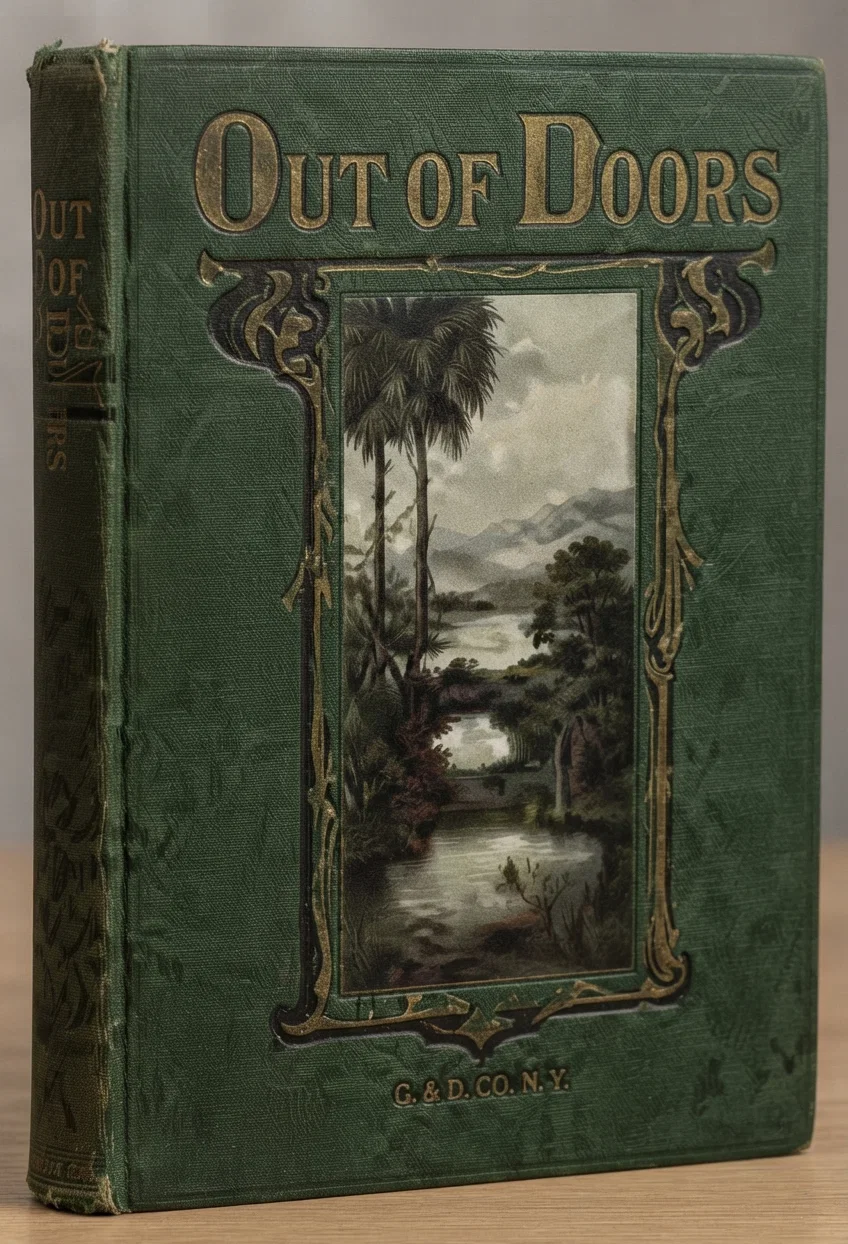
A copy of OUT OF DOORS will add immensely to the enjoyment of your vacation. This little work of 97 pages is filled with a spirit of enthusiasm for outdoor life. It is a real tonic, and will help you gain blessings under the open sky, in field and wood, and 'mid nature's charms, that you have never appreciated before. Here are some of the chapter headings:
Beauty Culture Out-of-Doors
More Fresh Air and Less Furniture
The Higher Ministry of Field and Wood
Around the Camp-Fire
"The Long Brown Path"
Back to Nature and the Soil
Bound in attractive cloth with photographic camp scene on cover, 60 cents.
For bicycles, lawn-mowers, go-carts—anything you want to run smoothly and easily—the best oil you can find is Standard Household Lubricant.
In the Handy Oiling Can
Standard Household Lubricant is guaranteed not to gum or corrode.
This makes it splendid for every kind of household use, and the can in which it comes, with patented nozzle attached, prevents leakage and loss by breaking.
Dealers Everywhere
STANDARD OIL COMPANY
(Incorporated)
461 Market Street San Francisco
Now a Monthly
By Editor
$1.00 a Year 10 Cents a Copy
SPECIAL FEATURES OF OCTOBER NUMBER
Rome and Marriage Again;
The Mediation of Christ;
The "Guardians of Liberty;"
The "Independent" Ignores the Peril;
A Catholic Convert in Brazil;
Papal Rome in Prophecy;
Presbyterian Assembly on Romanism;
The Privilege of Peter;
Many Other Striking Articles;
Frontispiece —
Roman Catholic Idolatry in Boston.
SPECIAL OFFER ON FIVE, ONE YEAR
Five copies, one year, to one address or to five separate addresses, only $3.00, or 60 cents each. Sender may include his own name. Or send $1.50 for ten copies six months. This number should be placed in the hands of every editor, attorney, clergyman, city and county official, and public-school teacher. We can furnish names and addresses.
Address our nearest agency or
THE PROTESTANT MAGAZINE
Washington, D. C.
The October Number
By Editor
Special "Stimulants and Narcotics" and "Mothers" Number
A FEW ARTICLES
Aids to Health Restoration;
Nerve Exhaustion;
Milk and Its Products;
Are Theaters Innocent?
Simple Methods of Infant Feeding;
Why I Am Against Liquor;
Stimulants and Narcotics;
Is Cancer Preventable?
There Shall Be No Grade Crossings;
Newspapers and Patent Medicines;
Christian Help Work in Washington, D. C.;
Questions and Answers (Eleven Replies);
Many other valuable features.
Earn your own subscription by sending us two yearly subscriptions at $1.00 each.
A good proposition for agents. 5 to 40 copies, 5 cents a copy, post-paid; 50 or more copies, 4 cents a copy. Join our large army of successful agents.
Order through our nearest agency or
LIFE AND HEALTH
Washington, D. C.
Special "Church and State" and "California Sunday Law" Number
By Editor
Beginning with January 1, 1913, the subscription price will be 35 cents a year, or $2.00 for ten copies, 1 year, to one or more addresses.
PARTIAL CONTENTS
Cover—Entrance to White House, Washington, D. C.;
Frontispiece—Photo of Senate Sunday Mail Report, printed upon silk, and displayed in office of postmaster-general;
Establishing God's Kingdom by Law;
Looking to the State for Morality;
God's Religious Liberty Example;
Putting the Church over the State in Ecuador;
American Principles in the Balance;
Religious Liberty in Puritan Times;
Absurdity of Proposed California Sunday Law;
The Question of the Century;
Religious Liberty by Divine Authority;
Un-American, unequal, unconstitutional—The California Sunday Law as Proposed;
Survey of the Field;
Temperance and Religious Liberty.
SPECIAL OFFER ON TEN, ONE YEAR
Good only until January 1, 1913. Ten copies, one year, to one address or to ten separate addresses, only $1.50, or 15 cents each. Sender may include his name as one of the ten. This number should be placed in the hands of every editor, attorney, clergyman, city and county official, and public-school teacher in your county. We can furnish the names and addresses.
Order through our nearest agency or
LIBERTY MAGAZINE,
Washington, D. C.
Good Books for the Holidays
HOW TO SELL THEM
The New Home Workers' Prospectus
" The main thing is to get out early, before others occupy the field. The books will sell themselves at sight with very little talking. "
Union Missionary Agent, North Pacific Union Conference.
The above illustration of the Home Workers' Prospectus appears on the first page of the new instruction booklet prepared to assist the home missionary worker in the sale of the beautiful small books especially desired between now and the holidays. The prospectus used contains samples of the following:
New Testament Primer,
Best Stories from the Best Book,
House We Live In,
Bible Child Life,
Uncle Ben's Cobblestones,
Elo the Eagle,
Story of Piteairn,
Advance Guard of Missions,
Making Home Happy,
Making Home Peaceful,
Steps to Christ,
Mount of Blessing,
Christ Our Saviour,
Our Paradise Home,
His Glorious Appearing.
The booklet explains the prospectus, tells you how to select and arrange samples for the books you wish to sell, how to make preparation for the work, and gives just the help needed in making introduction and entering upon canvasses for the books. It also suggests as to reporting, ordering, and delivering, and gives interesting experiences others have had with these beautiful books before the holidays.
Send request at once to your tract society for this booklet. It is free. If unacquainted with the location of your tract society, address
Pacific Press Publishing Association
Mountain View, California
Kansas City, Mo. Calgary, Alberta, Canada Portland, Oregon