Your ShelfYour Projects

Signs of the Times, Vol. 36, No. 38.

Multiplication and Addition

Signs of the Times

Sep 29, 1909

Pacific Press Publishing Association · Mountain View, California · Sep 29, 1909

Multiplication and Addition

GRACE to you and peace be multiplied in the knowledge of God and of Jesus our Lord; seeing that His divine power hath granted unto us all things that pertain unto life and godliness, through the knowledge of Him that called us by His own glory and virtue; whereby He hath granted unto us His precious and exceeding great promises; that through these ye may become partakers of the divine nature, having escaped from the corruption that is in the world by lust.
Yea, and for this very cause adding on your part all diligence, in your faith supply virtue; and in your virtue knowledge; and in your knowledge self-control; and in your self-control patience; and in your patience godliness; and in your godliness brotherly kindness; and in your brotherly kindness love.
For if these things are yours and abound, they make you to be not idle nor unfruitful unto the knowledge of our Lord Jesus Christ.

Question Corner

[To Our Inquirers.— (1) The name and address of all who ask questions must accompany questions, not necessarily for publication, in token of good faith, and that we may reply by letter if thought best. All communications will be considered confidential if so desired, and no name will be published unless requested. But we have no time to give to anonymous or unsigned epistles or articles. (2) Let the questions be to the point. Do not say, “Explain Josh. 7:1-8;” but state the thing upon which help is desired. (3) Questions can not be answered immediately in this department. Sometimes it will mean a month or more of waiting. We can not reply to the same question frequently. Read answers to other questions; you may find reply to yours. (4) Members of the Bible Band will kindly enclose stamp if answer is desired by letter. Others will please enclose ten cents. This does not begin to meet expenses oftentimes. (5) “Foolish . . . questions avoid.”]

2944.— Signs of a Divine Mission

Are miracles of healing a sign that the healers are God’s messengers or disciples? M. D.
It would be unsafe to say that. Some are healed by hypnotists; some through Spiritualist manifestations and manipulations. “Christian Science” claims to heal. Many of all sorts and classes of people claim to heal. The Bible declares of a certain apostate power that it works miracles. Rev. 13:13. Nowhere in God’s word are miracles of healing said to be a test of the genuineness of truth. We have two remarkable expressions in the Scripture; both referring to the last days. The first, characteristic of apostasy; the second, of His own true people. Of the Satanic workings of apostasy it says that they are “with all power and signs and lying wonders, and with all deceivableness of unrighteousness.” “Deceivableness of unrighteousness” is making unrighteousness appear like righteousness. 2 Thess. 2:8-10. Again: “There shall arise false Christs, and false prophets, and shall show great signs and wonders; so as to lead astray, if possible, even the elect.” Matt. 24:24. But of God’s children who shall await in triumph His coming, it is said: “Here is the patience of the saints: here are they that keep the commandments of God, and the faith of Jesus.” Rev. 14:12. The one great test of truth is: “To the law and to the testimony; if they speak not according to this word, it is because there is no light in them.” Isa. 8:20. And our Lord confirms this by saying: “Many will say to Me in that day, Lord, Lord, did we not prophesy by Thy name, and by Thy name cast out demons, and by Thy name do many mighty works? And then will I profess unto them, I never knew you: depart from Me, ye that work iniquity.” Matt. 7:22, 23. “Iniquity” means lawlessness. Loyalty to God is in harmony with His law, obedience to every precept of that law so far as the soul understands.

2945.— Cain’s Wife

Will you please explain how Cain took a wife from the Land of Nod, as there seemed to be the family of Adam only? S. H.
It is always well to remember that the Lord does not seek to satisfy our curiosity. The Bible is not written for that. There are clear evidences enough, however, to show that Cain’s wife was Adam’s daughter. The Bible does not tell us how many years elapsed before Cain took his wife. So far as we know there may have been a hundred or more years between the time that Cain was driven out because of his crime, and the time that he took his wife.
It must be remembered that the book of Genesis, with 50 chapters only, covers a period of twenty-five hundred years of the world’s history. And there is not space for all the details which would satisfy human curiosity.

2946.— Change of the Sabbath

Where do you find that Constantine changed the Sabbath? W. B.
We do not find that he changed it, nor have we said that he changed it. We do not believe that he did change it. What we have said is this: that the first Sunday law on record is one made by Constantine in A.D. 321. That Sunday law reads as follows: “Let all the judges and town people, and the occupation of all trades, rest on the venerable day of the sun; but let those who are situated in the country, freely and at full liberty attend to the business of agriculture; because it often happens that no other day is so fit for sowing corn and planting vines; lest, the critical moment being let slip, men should lose the commodities granted by Heaven. Given the seventh day of March; Crispus and Constantine being consuls, each of them for the second time.”
It is not a Christian law, for Constantine was then a heathen. The very next day, he issued another edict which was purely heathen in its character, giving instruction to the heathen haruspices concerning the examination of the entrails of beasts in the foretelling of future events.
The change of the Sabbath was a gradual work. Little by little, men lost their regard for the holy day of the Lord, while Sunday was kept as a great feast-day. In fact, in all the early ages of the church, Sunday was not considered a sacred day; a small portion of it was used for religious services, and the remainder for labor or recreation. As late as the fourth and fifth centuries, the two days were kept together as sister days, but more than a thousand years passed before Sunday was called the Sabbath. The Sabbath was crowded out largely in the fourth and fifth centuries. At last as in the council of Laodicea, A.D. 538, those who kept the seventh-day Sabbath were anathematized.

2947.— The Laodicean Church

Does the Laodicean Church mean the Seventh-day Adventist Church, or all denominations? B. F. C.
The Laodicean Church represents a condition. There are three conditions set forth pertaining to the last days, regarding the church of Jesus Christ; one of these is represented by Sardis, one by Philadelphia, and one by Laodicea. All of these exist in the time of the coming of Jesus Christ. The Sardis condition represents those who have departed from God, who have a name to live, but are dead. Against the Philadelphia Church God has no word of condemnation whatsoever; for those in the Laodicean condition He has no word of commendation. All who are in the condition represented in the description given in Rev. 3:14-21 are in the greatest danger. Lifted up in their own self-sufficiency, they know nothing of the richness of God’s grace. His appeal to that church is to each individual; and if each individual will hear the Master’s call and come out of that condition, he will become a member of the Philadelphian body, or will come into the true relationship of brotherly love. The church which will be translated at Christ’s second coming is the church of brotherly love, the Philadelphian Church. Out of the Laodicean, or lukewarm apathy every true believer will come, while the self-satisfied will go on as individuals to destruction.

2948.— Religion of Gibbon

Was Gibbon, who wrote the Roman history in five volumes, an atheist? W. B.
Gibbon’s history, better known as “The Decline and Fall of the Roman Empire,” is published in different editions; generally found in five volumes, but sometimes in eight, sometimes in twelve, sometimes in one. The author was what might be considered a skeptic. He seems to have believed in a God, but very clearly was not in harmony with the prevailing form of Christianity in his time.

Our Bible Band

Schedule for Week Ending October 9

Morning Evening
Su. Oct. 3 Isa. 17, 18, 19 Eph. 5:17-33
Mo. “ 4 “ 20, 21, 22 “ 6
Tu. “ 5 “ 23, 24, 25 Phil. 1
We. “ 6 “ 26, 27 “ 2
Th. “ 7 “ 28, 29 “ 3
Fr. “ 8 “ 30, 31 “ 4
Sa. “ 9 “ 32, 33 Col. 1

Suggestive Notes

Our Old Testament readings begin with Isaiah 17 and close with Isaiah 33. Chapter 17 is a prophecy against Damascus, at that time one of the great merchant cities of Asia, and one of the most ancient, if not the most ancient, of Syria. It lay at the foot of the southeast range of the Anti-Libanus Mountains; hence enjoyed a temperate climate, cooled by mountain breezes. The valley in which it is situated was very fertile, and is referred to again and again in the history of the Bible, as also in its prophecies.
For a time Benhadad of Damascus exercised a lordship over Israel, but the Lord declared that Damascus must come down. Assyria captured the city, laid it waste, and took its inhabitants captive. But by the time of the Medo-Persian supremacy, it had again been built up, and is now a city of 150,000 inhabitants, of whom about 130,000 are Mohammedans, 15,000 nominal Christians, and 5,000 Jews. Chapter 18 is a prophecy of the southern part of Africa, altho there are those who believe that it refers to the New World.
Chapter 19 is a chapter concerning Egypt, and evidently refers to the preaching of the Gospel both in Egypt and Assyria in New Testament times. Various prophecies follow, in chapters 20, 21, 22, concerning Assyria, the wilderness of the South, Idumea, and Israel. In the 23d chapter Tyre becomes the burden of the prophet; and in the 24th to the 27th are prophecies concerning the earth, its destruction and desolation on account of sin, and the deliverance of God’s children. Chapters 28 to 33 are prophecies concerning Israel, and Israel as typical of conditions in the Christian age.
Our New Testament Readings begin with the 17th verse of Ephesians 5 and conclude with the first chapter of Colossians. The last of Ephesians contains practical instructions concerning the whole family, and sets forth the intimate relationship between Christ and His church. It closes with a splendid appeal to the Christian soldier.
The epistle to the Philippians was written by the apostle Paul while in prison in Rome. The city of Philippi was an important town of Macedonia on the great highway from East to West. It was named after Philip II of Macedonia. In Paul’s time it was a Roman colony. In this place Paul was at first maltreated. Acts 16:22-24. Compare this passage with Phil. 1:30. While in need in Thessalonica, the Philippians sent aid to him several times. One of the reasons for writing the epistle was to acknowledge this aid. It is really one of the most touching letters. The apostle seems to pour his heart out to his friends, and entreats them to be of one accord and one mind. A marvelous lesson is given us concerning the humility of our Lord Jesus Christ as an example to the Christian. The third chapter especially is wonderfully instructive and encouraging.
Paul’s epistle to the Colossians, the first chapter of which falls into our lesson, was written to the inhabitants of the city of Colosse. The city was situated in Southwest Phrygia on the River Lycus, a great trade route to the East. It was a great, prosperous city in the fifth century before Christ; but it gradually diminished in size and importance as Laodicea, ten miles farther down the river, grew.
The church at Colossae seems to have been founded by Paul’s “fellow servant” Epaphras. One of the things that called out the epistle was false teachers who sought to engraft upon the belief of the Christians in Colossae a Jewish philosophy, and to induce them to pay more attention to outward forms, worship of angels, etc. It was written in all probability in the year 61 A.D. It is wonderfully similar in many respects to the epistle to the Ephesians, of marvelous depth and richness of thought. The first chapter, after its opening greeting, tells of the wonderful burden of Paul for the church, and from that proceeds to speak of our Lord Jesus Christ and the fulness which dwelt in Him.

“Go and Sin No More”

By the Editor
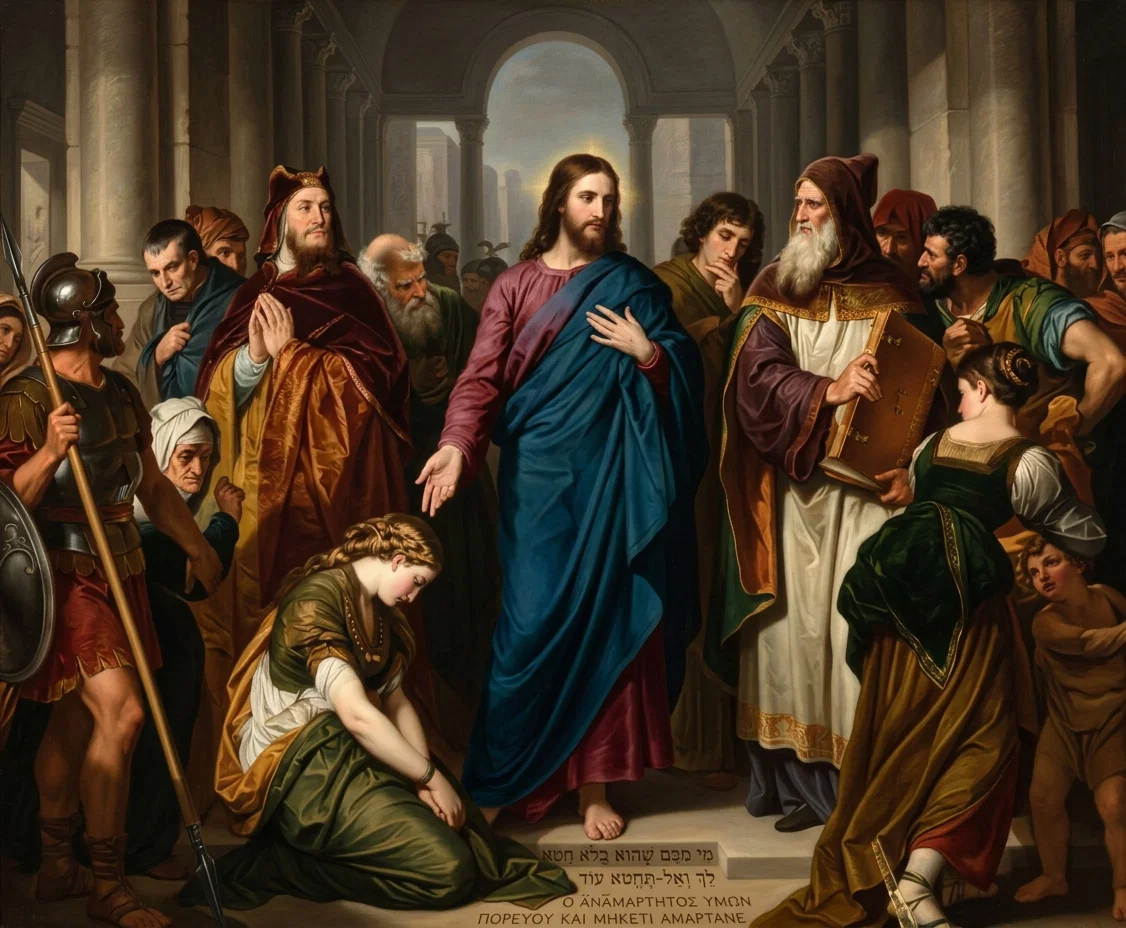
“Let him that is without sin among you cast the first stone.”
THESE are words to a sinner by the Friend of sinners, the One most reviled by sinners, whose name is greatly profaned by sinners, who has been most maligned, denied, and blasphemed by sinners,—Jesus of Nazareth. Yet is He their greatest Friend. Others spurn them when they come to them; He never spurned them. Others hold hard and bitter thoughts against the low and degraded; He pardoned and healed all those whose hearts asked pardon and healing. The great, learned, and pious teachers of His day counted the poor and sinful accursed and without hope; He blessed them and kindled hope where erstwhile reigned dark despair.
The instance which gave rise to the above-quoted words is recorded in John 8:3-11. It is a record of one of the traps set by the Jews to catch Jesus, but, as always, the outcome redounded to His glory. The scene was in Jerusalem, probably within the temple courts. The record is as follows:
**“And the scribes and Pharisees brought unto Him a woman taken in adultery; and when they had set her in the midst, they say unto Him, Master, this woman was taken in adultery, in the very act. Now Moses in the law commanded us, that such should be stoned; but what sayest Thou? This they said, tempting Him, that they might have to accuse Him. But Jesus stooped down, and with His finger wrote on the ground, as tho He heard them not. So when they continued asking Him, He lifted up Himself, and said unto them, He that is without sin among you, let him first cast a stone at her. And again He stooped down, and wrote on the ground.
“And they which heard it, being convicted by their own conscience, went out one by one, beginning at the eldest, even unto the last; and Jesus was left alone, and the woman standing in the midst. When Jesus had lifted up Himself, and saw none but the woman, He said unto her, Woman, where are those thine accusers? hath no man condemned thee? She said, No man, Lord. And Jesus said unto her, Neither do I condemn thee; GO, AND SIN NO MORE.”
The device of the enemies of our Lord seemed to be a perfect one. How could He free the woman without excusing sin or setting Himself against a civil law of the theocracy, given through Moses? Or if Jesus said, “Let her be stoned,” they could then accuse Him before the Romans as one who usurped authority, and an enemy ofCesar. It seemed to them that Jesus must in His reply set Himself against either Moses or Cesar. In the one case He would lose prestige as a religious teacher with the people, and in the other, they would through the Romans silence Him as one stirring up sedition.
Our Lord reads their thoughts. His pure eyes saw in them, cherished in heart and stamped on feature, the same sins and worse, of which they had accused the woman. And, stooping down, He wrote on the sand at His feet their sins, beginning with the oldest before Him. In their eagerness to trap Him, they did not notice at first what He was writing. They thought that He was indifferent to their plea; and they became insistent in their demands. The Master stood erect, and it needs no imagination to picture the look that swept the countenances of His interlocutors, and His deeper gaze that looked beyond the surface, piercing the innermost recesses of their hearts. With solemn tone and measured accent He responds: “He that is without sin among you, let him first cast a stone at her: And again He stooped down, and wrote on the ground.”
They heard His reply. They doubtless looked to the writing in the sand, and read in condemning letters their own hearts’ iniquities. No more is needed. Convicted of their own sins, fearful perhaps that they would be published to the world, not ashamed to sin, but ashamed to confess, they pass out, from the oldest to the last, till Jesus was left alone with the only sinner uncondemned.

“Hath No Man Condemned Thee?”

Jesus looks up, and finds Himself alone with the woman. He asks, “Where are those thine accusers? hath no man condemned thee? She said, No man, Lord.” How could they, in the light of eternal truth and righteousness, blazing the light deep down into the darkened chambers of their own vile hearts, and revealing sins, the wickedness of which the poor adulteress perhaps had never dreamed? How can men in the present blessed light of God’s Word, revealing, probing, searching the hearts of all, go on with unsparing condemnation of their fellows? How can professed Pharisees of to-day place themselves on the throne, and assume to condemn all who do not follow their interpretation of law or pronounce the shibboleth of their clan? How can professedly Christian society, among whose recognized leaders are rakes and debauchees, crowned by earth tho some may be, sit in judgment on the poor women, some of whom are ruined by the male prostitutes whose positions or wealth make them welcome to the same society? Would to God such could see, in the presence of the pure Jesus, their own hearts. They, as did their prototypes of old, would go out “convicted by their own consciences.”

“Neither Do I Condemn Thee”

This is the message of Jesus to the poor, humbled sinner at His feet. It is not the business of Christianity to condemn men or women. This does not mean that Christ excused the sin. Doubtless the woman’s sin had never seemed so heinous to her in all her life before as when she was bowed in the presence of Jesus. By not one word did Christ lessen the enormity of the sin. He knew as no other knew its terrible results. He was voluntarily bearing its fearful results for others’ sake, that He might save others. He knew that He could not frighten nor compel into a better life the penitent one before Him. She already knew the sin; what she needed to know was the Father’s mercy, hidden by the rigorous exactions of selfish Pharisaism. “Neither do I condemn thee;” thy sins are forgiven. Does this touch your heart? Would you be released from such a life? As God has the greatness in mercy to forgive, so He has the greatness of strength to sustain. “Go, and sin no more.” Blessed, soothing words to every contrite heart, now as well as then. O soul, bound in sin, the Master, the Lord of heaven and earth, speaks to thee, however scribes or Pharisees may condemn! You may be an adulteress, an outcast, a drunkard, a thief, a blasphemer; “Jesus Christ came into the world to save sinners.”
This is the work of Christianity. “For the Son of Man is come to seek and to save that which was lost.” “For the Son of Man is not come to destroy men’s lives, but to save them.” It is the lost sheep, torn, bruised, hungry, seemingly worthless, for which the shepherd ventures life and safety. It is the lost piece of silver that the church is to hunt. It is the sinner that needs the saving, the hungry that needs to be fed, the naked that needs to be clothed, the sick that needs a physician. And to reach these—these “lower classes,” men call them, but not less precious in God’s sight—who knows a better way than Jesus Christ followed? It was not by legislation that He led men back to the commands of God; it was not by compulsion or coercion that He labored; it was love, outgiving, winning love. Every attempt to reform the world or man by human legislation has resulted in evil and only evil. Every outflowing of love in sacrifice has won and bound some soul to God.

God’s Mercy and Power

How gloriously shines out the first, even toward the self-righteous, condemning Pharisees! He could have told their sins orally in public; but He did not. He could have told each man’s sins under each man’s name; but He left conscience to do the work. He might have written the sins in the rock of the temple, even as He graved the law in the rock; but He wrote them upon the sand, to show them how easy He could obliterate them. The only writing He did when on earth with human finger was to write men’s sins in sand; but on the hearts of men by divine love He engraved and implanted His law. And then He is all powerful. When He said to the impotent man, “Arise, take up thy bed and walk,” there was power in the word to enable the man to obey. So when He said to the adulteress, and to each and all, “Go, and sin no more,” there is power in the word to keep from sin.
“There’s a wideness in God’s mercy, like the wideness of the sea;\nThere’s a kindness in His justice, which is more that liberty.\nThere is welcome for the sinner, and more graces for the good;\nThere is mercy with the Saviour; there is healing in His blood.\nFor the love of God is broader than the measure of man’s mind,\nAnd the heart of the Eternal is most wonderfully kind.\nIf our love were but more simple, we should take Him at His word,\nAnd our lives would be all sunshine in the sweetness of our Lord.”

Creation

How great are Thy works, O Jehovah! Thy thoughts are very deep.” We see much more of the work of creation, than we are inclined to make a subject of study. Yet when we are moved to search out God’s revealed works, how mighty, how beautiful, how sublime they are. If given to speculation concerning the eternal mysteries of creation, the finite mind becomes entangled and lost in the eternal wonders of the infinite.
We see the grass, the flower, the tree, and its fruit,—they become our foods. This we see and know. From the seed to the fruit is the mystery, and this God knows. “The heavens declare the glory of God; and the firmament showeth His handiwork.”
“The days utter speech; And nights show knowledge; In every tongue their voice is heard, And us they teach.”
“In the beginning was the Word, and the Word was with God, and the Word was God. The same was in the beginning with God.” Here is the unity and association of the Father and Son, “before the world was.” Can we fathom the thought? can we unfold the mystery? Nay! let us rather rejoice and be glad in the things which God has revealed to us in His Word.
These are truly very great and sublime, and we may safely accept them in faith as an earnest of the things unrevealed. “In the beginning God created the heavens and the earth.” Here are the mightiest ten words inthe Scripture. They cover the longest period of time, and declare the most stupendous work that men’s minds can not conceive.
In the “ages of ages” of the long-ago, in God’s chronology of eternities, was the “beginning” of creation. Our minds may often revert to the time chronology of six thousand years as the “beginning,” but the Scriptures do not put it so, and we ought not to build speculative theories upon assumption.
Gen. 1:1 declares creation. “He spake, and it was.” Ps. 33:9. Scripture mentions no time; it simply declares the fact of creation. That may have been instantaneous, or have covered ages. Gen. 1:2 is tersely descriptive of the earth’s aspect when created, its formlessness, and the work of God’s Spirit to bring order out of chaos. How long after it was created did the earth remain in darkness and covered with water? The Scripture does not say. But it does say that the “Spirit of God moved”—“brooded”—upon it, to bring forth the aspect and conditions now known to us. 2 Peter 3:5-7. The gloom of the early creation is so graphically described by the words, “and darkness was upon the face of the deep.” The Hebrew word here translated “deep” is used with the Hebraic meaning of all that it implies,—of the formless, chaotic condition of the earth as it would appear to the observer could it have so been viewed, and as infallibly described by the inspired writer. The Greek equivalent of this term is “abyss,” translated in the New Testament as “bottomless pit.” This term was used by the ancients—both the Hebrew and the Greek—to describe regions desolate, chaotic, and unoccupied; and unmeasured, or unmeasurable; consequently of unknown depths; of waters or chasms.
The Spirit of God moved (Heb., “was brooding upon,” bringing forth), and when the work was completed, had brought forth the world as we now see it.
Darkness was upon the face of the deep; waters covered the earth; God said, “Let there be light;” the darkness began to dissipate, and there was light. Then He divided the waters, part of them went up in “clouds of mists,” and the residue settled back within the boundaries fixed for them in the “beginning.” Ps. 104:8, 9; Gen. 1:9. And “God called the dry land earth; and the gathering together of the waters called He seas; and God saw that it was good.”
Then God made the grass, herbs, trees, and flowers,—all vegetable life,—and planted them in the ground, from whence they came forth for the use and sustenance of man. Then by command were the stars, moon, and sun made manifest to the earth, and they were to divide the night and day, and for signs, and seasons, and for days, and years, and to divide light from darkness, and all this was pronounced good, and it was the first day. Then came the creative life in the water, and in the creatures that fly above the earth. Then said the Lord, Let the earth bring them forth, each after his kind. Then came the crowning work of creation—man—made in the image of God both as to physical form and moral nature. Gen. 1:26; Isa. 9:6; John 1:1-10; Heb. 1:1-6; Luke 1:31-33.
Thus we learn that Christ was with the Father before the creation; that He is the Creator; that all things were created by Him; that after the heavens and the earth were created, He brought forth the present order of things in all their beauty and usefulness, for the good of all His creatures, and His own glory, and nothing He did is in vain. He gave us the septenary cycle of our week, marking the end thereof by His holy Sabbath; for in six days God made His whole creation fit for man, then gave him the Sabbath as a memorial of all creation throughout all the ages of eternity.
“The earth is Jehovah’s, and the fulness thereof; The world, and they that dwell therein. For He hath founded it upon the seas, And established it upon the floods. “Who shall ascend into the hill of Jehovah? And who shall stand in His holy place? He that hath clean hands, and a pure heart; Who hath not lifted up his soul unto falsehood, And hath not sworn deceitfully. He shall receive a blessing from Jehovah, And righteousness from the God of his salvation. THIS is the generation of them that seek after Him. That seek Thy face, even Jacob.”
BRYN MAWR.

Preach Both Life and Death

A UNIVERSALIST preacher, after his conversion, told me that, in his twenty years' preaching the love of God and universal salvation, he never saw a sinner converted to God. God plainly and emphatically declares in Ezekiel, that if watchmen do not warn the wicked of the death-penalty for sin, they will not repent, and the watchman must perish with them. You may talk love to careless sinners until they are love-sick, but this pleasing aspect of redemption alone will never convert them. Both life and death must be set before them, the reward of the righteous and the punishment of the wicked. Love is more influential after conversion.— Rev. E. P. Marvin.
Continue reading: A Testimony Meeting