Your ShelfYour Projects

Signs of the Times, Vol. 37, No. 9.

Question Corner
Earlier text: The Future of the Earth — What It Is to Be

Our London Letter

(From our own correspondent, Mr. W. T. Bartlett, editor of Present Truth, London)
The Right Hon. Winston Spencer Churchill, M.P., a member of the Liberal cabinet
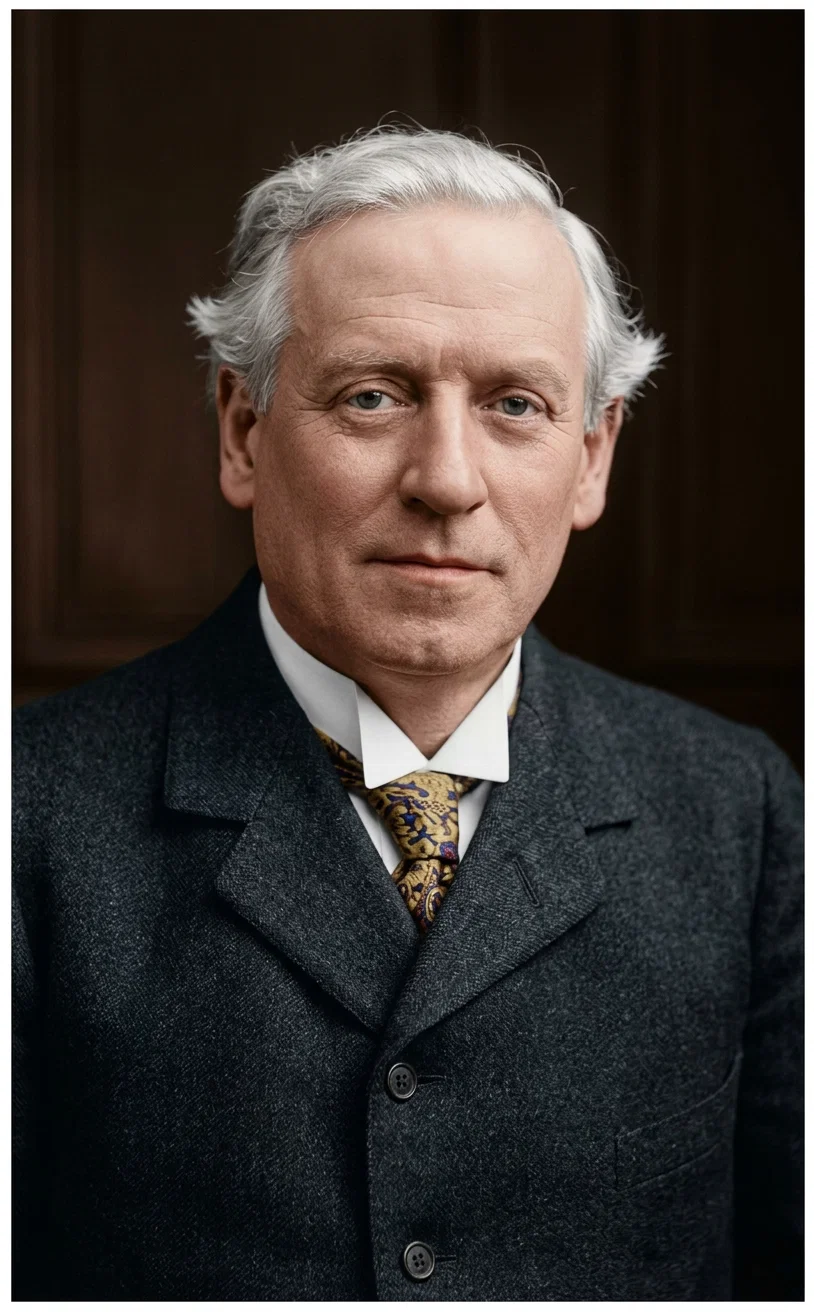
The Right Hon. H. H. Asquith, K.C., M.P., Prime Minister of England
Mr. John Burns, Member of Parliament, the great Labor leader of England
The Rev. Sylvester Horne, Member of Parliament
At the time of writing, England is in the throes of the general election. It is impossible to tell yet what the final results will be, but it begins to be clear that the Liberals and the Labor representatives on the one side will about balance the Conservatives on the other, and that the Irish Nationalist party will hold the balance of power. This will mean that the main issues on which the appeal was made to the country, will be decided in favor of the late government; for on these points Mr. Asquith, the Liberal premier, may reckon upon the support of the Irish party.

The Liberal Policy

The policy which the Liberals laid before the electors was, first and foremost, the endorsement of the budget, which was rejected by the House of Lords, including therein the annual tax on land values and the provision for a government valuation of all landed property, with a view to further taxation. The second item on the Liberal program was the abolition of the power of veto on legislation, hitherto possessed by the House of Lords, but never exercised by them except for the destruction of Liberal measures. There are two other items to which the Liberal government stands committed; one of them is the grant of a measure of home rule for Ireland, and the other is the disestablishment of the English state church in Wales.
To all of these measures the Conservative party were decidedly opposed; and furthermore, they stand committed to a policy of tariff reform for the protection of home industries.
If, as now seems probable, the Liberals take office again, they will insist, before doing so, on the royal support in the conflict with the House of Lords. This will doubtless mean that in the event of their measure for the reform of the Upper House being vetoed by the Lords, the king will consent to the manufacture of a number of peers sufficient to swamp the Tory majority in that House and so permit the measure to be made into law. It is hard to see how the king can stand out against such a demand; for the last year’s budget is not yet passed, and the next will be due in March, so that unless the government can get about its business quickly the finances of the country will be getting badly in arrears.
The Irish party will gladly stand by the Liberal and Labor representatives in their struggle with the peers, for in the removal of the veto of the Lords lies the only chance of passing a measure for conferring home rule upon Ireland. Mr. Gladstone was able to get a home rule bill through the House of Commons, but the Lords threw it out.

Irish Self-Government

After the veto is dealt with will come the struggle over Irish self-government. The Irish members will, of course, seek to take full advantage of the strong position they will occupy in the new Parliament, and will exact the fullest possible measure of autonomy for their country. It is very likely, indeed, that they will not be satisfied with the measure which Mr. Asquith will introduce; and the duration of the new Parliament will probably depend upon whether a compromise upon this question can be arrived at.
The problem of Irish home rule is a thorny one. Three quarters of the country is peopled by Catholics; but the wealthiest and most thickly populated portion is filled with ardent Protestants, who view with dread and abhorrence the possibility of being ruled by a Roman Catholic government. When Mr. Gladstone first introduced a home rule bill, public opinion in England was decidedly opposed to the measure; and it would not be difficult to revive the prejudices that were then entertained.
Impartial students of history admit that Ireland has suffered many and grievous wrongs at the hand of England in past centuries, and that abstract justice demands that she receive the fullest compensation. In all probability this compensation would be readily granted if the facts of history were only brought home clearly to the consciousness of the English people; but the unfortunate part of the situation is that the Nationalist representatives of Ireland have permitted themselves to speak in terms of bitter enmity against England, and this has led many to fear that a grant of self-government in Ireland would mean the establishment of a hostile power, always ready to offer aid to possible enemies, in dangerous proximity to our coasts. It would not be at all surprising, therefore, if the home rule question shouldprove a rock on which the Liberal party will experience shipwreck. It is already predicted that there will be another general election before a year has passed away.

Alarms of War

One of the notable features of the election campaign was the issue by Mr. Robert Blatchford, a prominent Socialist writer, of a series of alarmist articles insisting on the grave peril in which the increased German navy was placing this country, and demanding not only a considerable increase in our ship-building program, but also the formation of a powerful land army. The reason given for this latter demand was that unless we were in a position to come to the aid of France with a powerful army, Germany would, in her next war, take permanent possession of the provinces in the north of France, and establish herself at a number of ports facing our southern coasts. Thus she would be able effectively to dispute the control of the English Channel.
To meet this peril Mr. Blatchford called for an expenditure of fifty millions on the building of additional Dreadnoughts, the raising of an army of a million men, and the institution of compulsory military service for the male population of the United Kingdom. He claims to have received letters of strong approval from Lord Roberts and Lord Charles Beresford and from many officers of the army and navy.
Mr. Blatchford has been freely denounced as a scaremonger; but such prophecies as his have the baleful power of helping to fulfil themselves, and it is certainly true that public opinion in this country is moving more or less rapidly in the direction he indicates. Another writer, Mr. J. L. Garvin, who commands the public ear to a considerable degree, is vigorously urging that our next ship-building program must provide for at least twelve or fourteen Dreadnoughts, by means of a loan of $250,000,000, and that a policy of conscription is demanded in order to make our continental alliances effective. To enforce his plea, he calls attention to the following figures, which show how the German naval expenditure is steadily doubling itself every few years, while the English expenditure remains about the same:
Germany England
1895 £4,100,000 £19,600,000
1900 7,600,000 30,000,000
1904 10,500,000 36,800,000
1905 11,400,000 33,200,000
1906 12,300,000 31,500,000
1907 13,500,000 31,400,000
1908 16,900,000 32,300,000
1909 20,100,000 35,100,000
1910 22,000,000 ..........
Vast and significant as these figures are, they are small compared with the amounts men are beginning to speak of as the price of English naval supremacy. It will be better, they say, to spend hundreds of millions in preparation rather than forfeit thousands of millions as the consequence of defeat. But others can see that there is a necessary limit to the treasure that can be poured out in the multiplication and maintenance of armaments. Lord Courtney of Penwith, an advocate of peace, but a clear-sighted observer, recently wrote:
“If the balance of physical forces must always determine the course of history, the end is certain. It may be deferred and again deferred, but it is inevitable. We know it, tho we are not bold enough to confess it to ourselves. The tides of men are governed by secular conditions which the greatest craft of statesmen can not nullify. What is the secret of the incessant agitation that besets us for universal service, for imperial defense, for a war-union of all the dominions, but a creeping sense that forces are growing around us with which we are doomed to come into passionate collision, and we are already walking in darkness and in the shadow of death, and no light is vouchsafed us? From this gloomy outlook we may escape if we are content to advance abreast of others in the march of civilization, without straining to maintain an overtopping security in physical resources which nature and time must deny us. What we have done already must forever give us distinction in the world’s history, and it may well be surpassed by the glories of the future if we do not wreck our fortunes in the pursuit of the false policy of perpetual supremacy in force.”

Clerical Parliamentarians

One very remarkable circumstance of the present election is the successful candidature of the Rev. Sylvester Horne, who has been returned to Parliament as a supporter of the Liberal government. Mr. Horne is one of the most popular preachers of the day; and his church, known as Whitefield’s Central Mission, situated in one of the busiest districts of London, is noted for its multitudinous activities, amply sufficient in themselves to occupy its pastor’s energies. Mr. Horne, however, has given assurance that the work of his church shall not suffer in any way by his work as a member of Parliament. If he means to do anything like justice to his parliamentary duties, in addition to his pastoral responsibilities, he will probably break down under the strain.
The noted scientist and scholar, Sir Oliver Lodge
It seems an extraordinary thing that a minister of the Gospel should step into the arena of party strife and devote himself to political warfare; but there is a growing tendency among the Free churches of England for the ministers to throw themselves heart and soul into political struggles. Their training in public speaking makes them welcome allies on the political platform; and when they once surrender themselves to its fascinating excitements, and taste the sweetness of the world’s applause, their earlier call to a sacred ministry begins to die away. Two other candidates in this election have been Free church ministers. One of them has been for years, however, a pastor without charge, having devoted himself to the writing of popular novels. He failed to win a seat in Parliament on this occasion. The other, who succeeded, was for many years a preacher in charge of an important London church. He gave up the ministry to become a public lecturer.
Turning from political questions, it would seem from many indications that the high-water mark had been reached in missionary work. The London Missionary Society, the second largest in this country, has been compelled reluctantly to adopt a policy of retrenchment. A reduction in expenditure of fifty thousand dollars has been decided upon for next year. The Moravian Missionary Society, the oldest of all, is also in trouble, and will have to withdraw from some of its missions unless special help is at once forthcoming.
Last year the Roman Catholic Church in this country sent the Rev. Dr. Herbert Vaughan to the United States to study the methods which had proved so successful there in gaining non-Catholics. Dr. Vaughan has now started a college for the training of priests in this country, where he will give the same course of studies that has been followed in the preparation of workers in the United States. The Roman Catholic bishops here have all pledged the movement their support, and the priests who receive this training will give their whole time to the conducting of missions for non-Catholics.
Another noticeable feature of the times is the number of books which have lately been published on the subject of Spiritualism. Sir Oliver Lodge, a well-known scientist, is the author of one of these; and he, after a very careful and minute examination of the phenomena of automatic writing, in the course of which he gave full consideration to every possible explanation that could be offered, states it as his final conviction that nothing but intercourse with discarnate spirits will account for the information received. It is his opinion that—
“Man’s practical outlook upon the universe is entering upon a new phase. Simultaneously with a revolutionary increase in his powers of locomotion, the power of reciprocal mental intercourse also is in process of being enlarged; for there are signs that it will some day be no longer limited to contemporary denizens of earth, but will permit a utilization of knowledge and powers superior to his own, even to the extent of ultimately obtaining trustworthy information concerning other conditions of existence.”
This conclusion may seem a very cautious one to those who have watched the course of Spiritualism and noted its claims; but it is a fact of considerable importance that men of science who have been investigating Spiritualism for many years, and seeking, with their utmost skill, to find some natural explanation of its phenomena, have now reached the point where they feel forced to admit that there is no other explanation than that which Spiritualists themselves allege,—that is, that the dead are able to communicate with the living, and that they do so communicate under suitable conditions. W. T. BARTLETT.

Women and Cigarette Smoking

One of the extravagant whims which has taken hold of the society women in New York, a New York paper tells us, is that of cigarette-smoking with all of its “refined accessories.” At first it was only a fashionable fad; now the demon of appetite has taken hold of the women, and they must have the cigarettes, not simply on special occasions, but constantly. The following bill of items is given by a lady writer, stating what it would cost for a smoking outfit for a fashionable woman in a year: An inlaid tabouret for holding the smoking outfit, $500; cigarette ring for holding cigarettes, to keep the fingers from stain, $100; cigarette holder, $50; cigarette cases of different sorts, $300; ten thousand cigarettes with initial or monogram at $3.00 a hundred, $300; making a total of $1,250. And it is stated that one woman who has made a specialty of catering to the feminine trade sells to many women as many as ten thousand cigarettes a year. Physicians have come to the place where they say that it is indeed a menace to the future of their women patients; and in this, and the fact that the feminine beauty will soon be destroyed by the habit, lie hope that it will be broken.

Floods in Portugal

The year 1909 would not pass without Portugal's receiving another reminder that things are perishable and that the end is near. The earthquake of April 23 awoke some persons who in their turn sank back into a profound slumber. This time several days of rain caused three large rivers to overflow their banks and to bring ruin and desolation in their path.
The Tagus River, arising near Madrid, flows in a southwesterly direction, drains a large territory occupied by its tributaries, crosses Portugal, and empties into the ocean about seven miles from Lisbon. The Mondegus arises in the Estrella Mountains, and brings the mountain snow-water to the sea at about one half the distance between Lisbon and Porto. The Douro River also has its source in Spain, and wending its way through the Mountain ravines, finds an outlet near Porto. This river has a tributary called the Tamagus, which has many reminders of Roman times as well as have the three other rivers named above.
One would hardly think that the small amount of rain fallen would do so great damage. The inundations in five provinces brought famine to many and death to some. The earthquake was bad, but the flood was worse.
Outside of destruction in villages in the valleys of these rivers, of houses, of plantations, orchards, cattle, and men, women, and children, perhaps the cities of Porto and Villa Nova da Gaya suffered the most. Along the docks are storehouses of various kinds; yet no one should weep to see the large barrels of wine swept out to sea.
During the day one could see at any time dozens of boats of dwellers along the river's banks who had drifted or sailed down the river bringing to market their products. These on the days of flood before Christmas were destroyed and the remains carried by the water to the ocean. Large ships were also beaten to bits of driftwood, and many sailors nevermore responded to the roll-call. About a thousand houses were invaded by the waters, and the poor were made poorer still by the loss of their little possessions.
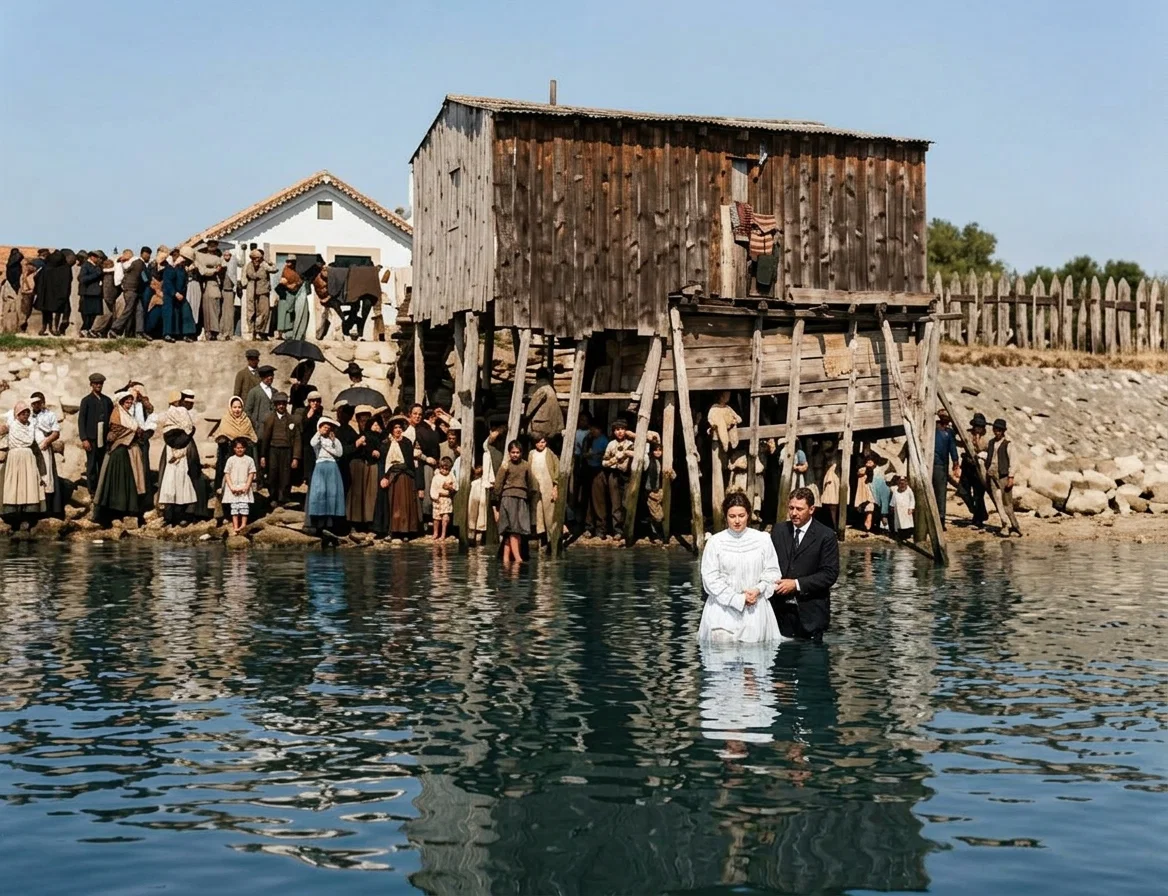
Baptism in Portugal September 25, 1909, C. E. Renfro officiating. The one baptized is now in Africa as a missionary.
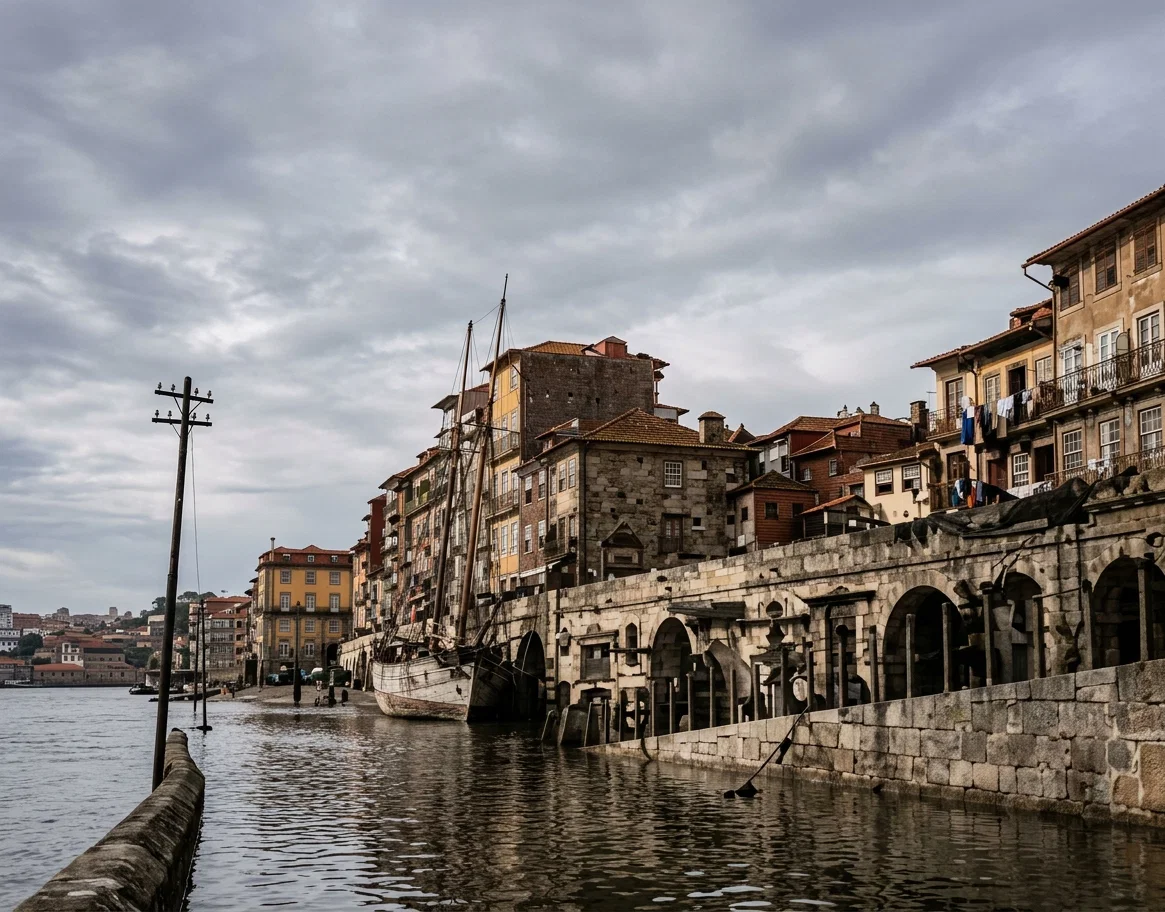
The Douro River, Portugal, out of its banks, carries a ship over the quay to the buildings.
Walking one day with a friend along the quay, he pointed to some signs, saying, “To here came the flood in 1860;” but since this last flood, he writes, “The inundation arose higher than the marks I showed you.” This would almost reach the second floor of any house. In Porto the electric and gas factories were ruined by the water, and the city remained without those lights, being reduced to petroleum lamps. Several hundred millions of dollars is the calculated loss.
Very high tides did not allow the rivers to empty themselves as they should, so the water rapidly backed up. Thus the drainage pipes in Lisbon remained filled, causing an overflow in the streets, bringing alarm to the inhabitants in some of the lower parts. A worse flood has not been known here.
In one picture we are sending, the river bank is to the left of the telephone pole; so its great rise can be calculated. This is some three miles from the ocean. Where the ship is, there was the usual market-place. Through our own little village of Laveiras runs a small stream in the winter, which at this time had spread itself like a large river. Men and boys entertained themselves catching oranges and wood which came drifting down. One man, while working at this, lost his balance; and only several days after was he found half buried in the mud. This circumstance reminded us that millions are dying without God or hope of salvation.
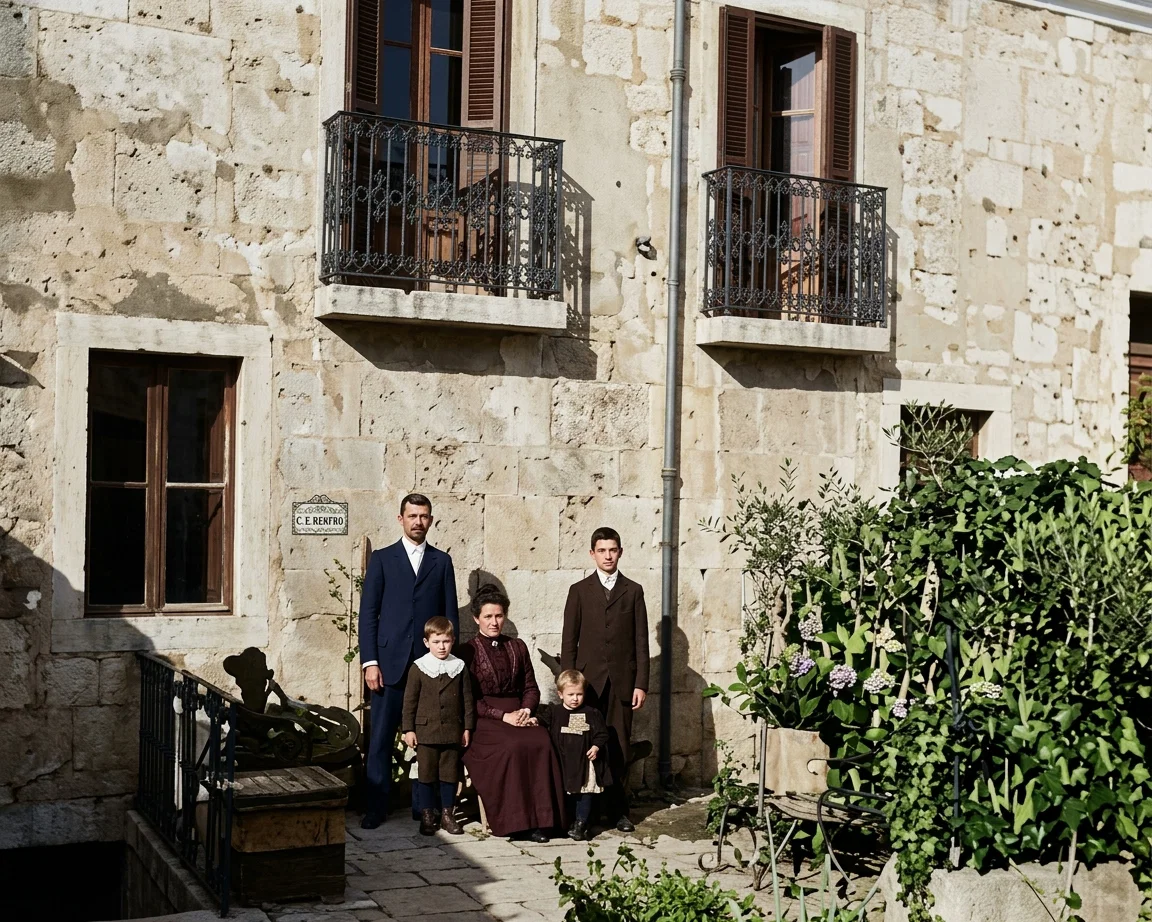
The home and family of C. E. Renfro. Colporteur on the left. Taken January 9, 1910.
Last year quite a few were baptized, but not all remained firm in the truth. In order to warn this people, we have one minister and a boy colporteur. We need more help to teach this people the message. Thousands of pages of literature have been scattered by the canvasser and young people's society. And we believe God will cause the seed sown to bring forth fruit to His honor and glory. 1910 opens up with conflicts; but God gives the victory. We are holding in our small hall four night meetings each week. We wish we could have a variety of reading-matter for free distribution to those who come to hear.
We are awaiting anxiously the coming of the worker called for by our president, L. P. Treche, at the General Conference. In the meanwhile we desire to be found at our post of duty, for the coming of Jesus is much nearer than when we first believed.
C. E. Renfro.

Dirt Clean and Unclean

Dr. R. G. ECCLES, in The Dietetic and Hygienic Gazette of New York, makes some discrimination of worth regarding dirt which is clean, and dirt which is unclean. He tells us that mud and soil, coal dust and ashes, paint and varnish, are almost as harmless as the clothes we wear; but the people that will permit such dirt as that are likely to be unclean otherwise. Some of the most dangerous dirt is that which is invisible. He warns us that we should not wash hands simply by the clock; but if we are engaged in that in which germs are likely to be passed on at all to others, the only proper way is to precede that work by a thorough washing of hands in soap and water. Some hands will pollute water by a mere touch, we are told, and can not be shaken without leaving behind evidences of unnamable dirt; and these are the kinds of hands, many times, that handle our bread, our meat, our fruit, our vegetables, our pastry, and our money.
It is supposed that most normal persons wash their hands and faces on getting up in the morning, or after particularly dirty forms of work; but with very many the absence of visible signs of dirt is sufficient excuse for the neglect of washing at all other times of the day, and he says, “How to combat this vicious impression is one of the most serious problems of hygiene.”
He refers to servants who are not particular, and some of whom seem to be abnormal disease spreaders. He cites the celebrated case of “Typhoid Mary,” who worked in one household in which six persons out of eleven were taken down with typhoid fever. In another town and in another household seven members out of nine fell victims; and in another state, four of her fellow servants developed the disease. The doctor suggests that it will be well for the mistress of the house to keep a careful watch of the habits of her servants, and learn whether they wash their hands in the dish-water or in the wash-basin.

Three New Journals.—

A word from our International Publishing Association, College View, Neb., tells us that three new quarterly magazines are being launched: one in the German language, Die Zeichen der Zeit, Signs of the Times; one in the Swedish, Tidens Tecken, Signs of the Times; subscription price of each being 30 cents a year. Another little magazine in the Danish-Norwegian, Lys over Landet, Light over the Land, a healthand temperance quarterly, 35 cents a year. These magazines may be obtained in quantities of 5 to 40, 5 cents per copy; 50 or more at 4 cents per copy. Sell at 10 cents each. They are good journals to circulate in communities speaking these languages. Many of the foreigners that come to our country are only too glad to obtain periodicals in their own language; and this offers a good opportunity. Write to the International Publishing Association, College View, Neb.

In the Prison of Iniquity

WITHIN Death’s somber valley many lie, The many who are stubborn, who rebel, Who rather choose to heed the prince of hell Than harken to the words of Him Most High; Held firmly by great chains of iron are they— Strong fetters of the gloomy, dismal Night— Within a prison-house, devoid of light, Where shameful, bold Iniquity bears sway!
Before the Flood, with man God’s Spirit plead, And in our later day it pleadeth still; It cometh to our heart to counsel, warn, And to prepare us for the day of dread; Its testimony with a ready will A few will heed—but more by far will scorn.
DELWIN REES BUCKNER.
Ambato, Ecuador.

For Religious Liberty.—

A large mass-meeting held in National Rifles’ Armory, February 7, entered emphatic protest against the Johnston Sunday Bill for the District of Columbia, the Washington Herald of the next day tells us. After several speakers had spoken upon the principles of religious liberty and shown how the bill if crystallized into law would militate against the liberty, a strong resolution was adopted by a rising vote. This resolution protested against all sabbath legislation and disapproved of any movement leading up to religious legislation.

An Opportunity

BROTHER D. T. SHIREMAN, who has given his whole life for the education of the poor, and years of it for the poor in the South, wonders whether there are not those who will place some of the magazines in the homes of the people for the benefit of the Baker Mountain orphan home and school.

53 in 5 hours

THIS MEANS

One lady sales agent sold 53 copies of the SIGNS MONTHLY in 5 hours. She frequently does as well, and it is only an average for many. Some agents sell nearly twice 53 in 5 hours.

THIS MEANS

That she earned $3.18 in that time, or over 60 cents an hour, for her net profit is 6 cents per copy. Could a woman of ordinary ability do better? Consider the number of hours of actual work.

THIS MEANS

That the time was spent in healthful, educative work; that she put in circulation hundreds of preachments on Christ’s Second Coming; on other Biblical questions; on Temperance; on Health subjects; on Religious Liberty; and on other topics of vital importance to the Christian and of interest even to the unbeliever.

March Number Now Ready

IT’S SPLENDID

If at all interested send for sample copy and “Helps.” They are free this month. No capital required; merely send $2.00 for 50 copies, or if you wish to start with more, send 4 cents per copy for as many as desired. 5 to 50 cost 5 cents per copy.

WE WANT MORE AGENTS

Single copy $1.00 per year; in combination with the weekly “Signs of the Times,” $2.25 per year.
Send orders to your tract society if you know its location; otherwise to

SIGNS OF THE TIMES

Mountain View, Cal.

February Issue of Life and Health

"Life and Health" for February comes to us with a beautiful snow scene cover, the trees wonderfully draped with winter art in snow. Its departments — As We See It, General Articles, Healthful Cookery, Current Comment, Abstracts, Medical Forum, Medical Missionary at Work, and Editorial—all seem to be up to date and very helpful. The magazine is but one dollar a year; ten cents a copy. Washington, D. C.

SEWING MACHINES AND PIANOS

I am agent for the Singer and Wheeler & Wilson machines and also a very fine, high grade piano. I am selling to our people at a great reduction. Will deliver any place in the United States. If interested, write me.
S. H. Colvin, Turlock, Cal.

Help Wanted

We are desirous of securing the services of ten graduated or trained nurses at once. Apply St. Helena Sanitarium, Sanitarium, Cal.

California Medical Missionary and Benevolent Association

Annual Meeting

THE thirteenth annual meeting of the California Medical Missionary and Benevolent Association, for the purpose of electing four or more members of the Board of Directors, and transacting any other business that may properly come before the meeting, will be held at Sanitarium, Napa County, Cal., on Wednesday, March 9, 1910, at 12 o'clock M.
L. M. BOWEN, President.
H. E. RANDALL, Secretary.
Continue reading: Nursing Training School Class