Your ShelfYour Projects

Signs of the Times, Vol. 37, No. 9.

Question Corner

Signs of the Times

Mar 1, 1910

Pacific Press Publishing Association · Mountain View, California · Mar 1, 1910

Question Corner

Please Be Definite.— For instance, a question comes to us asking us to be so kind as to explain the meaning of the latter part of “the 28th verse of Hebrews.” But the question is not definite enough so that we may know what chapter is referred to. There are five chapters in Hebrews which have 28 verses or more; chapter 7, chapter 9, chapter 10, chapter 11, chapter 12. If our correspondent will tell us what chapter is referred to we will be glad to answer the question if we can.

3053.—Another Day

Please explain Heb. 4:8, “For if Jesus had given them rest, then would He not afterward have spoken of another day.” G. W. Y.
1. Note that the word “Jesus” should be “Joshua,” as in the Revised Version. “Jesus” in Greek is the same as “Joshua” in the Hebrew.
2. God designed to give His children rest, eternal rest, when they were led into the promised land by Joshua; but He could not do it on account of their unbelief. Consequently they did not receive the eternal rest.
3. Because they did not enter rest, God afterward spoke of “another day,” the present, “Today if ye will hear His voice, harden not your hearts.”
4. The only true way in which the soul can find rest is to forsake the works of the flesh, and yield to God; and that is open to every soul now. Not that when the soul yields will he receive all that that rest means; but he will receive the earnest of that rest, the pledge of the purchased possession. If faithful to the end, when our Lord comes he will receive the eternal rest in the new heavens and the new earth which He will make.
5. “There remaineth therefore a rest to the people of God” (verse 9); literally, there remains the keeping of a Sabbath,—not such a one as sinful men have kept, to remind them of Eden lost, and also of the mighty power of God which redeems, a day in which also the weary body shall rest from toil, but the great spiritual Sabbath-keeping, in which every day of the week shall heighten the joys of the blessed Sabbath which sinless men will observe.

3054.—Compelling. Luke 14:15-25.—N. J. E.—

The parable of the great supper surely gives no ground whatever for religious legislation. There are different ways of compelling; some by force, others by convincing. The parable is an illustration of God’s effort to save His professed people. They are represented as men invited to a feast, but they have various excuses. They will not come. Finally the householder is represented as going out and gathering in the poor and the maimed, and the halt and the blind, people in the highways and hedges who are only anxious to know that there is such a feast for them, and they go. The compelling to come in is simply the presentation of the invitation in such a way that they feel that they must accept. There is no compulsion in God’s government. Whosoever will may come. Note in that very Scripture that the Lord very clearly shows in His application of the parable that man must himself choose against father, and mother, and children, and his own life also, if necessary, in order that he may be Christ’s disciple.

3055.—“They.” “Carcasses.” Isa. 66:24.—A. L. M.—

The “they” of Isa. 66:24 refers to God’s children. The when and the where of it are at the time when the city of God descends to the earth with the camp of the saints around it, when fire comes down from God out of heaven and destroys the wicked and the rebellious. See Revelation 20. Then it will be that the children of God will go forth and look upon the slain. There is one spot of earth made new when the city descends. Our Lord will stand in that day upon the Mount of Olives, and there shall be a very great plain. The very touch and presence of the Son of God will make that part of the earth holy and clean, and there will be the camp of the saints and the beloved city. The camp of the saints seems to extend beyond the city, we gather by comparing Zechariah 14 with Revelation 20. We do not see that it is necessary that the redeemed should go out upon the earth still under the curse. They can see the mass of the slain without doing that. “Carcasses” simply means dead bodies. The best definition given is the rendering of the American Standard Revised Version, “And they shall go forth, and look upon the dead bodies,” for that is what a carcass means. The dead bodies will be on that part of the earth which has not been renewed by the touch and presence of Christ and the holy city. The earth itself will be purified by the fires of the last day, which will burn up the dead carcasses of those who have been destroyed by the outshining of Jehovah’s glory.

3056.—Foreknowledge and Foreordination

If God knew just what kind of life a man would lead before he was born, is God responsible for the evil the man may do? N. J. E.
See for fuller explanation the little tract “Bible Election.” We can only say in reply to this question that foreknowledge is not foreordination; further, that character can only be formed by choice. It would be utterly impossible for God to compel a man to do contrary to that man’s desires, and still have a willing, free subject. The man must himself choose. God may see that the man will go on and go wrong; and yet He will use every means in His power to place before the man the value and blessings of right doing, but He will not, can not, compel that man to accept. We may see a man, passing through a forest, taking a wrong path, and we know that the taking of that wrong path means loss or destruction to the individual; and we warn him with all our power of persuasion to turn back and take some other path. But if deliberately in the face of such warnings he chooses the evil path, certainly we would not be held responsible. Just so it is that God warns men of the evil, pleads with them to choose the good; but He is not responsible for the man’s evil doing. That is a matter of the man’s choice; and every wicked man that holds any other man to account, vindicates God in that plan.
To compel one to be saved who does not want to be, would make heaven a miserable place in which to live. The one thing that will make eternal and everlasting happiness to the righteous, is that they are in perfect harmony with the place, in perfect harmony with the law, and with the King whose law and realm it is; but to compel a sinner to be saved contrary to his choice, would make to him a hell of heaven.

3057.—“Hell Fire.” Matt. 5:22.—N. J. E.—

The words “hell fire” in Matt. 5:22, literally are “Gehenna of fire.” See margin of Revised Version. They refer to the Valley of Hinnom, of which “Gehenna” is the shorter Greek term. The Valley of Hinnom, outside of Jerusalem, was a place where all refuse and offal of the city was cast. There constant fires were kept burning to consume whatever was cast into them; consequently the very figure itself stood for utter and absolute destruction. “Gehenna,” instead of referring to an eternal thing, indicates the end of all that is cast into it. It is strange how some have gotten the very opposite idea. Because the fire was kept burning, men have argued that whatever was cast into it lived. In the first place, it was only the refuse that was cast into the fire; and in the second place, it was cast there in order that it might be completely consumed. In many places in the Bible the wicked are likened to chaff, dry branches, fat of lambs, and other consumable material, to show that their end is death, or destruction. So eternal punishment means the same thing. Compare Matt. 25:41 with 2 Thess. 1:9. And note that the everlasting punishment of one is the everlasting destruction of the other; not everlasting punishing, but everlasting punishment; and everlasting punishment is eternal death.

3058.—“Till the Son of Man Be Come.” Matt. 10:23.—N. J. E.—

Taking this passage in connection with Luke 10:1, it seems to mean just this: Jesus sent out twelve disciples to go before His face to prepare His way and to tell the people of His coming. Again after these things the Lord “appointed other seventy also, and sent them two and two before His face into every city and place, whither He Himself would come.” So He tells His messengers that if they were persecuted in one Jewish city go to another. “Verily I say unto you, Ye shall not have gone over the cities of Israel, till the Son of Man be come,” or as the margin reads, “Ye shall not end the cities of Israel,” shall not have completed the work that the Master gave you, until He follows you. Where they went He would follow after. The coming seems to have reference to Christ’s coming in proclaiming His Gospel to the very cities to which He sent these persons.

3059.—Sabbath Made for Man

The Scriptures say that the Sabbath was made for man, and that “in six days the Lord made heaven and earth, the sea, and all that in them is,” etc. Was then the Sabbath made during one of the six working-days? A. L. M.
Not at all. The work which the Lord did for man covered one entire week. Part of that work was for man’s material benefit. All that work for material benefit came on the six working-days. God had a special regard for man’s spiritual nature; that pertained largely to the seventh day. The Sabbath was made for man; that could only come, of course, on the seventh day. It would be impossible to make a day before it came. On the seventh day the Lord laid the foundation for man’s Sabbath, the great spiritual center around which all other blessings revolved. On the six days He made the temporal blessings; consequently it could be said that on the seventh day the Lord finished His work, including all the material and spiritual blessings for mankind.

3060.—The “His” and the “Him” of Gen. 4:7.—N. J. E.—

Read as in the American Revised Version, “If thou doest well, shall it [the sacrifice] not be lifted up? and if thou doest not well, sin coucheth at the door; and unto thee shall be its desire; but, do thou rule over it.” The sacrifice was offered for sin. Cain ought to have brought an emblem which showed his faith in the Redeemer to come. He did not. He simply brought a mere thank-offering. The sin still remained. Had he only done that which was right, he would have been accepted, and the sacrifice would have been accepted; but not having a true heart of faith, the sin still remained like a wild beast, couching at the door ready to spring upon him, desiring to destroy him. But God’s injunction was to Cain to rule over the sin. That was his privilege. That privilege he refused; and the wild beast, sin, seized him and carried him captive.

3061.—Number of Popes.—N. J. E.—

From Victor bishop of Rome, A.D. 192, to the present pope there have been in the papal chair, according to Dowling, 240 popes. Rome claims papal descent from Peter, who probably never served in the Roman church. There were twelve or thirteen bishops between Peter and Victor. From Constantine’s time (Sylvester, bishop) to the present there have been 221. From the time the popes possessed temporal power in A.D. 756 to the present there have been 161 incumbents of the papal chair.

3062.—Acts 9:22.—C. E. O.—

The expression in Acts 9:22 simply means that “this is the Christ.” So reads the Revised Version. There is no word left out. The original word is translated “the” instead of “a,” as tho we would say, “this is truly Christ.”

What Is the Church?

By Abdiel
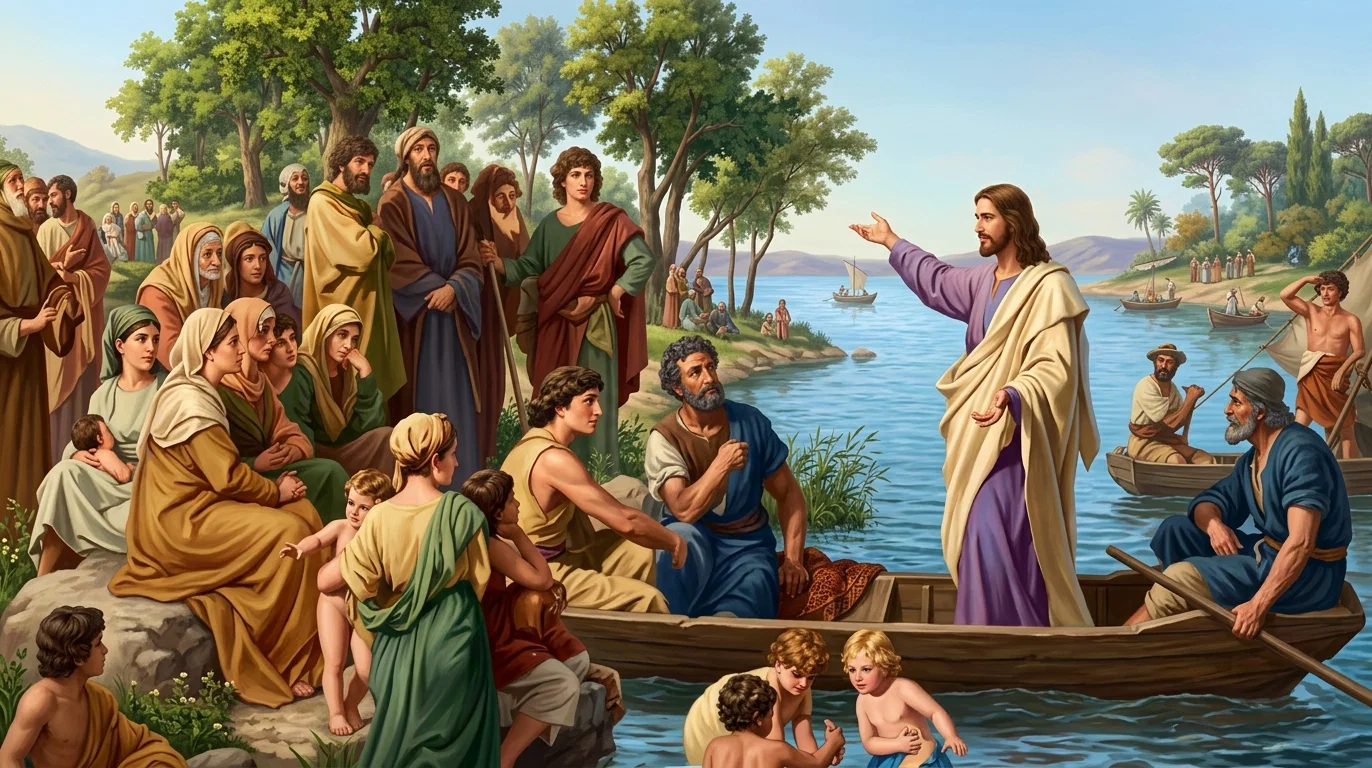
The great Head of the church teaching from the humble fisherman's boat the wonderful life-giving truths, having in them all the potency of the world's salvation. “The words that I speak unto you, they are spirit and they are life.” John 6:63.
AND gave Him [Christ] to be head over all things to the church, which is His body, the fulness of Him that filleth all in all.” “Ye are . . . built upon the foundation of the apostles and prophets, Christ Jesus Himself being the chief Corner-stone; in whom each several building, fitly framed together, groweth into a holy temple in the Lord; in whom ye also are builded together for a habitation of God in the Spirit.” “Christ also loved the church, and gave Himself up for it; that He might sanctify it, having cleansed it by the washing of water with the Word, that He might present the church to Himself a glorious church, not having spot or wrinkle or any such thing; but that it should be holy and without blemish.” Eph. 1:22, 23; 2:19-22; 5:25-27.
Of wonderful importance must that institution be of which Inspiration could use such words as the above. “The church of God,” “the church of Jesus Christ,” what is it? where found? How may we partake of its benefits and blessings?
The word “church,” as occurring in the New Testament, comes from the Greek word ekklesia (pronounced ek-klay-see’a). It means the “called out,” regularly, legitimately, called out. It is not a mere assembly (sullogos), coming together promiscuously, but a regularly summoned assembly, company, people. As it is the church of God or of Christ, that church is composed of those who respond to the regular call of God in His Gospel.

Out of What?

Out of what is the church called?—Out of the world of sin and misery and woe and darkness has God called His people. 1 Peter 2:9. He has chosen them out of the world. John 15:19. He has called them out from fellowship with unbelievers, with the iniquitous, with the unrighteous, the lawless, the idolaters. 2 Cor. 6:14-18. He calls His church out of Babylon, and from all her iniquity and the judgments which await her. Rev. 18:1-4. God does not, however, call His people to live hermits or not to mingle with the world, but to a separation from the principles of the world to the holy, the pure, the righteous principles of truth, in order that they might show forth the praises of Him who called them. 1 Peter 2:9.

The Means

The means by which God calls His church are variously set forth in His Word. God calls “by His grace” (Gal. 1:15); calls by “the Gospel of the grace of God” (Acts 20:24; 2 Tim. 1:9; 2 Thess. 2:14); by His Word, by His Spirit. God calls to repentance and faith, the ever true characteristic of the Gospel. Mark 1:15; Acts 20:21. Those who respond to these calls constitute the true church of God.

Darkened Times

There are times in the history of the world when God’s call is not clear and distinct, because His human ministers have proved recreant. At such times His church becomes broken into fragments or scattered among various organizations and associations. And this God has denominated Babylon. But whenever there has been a crisis in God’s work in the world, at the beginning of every great epoch, when the church has seemed to be utterly lost and broken, then God’s call has come distinct and clear, and the line of demarcation between His true church and all pseudo-organizations has been drawn strong and plain. Such was Moses’ call: “Who is on the Lord’s side?” Such was God’s call through Elijah: “If Jehovah be God, follow Him; but if Baal, then follow him.” Such was the call of John the Baptist: “Repent ye: for the kingdom of heaven is at hand, . . . Bring forth therefore fruits meet for repentance.” It was the call of Jesus: “Repent ye, and believe the Gospel.” “Except a man be born again, he can not see the kingdom of God.” Such was the call of Pentecost: “Repent ye, and be baptizedevery one of you in the name of Jesus Christ.” “Repent ye therefore, and be converted.”
The early church wandered away from God, became broken and scattered and confused. “Babylon”—confusion—is she called by Inspiration. In the Reformation, God made an effort to call His church out of Babylon, that she might again be one. But stalwart and strong as were the Reformers, the creed power of the reformed churches continued a “reformed” Babylon, and muffled, modified, and perverted the clear call of God.
These characteristics of the church have been foretold in prophecy; and when we see the church meeting those very predictions, we may know it to be God’s church still, “scattered and peeled” tho she may be.

The False Church

The character and career of the false church is likewise foretold in the Book of God, clearly, step by step, all the way, wandering in the world, united with the world, depending upon the power of the world, yet always claiming to be the true church. By the fruits, by the likeness to the Word of God, may we know each and both. Both are witnesses to His truth; the one to His truth exemplified in life, the other to error as predicted in the “more sure word of prophecy.”
The test of the remnant church is set forth in another article in this issue. It may be said, however, in passing, that the evidence of the true church is not in “outward show,” not in pomp and display, not in signs and wonders; but in her likeness to the Word, and the power of that Word in the life.

God’s Temple and Fortress

By Mrs. E. G. White

Builded of Living Stones

The church on earth is God’s temple. This building is to assume divine proportions and is to be the light of the world. It is to be composed of living stones laid close together, stone fitting to stone, making a solid building. Not all the stones are of the same shape or dimensions. Some are large, and some are small; but each one has its own place to fill. In the whole building there is not to be one misshapen stone. Each one is perfect. And each stone is a living stone, a stone that emits light. The value of the stones is determined by the light they reflect to the world.
Now is the time for the stones to be taken from the quarry of the world, and brought into God’s workshop, to be hewed, squared, and polished, that they may shine. This is God’s plan. He desires that every member of His church shall stand forth as did Daniel, every phase of the character under the divine ministration, that day by day each may be prepared to fill his place in the temple of God.
“Whereunto,” asks He who is the first and the last, “shall we liken the kingdom of God? or with what comparison shall we compare it?” In society He found nothing with which to compare it. He could not employ any of the kingdoms of the world as a similitude. Earthly kingdoms rule by the ascendency of physical power; but in Christ’s kingdom every carnal weapon, every instrument of coercion, is to be abolished. His kingdom is to be established to uplift and ennoble fallen humanity.
Christ makes His church a beautiful temple for God. “Where two or three are gathered together in My name,” He declared, “there am I in the midst of them.” His church is the court of holy life, filled with varied gifts, and endowed with the Holy Spirit. Appropriate duties are assigned by Heaven to each member of the church on earth, and all are to find their happiness in the happiness of those whom they help and bless.

The One Object on Earth

Through the ages of moral darkness, through centuries of strife and persecution, the church of Christ has been as a city set on a hill. From age to age, through successive generations, to the present time, the pure doctrines of the Bible have been unfolding within her borders. The church of Christ, enfeebled and defective though she may appear, is the one object on earth on which He bestows in a special sense His love and regard. The church is the theater of His grace, in which He delights to make experiments of mercy on human hearts.
The church is God’s fortress, His city of refuge, which He holds in a revolted world. Any betrayal of her sacred trust is treachery to Him who has bought her with the precious blood of His only-begotten Son. All down through the history of the world, faithful souls have constituted the church on earth. God has taken them into covenant relation with Himself, thus uniting the church on earth with the church in heaven. He has sent forth His holy angels to minister to His church, and the gates of hell have not been able to prevail against it.
Christ speaks of the church over which Satan presides as “the synagog of Satan.” Its members are the children of disobedience,—those who choose to sin, who labor to make void the holy law of God. It is Satan’s work to mingle evil with good, and to remove the distinction between good and evil. Christ would have a church that seeks earnestly to separate the evil from the good, whose members will not willingly tolerate wrong-doing, but will expel it from the heart and life.

The True Science of Salvation

To-day, as in the past, all heaven is watching to see the church develop in the true science of salvation. Christ has bought the church with His blood, and He longs to clothe her with salvation. He has made her the depositary of sacred truth, and He wishes her to partake of His glory. But in order that the church on earth may be an educating power in the world, she must cooperate with the church in heaven. Her members must represent Christ. Their hearts must be open to receive every ray of light that God may see fit to impart. As they receive this light, they will be enabled to receive and impart more and more of the rays of the Sun of Righteousness.
I appeal to every church-member to inquire, Am I doing all I can to honor my Redeemer? Truth held in unrighteousness is the greatest curse that can come to the world; but the truth as it is in Jesus is a savor of life unto life. It is worth possessing, worth living, worth defending.

What Church-Membership Means

Christ calls upon us to enter the narrow pathway, where every step means a denial of self. He calls upon us to stand upon the platform of eternal truth, and contend, yea, contend earnestly, for the faith once delivered to the saints. Paul wrote to Timothy: “Fight the good fight of faith, lay hold on eternal life, whereunto thou art also called, and hast professed a good profession before many witnesses.” “Hold fast the form of sound words, . . . in faith and love which is in Christ Jesus.”
As we near the time when principalities and powers and spiritual wickedness in high places will be fully brought into the warfare against the truth, when Satan’s deceptive power will be so great that, if it were possible, he would deceive the very elect, our discernment must be sharpened by divine enlightenment, that we may not be ignorant of Satan’s devices.
The whole treasury of heaven is at our command in the work of preparing the way of the Lord. By giving us the cooperation of the holy angels, God has made it possible for our work to be a wonderful success. But success will seldom result from scattered effort. The united influence of all the members of the church is required.

Heavenly Helpers

Heavenly messengers are waiting to communicate with those who have sunk out of sight, whose lives are a fulfilment of the words, “I live; yet not I, but Christ liveth in me: and the life which I now live in the flesh I live by the faith of the Son of God, who loved me, and gave Himself for me.” Of such men and women must the church be composed before her light can shine forth to the world in clear, distinct rays.
Our views of the Sun of Righteousness are clouded by self-seeking. Christ is crucified afresh by many who through self-indulgence allow Satan to gain control over them. The church needs men of devotion to bear to the world the message of salvation, pointing sinners to the Lamb of God,—men who, by their works of righteousness and their pure, true words, can lift their fellow men out of the pit of degradation.
It is God’s purpose that all shall be tested and tried, that He may see whether they areloyal or disloyal to the laws that govern the kingdom of heaven. All will be given the same opportunity that was granted to the first great rebel, to reveal the spirit that moves them to action. For a time the oppressors will be permitted to triumph over those who keep God’s holy commandments. To the last, God will permit Satan to reveal himself as a liar, an accuser, and a murderer. Thus the final triumph of His people will be made more marked, more glorious, more full and complete.

The True Church

How May We Know It?

Kadesh-barnea, just south of Palestine, noted as being the place where God's church in the wilderness came to a great opportunity and missed it through unbelief. Here in eleven days' journey from Sinai, the Promised Land might have been entered. See Numbers 14.
HERE are earnest, longing hearts in this sin-sad world that are hungering for truth.
There are eyes which have grown dim and heavy in looking for the heavenward path.
There are aching limbs and wayworn feet which have followed some road which promised hope but gave no rest. There are souls filled with the strife of sin that have longed, lo, these many years, for the Peace-giver, for the rest of peace, but have found it not.
In the world's great Babylon of creeds and churches and standards, where is the true? Is it any wonder that souls are puzzled, mystified, deceived, or despairing in the mazes of mysticism and the rival claims everywhere in evidence?
Yet are there multitudes who are asking for the true way, the true church; and we wish to help them if possible.
What are the marks of her divine adoption? What are the evidences of her commission from God to point the way, to conserve the truth, under God to save souls?

What Are Not Evidences

1. Great numbers should have no weight with us in determining the question. For error has ever been in the preponderance. It is easier for the carnal heart to follow the promptings of the flesh; and the true way does not minister to the natural longings of the heart, does not feed its passions, nor foster its pride. Every false religion takes strong hold of the cords and affections of the natural heart, and in some cases their devotees number millions.
2. Neither is fewness in numbers an evidence of God's favor. Altho we are told that few enter the narrow way leading to life, that Christ's church is a “little flock,” that it is the “remnant” in great crises which shall be saved, mere paucity of members is not an evidence of truth; for error has many little offshoots and idiosyncrasies which appeal to but few.
3. Nor wealth nor power nor pomp nor influence nor elaborate ritualism, nor all combined, are an evidence or are proofs of the true church of God. Many false religions and forms of idolatry have possessed all these, and by them have lured souls to ruin.
4. Neither claim nor succession of priesthood or ministry should be considered as evidences unless there are indubitable, substantial proofs apart from claim and succession. Yet on the mere claim of false Christs many have been deceived; and every apostasy nearly from the Christian church was led by men upon whose heads had been laid the hands of those who were in the “succession.” Neither claim nor succession creates or perpetuates “holiness, without which no man shall see the Lord.” A claim which has for its twofold evidence the claim itself and the confirming witness of its own manufacture, is unworthy of consideration.
5. Miracles, or healings of body, are not evidences of truth. Christian Science “heals,” hypnotism “heals,” Spiritualism “heals,” “faith-curists” “heal;” some “speak with tongues;” but none of these are evidences of the true church of God.
For the determination of the true church of Christ there is but one standard, the Word of God, the Bible. By divine power God has established His church. By precept has He marked out her conduct. By promise has He assured her sufficiency for all her needs. By prophecy has He foretold her history—His Called-out Ones. The establishment of His church does not begin with companies, but with individuals. And “the Head of every [called-out] man is Christ;” therefore of that church—the called-out ones—Christ is “the Head.” He comes into that church by the living faith of the individuals who compose it, and is held therein as its Head, its Master, by the abiding choice and willing submission of its members. No other power, no “man of sin,” no “mystery of lawlessness,” can then be enthroned save by consent of the souls who form the church.
That church will be marked by the possession of Faith; and faith has respect to the Word of God. Hence the standard of that church will not be a human creed, will not be God's will interpreted by human tradition, will not have upon it the rigid, molding, fettering power of a dead hand, but will be an advancing, developing, loyal body, holding to the one standard—the Book of Christian truth, the Bible. It will follow that and that only. It will weigh in its balances and measure by its standards all theories, all claims, all ministers, all apostles, all messages.
The faith of God's church will be an obedient faith. It will be a faith which accepts Christ Jesus, not alone as a cleanser from sin, but as the example of holy living. A faith which does not issue in obedience is abortive or spurious. In Jesus faith led to the keeping of all God's commandments, in the joyful doing of God's will. In each soul composing His church it will do the same. “He that saith he abideth in Him ought himself also so to walk, even as He walked.” 1 John 2:6. The Spirit of God in His church will “shed abroad” in each heart “the love of God” (Rom. 5:5); and “this is the love of God, that we keep His commandments: and His commandments are not grievous.” 1 John 5:3.
That obedience of faith to God's holy law is ever the strongest and clearest of evidences of the truth or error of all human claims. God's law, as spoken by His own voice from heaven, is the detector of error, the great confirmer of truth. “To the law and to the testimony: if they speak not according tothis word, it is because there is no light in them.” Isa. 8:20. Jesus makes the same law—the will of God, the transgression of which is iniquity, lawlessness,—the test:
“Not every one that saith unto Me, Lord, Lord, shall enter into the kingdom of heaven; but he that DOETH THE WILL OF MY FATHER which is in heaven. Many will say to Me in that day, Lord, Lord, have we not prophesied in Thy name? and in Thy name have cast out devils? and in Thy name done many wonderful works? And then will I profess unto them, I never knew you: depart from Me, ye that work iniquity.” Matt. 7:21-23.
The obedience of faith to God, the reception of the Spirit in Christ Jesus, will develop the whole man, spiritually, morally, mentally, physically. It will develop a church of clean, temperate men and women, who are workers for God. That they may be fitted for that work, God distributes to each and every true child the gifts of the Spirit. See 1 Cor. 12:4-28; Eph. 4:7-15. When Christ comes, His church will “come behind in no gift.” 1 Cor. 1:7.
Therefore the test of the true remnant is neither numbers nor power nor influence nor tradition nor “apostolic succession” nor miracles. Here are God's “hall-marks” of genuineness:
“And the dragon was wroth with the woman, and went to make war with the remnant of her seed, which keep the commandments of God, and have the testimony of Jesus Christ.” Rev. 12:17.
“Here is the patience of the saints: here are they that keep the COMMANDMENTS OF GOD, AND THE FAITH OF JESUS.” Rev. 14:12.
This is not saying that there are not true souls in every communion or outside of all communions. God watches over them; “for the eyes of Jehovah run to and fro throughout the whole earth, to show Himself strong in the behalf of them whose heart is perfect toward Him.” 2 Chron. 16:9. God is gathering them out, showing their errors, giving them light, and in the last crisis they will stand with His commandment-keeping church.
That church is composed of fallible, erring, imperfect mortals; but the infallible One is leading by His Spirit and Word. Every step of her halting, limping, yet victorious way has been foretold by prophecy. Her glory and power when obedient, her witness under persecution, her apostasy and union with the world, her scattering in great Babylon, her return to God and His truth, have all been predicted by His Word and fulfilled in her experience.
That church has liberty in Christ. She may be warred against, persecuted; but she will lift no carnal weapon against others. Her only warfare is against sin and error; her only object, to save souls. Come to Christ, reader, and be found among His “Called-out Ones.”

His Called-Out Ones

career. All these must be met by His church — His “Called-out Ones.”
Continue reading: The Future of the Earth — What It Is to Be