Influential Peace Congresses and Peace Societies—Are They Creating Sentiment That Will Throttle This War and Prevent Future Wars?
By MILTON C. WILCOX
THE reader of history lays down his last volume of the chronicles of the world with the conviction that war is the normal condition of mankind. Preparations for war, and recuperating losses and forces after war, cover practically the whole history of the great world powers, from Nimrod of Babylon, the mighty hunter of men, to the war lord of Germany, Emperor William II.
Few are the times in history's centuries when the temple of Janus could be closed. Few pages are there comparatively that have not been stamped or smeared with blood. The war god has been worshiped, and upon his shrine men of blood have laid their garlands and votive offerings, and he has been crowned preeminent; but there has been kept in the background the sad picture composed of the millions of nameless graves, the weeping mothers and widows and children whose sons and husbands and fathers come not back, none of whom were responsible for the fearful strife. And, too, upon the suffering masses who are left have been laid the colossal, crushing burden of debt.
WILL WAR CEASE?
Will it never cease? Good men have hoped it would. Some have dreamed that the influences of the Prince of peace, and the religion of Christianity, which is a religion of peace, would so mold the minds and hearts of men that world-wide peace would come. Others have thought that the common business sense of men would lead them to see the futility and the barbarity of war, the unbearable financial burden it entails, and help them to devise some plan to settle difficulties, national and international, without resort to bloodshed. Many noble men have been working for peace. Money has been bestowed in large sums, societies of various kinds and scope have been organized, and multiplied essays and innumerable articles have been published to the world, to create and foster the sentiments of peace. Many sermons have been preached from Christian pulpits to educate in the same direction.
It may be worth while to chronicle briefly some of these efforts. The first international congress of peace was held in London, at the suggestion of Joseph Sturge, in 1843. In 1848 the second was held at Brussels. In 1849 the third international peace congress was held at Paris. In 1853 one was held in Manchester, England. Richard Cobden and John Bright were present and took part. In 1878 one was held at Paris in connection with the international exhibition. In 1889 another exposition was held in Paris, in connection with which another peace congress was held. From that time on they became periodical. In 1908 the seventeenth sat in London, and in 1910 the eighteenth was held in Stockholm, Sweden.
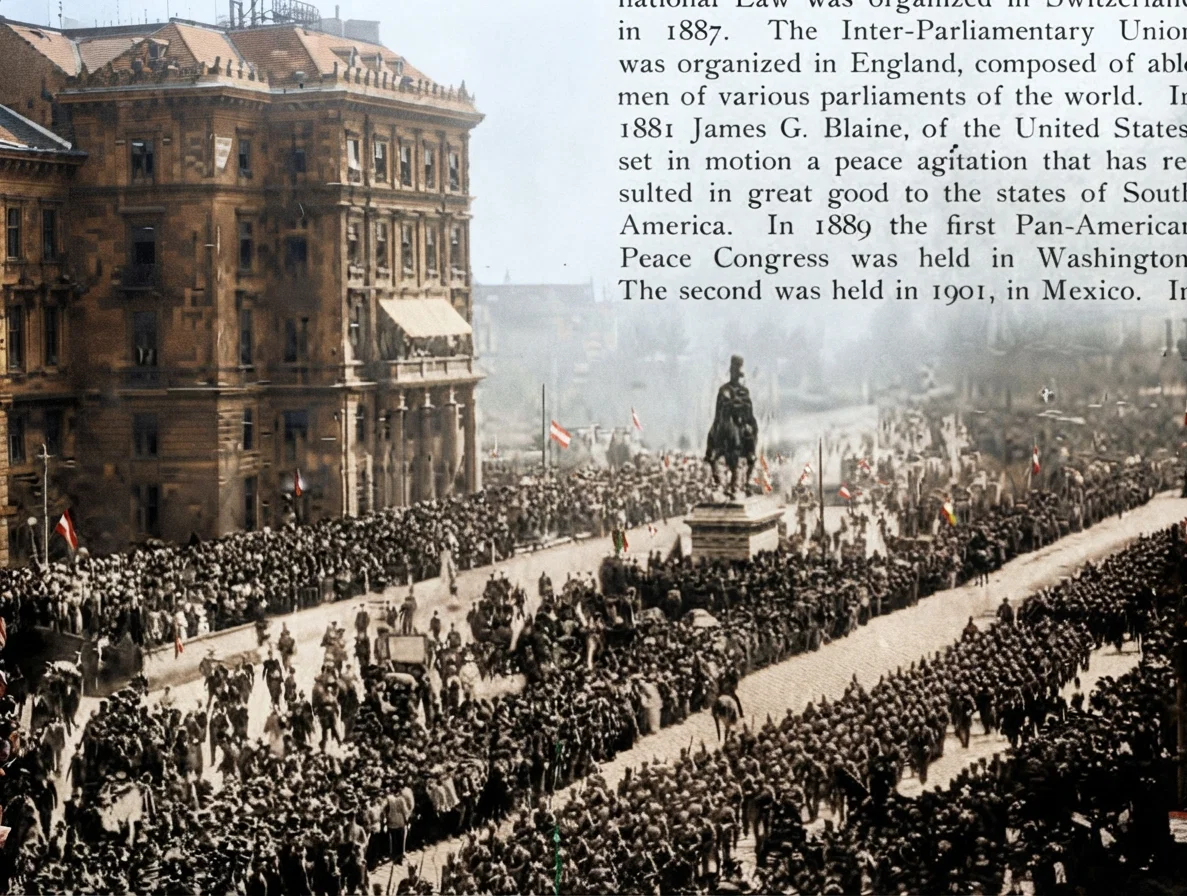
During this period the following organizations were effected: The Institute of International Law was organized by the French, composed of international lawyers of great ability. The American Society of International Law was founded with the same purpose in view. The Institute of International Law was organized in Switzerland in 1887. The Inter-Parliamentary Union was organized in England, composed of able men of various parliaments of the world. In 1881 James G. Blaine, of the United States, set in motion a peace agitation that has resulted in great good to the states of South America. In 1889 the first Pan-American Peace Congress was held in Washington. The second was held in 1901, in Mexico. In
1906 the third Pan-American conference included in its representatives the United States, and every South American state except Venezuela.
THE HAGUE CONFERENCES
From this peace agitation, Emperor Nicholas II, of Russia, in 1898 was encouraged to invite the nations of Europe to the Hague. Twenty-six responded to this, and the first Hague conference was held in 1899. It was hoped that this conference would bring about such a condition that international differences could be adjusted without war where the parties are honestly agreed. The second Hague peace convention was held in 1907. If we remember correctly, there were forty-four nations signatory to that convention. According to the actions of that convention, the signatory powers (1) would use their best efforts to insure the pacific settlement of international difficulties; (2) if diplomacy failed, they were, as far as circumstances would allow, to resort to the mediation of one or more friendly powers; (3) it would not be regarded as an unfriendly act if one or more powers—strangers to the dispute—should on their own initiative offer mediation to the states in disagreement, or even during hostilities, as President Wilson has done in this present European war; (4) in any disputes of international character, involving neither national honor nor vital interests, arising from a difference of opinion on points of fact, the parties who have not been able to come to an agreement should institute an international commission of inquiry to facilitate a solution of the dispute by an investigation of the facts; (5) they agreed that arbitration is recognized as the most effective and at the same time the517most equable means of settling disputes which diplomacy has failed to adjust.
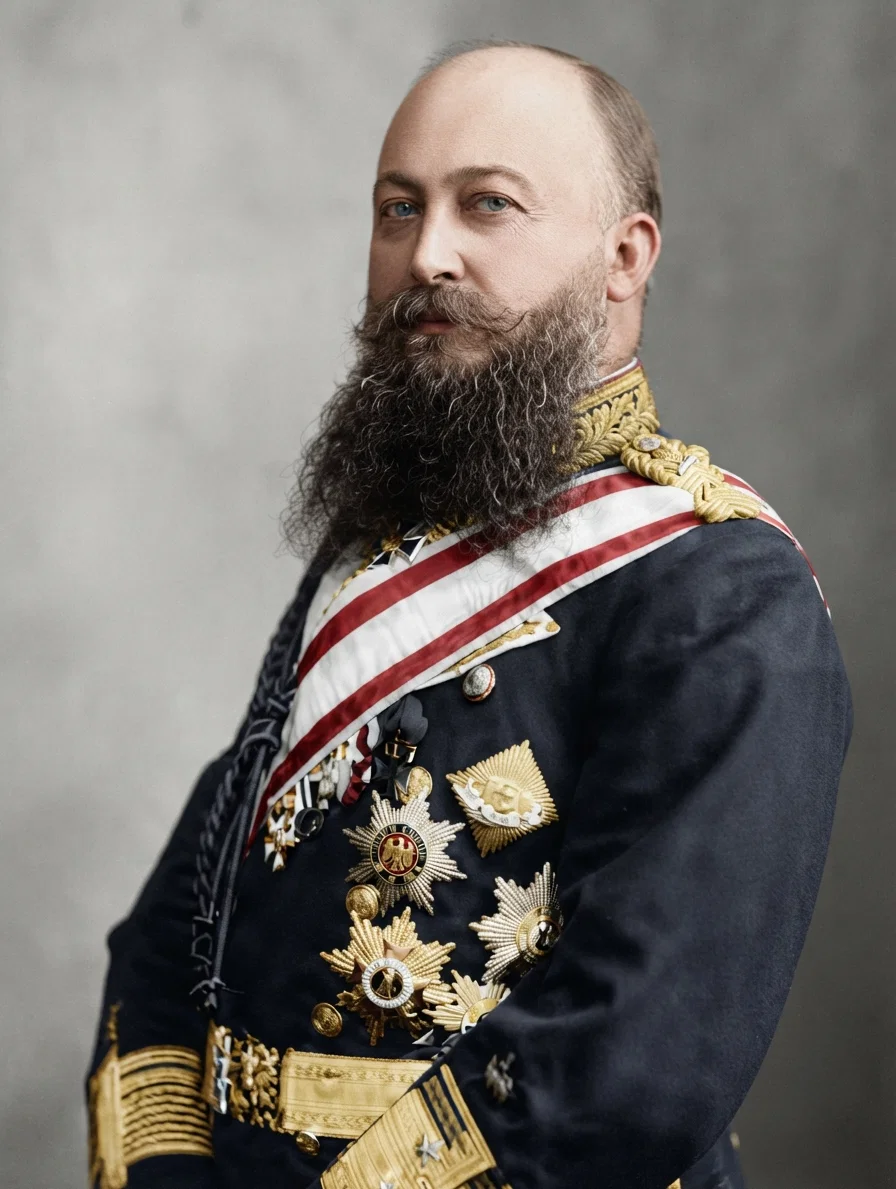
High Admiral Alfred P. T. von Tirpitz, commander of the kaiser's naval forces
If these principles had been followed out, we would have had no European war at the present time. Of course no force was given to these principles. No court was established that could decide and enforce its sentence.
PERMANENT ARBITRATION COURT
Secretary Knox, of the United States, proposed that there should be a permanently sitting court of arbitration, clothed with the functions of a "court of arbitral justice"; and the United States government accordingly suggested that the signatories should insert in the act of ratification a reservation to the effect that resort to the International Prize Court, in respect to decisions of their national tribunals, should take the form of a direct claim for compensation. This court
of arbitration should hold regular and continuous sessions, consist of the same judges, and pay due heed to the precedence created by its prior decisions.
While the Hague congress could not go so far as that, the sentiment was seemingly healthy. One of the endeavors at the Hague was to limit military operations, restrict military budgets. The following resolution was adopted: "The conference is of opinion that the restriction of military budgets, which are at present a heavy burden on the world, is extremely desirable for the increase of the material and moral welfare of mankind."
It also said that "governments taking into account the proposals made at the conference should examine the possibility of an understanding concerning the limitation of military and naval armaments in the war budgets." Both
the French and the Italian parliament urged that something should be done in this direction, but Germany was not agreed.
The only two powers in the world that have limited military expenses are Chile and Argentine. They have an agreement between themselves to limit military expenses and so reduce the tremendous cost. Either power that wishes to increase its armaments must give eighteen months' notice.
But along the lines of the peace movements have developed a long list of arbitration treaties. From October 14, 1903, down to June, 1910, one hundred and three arbitration treaties were signed between various powers of the world. Under the influence of the State Department at Washington this year twenty different arbitration treaties have been signed.
It was hoped that the preservation of the balance of power in Europe would maintain peace there. The Triple Alliance and the Triple Entente were formed for that very purpose; and through various treaties the little powers of Europe, such as Luxemburg, Belgium, Holland, Switzerland, Denmark, Norway, and Sweden, were held to be per-
petually neutral,—buffers really between the great powers.
UNDERLYING CAUSES—RUSSIA'S AMBITION
But all these things do not change the human heart, nor pacify the earth-hunger among the nations. Over in the east of Europe is a colossal power, Russia. Looking at it purely from the Russian standpoint, one can not blame the nation for wanting warm water ports, and the ability and right to maintain a navy the same as any other great power of Europe.
Russia is a wonderful producing country. She is one of the great wheat and oil producers of earth. She wishes to market these the same as other powers. Her ports on the Pacific are summer ports, frozen in winter. So it is on the Baltic Sea. There is only one
half of the year that it can be used to any advantage. She has wanted a port in the south, an outlet on the Mediterranean Sea, but this has been blocked by Turkey. Russia has felt, of course, with the regard that the other nations have for Turkey, that sometime she would have Constantinople, in order that she may have a Mediterranean port. Austria and Germany have felt that if Russia was allowed to extend in this direction, with the tremendous resources she has behind her, she would sweep over all Europe; and therefore Russia has been restrained of her ambition, and is still restrained.
AUSTRIA'S DESIRES
Austria also has her ambitions. The only ports she has are on the Adriatic. She would like to have a port on the Egean Sea—Saloniki for instance—but she has been restrained of her ambitions in this direction.
These are the primal causes of the difficulties at the present time. Connected with these, of course, are the ambitions of men like the late Ferdinand of Austria, who was just recently assassinated. It was his ambition, we are told, to form a great Austrian
Empire composed of the kingdoms of Austria proper, Hungary, Croatia, Servia, etc. He dreamed, under his Jesuit teaching, of another Holy Roman Empire, including the Balkan peninsula and Austria. This, to be sure, would have destroyed the Balkan powers, which are largely Slav, and more sympathetically connected with Russia. It would have destroyed Servia's independence and her dream of a larger kingdom. It would have been a constant menace to Greece, if it had not absorbed her.
While the little Balkan powers would war among themselves, they would probably unite against any power that would seek to swallow them up or take away their independence.
GERMANY'S INTENT
Germany also is interested in repressing the ambitions of Russia. She has at the present time the building of a railway from the Dardanelles to the Persian Gulf, down through the Euphrates Valley, and her terms with Turkey give her the right to police that railway six miles on either side—a practical control of the great commerce of the valley. She has other large interests in Asia Minor. She does not want Russia pressing down through Armenia from the north.
IMPERIALISM AND REPUBLICANISM
With all the other elements in this clash of arms, one must not leave out of his reckoning the struggle of systems. Europe has been largely ruled by monarchy, by imperialism, by autocracy. But struggling against this for centuries has been the innate sense of justice in men's minds, that they ought to have
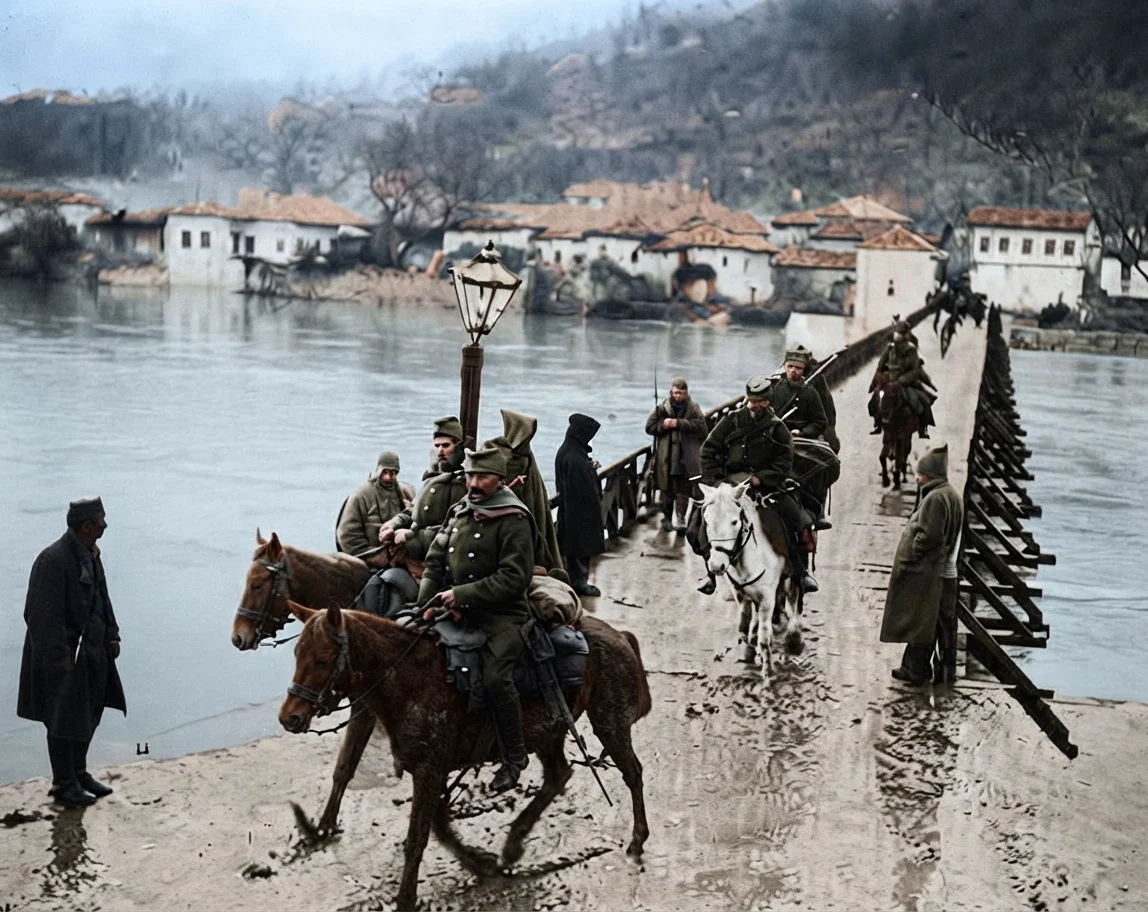
Photograph by Paul Thompson. Servian cavalry on the march. The picture is a forceful illustration of how much the country has been reduced. Every kind of horse is pressed into service, that ordinarily would not be considered for cavalry purposes. In many instances even the slow-going ox is used by the Servians in transporting military equipment.
Supreme Efforts for Peace
(Continued from page 5)
something to say in the management of what concerns them. Therefore this is a conflict between autocracy and democracy, between imperialism and republicanism, between oligarchism and socialism. The New York World pertinently points out this in the following:
"All the world knew that a declaration of war against Russia was in effect a declaration of war against France. Germany admitted it by mobilizing her army, not on the Russian frontier, but on the French frontier. A decisive blow was to be struck against the French republic, not against its imperial ally. It was not Russian despotism that was to be crushed, but French republicanism. The hollow hypocrisy of the whole proceeding is revealed in the fact that before the clash of arms is fairly begun, the Austrian invasion of Servia is practically abandoned. . . . What was begun hastily as a war of autocracy is not unlikely to end as a war of revolution, with thrones crumbling and dynasties in exile."
Oscar S. Straus, the well-known publicist, former United States ambassador to Turkey,6writing from London, says: "This Titanic world clash will be the obliteration of every monarchy in Europe. When the armed forces have fought themselves out, there will not be one sovereignty left." And then he tells us that the responsibility will rest upon "England and France to compel Russia to modernize her governmental system, and that right away. Upon them rests the burden of forcing Russia to give equal rights to her subjects. Otherwise the alliance, instead of proving a bulwark of strength, will become a burden. Unless Russia is made to see that unless she accords now, at once, full rights to those whose patriotism she relies on, she will have to contend with revolution within."
And the New York Independent of August 10 declares in a stirring editorial: "Whom the gods destroy they first make mad—mad with the lust of power, drunk with their own egotism. The head devils have signed their own doom. Their days are numbered. The monarchs must go—and they will."
TWO GREAT PROPHECIES
Notwithstanding all this, there are men who are preaching peace. Out of this, they declare, will come peace. They have looked upon the prophecy in Isaiah 2 and in Micah 4 as a declaration of peace sooner or later. The former scripture reads:
"And it shall come to pass in the latter days, that the mountain of Jehovah's house shall be established on the top of the mountains, and shall be exalted above the hills; and all nations shall flow unto it. And many peoples shall go and say, Come ye, and let us go up to the mountain of Jehovah, to the house of the God of Jacob; and He will teach us of His ways, and we will walk in His paths: for out of Zion shall go forth the law, and the word of Jehovah from Jerusalem. And He will judge between the nations, and will decide concerning many peoples; and they shall beat their swords into plowshares, and their spears into pruning-hooks; nation shall not lift up sword against nation, neither shall they learn war any more."
Certainly a blessed condition if it could only be brought about! The prophecy in Micah 4: 1-5 conveys the thought that it is not many peoples, but many nations, that shall go and say this; and it also suggests that it will not be a universal rule of Christianity, "for all the peoples walk every one in the name of his god; and we will walk in the name of Jehovah our God forever and ever." That is, it will be a union in which all religions of all kinds will unite through compromise. There are indications which would show that this is the dream of the papacy as well; that when that great arbitral court of federated churches and systems of religion shall be organized, at the head of it all will be the pope of Rome, and his will be the voice through which, it will be averred, the Lord will speak in judging between the nations.
There is another prophecy, found in Joel 3: 9-12, which we wish the reader would consider, that pertains also to the last days:
"Proclaim ye this among the nations; prepare war; stir up the mighty men; let all the men of war draw near, let them come
up. Beat your plowshares into swords, and your pruning-hooks into spears: let the weak say, I am strong. Haste ye, and come, all ye nations round about, and gather yourselves together: thither cause Thy mighty ones to come down, O Jehovah. Let the nations bestir themselves, and come up to the valley of Jehoshaphat; for there will I sit to judge all the nations round about. Put ye in the sickle; for the harvest is ripe: come, tread ye; for the wine-press is full, the vats overflow; for their wickedness is great. Multitudes, multitudes in the valley of decision! for the day of Jehovah is near in the valley of decision."
Certainly there could not be a stronger contrast than these two prophecies present,—the one particularly a condition of peace; the other a condition of war, until the great Judgment of God shall close the scene, and the earth shall receive its sentence of doom.
WHICH IS TRUE?
Are both prophecies true? Let us turn again to the one in Isaiah, and note some of its particulars. The Christian religion, represented by "the mountain of Jehovah's house," has indeed shown itself superior to all the various religions of the world, represented by "the hills"; and all the nations of the earth have accorded it outward honor and respect; and from among all these nations, there are those who have accepted it. But this acceptance, in a great many cases, is nominal; and where Christianity is accepted by a nation itself, and established as a national religion, it is always nominal.
Christianity is a religion of the heart and life, and no man knows it that does not know the power of Christianity in his life. It does not stand in comparison with other religions, but in direct contrast to them all. The world is selfish. Its ambitions are selfish. Its whole motive is self-centered. Humanity is fallen. It does not know Christ, and hence does not know the peace that comes through His sacrifice and the surrender of self.
The nations know nothing of this. The whole aim and ambition in each nation is to build up itself. The sacrifice must be on the part of others. Nor are nations converted as nations. Men can only be converted individually through the Lord Jesus Christ by faith. Therefore where nations adopt or seek to establish any religion, it is only the outward form, and not the essential inward life. Christianity is a life, and the life of Christianity purges away and burns up the selfishness of the man who receives it. Nations have not been converted that way; and yet with the sentiments of Christianity that have been spread abroad, they have come to count and call themselves Christian. Christian ceremonies, so-called, are connected with every great function of state. The rulers are themselves christened in babyhood by Christian ceremonies. They are crowned under Christian auspices. But the work that they do is anything but Christian, and consequently the aims and ambitions of such unregenerate hearts are bound to issue in unchristian things. They may promise peace, but there is no peace when there is no peace with God.
So in the words of the prophet, "the wicked are like the troubled sea, when it can not rest, whose waters cast up mire and dirt. There is no peace, saith my God, to the wicked."
WHOSE IS THE PREDICTION OF PEACE?
In the light of this, we may understand the prophecy of Isaiah 2. It is not God that says, "Come ye, and let us go up to the mountain of Jehovah." It is not God that says, "We will walk in His paths." It is not God that says, "He will judge between the nations," that "they shall beat their swords into plowshares, and their spears into pruning-hooks." It is the "many peoples" and the "many nations" who say this, and who declare that Jehovah says it. But it is not Jehovah who says it. And He calls His people "soothsayers" for saying it, worthy to be forsaken. It is the great false cry of peace that men are raising in the world today, which will not issue in peace, but which will issue, according to the prophecy of Joel, fulfilling before our very eyes constantly, in the increasing armaments and preparations among the nations of the earth.
A DEMONSTRATED PROPHECY
How true is the prophecy of Joel, demonstrated before the eyes of all continually! "Prepare war"; men are preparing war. "Stir up the mighty men"; and the mighty men are stirred. "Let all the men of war draw near, let them come up"; and from every land men are turning their faces toward the great center of conflict to-day, to join their regiments. "Beat your plowshares into swords, and your pruning-hooks into spears"; and how true is it that the finest and strongest and most effective metals of the world are placed at the service of war, and all the nations are vying with each other in the hurry of preparation! Even the weak ones are saying, "I am strong." Little Belgium withstands the mighty German army for days. In such a time as this, all the peace conventions and treaties are ropes of sand.
So they are gathering for the great harvest-time. Jesus says, in Matt. 13: 39, that the harvest is the end of the world. The valley of Jehoshaphat is where Jehovah judges. The "valley of decision" is the time when men are deciding either for God or against Him, as the whole world will soon decide.
NOT THE END
The fulfilment of these things is set forth in other articles in this issue much more fully than we can present it here. We place before the reader the contrast of these two prophecies, and say further, that this present conflict will not be the end. God has told us that when that end does come, the winds of strife and war will be blowing from every quarter, and there shall be "a great whirlwind." Jer. 25: 32. Read the whole chapter.
In another prophecy, in Rev. 7: 1-3, is given another picture, which precedes the fulfilment of Jeremiah 25. In that prophecy, the four winds of earth which would cause the fearful battle predicted by Jeremiah, are ready to blow; but God is sending out His mighty messengers to the various parts of earth, aided by noble men, who hold the winds until His own work is done in the earth, until His own servants are sealed, ready for His coming. Then the winds of strife will be permitted to blow, and the end will come.
The great battle of Armageddon will be fought, but not now. God's work is not yet7finished. God is still taking time to gather out from all the nations a people who will honor Him throughout eternity, and reveal to all the worlds in the universe "the praise of the glory of His grace" in taking fallen humanity, at enmity with God, and winning them to yield to Him, changing their character so that they shall rejoice in the privilege of serving Him in glorious freedom forever and ever.
Reader, do not be deceived by the false cry of peace. There will come a time when all the world will believe itself to be at peace; but "when they shall say, Peace and safety; then sudden destruction cometh upon them; . . . and they shall not escape." 1 Thess. 5: 3. The only hope of peace, the only lasting peace, is peace first of all with God through our Lord Jesus Christ.
Hope for the Fallen
[[FIGURE]]
THE fallen must be led to feel that it is not too late for them to be men. Christ honored man with His confidence, and thus placed him on his honor. Even those who had fallen the lowest He treated with respect. It was continual pain to Christ to be brought into contact with enmity, depravity, and impurity; but never did He utter one expression to show that His sensibilities were shocked or His refined tastes offended. Whatever the evil habits, the strong prejudices, or the overbearing passions of human beings, He met them all with pitying tenderness.
As we partake of His Spirit, we shall regard all men as brethren, with similar temptations and trials, often falling, and struggling to rise again, battling with discouragements and difficulties, craving sympathy and help. Then we shall meet them in such a way as not to discourage or repel them, but to awaken hope in their hearts.
God bids us, in dealing with the tempted and the erring, consider "thyself, lest thou also be tempted." Gal. 6:1. With a sense of our own infirmities, we shall have compassion for the infirmities of others.
His Masterly Tenderness Displayed
By Mrs. E. G. White
Unselfish Love and Sympathy Manifested — Divine Estimate of the Value of a Soul — The Most Sinful May Hope
The Sympathy We Should Have for Others
By MRS. E. G. WHITE
NOT because we first loved Him did Christ love us; but "while we were yet sinners," He died for us. He does not treat us according to our desert. Although our sins have merited condemnation, He does not condemn us. Year after year He has borne with our weakness and ignorance, with our ingratitude and waywardness. Notwithstanding our wanderings, our hardness of heart, our neglect of His holy word, His hand is stretched out still.
The Saviour's example is to be the standard of our service for the tempted and the erring. The same interest and tenderness and long-suffering that He has manifested toward us, we are to manifest toward others. "As I have loved you," He says, "that ye also love one another." John 13:34.
REVEAL HIS UNSELFISH LOVE
If Christ dwells in us, we shall reveal His unselfish love toward all with whom we have to do. As we see men and women in need of sympathy and help, we shall not ask, "Are they worthy?" but, "How can I benefit them?"
Rich and poor, high and low, free and bond, are God's heritage. He who gave His life to redeem man, sees in every human being a value that exceeds finite computation. By the mystery and glory of the cross, we are to discern His estimate of the value of the soul. When we do this, we shall feel that human beings, however degraded, have cost too much to be treated with coldness or contempt. We shall realize the importance of working for our fellow men, that they may be exalted to the throne of God.
A PIECE OF SILVER STILL
The lost coin, in the Saviour's parable, though lying in the dirt and rubbish, was a piece of silver still. Its owner sought it because it was of value. So every soul, however degraded by sin, is in God's sight accounted precious. As the coin bore the image and superscription of the reigning power, so man at his creation bore the image and superscription of God. Though now marred and dim through the influence of sin, the traces of this inscription remain upon every soul. God desires to recover that soul, and to retrace upon it His own image in righteousness and holiness.
We need more of Christlike sympathy; not merely sympathy for those who appear to us to be faultless, but sympathy for poor, suffering, struggling souls, who are often overtaken in fault, sinning and repenting, tempted and discouraged. We are to go to our fellow men, touched, like our merciful High Priest, with the feeling of their infirmities.
It was the outcast, the publican and sinner, the despised of the nations, that Christ called, and by His loving-kindness compelled to come unto Him. The one class that He would never countenance was those who stood apart in their self-esteem, and looked down upon others.
THE INVITATION A COMPELLING POWER
"Go out into the highways and hedges, and compel them to come in," Christ bids us, "that My house may be filled." In obedience to this word, we must go to the heathen who are near us, and to those who are afar off. The "publicans and harlots" must hear the Saviour's invitation. Through the kindness and long-suffering of His messengers, the invitation becomes a compelling power to uplift those who are sunken in the lowest depths of sin.
Christian motives demand that we work with a steady purpose, an undying interest, an ever increasing importunity, for the souls whom Satan is seeking to destroy. Nothing is to chill the earnest, yearning energy for the salvation of the lost.
THOSE WHO HAVE FALLEN THE LOWEST
"We are saved by hope." Rom. 8:24. The fallen must be led to feel that it is not too late for them to be men. Christ honored man with His confidence, and thus placed him on his honor. Even those who had fallen the lowest He treated with respect. It was a continual pain to Christ to be brought into contact with enmity, depravity, and impurity; but never did He utter one expression to show that His sensibilities were shocked or His refined tastes offended. Whatever the evil habits, the strong prejudices, or the overbearing passions of human beings, He met them all with pitying tenderness.
As we partake of His Spirit, we shall regard all men as brethren, with similar temptations and trials, often falling, and struggling to rise again, battling with discouragements and difficulties, craving sympathy and help. Then we shall meet them in such a way as not to discourage or repel them, but to awaken hope in their hearts.
God bids us, in dealing with the tempted and the erring, consider "thyself, lest thou also be tempted." Gal. 6:1. With a sense of our own infirmities, we shall have compassion for the infirmities of others.
A TENDER SPIRIT, A WINNING DEPORTMENT
It is always humiliating to have one's errors pointed out. None should make the experience more bitter by needless censure. No one was ever reclaimed by reproach; but many have thus been repelled, and have been led to steel their hearts against conviction. A tender spirit, a gentle, winning deportment, may save the erring, and hide a multitude of sins.
When one at fault becomes conscious of his error, be careful not to destroy his self-respect. Do not discourage him by indifference or distrust. Do not say, "Before giving him my confidence, I will wait to see whether he will hold out." Often this very distrust causes the tempted one to stumble.
MISUNDERSTOOD AND FULL OF DISTRESS
We should strive to understand the weakness of others. We know little of the heart trials of those who have been bound in chains of darkness, and who lack resolution and moral power. Most pitiable is the condition of him who is suffering under remorse. He is as one stunned, staggering, sinking into the dust. He can see nothing clearly. The mind is beclouded. He knows not what steps to take. Many a poor soul is misunderstood, unappreciated, full of distress and agony,—a lost, straying sheep.7He can not find God, yet he has an intense longing for pardon and peace.
O, let no word be spoken to cause deeper pain! To the soul weary of a life of sin, but knowing not where to find relief, present the compassionate Saviour. Take him by the hand, lift him up, speak to him words of courage and hope. Help him to grasp the hand of the Saviour.
COMPASSIONATE CONSIDERATION
We need to put ourselves in the place of the tempted ones. Consider the power of heredity, the influence of evil associations and surroundings, the power of wrong habits. Can we wonder that under such influences many become degraded? Can we wonder that they should be slow to respond to efforts for their uplifting?
Often, when won to the gospel, those who appeared coarse and unpromising will be among its most loyal adherents and advocates. They are not altogether corrupt. Beneath the forbidding exterior, there are good impulses that might be reached. Without a helping hand, many would never recover themselves; but by patient, persistent effort, they may be uplifted. Such need tender words, kind consideration, tangible help. They need that kind of counsel that will not extinguish the faint gleam of courage in the soul. Let the workers who come in contact with them consider this.
THE SUN OF RIGHTEOUSNESS MAY SHINE THERE
Some will be found whose minds have been so long debased that they will never in this life become what under more favorable circumstances they might have been. But the bright beams of the Sun of Righteousness may shine into the soul. It is their privilege to have the life that measures with the life of God. Plant in their minds uplifting, ennobling thoughts. Let your life make plain to them the difference between vice and purity, darkness and light. In your example, let them read what it means to be a Christian. Christ is able to uplift the most sinful, and place them where they will be acknowledged as children of God, joint heirs with Christ to the immortal inheritance.
By the miracle of divine grace, many may be fitted for lives of usefulness. Despised and forsaken, they have become utterly discouraged. They may appear stoical and stolid. But under the ministration of the Holy Spirit, the stupidity that makes their uplifting appear so hopeless will pass away. The dull, clouded mind will awake. The slave of sin will be set free. Vice will disappear, and ignorance will be overcome. Through the faith that works by love, the heart will be purified and the mind enlightened.
Soldiers of God
By J. H. Hartog
To Jacob it was said, "Thy name shall be . . . Israel: for as a prince hast thou . . . prevailed." Webster defines "prevail" to mean overcome. The true Israelites, therefore, are overcomers, prevailers, soldiers of God.
A soldier is one who fights for pay. The word "soldier," from solidus, denotes one who receives wages for battling. But not until after the battle does his sovereign bestow the decoration.
We, as soldiers of God, as Israelites, receive our solidus; for as we work for His cause, we are immediately and constantly paid, as no one will deny who has ever attempted to win souls for His kingdom. And after the victory, we too will receive our decoration, the crown, from our King.