Your ShelfYour Projects

Signs of the Times, Vol. 23, No. 25.

Editorial

Signs of the Times

Jul 1, 1897

Pacific Press Publishing Company · OAKLAND, CALIFORNIA · Jul 1, 1897

Editorial
"Thine is the kingdom, and the power, and the glory, forever. Amen." Matt. 6:13.
This is an everlasting truth, for the Lord himself has spoken it; yet to how many who daily utter the words are they little more than a form of speech! As a matter of fact, it is a confession which, if made with the spirit and with the understanding, brings the soul into the closest and most perfect relation to God.
The kingdom belongs to God. How exhaustive is it?—"The Lord hath prepared his throne in the heavens; and his kingdom ruleth over all." Ps. 103:19. "The Lord is in his holy temple; let all the earth keep silence before him." Hab. 2:20. "The earth is the Lord's, and the fulness thereof; the world, and they that dwell therein." Ps. 24:1. "The Most High ruleth in the kingdom of men, and giveth it to whomsoever he will." Dan. 4:17. "For God is the King of all the earth; sing ye praises with understanding. God reigneth over the heathen; God sitteth upon the throne of his holiness." Ps. 47:7, 8. Wherever in the universe created beings can look up and see a canopy of space above them, there is God's kingdom. Read Ps. 139:1-12.
People in general do not recognize God as universal King, but that makes no difference with the fact. A portion of God's dominion is in rebellion against him; but that does not destroy the fact that the kingdom is his by right. Many people worship gods of their own making, but that does not destroy the fact that there is but one God. In the beginning God gave the dominion of this earth to man (Gen. 1:28), but he did not thereby renounce his right to it. God is the King of kings, and it pleased him to rule this portion of his dominion through man, whom he had made in his image. Man was to be simply the agent through whom God would manifest his power on earth. The fact that man has refused to be the instrument of God's will, does not in the least impair God's original and eternal right to the kingdom.
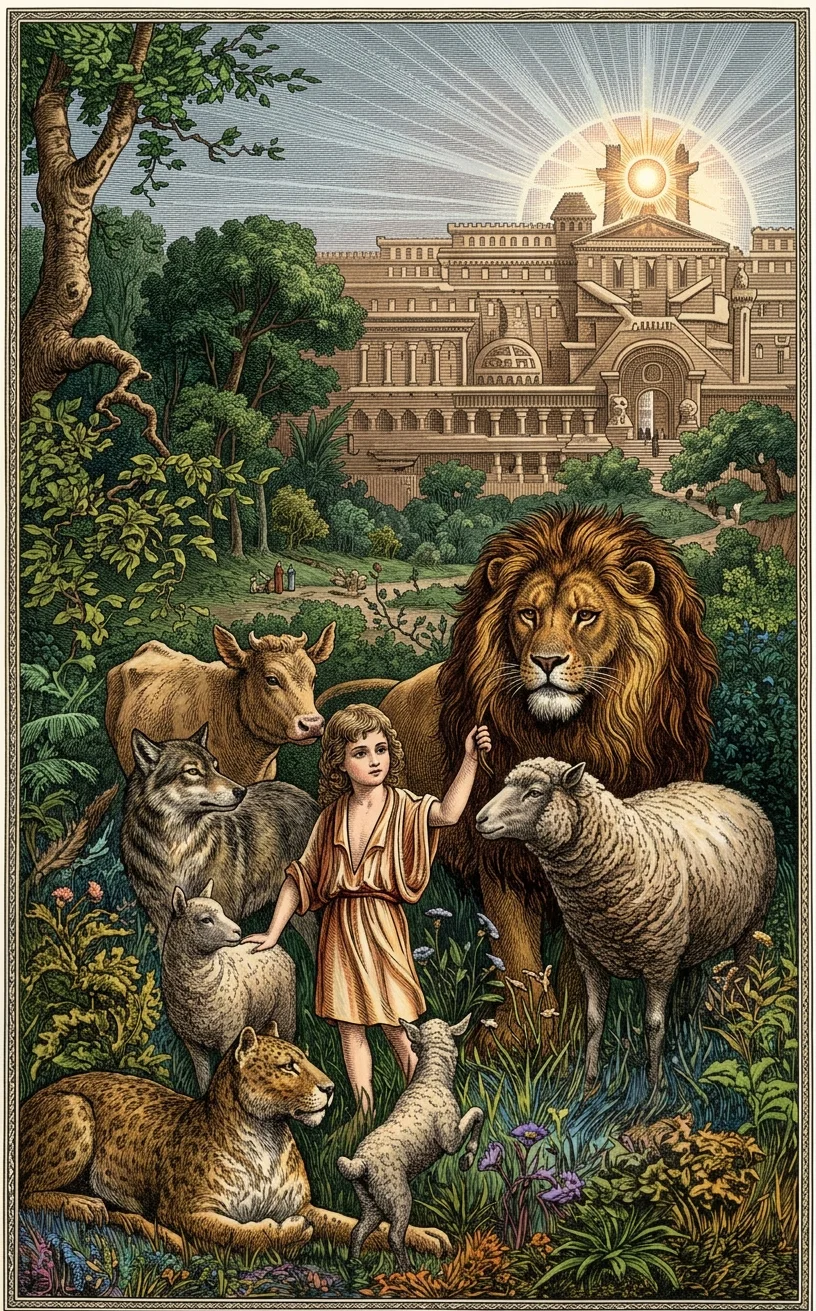
"They shall not hurt nor destroy in all My holy mountain; for the earth shall be full of the knowledge of the Lord, as the waters cover the sea." When all creation owns God's rule, "a little child shall lead them."
But our confession to God comes closer home. When the unbelieving Pharisees demanded that Jesus should tell when the kingdom of God should come, he replied: "The kingdom of God cometh not with observation; neither shall they say, Lo here! or, lo there! for, behold, the kingdom of God is within you." Luke 17:20, 21.
There is a story of a king who visited a school and questioned the pupils. Taking up a paper weight, he asked them to what kingdom it belonged. They replied, "To the mineral kingdom." Then pointing to a plant, he asked the same question, and they said, "To the vegetable kingdom." Then he asked, "To what kingdom do I belong?" The children were afraid to say that he belonged to the animal kingdom, and, as they hesitated, one said, "To God's kingdom." That was a truth, for every created thing in the universe belongs to God's kingdom, and there is but one law for all, namely, God's life.
Some one will say, "But God does not rule in wicked men's hearts." Quite true, because his rule is love, which they reject; but the fact remains that every human heart is God's rightful kingdom. His right is demonstrated by the fact that "he giveth to all life, and breath, and all things;" "for in him we live, and move, and have our being." Acts 17:25, 28. It is with his life alone that we live, for we have none of our own; and since the life belongs to him, he alone has the right to direct it.
That which may be known of God, that is, "his eternal power and Godhead," is manifest in men, even in the heathen, as well as in all the things that God has made. Rom. 1:19, 20. But men, unlike the trees of the field, "hold down the truth in unrighteousness," choosing rather to be their own masters than to allow God to rule. But "the way of man is not in himself; it is not in man that walketh to direct his steps." Jer. 10:23. Man has no more power in himself than the grass of the field has, and therefore when he attempts to rule the kingdom himself, he makes a sad failure.
Who alone has the right to rule?—He to whom the kingdom belongs. So when we say to the Lord, "Thine is the kingdom," we acknowledge that he alone has the right to rule, not only in our hearts, but in all the earth. But if we truly acknowledge the fact, we yield the kingdom fully to his control.
Just here is where many make a fatal mistake. They say, "The kingdom is the Lord's, but people in general will not acknowledge it, therefore we must compel them to submit to him." Such a course as that is virtually a denial of the fact that the kingdom is the Lord's. To say the least, God is as able to use force aswe are, and if he wished people to be forced to submit to him, he could do it. The fact that he does not compel people to serve him, is sufficient evidence that he does not wish men to seek to do so. His law is love, and therefore force is in direct opposition to his kingdom.
All that we are called upon to do, no matter who we may be, is to acknowledge God's right to the kingdom. Whoever acknowledges that the kingdom—that is, all mankind, including himself—belongs to God, will very naturally refrain from attempting to rule any part of it. He to whom the kingdom belongs has the sole right to rule, and if we are sincere in our acknowledgment of God's right, we will not meddle with his affairs. We will leave him to deal with other people as he sees best. By acknowledging his right to rule all the kingdom, we ourselves disclaim the right to rule any portion of it, even to our own lives. The only part of the kingdom, however, that we can yield up to God is ourselves. When we have done this, then we may tell others how good his rule is, and persuade them also to yield to his dominion.
There is strength in the heartfelt confession, "Thine is the kingdom," for God is able to protect his own. The battle is not ours, but his to whom we belong—"the King of glory." "Who is this King of glory? The Lord strong and mighty, the Lord mighty in battle." In his hand are power and might, so that none is able to withstand him. His thoughts toward us are thoughts of peace, and he desires nothing so much as our welfare both here and in eternity. What a blessed thing to know that "the Lord is our Judge, the Lord is our Law-giver, the Lord is our King; he will save us." E. J. W.

IS IT IDOLATRY?

AN earnest correspondent writes us with reference to the use of illustrations of any kind in the SIGNS OF THE TIMES, and characterizes it as idolatry, and the transgression of the second commandment. Our attention is called to a great many scriptures against idolatry, all of which we have read many times, and always, we trust, with profit.
But it seems to us that those whom our correspondent represents have missed the essential thought in the prohibition of the second commandment: "Thou shalt not make unto thee any graven image; . . . thou shalt not bow down thyself to them, nor serve them." The thought is that no image shall be made as an object of worship. It was for this reason that God revealed "no similitude" of himself; they could not make an image of the great Jehovah, for they had not seen him.
That images of things in both heaven and earth could be made to illustrate, adorn, and beautify, we learn by the Lord's especial direction in the instruction which he gave concerning the sanctuary and temple. The figures of cherubim, angels, were made over the mercy-seat and inwrought in the gorgeous tapestry which formed the vail and ceiling. The figures of almonds, pomegranates, and flowers were also prominent in beautifying the sanctuary. See Ex. 25:18-20, 31-34; 26:1; 28:4, 33.
The temple structure was also elaborately adorned. This was by the Lord's own direction, and to carry out this instruction did not violate the second commandment or any other prohibition against idolatry. That commandment, then, does not forbid the mere making of things, but the making of things to worship, or bow down to in reverence.
Further, when the Lord sent Ezekiel to the captives of Judah with a message, he was to illustrate it by the picture of a city, a fort, battering rams, and even by himself. Eze. 4:1-7. Still further the Lord directs his people in the latter days to "write the vision, and make it plain upon tables, that he may run that readeth it." Hab. 2:2. When one speaks the word of the Lord, he addresses men by the ear. When he pictures before them such things as are proper thus to portray, he addresses them through the eye. When he feeds the hungry and clothes the naked, he addresses them through their taste and feelings. When he carries flowers to the shut-in ones, he addresses them through the sense of smell. Any and all of these ways are legitimate if employed with an eye single to God's glory; and each and all of them may be made a form of idolatry if the one who uses them sets his heart upon self instead of God. A man can as easily, if he so desire, worship his flowers of speech as flowers which he paints. He is as truly an idolator who worships some theory, and who worships himself for refraining from everything prohibited by the theory, as the veriest worshiper of idols. Idolatry is not alone in outwardly bowing down to gods of wood or stone, but in mentally bowing down to the gods we have set on high in our own hearts.

OUR COMING LORD.

The Tokens of His Appearing.

THE second coming of Christ, with all the blessed hopes that center therein, is a Bible doctrine. By precept and promise, by symbol and figure and parable, is the grand culmination,—our Lord's eternal reign, which begins at his coming,—kept before us throughout the entire Word. At his coming occurs the resurrection of all the righteous dead, the conferring of immortality upon all the good of all ages, the revelation of his glory in his people, and the beginning of eternal righteous rule, when the kingdoms of this world will become the kingdoms "of our Lord and of his Christ, and he shall reign forever and ever."
This is not a shadowy reign by proxy. It is a spiritual reign of a spiritual king over spiritual subjects, but it is most emphatically literal. "This same Jesus" will come again. Acts 1:9-11. "The Lord himself shall descend from heaven with a shout." 1 Thess. 4:16. "Thine eyes shall see the King in his beauty." Isa. 33:17. "Behold, a King shall reign in righteousness." Isa. 32:1. "When the Son of man shall come in his glory, . . . then shall he sit upon the throne of his glory." Matt. 25:31. "If we suffer, we shall also reign with him." 2 Tim. 2:12. "And the kingdom and dominion, and the greatness of the kingdom under the whole heaven, shall be given to the people of the saints of the Most High, whose kingdom is an everlasting kingdom, and all dominions shall serve and obey him." Dan. 7:27. Welcome indeed will be the glad home-coming of all the children of light! Welcome the glad surcease from the sorrow and crime and sin and madness and unutterable wo and misery of earth! Welcome the eternal reign where "the work of righteousness shall be peace; and the effect of righteousness quietness and assurance forever." Isa. 32:17.

When Will He Come?

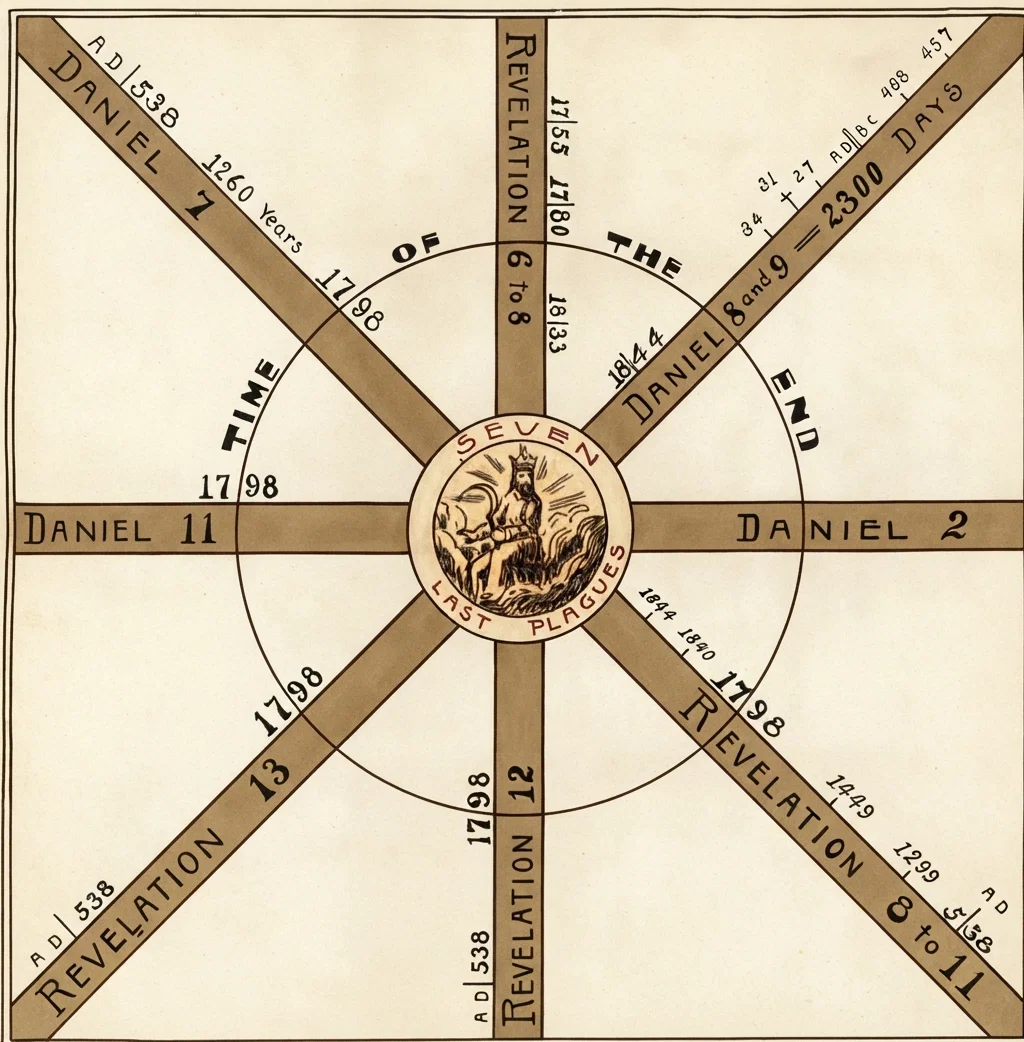
When will that glad day which knows no crime, no sin, no oppression, sorrow, death, or pain, be ushered in?—Soon; for his coming is near. A volume might be written in proof of this; we must be content to set it before our readers more briefly, and endeavor to help them to see by the eye the vast amount of evidence by the accompanying diagram.

I. The Prophetic Highways.

It is a common saying in England that all roads lead to London. This is a general truth; but it is an emphatic and universal truth of the Word of God that all the great lines of prophecy, the great highways on which God has marked out the course of empire, the rise and fall of kingdoms, and other great and striking events, lead to the second coming of Christ and his eternal reign. The radial double lines on our diagram represent these prophetic highways. There are more in the Word than are here given. We will not take them in order as they come upon the diagram, but as they occur in the Word of God.
1. The Second Chapter of Daniel.—In this the four great empires of earth, from the prophet's day forward, are represented by a great metallic image composed of gold, silver, brass, iron, and iron and clay. The head of gold represents the empire of Babylon, the one empire above all others which has molded, shaped, and influenced every succeeding kingdom by her grandeur, her pride, her assumptions, and especially her fornication, or the union of Church and State which obtained in that kingdom. To Babylon succeeded Medo-Persia, represented in the prophecy by the breast and arms of silver, reigning from B.C. 538 to 331. To Medo-Persia succeeded Grecia, the kingdom of brass, B.C. 331 to 161. Following Grecia came Rome, represented in her imperial and united state by iron, and in her divided state as she now exists in the Old World by iron and clay. In her last period of existence there will again be ten horns, symbolized perhaps by the ten toes, and by the ten horns of Rev. 17:12. "And in the days of these kings shall the God of heaven set up a kingdom, which shall never be destroyed." And the time draweth on apace.
2. The Seventh Chapter of Daniel.—This we have recently considered. Herein are the same four great empires presented under the symbols of cruel beasts, the lion, Babylon; the bear, Medo-Persia; the four-headed leopard, Grecia, and the great and terrible beast, Rome. The division of Rome into various kingdoms, symbolized in the second chapter by the admixture of iron and clay, is here shown by horns. The little horn we have shown in ourtwo last issues to represent the Papacy, which exercised spiritual domination over the world for 1,260 years, from A.D. 538 to the "time of the end," 1798. At the time of the later prophetic history of this power, the prophet sees the judgment of God in session, and, shortly after, the destruction of earthly powers, and the reward of the people of God. On this great highway the next event is the reign of Christ.
3. The Eighth and Ninth Chapters of Daniel contain a prophecy given when Babylon and her glory were in the past. It presents the three remaining of the great earth-empires under the symbol of a ram, a goat, and a little horn greater than all. The little horn is a symbol of Rome in its entirety, and its persecuting work against the people of God, under the daily or continual desolations of paganism, and the transgression of desolation under the form of Church and State which followed paganism, and which met its completest type in the Papacy. This great highway of prophecy is marked by the suffering and persecution of the people of God from the crucifixion of the Prince of princes to the end. So great is it that an angel of God asks, "How long shall be the vision concerning the daily [continual, paganism], and the transgression of desolation, to give both the sanctuary and the host to be trodden underfoot?" And the answer to the people of God in the person of the prophet is: "Unto two thousand and three hundred days; then shall the sanctuary be cleansed." The cleansing of the sanctuary is the last act of our great High Priest in heaven, the blotting out of sin, the approval of those worthy, previous to his coming. These days, or years (see Eze. 4:6), began with "the going forth of the commandment to restore and to build Jerusalem, B.C. 457." (See Dan. 9:25; Ezra 7:7.) In this period, during this great highway of time, are the following breaks in the journey: 49 years (B.C. 408) to the restoration of Jerusalem under Nehemiah; 483 years to Messiah the Prince, A.D. 27; 486½ years to his death upon the cross, A.D. 31; 490 years to the cutting off of the Jews as a special people, A.D. 34; the remaining 1,810 years reaching to 1844, when began in the earth the proclamation of the last great threefold message of Rev. 14:6-12, and in heaven the finishing of the work of our great High Priest in the most holy place of the heavenly sanctuary. The next event in this great highway of time is the second coming of our Lord Jesus Christ.
4. The Eleventh Chapter of Daniel is a literal prophecy of the important kingdoms and kings of the Old World from the time of the prophet onward. The last event is the utter destruction of the king of the north, held by many Bible commentators to be Turkey. In this prophecy is also fixed "the time of the end," which began in 1798. The next event in this road of time is the standing up of Michael, or Christ, to reign. Dan. 12:1.
5. Chapters 6 to 8 of the Revelation contain a prophecy of the seven seals, the opening of the book of the mystery of God, beginning with the opening of the Christian dispensation, and closing with the coming of Christ, and the prayer of the wicked to be hid from his presence. In this prophecy is also revealed the closing work of God in the earth in sealing his servants, a work now going on.
6. Chapters 8 to 11 of Revelation contain a prophecy of the seven trumpets and the two witnesses. The trumpets especially show the breaking up of the Roman Empire by the incursions of the northern barbarians, and the part which the Turkish power has played in this work. The following prophetic periods are herein mentioned. One hundred and fifty days, or years, from July 27, 1299, to 1449, from the reign of Othman to the time of the four sultanies of Aleppo, Iconium, Damascus, and Bagdad, and from thence 391 years and 15 days to August 11, 1840, when the independence of the Turkish Empire came to an end by the ultimatum of the powers of Europe. Since that time the Turk has been the "sick man of the east." Beyond this event in the prophecy are the last warning message, the wrath of the nations, and the coming of the day of judgment. In the prophecy of the two witnesses we have the period of 1,260 again repeated, fixing the time of the end in 1798.
7. Revelation 12 is a great general prophecy of the enmity of Satan and the earthly kingdoms through which he has persecuted Christ and his church. Satan and his agents are represented by a seven-headed red dragon; the church by a woman, and our Lord by the Man child caught up to God and his throne. Twice in this prophecy is the period of persecution of 1,260 years again presented. The close of our journey in this great highway brings us to the remnant church, keeping the commandments of God and the faith of Jesus, persecuted by the dragon through the powers of earth. The next event is the coming of Christ to save his people. Compare Rev. 14:12, 14.
8. Revelation 13:1-10 is a prophecy of the powers of earth used by Satan. In chapter 12 Satan as the great instigator of all persecution is shown. In chapter 13 his agents are symbolized by the beast with seven heads and ten horns, notably through the great 1,260 years' persecution of the Dark Ages. In the latter part of this chapter is the symbol of our own country, the last great molding power of the world. But, like all other earthly powers, it at last becomes an agent of Satan in persecution. Against these deceiving and persecuting powers the Lord sends to all the people of the earth a solemn warning message (Rev. 14:6-14); and the next scene which bursts upon the vision of the prophet is the triumph of the people of God at Christ's second coming over all earthly powers (Rev. 15:1-3).
Here are eight great prophetic highways, beginning at different places in the great field of time, but all of them leading us by unmistakable waymarks to the same goal, the second coming of our Lord. By each and all we are brought to the eve of that great event. The evidences upon each road thicken as we near the end, and the worn earth and her weary pilgrims of hope may look with expectant faces and exultant courage to the soon appearing of their King. "Whoso readeth let him understand."
But the waymarks in these great highways of prophecy are not the only evidences that God has given us that we are nearing the glorious, glad day when the earth will greet her King. God has given us special signs, all of which are this side of "the time of the end"—signs which will appeal to all—showing that Christ's coming is near. These, if the Lord will, we will present next week.

God Calls Men When They Are Busy

"GOD calls men when they are busy; Satan, when he finds them idle."

THE EVERLASTING GOSPEL AND THE UNCHANGEABLE SABBATH.

Christ and the Sabbath.

CHRISTIANITY is a life, and that life is the life of Christ. "We shall be saved by his life." Rom. 5:10. Christ, who is "the power of God" (1 Cor. 1:24), is the personality of the Gospel, which is therefore "the power of God unto salvation." The Gospel is not a system of abstract truth, in harmony with which we are to try to regulate our behavior, but it is "Christ in you the hope of glory." Everything in the Gospel centers in a living person, and not in dead dogmas. We are to be "found in him," and "as ye have therefore received Christ Jesus the Lord, so walk ye in him; rooted and built up in him, and established in the faith. Beware lest any man spoil you through philosophy and vain deceit, after the tradition of men, after the rudiments of the world, and not after Christ. For in him dwelleth all the fulness of the Godhead bodily. And ye are complete in him." Col. 2:6-10. The Gospel is therefore "the revelation of Jesus Christ;" but we know that "God was in Christ, reconciling the world unto himself," and that Christ is "the brightness of his glory, and the express image of his person," and hence we can see that the Gospel is the revealing, the going forth, of God in and through his Son, Jesus Christ.

Creation and Rest.

We have already found that the Son was the agent through whom the Father created all things, but we need to study this truth more fully. "In the beginning was the Word, and the Word was with God, and the Word was God. . . . All things were made by ["through," R. V., margin] him; and without him was not anything made that was made." John 1:1-3. The manner in which this creative power was put forth is thus stated: "By the Word of the Lord were the heavens made; and all the host of them by the breath of his mouth." "For he spake, and it was done; he commanded, and it stood fast." Ps. 33:6, 9. But since it is the Son "through whom are all things," it is clear that when God said, "Let there be," it was the voice of Jesus which was heard, and when "there was light," the same Gospel was preached to the eye which was afterward preached to the ear in the statement, "I am the light of the world." John 8:12. And so on each of the six days there was a revealing of God in Christ in action, but on the seventh day there was a revealing of God in Christ in rest. The record says: "And on the seventh day God ended his work which he had made; and he rested on the seventh day from all his work which he had made. And God blessed the seventh day, and sanctified it; because that in it he had rested from all his work which God created and made." As it was God in Christ who created, so it was God in Christ who "rested on the seventh day," and it was God in Christ who "blessed the seventh day, and sanctified it." "On the seventh day he rested, and was refreshed" (Ex. 31:17), or was "satisfied," just as when the work of redemption, which is the new creation, is completed, "he shall see of the travail [or labor] of his soul, and shall be satisfied" (Isa. 53:11); and then he blessed and sanctified the day, that it might be a blessing to man. The blessing of God upon Abram made him a blessing. "I will bless thee; . . . and thou shalt be a blessing." Gen. 12:2. So the blessing of God upon the seventh day made it a blessing.

Blessing, Righteousness, Life.

But let us see what is involved in the fact that "God blessed the seventh day." The blessing of God and righteousness and life are inseparable. In the twenty-fourth psalm, in giving the description of the one who shall ascend into the hill of the Lord, it says, "He shall receive the blessing from the Lord, and [or even] righteousness from the God of his salvation." Verse 5. And, further, the "mountains of Zion" are spoken of as the place where "the Lord commanded the blessing, even life forevermore." Ps. 133:3. But righteousness and life, which are thus shown to be in the blessing of the Lord, are found only in Christ, who is "the Lord our Righteousness" (Jer. 23:6), and "who of God is made unto us . . . righteousness" (1 Cor. 1:30), and who "is our life," so that "he that hath the Son hath life." This makes it evident that when the Lord blessed the seventh day, he put his own presence in Christ in it, and thus separated it and lifted it above all other days, as a special time and a special channel for revealing himself. This follows also from the fact that he not only "blessed the seventh day," but that he also "sanctified it." It is the revealing of the divine presence which sanctifies. Thus it was with the tabernacle. "And there I will meet with the children of Israel, and the tabernacle shall be sanctified by my glory." Ex. 29:43. But as we remember that there is "one Lord, Jesus Christ, through whom are all things," we know that it was the revealing of the glory of God in Christ by which the tabernacle was sanctified. In the same way it was the presence of God in Christ by which the ground at the burning bush was made holy, or sanctified. Ex. 3:5. And so it was the presence of the "Captain [or Prince, margin] of the host of the Lord," who is Christ, which made the ground holy when Joshua was by Jericho. Josh. 5:14, 15. But this shows that the seventh day became a holy day because the Holy One of Israel sanctified it by the holiness of his own presence in Christ.
The seventh day thus became the Sabbath, or day of rest, not by an arbitrary designation, but because God in Christ rested on that day, because God in Christ blessed and sanctified that day by imparting the holiness of his own presence to that day, a pledge of, and a channel for, the revealing of the same holiness to and in man.

The Sabbath a Sign of God's Power to Save.

Thus the Sabbath became the sign of the creative power of God in Christ, and the channel through which the holiness of his own presence in Christ was revealed. And when sin entered and man was by it cut off from the immediate presence of God, then the observance of the Sabbath became the means by which God might be known as one who could restore the fallen by the revealing of his own holy presence in Christ. And so the Lord said, "Verily my Sabbaths ye shall keep; for it is a sign between me and you throughout your generations; that ye may know that I am the Lord that doth sanctify you." Ex. 31:13. "Moreover I also gave them my Sabbaths, to be a sign between me and them, that they might know that I am the Lord that sanctify them." Eze. 20:12. He "who of God is made unto us . . . sanctification," and whose presence sanctifies, is himself the blessing and the sanctification of the Sabbath, and by remembering "the Sabbath day to keep it holy," or to treat it as the holy day which it is, we open up the way for the Sanctifier to reveal himself to us and in us.

True Sabbath-keeping.

The experience of Sabbath-keeping is not found in physical rest. The ceasing from any work serves a double purpose. It is a token that we have ceased from our own works, which are sin, and that God is now working in us "both to will and to do of his good pleasure" (Phil. 2:13), and it gives an uninterrupted opportunity to cherish the divine presence in the soul. But true Sabbath-keeping is found only in the realization of God's rest in being delivered from the power and the bondage of evil. This is the Gospel which God in Christ preached in the Sabbath, the same Gospel which was expressed in the words of the Saviour, "Come unto me, all ye that labor and are heavy laden, and I will give you rest." It is the same Gospel of deliverance, and by the same means, as was preached to the children of Israel when the Lord said to Moses, "My presence shall go with thee, and I will give thee rest." Ex. 33:14. Thus Sabbath-keeping brings to us the presence of him in whose presence "is fulness of joy," whose presence makes holy, and whose presence gives the rest which comes through deliverance from sin.
It is thus evident that an unconverted person, one who has not been brought "out of the land of Egypt, out of the house of bondage," can not truly keep the Sabbath. Not knowing the deliverance from sin which comes through the presence and the power of Christ, he can not experience the rest which alone is true Sabbath-keeping. Thus one does not keep the Sabbath in order to make himself a Christian, but because he is a Christian, and it is not to him a yoke of bondage, but rather the outward sign and the inward experience of freedom. Thus he is able to "call the Sabbath a delight; the holy of the Lord, honorable" (Isa. 58:13), because in it he finds the presence of him concerning whom the Lord has said, "Behold my servant, whom I uphold; mine elect, in whom my soul delighteth" (Isa. 42:1). So the promise is fulfilled to him, "Then shalt thou delight thyself in the Lord." Isa. 58:14.
This is not to say that one can not enjoy the presence and the blessing of the Lord on any day except the Sabbath, but it is true that there is a fulness of blessing, a double blessing, upon the Sabbath, which distinguishes it from every other day. When God created man, he blessed him, and afterwards he blessed the seventh day; and when man regards the Sabbath for what it is, the day blessed and made holy by the presence of God in Christ, the blessing upon man and the blessing upon the day constitute a double blessing which is to be enjoyed by man. But no other day besides the seventh has been thus blessed, and consequently on no other day can man enjoy the double blessing. The ability to make any other day a Sabbath for man would be the ability to bless and to save; but this is wholly of God, and therefore only God can make a Sabbath for man, and he has made but one Sabbath, the seventh day.

The One Gospel.

All this is involved in the truth that there can be no other Gospel, altho there are some who "would pervert the Gospel of Christ," and that "neither is there salvation in any other; for there is none other name under heaven given among men, whereby we must be saved." "Jesus Christ is the same yesterday and today, yea and forever" (Heb. 13:8, R. V.), and salvation has always been through faith in him, "the Lamb slain from the foundation of the world." It was through this faith that "Abel offered unto God a more excellent sacrifice than Cain, by which he obtained witness that he was righteous." Heb. 11:4. It was this faith which "was reckoned to Abraham for righteousness." It was by faith in this same Saviour that Moses, "when he was come to years, refused to be called the son of Pharaoh's daughter; choosing rather to suffer affliction with the people of God, than to enjoy the pleasures of sin for a season; esteeming the reproach of Christ greater riches than the treasures in Egypt." Heb. 11:24-26. It was this same Saviour who supplied the water of life to the children of Israel, "for they drank of that spiritual Rock that went with them; and that Rock was Christ." 1 Cor. 10:4, margin. The grace by which we are now saved is the grace "which was given us in Christ Jesus before the world began." And so the love of God, which was revealed in creation, is the same love which is revealed in redemption; and the Sabbath, which was instituted as the sign of God's creative power, is the sign of that same power revealed in redemption, or the new creation. And as God is the same, his love the same, and his power the same, so we have in the one everlasting Gospel the one unchangeable Sabbath.
W. W. PRESCOTT.

I SHALL KNOW HIM.

In the precious Word of God All the prophecies declare That my Lord will come again; On that morning bright and fair, When the trump of God shall sound, And the dead shall rise and stand, They shall know Him by the print Of the nail-mark in His hand.
I can see the saints arise, On that resurrection morn, For it says, "They shall be first," Who in Christ again are born. O, the time is drawing near, When before Him I shall stand! I shall know Him by the print Of the nail-mark in His hand. (MORFUDD.)
Continue reading: LOOKING UNTO JESUS