Your ShelfYour Projects

Signs of the Times, Vol. 38, No. 19.

Signs of the Times

Signs of the Times

May 16, 1911

Pacific Press Publishing Association · Mountain View, California · May 16, 1911

Signs of the Times

The Greatest of All

(I Corinthians 13, American Standard Revised Version)
If I speak with the tongues of men and of angels, BUT HAVE NOT LOVE, I am become sounding brass, or a clanging cymbal. And if I have the gift of Prophecy, And know all Mysteries and all Knowledge; And if I have all Faith, so as to remove Mountains, BUT HAVE NOT LOVE, I am nothing.
And if I bestow all my Goods to feed the poor, And if I give my Body to be Burned, BUT HAVE NOT LOVE, It profiteth me nothing.
LOVE suffereth long, and is kind; LOVE envieth not; LOVE vaunteth not itself, Is not puffed up, Doth not behave itself unseemly, Seeketh not its own, Is not provoked, Taketh not account of evil; Rejoiceth not in unrighteousness, But rejoiceth with the Truth; Beareth all things, believeth all things, Hopeth all things, endureth all things.
LOVE NEVER FAILETH: But whether there be Prophecies, they shall be done away; Whether there be Tongues, they shall cease; Whether there be Knowledge, it shall be done away. For we know in part, And we prophesy in part; But when that which is Perfect is come, That which is in Part shall be done away.
When I was a child, I spake as a child, I felt as a child, I thought as a child: Now that I am become a man, I have put away childish things.
For now we see in a mirror, darkly; But then face to face: Now I know in part; But then shall I know fully even as also I was fully known.
But now abideth FAITH, HOPE, LOVE, These three; And the greatest of these is LOVE.

"IF YE WILL INQUIRE, INQUIRE YE."

This Inquirers' Department is conducted for the purpose of helping those who are studying the Bible. The answers are oftentimes only suggestive. They are never to be considered infallible, only as they agree with the infallible Word. The writer who may answer them does not consider that his opinion is infallible. He will simply give the best that he has, and plead with the inquirer to search the Word. Such questions only will be answered as, to the editors, seem to minister to the good of the readers and to the mission of the paper. We can not answer repeatedly in the same volume questions upon the same scripture. The name and address must accompany question, not for publication, but as an evidence of good faith, and that answer may be made by letter if deemed advisable. No letters are answered which do not contain the name of the writer. It is well always to enclose stamp for reply.

3428 — The Tribe of Benjamin

Can you give me information as to what became of the tribe of Benjamin, one of the twelve patriarchs? L. H.
When the tribes entered Canaan, the tribe of Benjamin received its inheritance within the large portion allotted to Judah, so that after the division its territory adjoined that of Judah. Joshua 18:11-28. Jerusalem was in the territory of Benjamin. When the division of the kingdom occurred, as David belonged to or was identified with Judah, God gave him the tribe of Benjamin, and gave ten tribes to Jeroboam. Judah and Benjamin were ever afterward parts of the one kingdom, tho the families of the tribes preserved their tribal genealogy. See 2 Chron. 11:1; 15:8; Ezra 1:5; 4:1; Phil. 3:5. Most of the Levites remained with Judah. When the Jews were scattered at the destruction of the nation all tribal identity was gone.

3430 — Beginning and Ending of the Sabbath

How do you prove from the Bible that the Sabbath begins and ends at sunset, as Lev. 23:32 refers to a ceremonial sabbath? C. G. P.
But tho it does refer to a ceremonial sabbath, that sabbath covered a whole day, beginning when the day begins, ending with the day. But apart from this: (1) The day begins at even and closes at even. Gen. 1:5, 8, 13, etc. This must have been true of the Sabbath as of all other days, or else the sixth and first would have been out of harmony. (2) Read Neh. 13:15-21. The Sabbath began when the deep shadows of the wall were cast at sunset. (3) Jesus healed on the Sabbath; but the mass of the people, from mistaken notions, would not bring their sick till the Sabbath closed, which was "when the sun was setting," "when the even was come," "at even, when the sun did set." See Luke 4:31-40; Matt. 8:16; Mark 1:32. These texts teach very clearly that the day begins at even, and even is at the setting of the sun.

3426 — Consequence Not Punishment

Why should a person who is not sinful be punished with sickness?
Where is there a person who is not sinful save our Lord Jesus Christ? "All have sinned, and come short of the glory of God." Rom. 3:23. "If we say that we have no sin, we deceive ourselves, and the truth is not in us." 1 John 1:8. The sinful nature, the carnal, or fleshly, heart, comes to us by inheritance, with all its awful consequences,—sin, misery, sorrow, sickness, death. The only redemption from that condition is Jesus Christ, who "Himself took our infirmities, and bare our sicknesses." Matt. 8:17. "He was wounded for our transgressions, He was bruised for our iniquities: the chastisement of our peace was upon Him; and with His stripes we are healed. All we like sheep have gone astray; we have turned every one to his own way; and the Lord hath laid on Him the iniquity of us all." Isa. 53:5, 6.
Christ suffered for what did not belong to Him, but He made a way to save us from all the sufferings that did not belong to us. God allows sin to take its course, bear its fruits, spread its consequences, affecting in these both the evil and the good, and bringing affliction and suffering upon both innocent and guilty, that all may see how exceedingly sinful, wicked, maleficent, malignant, evil, is sin, and decide to turn from it forever. This is one reason why the innocent suffers the consequences of others' guilt.
Another reason is that God has bound the whole human family together, nay, the whole universe itself, in one great common bond of life. We can see it in the human body better than elsewhere, where if "one member suffer, all the members suffer with it;" and this is true in a greater or less degree of all humanity. God would have us by the unity of suffering and death learn the unity of healing and life and love in Him. Sometime, as in the case of the blind man, God will be universally honored and glorified by healing all who trust in Him from all the consequences of sin. John 9:1-7. If He bids us suffer for others' misdoing, we have in that suffering His own blessed companionship. Let us not by complaining miss the sweetness and strength and joy of the trial.

3427 — Dancing

Is it wrong to dance?

W. T.
It depends on the purpose and motive. People sometimes dance for very joy, unconsciously. This is oftenest seen among children. David danced when the ark of God was brought to Jerusalem. 2 Sam. 6:14. It was with him an expression of holy joy. So Miriam and the women of Israel sang and danced after the deliverance from the Egyptians. Ex. 15:20. But in all these ancient dances, which were largely rhythmic marches to the sound of music, the sexes danced separately; they were not the lust-breeding, vice-engendering dances of modern times, dances in which the sexes intermingle. The modern dance is to be condemned for the following reasons: (1) It is generally held in an ill-ventilated, super-heated, sometimes over-chilly, ballroom, in an atmosphere more or less saturated with dust or impurities. (2) It is accompanied by more or less drinking of intoxicants, or iced drinks when the person is overheated, both of which are productive of harm. (3) It does not have in it a single normal exercise that is promotive of health. Exercise is good, but exercise perverted is evil. (4) Customs in the dress of the gentler sex are often such as to arouse base passions in male participants of the dance, however innocent the wearer. (5) Confessions of dancing-masters and hundreds of others have told the same story; namely, that the initial step in a life of shame was first learned in the dance, too many of which dances could well bear, in their relation to some soul, "The Dance of Death." We are told that one learns in the dance the grace of motion, etc., but purity of heart and life is worth infinitely more.

3429 — Were the Old Prophets Mistaken?

We condense two large pages into the following: Were the old prophets mistaken in their predictions concerning Israel, as in Isa. 11: 11-16; Jer. 16:14, 15; 31:31, and other prophecies?
A. S.
There are certain principles which will help us greatly to understand the prophecies of the Old Testament concerning Israel, if we will learn and apply the principles. Otherwise all is confusion.
1. All God's promises and covenants in Old and New Testaments are to Israel. They come through the Jews to Gentiles. They are not to the Gentiles as such. Rom. 9:4. The Gentile, the stranger, the foreigner, is blessed only as he takes hold of God's covenants. Isa. 56:1-8; Eph. 2:11-22; Rom. 11:17. "Salvation is of the Jews." John 4:22.
2. Some of these promises and prophecies of the ancient prophets were fulfilled in the restoration from Babylon.
3. Some of these predictions are what may be called double prophecies, in which the prophet's vision included events close at hand and far off, just as in one's view of the mountains two peaks appear as one, tho when we reach them we find them separated by miles of valley. Those fulfilled before Christ would be fulfilled under the typical covenant conditions then existing; those fulfilled after Christ, according to the confirmed, antitypical covenant conditions. In the times previous to Christ the Jews as a nation would have occupied the center of the field; since Christ it is the Israel by faith, God's remnant church wherever found.
4. Some of these prophecies are conditional, depending upon Israel's acceptance or rejection. These conditions are very clearly stated in Jer. 18:7-10. The prophecy of the sanctuary of Ezekiel (chapters 37 to 48) is one of these. That sanctuary will never be built.
5. He who attempts to read the ancient prophecies of God concerning Israel without taking into consideration the clearer revelations of the New Testament is bound to go astray. Read the emphatic words of Paul: "How that by revelation He made known unto me the mystery; . . . which in other ages was not made known unto the sons of men, as it is now revealed unto His holy apostles and prophets by the Spirit; that the Gentiles should be fellow heirs, and partakers of His promise in Christ by the Gospel." Eph. 3:3-6. It therefore follows that whoever fixes up a theory that excludes God's great Gospel work to the world, for all alike, in which "there can not be Greek and Jew, circumcision and uncircumcision, barbarian, Scythian," is astray, and is bound to go farther astray.
In harmony with these principles our inquirer will have no trouble in settling many difficulties. He may find many obscure texts. Let him abide by the principles; the texts will sooner or later fall into line. The new covenant of Jer. 31:31 was confirmed by the death of Christ upon the cross. See Heb. 8:8-10. Its blessed fruitage is forever, and all brought in by it will be of Israel.

3431 — "Hated" and "Loved"

Please explain Rom. 9:12-14. Was it God who said, "Jacob have I loved, but Esau have I hated"?
It was the Lord who said it through the prophet. See Mal. 1:2, 3. But "hate" is not used in the sense of holding ill will or malice toward Esau, but in the sense of loving less. For instance in Prov. 13: 24 we read, "He that spareth his rod hateth his son;" which simply means that he does not love his son as much as he ought, or he would train his son for eternity, instead of easily indulging him now. Compare Matt. 10: 37 with Luke 14: 26. The "hate" of Luke means loving less than God. See also John 12: 25, "He that hateth his life;" that is, loves it less than he loves God. God preferred Jacob to Esau, because of the characters of the two men.

3432 — Altar in Egypt

Please explain Isa. 19:19, 20. What is the meaning of "altar"? Does it mean the great pyramid of Egypt? K. I.
We know no reason in the world as to why it should apply to the great pyramid of Egypt. We see no reason to make a prophecy of God's work, of Christ's coming and kingdom, out of a pagan mausoleum, wonderful tho the building is. We have seen no certainty or assurance in the many and diverse guesses that have been put forth in behalf of the general theory. Isa. 19:18-25 refers to the spread of God's truth and its fruits in Egypt. Down into Egypt went many, very many Jews. There the Scriptures were translated into the Greek language about 300 years before Christ. Great favors were extended to the Jewish people. A great center of devotion and worship was raised in that land of darkness, represented by the altar, a center where worshipers gathered. In consequence of this knowledge of God some of the strongest churches and centers of Christianity were in Egypt, rivaling Rome and Asia. This is in general the meaning we see in the prophecy.

3433 — The First Resurrection

Please explain Rev. 20:5, last clause, "This is the first resurrection." How is it the first when it is after the thousand years? H. B. Mc C.
It is not after the thousand years. The class of which the text speaks are those mentioned in verse 4. The rest of the dead do not live till the thousand years are past, but these of verse 4 are of the first resurrection. The word "this" applies to those of whom the revealer had just spoken, those close by. These very ones reign with Christ the thousand years. Verse 6. Then the rest of the dead are raised.

Readings from Solomon

Our readings for this week lie almost wholly in the writings of Solomon. Chapters 30 and 31 seem to be from others, and yet Solomon may have written both. The last contains a splendid description of a worthy woman. One of the great dangers in the reading of such short, condensed, sententious sayings, is that of hurrying over them without thought. They are not narrative nor connected argument. They need time.
Ecclesiastes should be read from the view-point of one who had yielded himself to all the follies and pleasures of life, and failed to find profit or pleasure in any. Such did Solomon, and the book reveals his experiences, that men may profit by them.

Schedule for Week Ending May 27, 1911

Schedule for Week Ending May 27, 1911
Sunday May 21 Proverbs 14-16
Monday " 22 " 17-19
Tuesday " 23 " 20-22
Wednesday " 24 " 23-25
Thursday " 25 " 26-28
Friday " 26 " 29-31
Sabbath " 27 Ecclesiastes 1-4

The Revelation of God

Plan of Salvation—No. 1
By Mrs. E. G. White
THE law of love is the foundation of God's government, and the service of love the only service acceptable to heaven. God has granted freedom of will to all, endowed men with capacity to appreciate His character, and therefore with ability to love Him and to choose His service. So long as created beings worshiped God they were in harmony throughout the universe. While love to God was supreme, love to others abounded. As there was no transgression of the law, which is the transcript of God's character, no note of discord jarred the celestial harmonies.
But known to God are all His works, and from eternal ages the covenant of grace (unmerited favor) existed in the mind of God. It is called the everlasting covenant; for the plan of salvation was not conceived after the fall of man, but it was that which was "kept in silence through times eternal, but now is manifested, and by the Scriptures of the prophets, according to the commandment of the eternal God, is made known unto all the nations unto obedience of faith."
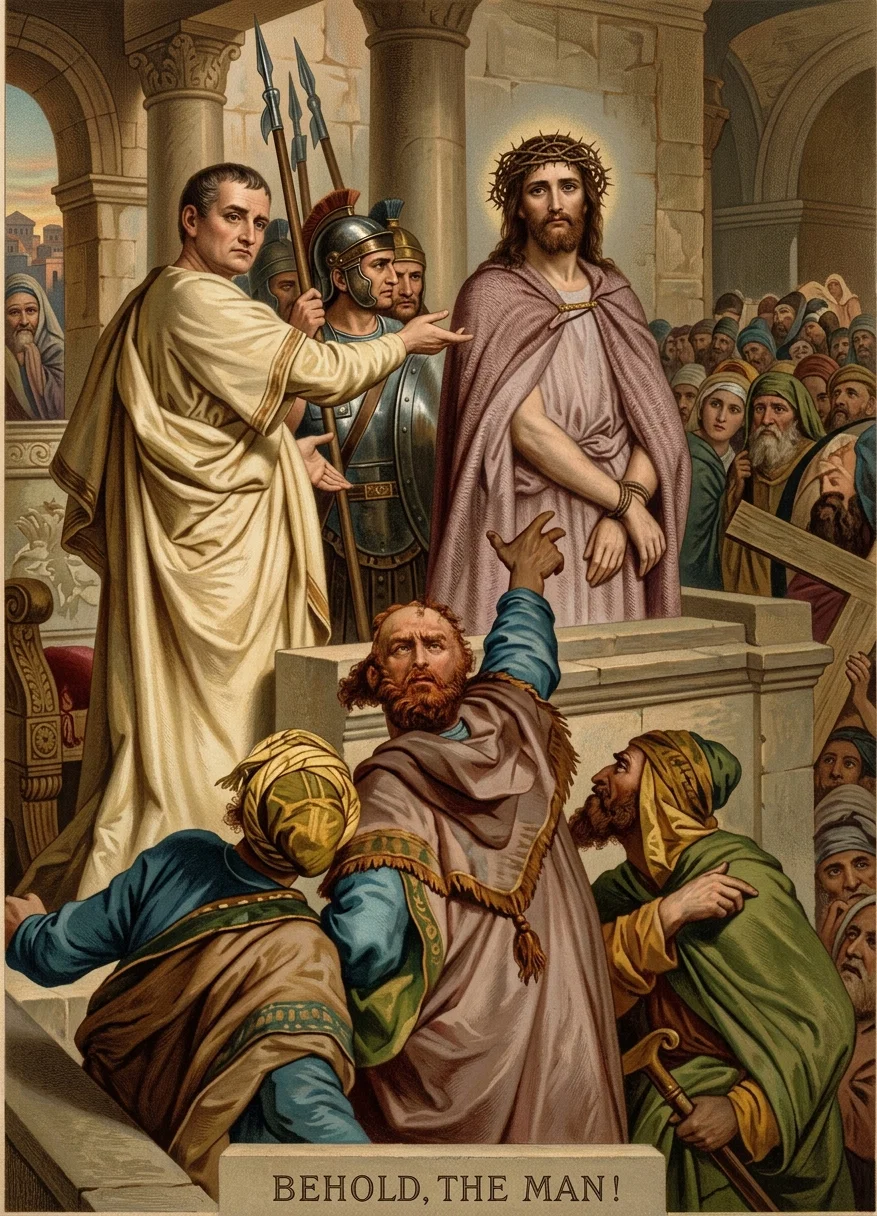
BEHOLD, THE MAN!
BEHOLD, THE MAN!
The purpose and plan of grace existed from all eternity. Before the foundation of the world it was according to the determinate counsel of God that man should be created and endowed with power to do the divine will. The fall of man, with all its consequences, was not hidden from the Omnipotent. Redemption was not an afterthought, a plan formulated after the fall of Adam, but an eternal purpose, suffered to be wrought out for the blessing, not only of this atom of a world, but for the good of all the worlds that God had created.
Before Him who rules in the heavens, the mysteries of the past and future are alike outspread, and God sees, beyond the wo and darkness and ruin that sin has wrought, the outworking of His purpose of love and blessing. Tho clouds and darkness are round about Him, yet "righteousness and judgment are the foundation of His throne."

The Revelation of God

Through creation and redemption, through nature and through Christ, the glories of the divine character are revealed. By the marvelous display of His love in giving "His only-begotten Son, that whosoever believeth in Him should not perish, but have everlasting life," the character of God is revealed to the intelligences of the universe. Through Christ our heavenly Father is made known as the God of love.
When man sinned, all heaven was filled with sorrow; for through yielding to temptation, man became the enemy of God, a partaker of the satanic nature. The image of God in which he had been created was marred and distorted. The character of man was out of harmony with the character of God; for through sin man became carnal, and the carnal heart is enmity against God, for it "is not subject to the law of God, neither indeed can be."
To the angels there seemed to be no way of escape for the transgressor. They ceased their songs of praise, and throughout the heavenly courts there was mourning for the ruin sin had wrought. Out of harmony with the nature of God, unyielding to the claims of His law, naught but destruction was before the human race. Since the divine law is as changeless as the character of God, there could be no hope for man unless some way could be devised wherebyhis transgression might be pardoned, his nature renewed, and his spirit restored to reflect the image of God. Divine love had conceived such a plan.

An Enemy of God and Man

It was through Satan's misrepresentation of God's character that man was led to doubt the reality of His love, and came to look upon God as his enemy. As Satan had done in heaven, so he did on earth,—declared God's government unjust, the restrictions of His law unnecessary, and bade man, as he had angels, to throw aside the yoke and let the dictates of their own nature be their only guide and law. He promised liberty; but as he himself is the servant of corruption, he brought the race into bondage, to sin, misery, and death. He represented God as claiming all and giving nothing, as requiring men's service for His own glory, but denying Himself nothing for man's good.
In the work of creation, Christ was with God. He was one with God, equal with Him, the brightness of His glory, the express image of His person, the representative of the Father to the sinner, to win him back to allegiance to God. But Christ could manifest the Father's love; for God was in Christ, reconciling the world to Himself. Christ could be the "Day's man" between a holy God and lost humanity, one who could "lay His hand upon us both."

None but Christ

could redeem man from the curse of the law. He proposed to take upon Himself the guilt and shame of sin,—sin so offensive in the sight of God that it would necessitate separation from His Father. Christ proposed to reach to the depths of man's degradation and wo, and restore the repenting, believing soul to harmony with God. Christ, the Lamb slain from the foundation of the world, offered Himself as a sacrifice and substitute for the fallen sons of Adam, tho in this offering all heaven was involved in infinite sacrifice. But the Father so loved the world that He gave His only-begotten Son, that through His smitten heart a channel might be found for the outflowing of infinite love for fallen man. Man had become so degraded by sin, his nature so perverted by evil, that it was impossible for him of himself to come into harmony with God, whose nature is purity and love. But Christ redeemed him from the condemnation of the law, and imparted divine power, and through man's coöperation, the sinner could be restored to his lost estate.

"By Grace Are Ye Saved"

The grace of Christ alone could change the heart of stone to a heart of flesh, make it alive unto God, and transform the character, so that a degraded child of sin might become a child of God and heir of heaven. Man had no power to justify the soul, to sanctify the heart. Moral disease could be healed only through the power of the great Physician. The highest gift of heaven, even the only-begotten of the Father, full of grace and truth, was able to redeem the lost.
The only hope for the fallen race was found in becoming reconciled to God. Satan had so misrepresented God that man had no true conception of the divine character. Christ came to the world, and in carrying out the plan of salvation, revealed the fact that "God is love."
(To be continued)

God's Law and Forgiveness

By F. M. Oliver
NOW we know that God heareth not sinners: but, if any man be a worshiper of God, and doeth His will, him He heareth." John 9:31. The young man who stated this grand truth, was just a short while before only a poor, blind beggar. From his birth he had not been able to see the light of day or to view the beauties of nature. But now he could not only see, but could discern enough spiritual truth to bring condemnation to the hearts of the proud Pharisees.
These men had turned away from not only the Lord Jesus, but His law as well; and they would do almost anything to keep the people from believing on Christ. So they said, "Give God the praise: we know that this man is a sinner." Verse 24. They were ready to cast any one out who would confess Jesus as the Christ; and the parents of the young man, fearing excommunication, said: "By what means he now seeth, we know not; . . . ask him: he shall speak for himself." Verse 21. They feared the people, and loved the praise of man more than the praise of God.
The son represents the true follower of Jesus. He faced the frowning Pharisees, and with undaunted courage confessed his Healer. They who had closed their eyes to God's Word, and were as blind spiritually as this man had been physically, reviled him, and cast him out—excommunicated him. But Christ, knowing that he had been cast out, came to him with such comforting words that the young man believed on Him and worshiped Him.
When friends, fathers, and mothers forsake us, then the Lord will take us up. We must be willing "to speak for ourselves," and to choose the right, no matter if all the world should forsake us. Mark 10:29, 30.
The wise teachers of Christ's day would make the people believe that Jesus was a commandment-breaker. John 9:16. They were trying to destroy the work that Christ came to do.
They had turned their backs upon the true God. They had forgotten His law, and were teaching instead, the traditions of men. Mark 7:5-9. The day Christ healed this man, was the Sabbath; and for this act of mercy the Jews said He was a sinner. Yet at the very time, they were planning how they might take His life. They were blind to the demands of God's spiritual law; and when the goodness of God was manifested, they were ready to denounce the good as the works of the wicked one.
O, the awfulness of departing from God to the extent that we will call, as they did, evil good, and good evil. The Lord is ever ready to hear and to lead those who will give heed to His law; but those who close their ears to the law, He knows afar off. "He that turneth away his ear from hearing the law, even his prayer shall be abomination." Prov. 28:9. "If I regard iniquity in my heart, the Lord will not hear me." Ps. 66:18.
Christ had His Father's law written in His heart. Ps. 40:7, 8. He died that the law might be written in the heart of all who believe. Jer. 31:31-33; Heb. 8:8-10. He came to "magnify the law, and make it honorable." Isa. 42:21. He came to take away our sins. Isa. 43:25. And "sin is the transgression of the law." 1 John 3:4.
He swept away the traditions of the Jews, and said, "Full well ye reject the commandments of God, that ye may keep your own tradition." While they claimed that Christ's act of healing on the Sabbath was sin, Christ, who would have them see the broadness of God's law, showed that it was the very best way of observing the Sabbath. As He said on another occasion of the like, "It is lawful [according to law] to do well on the Sabbath days."
There is a lesson for our day. Men will not come to Him, that they may have life. This young man was not only healed of his physical blindness, but his spiritual eyes were opened, and he saw Christ, and worshiped Him. Reader, have your eyes been opened to God's truths? Are you willing to forsake all things that would keep you from the kingdom of God? Would you know your duty? Christ is the Way, the Truth, and the Life, His Word is the Guide-Book, and it will not lead us in the wrong way. "Let us hear the conclusion of the whole matter: Fear God, and keep His commandments: for this is the whole duty of man." Eccl. 12:13.
Pomeroy, Washington.

The Coming of Christ, Literal, Personal, Visible

By H. W. Cottrell
WHEN the human family had bartered away the conditional life given them by the Creator, then the All-Father so manifested His love to man, "that He gave His only-begotten Son, that whosoever believeth in Him should not perish, but have everlasting life." John 3:16. On account of man's absolute helplessness, God tendered to him an endless life in the gift of the divine Son, conditioned on individual belief in and acceptance of Him as the only way to life.
In fulfilment of the prophetic Word, Christ left the glories of the heavenly world, came to earth clothed upon with a fleshly garb, lived an example to man among men, suffered the ignominious death of the cross, that men might see with the natural sense of sight the life given in their behalf, and know, each one for himself, that "we shall be saved by His life." Rom. 5:10.
The gift of Christ's life was a free gift on His part. His interest in man's redemption was equal to that of the Father. The gift was the sacrifice of both the Father and the Son, and the life given was equal to that of the life of either or of both the Father and the Son. "Therefore doth My Father love Me, because I lay down My life, that I might take it again. No man taketh it from Me, but I lay it down of Myself. I have power to lay it down, and I have power to take it again." John 10:17, 18.

A Literal Resurrection

After His resurrection, He was with His disciples in person, just as He had been with them in a material form prior to the cross. From a lack of familiarity with the teachings of the prophets, His followers had imbibed the belief that He would set up a literal kingdom at that time, and bring all unbelievers into subjection to His reign. But such was not Heaven's plan. The Master had been teaching them of His intended departure from them, and of His return to them the second time; but they had so far failed to grasp the thought.
Upon one occasion He said to them: "Let not your heart be troubled: ye believe in God, believe also in Me. In My Father's house are many mansions: if it were not so, I would have told you. I go to prepare a place for you. And if I go and prepare a place for you, I will come again, and receive you unto Myself; that where I am, there ye may be also." John 14:1-3.
Associating with this language of the great Teacher, His utterance in the divine commission, "Go ye therefore, and teach all nations: . . . and, lo, I am with you alway, even unto the end of the world" (Matt. 28:19, 20), the reader will discern that Christ made unquestionable reference to His literal departure and personal return to His people.
In harmony with this utterance, He made His personal departure from them; for we read: "And when He had spoken these things, while they beheld, He was taken up; and a cloud received Him out of their sight. And while they looked steadfastly toward heaven as He went up, behold, two men stood by them in white apparel; which also said, Ye men of Galilee, why stand ye gazing up into heaven? this same Jesus, which is taken up from you into heaven, shall so come in like manner as ye have seen Him go into heaven." Acts 1:9-11.

A Literal, Personal Return

Christ's personal return to heaven was witnessed and testified to by both men and angels. They were eye-witnesses of that signal event that marked that now historic epoch. He returned to heaven to make the necessary preparation for the home-coming of His children. Blessed be the eternal Father and the divine Son, for the assurance vouchsafed to all people of the Master's visible, literal, personal return for His redeemed ones, as evidenced by the unimpeachable testimony of Christ Himself, "I will come again;" and that of the two attending angels, "This same Jesus, which is taken up from you into heaven, shall so come in like manner as ye have seen Him go into heaven."
His spiritual presence in the individual heart at conversion or at the hour of death is not the fulfilment of the afore-quoted texts; for there have been millions of Christians who have died, and a still greater number of sinners converted. All these could not be His second coming. And the manner is not the same.
Said Jesus: "Wherefore if they shall say unto you, Behold, He is in the desert; go not forth; behold, He is in the secret chambers; believe it not. For as the lightning cometh out of the east, and shineth even unto the west; so shall also the coming of the Son of Man be." Matt. 24:26, 27.
His return must be as literal as was His ascension. Enoch, the seventh from Adam, prophesied of Christ's second coming. Paul attaches eternal consequences to His second coming: "Unto them that look for Him shall He appear the second time without sin unto salvation." Heb. 9:28.
"I will come again"—once more; a second time. The first time, He came to tender His own endless—eternal—life to man, in exchange for man's limited life. The second time, He will come "without a sin-offering." He will come as the glorified king to reap the harvest in-gathering.

The Hope of the Ages

The second coming of Christ has been the joy and hope of God's people throughout all the ages. David, Isaiah, Job, and all the apostles, looked forward with longing desire to see King Jesus face to face, Their hopes will yet be realized. Our highest anticipation of that signal event, which will mark the beginning, determine the continuance, of an unmolested reign of the redeemed with their Lord, will then be immortalized.
That His coming will be literal, personal, visible to all men is evidenced again: "Hereafter shall ye [His enemies] see the Son of Man sitting on the right hand of power, and coming in the clouds of heaven." Matt. 26:64.
Jesus designed to give assurance and comfort to those heart-pierced, sorrowing disciples. Surely there was comfort in the words, "I will come again."
How soul-inspiring that associate thought expressed by the attending angels at His ascension, "This same Jesus, which is taken up from you into heaven, shall so come in like manner as ye have seen Him go into heaven." The manner of His ascension unquestionably determines the nature of His second coming to be literal, personal, visible to the human eye—not mystical, non-corporeal, invisible, ethereal, mysterious. The poet expressed divine truth in the words, "We shall see Him face to face."
Christ was and now is "Wonderful, Counselor, The mighty God, The everlasting Father, The Prince of Peace." Isa. 9:6. The cloak of human flesh the Deity took upon Him—the human nature of which He "took part"—was glorified, and at His resurrection immortalized. Thus He ascended to glory, and thus He will return in glory, to glorify His people.
That will be a glorious morning, an eventful day, hopes all realized, and the Christian's joy full, as he beholds his Redeemer eye to eye, "when He shall come in His own glory, and in His Father's, and of the holy angels." Luke 9:26.
Dear reader, are you "looking for that blessed hope, and the glorious appearing of the great God and our Saviour Jesus Christ"? Titus 2:13.

The Last Message

By Edith Smith Casebeer
To work! To work! The hour has come, The trumpet sounds, the strife is on; And from the hearts of faithful ones Goes up the prayer, "Thy will be done!" And from their homes they hasten out, Their wills behind, their wants forgot, Eager to tell those who know not That Christ the Lord is coming.
God's work, God's work, the angels join, And filled with love to earth, come down To witness who 'll accept the Son. As here and there, from out earth's throngs, Go up from hearts glad, holy songs, They ask a pardon from all wrongs, For Christ the Lord is coming.
No work, no work—the work is done; The time to work for souls is gone. And some are sealed for Heaven's crown, But some in darkness have gone down. Then loud and long we hear the cry Of saved ones pointing toward the sky, "Lo, our redemption draweth nigh, For Christ the Lord is coming."

Waiting for the Lord’s Salvation

"And it shall be said in that day, Lo, this is our God; we have waited for Him, and He will save us: this is the Lord; we have waited for Him, we will be glad and rejoice in His salvation." Isa. 25:9.

The Answer of the Text

[The answers to the questions are from the American Revised Version. Omitting questions, and disregarding sometimes the capital at the beginning and the period at the close of an answer, the text may be read continuously. In notes and comments both versions are used without designation.]
1. With what statement does this vision open? And a great sign was seen in heaven.
2. What was this sign? A woman.
3. What was her appearance?
Arrayed with the sun, and the moon under her feet, and upon her head a crown of twelve stars.
4. What was her condition? And she was with child; and she crieth out, travailing in birth, and in pain to be delivered.
Continue reading: The Gospel Revealed