Your ShelfYour Projects

Signs of the Times, Vol. 32, No. 7.

FUNDAMENTAL PRINCIPLES. No. 1.
Earlier text: THE VALLEY OF ACHOR

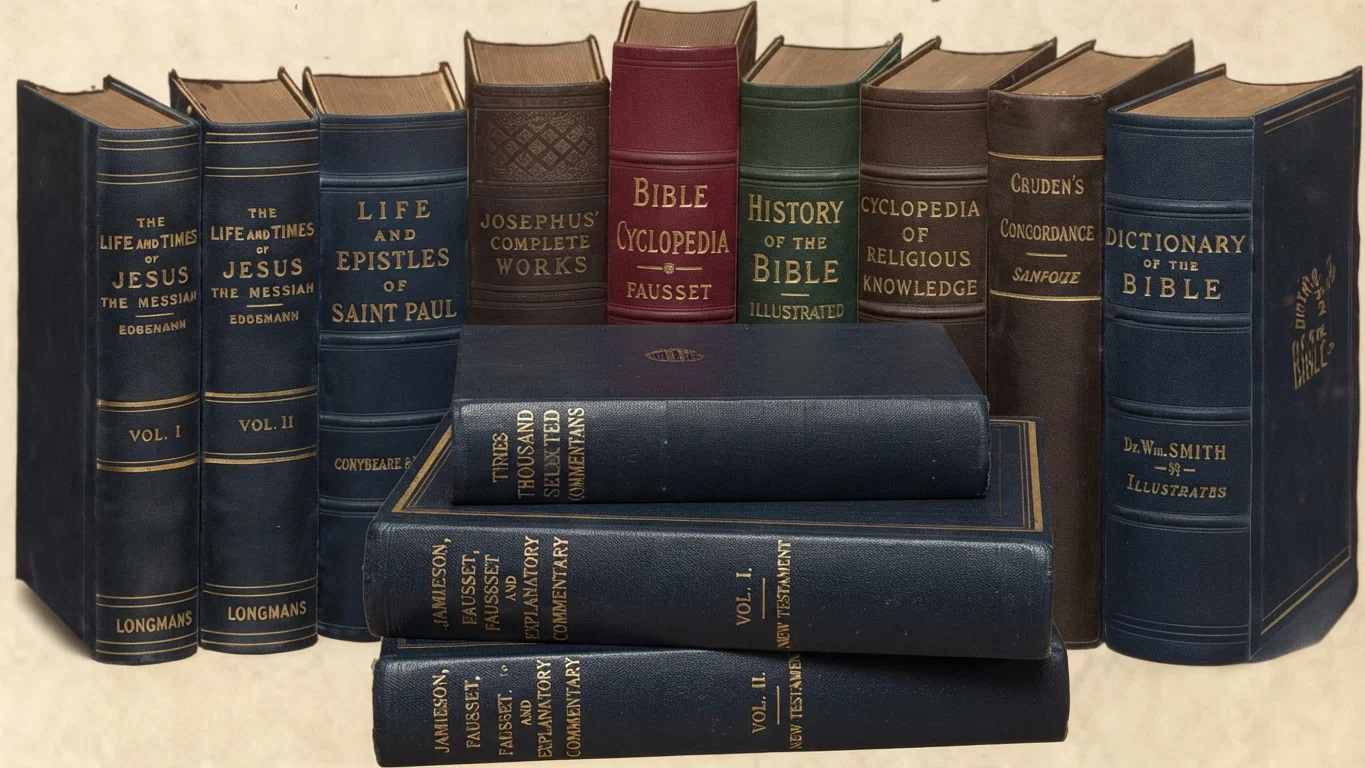
A GREAT BARGAIN IN BOOKS

A STANDARD BIBLE REFERENCE LIBRARY OF TWELVE LARGE HANDSOME VOLUMES CONTAINING 9,834 PAGES

AT ONE-QUARTER ORIGINAL PRICE

EVERY BOOK NEWLY MADE SATISFACTION GUARANTEED ORIGINAL PRICE, $44.50; NOW ONLY $11.00; SAVING $33.50
Every Volume Strongly and Handsomely Bound in Cloth. Average Size of Volumes 9 5/8 x 6 7/8 x 1 3/4 inches.

Jamieson, Fausset, and Brown's Bible Commentary (2 Vols.)

A complete commentary—critical, explanatory, and practical—on the Old and New Testaments. Consists of notes that are concise, learned, and easily understood, that elucidate the difficult passages of Scripture. 1,380 pages. Former price, $9.00.

Edersheim's Life and Times of Jesus the Messiah (2 Vols.)

Gives a full account of the society, life, and development—intellectual and religious—in Palestine, to serve as a frame and background for the picture of Christ. A life of the Saviour which is critical as well as Biblical. 1,524 pages. Former price, $6.00. This is the authorized American edition.

Fausset's Critical and Expository Bible Cyclopedia

This great work is the result of seven years of labor by the author; contains 3,700 articles, and makes a complete and perfect Bible Cyclopedia. 750 three-column pages, 600 illustrations. Regular price, $5.00.

Sanford's Concise Cyclopedia of Religious Knowledge

A storehouse of information regarding Church History, Bible History, Names, Places, Customs, Doctrines, Creeds, Denominations, The Early Church, The Story of the Reformation, the various Young People's Societies, Theologians, Scholars, Cathedrals, Churches, etc. 985 pages, beautifully illustrated. Former price, $3.50.

Conybeare & Howson's Life and Epistles of St. Paul

There is no work that will compare with this in giving a lifelike picture of the great apostle and the work which he did. 1,014 large pages, many fine illustrations, maps, charts, etc. Formerly sold for $4.50.

The Complete Works of Flavius Josephus

In this great work is contained the History and Antiquities of the Jews, Destruction of Jerusalem by the Romans, Illustrations concerning Jesus Christ, John the Baptist, James the Just, and the sacrifices of Isaac. Nearly 1,000 pages. Former price, $4.00.

Cruden's Complete Concordance

Scripture is the best interpreter of Scripture, and, next to the Bible, no volume is of greater value to the Bible student than Cruden's Concordance. 756 pages. Former price, $1.50.

Smith's Dictionary of the Bible

An indispensable aid to Ministers, Teachers, Families, Sunday-school Superintendents, and Bible readers generally. 1,024 pages, finely illustrated. Former price, $4.50.

Kitto's Illustrated History of the Bible

No modern writer has done more to clothe with a fresh and living interest the main personages and incidents in Bible history than JOHN KITTO in this magnificent work. Over 100,000 copies have been sold. 735 double-column pages, 220 illustrations. Former price, $4.50.

Three Thousand Selected Quotations

By JOSIAH GILBERT. Introduction by CHAS. S. ROBINSON, D.D. Burning words of brilliant writers from the literature of all ages, with complete index of authors and subjects. 681 pages. Former price, $2.00.

CASH PRICES

Complete Set, 12 Volumes - $11.00 Choice of 10 " 10.00 Choice of 8 " 8.25 Choice of 6 " 6.75 Choice of 4 " 5.00 Choice of 2 " 3.00

MONTHLY PAYMENT PRICES

Complete Set, 12 Volumes - $13.00 Choice of 10 " 12.00 Choice of 8 " 10.00 Choice of 6 " 8.00 Choice of 4 " 6.00 Choice of 2 " 4.00
On the Monthly Payment Plan we require an advance of $2.00 with order and promise to pay $1.00 monthly until payment is completed. Books forwarded at once on receipt of cash price or first installment of $2.00. Customers pay freight or express charges. Customers at remote points or in foreign countries desiring us to prepay will need to send 30c. per volume to cover cost of postage or express. Safe delivery guaranteed to any station in the country or to any mail point in the world. We will take back books that are not satisfactory in ten days after examination and return money, deducting only the return transportation charges.
As to our reliability, we refer to the SIGNS OF THE TIMES, or to any commercial agency. Established 1866.
Mention the SIGNS OF THE TIMES when ordering. THE S.S. SCRANTON CO., PUBLISHERS HARTFORD, CONN.

WHAT DOES IT MATTER?

It matters little where I was born, Or if my parents were rich or poor, Whether they shrank at the cold world's scorn, Or walked in pride of wealth secure, But whether I live an honest man, And hold my integrity firm in my clutch, I tell you, my boy, plain as I am, It matters much.
It matters little how long I stay In a world of sorrow, sin, and care, Whether in youth I am called away, Or live till my bones and head are bare.
But whether I do the best I can To soften the weight of adversity's touch On the faded cheek of my fellow-man, It matters much.
It matters not where be my grave, Or on the land or on the sea, By purling brook or 'neath stormy wave, It matters little or naught to me.
But whether the angel of God comes down And marks my brow with His loving touch, As one that shall wear the victor's crown, It matters much. —From the Swedish.

STRENGTH

TALKS TO YOUNG MEN. No. 1.

STRENGTH.

Physical Strength.

SAYS the Sacred Word. "The glory of young men is their strength." How true this is! Where is there to be found a live, well young man who does not rejoice in his strength; he likes to be called strong. He swings his dumb-bells or Indian clubs, practises on the horizontal bar, and delights in games which try the physical man. The Lord likes strong men or He would never have left on record the interesting ones of His Word, such as Samson, Asahel, Jashobeam, and all the mighty men of David. As a growing youth no part of scripture delights a young boy more than the story of Samson. William Wallace, the "hero king of Scotland," who was twice as strong as Bruce, Bruce as strong as any other two Scots, draws his unbounded admiration.
He admires the great warriors and fighters, who against great odds have won decisive victories by their own strength. The story of Washington's strength holds him; and he cares more to hear about tales of Lincoln's mighty thews than he does of the Emancipation Proclamation.
All this as to physical strength. It is good to be well, and symmetrical, and strong. Therefore rejoice, O young man, in thy strength. It is a splendid possession if rightly used.
Then work for it. Six things are necessary: Good food, fresh, sweet air, sufficient exercise, plenty of sunshine, a clear conscience, and a sunny disposition. Perhaps there is another lurking somewhere which will round out the perfect seven, but it does not come to mind at this writing. Perhaps some of our young men can suggest another.

Good Food.

By food is meant that which goes into the mouth to nourish the body. Air is food and sunshine is food, but by food here is meant what we eat and drink. And the best food is not the specially-prepared, patent affairs on the market, nor the highly-seasoned dishes, which taste so good to a perverted appetite, and are borne so ill by a perverted stomach. Good, nourishing, old-fashioned food, potatoes and gravy, the legumes, good graham or whole-wheat bread and butter, fruits and nuts, as God gives them, thoroughly masticated. Keep the teeth strong and elastic by good food and exercise. Eat zwieback, crusty bread, and masticate, masticate. Abjure hot yeast bread; it may taste good; but it is an enemy. Don't mix foods in your stomach too much, nor eat too great a variety at a meal. Keep to the simple diet; if you do not, you will live to wish you had when you are old. Thus one high-liver soliloquizes (I quote from memory):
"The stomach crammed from every dish, Of roast and stew, of flesh and fish, Where wind and phlegm and acid jar And the whole man is one intestine war, Longs oft the schoolboy's simple fare, The temperate sleep and spirits light as air."
Keep to the schoolboy's simple fare. Eat sparingly, if at all, of rich pies, pastry, or cakes. Stop eating when you are through. Be pleasant.
Drink; man must drink. The greater part of his body is made up of water. He should supply its need. Drink is needed for food; it is needed to wash out the system.
What shall it be? Coffee? Whisky? Beer? Wine? Substitutes for any or all of these? Nay, verily; for all these clog and stupefy and paralyze the life-channels and life-organs. They irritate and narcotize the nerves. They are only poisoned water, dressed up to suit perverted tastes. O, no, lads, drink water, pure, sweet, life-giving water; water which never brought the blush of shame to the cheek of man; which never bleared an eye, or reddened a nose, nor bloated a face, nor caused the feet to stumble and stagger and fall; which never muddled a brain nor turned a man to a demon; which never blasted hopes nor blighted brightest prospects; which never made millions lazar-houses of diseases; which never cursed the world with crime and madness and widows', and worse than widows', moans, and worse than orphans' cries. Drink, drink a goodly quantity, but drink clear, pure, sweet, life-giving, sparkling water.
But I have talked long enough, boys, for this time. I wanted to talk about fresh air and exercise, and the other things, but I will leave those till next time. I would like to hear from the young men who read this. ABDIEL.

CHARACTER VERSUS REPUTATION.

"WHAT is he worth?" is a question that is often asked in this age of the world when the large majority are clamoring for wealth and position.
And "What are you worth?" is a question which should receive the earnest attention of every individual, and especially of the young—not in money or property, not in position or prominence, but in character. Our character is what we really are—that which determines our true worth.
Reputation is not character, as many people seem to think. It is only what people think of us, not what we really are—man's opinion of us, not God's; for "man looketh on the outward appearance, but God looketh on the heart."
Men may speak evil of us, they may prejudice others against us, but they can not injure our character. If we are not guilty, "the good can well afford to wait" God's own good time.
Our Saviour when upon this earth was "despised and rejected of men," evil-spoken-of, backbitten, persecuted, forsaken by His own disciples, tried, condemned, and crucified with two thieves, and still His character stands out in all its spotless purity—"the One altogether lovely," "the Chiefest among ten thousand."
And so with His followers. We who are commissioned to bear the last message of mercy to a fallen world, must not look for, or seek, the favor of men. We must form a character strong and true like our perfect Pattern. We can be men and women of integrity and uprightness, so that our associates will be bound to respect us because we are true to the principles we hold to be right.
Let us put into our character-building, not wood, hay, and stubble, but gold, silver, and precious stones, and build so carefully that our structure may be perfect and entire, wanting nothing.
Does it not behoove us, as young people and especially in view of the trying times about us and before us—to tear down the weaker materials, build up the old waste places, and study the Word of His grace, which is able to build us up and give us an eternal inheritance among all them which are sanctified? KATHRINA BLOSSOM WILCOX.

SUCCESSES OF YOUNG MEN.

IT is said that the biographies of great men constitute the history of the world. So it is; and we might modify the statement by saying that the biographies of the young men of to-day constitute the history of the present. Never in all the past have young men accomplished more, never have they stood higher. Young men stand at the head of governments, states, and corporations; young men lead in science, politics, and religion; young men fill the chairs in the colleges, the pulpits of the churches, and the offices of the state.
Not that young men in the past have not stood high and accomplished great things; but in the past there were not so many thus exalted. Yet ancient lore abounds with accounts of the triumphs of youth; and of these none are more thrilling than those of the Bible itself. Who has not admired the youthful reform-kings of God's people anciently? Their histories read like stories.
Asa came to the throne when he was probably about twenty years old. With the exception of the prophets Azariah and Hanani and the faithful Levites, his surroundings were bad. With a bad father, a bad grandfather, and a bad grandmother, and the heathen influences on every side, what could be expected from so young a ruler? From a human standpoint, no more than his fathers had done. What is the secret? "Asa did that which was good." He trusted in God, and his first work of reform was to restore the worship of the true God among his people. The land was full of strange gods, the gods of the heathen about them; and these Asa removed and destroyed. The images were broken down, the groves where the heathen worship was conducted were cut down. Because of her wickedness, the queen-mother was removed. Her position was one of dignity and influence, yet the king, fearless in the knowledge of right-doing, set her aside. "And he commanded Judah." Not only did he serve God, but he determined that his people should serve Him, and every influence that would tend to lead them from right was removed.
For ten years the kingdom had rest. Through that time Asa was faithful. That was his testing time, that time of peace and rest. When great reforms are needed, when the foe presses about them, in adverse circumstances, then men will stand firm and work zealously; but let peace and quiet come, and what strength it takes to stand true to principle. Asa had stood the test in time of peace, and when the invading army of Zerah the Ethiopian came against him, he cried unto the Lord, for, said he, "There is none beside Thee to help." "So the Lord smote the Ethiopians before Asa." Naturally enough, his prayer of faith was assurance of victory.Forty-one years Asa reigned, and tho the latter part of that time was marred by his lack of trust in God, yet the reforms he effected were far-reaching.
Hezekiah was still a young man when he came to the throne,—only twenty-five years old. He was also the son of a bad father, yet he brought about many much-needed reforms. His first work, as was the first work of Asa, was to open the temple and re-establish the worship of the true God, a work that took no little ability and determination, for tho the people were no doubt dissatisfied with the condition of things under the reigns of his father and grandfather, the evil beliefs and practices were strong upon them. However, he went to work, and when the temple was cleared of all the accumulated rubbish of years, he sent letters by messengers from city to city throughout the northern kingdom inviting the people everywhere to forsake their idols and return to the true God, and to come to a great religious festival at Jerusalem. Some came, and others mocked and laughed them to scorn. Nevertheless, a great Passover feast was held, lasting for fourteen days, during which time many sacrifices were offered, with great gladness. It was indeed the greatest revival Israel had known, "since the time of Solomon there was not the like in Jerusalem." Under the king's direction, the people went through the city, breaking down their idols, cutting down their groves, destroying their "high places," and their altars.
Another of the kings of Israel demands our attention, that is Josiah. The record of his reign is that he did that which was right. Placed upon the throne at the tender age of eight, succeeding a wicked father, to govern a wicked and idolatrous people, his position was a trying one. One sentence of his story tells the secret of his success, "While he was yet young, he began to seek after the God of David his father." At the age of sixteen he turned to God. While yet the best part of his life lay before him, he took up the work of the Lord, purging Jerusalem of her idols, going so far as to burn the bones of the priests on their own altars. Not alone in Jerusalem, but from one end of the kingdom to the other the work of reform was carried on. Then, in the eighteenth year of his reign, he repaired the temple, a work which resulted in the finding of the roll of the law so long lost in the rubbish of the temple. Israel as a nation had sinned away her day of grace, but the king who looked to the God of his fathers "while he was yet young" was not visited with the punishments that came on the nation for her evil deeds, tho he died in battle, bravely defending his own land.
These men, these young men, knew what it meant to stand for principle when all about were those who discouraged and hindered them. The simple accounts do not impress us, but the actual results attained would compare with a complete change in the form of the government of a modern nation perhaps, a change highly improbable, if not impossible. Two of them are classed with the three "perfect kings of Israel," David, Hezekiah, and Josiah. What they did was accomplished through devotion to duty and obedience to God, conditions that can be met by any young man of the present day. With his eyes fixed on the Saviour, his heart set to do the will of the Lord, his hands ready and strong to lift and pull, and push if need be, any young man with the much-lauded, and much-to-be-lauded, ambition for success will succeed. MAX HILL.

THE DEADLY CIGARET.

THE statistics in regard to heart disease among boys, caused by the use of the cigaret, are simply appalling. One hundred and fifty boys were recently examined in Chicago as to their physical qualifications for positions on the various high school athletic teams, and nineteen of them were rejected because of the tobacco heart. In a preliminary examination for West Point, Pittsfield, Mass., one-fourth of the candidates were rejected for the same cause. The army and navy records present a fearful list of heart failures from the same evil habit. It is also a fruitful source of insanity, as many medical men testify. Every teacher of boys can adduce instances of young lads ruined mentally, morally, and physically by the terrible habit grown into a vice.
The cigaret fiend is the boy who has become a complete slave to his appetite. Once fairly in its grasp, he is stunted in development, lost to ambition, sunk to all appeals to honor; he will lie, steal, do anything to satisfy his insatiable cravings. Ninety-two per cent. of the boys in the Pontiac Reform School and in the John Worthy School are cigaret-smokers, and of these the majority are "fiends." The records of the reform schools for the girls show similar facts. —Selected.

EXCURSIONS

Low Rates to California

On sale every day, from February 15 to April 7, from all eastern points. Following are a few:
Chicago, $33.00 Bloomington, $32.00 Peoria, $31.00 St. Louis, $30.00 Cairo, Memphis, and New Orleans, $31.65 Kansas City and Leavenworth, $25.00 St. Joseph, Atchison, Council Bluffs, $25.00 Omaha, Dallas, Fort Worth, Houston, $25.00 Nearly all points in Kansas, $25.00 Oklahoma and Indian Territory, $25.00 Denver, Colorado Springs, Pueblo, $20.00 New York, $50.00
Santa Fe Agents will take deposits of money to cover price of tickets, which will be promptly furnished to passengers at any point.

TICKET OFFICES

653 Market St., San Francisco 1112 Broadway, Oakland Also any Santa Fe Agent.

GET A TRANSFER.

If you are on the gloomy line Get a transfer. If you're inclined to fret and pine Get a transfer. Get off the track of doubt and gloom; Get on the sunshine train, there's room— Get a transfer.
If you are on the worry train Get a transfer. You must not stay there and complain, Get a transfer. The cheerful cars are passing through, And there is lots of room for you— Get a transfer.
If you are on the grouchy track Get a transfer. Just take the happy special back— Get a transfer. Jump on the train and pull the rope That lands you at the station Hope— Get a transfer.
—Anon.

QUESTIONS FOR IDLE MOMENTS.

"To understand a proverb, and a figure, the words of the wise, and their riddles." Prov. 1:6, A. R. V., margin.
[From month to month we shall present before our young readers various questions, enigmas, etc., on Biblical and historical subjects. The answers of any one month will be given the next month. We invite answers from our young readers.]

Bible Enigma.

I am composed of 25 letters. My 8, 7, 10, 14 is the name of a noted patriarch. " 18, 19, 15, 9 is the father of all humans. " 4, 5, 22, 23 is a son of the first man. " 2, 3, 17, 19, 24, 25, 8, 12, 6, 4 is what Israel passed through. " 6, 3, 17, 7, 21, 9 is a noted Bible pool. " 25, 23, 7, 19, 12, 4 is an island in the Mediterranean mentioned by Luke. " 8, 7 is the Bible name of a city of Egypt. " 11, 1, 19, 12, 6, 23 is a place on the border of the Promised Land. " 16, 15, 19 is a tribe in Israel. " 20, 3, 4, 14, 16, 21, 22, 12 is a gate in Jerusalem, spoken of by Nehemiah. My whole is a proverb which every boy ought to remember.

Bible Questions.

(Give Bible references.)
  1. How did the Bible come to us?
  2. Who was it that said when a son was born, "I have gotten a man from the Lord"?
  3. Who is the first worker in brass and iron mentioned?
  4. Where do we find the first Bible poem?
  5. Who said, "My punishment is greater than I can bear"?
  6. Who said, "We have found Him of whom Moses in the law and the prophets did write"?
  7. How old was the oldest man of whom we have record?
  8. Who is said to have died before his father?
  9. In whose days was the earth divided, and how did his father commemorate the event?
  10. What is the most remarkable case of friendship mentioned in the Bible?

Word Square.

Reading from top to bottom and left to right the same.
The first is the name of a patriarch. The second is the name of a wicked king of Israel. The third is the name of a Canaanite king. The fourth is what Adam and Eve strove to do.

SUNSET MAGAZINE

DESCRIBES

California

Not only California, but all the great West, is truthfully described in the beautifully illustrated pages of this virile Western monthly. Its fine half-tones make you SEE the country, while its descriptive and industrial articles TELL YOU EXACTLY what is to be found there. It is

"Opportunity"

in visible form, for it shows the wonderful chances for success now open in the new West for wide-awake people.
If your news dealer doesn't carry SUNSET, send us his name and address and write for sample copy.
HOME OFFICE: 431 California St. San Francisco, California.

A Living Witness.—In the Fourth Century of the Christian era the rapidly-apostatizing church, which yet possessed a little strength, observed both Sabbath and Sunday, the former as a fast to some extent, the latter as a festival day. During this period missionaries were sent to Abyssinia, and the Abyssinians were converted—nominally and otherwise—to the Christian religion as it was brought them, even to the observance of the two days. Ever since that time, corrupted tho their religion is, they have observed these days as they received them. They are living witnesses to the perpetuity and truth of God's Sabbath, and that it was observed by the early church. Centuries after their conversion the Roman Church endeavored to crush out Sabbath-keeping, but failed. Will it be accomplished in these latter days by crushing the nation?

Disasters and California Petroleum

Awful disasters on land and sea have been recorded during the last few weeks, the greatest among which is the loss of the steamer Valencia in British waters between Vancouver Island and the mainland; the loss of life reaches about one hundred forty. For many hours many clung to the ship fast on the rocks with the waves breaking over her, hoping to be rescued, but the sea was so rough rescue seemed impossible. A despatch from Panama, February 2, reports that the city of Buena Ventura, in Colombia, was destroyed January 31, by a tidal wave.
"For California" for December, published by the California Promotion Committee, gives especial attention to the oil industry in California. It discusses the early and later history of petroleum, the uses of petroleum and products for production of power, petroleum as fuel on locomotives and steamships, manufacturing uses of asphaltum, and California's production of petroleum. The number is of great interest, especially in showing one of the products of the great Golden State.

Memory Verses from the Bible

"Memory Verses from the Bible."—We received some time ago, and regret that we have not noted it before, a little pamphlet of thirty-two pages from the Rev. R. H. Smith, Walkertown, Virginia, entitled "Memory Verses from the Bible." The price is two cents, but if the price includes postage it ought to be three. The design of the little booklet is to induce Sunday-schools to learn the Word of the Lord, and then review from time to time. The same thing can be used by any one in private. The pamphlet is divided up into weeks and also into subjects. For instance, the first subject is "The Word of God;" the second is "God," revealing Him as the everlasting Creator, and the blessed, unchanging character He has; the third is "Sin;" following that "Salvation," "Precepts and Promises," "Prayer," etc., closing with the Ten Commandments. Of course one really ought to know many more Scripture verses than are contained in this little pamphlet, but to one who has not been garnering precious gems from the Bible, this will prove a good start, a little pocket of pearls, which one may begin to commit and treasure, and place in the various settings of every-day experience.

In the Richest, Most-Christian City.

Late despatches and articles from London tell us of the fearful condition of things in that great city. It is stated that nearly one-sixth of the population of that greatest, wealthiest city of the world are constantly under the reign of hunger and want; and that daily great processions are marching through the city clamoring for relief. In these processions are mothers with babes in their arms. Banners are carried bearing various devices and some of them threatening; but with the patience of the Anglo-Saxon race there has been no violence, no harm has been done. But if present conditions continue much longer, there is no knowing what a mad, hungry mob may do; and much of the wealth which might have been expended for bringing relief to these poor people will be utterly destroyed in fire and pillage.
What a grand opportunity it would be for some of the great beer millionaires, for instance, to take the money which they have gotten from the needs of the poor, and expend it for food and clothing for the needy ones. What blessings would come to the large landlords if they would take their acres of private parks—chloroform their kennels of dogs if need be—and use the land for the relief of the poor. And how much greater pleasure would come if the immense sums that are paid for royal pomp and show were used to build roads or other public works of utility, so as to give the unemployed something to do.
Truly this is a sad old world when men and women starve under the shadow of palatial mansions, the owners of which have more than they can possibly use, or that human heart ought to wish. But these increasing extremes are only telling in emphatic language what God has told in His Word, that the time is soon coming when He who regards the poor will take to Himself His great power and reign.

Our Bible Enigma.

In working out our Bible enigma, write on a slip of paper numbers up to twenty-five, as 1, 2, 3, etc. Then fit the various parts to this. When all the letters are found in the order there given, the proverb will be complete. There will be some of which you are sure. Set those down first, then search for the others.

Bequests

Bequests.—There was given in the year 1905 by gifts and bequests to educational institutions, religious enterprise, charity, libraries, museums, art galleries, and municipal betterments in the United States the huge sum of $104,586,422. This is the largest for several years, but not so large as in 1901 by more than eight million dollars. Very much of this has been given by men who have made immense fortunes in exploiting the people and the country.

Federation of Churches in the States

The "Spokesman Review" of Spokane, Washington, informs us that following the lead of the Inter-Church Conference in New York effort is being made to bring about a permanent federation of churches in Montana, and Wisconsin and others are falling into line.

New Songs Received

Two beautiful songs have recently been received at this office from Mr. Chas. P. Whitford, of Fort Ogden, Florida. The titles are "Footsteps That Never Come," and "Homeward;" and they will be mailed by Brother Whitford to any address for 25c for the two. We are sure that our musical friends will be pleased with these songs.

Central Union Conference

The Central Union Conference convened January 18, in Kansas City, Mo. as per appointment, with nearly all the delegates present. The meeting has a very strong missionary tone. It has never been my privilege to attend a meeting where there seemed to be a better spirit and harmony, or a stronger determination on the part of the workers to see our work advance strongly in all lines. I will have more to say about the meeting after it is over.
T.

Coming Temperance Issue

Two weeks from this issue our Home department will be specially given to Temperance. We are sure it will be helpful.

Federation Articles Concluding

Next week closes the special articles on the Federation of Churches. There will be much more said however; for there is much more that ought to be said. Read the first article in our Outlook department in this issue. That ought to be an eye-opener.

A Home Department for Young Readers

Our Home department is given this week wholly to our young readers, and to our old-young readers. There is also a puzzle department along good lines, we believe. We hope to make this monthly department both pleasant and profitable. There are families where the SIGNS is the only paper in the home. It is to interest the young that we give one issue in a month to them. That we may better help our young readers, we shall be glad to hear from them.

You have reached the end of this edition.

Signs of the Times · Feb 14, 1906