Your ShelfYour Projects

Signs of the Times, Vol. 32, No. 7.

FUNDAMENTAL PRINCIPLES. No. 1.
Earlier text: Question Corner

THE VALLEY OF ACHOR.

[By Rev. Alexander Maclaren, D.D., in The Examiner.]
"I will give her . . . the Valley of Achor for a door of hope." Hosea 2:15.
THE prophet Hosea is remarkable for the frequent use which he makes of events in the former history of his people. Their past seems to him a mirror in which they may read their future. He believes that "which is to be hath already been," the great principles of the divine government living on through all the ages, and issuing in similar acts when the circumstances are similar. So he foretells that there will yet be once more a captivity and a bondage, that the old story of the wilderness will be repeated once more. In that wilderness God will speak to the heart of Israel. Its barrenness shall be changed into the fruitfulness of vineyards, where the purpling clusters hang ripe for the thirsty travelers. And not only will the sorrows that He sends thus become sources of refreshment, but the gloomy gorge through which they journey—the Valley of Achor—will be a door of hope.
One word is enough to explain the allusion. You remember that after the capture of Jericho by Joshua, the people were baffled in their first attempt to press through the narrow defile that led from the plain of Jordan to the highlands of Canaan. Their defeat was caused by the covetousness of Achan, who, for the sake of some miserable spoil which he found in a tent, broke God's laws, and drew down shame on Israel's ranks. When the swift, terrible punishment on him had purged the camp, victory again followed their assault, and Achan lying stiff and stark below his cairn, they pressed on up the glen to their task of conquest. The rugged valley where that defeat and that sharp act of justice took place, was named in memory thereof, the Valley of Achor, that is, trouble; and our prophet's promise is that as then, so for all future ages, the complicity of God's people with an evil world will work weakness and defeat, but that, if they will be taught by their trouble, and will purge themselves of the accursed thing, then the disasters will make a way for hope to come to them again.
But the promise, like all God's promises, has its well-defined conditions. Achan has to be killed and put safe out of the way first, or no shining hope will stand out against the black walls of the defile. The tastes which knit us to the perishable world, the yearnings for Babylonish garments and wedges of gold, must be coerced and subdued. Swift, sharp, unrelenting justice must be done on the lust of the flesh, and the lust of the eye, and the pride of life, if our trials are ever to become doors of hope. There is no natural tendency in the mere fact of sorrow and pain to make God's love more discernible, or to make our hope any firmer. All depends on how we use the trial, or as I say—first stone Achan, and then hope!
So, the trouble which detaches us from earth gives us new hope. Sometimes the effect of our sorrows, and annoyances, and difficulties, is to rivet us more firmly to earth. The eye has a curious power, which they call persistence of vision, of retaining the impression made upon it, and therefore of seeming to see the object for a definite time after it has really been withdrawn. If you whirl a bit of blazing stick around, you will see a circle of fire tho there is only a point moving rapidly in the circle. The eye has its memory like the soul. And the soul has its power of persistence like the eye, and that power is sometimes kindled into activity by the fact of loss. We often see our departed joys, and gaze upon them all the more eagerly for their departure. The loss of dear ones should stamp their image on our hearts, and set it as in a golden glory. But it sometimes does more than that; it sometimes makes us put the present with its duties impatiently away from us. Vain regret, absorbed brooding over what is gone, a sorrow kept gaping long after it should have been healed, like a grave mound of which desperate love has pulled turf and flowers in the vain attempt to clasp the cold hand below—in a word, the trouble that does not withdraw us from the present will never be a door of hope, but rather a grim gate for despair to come in at.

New Hope.

The trouble which knits us to God gives us new hope. That bright form which comes down the narrow valley is His messenger and herald—sent before His face. All the light of hope is the reflection on our hearts of the light of God. Her silver beams, which shed quietness over the darkness of earth, come only from that great Sun. If our hope is to grow out of our sorrow, it must be because our sorrow drives us to God. It is only when we by faith stand in His grace, and live in the conscious fellowship of peace with Him, that we rejoice in hope. If we would see hope drawing near to us, we must fix our eyes, not on Jericho that lies behind among its palm-trees, tho it has memories of conquests, and attractions of fertility and repose, nor on the corpse that lies below that pile of stones, nor on the narrow way and the strong enemy in front there; but higher up, on the blue sky that spreads peacefully above the highest summits of the pass, and from the heaven we shall see the angel coming to us. Sorrow forsakes its own nature, and leads in its own opposite, when sorrow helps us to see God. It clears away the thick trees, and lets the sunlight into the forest shades, and then in time, corn will grow. Hope is but the brightness that goes before God's face, and if we would see it we must look at Him.
The trouble which we bear rightly with God's help, gives new hope. If we have made our sorrow an occasion for learning, by living experience, somewhat more of His exquisitely-varied and ever-ready power to aid and bless, then it will teach us firmer confidence in these inexhaustible resources which we have thus once more proved. "Tribulation worketh patience, and patience experience, and experience hope." That is the order. You can not put patience and experience into a parenthesis, and, omitting them, bring hope out of tribulation. But if in my sorrow I have been able to keep quiet because I have had hold of God's hand, and if in that unstruggling submission I have found that from His hand I have been upheld, and had strength above mine own infused into me, then my memory will give the threads with which Hope weaves her bright web. I build upon two things—God's unchangeableness, and His help already received; and upon these strong foundations I may wisely and safely rear a palace of hope, which shall never prove a castle in the air. The past, when it is God's past, is the surest pledge for the future. Because He has been with us in six troubles, therefore we may be sure that in seven He will not forsake us.
Then, dear friends, let us set ourselves with our loins girt to the road. Never mind how hard it may be to climb. The slope of the valley of trouble is ever upwards. Never mind how dark the shadow of death which stretches athwart it is. If there were no sun there would be no shadow; presently the sun will be right overhead, and there will be no shadow then. Never mind how black it may look ahead, or how frowning the rocks. From between their narrowest gorge you may see, if you will, the Guide whom God has sent you, and that Angel of Hope will light up all the darkness, and will only fade away when she is lost in the sevenfold brightness of that upper land, whereof our "God Himself is Sun and Moon"—the true Canaan, to whose everlasting mountains the steep way of life has climbed at last through valleys of trouble, and of weeping, and of the shadow of death.

"MAKE STRAIGHT PATHS."

FREQUENT mention is made in the Scriptures of the straight way as compared with the crooked. "Make straight paths for your feet." Heb. 12:13. "The way of peace they know not; . . . they have made them crooked paths." Isa. 59:8.
From these and similar expressions we may understand that the straight path indicates the way of righteousness, while the crooked way symbolizes a life of deception or sin in its varied forms.
The cherubim of Ezekiel's vision "went every one straight forward; whither the Spirit was to go, they went; and they turned not when they went." Eze. 1:12.
It is not in self-interest that we are to tread the narrow way. Our relations with others are such that we are unconsciously influenced one by another; as we walk, so will certain others walk. How forcible then are the words of Inspiration, "Make straight paths for your feet, lest that which is lame be turned out of the way; but let it rather be healed." Heb. 12:13. Even in the common matter of eating and drinking, our example may lead another into error. Are we ready to say with Paul, "If meat make my brother to offend, I will eat no flesh while the world standeth, lest I make my brother to offend?" 1 Cor. 8:13.The true Spirit of the Master says, "For their sakes I sanctify Myself." For other's sake we, too, are to tread the narrow way, that some weaker one following in our humble steps may so gain with us an entrance into eternal life.
As we journey on through this wilderness world, we are not alone. Christ and holy angels attend us. "They shall bear thee up in their hands, lest thou dash thy foot against a stone." Ps. 91:12. "I will make darkness light before them, and crooked things straight." Isa. 42:16.
Our God has promised to exalt the valleys and to level mountains in preparing a highway for His people to the holy city. This is the "way of holiness," in which "the ransomed of the Lord shall return, and come to Zion with songs and everlasting joy upon their heads; they shall obtain joy and gladness, and sorrow and sighing shall flee away." Isa. 35:8-10.
AUGUSTA W. HEALD.

WHY NOT LIKE CHRIST?

THAT men can not realize Jesus, and be like Him, is not because of abundance of God-given blessings and gifts, but because of the evil of their hearts. It is not because of want of good seed that the sower went to sow; it is because of the tares and thistles the enemy scattered, that we suffer, and fear, and seek protection by law of men against each other.
Supposing anybody would live up to every precept of the Sermon on the Mount, how long would he exist? Granted that he would fare as did Jesus, would God forsake him? It is our pride, our carnal lust, our unbelief, that are tormented. And we battle for such as tho they were our God-given rights. More, we baptize such Christian, justify and sanctify them in the name of the Father, the Son, and the Holy Ghost, and wonder why our prayers are not accepted.
The cross we most fear is the one that crucifies such hopes and desires in us as never can inherit life eternal. The only faith acceptable to God we all can live up to, in spite of all the powers on earth and the hatred of men.
Christ has proved this.
JOHN C. KASTNER.

FEDERATION OF CHURCHES

THE FUNDAMENTAL ERROR.

(Concluded from last week.)

Increase of Assumed Authority.

AND of this thing in the third century the record is as follows:
"It is to be observed, however, that, notwithstanding the primitive and venerable mode of church government, which had been established by the apostles, appeared for the most part still thus firmly to maintain its ground, it was yet in reality on the wane, and gradually giving way, more especially in the larger churches, to a form that inclined rather to the despotic or monarchical nature. For as is commonly the case in human affairs, the bishops who presided over congregations of any consequence, being elated by their situation, and not feeling satisfied with the limited degree of power that had been originally committed to their hands, began to arrogate to themselves an extent of authority and importance to which they had not before made pretensions, and artfully encroaching step by step, no less on the rights of the presbyters than on those of the people, they eventually succeeded in altogether dispossessing both of their ancient and undoubted privileges, and placing everything at their own immediate judgment and disposal.
"Innovations of this kind, however, could not, of course, be attempted without requiring some sort of justification, and we accordingly find, about this time, certain new maxims and dogmas propounded respecting the right government of the church and the functions and authority of bishops; the force and validity of which, however, so far from being easily perceptible, should seem to have been but very imperfectly comprehended even by those who may be considered as the first promulgators of them.
"In furtherance of these episcopal encroachments we find Cyprian standing forth a distinguished example to his brethren. Being of the episcopal order himself, and, as is too obvious to be denied, of an ambitious, domineering spirit, he entered the lists as a most strenuous advocate for the dignity and authority of bishops, and in order to prevent any part of what he considered as their just rights, from being at a future time, under any pretense whatever, either wrested from them or even called in question, labored earnestly to establish the whole on an immovable and eternal basis."—Mosheim's "Commentaries," Cent. III., Sec. XXIV.
Cyprian declared that "the church is founded upon the bishops, and every act of the church is controlled by these same rulers." And further, "Whence you ought to know that the bishop is in the church, and the church is in the bishop; and if any one be not with the bishop, then he is not in the church."
Thus the system of federation and centralization for power that began in the second century and which in the third century had developed an episcopal despotism and monarchy in the church, culminated in the fourth century in the grand world-federation for power with and in the state, and thus developed the world despotism and world monarchy of the bishopric of Rome—the Papacy. And it can not be denied that the final development of the actual working Papacy is but the steady, logical growth and development of the very first step away from the individuality, the integrity, and the liberty, of the Christian congregation. And the Papacy was in that first step just as truly, though not in such full and vigorous working, as it was in the later steps in the fourth century and onward.

The Nature of the System.

Note that the history says specifically that this scheme of "federation," "Confederation," etc., had its origin "among the Greeks, with whom such confederations of several cities, and the consequent conventions and their delegates, had long been in use." It was therefore plainly in its very origin the application of the human, the worldly, the heathen, system of government to the divine, the heavenly, the Christian living organization. For the church which Christ and His apostles left on earth was, and was ever to be, organized from God alone, through Christ the Head, with the divine life sent straight down from heaven in the Holy Ghost. Eph. 4:15, 16; Col. 2:17-19; 1 Cor. 12:11-13, 25, 26. By the divine life alone, from God alone, through Christ alone, by the Holy Spirit alone, that church was, and is ever to be, organized; and so was, and is ever to be, a living "building," built of living stones, fitly framed together in Christ by the Holy Spirit, and growing "unto an holy temple in the Lord," "for an habitation of God through the Spirit." 1 Peter 2:4, 5; Eph. 2:19-22.
Now to think of applying to this divine, heavenly, Christian, living church the form of a human, worldly, heathen state or government, was utterly to miss the true idea of the church and its organization. It was at once to put a human figmentary conception in the place of the divine thought. And in its workings it was nothing else than an attempt to repress, to confine, and to stereotype, in a dead, human, and heathen form of earthly government, the divinely living, growing, and heavenly church.
But the heathen idea and conception of things, passed off for the Christian idea and conception, is nothing but the Papacy. The heathen idea and conception of the church of God, passed off for the Christian idea and conception of that church, is the very essence of the Papacy. And the heathen form of a federated state, passed off as Christian and as the divine order and organization of the church of Christ and of God, is the Papacy full-formed. And for professed Protestantism, in spirit and in letter, to reproduce this thing, is to present to the world an image of the Papacy full-formed. And that the Congregationalists, whose very name stands for the independence of the congregation, should be found in this church-federation is a sufficient evidence of apostasy. But that the Baptists of all people, the Baptists, who have all these ages stood so nobly for the great truth of the individuality, the integrity, and the liberty, of the churches and of other people—that the Baptists should be found taking an active and leading part in this federation of churches, certainly indicates that the apostasy of the Protestant denominations is about complete.
That all that the Papacy has ever been should spring from the original church-federation and "confederation," is not at all surprising. Indeed, in view of the facts, it is the only thing that should be expected, or that could logically or intelligently be expected. And that now the living image of the Papacy will spring from church federation again, is the only thing that should be expected or that can logically or intelligently be expected. To say, to point out, that such can be the only outcome of church-federation, confederation, etc., now, is not in any sense to be considered extreme, it is in nowise to raise any prejudiced cry, nor yet is it to sound a mere scare-alarm. It is but the application of the calm faculties of sober sense, of intelligent discernment, and of logical deduction, to the unquestionable facts of history and truths of the Scripture; and is but the learning from these facts and truths the most obvious lessons—lessons that are plain everywhere on the very surface of the thing, and which grow only more forcible and more impressive the deeper the study is carried.
The errors in church-federation and of church-federation are many. They are palpable, they are deceptive, they are destructive. But of all these errors, the fundamental error is church-federation itself.

The Peacemakers

"Blessed are the peacemakers; for they shall be called the children of God."

God’s Glory and Forgetfulness of Self

God's glory, and forgetfulness of self—such must be the aim of all true spiritual life. We offer up our life to God's glory when every action, however trifling, is performed for His sake. There is also a passive surrender to God, which lies chiefly in a loving acceptance of whatever He may lay upon us. He deigns to accept all, even our most trifling actions; nothing is too worthless to be offered to Him, nothing is really unimportant, since we can serve Him thereby.—Abbe Guillore.

THE HARVEST OF THE EARTH.

1. What is the great harvest of earth? 'The harvest is the end of the world.' Matt. 13:39.
2. What message of mercy is given to prepare them for that day? 'Fear God, and give glory to Him; for the hour of His judgment is come; and worship Him that made heaven, and earth, and the sea, and the fountains of waters.' See Rev. 14:6-12.
3. What will this message bring about in the earth? 'Multitudes, multitudes in the valley of decision; for the day of the Lord is near in the valley of decision.' Joel 3:14.
4. What character will that message develop among those who decide for God? 'Here is the patience of the saints; here are they that keep the commandments of God, and the faith of Jesus.' Rev. 14:12.
5. Who then will come to reap? 'I looked, and behold a white cloud, and upon the cloud one sat like unto the Son of Man, having on His head a golden crown, and in His hand a sharp sickle.' Verse 14.
6. What messages are given to Him and His messengers? 'Thrust in Thy sickle, and reap; for the time is come for Thee to reap; for the harvest of the earth is ripe.' 'Thrust in Thy sharp sickle, and gather the clusters of the vine of the earth; for her grapes are fully ripe.' Verses 15, 18. See also Joel 3:13.
7. What will each class reap? 'He that soweth to his flesh shall of the flesh reap corruption; but he that soweth to the Spirit shall of the Spirit reap life everlasting.' Gal. 6:8.
8. What will those who have not decided for God then say? 'The harvest is past, the summer is ended, and we are not saved.' Jer. 8:20.
9. What opportunity does God now give to all? 'Behold, NOW is the acceptable time; behold, NOW is the day of salvation.' 2 Cor. 6:2.

OUR WORK AND WORKERS.

AFTER some meetings held in Smithland, Iowa, by Brethren J. C. Clemens and O. M. Kittle, ten members were added to the church.
MEETINGS recently held at Plainview, province of Saskatchewan, Canada, by Brother John Peters, resulted in eight new Sabbath-keepers.
TWENTY-THREE candidates were recently baptized at Prattville, Mich., by Brother P. C. Hayward. The use of the Baptist church was kindly granted for the occasion.
CORRESPONDENTS of the General Conference office, or any of those who are connected with it, are requested to take notice that the address is now Takoma Park Station, Washington, D. C.
MEETINGS held at Mount Zion, Ind., by Brother F. M. Roberts brought out five converts, who united with the church in that place. Many others are said to be deeply interested in the study of the Word.
IN the North Dakota Gleaner, Brother Martin Olson mentions having sold twenty-six special SIGNS in about three hours. He found a number of people who were deeply interested in the truths presented.
ON account of the ill health of himself and wife, Brother J. M. Rees has been compelled to resign the presidency of Southern Illinois Conference. Brother W. D. Parkhurst, of Grand Rapids, Mich., has been called to fill the vacancy.
DURING the months of December and January, under the labors of Brother H. W. Reed, twenty-eight members were added to the church at Fish Creek, Wis. At the time of this report five others had covenanted to keep "the commandments of God, and the faith of Jesus," who had not united with the church.
IN the Manitoba Worker, Brother E. R. Patter says: "With the Lord's help and blessing I was able to finish delivering 'Object Lessons' just before Christmas, in all 200. On Christmas day I started for the Icelandic settlement south of Morden, and by January 12 had sold and delivered eighty 'Prophecies of Jesus' in the Icelandic language."
JANUARY 13, five persons were baptized at the Chicago South Side church, three of them under fourteen years of age. Brother Wm. Covert, president of the conference, administered the ordinance. On the same day, eight members were added to the Englewood church of Chicago. This church has recently changed the meeting-place to 830 Sixty-third Street.
AT the late session of the North Dakota Conference, the following officers were chosen: President, John G. Walker; vice-president, Chas. Leer; secretary, A. E. Doering; treasurer, Alice H. Robinson; business agent, Richard Graham; executive committee, J. G. Walker, Chas. Leer, Lars Neilson, A. E. Doering, E. M. Strong, C. L. Kendall, Henry Humann.
THE second biennial session of the Northern Union Conference will convene at Lake Street church, corner Fourth Avenue S., Minneapolis, Minn., March 1-11. In addition to the usual business of the conference, important Bible studies and institute work will be conducted during the entire time. Brethren A. G. Daniells and G. A. Irwin will be in attendance.
IN the matter of securing petitions against the proposed Sunday law in Canada, we see it noted in the Messenger that one brother secured 300 in five days. Brother A. O. Burrill says: "I find that the average man does not want stricter Sunday laws." But such laws are not made now-a-days to suit the "average man"—that is, the ordinary people; they are made to please those who are supposed to wield political influence.
A BROTHER reporting to the Indiana Reporter says: "We are sorry that it seems necessary for our people to move so much." Well, if "our people," in moving so much, will do as the disciples of Jerusalem did when they were obliged to move, the more they move the better. When they became satisfied with colonizing in Jerusalem, the spirit of persecution was allowed to come in and scatter them abroad. "Therefore they that were scattered abroad went everywhere preaching the Word."
OUR faithful brother, W. L. Chrispin, writes as follows from Baltimore, Md., under date of January 20: "I am an old ex-Confederate soldier, nearly sixty-four years of age, badly ruptured on my right side and nearly blind. I do not say this to complain, but that you may know my status physically. The Lord has signally blessed me in disposing of the SIGNS from door to door. My heart has been made glad many times as I would go from house to house with the paper, praising the Lord continually for the success attained. This is truly a consecrated work, and the Lord will go before and direct those who engage in it with consecrated hearts. They will not only be blessed themselves, but, like faithful Abraham, will be a blessing to others. It will ever be a source of comfort to me that I improved the opportunity of working with the SIGNS; and I hope to meet in the New Jerusalem many who will have been brought in by such humble instrumentality."

THE GIVING OF THE GOSPEL TO THE JEWS.

THE hearts of the civilized world have been stirred at the cruelties which have recently been perpetrated upon the thousands of Jews in Russia. As the newspapers have described the torrents of blood which have flowed in the streets of the cities and towns of Poland and Russia, thousands have been led to sympathize with the poor downtrodden Jews. Thousands, yes hundreds of thousands of dollars have been raised, yea, more than a million of money has been subscribed to assist the poor Jews in Russia. This certainly shows a commendable spirit, one that is greatly appreciated.
While the Jews have been helped this way there is need, a greater need, which has not touched the hearts of Christendom as much as it should. The greatest need of the Jew is not firearms, nor ammunition, nor weapons of self-defense. His direst need is the Gospel of the Lord Jesus Christ. He needs to know the power and grace of the Lord Jesus. He needs the power to conquer sin. He needs enlightenment, to understand his own Bible. The greatest sympathy that can be shown by Christians toward the Jews to-day is to give them the Gospel of the Lord Jesus Christ.
Not only is this a duty that Christians should discharge, but it is a debt they owe. Everything the Christian world has to-day it received from the Jews. The blessed Bible was given to us by the Jews. The greatest prophets, priests, kings, poets, legislators, and jurists of Bible times were Jews. The greatest laws the world has ever received came through the Jews. The blessed Saviour Himself was a Jew. Salvation is of the Jews. The early Christian church was cast largely in a Jewish mould. During the first century of the Christian era much Jewish blood was spilled in order that the Gospel might be given to the Gentiles. The heathen world first heard the Gospel through Jewish missionaries. They were exiled, banished, persecuted, torn asunder, and despised everywhere in order that the good news of a crucified and risen Saviour might be made known to the Gentiles. Well could the apostle Paul say: "It hath pleased them verily; and their debtors they are. For if the Gentiles have been made partakers of their spiritual things, their duty is also to minister unto them in carnal things." Rom. 15: 27.
Certainly the Gentiles owe the Jews a great debt; and one of the principles of the Gospel is to "owe no man anything." Therefore it is time that the debt, in part at least, should be paid to the Jews.
But God says that there is a remnant even at this present time, according to the election of grace, that is to be saved. Rom. 11: 5. There is a movement now on foot to bring the Gospel to the Jews in the present generation. They must hear it before the Lord comes, and they will help spread the glad tidings of the soon-coming King. Dear reader, do you not want to help in this good work? During the past year nearly four million pages of reading matter have been given to the Jews in this and other lands, and millions more will be distributed this year. An organized mission work is about to be opened in the city of Boston, and other plans are being set on foot for the spread of the Gospel among the Jews. There are two ways in which you, dear reader, can help. First, get some Jewish tracts and hand them to your Jewish friends and neighbors; for there are Jews everywhere. Secondly, send a good, liberal offering to help carry forward this good work. The tracts are sent gratuitously. All offerings for the circulation of these Jewish tracts, or help in this Jewish mission work, may be sent to H. B. Tucker, secretary of Central New England Tract Society, South Lancaster, Mass.
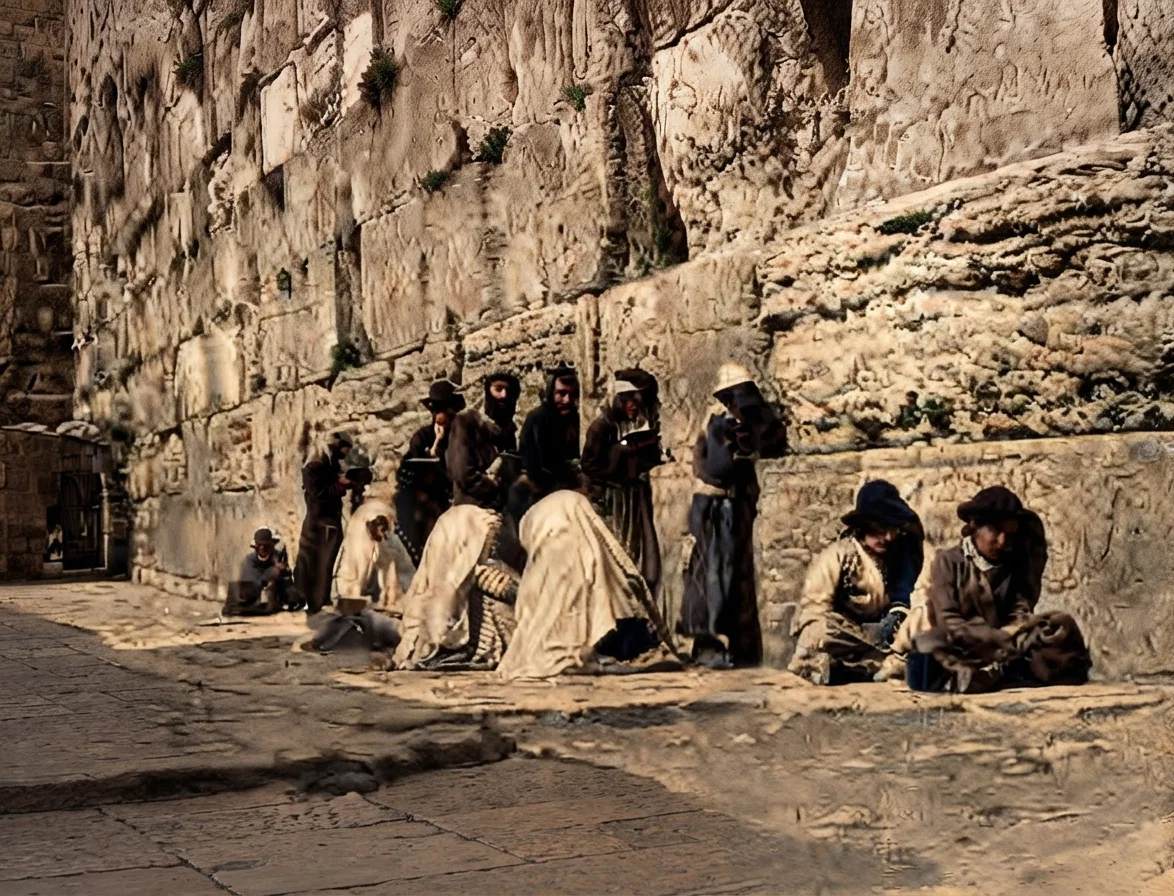
THE WAILING PLACE OF THE JEWS.
"Pray for the peace of Jerusalem." Pray for the poor Jews. Give to them a few crumbs of the Bread of Life, the loaves of which they have given to the world in ages past. Let the Jews see that the Christian people are interested in them, and want to give them the truth of the Gospel, which is God's only solution for the sadness and sorrows and persecutions of the Jews.
F. C. GILBERT, A Hebrew Christian, South Lancaster, Mass.

"BUT THOU ART THE SAME."

[William J. Gray, in Sunday-School Times.]

YESTERDAY.

THY works from first creation Have hymned continual praise, Toward perfect consummation Moves truth from Chaldean days; Through man's millennial ages Love holds unbroken sway, With Thee time's transient pages Form one grand yesterday.

TO-DAY.

Each starry constellation The heavenly silence sweeps, In constant adoration Of Thee who vigil keeps; By Thine unfailing forces Hold they appointed way, From Thee flow full resources For universe to-day.

FOREVER.

Tho future generation May flee in awed dismay, As final conflagration Melts heaven and earth away; Not solvent flood nor fiercest flame Thy Word from Thee shall sever, Unchanging and unchanged, the same, Thou art through vast forever.

WANTED FOR MISSIONARY WORK.

(Always prepay postage.)
SIGNS, Review, Watchman, Instructor, Life and Health, Life Boat, and large tracts. Address, C. H. A. Brooke, Light House Service, Alcatraz Island, Cal.

BIENNIAL MEETING PACIFIC UNION CONFERENCE.

THE third biennial session of the Pacific Union Conference of Seventh-day Adventists is called to convene in the Seventh-day Adventist Church at Portland, Ore., at 9:00 A.M., Thursday, February 15, and will continue until the 25th, 1906, for the purpose of selecting the officers and executive committee of the Pacific Union Conference for the ensuing biennial term, and transacting such other business as may properly come before the meeting. Each local conference and mission field is entitled to one delegate in the sessions of the conference, without regard to numbers, and one additional delegate for every three hundred church-members. W. B. WHITE, President, J. J. IRELAND, Secretary.
FERRY'S SEEDS Make sure a yield of quantity and quality. When your father planted Ferry's, they were the best on the market, but they have been improving ever since. We are experts in flower and vegetable seeds. 1906 Seed Annual, beautifully illustrated, free to all applicants. D. M. FERRY & CO., Detroit, Mich.

AN INDUSTRIAL MISSION SCHOOL.

Brother Joseph Clark, Ceballos, Cuba, appeals to those who have some means, however limited, or property or articles which they might dispose of, to invest in establishing an industrial Mission School in Cuba. He writes that there is an excellent opening for a self-supporting work, and that trained workers can be secured, if they are able to get some means with which to start. He desires to correspond with any who may possess any surplus property which might be realized from and used in this worthy cause. Address, Joseph Clark, Ceballos, Cuba.

HILLSIDE NURSERY, SOMERVILLE, MASS

50 BULBS 25 Cents. Will grow in the house or out of doors. Hyacinths, Tulips, Gladiolus, Crocus, Fuchsias, Oxalis, Tuberoses, Begonia, Jonquils, Daffodils, Chinese Lily, Dewey Lily, Gloxinia, Lilies of the Valley—all postpaid, 25c. in stamps
Gloxinia, Lilies of the Valley—all postpaid, 25c. in stamps or coin. As a premium with these Bulbs we will send FREE a big collection of flower seeds—over 200 kinds.

HILLSIDE NURSERY, SOMERVILLE, MASS

FOR SALE.

ONE house and lot in Boulder, Colo., four blocks north of the Colorado Sanitarium. Size of lot 50x150. Eight-room house, three large closets, bath-room, and pantry. Large cellar under the house. The house is frame, lathed, plastered, and papered, and is new, facing the east with a lovely location. Small barn for a cow, chickens, coal house, etc. Price, $1,500, with one-half down, other on payments. Reasonable terms. Address the undersigned. G. Phillips, 1109 E. 12th St., Kansas City, Mo.

IMPORTANT TO TRAVELERS

The SUNSET-PIEDMONT AIR LINE announce the opening of their through line via New Orleans. Personally conducted cars, San Francisco to Washington, D. C., via Coast Line and Los Angeles, tri-weekly. Tickets at lowest rates to Washington, Baltimore, Philadelphia, New York, New England, and all Eastern points. Through the Old South. Quick time. Best service. Write Phil K. Gordon, 633 Market St., San Francisco, for full information.
See Use IT It's WORTH Seeing Using

Northfield Hymnal

BY GEO. C. STEBBINS

ITS SALE DOES GOOD

5 Cents ROYALTY Paid "The Northfield School" on every copy sold Cloth Bound, $25 per 100; 80c. post-paid Returnable Samples mailed to "Earnest Inquirers" Published by the publishers of the famous "Gospel Hymns," THE BIGLOW & MAIN CO., New York or Chicago.
Continue reading: A GREAT BARGAIN IN BOOKS