"Every word of God," says Phillips Brooks, "is both truth and duty." Those who try to find the truths of Christianity without doing the duties of it, will always be doubters, never quite reaching certainty or true faith. "If any man willeth to do His will, he shall know of the teaching," is an essential rule.—Great Thoughts.
Decorative Divider
—★—
Correcting Our Faults
By Fenelon
Do NOT be discouraged at your faults; bear with yourself in correcting them, as you would with your neighbor.—Fenelon.
True Temperance
THE last virtue named in the list of the fruits of the Spirit in Gal. 5:22, 23, is temperance. This does not mean that if there be other Christian graces, they are not the fruit of the Spirit. These are but samples of the fruit; for the tree of righteousness, the life of which is the Spirit of God, bears every good fruit. The fruit of the Spirit is all-embracing. From this Source of life springs everything that is good.
Temperance is defined as being “habitual moderation in regard to the indulgence of the natural appetites and passions.” A better definition is, perhaps, “the moderate use of that which is good, and total abstinence from all things evil;” or this: “the moderate and proper use of that which is good.” The original word in the text rendered “temperance” means “self-control;” and self-control, the control of self in God’s way, and according to His rule, includes all the above definitions and more. It means the subjection of human lust and passion to the will of God; for it is only the power of God in man that can control man.
Temperance is often applied to the moderate use of, or total abstinence from, intoxicating liquors. That intemperance in appetite reaches its climax in such indulgence, that the victims wrecked and swept to eternal destruction number here their millions where elsewhere they number thousands, that no words can tell or brush portray the misery, agony, wretchedness, wo, and utter despair which everywhere follow the blasting, blighting alcoholic fiend, need not be recounted here. All know more or less of the dread blight. Almost every home has seen or sadly felt its shame and wo. But intemperance in alcoholic drinks is the last mile in the journey, not the first. It is the fruit, not the seed sowing. It is the midnight, not the sunrise. It is the irresistible torrent, not the source of the stream.
Intemperance begins with the infant. Oftentimes it is taught it from the mother’s breast. Self is indulged. The appetite is perverted by too frequent feeding. While the little one should still be eating milk, its natural food, it is fed on spiced cakes or pies; it is given sips of tea or coffee; later it partakes of stimulating meats, irritating, spiced foods, pickles, has its cup of tea or coffee; and right here is taken the first step in intemperance. The appetite is perverted, becomes abnormal, craves stimulating and various foods and drinks—the will becomes weakened; the child has never been taught self-control. And to such cases, when the temptation to use tobacco, a stepping-stone to alcohol, is presented, the victim of perverted appetite and self-indulgence falls an easy prey. When the temptation is presented to drink beer or wine, or some of the lighter liquors, the same weak, self-indulgent appetite yields; and the occasional drinker becomes a moderate drinker, the moderate drinker a drunkard. The evil began in the home circle, around the family table. The fond but too unwisely indulgent parents, if they have not given the appetite to the son as an inheritance, have trained him in the first steps of the way of intemperance. These are facts for parents, Christian parents, to ponder.
A Great Change
An old story comes down to us of a striking conversation between a Pope and a pious priest. The Pope was boasting of his jubilee offering, and remarked to the priest, "Peter can not now say, 'Silver and gold have I none;'" and the priest responded, "No, your Holiness; neither can he say now, 'In the name of Jesus Christ of Nazareth rise up and walk.'" The anecdote, whether true or not, represents a greater change in character than condition.
Away from the Word
By Editor
THE discussion, the real struggle, in the International Sunday-school ranks over the text of the lessons, is of intense interest to the student of prophecy, as showing the trend of religious thought. A few years ago there was no question whatever, so far as we know, over the text; it must be purely Biblical. But now, according to the report of the meeting in the Call, the Methodist Church North and South, the Congregationalists, and the Northern Presbyterians, desire to—
issue lessons in which the “lily,” as the theologians say, shall precede the text. They would draw their examples and parables from the every-day life of the twentieth century, in an effort to show the children of their Sunday-schools that all virtue and righteousness was not lost with the saints. With them, they declare, it is a question of expediency. On the other hand, the ministers of most Southern churches, strongly supported by the Canadians, hold that no literature can be more inspiring than the Word of God, and no illustration more striking than the parables of Christ. With them, too, it is largely a matter of expediency, they say, as well as a certain amount of jealousy for the Bible.
There is also the question between the two systems of lessons, the uniform, in use since 1872, and the graded, which have been issued by the committee within the last three years, in accordance with the demands of certain progressives in the Sunday-school world.
The Rev. J. R. Sampey, of Louisville, Kentucky, a member of the lesson committee, tells us that of a series of 572 lessons in the graded series, 57 are termed “extra-Biblical,” and ten are on the great book of nature. But most of the nature teaching at the present time is not only extra-Biblical, but anti-Biblical. It tends toward either infidelity utterly, or pantheism; and as soon as the bars are let down, and others things are admitted into the Sunday-schools, the great danger is that all these anti-Biblical teachings will come trooping in with all the rest, just as they are in our seminaries and colleges at the present time. We sincerely hope that those who hold for the Bible text will be victorious. It is not a matter as to whether there are as good people now as there were then; but the book was given by inspiration; it comes to us as the Word of God; it contains, as all Protestant creeds have declared, all that is necessary for our salvation. Stick to the Word. The only way we have of determining what is authority in the religion now is not through an infidel science or theological speculation, but, is it in harmony with the Word? There are thousands of Bible believers outside of San Francisco who are anxiously waiting the answer that shall be given by the decisions in that convention. It ought not to be a matter of expediency on the part of either party. It ought to be a matter of high and holy principle. Upon that must the Christian stand.
Rebuilding a Diseased Nose
Surgery is doing some wonderful things nowadays. Just recently in Reno, Nevada, Dr. George J. Larue Robinson performed an operation on a young woman whose nose had been eaten away by disease which destroyed both nasal bones. A rib was cut and used in the place of the bones. When the healing process was completed, the nose was restored.
What Is the Reason?
One of the speakers in the Sunday-school convention, the Rev. McElfresh, said: “Millions are given annually in this country for education, but education in the public schools is non-religious. In many States it is even forbidden by law to read the Bible in the schools. It means that the education of our boys and girls in Christianity is coming back to the church, and the church is not prepared for it. The problem is one of divine training. In our department we are doing what we can, but we should have the coöperation of the denominational colleges.”
If the church had recognized this as she should in the past, she would not only have been prepared for it, but would herself have been a great educational religious seminary. It is worth while to ask whether the fault does not lie with those who are professing to preach the Word, and who have been set apart to preach the Word, that, with notable exceptions, the Word has not been taught. There are very few expository sermons, very little systematic teaching of the Bible. If the church would do her duty, she would have sufficiency of Sunday-school teachers. Think of what a school it would be sitting under the teaching and preaching of such men as Alexander McClaren or Charles Spurgeon; and yet this ought to be the case in every church, under every minister set apart to preach the Word. And that Christianity should pervade all education. The schools of the world, the State schools, can not give this. All education of Christians ought to be permeated with Christianity through and through.
The Incubus of Intemperance
IN a recent number of Cassell's Magazine is an article by Sir Thomas Whittaker, member of Parliament, on the cost and loss of drinking in the United Kingdom. He estimates that the expenditure on intoxicants during the last five years has averaged $825,000,000 a year. Deducting $175,000,000 as the average amount received during that time by the State in the form of duties, the direct cost of the liquor to the public is $650,000,000 a year, besides the indirect cost of poverty, crime, insanity, and disease caused by drink, together with the loss of the labor of those who are by this incapacitated. And he estimates that the indirect loss balances the revenue which the State derives from the trade, so that he puts the expenditure on drink down at $825,000,000 a year. He shows that if that amount were expended for the estimated tax revenue for national expenditure, the country would be free of all taxes.
The housing or rent problem is a serious one in England; but as much is spent on drink as the annual value of every dwelling-house in the United Kingdom. The drink would have paid all the rents. More was spent on drink than all the railways took for passengers, goods, minerals, cattle, and parcel traffic, for all that they do, and for every service they render. The drink bill would pay the cost of everybody and everything that is now carried by rail, and leave a large balance to pay for those who would wish to travel. These facts ought to appeal to reasonable men. What is true in England is true in America. From the simple standpoint of economics alone, the drink traffic ought to be wiped from the face of the earth.
Our European Letter
By J. Vuilleumier
From Our Own Correspondent
[Mr. Jean Vuilleumier was formerly editor of Les Signes des Temps, of Bâle, Switzerland, has spent several years in the Americas as journalist, teacher, and preacher, and is now engaged in teaching. He is well informed on European and world affairs.—Ed. S. or T.]
Protestantism in Geneva
In the midst of external prosperity and the glories of nature, Geneva is passing through dark experiences. Only two years ago, we had the great Calvin Jubilee, which seemed to give a new luster to the religious reputation of this city. But this great demonstration did not heal the grievous sores of which Geneva as a religious community is suffering. On the one hand, a great influx of world-loving, either irreligious or Catholic population, is coming in from the surrounding countries. A great many of them become naturalized. Naturally they help in electing the officers of government, many of whom know nothing of the history and spirit of old Geneva. Lost in this new element, which makes out a large majority, the small nucleus of sturdy Protestants is nearly drowned, and their efforts to counteract and resist the mighty wave of evil is almost hopeless. Such has been the case in late years in the endeavor to fight the liquor traffic, legal prostitution, and gambling.
We have had in the last few days a new and bitter illustration of this. The Casino, an amusement resort, was operating a gambling establishment in defiance of a clear article of our Swiss constitution. The Geneva government remaining deaf to all complaints, the matter was carried to the federal authorities. After a careful study of the matter, the federal council has issued a decree ordering the closing of the gambling portion of the pleasure resort. Thereupon, a mass-meeting was organized by the frivolous, office-seeking party to protest against this decree. Six thousand persons were gathered in a public hall, and were harangued by half a dozen speakers, among them the president and vice-president of the city government. The religious element of the community, which is more or less responsible for the various moralizing campaigns going on in the city, was vituperated and insulted in no ordinary fashion. In this wholesale abuse were included, of course, "ultra-protestantism" and "Calvinism;" and all this in the name of liberty, honor, and the good name of Geneva! One of the speakers, the vice-president of the State Council, said that he had not witnessed such a glorious demonstration in his whole already long political career. The manifestation ended with disorder and noise through the streets and before the building in which the "Journal de Geneve" is edited.
The Morality of Geneva
The Protestant people are ashamed and disgusted and almost discouraged at the prospect which faces them. Any illusions which they might have entertained as to the real issue before them have now disappeared. Geneva, as a Protestant, religious, or even moral city, is a thing of the past. Would to God that those who claim to believe in the Christ of the Bible were consistent Bible Christians themselves. There might be some hope left. Matters in Geneva looked worse than now when Calvin took up the task of moralizing and evangelizing the city. Once he was exiled; and ever after that it took all the forbearance, all the faith in God and in the Scriptures, that animated him and his successors, to succeed in establishing a clean city and in maintaining it such for a century or more. Vergerio, bishop of Capo d'Istria, going through Geneva, about 1540, did not meet a single beggar (which was a strange thing to an Italian). Another traveler at that time marveled very much at the harmony and the order which he saw there, and declared that he would like to transfer this city to Germany.
IN THE CITY OF GENEVA, SWITZERLAND, THE HOME OF CALVIN
Higher Criticism
But they held to the Bible, and to the God of the Bible, and to the Christ of the Bible; and it worked wonders, by the blessing of God. This is not the case now. Under a guise of respect, the Bible is being demolished by all the theological professors, and infidelity is thus fostered among the mass of church-going people. A few individuals here and there dare to raise their voice against this "higher criticism;" but their voice is hushed by a conspiracy of silence. No one with sufficient authority to claim attention has come out to antagonize and denounce this baneful work.
This stage of the controversy seems to have passed by in some portions of Germany, where university professors are bold enough, probably on account of general indifference, to deny publicly the existence of such a being as Jesus Christ. "Jesus of Nazareth never existed," they say: "authentical history does not know Him. All that is told about Him is pure imagination." So says Mr. Arthur Drews, professor of philosophy at Carlsruhe. This was the burden of lectures which he gave in Frankfort, Jena, Berlin, and other places of learning. He found an opponent in Professor de Soden, who thought that if the proposition were true, internal Christianity would not lose very much. At Jena Mr. Drews silenced all opposers by saying that he did not care very much whether Jesus existed or not, provided it were granted that "the Jesus of the Gospels" never existed—a proposition to which all "liberal Protestants" were ready to adhere. At Berlin, however, an enthusiastic crowd filled two large halls to listen to lectures in favor of the belief in the historic Christ. This is very well; but these people would be doing better still if they were careful to see that the Gospels upon which their faith in Christ is based are not broken to pieces by their own professors or pastors.
Mob Law in France
The recent disorder in Champagne, France, has caused the loss of thirty million francs' worth of property, most of which consisted in millions of liters of champagne poured out on the streets, and in houses devoured by fire. This shows distinctly that the spirit of anarchy is unfortunately gaining ground instead of receding. How could it be different where religion is unknown except under the form of superstition, where pleasure-seeking and money-making are the only ideals followed, and where government, instead of stepping in firmly to repress and punish violence and wanton destruction, thinks only of pandering to popular passions in view of securing the votes of Socialists at the coming elections! Socialism holds the balance of power, and has filled France with its doctrine of strike and violence. The weakness of the government fosters the idea that "nothing can be obtained without violence; through violence everything is obtainable; little is risked in using violence."
"This timorous weakness of repressive measures," says a paper, "has much to do with the repetition of troubles in all the recent disorders in France. This attitude is unaccountable and seems to us one of the ominous features of the situation."
Political Situation in Europe
But we must leave international troubles, to spend a few moments looking at the general political situation in Europe. As the daily papers have shown, the question of armaments has for several weeks focused the attention of statesmen. England, spurred by hostile movements on the part of Germany, has again sought its safety in making an enormous jump toward increasing its naval expenses. This was not an easy resolution to obtain from Parliament; but some very clever speeches by Sir Edward Grey, by Mr. Balfour and others, carried the matter successfully. The interesting feature of this parliamentary victory is the way in which satisfaction was given at once to rabid war partizans and to no less determined partizans of peace. To the former, an increased program of Dreadnoughts was presented; the latter were captured by a scathing denunciation of war expenses and by the prospect of a coming world arbitration era.11
"The House might well say," said Sir Edward, "that it was a paradox that, the relations between the powers being as they were, armaments should be increasing so rapidly. Yes, but a much greater paradox is this,—that the growing enormous burden of naval and military expenditure, is coinciding not merely with the friendly relations between the powers, but with the growth of civilization as a whole." "Should this tremendous expenditure and rivalry go on much longer," he went on to say, "they would in the end break civilization down. Some people think it will lead to war, but I think it more likely that this burden will be dissipated by international revolutions; not by nations fighting against each other, but by the revolt of masses of men against taxation."
And yet the same speaker quieted all fears by waving before Parliament the olive-branch of peace. Such was the impression made by this speech, that mass-meetings were organized, mainly by pastors, to approve and extol the peace prophecies of the secretary of foreign affairs.
One of many papers says:
Everything tends toward peace, but we notice that this is a peace with nations armed from head to foot, with arsenals overflowing with ammunitions, and powder kept very dry indeed; a peace, forsooth, such that no government can make a move without setting Europe ablaze. This is what can well be called dancing upon a volcano.
Another paper says:
How long will this farce last? No one knows. One can feel that slowly the culmination is approaching, but wo to the nation which shall be taken unprepared.
The Fearful War Burden
Describing the increasing war expenses, the leading editor of the "Journal de Geneve" remarks:
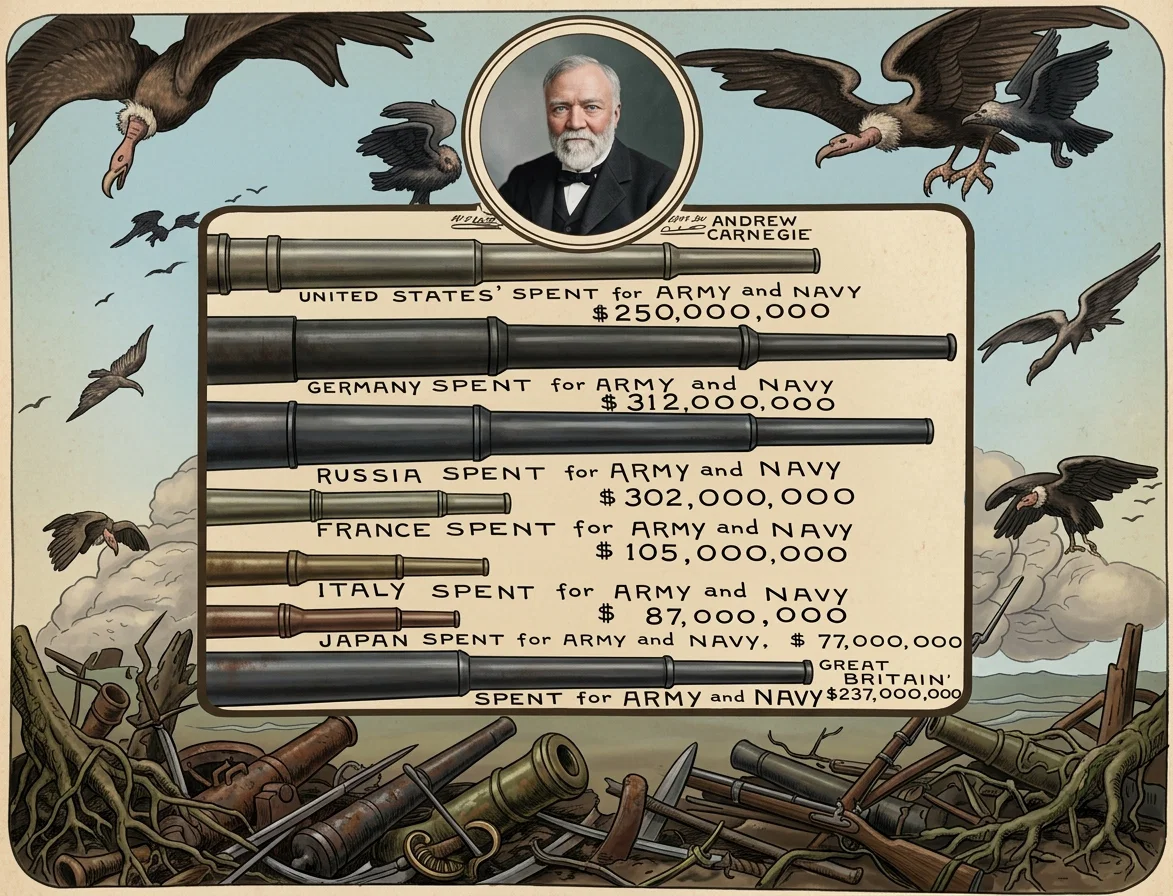
These fantastic figures represent an effort on the part of the nations which it seems impossible for them to stand much longer. Already in England as well as in Germany, the great political crises of the last few years were caused by a question of taxes. As a result, civilized humanity is panting under moral anxiety. People may well say that these formidable armaments have maintained the peace; it is nevertheless a cause of concern to think that so much progress accomplished, that so much light thrown upon the world, have ended in this state of universal suspicion. Where are we going? No one knows. We are groping across a dark forest filled with burglars and wild beasts. . . . Never was peace so much spoken of since all nations are armed to the teeth. . . . We are running down toward destruction. How can we stop?
A French representative and ex-minister, M. Jules Roche, has made an approximate estimate of the cost, and has endeavored to describe the economical consequences, of a future war. He figures on the basis of the Franco-German War, which cost eleven francs ($2.20) a head each day. Counting that 2,860,000 men would be called out the first month of war, the daily expense would be 68,000,000 francs ($13,600,000). If the war lasted eight months, as it did in 1870-71, the total expense would be 9,810,000,000 francs ($1,962,000,000). Adding 10,700,000 men for Germany, Austria, and Italy, at ten francs a head each day (which is only about half what it would cost now), we would have 100,000,000 francs ($20,000,000) a day to add to the other sum. This leaves out the expense represented by England, the United States, Russia, etc. It also leaves out all naval expenses, which would make out nearly as much as the war on land.
The above cartoon was made from a clipping of a daily paper which was sent us. If we knew the journal from which it was taken, we would gladly give credit. It is a striking illustration of the relative standing, among the nations, of war and peace.
"These amounts," remarks M. Roche, "are much higher than the total revenue of each country. For instance, we have estimated the French war expenses at 68,000,000 francs a day; but actually the entire expenses of the French State amount only to 10,000,000 a day, of which 2,000,000 goes for war, thus leaving only a total expense of 8,000,000. In other words, a war would mean an increase of expense three and a half times that of the total budget of the State." But as M. Roche has not counted anything for naval war, and has rated the whole estimate at half the present cost, the real figures would be fourteen times the amount of the actual revenue of each government!
But this is not all. Where would this money come from? For we must consider that the economical and industrial operations—in other words, the production of wealth—would be rendered well-nigh impossible were almost the entire male population between twenty and forty-five called under arms. These fifteen to twenty million men leaving their work all at once will paralyze all large economical operations. Individual work only will be practicable; but how limited this work has now become! Social life will come to a standstill. What will come of electric and gas plants, of street-cars and other conveyances, of banks, of post and telegraph offices, of mines, of printing-presses, of flour mills, of factories of every description, and of ever so many industries, trades, and public services, which have become necessary to national life? Yes, what would become of naval traffic, without which the physical life of a nation is hardly to be conceived at the present time?
"The money crisis," concluded M. Roche, "would inevitably burst upon us with all its dreaded consequences. Everywhere, almost simultaneously, would be witnessed a crisis, an economical cyclone, such as was never seen in any nation since the world began."
Aye, and the solemn descriptions of the Holy Scriptures referring to this very state of things should be deeply meditated just now.
Current Events
The Eighth District judges of the Federal Circuit Court of the United States declare that the Union Pacific merger is legal, for it did not constitute illegal restraint of commerce. Supreme Justice Van Devanter concurs in the opinion. A dissenting opinion was filed by Judge William C. Hook, who contends that there was active, vigorous, and substantial competition between the two roads before the Union Pacific purchased the Southern Pacific, and he further says that "under one or both of these tests the Union Pacific could probably have lawfully purchased control of all the great railroad systems in the United States."
It is a wonderful record that W. E. Johnson, a Southern Pacific passenger conductor on the Sunset Route, has made. Since November 11, 1899, he has traveled 2,104,802 miles, making 580 trips between San Francisco and Washington, and has never met with an accident. His experience ought to break some of the foolish superstitions; for he tells us that he started on 400 of these trips on Friday, and on a number of occasions has departed from either the National Capital or San Francisco on Friday the 13th.
In the reply to President Taft's message of congratulation to King George of England, the King responded: "I heartily thank you and the people of the United States for the very kind congratulations which you offer me on this great and solemn day, and for the good wishes which you express for the prosperity of the British dominion and for the welfare of myself and my family. I heartily reciprocate your wishes that the friendly relations between the United States and my country may ever continue." Signed, "George R. I."
The Rev. Franklin Baker, pastor of the First Unitarian Church in Sacramento, a news despatch declares, said in his sermon Sunday, June 25, that the fifteen million dollars spent in baseball last season was better spent than the same sum in foreign missions. His sermon was a defense of Sunday baseball. His texts were, "To the pure are all things pure," and "Remember the Sabbath day, to keep it holy,"—neither of which had any application to the subject in hand.
It was a wonderful exhibition of naval force which greeted the newly coronated monarchs of England. There were six miles of fighting craft of various nations. 185 ships roared their congratulations to the monarchs. Eighteen nations were represented, and the biggest war-ship afloat was the Delaware, from the United States.
June 24 the great Sunday-school convention in San Francisco took pledges to the amount of $125,000. This, it is said, is about half enough for the estimates of the next three years. Quite a number of life memberships were taken at $1,000 each.
LETTERS TO A YOUNG MAN
BY A YOUNG MAN
V. Sunshine—Prayer—Radiant Christians—Evening Gatherings—Higher Ideals
MY DEAR ROBERT,—
This is a gray day. Dull, heavy clouds shut in the horizon on all sides, and the air seems oppressive. There is all the bareness of winter with none of its tonic quality. Every one I have met this morning has looked sad. What an effect sunshine has on us! What a pity we can not on such days as this reveal a little more of the sunshine within! If a man were to determine deliberately to put on a smiling face whenever the weather happens to be of the gloomy kind, would it not cheer the hearts of his associates? and might it not indirectly lighten the gloom in his own heart? We are all more or less creatures of moods. We may go to bed feeling bright and happy, and awake in the morning with a brooding sense of utter misery. The cause may be a change in the weather, an attack of indigestion, a bad headache, or something lying deeper, unexplainable, perhaps, but very real.
What is the cure for such moods? In the first place, they should as far as possible be ignored. Do not remit one iota of the day's duties because of moods. Follow the regular program. Put on a clean collar and a bright tie; dress with more than usual care, so that there will not be the slightest suggestion of neglect in your outer garb. Then, for the inner: Think of God's mercies,—"count your many blessings, name them one by one." Let the mind in its vacant moments dwell lovingly on the goodness of the great Creator. Think of the hearts that are torn and bleeding as the result of real suffering; think of the many lonely hearts, of men and women who are struggling bravely against great odds; and determine with all your might to look pleasant, and to say something kind and pleasant to as many persons as give you the opportunity. If possible, too, think of some absent loved one who is living under trying circumstances, and plan sometime during the day to write him or her a letter of sympathy which shall be full of brightness and blessing. It is one great advantage in having these sad moods ourselves that we are able at such times to understand the sorrows of others.
Christians should be happy, and they should look happy. A gloomy Christian is a contradiction of terms. "These things have I spoken unto you, that My joy might remain in you, and that your joy might be full." To indulge the spirit of murmuring, to look on the dark side even for a moment, is to open the door of temptation. Backsliding begins with unthankfulness. The Bible, while it gives some dark pictures of human depravity, is on the whole pervaded with the note of joy and triumph. Its heroes were men who knew that the joy of the Lord was their strength. If they lost the feeling of joy, they knew that sin was the cause; and putting away the sin, they prayed with David, "Restore unto us the joy of Thy salvation; uphold us with Thy free Spirit." Men of to-day who have accomplished great things, have been men of good cheer, whom it was good to look upon. George Müller, the revered founder of the Bristol orphanages, where for many decades now, some two thousand orphan children are cared for year by year, the money and supplies coming in wholly as a result of prayer, was one of these cheerful, radiant saints. It was his habit to spend the first half hour or more in the morning in communion with God, and he was accustomed to say that the result of these meditations was always in the direction of producing a spirit of joy and confidence. "I make it my first business," he would say, "each morning, to be first of all happy in my God. Then only am I ready for the duties of the day."
I did not intend to write at such length on this subject, but the dulness of the day suggested it; and pardon me if I mistake, but it seems to me that I have detected something of a slight undertone of gloom in some of your recent letters. You have been too considerate of me to express this feeling in so many words, but I have detected it, and I want to encourage you to fight it. Young people are supposed to be largely free from melancholy; but as a matter of fact they are much affected by it, and need special grace to rise above it. In fact they need to recognize it as sin, and flee from it as they would from any of the grosser forms of vice.
I see that you are giving a good deal of your time to "social duties," as they are called. I don't know much as to the nature of the evening gatherings that are occupying your energies, but I hope they are more profitable than some I have attended. I rarely come away from such entertainments without feeling that precious time has been worse than wasted; not because there has been any undue levity of behavior on the part of the guests, not because anything strictly improper was said or done, but rather because the whole thing wasn't worth while. In the first place, the hostess nearly always labors under the delusion that we are so many little children that must be amused by some childish game every minute. There must be contests of skill in this, that, or the other utterly inane and worthless pursuit that no young person of sense would think of doing at home, but which he is supposed to enter into with great gusto just because he happens to form one of the company. It is unnecessary to specify. You know what I mean. All the papers and magazines teem with programs and suggestions with which the hostess is supposed to relieve the tedium for the young men and women who have been unfortunate enough to be brought together for a couple of hours, and are presumably so bored with one another's presence as to require some antidote. Personally it seems to me a wicked waste of time.
How much better to give young people some opportunity to converse with one another, and if necessary suggest topics now and then, and in one way or another encourage them to exercise themselves in this well-nigh lost art! We believe that the happiness of heaven will largely consist in the harmonious social intercourse of the saved ones with one another and with the holy angels. Then can we not here and now begin to cultivate the art? I don't mean mere chit-chat, I don't mean gossip, and I don't mean endless remarks about the weather. I mean sustained conversation on some subject that is worth while,—some good, inspiring book that has been read, some project for mutual helpfulness, some topic of current news—anything that will employ the energies of mind and heart so that at the close of the evening's entertainment, one can feel that something was done that was worth while.
If these evening gatherings are to serve the purpose of enabling young people to become acquainted with each other with a view to selecting their life partners, then it is all the more incumbent on the hostess to encourage the higher ideals that I have mentioned. The happiness or unhappiness of a life union often depends on whether the acquaintance was formed on a high or a low plane. The young woman who shines best at one of these frivolous entertainments, may be least fitted to make a true helpmeet for the young man with a serious purpose. And the young man who may be the life of such a gathering, may prove worthless in the stress and conflict of real living. Life is such a solemn thing that we can not afford to spend any part of it in mere frivolity,—killing time, as the saying goes. Life is especially solemn for the young man, because such infinite consequences follow the least misstep. If anybody might be excused for spending evenings in a foolish way, it would be the old men and women who have about finished their life-work, whose characters, for good or evil, are formed, and who would therefore suffer less from such a letting down than the young people.
It is a fine thing, when invited to a gathering which does not promise some definite good, to have a previous engagement; if not with some one else, then with yourself. If you have a program, as you ought to have, and try to carry it out conscientiously, you will find very little time for social cares, and your progress in all worthy things will be correspondingly rapid.
I believe this is all for to-day.
Ever yours,
L. P.
Entertaining Temptation
THERE is a deal of truth and wisdom in the remark of the Southern Highlander quoted by President Frost of Berea College: "Yeou cay'n't help a-hevin' bad thoughts come into yer heads, but yeou hain't no necessity fer ter set 'em a cheer." That expresses the whole philosophy of temptation in a nutshell. The sin lies not in the entrance of the evil, but in harboring it. Man-soul is, as Bunyan13represented it, in a state of siege. Sometimes the enemy attempts to storm it by sheer force. Temptation assails us with battering-ram and bayonet. At other times the approach is friendly, persuasive, insidious. The door-bell is rung and the face of temptation appears at the door, smiling and seductive. Then, alas for us if we invite him in and "set him a cheer"! The most effective thing to do, when temptation appears in this guise, is to scan him just long enough for identification, and then slam the door in his face. He does not fancy that treatment. It does not encourage his speedy reappearance. And, under the circumstances, this is good manners as well as good morals.
— Young People's Weekly.
Prayer in Times of Need
"When prayer delights the least,
Then learn to say,
Soul, now is greatest need
That thou shouldst pray."