Your ShelfYour Projects

Signs of the Times, Vol. 38, No. 27.

True to God and Man

Signs of the Times

Jul 11, 1911

Pacific Press Publishing Association · Mountain View, California · Jul 11, 1911

True to God and Man
WE owe allegiance to the State; but deeper, truer, more, To the sympathies that God hath set within our spirit's core; Our country claims our fealty; we grant it so, but then Before man made us citizens, great Nature made us men.
He's true to God who's true to man; wherever wrong is done, To the humblest and the weakest, 'neath the all-beholding sun, That wrong is also done to us; and they are slaves most base, Whose love of right is for themselves, and not for all their race.
— James Russell Lowell.

Schedule for Week Ending July 22, 1911

Schedule for Week Ending July 22, 1911
Sunday July 16 Jeremiah 7-9
Monday " 17 " 10-13
Tuesday " 18 " 14-17
Wednesday " 19 " 18-21
Thursday " 20 " 22-24
Friday " 21 " 25-27
Sabbath " 22 " 28-30
Our whole week's reading lies in the book of Jeremiah, chapters 7 to 30, inclusive. The reader will notice that the chapters are not in chronological order after chapter 20 until one reaches chapter 46. For instance, chapter 21 has to do with the reign of Zedekiah, while chapter 25 is a prophecy that was given in the fourth year of Jehoiakim. It has been suggested that the manuscripts of the different prophecies of Jeremiah, when gathered together by Ezra, and others of the Great Synagogue, were not placed in chronological order. Consequently, the book itself is in the order that it is now. This does not militate in any way against the book, its inspiration, or what it tells us. If the reader wishes to read from chapter 20 on in chronological order, or at least approximately so, we give the following: After chapter 20 read 22, 23, 25, 26, 35, 36, 45, 24, 29, 30, 31, 27, 28, 21, 34, 37, 32, 33, 38, 39:15-18; 39:1-14. Following this, chapters 40-44, 46. From that they are in order to the close.
The reader will be strongly impressed, if he reads thoughtfully, with the constant sadness and depression which must have borne down the prophet as he gave his awful messages to backslidden Israel. And yet, in all these messages there was opportunity for Israel to repent. If they had heeded the voice of the prophet, had surrendered themselves to the King of Babylon, had been willing in a submissive spirit to meet God's judgments which were visited upon them, Jerusalem would have stood, and the awful calamities would not then have come upon her. But religion had become with Israel a mere form, and mingled with the worship of God were the grossest forms of idolatry. Jeremiah was accused of treason to the State, was said to be in league with the Babylonians, false prophets innumerable rose up, flattering the ear of the kings and speaking peace. But Jeremiah, who lived as in the presence of God, gave God's message. It is indeed a wonderful story of a nation and a man.

"IF YE WILL INQUIRE, INQUIRE YE."

This Inquirers' Department is conducted for the purpose of helping those who are studying the Bible. The answers are oftentimes only suggestive. They are never to be considered infallible, only as they agree with the infallible Word. The writer who may answer them does not consider that his opinion is infallible. He will simply give the best that he has, and plead with the inquirer to search the Word. Such questions only will be answered as, to the editors, seem to minister to the good of the readers and to the mission of the paper. We can not answer repeatedly in the same volume questions upon the same scripture. The name and address must accompany question, not for publication, but as an evidence of good faith, and that answer may be made by letter if deemed advisable. No letters are answered which do not contain the name of the writer. It is well always to enclose stamp for reply.
Note.—It is impossible, in the nature of the case, to keep our questions up to date. We have always on hand from ten to fifty questions waiting; so we hope our inquirers will be patient. Sooner or later their questions will be answered by mail or in the "Question Corner." Sometimes questions are asked which have been answered for others. In such case it is impossible for us to answer them twice. We hope that all who ask questions will read the answers to others, and in these they may very frequently find their own questions answered. This is true also as regards articles. We have questions concerning the beast and his image and the mark; all these are answered in the articles on the Revelation.

3501 — Elijah the Prophet. Mal. 4: 4-6

Will Elijah the prophet come down from heaven and preach the truth in the last days?
The prophecy of Malachi is of twofold application. One of these applications was met in John the Baptist. The angel said of John, in Luke 1:17, "And he [John the Baptist] shall go before His [Christ's] face in the spirit and power of Elijah, to turn the hearts of the fathers to the children, and the disobedient to walk in the wisdom of the just; to make ready for the Lord a people prepared for Him." In the 11th chapter of Matthew Jesus expressly says of John, verse 14, "And if ye are willing to receive it, this is Elijah, that is to come." And yet John was not the actual Elijah, as he expressly tells us in John 1:21, but he was Elijah in the sense of the fulfilment of that prophecy at the first advent of our Lord. But that which was fulfilled in a single individual then, takes a great deal wider scope in the last days. One individual could go to the Jewish nation and bring before all the people of that nation God's message concerning Christ's first coming. But there is to go to the world a message concerning His second coming. Rev. 14: 6, 7. No one man can bear that message to the world; and so Elijah and John the Baptist are types of the people whom the Lord calls to bear His last message to the world. Conditions will be the same in the world as Elijah found, and John the Baptist found. For instance, there was the strongest kind of union of Church and State, contrary to God and His truth, in the days of Elijah. We have Jezebel, the corrupt, idolatrous, sun-worshiping Queen, urging on Ahab to the persecution of the Lord's people. We have, in the days of John the Baptist, Herod, influenced by Herodias, the wicked woman whom he had married. In Elijah's day we have the backsliding of Israel and their turning away from the true God to sun-worship. So it was in the days of John the Baptist; God's people had departed from Him, and were sunken in cold, dead formalism, making void the commandments of God by their tradition. Those are the conditions that exist to-day; and God is asking His faithful people to give to the world the great threefold message of Rev. 14: 6-12. That message meets all the conditions that are in the world, and that message will go and is going with "the spirit and power of Elijah," just as John the Baptist went before Him then. Consequently the antitype of Elijah is not some man who may call himself Elijah; it is not vested in one individual, but in the whole people that will carry God's message to the world.
Another thought: the important thing is not the messenger, but the message. This has been true in all ages. Elijah was not the important thing — the mere man; it was the message from Jehovah which he bore to Ahab. John the Baptist, as a mere man, was not the important thing; and when the Jews asked him who he was, he declared, I am not this, and I am not that; but when they demanded who he was, he said, "I am the voice of one crying in the wilderness." The important thing was to be the voice of God. And so in the last message that shall go to the world, the important thing is the message, and not the mere persons that give it; but it will be given by a whole people in the spirit and power of Elijah.

3500—The Word "Nephesh"

In "Topical Bible Studies," published at your office, page 17, paragraph 2, we read, "Nephesh occurs in the Old Testament 745 times." Now I wish to know if the editor of this tract himself looked up these 745 occurrences of the word "nephesh" in the Old Testament, and if he is sure, and absolutely certain, that it does occur 745 times.
As to how this was with the first editor of the tract we do not know. Later editors we are sure have not counted all the occurrences of the word. It is not an easy matter to do this; one needs an absolutely accurate concordance in order to do it, or else to read through the entire Hebrew Bible, marking its occurrences. We will, however, give you what is considered excellent authority: first, "The Companion Bible," issued by the Oxford Bible Company. They say that the word nephesh occurs 754 times in the Hebrew Old Testament. The following classifications are given: (1) It is used of the lower animals only, in 22 passages, translated in 9 different ways: creature, thing, life, the life, beast, the soul, breath, fish, her. (2) It is used of the lower animals and man, in 7 passages, rendered in 3 different ways: creature, the life, soul. (3) It is used of man as an individual person, in 53 passages, translated by 6 different words: soul, person, persons, any, man, and; and in one case (Num. 31:35) not rendered. (4) Of man as exercising certain powers or performing certain acts, in 96 passages, with 11 different renderings: soul, man, any, one, yourselves, person, themselves, himself, he, herself, Himself. (5) Of man as possessing animal appetite and desires, in 22 passages, in 5 different ways: soul, pleasure, lust, appetite, greedy. (6) Of man as exercising mental faculties, and manifesting certain feelings, affections, and passions, in 231 passages, rendered in 20 different ways: soul, mind, heart, hearty, will, desire, pleasure, lust, angry, discontented, thyself, myself, he, his own, him, himself, herself, yourselves, man, so would we have it. (7) Of man as being cut off by God and as being slain or killed by man, in 54 passages, in 8 different ways: soul, person, any, any person, him, mortally, life, thee. (8) Of man as being mortal, subject of death of various kinds, from which it can be saved and delivered and life prolonged, in 243 passages, in 11 different ways: soul, life (lives), ghost, person, tablets, deadly, himself, me, they, themselves, yourselves. (9) Of man as actually dead, in 13 passages, in 3 different ways: the dead, dead body, body. (10) In 13 passages all rendered "soul," as going to a place described by 4 different words: the grave, grave, hell, pit. This seems to be as accurate as any list we have found, as the passage is given in every instance in which the word occurs. Upon this we think our inquirer can depend.

3502 — Circumcision

What answers in the Christian dispensation with children, to circumcision in the Jewish? G. N.
Circumcision separated Israel from other peoples and from sin unto God. See its origin among the Abrahamic family in Genesis 17. It was to be a sign to Israel that they were separate unto God, and that God's righteousness was upon them. Through that they ought to have seen the necessity of heart cleanliness. Deut. 10: 15, 16; Rom. 2:28, 29.
The one thing that answers to the rite in this dispensation is conversion to God. That is the only hope of our children. "For in Christ Jesus neither circumcision availeth anything, nor uncircumcision, but a new creature." Gal. 6:15. See also 1 Cor. 7:19; Gal. 5:6.

3503 — Voting in Civil Elections

Should a Christian vote at county, State, or national elections?
M. M. M.
We do not see any reason why a Christian should not express his opinion at the ballot box as between measures or men. But he has no business in the politics of this world. Our commonwealth, citizenship, "politeuma," is in heaven. Phil. 3:20. We must expect to be disappointed in this world, be deceived by men and disappointed by results. Where clear principles are at stake, stand for right and truth, which may demand that we shall not vote. Every man must decide the question with God. Our advice is, Keep out of politics. If you vote, be sure that you are true to principle.

Not One Word Will Fail

3504 — G. N. Matt. 7:22, 23 — This scene may take place at the end of the thousand years, "in that day." See Rev. 20:11, 12. In these great events the Bible does not deal in smaller details, but we may be assured that in God's judgment "there is a time there for every purpose and for every work." Eccl. 3:17. Not one word will fail.

3505 — The Occurrence of "Ruach"

In "Topical Bible Studies," published by your office, page 19, second paragraph, I read, "Ruach occurs in the Old Testament 442 times." Is this correct? Does the editor know it to be correct?
We give as the authority of its occurrence "The Companion Bible," published by the Oxford Bible Company. It declares in its appendix, "The word ruach occurs 389 times in the Hebrew Old Testament." In the Authorized Version it is rendered "spirit" in 237 passages, and no other word is rendered "spirit" except n'shamah, "breath," in Job 26:4 and Prov. 20:27. In the remaining 152 places it is translated in 22 different ways. In the Revised Version it is rendered "spirit" 224 times. It is first rendered "the Spirit of Jehovah," "the Holy Spirit," "the invisible, divine power manifesting itself in creation," etc. The invisible part of man, the invisible characteristics of man. It is rendered "breath," "spirit," "wind," "courage," "anger," "blast," sometimes put for the whole person, sometimes for angels, cherubim, and evil angels. We believe that this work can be thoroly relied upon. In each instance of its occurrence the passage is given. We have not space for these passages in the "Question Corner."

3506 — Evil in a City. Amos 3:6

Please explain "Shall there be evil in a city, and the Lord hath not done it?" Amos 3:6. J. W. M.
"Evil" is not used in the sense of sin, but of judgment, such as fell upon Sodom, Babylon, Tyre, Jerusalem, and other cities. God sends or suffers to come upon cities calamity. The American Revised Version reads better—"Shall evil befall a city, and Jehovah hath not done it?" God was then warning Jerusalem and Samaria of coming judgments; they were not to take those judgments as mere happenings. It is also a truth for this time.

The Gospel in Type and Antitype

By Loretta V. Robinson

V. The Heavenly Sanctuary, Its Services, Its Cleansing

Now of the things which we have spoken this is the sum: We have such an High Priest, who is set on the right hand of the throne of the Majesty in the heavens; a minister of the sanctuary, and of the true tabernacle, which the Lord pitched, and not man. Heb. 8:1, 2.
WHEN studying the earthly sanctuary and its services, we were but viewing the "shadow of heavenly things;" but when the substance that casts the shadow is reached the shadow ceases, and we have the reality.
Instead of bringing an innocent lamb from the flock, and confessing over it our sins, as did the ancient Jew, we behold the spotless Lamb of God bearing our sins on Calvary's tree.
In place of the erring human priest bearing the blood of the lamb into the earthly sanctuary to make atonement for our sins, we have a High Priest "who is holy, harmless, undefiled, separate from sinners," bearing His own blood into the true tabernacle on high, where He ever lives to make intercession for us. Heb. 9:12.
As the ministration in the earthly sanctuary consisted of two great divisions, each occupying a period of time and having a distinctive place, so the antitypical ministration must consist of two divisions, and to each a department of the sanctuary be devoted; for, says Paul, "Christ is not entered into the holy places made with hands, which are the figures of the true; but into heaven itself, now to appear in the presence of God for us."
From this text it is evident that Christ ministers in both apartments of the sanctuary in heaven; and hence according to the type, or shadow, He must have begun His ministration, at His ascension, in the first apartment, or holy place.
The Sacrifice had been provided, the merit of which was sufficient to avail with God to cancel the guilt of the entire world. Here an Offering was given, upon which all who would, might lay their sins. Whether or not the Sacrifice shall be of benefit in any individual case, depends on the action of that individual himself.
Having provided the Sacrifice, Christ commences His work as Priest, and sends forth the invitation to all the world, Come unto Me for pardon and everlasting life.

The Way of Our Coming

The way of our coming is described in Acts 20:21.—"Repentance toward God, and faith toward our Lord Jesus Christ."
As in the former dispensation the penitent laid his sins upon his victim by confession over him of his transgressions, so we lay our sins upon Christ by confessing them to God through Him.
It is true that God "laid upon Him the iniquity of us all," on the cross; but that would avail us nothing unless we give up those sins, and put them where God put them. Otherwise Christ's sacrifice would also be in vain for us.
But when, by repentance and confession, we make Christ's "soul an offering for sin" (Isa. 53:10), through His ministration for us the sin is transferred to the sanctuary above. And thus there is in this dispensation, as in the former, a transfer of sins; there in figure, here in fact.
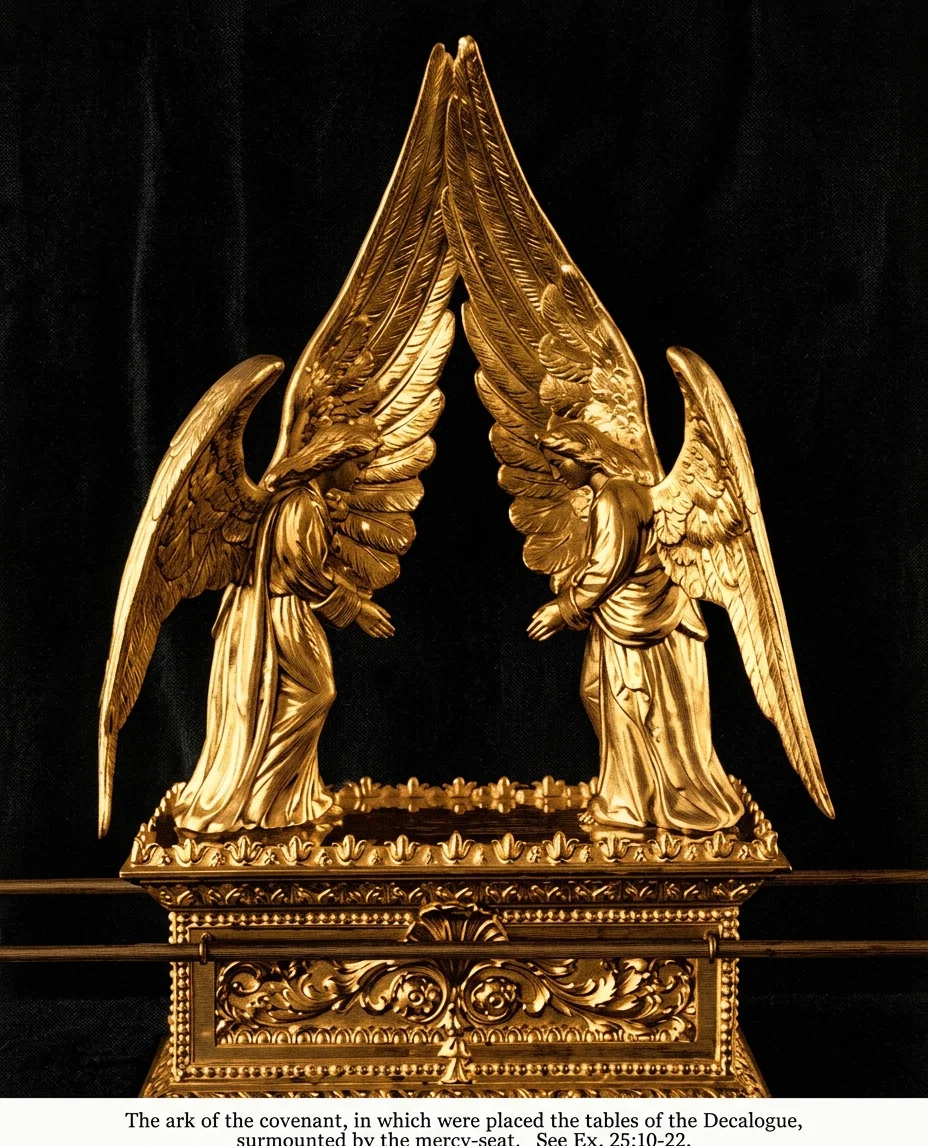
The ark of the covenant, in which were placed the tables of the Decalogue, surmounted by the mercy-seat. See Ex. 25:10-22.
The same question now confronts us as was connected with the earthly sanctuary. What final disposition is to be made of those sins? Do they remain in the sanctuary above forever? No; thank God, the plan of salvation was laid sufficiently deep to remove sin from the universe.

The Final Putting Away of Sin

As in the type the earthly sanctuary had to be cleansed, even so the heavenly.
"But I can't believe," says one, "that there is anything in heaven that needs cleansing." Let such note carefully the apostle Paul's testimony on this point: "And almost all things are by the law purged with blood; and without shedding of blood is no remission. It was therefore necessary that the patterns of things in the heavens should be purified with these; but the heavenly things themselves with better sacrifices than these." Heb. 9:22, 23.
One definition of the word "remission" is, sending back, sending away. Remission of sins is that absolute disposal of them that removes them forever; therefore "without the shedding of blood" there could be no removing of sins, or cleansing of the earthly sanctuary, which was a pattern of the things in the heavens. This cleansing was necessary, says the apostle, to be done by the blood of beasts; and the very same reason exists for the cleansing of the heavenly sanctuary, but it must be cleansed with blood that is "better" than the blood of animals, even the precious blood of Christ.
This is again positive proof that sins are transferred to the heavenly sanctuary, or there would be no necessity for its cleansing.
But what is the cleansing of the heavenly sanctuary? Again we must go back to the type. We find that on the tenth day of the seventh month, the high priest went into the most holy place with the blood of the Lord's goat, to cleanse the sanctuary.
Notice what is said of this tenth day: "It is a Day of Atonement." "Ye shall do no work in that same day." "Ye shall afflict your souls." "For whatsoever soul it be that shall not be afflicted in that same day, he shall be cut off from among his people." Lev. 23:27-29.

A Day of Judgment

This day, then, was a day of decisions, when every case was decided according to the attitude of the individual. If he was found penitent, confessing and putting away his sins, he was counted among the people of God, and was cleansed with the sanctuary.
If he was indifferent or careless that day, he was cut off from God's people. Lev. 16:29, 30.
Of what day were this day and work a type?
What do we call that day which determines the destiny of every soul? It is none other than the great judgment-day, when "we must all stand before the judgment-seat of Christ." It is the day brought to view in Rev. 20:12: "And I saw the dead, small and great, stand before God; and the books were opened: and another book was opened, which is the Book of Life: and the dead were judged out of those things which were written in the books." It is the day when Christ changes His ministration from the holy to the most holy place, as brought to view in Rev. 11:19: "And the temple of God was opened in heaven, and there wasseen in His temple the ark of His testament." The ark had its position invariably in the second apartment of the sanctuary; and in the type this apartment was not opened until the Day of Atonement, or day of judgment.
The prophet Daniel gives a vivid description of the opening scene of the judgment: "I beheld till the thrones were cast down [or placed], and the Ancient of Days did sit, whose garment was white as snow, and the hair of His head like the pure wool. His throne was like the fiery flame, and His wheels as burning fire. A fiery stream issued and came forth from before Him; thousand thousands ministered unto Him, and ten thousand times ten thousand stood before Him: the judgment was set, and the books were opened." Dan. 7:9, 10.

A Preliminary Work

But I hear some one say, "I thought the judgment took place at the second coming of Christ." Permit us to direct your attention to a few texts bearing on this point. The wise man says, "God shall judge the righteous and the wicked; for there is a time there for every purpose and for every work." Eccl. 3:17. The judgment, then, occupies a period of time sufficient for the examination of every purpose and every work, which could not be the case should the judgment take place at the coming of Christ; for when He comes, the living righteous are changed "in a moment, in the twinkling of an eye," and the righteous dead are "raised incorruptible." Again, in Luke 20:35 Jesus speaks of those who shall be "accounted worthy to obtain that world, and the resurrection from the dead." The accounting worthy, then, must take place before the resurrection.
Those living at the time of the coming of Christ have also been "accounted worthy to escape all these things that shall come to pass, and to stand before the Son of Man." Luke 21:36.
The cleansing of the sanctuary is this work of judgment.
When the sinner comes to God and confesses his sins, pardon is written against them, but the sins remain on the books of record until the day of judgment. Otherwise how could God "bring every work into judgment, with every secret thing, whether it be good, or whether it be evil"? Eccl. 12:14.

Blotting Out of Sin

The exhortation is given us to "repent, . . . and be converted, that your sins may be blotted out, when the times of refreshing shall come from the presence of the Lord; and He shall send Jesus Christ." Acts 3:19, 20. The blotting-out time is here referred to as preceding the times of refreshing that precede the coming of Christ. The Revelator speaks of it in connection with the overcomer: "He that overcometh, the same shall be clothed in white raiment; and I will not blot out his name out of the Book of Life, but I will confess his name before My Father, and before His angels." Rev. 3:5. The judgment alone will reveal who the overcomers are, and such will have their sins blotted out, and their names retained in the Book of Life; but those who are not found penitent, and clothed in the garment of Christ's righteousness, will like ancient Israel be cut off from among God's people, and their sins will come back upon themselves. Thus the heavenly sanctuary will be freed, or cleansed, from even the record of sin. And as the high priest in the type, bore out the sins of Israel and confessed them over the head of the scapegoat, which bore them away into a land not inhabited, so Christ's work for the redemption of man and the purification of the universe from sin, will close with the removal of sin from the heavenly sanctuary, and the placing of the same upon Satan, the antitypical scapegoat, who will bear the final penalty. The reason for this is evident, since he is the originator of sin, the direct instigator of all the sins that caused the death of the Son of God. "So as a vehicle he bears away the sins of the righteous, because he is guilty of them all. He planned them, and executed them as far as he was able; and therefore in being punished for them he will be punished only for his own guilt." The guilt of the righteous in connection with those sins was borne by Christ on the cross.
At the end of the thousand years Satan, with all the wicked, is cast into the lake of fire, which will burn them up, and "leave them neither root nor branch." "And in that time, saith the Lord, the iniquity of Israel shall be sought for, and there shall be none; and the sins of Judah, and they shall not be found." Jer. 50:20. O, happy day! May the reader and writer be numbered among that purified throng!
But the question now arises, When will Christ go into the most holy place, and begin this work of judgment, and cleanse the sanctuary, and finish up the work of the Gospel in the earth? Can we know the time? This will be considered in our closing article.

He Is Worthy of Our Confidence

MANY of the questions that come to our minds and bother us are very easily settled when we take into consideration who and what God is, and who and what we are. He is Creator, all-righteous; we are creatures, all-sinful. When we behold His saving grace manifested in the gift of Christ, how can we ever conceive that any act of His in connection with humanity is born of aught else than all-wise love? or that these several acts, each and all, do not work for the best good of each and every individual?
In many of the acts of God, especially those that He wrought in Jesus during the three and one half years of heavenly ministry here among sinful men, the marks of love and wisdom are clearly evident to us, despite our blindness and hardness of heart. There are other acts that may not at first reveal to us so clearly His loving-kindness; but when the mind is illuminated by more of His Word and Spirit, these also are recognized as the merciful workings of the One who knows the end from the beginning.
But as our physical eyes have not the power to discern in the night as readily as in the day, or to penetrate the sun’s rays and discover the sun itself, so likewise are there depths in God’s dealings with mankind which our spiritual understanding is too weak to comprehend. Here faith grasps firmly the Word that speaks His love.
Thousands have never seen the ocean, but they have heard and read of it from travelers, they have seen it represented on the maps, they have full confidence that it is as vast as it is represented. Equally worthy of our confidence are the testimonies of our Father’s boundless love.
Some raise the question of rights. Tell me, how has the creature secured rights over the Creator? How has sinful man, or anything that comes forth from him, secured rights over the One who created him upright, and against whom he sinned? Rather than argue for rights, let us break forth in praise of the self-denial that has freely provided us a Saviour, and of the long-suffering that grants us here the unmerited opportunity of choosing Him, and following Him in loving service.
Some tell us that God is working against man. Yes, He is. How does this come about? How does it come about that things are heavy?—Because gravitation is drawing them all in a downward direction. When we hold or lift anything, we work against the power of gravity as manifested in that object. God’s loving acts are ever manifest, holding and lifting man against the power of sin, which is pulling him downward. Yes, God is against all man’s natural inclinations, and this is our salvation.
Man is walking away from God, and God keeps putting obstacles in his way to stop him. He calls to him, to get him to turn about. God is love, and has an eternal life appointment for man; therefore He is doing all that is possible to stop him in his downward way to eternal death. Let us face about, and work with Him to make our calling and election sure.
W. W. WHEELER, Ambato, Ecuador.

Decorative Divider

—**—

Decorative Divider

—**—

Lost His Faith in God

A small boy, new to the Sabbath-school, was greatly pleased with his picture card and its text, "Have faith in God." On the homeward way, however, the precious possession slipped from his fingers and fluttered from the open street-car, and immediately a cry of distress arose: "O, I've lost my 'Faith in God!' Stop the car! Please stop the car!" The good-natured conductor signaled, and the card was regained amid the smiles of the passengers. One of them said something about the "blessed innocence of childhood," but a more thoughtful voice answered, "There would be many truer and happier lives if only we older ones were wise enough to call a halt when we find ourselves rushing ahead on some road where we are in danger of leaving our faith in God behind us."—Anon.

Decorative Divider

---**---

Knowing Where to Stop

“It is easier to say nothing or too much, than to know just where to stop. It is easier to fast entirely, than to abstain from eating more than necessary. It is easier to give reproof, than to take it.”
Continue reading: Recognizing Your Need