I WONDER how many church clerks realize what an important position they are occupying, and what a great opportunity they have for cheering sad and discouraged, and often tempted, souls. And I wonder if they ever think that, because of a lack of faithfulness on their part, precious souls are sometimes lost to the cause of truth. Of course it is not only the privilege, but the duty of absent members to report to their home church, whether the clerk writes to them or not; but they do not always do this, and the clerk, by her friendly, Christian letters, can often save the absent members from drifting away from Christ. And so I shall offer a few suggestions for the benefit of church clerks who have never been absent members themselves, and therefore do not always fully realize the needs of those who are deprived of church privileges.
I consider it very important to write to the absent member long enough before the quarterly meeting so that his answer may be received just before that occasion. Write a good, earnest letter,12showing him that you are interested in him, and that the church is interested in his welfare and desires to hear from him. Tell him his letters will be a source of strength to the home church, and urge him to write immediately. We all know how easy it is to answer a letter when we first receive it. How many of us have been very enthusiastic over letters which we have received, and have thought we would answer them in a short time; but after a few days our interest cooled, and we put off writing until we did not feel like it, and consequently did not write.
Of course it takes time for the clerk to write to all the absent members when the church is a large one, and she may feel that she has not the time for so much writing. But we always find time to do that in which we have the most interest. If church clerks really feel a burden for their work, and they certainly should, for we should never do anything into which we can not put our heart, they will find time for it.
And if an absent member should send tithe or an offering, by all means do not fail to acknowledge it—not simply by a receipt, for that alone seems merely a matter of business, but write a few words showing your appreciation of the donation. I remember, when the Haskell Home was first built, of sending a donation to it, and of receiving in reply a warm letter of thanks, and also a photograph of the building. Well, I can not tell you how much deeper it made my interest in the Home, and how I wished I could donate much more. Again, I made an offering for something. I forget what it was now, but it was while I was in Battle Creek, and the clerk wrote me a receipt, and on the receipt wrote the word “Thanks.” Of course it made me feel that the offering was appreciated, and also I felt that the young man was careful and thoughtful in his work. Another instance which I will mention is that of an absent member who sent to the home church thirty dollars as tithe. The name of the clerk not being known, it was sent to the elder. Nothing was received in return but a receipt—not a word of thanks or encouragement. This is just as it should not be.
Do not be afraid of dealing gently, and even leniently, with absent members. You know not their temptations and discouragements. And unless you have been an absent member, you do not know how much a letter is appreciated, and how it warms and revives a discouraged soul to feel that he is still remembered, and that the church has still an interest in him. How it makes my heart ache to see a notice in the REVIEW from a church, stating that if the absent members do not report by such a time, their names will be dropped from the list! Is that the way that Christ instructed us to deal with an erring brother? Why will not his instruction apply to absent members as well as to the erring ones who are still with us? Why not ask for their addresses so you may be able to write to them, and then kindly and in a Christian manner urge them to report? I would say again, We can not deal too gently with the absent, and perhaps erring members. How does God treat us when we wander from him? And should we take it upon ourselves to be less merciful to our brother?
The Young People Respond
BROTHER H. H. HALL writes from Oakland, Cal.:—
“This idea of definite, unceasing labor seems to attract our people. Yesterday I had the opportunity of reading the recommendations and explaining them to our church. In the afternoon a few of our young people met at a private house to talk over missionary operations, and invited me to be present. We had a good meeting, and organized for this campaign. Enclosed you will find a copy of the paper under which each is to subscribe his name. I earnestly hope that the Young People’s Work, which is to be a part of the convention, may be so successfully carried out that we may gain the united co-operation of the thousands of young people.”
Copy of Paper Subscribed To
“We, the undersigned young people of the Oakland Seventh-day Adventist church, being in hearty sympathy with the missionary recommendations passed by the recent General Conference Council, do hereby band ourselves together to assist to the extent of our ability in carrying on this mighty missionary campaign, which is to know no cessation until this gospel of the kingdom is carried to every nation, tongue, and people.”
Tracts in Connection With Public Effort
BROTHER W. W. SIMPSON writes from Los Angeles, Cal., of experiences there in tract distribution:—
“I am glad to learn that there is to be a revival of the missionary work in the field, and I believe that much good can be done in the distribution of tracts. I feel sure that we as ministers have let many valuable opportunities pass by unimproved by not using more tracts in connection with tent efforts. I find the liberal use of tracts in connection with tent-meetings is an excellent way of securing most liberal collections. The Lord has clearly demonstrated this in our recent effort in the city of Los Angeles. We have just closed a successful seven weeks’ meeting. Our collections during this effort have amounted to about twelve hundred dollars. I have given away four hundred and fifty dollars’ worth of tracts,—at wholesale price. Each evening I would give out tracts free to all who attended, and about three times a week take up a collection to pay for these tracts, and the result is that we have received sufficient to pay for all the tracts, also all our tent expenses, which have been very heavy, and have a surplus of five hundred dollars with which to begin another effort. Fully one hundred persons have begun to keep all the commandments. We shall never know the results until Jesus comes. We have truly scattered tracts like the leaves of autumn, and they have had a wonderful influence in increasing our collections, besides opening the eyes of many to the truth.”
Missionary Campaign Committees
As standing general committees on the missionary campaign, to whom any inquiries may be addressed for information or counsel in the various districts, the council at College View appointed the following:—
For Pacific Press district: H. H. Hall, W. B. White, J. Cochran, George Pettit.
For Review and Herald district: W. A. Colcord, D. W. Reavis, W. C. White, S. N. Curtiss, J. E. Froom.
For Southern Publishing House district: I. A. Ford, J. E. White, G. I. Butler, S. N. Haskell.
The Place for Missionary Work
A MISSIONARY in Borneo writes to the Missionary Review:—
“I learned a lesson from a Dutchman who had been three months one hundred miles farther up the river buying rubber, and one hundred miles from any civilized person. I said: ‘Isn’t it lonely up there?’ He answered, after a shrug of his shoulders: ‘Yes, but that is the place for rubber.’ So, if you ask me if I am lonely, I may say: ‘Yes, but this is the place for the missionary work.’”
The Lord sends his people where the light is needed. The eternal riches in the souls saved from sin, are worth all that they cost.—Selected.
An Institute in Prison
THIS note from Turkey will remind us of our own privileges and blessings, as we plan for missionary institutes and effort, with none to molest. Dr. George writes from Constantinople:—
“Brother Baharian had been planning for some time on having a workers’ institute at Aintab. But now the authorities—or Providence, one or both—have gathered him, and all but one of the workers in that part of the country, to the prison at Urfa, where they are now having their contemplated institute. This is doubtless the safest place for them to hold it. They have liberty to study the Bible together, and also to teach the prisoners. Pray that God will bless their little institute, and also, when it is finished, give them liberty to go and forth to preach the message in that field.”
Russian and Japanese Soldiers Compared From the Stand-point of Diet
By D. T. Bourdeau
D. T. BOURDEAU
LET the following extract from the editorial section of the Grand Rapids (Mich.) Herald, of September 25, have its due weight on the relative value of meat and cereals, from a dietary stand-point:—
“The present war in Manchuria is teaching us many things, and compelling us to revise opinions that had long become fixed in our minds. The Japanese are usually a mild people, very polite and kindly toward all, noted for their gentleness toward children and animals, living almost entirely upon cereals, mostly rice. Some of the swaggerers have long maintained that such people could not be formidable fighters, and that no rice-eating nation produced warriors.”
“Most people believed it, and the achievements of the Japanese came as a surprise. They can outmarch, outplot, outflank, and outfight the big, noisy Russians, who eat great quantities of meat and drink fiery vodka. Rice seems to make brawn and brain. If these new lights illumine more of our long-cherished prejudices, we shall be permanently made wiser. As a matter of fact, the quiet men are usually the best fighters. They expend their breath in action, not in words. The braggart often fights, but when it comes to the desperate chances and forlorn hopes, it is the quiet ones who bear the tests.”
This is but a fractional part of what is said on this subject by candid writers and by others of reflecting minds, who are becoming more and more deeply convinced that a vegetable diet is the diet par excellence. May those who have long had light on what constitutes the best diet, profit by such admissions as those contained in the testimony given above.
That Boy of Yours
By Mary A. Abbott
Do you remember when he was but a tiny dot, almost hidden by flannels and laces, that as you pressed him still closer, you thought of the upright, lovable boy he would make—yes, of the honorable, God-fearing man? But it is of the “upright, lovable boy” I want to speak now. You find he is gradually growing away from you, now that school, playmates, and other associates come in to interest him in many ways, where formerly you were all in all to him. It grieves you, but it would never do to keep your boy to yourself, even if you could, neither will it do to assume no responsibility as regards the choice of his companions.
You know what an imitator your boy is. How from babyhood he has tried to do what his father or some older person did. Therefore his boy companions will influence him greatly. You must help him to select these companions; and you can not do this unless you take an interest in his outdoor life. Because a bad boy knows so well in what a “good time” consists, he is likely to be chosen by your boy as a companion. His games may be harmless, even beneficial, but gradually his influence will be felt, and his language and his sentiments will have an ill effect upon your boy. Bad habits are easily acquired; good ones are formed by patient cultivation.
The choice of a companion several years his senior by your boy is often a source of danger, and usually undesirable. He listens to stories of “manly” actions, learns of smoking, swearing, and other rough, if not wrong, ways. There are many excuses: “It’s only for fun,” “All the boys do,” “The boys will laugh at me if I don’t.” O, how quickly a boy grows away from you! What can a mother do?
Listen! Help him to develop a strong moral character by teaching him that it is a test of strength to do what is right rather than yield to what is wrong; that it is a coward who can not say “No” when it should be said. Let him see that you are interested in all that he is interested in. Let him find you enjoy his descriptions of the victory of his particular “club,” and are pleased with the cleverness or quaintness of his pets. Let him feel that you share his joys and sorrows, whether small or great. If you have his confidence, then your influence will be felt every hour of the day. If he knows that he has a sympathetic listener and companion, as well as adviser, in you, you need not fear that his boy companions will have greater power over him than you.
Cultivate in him a personal interest in his home. Consult him in the arrangement and furnishing of his room. Why should not his bedroom be as cheery and attractive as his sister’s? Have lots of pictures, all sorts of animals, of sports, of people, and try to educate his taste for the best of each kind without his feeling that you belittle his choice. Then let him decorate his “den” with his curiosities, if he wants to. You can stand a little dust, if it helps you keep your boy. Use his room as an agent in teaching order. He will like to have it snug and “ship-shape.”
Teach your boy to enjoy his home by making him feel free to invite his friends to his room. Let him share his pleasure with his boy friends. He will want them to be nice if he is going to bring them into his home, his own room. Teach him to choose for his friends those who are worthy to enter the “charmed circle” of home. O, you mothers, what a lot you have to teach!—Mary A. Abbott, in The Housekeeper.
Don't Be Afraid
By A. W. S. Cunningham
A SHORT time ago I read a story which was told in the following words:—
Three little children were spending the evening together, when a violent thunder-storm came on, which compelled them to stay where they were all night.
Just before prayers the gentleman of the house told them they might each choose the Bible verse they liked best, and tell why they loved it. “I know what my verse will be for this night,” spoke up Margery, “but I don’t know14where to find it; it says, ‘The God of glory thundereth.’”
“Why did you choose that verse, Margery?” inquired her friend.
“Because I think it is so nice, when you hear that awful noise, to know it is God. It makes me think of one day long ago, when Aunt Annie was out, and I heard a great noise in the loft when I was all alone in the house, and I was so frightened I screamed, and father’s voice called out: ‘Do not be afraid, little Margie, it’s only father.’ And now when it thunders very loud, it always seems as if I heard God say, ‘Don’t be afraid, little Margie, it’s only Father,’ and I don’t feel a bit frightened.”
When the trials of life are thundering around us, may we manifest the same peaceful trust in God. May we be able to hear above the din of temporal trouble his loving voice saying to our souls, ‘Do not be afraid, it is Father.’—A. W. S. Cunningham, in Present Truth.
October Lessons
By H. I. Morse-Farnum
H. I. MORSE-FARNUM
“Day unto day uttereth speech, and night unto night showeth knowledge.”
THE berries of scarlet, leaves of red, Amber, russet, and gold, Tell that the palmiest days are fled, And summer is waxing old.
The beautiful light of waning day, Peering through sunset sash, Heightens and brightens October’s ray, Its maples and mountain ash.
Alas! the day, in perfect array Of beauty, wealth, and grace, Lingers but briefly, passing away, Shadows fall in its place.
Why need we miss the lessons that gleam In sunset’s ruddy glow, In the falling leaf and purling stream Or mighty river’s flow?
Over and over the lesson is told; In roar of cataract heard, Flung out in words of scarlet and gold, And trilled by every bird.
In tenderest tints of vernal time, In summer’s joy and bloom, In variegated autumn’s prime, In winter’s shroud and tomb,
Nature is chanting lessons to you, Talking with voice and scene, Pure and benign as canopy blue. Hear ye the words between?
“Changeful and brief this motley array, Sliding sands in the glass; Nearest and dearest idols to-day, Smiling, greet us, and pass; But anon they are hidden away.”
What sheaves are we gleaning, passing along, Out from living and thought? Out of the toiling, sorrow, and song? Only the good we have wrought.
Unerringly, a diamond pen Records the real worth; Eternity restores again The only wealth of earth.
Only a Jack-knife
When James A. Garfield was struggling to obtain an education, he supported himself for several years by teaching. The little wooden house where he began his work as teacher is still standing; while some of the boys and girls who received instruction from him that term are yet alive to testify to his faithfulness as a common-school teacher. He was quite a young man at that time, in fact, he was still in his teens, and it must have been rather embarrassing for him to attempt to teach young men and women, some of them older than himself; but he was honest in his efforts to try to do his best, and, as is always the case under such circumstances, he succeeded admirably.
One day, after repeatedly cautioning a little boy not to hack his desk with the new knife in his possession, the young teacher transferred the offending knife to his own pocket, quietly informing the culprit that it should be returned at the close of the afternoon session.
During the afternoon two of the committeemen called to examine the school, and young Garfield was so interested in the special recitations conducted that he let the boy go off in the evening without even mentioning the knife. The subject did not recur to him again until after tea, and perhaps would not have been recalled to him then had he not chanced to put his hand in his pocket for a pencil.
“Look there!” he exclaimed, holding up the knife. “I took it from Sandy Williams, with the promise that it should be returned in the evening, and I have let him go home without it. I must carry it to him at once.”
“Never mind, man! Let it stand till morning,” urged Mrs. Ross, the motherly woman with whom he boarded.
“I can not do that,” replied Garfield, “the little fellow will think I’m a thief.”
“No danger of that, James,” insisted the well-meaning woman. “He will know that you forgot it.”
“But you see, I promised, Mrs. Ross, and a promise is always binding. I must go to-night, and carry it to him,” urged the young man, drawing on his overcoat.
“It is all of two miles to his father’s, and just look how dark it is, and raining, too,” said the woman, opening the door to convince her boarder that things were as bad as she had represented them.
“I am young and strong, and can make my way quite easily,” insisted Garfield. “It is always better to right a wrong as soon as you discover it, and I would rather walk the four miles in the mud and rain than disappoint one of my pupils. Sometimes example is more powerful than precept, and if I am not careful to live an honest life before my pupils, they will not give much heed to what I say on such subjects. There is no rule like the golden rule, but he who teaches it must live it, if he expects others to follow his teaching.”
Mrs. Ross said no more, and James went on as he had proposed; and before the little boy went to sleep, he was happy again in the possession of his treasure, over which he had been lamenting all the evening. The young teacher declined the hospitality of the family for the night, and walked back in the darkness to his boarding-house; and, as he afterward told Mrs. Ross, felt all the better for standing up for his principles.—Selected.
How to Cure a Sprain Quickly
As soon as possible after the accident, immerse the part in water as hot as can be borne. Add boiling water every few minutes, thus gradually increasing the temperature as the skin becomes accustomed to the heat. The duration of the hot bath should be from fifteen to thirty minutes, or until the pain is relieved. When the heat seems to increase the pain, the part should be removed at once.
Now apply a moist cheese-cloth bandage about three inches wide, four thicknesses. The bandage should be ten or fifteen feet in length, and may be prepared while the hot bath is being administered. The roll of bandage should be immersed in very cold water, then squeezed dry, and applied to the foot, if the ankle joint is affected. Beginning at the toes, apply smoothly and snugly all the way to the knee. Over the moist bandage apply several layers of flannel bandage. The bandage should be applied smoothly and snugly so as to retain the heat. The patient should remain in bed with the foot elevated. Renew the hot bath three times a day, each time applying the moist bandage afterward. The moist bandage should be worn day and night.
On the second day, after the hot bath, and just before the moist bandage is applied, with the patient lying on his back and the foot raised, friction should be made from the ankle upward toward the knee. The hand may be passed carefully, gently, over the swollen parts from below upward with firm but gentle pressure. The rubbing may be continued for five minutes. On the third day the joint may be moved by an assistant. The movement should be executed slowly by the assistant, and without going so far in either direction as to cause severe pain.
After the third day, movements may be applied more freely, and the massage, or rubbing of the joint, may be applied more thoroughly, always working from below upward so as to reduce swelling. By the fifth day, even when the joints are quite badly sprained, the patient may make voluntary use of the foot, and may walk by exercising extreme care.—Selected.
Fasting in Therapeutics
HAVING had occasion to study diet, my attention has been directed to fasting as a therapeutic agent, and the following case seems worthy of record.
The patient was a man, aged sixty-five years, who had been a hard drinker and a good eater all his life, working on contracts. He was much crushed and nearly drowned by scaffolding falling upon him. His life was for a time despaired of, but he recovered. When I saw him seven years after the accident, he was crippled on one foot, and walked with a stick very slowly. He could not sleep in the night from coughing and spitting, passed urine every hour, and could hardly turn in bed from a stabbing pain in the side. He could not dress himself, and was altogether in a pitiable condition. Having seen him, I promised him that if he would follow my advice, he would renew his youth. He was a man of powerful will, and he said that he would do anything to get well.
I put him upon a little fruit twice daily. In five days he lost ten pounds in weight, and he could dress himself and lace his boots, which he had not done for years. As he lost weight, his vigor increased, and he began to work in his garden and to take long walks. All his troublesome symptoms left him, and he could sleep like a child from 9 P. M. to 4 A. M., without waking. He had to get new clothes to suit his reduced size, and in November (he began in June to restrict his diet) declared that he felt as well as ever he did, and were it not for the damage he had received in the accident, he might resume work as before. November 10 I saw him wheeling up a hill a barrowful of potatoes which he had himself dug.
The change in his pulse was remarkable. I never felt nor saw a pulse more irregular and intermittent in character at first, but it gradually improved and became fairly regular. He said he was neither hungry nor thirsty on the fruit diet. He now eats only about a quarter of what he did formerly, and when the weather prevents him from working or walking, he at once gains weight.
This case seems deserving of attention from the marvelous change produced by abstinence, and may encourage us to try a partial or perfect fast in suitable cases.—The Lancet.
Cairo an Educational Center
By W. H. Wakeham
W. H. WAKEHAM
To be acquainted with a country is to know its needs. To know the needs of a given mission field is, to the Christian, to enlist his sympathies, his co-operation to supply those needs. So I believe that a brief statement of the educational work centering in Cairo, Egypt, will emphasize the importance of this place as a center for the third angel’s message, from which the everlasting gospel of the kingdom may go to the whole Moslem world.
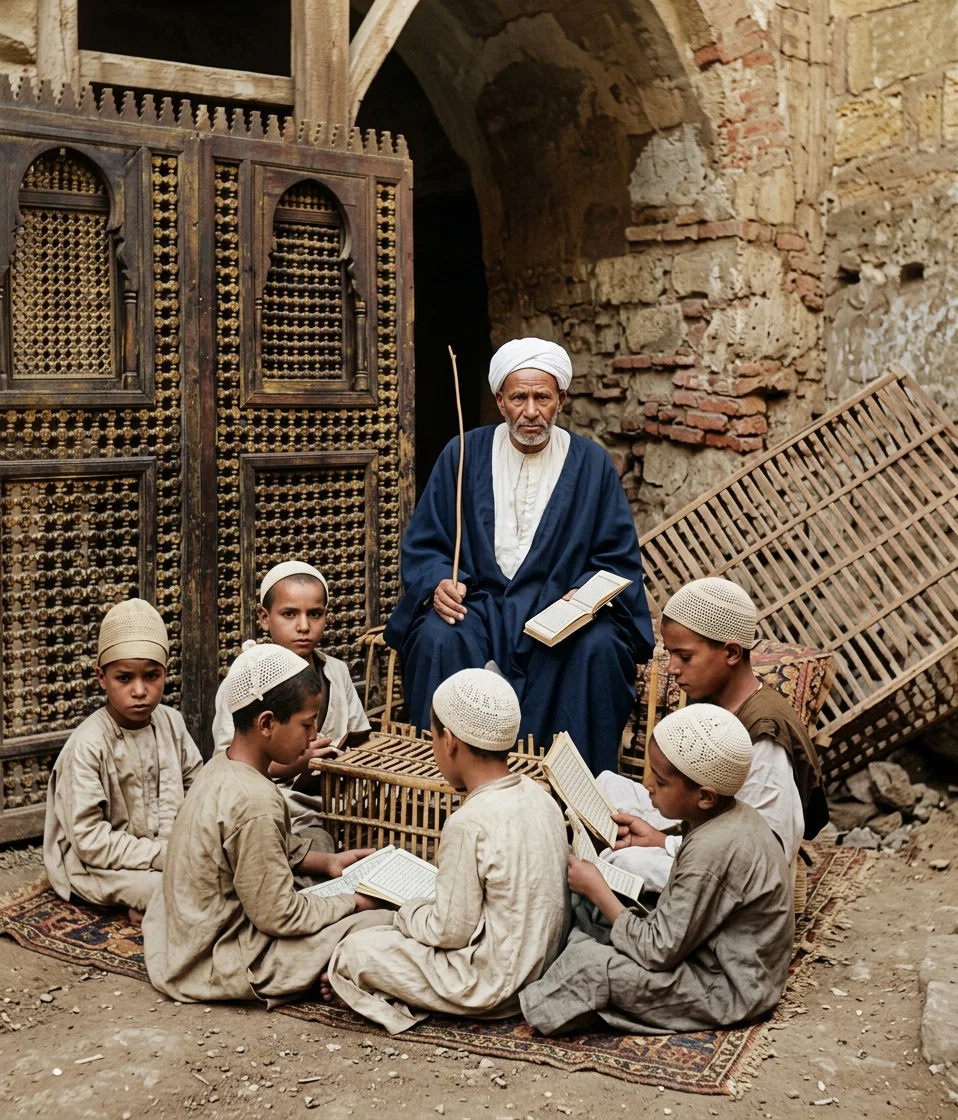
A MOHAMMEDAN SCHOOL
Cairo is not only the metropolis of many Egypt, but it is by far the largest city in Africa. It is the political, commercial, and educational center of Egypt. Its influence is paramount not only in the lower and middle divisions of the country, but in Upper Egypt, through the Sudan, to the borders of Abyssinia. This being the case, anything coming from Cairo takes precedence over all else. To many of the natives in distant provinces, a trip to Cairo is the event of a lifetime. In all Egypt, if I am rightly informed, there is not a book or periodical published outside of Cairo or Alexandria. While visiting Kena, a city of about forty thousand inhabitants, some four hundred miles up the river from the capital, I inquired why some enterprising native did not start a daily or weekly paper in such a city. I was informed that it would not receive sufficient patronage to live, as everybody wanted news directly from Cairo, so that it would be “official.” And while the American Mission has its training college at Assiut, its native church paper is published at Cairo.
The Schools of Cairo
First is the so-called “University” of Azhar. Though having an attendance of from three thousand to four thousand every year, this institution is chiefly a conservatory of the Mohammedan religion, the principal studies being the Koran, Mohammedan law, and the Arabic language and literature. It is said that young men from all parts of the Mohammedan world, even from India and the Malay Peninsula, are drawn together here. A recent writer says:—
“The Azhar is indeed the university of Islam. Its influence is felt wherever the Moslem religion is known, and its disciples are collected from all parts of the Moslem world.”
To all students this school is absolutely free, no charge being made for anything the student receives. The teachers work without salaries. The attendance is not so large as formerly, as many young men of more progressive ideas prefer to attend the schools which afford a broader and more practical education.
Cairo has a fairly well-equipped “school of medicine,” under the direction of English physicians. It enrolled last year ninety-eight young men, many of them among the brightest in Egypt. There is also a law school, with an attendance of about two hundred, an industrial school with one hundred students, and a school of arts having about three hundred in attendance. The kuttabs, or intermediate schools, have an attendance of about twelve thousand children, of whom eight hundred are girls.
An advance move has recently been made toward the better education of Moslem girls. As nearly all the girls’ schools in Egypt are taught by European or Syrian teachers, a teachers’ school for Mohammedan girls has been opened with about sixty pupils. There are also about fifty native young women, mostly Moslems, taking a medical course. This would have been considered an innovation a few years ago; and, indeed, the old fanatics shake their heads. But the progressive view these advanced moves in educational lines with satisfaction and pride. There are a number of flourishing Mohammedan schools, supported by private individuals of wealth. One of these, which was established some years ago by a rich Moslem, now dead, has in its charter a clause forbidding Christians to ever set foot in its domains. And this spirit is not dead yet.
Besides the government schools, each church represented here has its own educational institutions. The largest of these is Coptic, with an enrolment of about one thousand. This is the principal Coptic school in Egypt, although that church has many others. Then there are the Greek Church schools, Armenian schools, Roman Catholic schools, and a number of private schools in which many hundreds receive some education. In the lower schools, however, and in many of the higher grades, the work done is very superficial. Especially is this true of schools taught by Oriental teachers. The young Egyptian is taught to memorize, but not to reason. The principles of logic find a very small place in his mental make-up; but his power of memory is wonderful. One young man who attended my English class for a time, could repeat every rule in the English grammar, but could not write a correct sentence in the English language. It is very unsatisfactory for a European to argue with the average native; for he never knows when he is beaten, and “e’en though vanquished, he would argue still.”
A word should be said concerning the schools conducted under the auspices of the American Mission (Presbyterian). As already stated, their training college is located at Assiut, about two hundred miles from Cairo. These pioneer missionaries have been a prominent factor in stimulating educational interests throughout Egypt. Aside from their college, their chief schools are in Cairo and Alexandria. Their course of study here is not advanced; but in those classes which are taught by American teachers, the character of the work is first-class, the teachers being both competent and conscientious. Their church in the United States has undertaken to raise one hundred and twenty thousand dollars to open a girls’ college in Cairo, also one in Alexandria. They have already secured a site for the institution in Cairo, at a cost of sixteen thousand dollars.
The English Church Missionary Society also has schools in Cairo, but I have but little information concerning them.
All this shows the importance of Cairo as an educational center, and should lead us to consider how this strategic point16may be used to advance the cause of present truth, and so hasten the coming of the King.
Although real estate is very high here, yet I am convinced that it would be a wise policy to secure, as soon as possible, a small property for permanent headquarters. We ask the brethren and sisters of the home land to pray for the advancement of the work here.