The first meeting of the General European Conference convened at 5 P. M., July 14, 1904, in the large pavilion on the Friedensau camp-ground, near Magdeburg, Germany. The delegates, of whom there were fifty-six, came together in open session twice daily, except Sabbath, until Monday evening, the nineteenth. As most of our readers will remember, the General European Conference was organized in Friedensau in the summer of 1901, and had a second meeting in London in the spring of the following year, so that the present gathering is really the third we have had thus far.
As a fitting introduction to the conference, the president, Elder L. R. Conradi, read Isaiah 52—that stirring, yet beautiful and tender call of God to his people to awake, to put on their strength, and to go forth with clean hands, carrying the glad tidings of peace to all nations, and saying unto Zion, “Thy God reigneth!” The time is not far distant when the ends of the earth shall see his salvation, and it is as heralds of this salvation that we have been called out, a remnant unto the Lord our God.
One controlling purpose animated every speaker, and this one purpose predominated in all the resolutions and business transactions: this thought is expressed in the words spelled out by the workmen in a sort of brick mosaic, as they slowly laid the outside walls of the north and south dormitories of the Friedensau Industrial School,—“The Lord cometh; pray and work.” Wonderful indeed is the inspiration that comes to us when this sentiment is allowed to be the one theme at a large gathering such as we had on those quiet grounds.
Our outward surroundings were all that could be desired, in the midst of the secluded wood. The weather was warm, nicely adapted to the comforts of those sojourning in tents for a season, and the sky was almost continually cloudless. We had no rain. About eight hundred of our German brethren were in attendance. We never attended a meeting characterized by greater spirit of oneness and unity in all that was undertaken.
A glance at the following list of delegates will show how fully the field was represented:— America, W. A. Spicer; General European Conference Committee, L. R. Conradi, O. A. Olsen, P. A. Hansen, B. G. Wilkinson, H. F. Schuberth, O. A. Johnson, Dr. J. C. Ottosen, W. C. Sisley, H. R. Salisbury, J. T. Boettcher, and Dr. P. A. De Forest; North England, E. E. Andross; South England, T. C. O’Donnell; Wales, A. F. Ballenger; general delegates from Great Britain, Dr. A. B. Olsen, Mr. and Mrs. C. H. Castle; Scandinavian Union, C. C. Hansen; Denmark, Mr. and Mrs. J. P. Hansen; Norway, C. M. Jensen; Sweden, C. Kahlström; Finland, A. Boettcher; Iceland, D. Ostlund; Latin Union, Mrs. B. G. Wilkinson; French Switzerland, L. P. Tieche, P. Schild; German Switzerland, J. Erzenberger, H. Steiner; German Union, Dr. A. J. Hoenes, H. Hartkop, A. C. Christiansen; Western Germany, J. Pieper, O. Luepke, W. Krumm, A. Pages; Eastern Germany, E. Frauchiger, C. Rehlin, C. Sinz; Southern Germany, C. W. Weber, G. Hofer; Rhineland, G. W. Schubert, W. Varlemann; Eastern Prussia, G. Olander, E. Nopper; Southern Russia, H. J. Loebsack, H. Berg, C. Laubhan; Northern Russia, K. Remfert, J. Jurickson; Middle Russia, J. Perk; Hungaria, J. F. Huenergardt; Austria, L. Mathe; Holland, J. Wibbins; Orient, F. Horner, G. Dail.
In reviewing the work of the past two years, the president said, in part:—
“We have great reason to thank God for his protecting care and providence over our field. During 1902 and 1903 there have been 3,138 additions to our numbers, bringing our membership up to 9,547. Our net gain was 1,950. We have organized one hundred and twenty-four churches and companies; we have formed the British Union, the Scandinavian Union, the North England, the Rhenish, and the Prussian Conferences, and have organized the Latin Union, the French, the Hungarian, the Austrian, and the Balkan Missions, while we have entered Rome and Spain and Flemish Belgium, and Tiflis in Asiatic Russia, and opened our mission to the heathen in German East Africa. We have also been able to secure a director for the Oriental Mission, and a man to take charge of the work in Turkey.”
“At the beginning of this period we had one hundred and eighty-four evangelical workers; two years later the number had increased to two hundred and ten, not counting thirty-eight other workers, or, there was an increase of six ministers and twenty-one Bible workers, but we had a loss of one licentiate.”
“The tithe for 1903 was $68,581, as against $47,593 in 1901, showing an increase of nearly $21,000. The tithes and offerings for the two years were $146,800. The Mission Board appropriated to our field, from July 1, 1902, to July 1, 1904, $35,872 in cash, showing that our actual expenditure has been at least $181,000.”
“We have three organized union conferences, two union mission fields, thirteen local conferences, ten missions, and fifteen important institutions, one third of which have been opened during the last two years.
“Our needs most urgently demand the enlargement and improvement of our educational facilities for the development of native workers, a better condition of the finances of the medical department in certain parts of our field, and an increased literature in many of the languages already containing some of our publications, and good tracts and books in the tongues we have as yet left untouched.”
The second day was devoted to the reports of the union presidents. The first of these to speak was Elder O. A. Olsen, of Great Britain. He told of the growth in that field, with its forty-two million inhabitants. During the two years, 259 were added to the denomination in this field, but the net gain was only 168, giving a total of 1,160 members in the British Union Conference. The tithe amounted to $27,636, and the offerings to $2,032, besides $6,865 raised in the field for local enterprises; America has given, on appropriations and for institutions there, $22,418.
Elder P. A. Hansen was not present at the time, but he arrived later, and his report showed that within the biennial period they have been able in the Scandinavian Union Conference to baptize and receive by vote just 500; and, as their membership arose from 2,006 to 2,271, there was a net gain of only 265. The tithe for the period was $26,082, and the gifts were $3,504.44, while their book sales were $61,257. They had twenty-two ministers, three licentiates, nine Bible workers, eight other workers, and sixty-seven canvassers.
Elder B. G. Wilkinson, in behalf of the Latin Union Mission, stated that among the one hundred million inhabitants of the countries in his field, we had 494 members, Dec. 31, 1901, but two years later there were 651, showing a net increase of 157, although there had really been no actual growth in their working force. The tithe for that time was $9,270, the gifts were $3,126, and book sales, $9,614. The greatest need of this union at present is a school for the training of workers, and this will soon be provided.
The Oriental Mission has 55,766,000 inhabitants. Our chief efforts have been put forth in Turkey, Syria, and Egypt; we have not entered Persia, and have done no permanent work in Greece. From Dec. 31, 1901, to Dec. 31, 1903, there were fifty-one additions, with a net gain of thirty-one. Our baptized membership is 212. However, on account of the great difficulty in baptizing candidates, we carry seventy-two “unbaptized Sabbath-keepers” on our lists, making a nominal membership of 289. Our twenty-one workers are divided proportionately among each of the three fields, as we have just seven in Turkey, seven in Egypt, and seven in Syria. The tithe amounted to $2,143, the gifts to $438.17
Elder Conradi reported that the German Union Conference contains 270,000,000 people, and is, therefore, the largest union conference in the world. At the close of 1901 its membership was 3,818; 2,229 were baptized and voted into the church during the next two years, bringing the membership up to 5,156, so that the net gain was 1,338. At the time of its organization, the German Union Conference had a tithe of $17,500, while for 1903 it was $35,640, nearly doubling in the two years and a half; for the two years, the tithe amounted to $62,587, the gifts to $10,004, the book sales to $85,308. We had one hundred and seven workers, showing a net gain of thirty-one for the biennial period.
Two meetings were given especially to the educational work. The last two years we have had about two hundred and twenty students in our European schools, and one hundred and two of these have entered the work not only in various parts of our own field, but also in India, East, West, and South Africa, the Orient, South America, and Australia. Our two permanent schools are located in Friedensau and London; institutes have been held in Christiania, in Copenhagen, in Geneva, and in Paris.
Brother Luepke stated that the work in Friedensau is conducted in the German and Russian languages. The school capital arose from 43,973 marks in 1901 to 101,938 marks in 1903; our educational fund has gradually decreased from a credit several years ago to a deficit of about 10,000 marks, a large number of students having received help from the educational fund, but most of this money will be returned as soon as the students enter the work. From 1899 until the present time, we have had one hundred and eighty-five students, one hundred and one of whom have entered the work in Germany, Hungaria, Flemish Belgium, German Switzerland, Austria, North and South Russia, Palestine, Balkan States, Holland, Sweden, and German East Africa. Our course is but two years in length. It needs to be extended, and we ought to have a larger faculty.
Professor Wilkinson spoke of the two institutes they have had in Geneva and Paris, as a result of which they have been able to train one worker for Italy, four for French Switzerland, and two for France, and one young man who received the message there has returned to carry it to Argentina, South America. The institutes in Christiania and Copenhagen also did creditable work, and a large number of the students there have gone into the colporteur work.
Professor Salisbury stated that the school in London started three years ago, and gives its special attention to the development of evangelical laborers. Its course is from two to four years in length, and there are about fifty students in attendance. Many are able to support themselves by canvassing, and, as a general thing, these are the best in their studies and most promising as workers. Four of the eight companies of believers in the vicinity of London are placed in the charge of students who are preparing for the ministry. One tent company this summer is entirely manned by students from the London school.
(To be continued)
Mission Notes
WITHIN the Uganda British Protectorate a recent census shows 1,070 church buildings, with a seating capacity of 126,850, and an average Sabbath attendance of 52,471. It is only twenty years since the first Christian baptism took place in that country. Verily, this is a wonderful land for the spread of the gospel, and bids fair soon to outdo even Hawaii or Madagascar.—Selected.
A Moravian Missionary Among the Bushmen
ONE of the early Moravian missionaries to South Africa started a school among the Bushmen. When the Dutch government found that his converts were learning to read and write and to lead intelligent Christian lives, they sent the missionary home. But every day of his life for over forty years he prayed for his beloved Bushmen, and was at last found, like Livingstone, dead upon his knees. But his prayers were answered; for when the Moravian Church resumed the work half a century afterward, they found some faithful converts of the pioneer missionary.—Via Christi.
Mission to Northern Nigeria
A PARTY of four young men recently sailed from England, for Northern Nigeria, under the direction of the Sudan United Mission. The Bautchi Hills will be the center of the work. This party includes Dr. A. H. Bateman, a graduate of the University of Durham, and a representative from Scotland, from Ireland, and from Germany. They will begin work among the heathen tribes in the Bautchi district, which, though twice the size of Ireland, has never had a missionary. There are about twelve British workers, in three British stations, in Hausaland. But none of these are laboring among the pagan people, many of whom have never accepted Mohammedanism, which had made inroads in that part of the country.
Indian Ascetics and Morality
THERE are about five million five hundred thousand men in India who have given up all earthly employment, who live apart as ascetics, and spend their time in roaming around the country as religious mendicants. These persons are, in the main, doubtless possessed of the laudable ambition to be holy and to prepare themselves for union with Brahm. And yet, as a matter of fact, they are the most pestilential in their morals of all the people of the land. At the same time many of them regard themselves, and are regarded by their co-religionists, as the acme of piety. Nevertheless, they daily trample under foot every command of the decalogue.—Selected.
China Inland Mission Statistics
The China Inland Mission had, on Jan. 1, 1904, in 199 stations in China, 743 missionaries, men and women, besides fifteen still engaged in study, and twenty-five engaged in home work or not yet assigned to stations; 465 of its missionaries are women. The receipts of the society for 1903 were $225,458. It reports the number of conversions in its stations in China in 1903 at 1,700. Ten years ago the annual number of conversions was about 700. Comparison of the two figures suggests that the powers of evil prepared the way of the kingdom when they sought to barricade it by that terrible outburst in 1900.—Selected.
Waldensian Missions in Italy and Uruguay
In Italy the Waldensian Church, the ancient church of the Alpine Valleys, has contributed six thousand of its members to the Italian colony which is settled upon the Platte River in Uruguay, South America. Italian Protestants have established 'a Christian college for their people in that country. An American woman has given ten thousand dollars to the theological seminary at Florence; and the college at Torre Pellice, in the Alps, has now ten professors. From these two institutions go forth the ministers, evangelists, and missionaries, establishing new mission stations every month.—Missionary Review of the World.
Scripture Distribution in China
WE hear from Shanghai that the issues—as distinct from actual circulation—sent out from the Bible Society there into the different provinces of China during the first nine months of the present year have amounted to a total of 989,000 copies of Scripture. Nevertheless, for every person in China who has a Bible, there are about two thousand who have none; for every person who has a New Testament, there are two hundred and fifty who have none; for every person who has a single copy of the Gospels, or other small portion of Scripture, there are forty who have none. So the work is only commencing.—Selected.
Women Put to Work in North Africa
Some of the Berber tribes of North Africa yoke their women to the plow with their oxen, and thus make them work in the field. Even aged grandmothers and great-grandmothers are treated in this manner, but they trudge along the furrow with amazing cheerfulness. They do not feel any degradation, because they have never been used to anything else. - A Berber chieftain who was remonstrated with for putting his own aunt, a woman over ninety, to work in the fields, replied, calmly: “Women are bestowed by Allah for pleasure and profit. When they grow too old and ill favored to give pleasure we turn them to profit.” This is the prevailing sentiment throughout North Africa, except with some of the Bedouin and Kabyle tribes, among whom there is a more chivalrous feeling toward women.— Selected.
October Twenty-Nine
DON’T forget the missionary conventions to be held in all our churches, October 29.
These conventions, according to the recommendation of the General Conference Council, are to introduce “a mighty missionary campaign . . . which shall know no cessation until this gospel of the kingdom is carried to every nation, tongue, and people.”
It was also recommended “that such varied and effective plans be developed in every conference and church as will assign a specific place in this movement to every man, woman, and child among us.”
There will be four readings for the first convention, together with suggestions concerning the meeting itself. The readings will be as follows:—
“A Call to Service,” Mrs. E. G. White.
“Continuance in Well-Doing,” A. G. Daniels.
“Best Ways of Using Periodicals and Tracts,” various writers.
“Our Young People, Their Privileges and Responsibilities,” M. E. Kern.
These were published in the REVIEW of October 20. In view of this, and of the other valuable matter contained in this paper, it was also recommended that “librarians, church elders, and conference laborers seek to place it in the home of every Sabbath-keeper.”
Is your church ready for this convention? The members of each church should plan for this meeting, arrange for different readers and speakers, and encourage every one to take some part. See the program of the Takoma Park church on another page, as a suggestion so simple that it can be carried out anywhere.
If this missionary campaign is to be19what its name implies, every one of our people must have an opportunity of sharing in its responsibilities, hence the recommendation, which has already been quoted, to the effect that a specific place in this movement be given to every man, woman, and child among us.
HARRY ARMSTRONG
By Harry Armstrong
Ceylon
COLOMBO.—My soul burns within me when I see so many precious souls outside of the truth God has given to us. There is at this time on this island many who are simply waiting for the truth to reach them. They are dissatisfied with what they have found, and are still seeking for more light. It will take both men and means to do the work that God would have done in this place. But I believe that as this need is brought before our people, God will cause hearts and pocketbooks to be sanctified to answer this call in a way that will speedily accomplish his purpose, and prepare a people for his coming.
We can understand now why God led us not only to Colombo, but to the very house in which we live. We have been able to live the truth before the family here, and the gentleman, Mr. Henri Tussaint, has begun to observe the Sabbath of the Lord. This is the first Sabbath-keeper in Ceylon, and we thank the Lord for bringing this dear young man into the truth. He is a school-master, and through his kindness I have been for some time conducting a Bible study each morning. This is much appreciated by the students, and we hope that it may not only be a blessing to them, but also give us an entrance into their homes.
In this dear brother we can see one who, by the grace of God, will be a power in the work. He is a worker. Educated for the ministry, he would not enter the church because of the deadness of formalism which prevails. He therefore has been standing alone for aggressive evangelization, which would be in harmony with the Word of God. He is now rejoicing in the truth, and is rededicating his life for its advancement.
We are having meetings in his house each Sunday, and also on Wednesday evening. Not many attend, but we hope in this way to make a start, and open up a center of work. Our courage is good, and we believe that God will soon raise up a living memorial in this place, and that a company will be formed of whom it can be said, “Here is the patience of the saints: here are they that keep the commandments of God, and the faith of Jesus.”
Through the kindness of the editor of the Ceylon Independent, I have been invited to contribute a weekly article to the newspaper-reading public of Ceylon. There is another avenue open for light and truth. I believe that the time has fully come for the closing up of God’s work in the earth. And now, if all our dear people would stand together in loyal devotion to the cause, giving themselves and their means, the work could then move in harmony with God’s design.
HARRY ARMSTRONG
NEILS ANDERSON
By Neils Anderson
From Iceland
REYKJAVIK.—I came to Iceland in November, 1902. After spending some time at the home of our dear Brother and Sister Ostlund in Seydisfjord, I went to Akureyri, in January, 1903, and began to take subscriptions for our paper, at the same time selling a number of books. In March I went into the country about Eyjafjardssysin and Isafjardarsysin. That year the number of subscriptions from January to September was seven hundred and thirty-eight. After that I came to Reykjavik in September, where I remained, taking subscriptions until spring. I secured six hundred subscribers in Reykjavik. In the beginning of June, 1904, I started out in the country, and have sold books, and taken more than two hundred subscriptions.
It is difficult to describe the circumstances under which we have to work. The people are poor, and many who wish to buy our books are not able to do so. Often they have to deal with us through the merchants; that is to say, when they have money-worth on their account in the books of the merchants with whom they deal, they can not, as a rule, get their money in order to pay for what they wish to buy. So they have to go to the merchant and ask him to pay a certain amount out of their credit. When we receive payment for a book, for instance, it often happens that we get it in the form of a note on some merchant, as so much credit in our behalf; we then take goods for the amount, instead of money.
The people are scattered around the coasts and in the valleys. In many cases it is long distances between the houses. The traveler must go on horseback, because there are so many rivers, brooks, and bogs, with few bridges. The water is very cold, as it comes from the glaciers (icy mountains). The horse also carries the books. It costs some to travel on horseback, but we must do it to avoid sickness and to be able to transport our books.
A few ask one krona for a night's lodging. This we pay with books. But there are some who do not ask for payment, and one is left to pay as he sees fit. The people are glad to receive visits, and are very hospitable. A person can almost always find lodgment if he is willing to take such as there is.
The people ask me many questions concerning the Sabbath, why I keep Sabbath on Saturday and not on Sunday, etc. When I explain, they do not oppose the truth. They are not afraid of us nor of our books. The priests do not warn them against us, and the people buy and read our books without prejudice.
I will live for my Lord, and I am glad to be at work for him, and I expect that the seed sown will spring up in due time.
NEILS ANDERSON
Japan
By F. W. Field
ISHINOMAKI.—We have had quite a hot summer in Japan this season. The thermometer never goes very high,—ninety to ninety-five degrees,—but the humidity makes the heat quite oppressive. We find that it is expensive to spend the summer at any of the regular resorts frequented by the missionaries, so until this season we have remained at Tokyo. But this summer we received a very kind invitation from a missionary acquaintance to spend a few weeks with her. We left Tokyo the first of August, and will probably remain during the month. Our friend is very kind and unselfish, and we are having a pleasant time.
Meanwhile, we are watching for opportunities to do what good we can, and are finding some. We already have had some interesting experiences. Last week I was asked to address an educational meeting at the conclusion of a summer school. I spoke on faith as the basis of education. I was asked to speak again the next evening, and talked on the relation between civilization and morality of character.
Yesterday I addressed a charitable society composed of ladies. I chose for my subject true benevolence, directing their minds to the benevolence of God in nature and in the plan of salvation. Then again in the evening I spoke before an association of students, on the true ideals of manhood, contrasting Alexander the Great and Abraham Lincoln, then presenting Christ as the perfect ideal. Especially at these meetings yesterday there was a good attendance of representative people, and I hope some good will result. Of course I spoke through an interpreter. F. W. FIELD.
The Glendale Sanitarium
By J. A. Burden
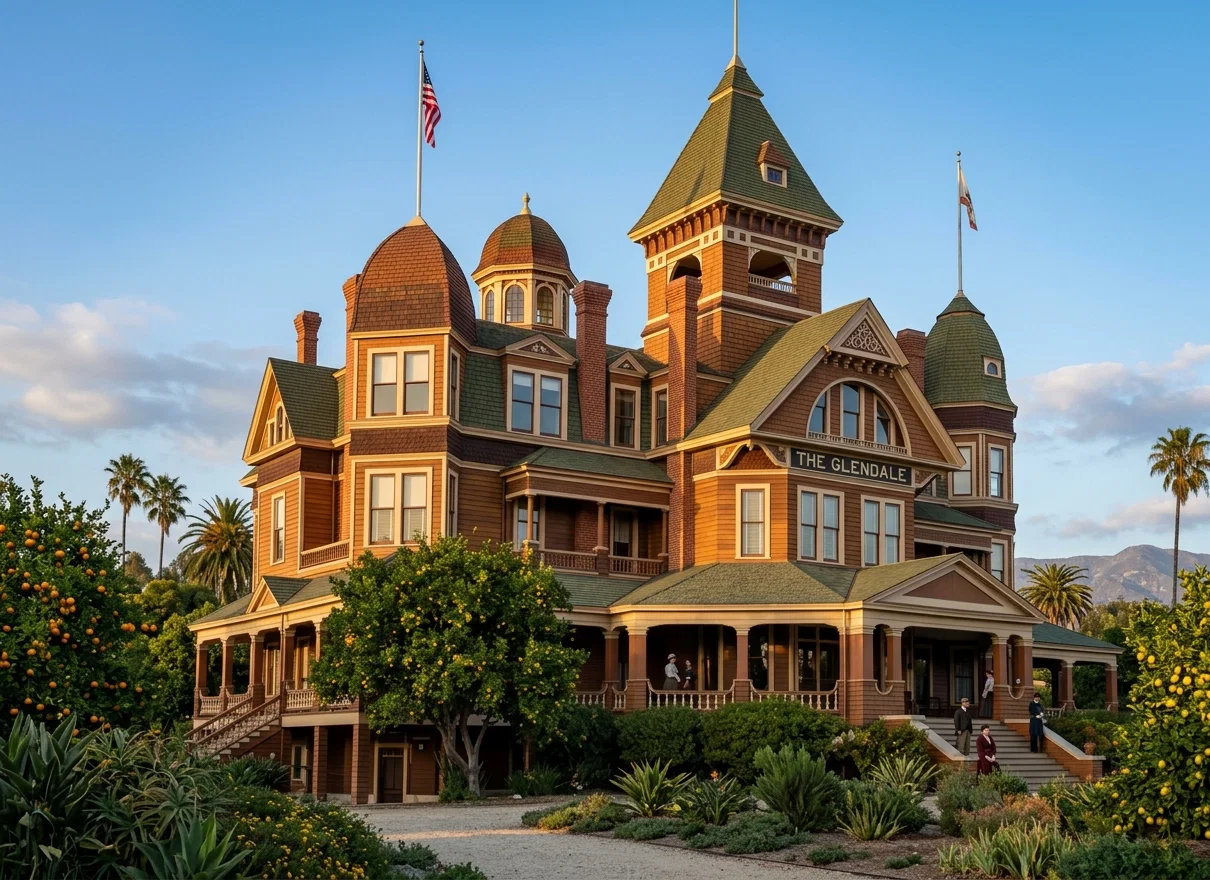
GLENDALE is the name of the new sanitarium located amid orange, lemon, and olive groves in one of the most beautiful and fertile valleys of Southern California. It is only nine miles from Los Angeles, and one mile and a half from the main line of the Southern Pacific, which runs from Los Angeles to San Francisco. A branch of the Salt Lake road runs within two blocks of the sanitarium, and the Glendale and Tropico electric line carries passengers from the Arcade depot in Los Angeles to the sanitarium door. So while the institution is located in the country, it has convenient access to the city and to all parts of the outside world.
THE GLENDALE SANITARIUM
The Fernando Valley, in which the sanitarium is located, affords an excellent supply of fresh fruits and vegetables. There are acres of strawberries and other small fruits, beside the beautiful groves of oranges and lemons. These are interspersed with alfalfa fields, vineyards, and vegetable gardens.
The ocean breezes blowing over the low range of foot-hills that hide the waters of the broad Pacific from view, fan the valley by day; and the cool mountain air by night is conducive to refreshing sleep in the warmest weather. Surrounded by hills and mountains, with an altitude of six hundred feet, Glendale Sanitarium possesses natural advantages found only in this great sanitarium country.
A thirty-minute ride on the electric line takes one to Los Angeles, and in an hour and a half the cars convey the visitor to Long Beach or any of the other sea-side resorts. A few miles from the sanitarium the mountains rise several thousand feet. An abundance of pure mountain water is conveyed in pipes to the different rooms of the building, and also to the grounds, which are planted with trees, shrubs, and flowers.
The building is a three-story structure, and contains seventy-five rooms. As it now stands, it cost over forty thousand dollars, and the grounds are worth five or six thousand dollars. The Lord gave us the entire property for twelve thousand five hundred dollars. To tell of the remarkable way in which he did it would be a long story. Most of our readers have probably read with interest what has been said through the spirit of prophecy for the past three years in reference to the medical work in Southern California. We were also told that buildings suitable for sanitarium work could be obtained at low prices.
Some time ago the Glendale property was favorably considered by the sanitarium committee. The owners held it at twenty-six thousand dollars. At that time there was no electric car line to the place. Later, the property was offered at seventeen thousand dollars. The price was regarded low, still no definite action was taken to secure the place. Last spring the electric road was completed. The committee was still considering the question of the sanitarium. After prayer and consideration, it was decided to present the nature and object of our medical work to the owner, and ask him to make a concession in the price on behalf of the work. As a result, the property was purchased on easy terms for twelve thousand five hundred dollars. At the camp-meeting held in Los Angeles, September 1-12, a resolution was passed by the conference to purchase the Glendale hotel, and to equip it for a sanitarium. Over five thousand dollars was raised by the brethren and sisters present, in donations and pledges, and over three thousand five hundred dollars in cash deposits to start the work. We trust this good beginning will continue until many more will have a part in establishing this memorial.
As Southern California is fast becoming the great sanitarium of the world, may we not look for help outside the conference? A sanitarium in a field like this is of more than local interest. There are a variety of ways in which we can assist the institution now struggling to get a start.
The Lord has spoken so definitely concerning the establishment of the medical work here that we are sure he has the means in the hands of his people to make it a success. All we desire is to open the way for him to move upon the hearts of his people to co-operate with him in carrying the enterprise forward. Donations of money, time and furnishings are always in order. These are among the best ways to help the cause of God. A large amount of furniture, bedding, linen, etc., will be required to furnish the institution. It will greatly lessen the expense of fitting up if those who can will donate something. Others might greatly assist in starting the work by depositing money without interest, or by loaning it at a low rate of interest. We shall be pleased to correspond with any who can help in this way. All can assist by calling the attention of friends and neighbors who may be in need of the benefits to be derived at the sanitarium, and last, but not least, by praying for its success.
If the Lord wills, we hope to be ready to receive patients about the middle of November; but the formal opening will probably take place a little later.
J. A. BURDEN.
The Missionary Campaign
By E. T. Russell
At the late General Conference Council held at College View, Neb., it was recommended that a general missionary campaign be conducted by our people during the months of October, November, and December, the same to be continued during the year. A missionary meeting will be held on a specified Sabbath in October, and another on a specified Sabbath in November. At these meetings field work will be considered, also the character of the literature to be used during the missionary campaign, and the best methods of placing it in the hands of the people.
Another important part of the work will be the circulation of the Signs of the Times, Life and Health, Southern Watchman, Christlicher Hausfreund (German), Evangelists Sendebud (Danish), and the Sions Vaktare (Swedish). These foreign papers are published at College View, Neb. On the covers of these papers will be advertised some of our most popular books, such as “Steps to Christ,” “Mount of Blessing,” etc. This will prepare the way for the sale of these and other books from house to house by our people. An earnest effort will be made to sell tracts and pamphlets containing present truth. The plan of this work will be set forth from time to time in the columns of the Signs and Southern Watchman, and in our German and Scandinavian papers.
I hope all will take hold energetically of the work suggested by the council. Our brethren everywhere ought to be doing their utmost to push the circulation of the special series of our papers. I sincerely hope that our foreign-speaking brethren will do all they can to aid in the circulation of the Signs and Southern Watchman, and that, on the other hand, our English brethren will do their best to assist in the distribution of the special series of the German and Scandinavian papers. I would suggest20that our English churches take quite a number of the special series of the foreign papers, and see that they are disposed of among the foreign-speaking people in their respective localities. And I would especially urge our foreign brethren to order quite a number of the special series of the foreign papers for distribution as they may deem best, but I would advise, as far as possible, that these papers be sold, as they ought to sell readily at five cents a copy. I earnestly desire to see fully two hundred thousand copies of the foreign papers sold during the missionary campaign. Can we not depend on the readers of this article to assist in this work, that our hopes may be realized, and that the truths which these papers will contain may be placed before the foreign-speaking people in this and other countries wherever these papers find their way?
Below is a price list of both foreign and English papers in sets of four papers each:—
From 1-4 sets .................20 cents
5 or more sets to single name and address ...............15 "
From 5-20 sets to one address..12 "
25 or more sets to one address..10 "