FROM the Golden Gate to Plymouth Rock; from the sea-level where the billows of the broad majestic Pacific lap the feet of the offshoots of the Sierras to the bleak wintry shores of the fiercer Atlantic; from the land of ever-blooming roses, and blossoming callas, and verdant palms, to the land enshrouded in snow and locked in the icy bands of the frost king, where the trailing arbutus, spring's earliest floral messenger, and the odorous leek of the deciduous forests, wait tardy permission to greet the warmth of the opening year; from groves of orange and lemon, laden with golden fruit, to maple sugar orchards, patiently waiting spring's proclamation of emancipation; from out-of-door picnics, and plowing, and seeding, and harvesting of root crops and fruit gathering, to lumber camps, ice harvesting, sleigh-bells, and skating, with nose and ears atingle with the frost; from 70° Fahrenheit to zero and downward; from summer land to winter land; from California to Massachusetts, we journeyed en route to General Conference, held in the quiet yet ancient little village of South Lancaster, thirty miles west of Boston.
There were seven in our party (the complete scriptural number), and we traveled by the splendid Sunset Route from San Francisco, the sentinel by the sea, to New Orleans, the "Crescent City," at the mouth of the "Father of Waters;" thence by the Piedmont Air Line to Washington, the capital of the nation; thence to New York, the metropolis of the Western World, by the well-known Pennsylvania Road; to Boston and our destination by the Fall River line of steamers and connecting railways if the ocean travel had not congealed.
Interesting! There is no transcontinental trip like it. Look upon it as outlined on some great map of the United States. Like a rough, irregular outline of an old-fashioned cradle rocker this great railway route spans the broad continent, one end at San Francisco, the other at New York, the lower part of the bend marked by a line drawn from El Paso to New Orleans, cutting in twain (for the Southern Pacific extends into Oregon, whence came two of our party) the longest way each of the two largest States in the Union, and stretching from ocean to ocean a distance of over four thousand miles, passing through every variety of soil and climate and scenery of these territories and sixteen sovereign States. So much in general.
In detail the Southern Pacific in California traverses the great Sacramento Valley north of San Francisco and the San Joaquin Valley south, the latter, extending from San Francisco Bay and its branches to the Tehachepi Mountains. This range separates Southern California, of which Los Angeles is the commercial center, from the rest of the State. "South of Tehachepi" among the political tribe sometimes suggests a separate State government, even as "west of the Sierras" used to suggest in earlier days a separate empire.
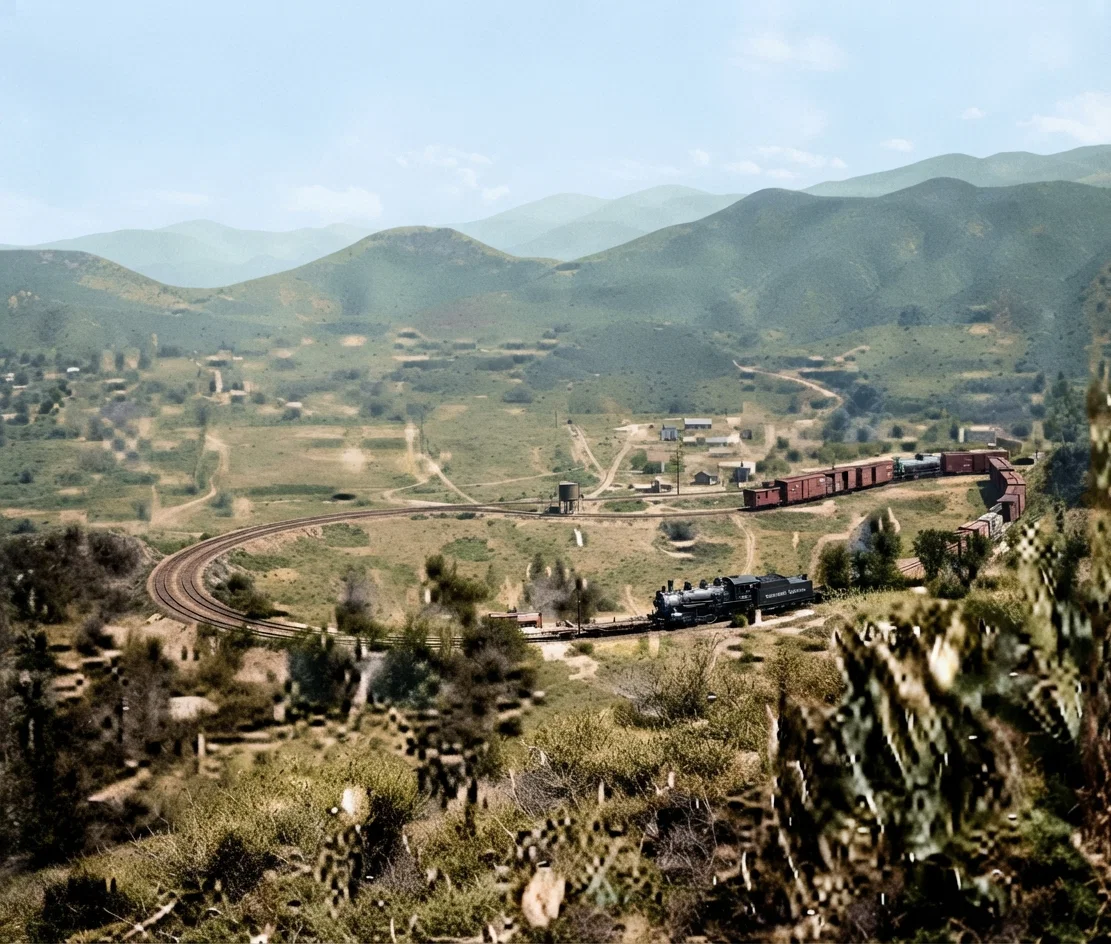
But up the Tehachepis! What a climb! New vistas of mountain and cañon and tableland and mountain brook and winding road open at every turn. And there are many turns which only skilful engineering could make. In and out, out and in, back and forth, doubling upon itself, the glistening track coils and wriggles and twists and thrusts itself up the mountain. Now it skirts the mountainside, now it bridges some frightful chasm, the next moment it plunges into the Egyptian darkness of some one of the nineteen tunnels (if memory rightly serves) which lie between Bakersfield at the foot and the summit, in and out of which the road climbs over 3,600 feet in forty-eight miles. Tantalizing to the observer are these tunnels; for they spoil many beautiful scenes; but they repay in new surprises as one emerges from their cavernous blackness. Among these tunnels is the famous "Loop," in which the road of necessity loops under itself in order to make the grade.
From Tehachepi the road descends by easy grades to Los Angeles (City of the Angels—both good and evil), the best-advertised city in the West, and perhaps worthy. It is a beautiful, enterprising town, with fine surrounding country, abundant in fruitfulness.
The Loop, Southern Pacific Railroad, Tehachepi Mountains, California.
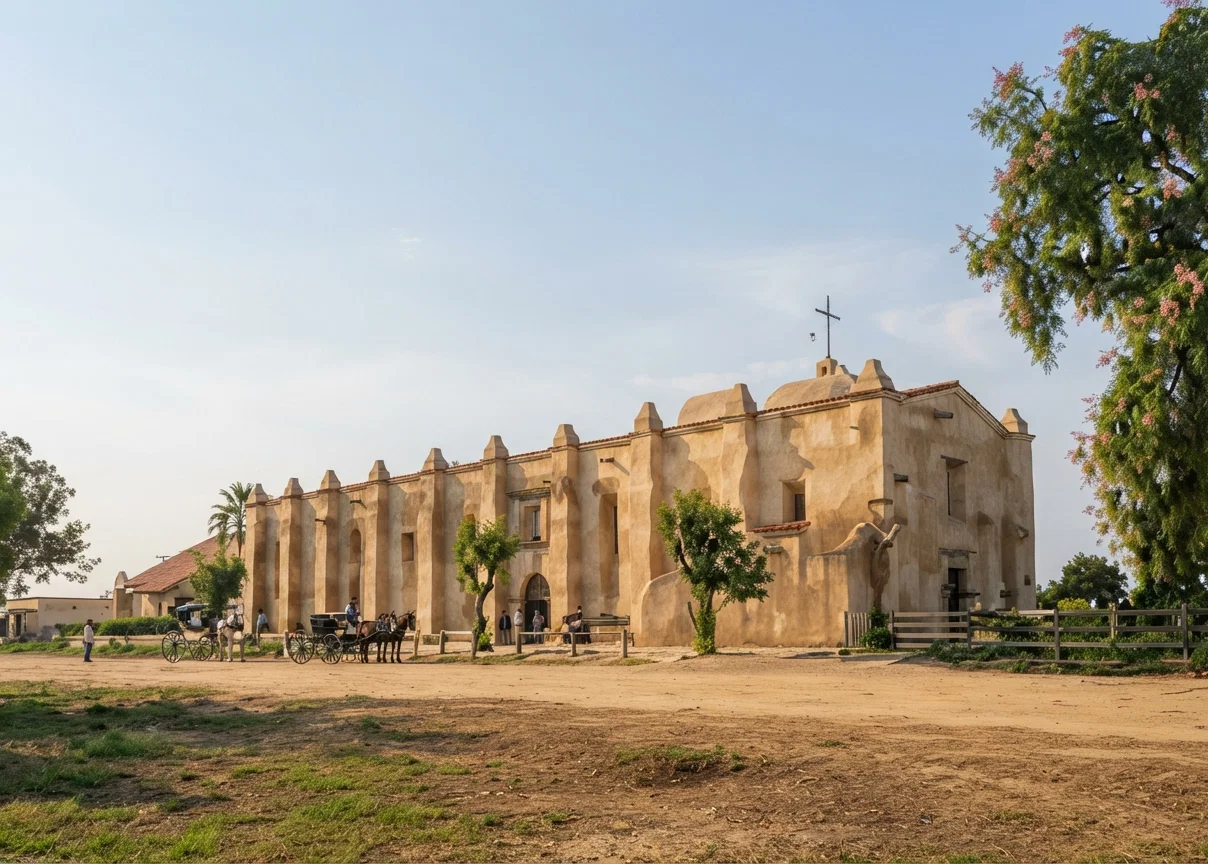
Thence past old San Gabriel Mission, built in the old Spanish days, through orange and lemon groves laden with golden fruit ready to gather, on February 2 (think of it, Eastern brother!), past palm and banana, up the mountain again, till we reach the height of 2,560 feet, at Beaumont. Then in the short distance of seventy-four miles we plunge down the mountain, over 2,800 feet, into Salton Valley, 263 feet below ocean level. Here, in tropical heat, science and patient industry compel the heavy water of this inland sea to yield its product of chloride of sodium to satisfy the saline needs of the corrupting earth. This valley was doubtless a part of the Gulf of California, separated by some convulsion of nature which upheaved the intervening mountains.
From out the Salton Sea we traverse the deserts of Southern California and Arizona, where reign supreme, each in his sphere, the rattlesnake, the Gila monster, the centipede, the tarantula, the nomad miner, the indigent and indigenous Indian, and the employee of the railway. And yet the soil is generally fertile, often exceedingly so, could it have but water, a need which the blistering sun seems to mock where, through the superheated, shimmering air, it turns desert sands and hollows into rippling lakes and bays and streams in whose depths are reflected shore and hill and mountain and cloud, and on whose bosom float ships in full sail. Such we actually saw with our own eyes. The wicked mirage; it is like the glittering, iridescent ambitions and glories of earth, which lure but to deceive, which lead on the thirsty victims till their bones lie bleaching on the deserts of oblivion and their hopes are forever perished.
But to return. This section of country once supported a noble aboriginal population; for here dwelt the cliff-dwellers and the builders of great towns and mighty fanes, relatives or ancestors of the Aztecs. The remains of these ancient people or peoples show them to have been possessed of a degree of civilization far surpassing that of their degenerate successors. Among the better specimens, perhaps, of the present natives are the Yumas, many of whom may be seen at the town of Yuma, near the mouth of the Colorado, our first entrance into Arizona. Very shrewd are these natives, equaling the Egyptian, in the gathering of "backsheesh," unwilling even that the camera shall catch their features unless paid for it; but if they could be photographed in original, picturesque, and variegated garb and pose, it would be worth while. But the light was poor and day was declining as we passed through.
Through ancient, modern, Mexican, American Arizona, where meet all extremes, our route passes, tapping the territory north and south at Maricopa, Benson, and Bowie. On we go, clipping off the southwest corner of New Mexico, the northern and central parts of which may be reached by rail from Deming, and also from El Paso (The Pass) from the extreme western end of the great State of Texas, where Mexico, New Mexico, and Texas meet. In Texas we go 950 miles through desert, waterless portions, through great grazing plains, where vast herds grow fat on the succulent grasses, through corn and cotton lands, which we believe would be equally fertile and more profitable for the tiller if a greater variety of crops was cultivated. A great State is Texas, with unlimited agricultural resources, yet waiting the key held by energy and industry.
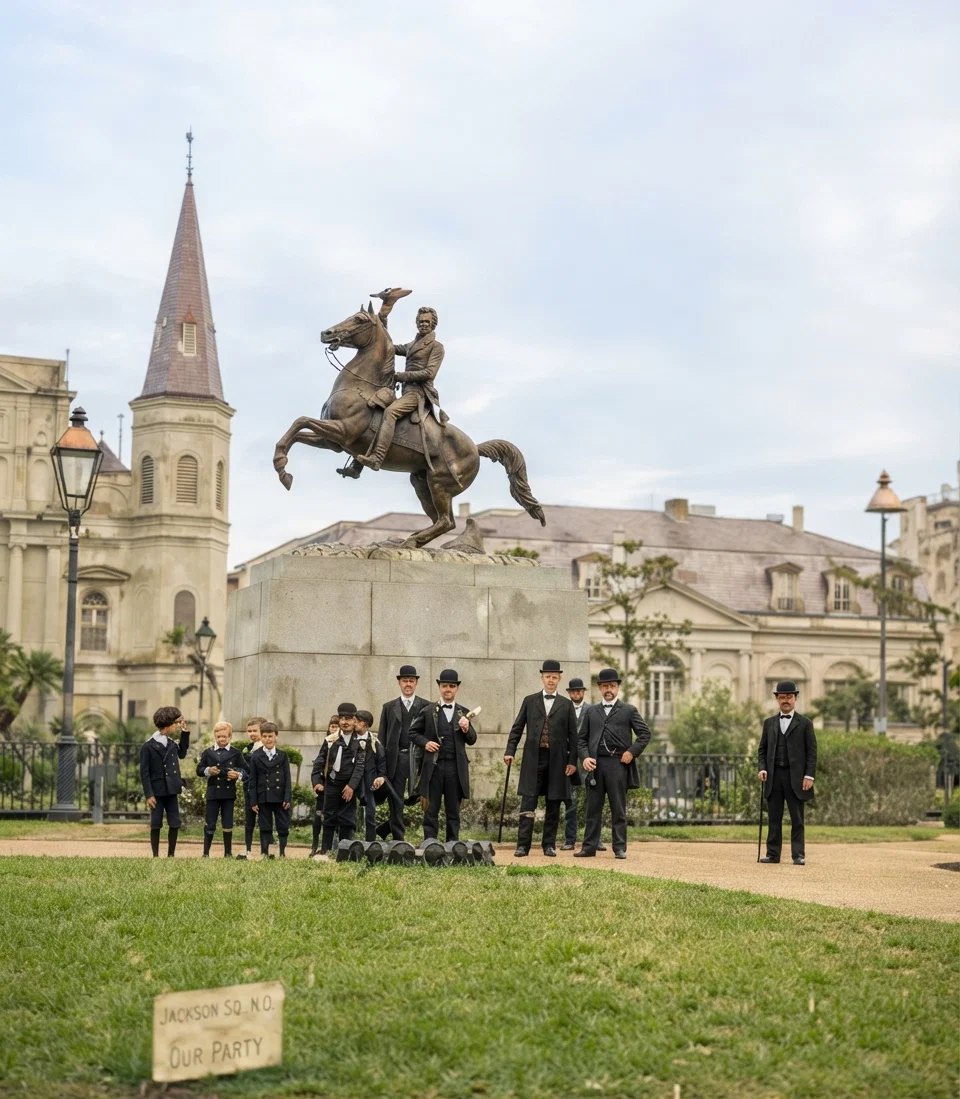
Sunday morning early brings us to New Orleans, in a thick fog. There are many things of interest to the northerner in this quaint old city. It is different from most cities. Its population is cosmopolitan,—American, French, Italian, Creole, Negro, Chinese, and others. Features worth seeing are the old French markets; the levees, by which the city is protected from the mighty Mississippi in its madness; Lake Ponchartrain, a beautiful body of water and noted summer resort; Audubon Park, where once the first sugar cane of Louisiana was grown, embracing 240 acres and containing the largest conservatory in the world; Jackson Square, the most historic spot in Louisiana, in the center of which is a fine equestrian statue of General Andrew Jackson, on one side of which are buildings in which all9the transfers of Louisiana to different nations took place; the beautiful cemeteries, most of the interments in which are made above ground; and many other attractions, which we have not space to mention. We can not forbear reference to Margaret Monument, the first erected to a woman (Margaret Haughery) in America, who, reared in poverty, accumulated a fortune in the milk and bakery business, and donated the larger part of her income in behalf of the poor. Her example ought to be a stimulant to the great city. The street-car service of New Orleans is of the very best; the chief streets are beautiful, the street-car tracks occupying the center exclusively, with green grass on either side of the track; and the employees are as uniformly accommodating and courteous as those of Oakland, and that is saying much.
San Gabriel Mission, near Los Angeles.
From New Orleans our route lay over the Piedmont Air Line to Washington, traversing several roads from the Crescent City to the capital, passing through the States of Louisiana, Mississippi, Alabama, Georgia, the Carolinas, Virginia, and Maryland. Mobile, Montgomery, Atlanta, the great railway center of the South, Spartansburg, Charlotte, Greensboro, Danville, Lynchburg, are all thriving cities and towns, strung like great beads on an iron thread, each having its special and peculiar advantages and attractions. One sees the old South and new. Opportunities offer themselves to the thriving settler all along the way. "Go South" is to our mind as opportune a cry to him seeking a home as to "go West." In some localities cotton mills are springing up, and a new aspect of affairs is presented to the traveler of olden time. Approaching Washington the foot-hills of the Appalachian Range present varied and beautiful landscape scenes, but all the way from New Orleans it is interesting. From Washington to New York we traveled through Baltimore, Wilmington, Philadelphia, Trenton, and Jersey City.
We found throughout the great four-thousand-mile journey the railway service good, and the railway employees, from general agents to porters, uniformly kind, obliging, and courteous. Especially would we mention Mr. H. G. Jones, the conductor of our car from San Francisco to Washington. As we stopped off at New Orleans, we were compelled to leave him, or he us, a matter regretted by all our party. We are sure that whenever any one of the company again comes through on the great Sunset Route and Piedmont Air Line he will inquire if he shall have Mr. Jones as car conductor.
We saw no snow, save on the mountain heights, till we reached Virginia. When we got to Philadelphia and New York, after a stop of three days by the way, the mercury was below zero, and many of the great cities of the country were suffering severely. In New York the suffering was intense, growing worse as the storm and cold continued, touching the heart-strings of the charitable and truly religious. The papers confessed man's inability, with all his scientific knowledge and facilities, to cope with nature in her angry moods.
How puny is man to meet even the fluctuations and convulsion of nature! Would that he could realize that the God who can control nature is above all, and is able to work, and will work, all things for the good of all those who are truly His.
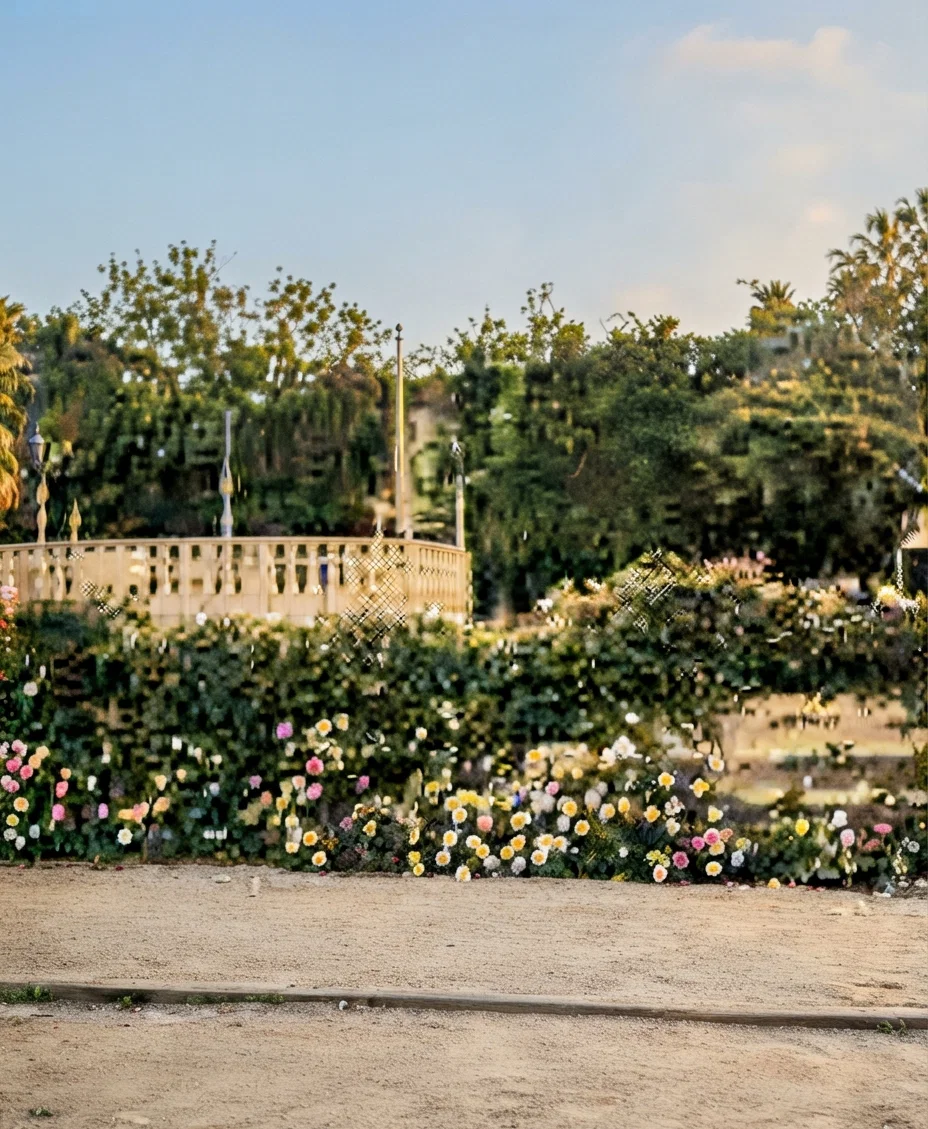
Garden, S. P. Railroad Station, Los Angeles, Cal.
Jackson Monument, New Orleans, La. Our party, with city boys in the foreground.
THE HINDERING CAUSE.
By C. M. S.
THE Chicago New World (Catholic), in speaking of the matter of Protestant evangelistic work in Porto Rico, says, "The days when Protestantism was able to make numerous converts from Catholicism have long since passed away." There is some ground for this statement; and it speaks volumes of warning to the various Protestant denominations, a warning to get back—or rather go forward again—to the basic principles of Protestantism, of true Christianity. There was a vast gulf between Protestantism and Catholicism when the Reformation was in its youth, and, notwithstanding that gulf, converts to Protestantism,—to Christianity from Catholicism,—were many. Why have they not continued? The reason is obvious. The gulf has been narrowing, and certain influential denominations have been stretching their hands across to Rome. What use is there in becoming a Protestant if one must reach back to Rome for succor?
Let the Protestant denominations of the world unite in this one thing, a determination to cease meddling in the politics of the world, and stand squarely for a separation of religion from the civil affairs of their countries. Then will they be on the road again to true, vivified Protestantism. Let them, like a growing tree, snap the cords of man-made creeds that human hands have bound about them to stifle their progress in things divine, and give themselves the chance to grow that God always designed they should have, turning again to "the Bible and the Bible only" for their rules of faith and practise; then look to God, and not to any human government, for the help and strength necessary to carry on their work. Then will they have success; then will they have the blessing of God; then will they win converts not only from Catholicism but from every form of error, and from every benighted region in the world; then will they be Protestants indeed, working God's will in the earth. And may God grant that many of them will do this right speedily. C. M. S.
SINISTER LEGISLATION.
By William Nelson Glenn
SENATE Bill No. 699, of which the following is a copy, is now before the Legislature of California:—
"SECTION 1. Every bill, placard, poster, pamphlet, or other printed matter having reference to an election, or to any candidate, shall bear upon the face thereof the name and address of the printer and publisher thereof, and no payment therefor shall be made or allowed unless such address is so printed. Any violation of this act shall be a misdemeanor."
"SEC. 2. This act shall take effect immediately."
The purpose of such a law is apparent, tho evidently designed to be obscure. The purpose is to compel all candidates for office to patronize a certain class of printers; or, if they do not do so, to have the combined political influence of that class set against them. Under such a law, a man could not have printed a simple card announcing his candidacy without stating on the card where it was printed. If he should do so, he would be adjudged a criminal, and either fined or imprisoned, or both fined and imprisoned. It may do in politics (which has become almost a synonym of corrupt practise) to watch and make even every proper act of a candidate an object of vicious attack; but to compel the officers of the law to become a party to such espionage and unwarranted prosecution or persecution, would be, to say the least, disgraceful legislation. The law already prohibits under penalty the publication of libelous or otherwise injurious matter, and it is certainly a sinister purpose that would make it a penal offense to publish otherwise proper matter without telling the public who did the printing. Have we indeed come to that point where a man's right to run for office or to do a legitimate business is dependent upon the dictation of some confederacy? And have we come to the time when it is deemed the legitimate province of the State to enforce such a condition by law?
W. N. G.
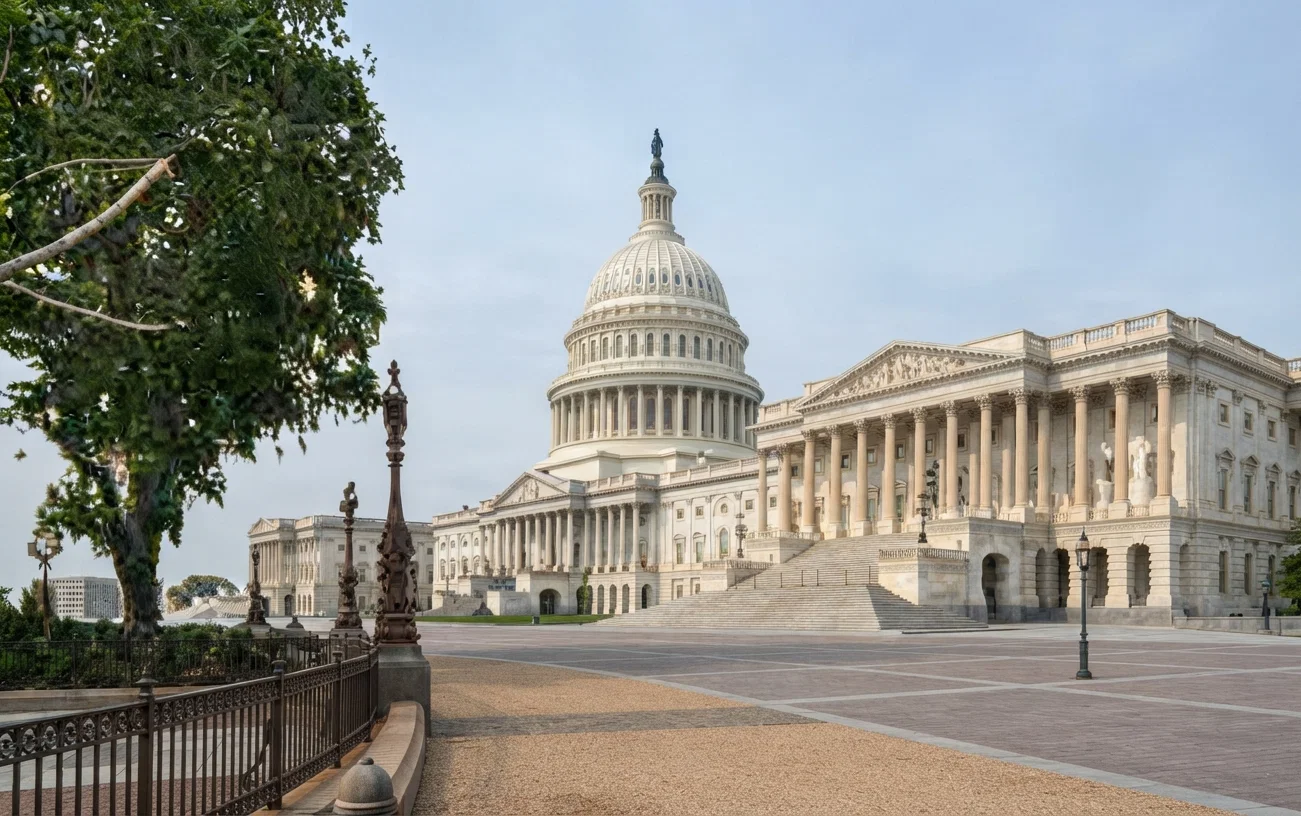
Capitol at Washington, D. C., East Front.
The Worth of Freedom
By W. N. G.
"The day that makes a man a slave takes half his worth away."
More Life and Fuller
'Tis life whereof our nerves are scant;
'Tis life, not death, for which we pant;
More life and fuller that we want.
THE PRATT BABY.
By Sydney Dayre
"WHAT'S to be done with the Pratt baby?" That was the question which was stirring the small village. Answers of various kinds were attempted.
"Mis' Peters says she'd be glad to—"
"But she couldn't, with her poor health."
"Mis' Bates might."
"But she won't."
"Mis' Lane's got her hands full a'ready."
"Mis' Dr. Miller hasn't a thing to prevent her doin' it."
"Not a chick nor a child—"
"And plenty of money."
But with all the cleverness displayed in fitting duties for other people, the Pratt baby remained homeless, altho kindly looked upon as a sort of village protégé.
Its father had been run over and killed a month after its birth. The mother took it hard and wilted out of life, so that by the time the baby was eight months old it looked out on a world in which it was absolutely without possession, yet with eyes as bright and blue and cheeks as fair and rosy as if it had been the child of an empress—perhaps more so.
For the present the baby was "staying on" in the family of Mrs. Garvey, in whose house Mrs. Pratt had rented a small room. Mrs. Garvey had six children of her own, but there was still room in it for another.
"A blessin' 'twould bring to anybody, the sweet cratur! wid its eyes laughin' and dancin' at ye the day long. An' it's meself would niver let it out of the house but for havin' nobody to stay wid it when I'm out washin'."
During such absences Billy Garvey was detailed nurse, an arrangement which suited the small boy well, for he hated school and loved the baby. It was his care day and night. Billy knew no joy greater than lay in the touch of its clinging little hands and its merry laugh as he performed for its amusement every antic known to boys.
When the first snow came Billy bundled up the baby and took it out on his sled. The baby and Billy both enjoyed this, tho it had its drawbacks. If Billy rounded a corner swiftly the baby rolled off; if he started up suddenly the baby tipped over backwards. Consideration of these difficulties led to a bright thought on Billy's part. He nailed a soap box on the sled. This he filled with hay, and when he drew it out with his blue-eyed charge no child of an empress was ever lovelier or more tenderly smiled on, no charioteer prouder than Billy.
Up and down the two or three short streets he trotted one mild afternoon. It was market day, and a number of farmers were in from the country. Billy varied his sport by hitching his sled to the backs of two sleighs, thus securing a ride for himself, mounted on a narrow ledge in front of the soap box. Quickly he sprang from one vehicle to another as they came and went, during which capers only the tender Providence which guards the helpless saved the baby's innocent life from being trampled out.
The short winter afternoon was closing in—too soon, for neither Billy nor the baby were tired of the fun. Teams were scarcer, and after a ride behind a homeward-bound farmer, Billy quickly detached his sled and as quickly fastened it to one going the other way, with prospect of another spin. But disappointment waited, for just near the edge of the village the sleigh stopped.
Billy waited, for it was nearly at the foot of a long hill. His adroit scheme was to get himself hauled to the top of this and then take a run down, excited to a wild rate of speed by the delighted crows and shrieks of the baby.
The farmer stayed a long time, and Billy grew tired. Nothing but the prospect of this latest rush down the hill would have kept him. He saw some boys at play a little way back on the street, and went to see what they were doing.
And just in the unlucky moment when his attention was fully engaged, Farmer Crofts hurried out of the store and jumped into his box sleigh. His horses, with the sleigh, had been turned diagonally toward the store; the baby in the soap box was just beyond range of his sight as he came. And in the gathering twilight no one chanced to see the precious morsel of a craft sailing along after the big sleigh, as the horses, tired of standing, sped, not up the hill as Billy had anticipated, but down another road, winding out of sight at once.
With one glance Billy had seen the baby safe; with the next his scared eyes saw only vacancy before the store door. With a wild cry he dashed toward where he had left his treasure.
"My baby! Where's my baby? Bring him back—bring him back!"
But sleigh, soap box, and baby had melted completely into the shadows. Billy ran first up one road, then down the other, at last, with a heart full of despairing misery, carrying home his sorry tale.
He could not tell to whose sleigh he had tied the baby, could not tell in which direction it had gone, did not know how far it might go.
Quickly through the village ran the tragic news, "Billy Garvey's lost the Pratt baby."
Tears sprang to more than one pair of eyes.
"I—wisht I'd taken it."
"I might 'a', just as well as not."
"I was just thinkin' of it."
"I would in a minute, if—"
But there were no conditions in the matter now, no prospect of a return of lost opportunity. The Pratt baby was lost, and the village mourned.
Farmer Crofts' horses stepped briskly along in the early evening. The increasing cold and steady motion made the baby drowsy, and, like a sensible baby (he was one of the kind who always seemed to do the right thing in the right time and place—perhaps that was his inheritance in lieu of any other), he cuddled down into the straw and went to sleep. The farmer did not know of the unusual attachment to his sleigh until he had put his horses in and was unloading it of things he had bought. Then he stumbled over the soap box and nearly fell, scattering bundles of groceries about.
"What's this?" Mr. Crofts lifted a lantern he had lighted. The baby held up his head and gave a little gurgle of pleasure at sight of the light.
"Well, I am blessed!" Mr. Crofts held the lantern closer, then jerked it away as two small balls of hands made a clutch for it. Then he put into another shape his exclamation, the truth contained in which he so little realized: "Well—if I ain't blessed!"
A look of blank bewilderment came over his face.
"How did you git here?"
If baby and soap box had fallen from the skies it could not have been a greater surprise. His surprise was none the less when he saw the string and realized how his unexpected visitor had come. What was he to do?
"Well, seein' you be here, I s'pose you can't be left out in the cold."
Not knowing what else to do, he picked up sled, soap box, and baby, and carried them into the house.
"Here, Maria," he said, setting his burden on the kitchen floor, "look what somebody's sent you."
Mrs. Crofts gazed in amazement, then in displeasure.
"Jacob, what do you mean? You don't mean that you've let somebody put something on you—"
"No, indeed, I don't. You may get as mad as you like with somebody, but not with me. That sled was hitched onto the back of the sleigh, and come all the way from Bentley."
"Well, I declare! A little mite like that out in the cold. But you see how 'tis—a game of somebody's to put that child on us. They'll be fooled, tho."
"Yes. I'll take it over to the poorhouse to-morrow. They can look for it there if they want it."
"They won't look for it. Well," as small grunts and sniffs arose from the box, "seein' it's here, I s'pose we can't let it starve."
"Anyhow, it's a putty little creature."
The baby had by this time, after much winking and blinking, accustomed his eyes to the lighted room, and was now giving signs of being restless. As Mrs. Crofts approached him with much the look with which she would have regarded a stray kitten (she not liking cats), he, being accustomed to go to everybody, held out his hands with a look of gracious readiness to be pleased if well treated.
"Well, it is kind o' bright."
The baby took eagerly the warm milk brought for him, then settled back into Mrs. Crofts' arms with a look of perfect content with the existing state of things. Mrs. Crofts laughed.11
"I can't set here holdin' a baby. You take him while I set things on."
She held him while the meal was eaten, then again passed him over to the farmer. Baby made a dash for the bushy, half gray whiskers, burying his laughing, dimpled face among them with crows and coos, which plainly invited a game of romps of the baby order. This was, however, soon over.
"He's goin' to sleep."
There was something pathetic in the peaceful trust with which the lids closed over the blue eyes as the pressure of the small head became heavier on the arm. It went to the heart of the Pratt baby's new care-takers.
"It's a cold day, Jacob," said Mrs. Crofts the next morning. "I've got a conscience, if I am set agen' bein' put on, and I don't like the idee of that little creatur' takin' a long ride such a day. To-morrow'll be milder, maybe."
To-morrow was milder, but Mrs. Crofts remarked:—
"A day or two won't make no difference, now he's here."
On the third day a boy rushed into the house with a cry:—
"O my baby! I've found you—ain't I? How came I ever to let you git away from me?"
And the Pratt baby pulled Billy's hair and poked into his eyes and rubbed his pink cheeks against the freckled ones with such little crows and squeals of delight as brought a distinct pang of jealousy to Mrs. Crofts' heart.
"Is he your'n?" she asked Billy.
"Yes. Leastways—I mean—he's the Pratt baby. He lives to my house. I've come for him. The sled's right here. I'll soon fix him up."
Setting the baby on the floor, Billy made a rush to the shed and soon brought in the soap box.
"Stop," said Mrs. Crofts, as Billy spied the small hood hanging on a nail, "if that baby's got to ride into Bentley to-day he ain't goin' in a soap box. Jacob," she called into the back yard. "I want you to hitch up and drive into Bentley. This boy's come for the baby. Says it's his'n," with a slight quiver in her voice, "and if he's to go he's got to go comfortable."
"Who'd 'a' thought anybody'd ever be wantin' the poor little chap?"
The farmer's surprise was complete when his wife appeared wrapped for the ride with the baby in her arms.
"I'm goin' to see him safe with them that has the right to him," she said firmly, adding, with some severity, "and that won't let him go cavortin' over the country in a soap box on a winter day."
Billy wilted at this, but was sustained by his joy in the recovery of the baby, comforting himself by little pokes at the soft bundle covered up in Mrs. Crofts' arms, to make sure it was safe there.
Its warmth reached the innermost recesses of her heart—a pain with it at thought of the lonely house to which she would go back without it. It had been but a few hours in which the strange, unlooked-for, unwelcomed visitant had been under her roof, and yet day and night the little presence had borne a growing sweetness. How its baby voice had filled the silent home to which she shrank from returning!
The return of the baby was heralded by triumphant shouts from Billy.
"He's back! He's back! I've found him! We've got him!"
Men came to the store doors to listen, and women ran out of small houses with shawls over their heads. A small crowd had gathered by the time Mrs. Garvey's door was reached.
It was Billy's intention to snatch the baby and rush in with a wild whoop. But Mrs. Crofts held on to it and walked with dignity into the house.
Mrs. Garvey seized the baby and wept over it a torrent of Irish fondling, while the other women waited their turn for a hug, as a babel of tongues arose.
"I'm willin' to say I'm ready to take that blessed baby"—
"I'd decided to do that myself"—
"I'm able to do well by him, and"—
"I was with his mother to the last, and I've the best right"—
Mrs. Crofts looked about on the clamoring women.
"Which of you is the mother of this child?" she asked.
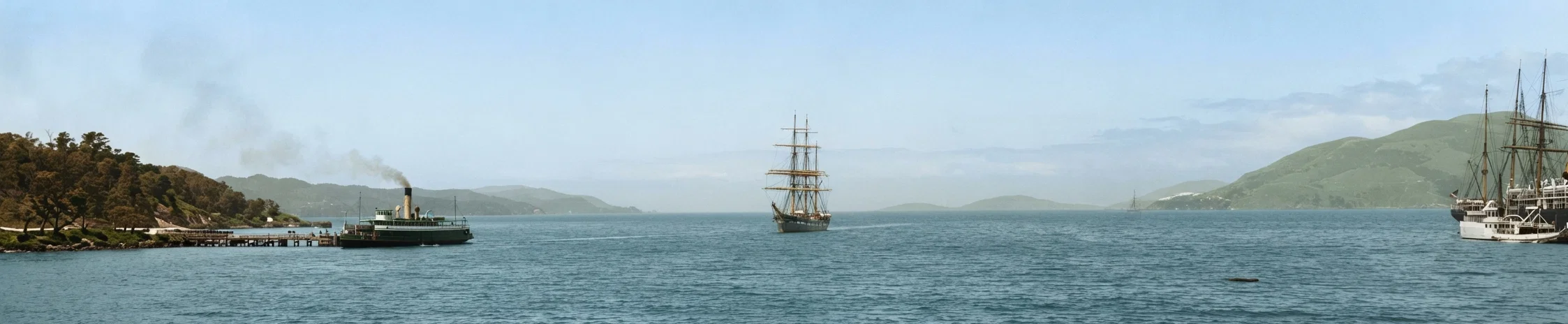
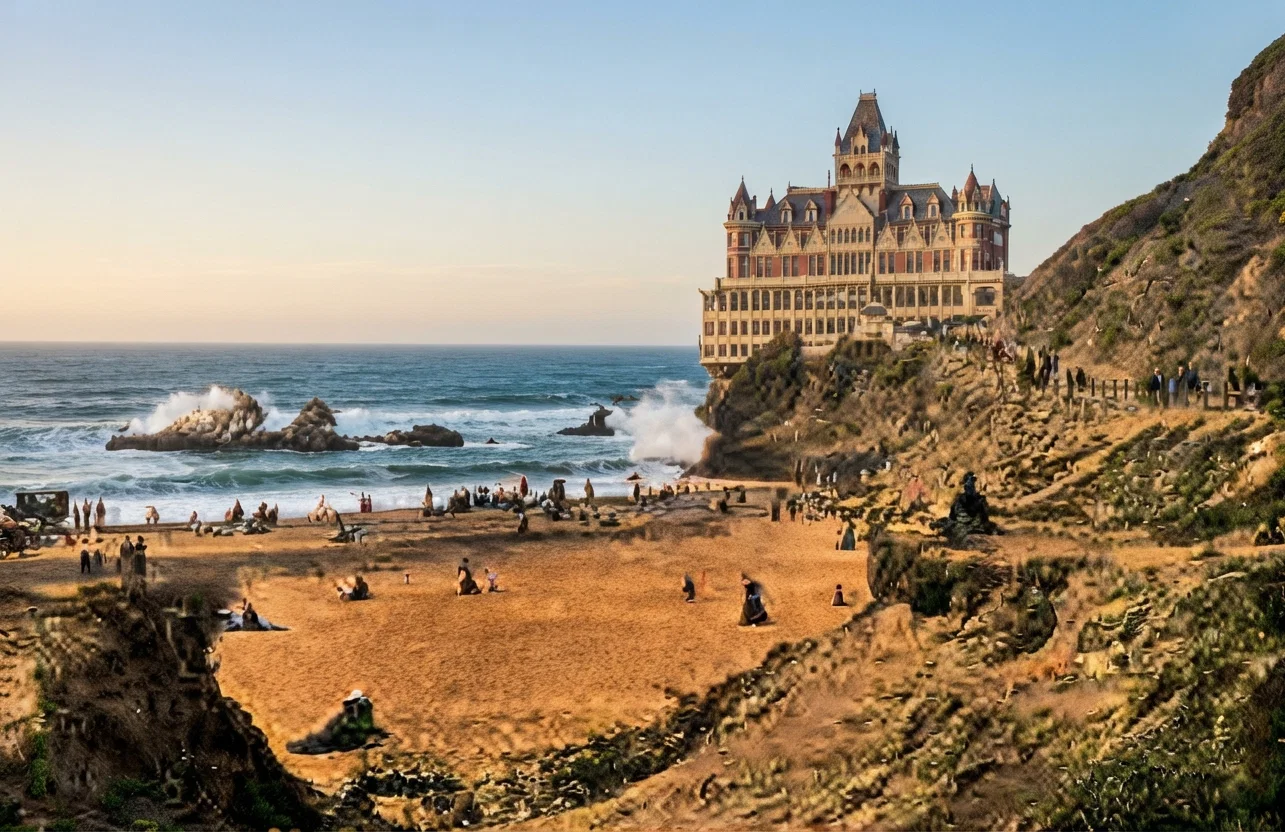
The Cliff House—Near Entrance to the Golden Gate—South View.
A blank silence for a moment, broken by Mrs. Garvey.
"It's meself would have been glad enough to take the darlint when there was no one else to do it, but for"—
"I'm ready to do it now"—
"I can give him a good home."
"Well," Mrs. Crofts arose, and with an authoritative air took the baby from the hands of the woman who just then chanced to be caressing it, "this baby come to me, all unbeknown, ridin' by itself in the winter night. If the Lord didn't send him I'd like to know why. If anybody else wanted to care for him it's a pity they didn't find it out before. I'm goin' to take him home and keep him, and if the town authorities wants to interfere they'll know where to come for him."
She strode toward the door, but stopped at sound of loud sobs from Billy, her face softening into a beaming smile.
"You come and see him whenever you want. He's to be your'n yet, all the same."
The town authorities never saw fit to find fault with the home which Billy had found for the Pratt baby.—Sydney Dayre.