BEYOND the shimmering orb of day,
Beyond the fleecy cloudlets bright,
Beyond the silvery moonbeam's ray,
My weary soul would wing its flight.
Beyond the realms of earthly wo,
Beyond the wintry frosts of time,
To God, my Father, would I go,
And dwell in Eden's goodly clime.
Beyond the mountains' snow-crowned peaks,
Beyond the western hills afar,
Beyond the spangled stars of night,
There's a home with gates ajar.
There's a home—a blessed home—
Whose nations never weary grow,
Where death and sadness never come,
And peaceful waters ever flow.
My spirit pants for that blest clime,
For regions fair beyond the skies;
My fainting soul longs for release;
My tired hands would grasp the prize.
My trembling soul amid its pain
Longs for those spicy gardens rare,
With my Beloved to ever reign,
Within those mansions over there.
MRS. ALICE M. HARPER.
Laingsburg, Mich.
How to Live a Century
By B. F. Richards
HOW TO LIVE A CENTURY. No. 7.
PURE air is food for the lungs, as bread is food for the stomach; and an inexhaustible supply of it has been furnished, fresh and free, to every living creature. It is possible for a person to live a whole month without solid food; but when deprived of fluid to drink, life becomes extinct more quickly; but when deprived of air, the person can live only a few moments.
All through life's journey, from the first breath in infancy to the last act of respiration in old age, air is an absolute necessity.
This vitalizing element, with its invigorating influence, can be heard playing in the tree-tops, whizzing around the corners of the house, and we feel it fanning our own cheeks; it is everywhere, rushing along on errands of mercy, imparting life to man, plant, and beast.
Air is a life-preserver; it is the particular friend of man; and he who barricades the doors and windows against this life-saving friend, gives a cordial invitation to disease and death to enter.
Open the doors and windows, and let the sun shine in, and let the wind blow through the rooms every morning, for they are disinfectants performing labor of a sanitary nature. Breathe long and deep; fill the lungs to their utmost capacity with pure air several times each day, and keep the home well ventilated night and day; and remember that when night comes on, all the air you have, in or out of the house, till the next morning, is "night air," and you can not bottle day air enough within the sleeping-room to last through the night; so by all means let the air circulate through the room, and thus keep a fresh supply of this life-giving element constantly with you.
More fresh air is required during sleep than when awake, for increased quantities of poisonous products are given off from the lungs and skin at this time; so each respiration renders the air in an unventilated room more unfit to be breathed again.
Keep the windows sufficiently open so the fresh "night air" can come in from one side, and the impure air can go out through the other. The upper sash should be down one inch and the lower sash up one inch for each person sleeping in the room. A lamp burning in the room should be counted as equal to one person, and a gas jet equal to six or more persons, according to size of burner. It is suicidal for any person to sleep or live in an unventilated room, for when deprived of pure air, the person will die sooner than from being robbed of any of the other life elements.
The writer has seen many instances where vines covered with heavy foliage were growing before the windows of the sleeping-room, for the express purpose of keeping out the sun. The sun, like the air, is a powerful agent, prolonging the life of the human family by burning and in other ways destroying the enemies that are lurking about in our pathway. So, in place of shutting the sun out, remove every obstruction, curtain, blinds, and vines, and let your friend shine in.
Sunshine and fresh air make cheerful homes, and, combined with wholesome food, pure water, and cleanliness of the body, make cheerful12people; and cheerfulness inspires activity, like the sparkling brook, as it glides so gracefully over its pebbly bed, proving a blessing to everything within its reach, and making living objects happier for having passed that way.
"A merry heart doeth good like a medicine; but a broken spirit drieth the bones." Prov. 17:22. Be cheerful always, in the home and away from it; "look on the bright side," and cultivate a desire to make others happy, and happiness will not be a stranger to you.
Carlyle said: "Wondrous is the strength of cheerfulness, altogether past calculation its powers of endurance. Efforts to be permanently useful must be uniformly joyous,—a spirit all sunshine, graceful from very gladness, beautiful because bright."
If we would live to a "ripe old age" we must entirely abandon the use of tobacco in all of its forms; also the use of alcoholic beverages, for they are enemies, dangerous in character, stealthily undermining the foundation on which life depends.
One of the most common causes of nervousness and dyspepsia is tea and coffee; there are 3,000,000,000 pounds of tea, and 1,000,000,000 pounds of coffee consumed annually. Tea and coffee waste vital force, impair digestion, and affect injuriously the nervous system; they break down the delicate house in which we live, and prevent the builders from repairing the same, and, if allowed to continue in their work of obstruction and destruction, the house will surely become uninhabitable and useless.
B. F. RICHARDS.
Life and Death
By Daniel Webster
ONE may live as a conqueror, a king, or a magistrate, but he must die as a man.—Daniel Webster.
OUR WORK AND WORKERS.
By Editor
SINCE the last General Conference, two years ago, sixteen of our ministers have died.
THE Seventh-day Adventist Church has one foreign missionary to every 220 members.
A REPORT of Sister Ella N. Adams notes the addition of four members to the church at Telluride, Colo.
SAYS Brother W. A. Alway, who has been laboring about two years in Utah: "I have found the SIGNS OF THE TIMES a most excellent medium in reaching the people of this State."
ON a recent visit of Brethren C. L. Taggart and J. T. Sweatt to the church at Benton, Ill., five persons presented themselves for membership.
THE first term of the new industrial school in Wood County, Wis., will be opened about the middle of April. As the buildings are not all completed, or the grounds all prepared, this summer term will give excellent opportunity for young men to work their way.
A REPORT from the recent General Conference at South Lancaster, Mass., says: "There were about 150 delegates present—all the State conferences in this country being represented, also the British field, France, Germany, Switzerland, Sweden, Norway, Denmark, Africa, South America, West Indies, and Australia."
IN a recent Review Brother C. P. Bollman reports that "the church at Sandhill, Ky., was organized January 19, with only seven members, all of whom had received letters from a church at Bowling Green; but on the next Sabbath six additional members were added." At Bowling Green there are two churches—one of white and the other of colored members.
FROM Finland comes the good news, reported by Brother John Hoffman in the Minnesota Worker, that our laborers there have secured a boat for use among the hundreds of little islands of the south coast. The report says: "The Lord helped us to get a large boat all up for 1,000 marks, or $200. Every one says it is a good sea-boat, and that the riggings and anchors alone are well worth what we paid for the whole."
THE growth of the work of Seventh-day Adventists shows development through certain lines of work, prominent among which are the following: The publishing work, which began in 1849; the health and temperance and sanitarium work, organized in 1866; the tract and missionary work, and the educational work, which arose together in 1874; the Sabbath-school Association was formed in 1877; the religious liberty work was organized as a special department in 1889, and the medical missionary work in 1893.
A LETTER in the Workers' Bulletin from Brother Isaiah Moore, formerly of Iowa, but now of the Morning Star crew on the Yazoo River, tells this story: "The poor and neglected are numbered by thousands. Could you go with me to the homes of the colored people, and see their condition in general, your hearts would ache for them. The situation is awful at present. This last year it was so wet that they had only about one-third of a crop, and a great deal of that rotted in the field before it was gathered. But, worst of all, cotton, which, as you know, is about all they raise here, is low in price on account of the poor quality of the crop. This will yet cause much suffering on the part of the renters. The rent must be paid, and the storekeepers will not sell on time. The people, having little or no money left from their last year's crop, will have to go with little to eat, and so poorly clad that they are ashamed to be seen. Under these great difficulties God is blessing the work and workers beyond all that could be expected. Our chapel where we hold school is filled nearly to overflowing. Through the help received from Iowa and other Northern States, the hungry are being fed and the naked clothed."
A REPORT in the Bivouac from Brother S. Wareham, who went to Trinidad Island from Montana as a self-supporting missionary, gives a sad account of the poverty of the people: "While we need workers in all lines of the message, we especially need help to teach this people how to till the soil, and to make a living for themselves. All our brethren here are poor, so it seems almost impossible for them of themselves to get a start in any independent occupation. There are, I am told, about 120 Sabbath-keepers in the island. We have no church building in Port-of-Spain, and it costs the Foreign Mission Board about twelve dollars a month for rent on our meeting-place, and the church is able to pay only a small part of this; so you see what could be saved if we had enough to put up a small building, say three hundred dollars. The only church building our people have on the island is at Couva, a village about thirty miles from Port-of-Spain, the brethren there being in very little better circumstances. There is a little thatched chapel up in the hills at Indian Walk, that cost about forty-five dollars. The work must be opened up in other places in the island in answer to the urgent calls, but the brethren are now helping to their utmost."
"WILL A MAN ROB GOD?" is an important pamphlet on the tithing system. It treats every phase of this great question, and deserves special attention in these days, when the Lord's means of supporting His cause is almost lost sight of. Price, 10c each. Pacific Press Pub. Co., Oakland, Cal.
Combination Offers
REFERENCE TEACHER'S BIBLE Minion Type
Page 5 1/2 x 8 inches
The Bible is substantially bound in morocco, divinity circuit, leather lined to edge, round corners, red under gold edges, minion type, and contains over 650 pages of finely illustrated Helps to the study of the Bible.
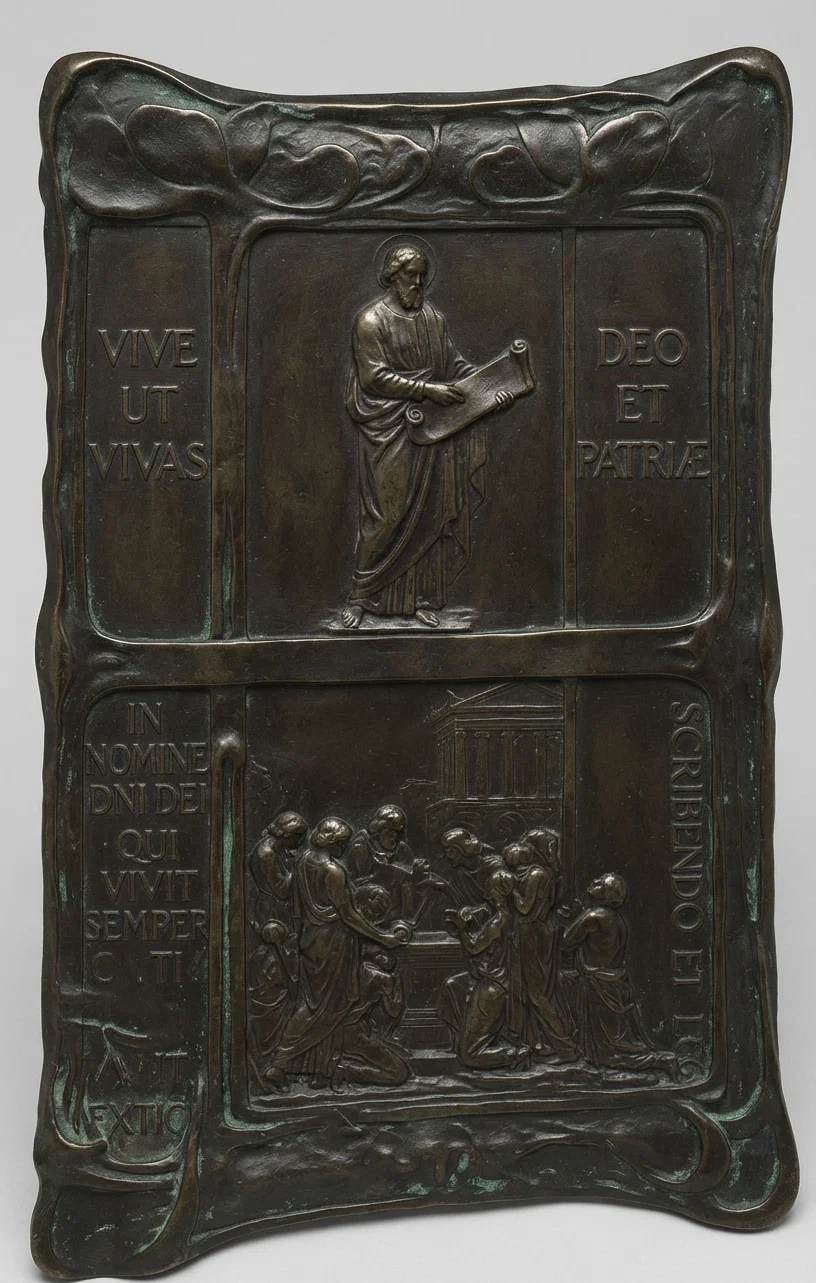
BRONZE PLAQUE.
One feature of special value in the Helps contained in this Bible is the COMBINED CONCORDANCE, which unites, in a very convenient form for ready reference, a Concordance, Subject Index, and Pronouncing Dictionary of Scripture Proper Names.
Sent post-paid with the SIGNS one year - $2.75
Bible sent free on receipt of 7 new names and $7.00
DICTIONARY OF THE BIBLE
BY DR. WM. SMITH.
Size 6½ x 9½ x 2½ inches,
Cloth bound.
Dr. William Smith's Dictionary of the Antiquities, Biography, Geography, and Natural History of the Bible is admitted by those most competent to judge to be the best of its kind in the English language. Its editor and his associate contributors are well known as among the most eminent Biblical scholars of our time, in both Europe and America.
The book contains over one thousand pages, is illustrated, and gives a full and accurate account of every name and place mentioned in the Bible, which can possibly need explanation; of every animal, plant, or mineral alluded to by the Sacred Writers; and of every custom and article of use among Jewish and contemporary nations.
This Dictionary is published by Scranton & Co., of Hartford, Conn., and sells at $4.50.
Our Price, post-paid, with the SIGNS, one year, $2.25
Book sent Free for Five New Yearly Subscriptions and one renewal at $1.00 each.
HEART-LIFE CLASSICS
By Editor
A choice line of devotional story books bound in cloth, size 6½ x 4½ inches. Excellent books for Sabbath-school libraries. Will be read with much interest and profit by both old and young.
Pilgrim's Progress, Jessica's Prayer and Jessica's Mother, Nobody Loves Me, Olive's Story, Helps over Hard Places—for Girls, Helps over Hard Places—for Boys, Line upon Line, Heart-Life, A Bag of Stories, Shepherd Psalm.
Each price 40 cts.
One copy, post-paid with SIGNS one year . . . $1.25
Any single book sent Free for One New Subscriber and One Renewal at $1.00 each.
If you desire the whole set of ten volumes mentioned above, we will send them post-paid FREE for Eight New Yearly Subscriptions at $1.00 each ($8.00).
ADDRESS
SIGNS OF THE TIMES, OAKLAND, CAL.
THE HOME LIFE.
By J. R. Miller
THERE is need for the lesson of gentleness in homes. There love's sweetest flowers should bloom. There we should always carry our purest and best affections. No matter how heavy the burdens of the day have been, when we gather home at nightfall we should take only cheer and light. No one has any right to be ungentle in his own home. If he finds himself in such a mood, he should go to his own room till it has vanished.
The mother's life is not easy, however happy she may be, for hours are long, and her load of care is never laid down. When one day's tasks are finished, and she seeks her pillow for rest, she knows that her eyes will open in the morning on another day full as the one that is gone. With children about her continually, tugging at her dress, climbing upon her knee, bringing their little hurts, their quarrels, their broken toys, their complaints, their thousand questions to her, and then with all the cares and toils that are hers, and with all the interruptions and annoyances of the busy days, it is no wonder if sometimes the strain is almost more than she can endure in quiet patience.
Nevertheless we should all try to learn the lesson of gentleness in our homes. It is the lesson that is needed to make the home happiness a little like heaven's.—Rev. J. R. Miller, D.D.
POLITICAL SPEECHES AND DEBATES OF LINCOLN AND DOUGLAS......
By Editor
A BOOK FOR THE TIMES. The following is one reason why this discussion by these two able lawyers and statesmen should find a large place amongst the people of this country to-day: Another attack is made upon the Declaration of Independence and the Constitution in an attempt once more "to turn a free people back into the hateful paths of despotism." Then, the attack was upon the clause which declares that "all men are created equal." Now, the attack is upon that clause which declares that governments derive their just powers from the consent of the governed. Then, there was rendered a decision of the Supreme Court of the United States which perverted the Constitution in the interests of that attack. Now, there is a decision of the Supreme Court of the United States which perverts the Constitution in the interests of this attack. The careful study of this history-making discussion and of the principles involved will prepare the people successfully, and in the right way, to meet all attacks upon the immortal Declaration, and to correct any and all perversions of the Constitution.
43 "And after the two days He went forth from thence into 44 Galilee. For Jesus Himself testified, that a prophet hath no honor in his own country. So when He came into Galilee, the Galileans received Him, having seen all the things that He did in Jerusalem at the feast; for they also went unto the feast. 46 "He came therefore again unto Cana of Galilee, where He made the water wine. And there was a certain nobleman, 47 whose son was sick at Capernaum. When he heard that Jesus was come out of Judea into Galilee, he went unto Him, and besought Him that He would come down, and heal His 48 son; for he was at the point of death. Jesus therefore said unto him, Except ye see signs and wonders, ye will in nowise 49 believe. The nobleman saith unto him, Sir, come down ere 50 my child die. Jesus saith unto him, Go thy way; thy son liveth. The man believed the word that Jesus spake unto him, 51 and he went his way. And as he was now going down, his 52 servants met him, saying, that his son lived. So he inquired 53 of them the hour when he began to amend. They said therefore unto him, Yesterday at the seventh hour the fever left him. So the father knew that it was at that hour in which Jesus said unto him, Thy son liveth; and himself believed, 54 and his whole house. This is again the second sign that Jesus did, having come out of Judea into Galilee.
1 "After these things there was a feast of the Jews; and Jesus 2 went up to Jerusalem. 3 "Now there is in Jerusalem by the sheep gate a pool, which is called in Hebrew Bethesda, having five porches. In 4 these lay a multitude of them that were sick, blind, halt, withered. For an angel of the Lord went down at certain seasons into the pool, and troubled the water; whosoever then first after the troubling of the water stepped in was made 5 whole, with whatsoever disease he was holden. And a certain 6 man was there, which had been thirty and eight years in his infirmity. When Jesus saw him lying, and knew that he had been now a long time in that case, He saith unto him, Wouldst 7 est thou be made whole? The sick man answered Him, Sir, I have no man, when the water is troubled, to put me into the 8 pool; but while I am coming, another steppeth down before 9 me. Jesus saith unto him, Arise, take up thy bed, and walk. And straightway the man was made whole, and took up his 10 bed and walked. "Now it was the Sabbath on that day. So the Jews said 11 unto him that was cured, It is the Sabbath, and it is not lawful 12 for thee to take up thy bed. But he answered them, He that made me whole, the same said unto me, Take up thy bed, and 13 walk. They asked him, Who is the Man that said unto thee, 14 Take up thy bed, and walk? But he that was healed wist not who it was; for Jesus had conveyed Himself away, a multitude being in the place. Afterward Jesus findeth him in the 15 temple, and said unto him, Behold, thou art made whole; sin no more, lest a worse thing befall thee. The man went away, 16 and told the Jews that it was Jesus which had made him whole. And for this cause did the Jews persecute Jesus, because He did these things on the Sabbath."
NOTE.—The texts inclosed in marks of parentheses, while not essential to the lesson study, will be found to throw much light upon the lesson, and are suggested for those who wish to study further.
SUGGESTIVE QUESTIONS.
After remaining two days with the people of Sychar, where did Jesus then go? John 4:43.
What reception did He first meet in Galilee? Why? Verse 45. (John 2:14-23.)
Coming to Cana, whom did He meet there from Capernaum? Verse 46.
What request did the nobleman make of Christ? Verse 47. (Ps 139:2.)
After some words between them, what did the Saviour say to the nobleman? Verse 50. (Ps. 107:18-20.) Note 1.
Believing these words of Christ, what did the nobleman hear on his way home? Verse 51.
Upon inquiry as to the time when his son began to amend, of what was the father convinced? Verses 52, 53.
Whom did He find at the pool of Bethesda, with an affliction of many years' standing? Verses 2-5. Note 2.
Seeing this cripple, what did Jesus ask him? Verse 6.
Upon hearing the poor man's sad story, what did Jesus then say to him? Verses 7, 8. (Acts 3:6; 4:10.)
When the Jews saw the man carrying home the pallet on which he had lain, what objection did they raise? Verses 9, 10.
Whose authority did he give for doing as he did? V. 11.
In the meantime, where was Christ? Verse 13.
Finding the man shortly after in the temple, what did Jesus say to him? Verse 14. (John 8:11; Matt. 12:45.)
What did the man then tell the Jews in answer to the question previously asked him? Verses 15, 12.
What did the Jews therefore seek to do to Jesus? Why? Verse 16. (Matt. 12:10-14.)
Side Lights.—"Desire of Ages," pp. 196-213.
NOTES.
1. Except ye see signs.—In these words Jesus laid bare the heart of the nobleman, showing him that He could and did read his inmost thoughts. The nobleman would make his belief in Christ dependent upon the answer to his prayer; but Christ's searching words convinced the anxious father that he was talking to the Messiah. His real faith in Jesus began at that moment, and is evidenced by his prayer, "Sir, come down ere my child die."
2. The pool of Bethesda.—"At certain seasons the waters of this pool were agitated, and it was commonly believed that this was the result of supernatural power, and that whoever first after the troubling of the pool stepped into the waters would be healed of whatever disease he had. Hundreds of sufferers visited the place; but so great was the crowd when the water was troubled that they rushed forward, trampling underfoot men, women, and children weaker than themselves. Many could not get near the pool. Many who had succeeded in reaching it, died upon its brink. Shelters had been erected about the place, that the sick might be protected from the heat by day and the chilliness of the night. There were some who spent the day in these porches, creeping to the edge of the pool day after day in the vain hope of relief."—Desire of Ages.
LESSON I.—SUNDAY, APRIL 2, 1899.
THE RAISING OF LAZARUS.
NOTE.—The home of Lazarus and his sisters, Martha and Mary, was at Bethany (now called El-Azarieh), on the eastern slope of the Mount of Olives. Jesus often stopped at this home, for He "loved Martha, and her sister, and Lazarus." Lazarus was taken sick, and his sisters sent for Jesus, who was at Bethabara, on the other side of Jordan. But Jesus did not start for Bethany until two days after receiving the summons, and when He arrived at Bethany Lazarus had been dead four days. Hearing that He was coming, Martha went out to meet Him, and said, "Lord, if Thou hadst been here, my brother had not died." After some conversation, Jesus remained outside until Martha went to the house and sent Mary out to greet Him.
32 "Mary therefore, when she came where Jesus was, and saw Him, fell down at His feet, saying unto Him, Lord, if Thou hadst been here, my brother had not died. 33 When Jesus therefore saw her weeping, and the Jews also weeping which came with her, He groaned in the spirit, and was troubled, 34 and said, Where have ye laid him? They say unto Him, 35 Lord, come and see. Jesus wept. The Jews therefore said, 36 Behold how He loved him! But some of them said, Could 37 not this Man, which opened the eyes of him that was blind, 38 have caused that this man also should not die? Jesus therefore again groaning in Himself cometh to the tomb. Now it 39 was a cave, and a stone lay against it. Jesus saith, Take ye away the stone. Martha, the sister of him that was dead, saith unto Him, Lord, by this time he stinketh; for he hath 40 been dead four days. Jesus saith unto her, Said I not unto thee, that, if thou believedst, thou shouldst see the glory of 41 God? So they took away the stone. And Jesus lifted up His eyes, and said, Father, I thank Thee that Thou heardest Me. 42 And I knew that Thou hearest Me always; but because of the 43 multitude which standeth around I said it, that they may be- 44 lieve that Thou didst send Me. And when He had thus spoken, He cried with a loud voice, Lazarus, come forth. He that was dead came forth, bound hand and foot with grave-clothes and his face was bound about with a napkin. Jesus saith unto him, Loose him, and let him go. 45 "Many therefore of the Jews, which came to Mary and beheld that which He did, believed on Him."
Golden Text: "I am the resurrection, and the life." John 11: 25.
SUGGESTIVE QUESTIONS.
(1) Where was the scene of this lesson? (2) At what home in Bethany had Jesus frequently stopped? (3) Why did He make that a frequent stopping-place? (4) What had now occurred to cause sadness in that home? (5) For whom did the sisters send in their time of sorrow? (6) What was the sad condition when He arrived at Bethany? (7) Which of the sisters went out first to meet Jesus? (8) What did she say to Him? (9) When Martha returned to the house, who came out to see Jesus? (For answers to foregoing questions, see introductory note.) (10) When Mary came out where Jesus was, what did she do and say? V. 32. Note 1. (11) How was Jesus affected by the scene of mourning? V. 33. (12) What question did He ask? What was the reply? V. 34. (13) How was the deep sorrow of Jesus manifested? V. 35. Note 2. (14) What did the Jews say when they saw Him weeping? V. 36. (15) What query did some of them raise? V. 37. (16) Then what did Jesus do? What kind of grave was it? V. 38. (17) What command did Jesus give? What did Martha say about opening the grave? V. 39. Note 3. (18) How did Jesus reply to her protest? V. 40. (19) When the stone was taken away, what prayer did Jesus offer? Vs. 41, 42. Note 4. (20) After the prayer, what did He say? V. 43. Note 5. (21) What was the response to this call? Then what further order did Jesus give? V. 44. (22) What was the effect of this miracle upon the people? V. 45.
NOTES.
1. "If Thou hadst been here."—Notwithstanding all the teaching of Jesus, both in word and in deed, concerning His divine origin and power, even His most devoted Jewish disciples could not grasp the idea that He could do anything for them unless He were present in person. This faith had to be first manifested and the fact demonstrated by those not of the Jewish Church. See Luke 7: 2-10; John 4: 46-53.
2. "Jesus wept."—His tears were no evidence of what some men term effeminacy, or weakness of character. They bespoke deep sorrow and strong sympathy with grief. His sorrow was not because of the death of Lazarus, for He had told His disciples that He was glad of the occasion for their sakes, that they might believe (verse 15); it was because of the unbelief of His people who were about to reject their only hope of salvation, notwithstanding the overwhelming evidence of His Messiahship.
3. "Dead four days."—This was deemed certain evidence that decomposition had begun, and to raise such an one to life could not be accounted for on any other theory than by the exercise of divine power. It was the opportunity for which Jesus had waited when He received the message that Lazarus was dead.
4. "I thank Thee that Thou hast heard Me."—This shows that Jesus had prayed over the matter before coming to the tomb, and had the mind of the Father as to what He should do. His audible prayer at that time was to give the glory to God for the miracle, and that those present might have indisputable evidence of His connection with the Father.
5. "Lazarus, come forth."—Whom did He call?—Lazarus. What did He call?—The cold, decomposing body that had been dead four days. Whence did He call Lazarus?—From the tomb. Is there any intimation that Lazarus had been anywhere else than in the tomb?—No. We have the testimony of the Lord Himself that Lazarus was dead (verse 14), and that his death was a sleep. There is no consciousness in perfect sleep, not even a dream, and "the dead know not anything." Eccl. 9: 5. The miracle was a complete re-creation of Lazarus, and, up to that time, was the crowning evidence, from a human standpoint, that Jesus was the Son of God.
Lessons by Mail on Medical Electricity or How to Use the Battery
By G. L. Abell
By Prof. G. L. Abell
Member of the Board of Directors of the Electro-Medical Society of San Francisco.
Learn how to use the battery and treat yourself. Many diseases are quickly cured by the proper application of electricity. The course embraces the treatment of every organ and part of the body. The lessons are written in plain language and are illustrated. Course, five dollars. Send for circular. Address,
PROF. G. L. ABELL, School of Chemistry and Electro-Therapeutics. 22½ Geary St., San Francisco, Cal.
Healthful
Delicious
Nut
Foods
EASILY and cheaply made in any household by the use of our complete equipment for grinding and emulsifying nuts. The production of our mills is unsurpassed.
Full directions and a booklet containing many valuable nut food recipes, free with each mill.
NUTS
Shelled and unshelled, of all kinds at reasonable prices
For further information, catalog, price-list, etc., write to
JOSEPH LAMBERT
Battle Creek Michigan
When you write, please mention the SIGNS OF THE TIMES.