Pacific Press Publishing Association, Mountain View, California
Page 1
Signs of the Times
Mar 21, 1911
Pacific Press Publishing Association · Mountain View, California · Mar 21, 1911
Pacific Press Publishing Association, Mountain View, California
Pacific Press Publishing Association, Mountain View, California
Question Corner
By Editor
"IF YE WILL INQUIRE, INQUIRE YE."
This Inquirers' Department is conducted for the purpose of helping those who are studying the Bible. The answers are oftentimes only suggestive. They are never to be considered infallible, only as they agree with the infallible Word. The writer who may answer them does not consider that his opinion is infallible. He will simply give the best that he has, and plead with the inquirer to search the Word. Such questions only will be answered as, to the editors, seem to minister to the good of the readers and to the mission of the paper. We can not answer repeatedly in the same volume questions upon the same scripture. The name and address must accompany question, not for publication, but as an evidence of good faith, and that answer may be made by letter if deemed advisable. No letters are answered which do not contain the name of the writer. It is well always to enclose stamp for reply.
3383.— Salvation of Children
By Editor
(1) Does the Bible teach that all children of godly parents under the age of accountability, or the age of deciding for themselves, shall be saved? (2) If so, are they included in the 144,000 of the last generation? (3) Is it possible for a mother alone to meet outside influences and train her children aright without Sabbath-school or church privileges? H.
1. The Bible does not deal in its condition with those not responsible; but the affirmative to the first question, it seems to us, is self-evident. See Deut. 30:19; 1 Cor. 7:14. If children have not sinned against God surely He will not hold them responsible. Jesus saves all from Adam's sin irrespective of character. Children have no sins of their own to condemn them. Will not the blood of Christ avail for them? We may safely leave all these things with God.
2. In the opinion of the writer, no. The 144,000 will have had an especial experience which children could not have. These children and others may stand with this representative company, but not be numbered with them. In other Bible numberings women and children are not included in the numbers, yet they stand with those numbered.
3. No, it is not possible for a mother to train her children for God alone, whatever the surroundings; but united with God, she has all power. Read "Does Motherhood Pay?" in issue of March 7. It takes more than mortal power to save and mold the souls of children. First of all let the mother give her children to God; then let her with Him train them for Him, prayerfully, perseveringly, hopefully.
3384.— Satan a Person
By Editor
Kindly explain Matt. 4:1-11. Are we to understand that Satan was actually present? P.
Certainly. Jesus was really present; why was not His adversary? Satan pointed to the stones, carried our Lord to a pinnacle of the temple, took Him into an exceedingly high mountain. The devil "came" to Him there in the wilderness, and after the fierce temptation, then "the devil leaveth Him." It was a crisis in Satan's affairs, and he was personally present.
3385.— Soul and Spirit
Does the soul go to heaven at death? What is meant by "soul"? P.
The word "soul" is summed up under three definitions:
1. The whole man, the person. This is its primary use. "Man became a living soul." Gen. 2:7. "Eight souls were saved" in the ark. 1 Peter 3:20. See Joshua 10, where it is spoken of persons again and again, as souls "destroyed." "Every living soul died in the sea." Rev. 16:3. In the original we read of "dead souls," rendered "bodies."
2. It is spoken of the animal life, common to man and other creatures as well, that which makes man a living, conscious being; and it is sometimes spoken of as the responsible person. See Luke 12:19; Matt. 16:26. The last text the A.R.V. renders "life." This responsible soul dies. "The soul that sinneth, it shall die." Eze. 18:4, 20.
3. It sometimes means the emotions, affections, powers, in such texts as, "Bless the Lord, O my soul." Ps. 103:1. But in no case is the soul said to be immortal, or capable of conscious existence apart from the body. It is mortal, subject to death. The spirit is a higher life which came from God as life and returns to Him as life. Compare Gen. 2:7 with Eccl. 12:7. Read the articles by Prof. G. W. Rine now running in this journal.
3386.— Compulsory Work on Sunday
By Ellet Joseph Waggoner
A person who keeps the Sabbath hires a man or woman to work for him who keeps the first day. Should he or she be required to work on the first day? Would it be right to require them so to do? E. C. W.
This is supposed to be a free country. Involuntary servitude is not permissible. No man or woman can compel other men or women to work the first day of the week, or require them to work if they do not wish to work. If one works contrary to his convictions, it is because he prefers the wages he gets to his conviction of duty, or he fears to offend his employer, or he fears he will lose his place. No one can be truly said to regard or keep as a Christian any institution or ordinance which he would yield for temporal consideration. Understanding of such matters should be had at the time when bargains or agreements are made. So much for the employee. On the other hand, no man or set of men, laborers or employers, should even speak to compel a single soul to violate conscience.
3387.— What Shall He Do?
By Editor
To shorten the question thus, Is it right for a man to withdraw from a church and join another which he believes to be in harmony with the Word of God? K.
It is always right to follow the truth of God. When we have seen what we know to be truth, truth which lies outside of the church to which we belong, let us try to win the church to that truth. If we can not do this, it is our manifest duty and privilege to join with those of like precious faith.
The first text refers to the resurrection and judgment, when all shall stand before God to receive the reward of their deeds. In the judgment, while it will be shown that Sodom will be justly condemned, yet Samaria, the ten-tribe kingdom, will be worthy of greater condemnation, because she sinned against greater light. The second text, Isa. 66:24, is a scene presented at the end of the 1,000 years, when the wicked perish by a breath from God. Their slain bodies will be seen by the righteous before the purifying fires, kindled by God's presence, rid the earth of sin and all who are identified with it. Compare with Revelation 20; Mal. 4:1. Job 14:20, 21 speaks of the death of man and his ignorance in death of the affairs of life. "The dead know not anything." Verse 22 notes his unsatisfaction in this life while he waits for death. His flesh has pain and his soul mourns.
3389.— Time of Celebrating the Lord's Supper
By Editor
Why do some celebrate the ordinances every three months, some every Sunday, while some contend that, like the Passover, it is celebrated once a year?
There is no regular time given in the Scriptures for the celebration of the Lord's Supper. The fact that it was one time observed on the first day (Acts 20:7), is no evidence that it should always be so observed. If "breaking bread" means the Lord's Supper, it was once observed daily. See Acts 2:46. The Lord's Supper is not the Passover, nor is it a continuation of it. That ended at the cross, as did all the other sacrifices, every one of which typified Christ. The Lord's Supper is a remembrancer of Christ's death, a pledge of His second coming. He has left it to His people to observe at whatever season they wish. This is implied in the expression, "As often as ye eat." 1 Cor. 11:26. Some denominations observe it as a convenient, medium time once a quarter.
3390.— The Moon Became as Blood
By Editor
Where will I find proof that "the moon became as blood," predicted in Rev. 6:12, has been fulfilled? A. A. A.
See the book "Daniel and the Revelation" on the passage in question. It occurred on the night of May 19, 1780. Altho the moon was then at the full, the night generally was fearfully dark. Whenever the moon was seen it had the appearance of blood. Letter of Milo Bostwick of Camden, N. J., March 3, 1848. See "Important Historical Extracts," page 160.
3391.— Soul and Body
By Editor
Will you please explain Matt. 10:28? We were under the impression that soul and body are one and the same.
"Soul" sometimes means the whole person, but never means merely the body. It sometimes means the creature life, and generally so in the New Testament. It comes from the same Greek word that is rendered "life" and "soul" in Matt. 16:25, 26.
3392.— The Fate of Judas
By Editor
Please explain Acts 1:18, which says that Judas "burst asunder." Matthew says he "hanged himself." D.
Both are true. He hanged himself over one of the rocky declivities near Jerusalem, and the rope or branch broke, and he fell, and his body seems to have burst open.
Galilee of the Gentiles
3393.— P.— Galilee of the Gentiles was the northwestern part of the Promised Land, occupied by various peoples. These were enlightened with the Gospel at that time. In a way they were a type of the great Gentile lands beyond the borders of Israel upon which later the light would shine.
Out of Babylon to Zion
By Editor
3394.— E. W. W.— The publication in a book of "Out of Babylon to Zion" has not yet been considered. It will be impossible to put in book form all the excellent series the SIGNS has published.
Our week's lesson is found wholly in Joshua, chapters 1 to 22. The book was doubtless largely written by Israel's leader. His name means "saviour," even as does "Jesus" in Greek. He was one of the two of his generation that "wholly followed the Lord" during the forty years of temptation and the time of the wilderness. He entered upon his greatest work when about eighty years of age. He led the children of Israel through the Jordan, divided for them the land, set them in a fair way to conquer all their foes and find the promised rest. In all his work of victory the Captain of Jehovah's hosts was with him. When Jericho, the first-fruit of that evil land, fell, it was the invisible army of God that leveled its walls; but when Israel failed to trust, they were defeated, as at Ai. How soon they might have possessed the land had they been faithful! From the triumph of Jericho there was general backsliding. Captivity came again and again, and Israel lived in adversity the years she might have lived in prosperity.
The Sanctuary
By Mrs. E. G. White
By Divine Command
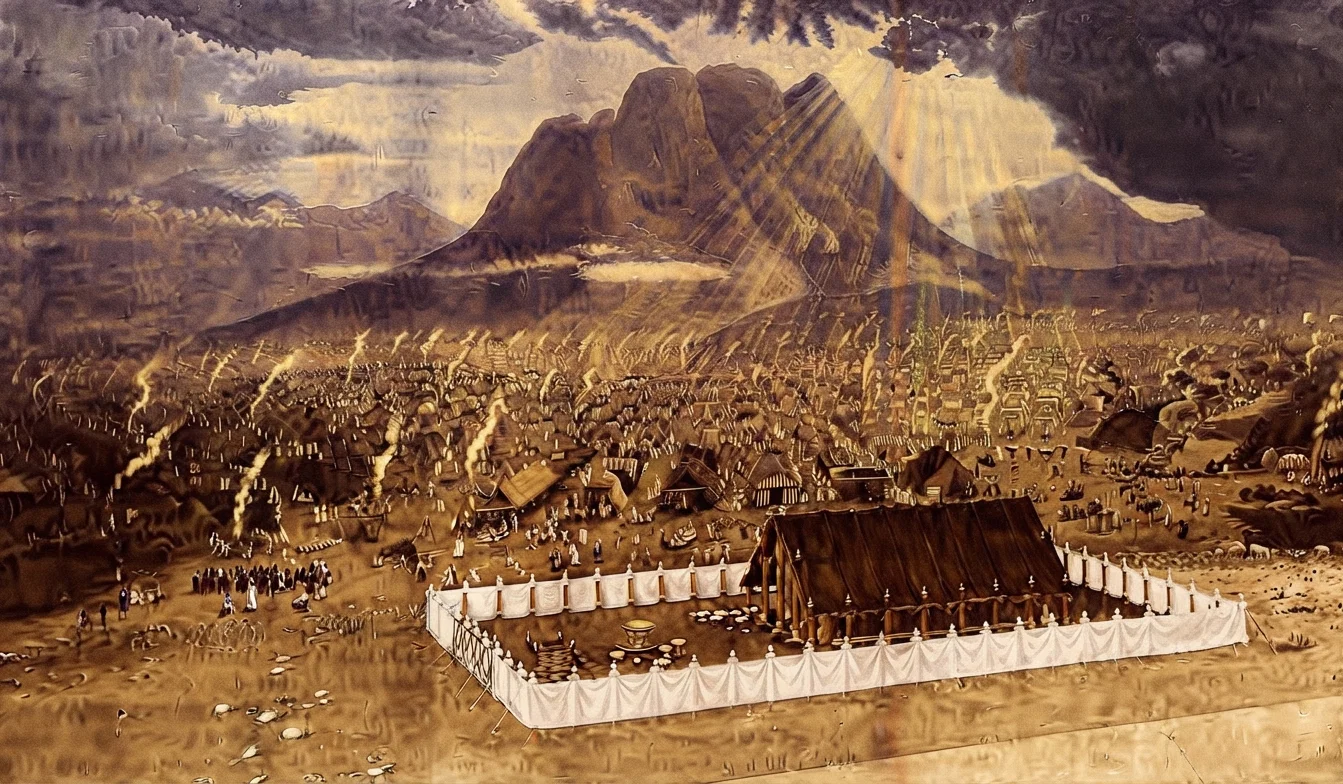
The tabernacle constructed by the Hebrews in the wilderness was made according to the divine command. Men called of God for this purpose were endowed by Him with more than natural abilities to perform the most ingenious work. Yet neither Moses nor these workmen were left to plan the form and workmanship of the building.
God Himself devised and gave to Moses the plan of that sacred structure, with particular directions as to its size and form, the materials to be used, and every article of furniture which it was to contain. He presented before Moses a miniature model of the heavenly sanctuary, and commanded him to make all things according to the pattern shown him in the mount. And Moses wrote all the directions in a book, and read them to the most influential of the people.
Then the Lord required the people to bring a free-will offering, to make Him a sanctuary, that He might dwell among them. "And all the congregation of the children of Israel departed from the presence of Moses. And they came, every one whose heart stirred him up, and every one whom his spirit made willing, and they brought the Lord's offering to the work of the tabernacle of the congregation, and for all his service, and for the holy garments. And they came, both men and women, as many as were willing-hearted, and brought bracelets, and earrings, and rings, and tablets, all jewels of gold: and every man that offered offered an offering of gold unto the Lord."
THE SANCTUARY BUILT BY MOSES
Offerings of the People
And every man, with whom was found blue, and purple, and scarlet, and fine linen, and goats' hair, and red skins of rams, and badgers' skins, brought them. Every one that did offer an offering of silver and brass brought the Lord's offering; and every man, with whom was found shittim wood for any work of the service, brought it. And all the women that were wise-hearted did spin with their hands, and brought that which they had spun, both of blue, and of purple, and of scarlet, and of fine linen. And all the women whose heart stirred them up in wisdom spun goats' hair. And the rulers brought onyx stones, and stones to be set, for the ephod, and for the breastplate; and spice, and oil for the light, and for the anointing oil, and for the sweet incense.
Great and expensive preparations were necessary. Precious and costly materials must be collected; but the Lord accepted only the free-will offerings. Devotion to the work of God, and sacrifice from the heart, were first required in preparing a dwelling-place for the Most High. And while the building of the sanctuary was going on, the Israelites, old and young, men, women, and children, brought their offerings, until those in charge of the work decided that the people had brought enough, and even more than could be used. And Moses proclaimed throughout the camp, saying, "Let neither man nor woman make any more work for the offering of the sanctuary. So the people were restrained from bringing."
The Sanctuary, the Ark, the Mercy-Seat
The tabernacle was so constructed that it could be taken apart and borne with the Israelites in all their journeyings. Yet it was a structure of extraordinary magnificence. The walls consisted of upright boards heavily plated with purest gold. The sacred building was composed of two apartments, separated by a rich and beautiful curtain, or veil. A similar veil closed the entrance of the first apartment. These4veils, with the curtain which formed the ceiling of the tabernacle, were of a variety of colors, most beautifully arranged; while inwrought with threads of gold and silver were cherubim, to represent the angelic host, who are connected with the work of the heavenly sanctuary, and who are ministering angels to the saints upon the earth.
In the inner apartment was the ark, which was the most sacred object connected with that system of worship. It was a chest of precious wood, overlaid within and without with pure gold, and having a crown of gold about the top. In the ark were placed the tables of stone upon which God had engraved with His own finger the Ten Commandments. It was made expressly for this purpose, and hence was called the ark of the covenant, and the ark of the testament, since the Ten Commandments were God's covenant, and the basis of the covenant made between God and Israel.
The cover of this sacred chest was called the mercy-seat. This was a costly and magnificent piece of workmanship. It was beaten out of one solid piece of gold, and two cherubim were made, one standing on each end, beaten out of the same piece of gold. Their faces were turned toward each other, and were looking reverently downward toward the mercy-seat, which represents all the heavenly angels looking with interest and reverence to the law of God deposited in the ark in the heavenly sanctuary. One wing of each angel was stretched forth on high, while the other covered their forms. The ark of the earthly sanctuary was the pattern of the true ark in heaven. There, beside the heavenly ark, stand living angels, each with one wing overshadowing the mercy-seat, and stretching forth on high, while the other wings are folded over their forms in token of reverence and humility.
The Altar, the Table, the Candlestick
The veil of the sanctuary did not reach to the top of the building. The glory of God, which was manifested above the mercy-seat, was partially visible from the first apartment. Directly before the ark, but separated by the curtain, was the golden altar of incense. The fire upon this altar was kindled by the Lord Himself, and was sacredly cherished by feeding it with holy incense, which filled the sanctuary with its fragrant cloud, day and night. Its fragrance extended far around the tabernacle. When the priest offered the incense before the Lord, he looked toward the mercy-seat. Altho he could not see it, he knew it was there; and as the incense arose like a cloud, the glory of the Lord descended upon the mercy-seat, and filled the most holy place, and often so filled both apartments that the priest was unable to officiate. As the priest in the holy place directed his prayer by faith to the mercy-seat, which he could not see, so the people of God direct their prayers to Christ before the mercy-seat in the heavenly sanctuary. They can not behold their Mediator with the natural eye; but with the eye of faith they see Christ before the mercy-seat, and direct their prayers to Him, and with assurance claim the benefits of His mediation.
These sacred apartments had no windows to admit light. The candlestick, beaten out of one solid piece of gold, was kept burning day and night, and gave light to both apartments. The gold-plated walls, reflecting the light from the seven lamps of the golden candlestick, the richly embroidered curtains of blue and purple and scarlet, with their shining cherubim, the table of showbread and the altar of incense, glittering like burnished gold, presented a scene of magnificence and glory which no words can describe.
Before the Mercy-Seat
No mortal eye but that of the high priest could look upon the sacred grandeur of the inner apartment, the especial dwelling-place of God's visible glory. Only once a year could the high priest enter there, after the most careful and solemn preparation. With trembling he went in before God, and the people in solemn silence waited his return, their hearts uplifted to God in earnest prayer for the divine blessing.
Before the mercy-seat, God conversed with the high priest. If he remained an unusual time in the most holy place, the people were terrified, fearing that because of their sins, or some sin of the priest, the glory of the Lord had slain him. But when the sound of the tinkling of the bells upon his garments was heard, they were greatly relieved. He then came forth and blessed the people.
The Fiery, Cloudy Pillar
After the building of the tabernacle was completed, Moses examined all the work, comparing it with the pattern shown him in the mount and the directions he had received of God, and all the multitude of Israel pressed in crowds around the tabernacle, set upon an eminence, to view it with critical eye. They regarded it perfect. They saw the golden furniture carried in, the altar and laver put in position; and while they were contemplating the full effect with reverent satisfaction, suddenly their attention was attracted to the pillar of cloud which had conducted their travels through the wilderness. The cloud arose and floated over the tabernacle, then descended and embraced it. There was a revealing of divine majesty, and the dazzling splendor was overwhelming; even Moses was not able to enter the burning glory which enshrouded the tabernacle, until the cloud had in a measure hid the exceeding brightness.
Thus the Lord signified that He accepted the tabernacle built for His presence; and ever after this manifestation, when the children of Israel encamped, directly over the tabernacle rested the pillar of cloud by day, and the bright glory in the pillar of fire by night. When the cloud ascended they knew this was the signal for them to resume their march onward. When it continued to rest over the tabernacle they were to rest from their journeying. When the Lord signified His acceptance of their work in the manifestation of His glory, the hearts of the people were inspired with awe and with gratitude. There was no noisy demonstration of joy; but with softened hearts and flowing tears they murmured low yet earnest words of thankfulness that God had approved the work of their hands, and had condescended to dwell more directly with them than ever before.
The Lord directed the Israelites in all their travels through the wilderness. When it was for His glory and the good of the people, that they should pitch their tents in a certain place, and there abide, God signified His will to them by permitting the pillar of cloud to rest directly over the tabernacle. And there it remained until God would have them journey again. Then the cloud was lifted up high above the tabernacle, and they journeyed again. In all their journeyings they observed perfect order. Every tribe bore a standard, with the sign of their father's house upon it, and every tribe was commanded to pitch by their own standard. And when they traveled, the different tribes marched in order, every tribe under their own standard. When they rested from their journeyings, the tabernacle was erected, and the different tribes pitched their tents in order, in just such a position as God had commanded, around the tabernacle, at a distance from it.
When the people journeyed, the ark of the covenant was borne before them. "And the cloud of the Lord was upon them by day, when they went out of the camp. And it came to pass, when the ark set forward, that Moses said, Rise up, Lord, and let Thine enemies be scattered; and let them that hate Thee flee before Thee. And when it rested, he said, Return, O Lord, unto the many thousands of Israel."
Taking Joy Home
By Annie Cowan Sangster
By Annie Cowan Sangster
To AWAKE full of joy that the Master
Doth so graciously lengthen our days;
Work and play will be sweet if with hands, heart, and feet
We willingly follow His ways.
Taking time in the dawn of the morning,
Ere the day's varied labors unfold,
To uplift our eyes where in sunrise skies
Seems mirrored the City of Gold.
In each sweet opening blossom, a tender
And a beautiful token to see:
He who cares for the flowers through the day's changeful hours
Will ever be mindful of me.
To list amidst the busiest duties
To the songs where the rose vines entwine;
For the birds of the air have no sorrow nor care,
They are kept by a love divine.
Breathing deep of the peace of the night-time,
In the open, where white lilies are —
For He holds in its place, in the infinite space,
Each glittering, tremulous star.
In the holy of holies to enter,
To commune with our great High Priest;
Tender watch He will keep, while His loved ones sleep,
When the toil of the day has ceased.
Just to look for the joy that lies near us —
There is more than our poor heart can hold;
And the seeker for truth finds the fountain of youth,
Finds the wealth of a treasure untold.
Call these beautiful blessings not common;
They are wondrous and free to all ranks;
And the glad heart in tune finds them lavishly strewn;
Each day yields a harvest of thanks.
Protestantism Drifting
By G. B. Thompson
II. Departure from the Faith
We hesitate somewhat to speak of the departure of professed Protestantism from the original platform of "the Bible and the Bible only" as the rule of faith, lest we be misunderstood. Conscious of our own frailties, we have little disposition to sit as a critic on others. But conscious also of our responsibility as a watchman, we dare not sit still and hold our peace when danger is impending. Were it not for this we would maintain silence now. But when infidelity dresses up in sacerdotal paraphernalia, and enters the synagog of the most high God, and with lordly mien, subtle and mysterious reasonings, and philosophical speculations, claims to be the Gospel of the Son of God, and begins the work of destroying faith in the Word of God, and blasting the hopes of those who have hitherto trusted in the Bible as a revelation from God to man, it is not a virtue to be commended to sit idly by, like a coward, while mankind is dragged into the seething Niagara of unbelief.
Ingersoll, the noted infidel, is reported to have said before his death that he did not need to lecture against the Bible any longer, for the reason that the preachers had gone at it. This is a serious indictment, and yet we are forced to confess with sorrow that to some extent it is the truth. Not that all are guilty as charged; far from it. But the professed exponents of "Higher Criticism," and of "science falsely so called," are found in many pulpits, in schools and theological seminaries, as editors of Bible dictionaries and of strong religious journals. While not desiring to sow more widely the seeds of doubt and skepticism taught under the garb of Christianity, and by professed Protestant leaders and ministers who claim the Bible as their rule of faith, yet it is necessary that some of their statements, some of this "fruit of Sodom," be laid before the reader, that he may judge for himself.
In the Homiletic Review of November, 1909, an article is published from the pen of the Rev. S. W. Blunt, of Nottingham, England, entitled "What Have the Cities Given Us?" He says:
The last fifty years have seen a very remarkable change. I doubt if many could now be found to argue in the old-fashioned way; I doubt if the sturdiest opponent of Biblical criticism would dare to assert that we may take our rules at haphazard from the Old Testament, without modifying or rectifying them by reference to the Christian standard.
That is to say, we dare not follow the Bible as it reads, until it has been interpreted and rectified by a "Christian standard." By a "Christian standard" he means, of course, the opinions of some unbelieving Bible critics. Again he says:
Many of the books of the Old Testament are not, in their present form, by the reputed authors; for example, most of the Pentateuch can not be by Moses, . . . while to the works of the prophets there have been many additions made by later writers. We shall at once be inclined to say that if this be so the Old Testament contains a great deal of sheer impudent forgery. But this is a complete mistake. Forgery implies the intention to deceive; and such an intention did not enter the minds of those Jews who passed their own writings under some great man's name.
The advance of knowledge, moreover, has shown that much of the earlier part of the Old Testament is legend or tradition, not strictly accurate history.
Is the foregoing true Protestantism, an appeal to the integrity of the Bible? No, indeed; it is infidelity. Convince a man that there are some "forgeries," "legends," or "traditions" in the Bible, and he does not know for sure where they are, in which chapter, verse, or book they may be found, and this serves to cloud with doubt the whole Bible. This is the work of infidelity.
Dr. Lyman Abbott, one of the foremost lights and leading clergymen of the present time, in the Outlook of August 20, 1907, expressed himself, editorially, as follows:
Popular opinion, gradually imbibing its ideas from literary scholars, is learning that the Bible is a collection of Hebrew law, history, and literature; that it is to be studied and interpreted as other collections of literature; that it grew up as other collections of literature have grown up; that an infallible book is an impossibility.
This "Higher Critic" simply places the Bible on a level with other books, and teaches that it should be reined up to the bar of human reason just the same as "other collections of literature," and that it is not an infallible guide. This teaching is not that of true Protestantism; it is akin to Catholicism. It is the belief of the Roman Church as expressed by Cardinal Gibbons. He says: "A rule of faith, or a competent guide to heaven, must be able to instruct in all the truths necessary for salvation. Now the Scriptures alone do not contain all the truths which a Christian is bound to believe, nor do they explicitly enjoin all the duties which he is obliged to practise."
What a wide departure is here witnessed from the Protest of the Princes, which declared that the Bible "is the sure rule of all doctrine." The following, taken from the Syracuse (New York) Journal of March 7, 1899, is significant:
At the regular weekly meeting of Methodist ministers of New York, the proposition "that the inerrancy and infallibility of the Bible are no longer possible of belief among reasoning men" was advanced in a paper read by the Rev. S. P. Cadman, pastor of the Metropolitan Temple. Mr. Cadman pointed out alleged discrepancies, and asserted that the time had come when people could find truth only at its fountainhead, Christ. At the conclusion of Mr. Cadman's paper, the four hundred ministers present applauded him.
Picture the scene if you can. Four hundred so-called Protestant ministers, pastors of large congregations in the city, clapping their hands in applause and endorsement of a claim by one of their number, that God's Word is full of mistakes! We can scarcely credit the report. We might expect such a scene at the weekly gathering of a secular league, or an infidel club, but hardly in a large body of preachers, the professed friends of the Bible. How much faith can we reasonably expect to find in the congregations over which such pastors preside? Does the Syracuse meeting stand alone in its infidelity? The late Wm. R. Harper, Ph.D., late president of Chicago University, was an eminent Higher Critic. The Chicago Herald of Jan. 29, 1894, reports him as saying in a lecture:
The story of the murder of Abel by his brother Cain is a myth. It is no more the truth as far as we know than the myth of the capture of Troy by a wooden horse, or the foundation of Rome by Romulus and Remus.
The Christian Register of June, 1891, tho in harmony with Higher Criticism, is forced to say:
Thomas Paine, tho stigmatized and set aside as an infidel, finds reincarnation in the modern Bible critic. Paine pointed out the contradictions in the Bible which render impossible the claim that it is an infallible book. He lived too far in advance of his age. The spirit of modern scientific criticism had not come. Now it is interesting to find that with a different spirit, and with different tools, . . . the professors in our theological seminaries are doing again the work which Paine did.
"Paine reincarnated!" With "different tools" doing the "same work" he did! What an awful indictment, and from the camp of the Higher Critics! We commend this to their sober consideration. No man whose heart has been transformed by the power of the Holy Spirit, through the Word, will be found placing the Bible on a level with other books, or believing a doctrine that "reincarnates" Thomas Paine. A study of the Bible changes men's hearts; but not so with other books. Who ever heard of a drunkard or a thief being redeemed by a study of some science, like geology, or mathematics? Studying a dictionary does not cause the passions of the heart to subside. But millions are ready to testify that the study of the Bible has done this for them.
Dr. Reuben A. Torrey, at the close of a sermon on unbelief, said, "I want to ask every man who has been saved from intemperance, or other sins, to stand up." Nearly a thousand men arose to their feet. Continuing, he said: "I want to be fair! I want any unbeliever who has been saved from his intemperance by his infidelity to stand." Back under the gallery a man was struggling to his feet. Torrey said, "Stand up and tell it out, my man; how did your unbelief save you?" But the man beside him said, "He can't tell it; he's drunk."
It was a belief in the Bible, and the Bible only, as a rule of faith, that lifted the world out of the gloom of the Dark Ages, by bringing to sinners a power, through faith in God's Word, that would save them from sin. Now when this holy Book is taken by its professed friends, by Protestant expositors, and placed on a level with the tomes of ancient lore written by man without divine illumination, there is nothing for the world, but to lapse again into a darkness and gloom more dense than before.
Further evidence that Protestantism is drifting from the foundation laid at the Diet of Spires in 1529 must be reserved for other articles.