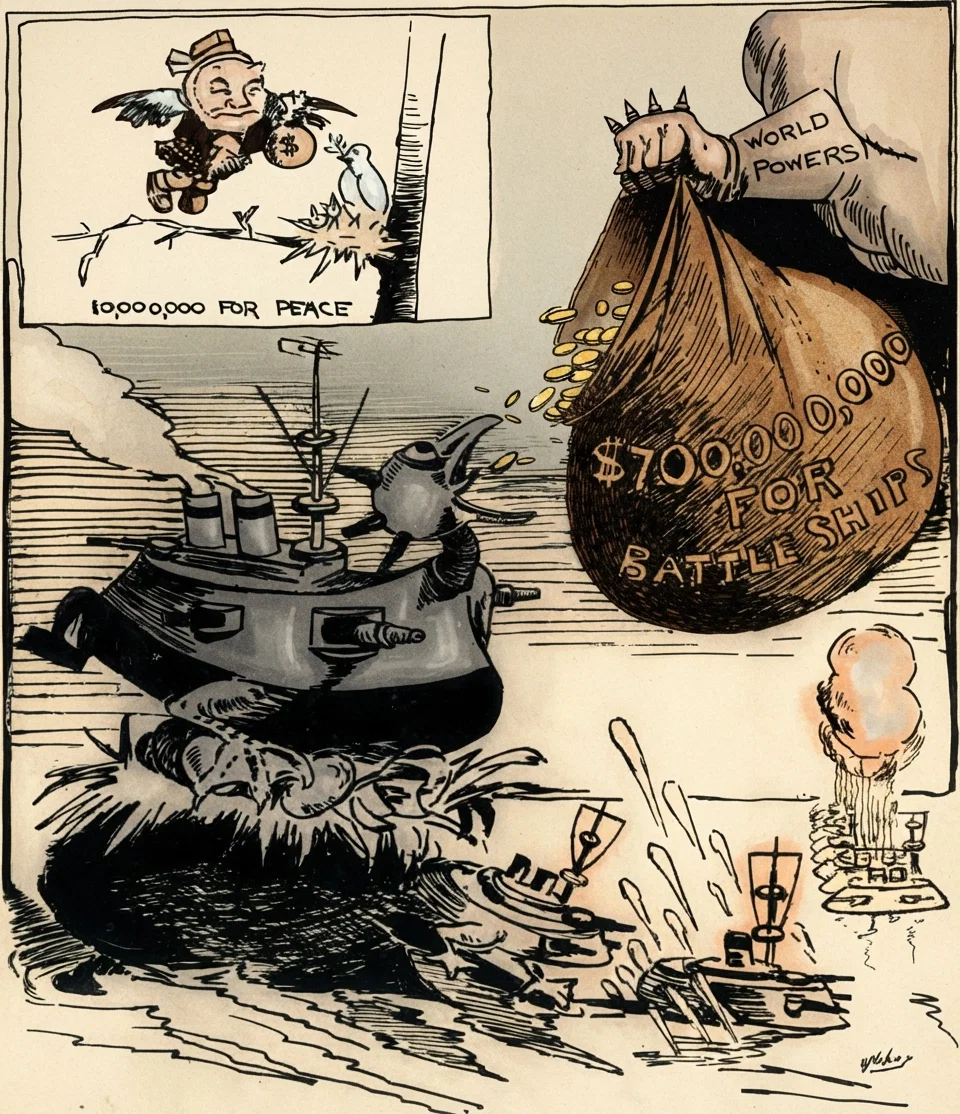
Let us therefore inquire, seeing that He knows the end from the beginning, if He has declared aught concerning the war preparations in these latter days. Unhesitatingly we reply, He has. We will quote but one passage at present; namely, Joel 3: 9-14:
Proclaim ye this among the nations; prepare war; stir up the mighty men; let all the men of war draw near, let them come up. Beat your plowshares into swords, and your pruning-hooks into spears: let the weak say, I am strong. Haste ye, and come, all ye nations round about, and gather yourselves together: thither cause Thy mighty ones to come down, O Jehovah. Let the nations bestir themselves, and come up to the Valley of Jehoshaphat; for there will I sit to judge all the nations round about. Put ye in the sickle; for the harvest is ripe: come, tread ye; for the wine-press is full, the vats overflow; for their wickedness is great,
Multitudes, multitudes in the valley of decision! for the day of Jehovah is near in the valley of decision.
Surely we may easily see in this prophecy the following predictions: (1) That there will be great and wide-spread preparations of war among the nations far and near, so that even the weak ones will prepare, and say, "I am strong." This world-wide ambition will be persistent, insistent.
2. It will be an all-absorbing ambition. The pursuits of agriculture, the things upon which the life of the people depends, will become secondary to the preparation for war. Money needed for relief of the needy, for promotion of industries, for development of land products, will be expended in improved implements of war. The prophet talks in the language of his time. It was then swords and spears; it is now mighty guns and battleships, aeroplanes and torpedo-boats, mighty explosives and submarines. But, they are drawing from depleted treasuries, the resources of which ought to be used to make life easier.
3. The prophecy declares that the great culminating war will be fought in the East, in the Holy Land perhaps, in the Valley of Jehoshaphat ("the Lord judges"), where God will visit upon the nations the fruit of their folly.
4. All this war preparation will take place when the harvest of nations is ripe, when the day of Jehovah is near, when the multitudes of earth are deciding the great moral questions placed before them by God's last great threefold message of Rev. 14: 6-14. Jesus declares, "The harvest is the end of the world," or age. Matt. 13: 39.
Are these predictions fulfilled? We do not need to answer it. The great mass of newspapers and journals of years teem with affirmative responses. Every yearly budget of every nation responds with an emphatic YES. Improved muskets, improved multiplying guns, improved shells and cannon, improved, more sensitive, and more powerful explosives, greater and mightier battleships, and a hundred and one other things, all affirm with mighty emphasis that the prophecy of the ancient seer is fulfilling before our eyes.
What of Peace?
Have the peace cry and peace conferences been predicted by the "more sure word of prophecy"? They have abundantly. Here is one of the predictions made by the son of Amoz, seven centuries before Christ: "And it shall come to pass in the latter days, that the mountain of Jehovah's house shall be established on the top [margin, "at the head"] of the mountains, and shall be exalted above the hills; and all nations shall flow unto it. And MANY PEOPLES SHALL GO AND SAY,
"Come ye, and let us go up to the mountain of Jehovah, to the house of the God of Jacob; and He will teach us of His ways, and we will walk in His paths: for out of Zion shall go forth the law, and the word of Jehovah from Jerusalem. And He will judge between the11nations, and will decide concerning many peoples; and they shall beat their swords into plowshares, and their spears into pruning-hooks; nation shall not lift up sword against nation, neither shall they learn war any more." Isa. 2: 2-4.
Let us note some of the particulars:
1. It is a prophecy of the latter days, the same as the one quoted above from Joel.
2. It declares that among the religions, great and small, of the world in the latter days, the religion of Jehovah, Christianity, will nominally occupy the highest place concededly by the nations.
3. That because of this, nations will turn to it nominally; for a nation, a government, can turn to it in no other way.
4. That because of this, many peoples (representatives of nations, see Micah 4: 2, peace congresses of nations), shall SAY, shall utter this prophecy of peace. Mark that the prophecy does not say the nations will beat their swords into plowshares or spears into pruning-hooks; it does not say that they will learn war no more; but that there will be many who will raise this peace cry and appeal to the nations to do this very work.
5. But that the nations will not yield to God, to the righteousness and peace of Christ, even tho they profess His name, is indicated by the prophet's earnest appeal and the sad statement which follows: "O house of Jacob, come ye, and let us walk in the light of Jehovah. For Thou hast forsaken Thy people the house of Jacob, because they are filled with customs from the East, and are SOOTH SAYERS LIKE THE PHILISTINES, and they STRIKE HANDS with the children of FOREIGNERS." Read the remainder of the chapter. The peace cry is not in "the light of Jehovah;" it is a cry based on compromise and error.
Is this prophecy fulfilled? Yea, verily, it is abundantly fulfilling, even as that of Joel, before our eyes, in its every particular. God offers peace on the great and substantial basis of righteousness. He has peace — it waits — "to him that is far off and to him that is near;" and there is healing in the peace; but "there is no peace, saith my God, to the wicked." Read Isa. 57: 19-21. The King of Peace is King of Righteousness, and the children of peace must be children of righteousness; for "the work of righteousness shall be peace; and the effect of righteousness, quietness and confidence forever." Isa. 32: 17.
We sympathize with the peace lovers and peace promoters; but the peace for which so many long will never come, even tho all the world fast and pray for it, until there shall be the intensely greater longing for righteousness, the righteousness which Jesus Christ alone can give to the man who forsakes his sins and who walks in the light of Jehovah. Peace congresses may meet, nations may federate, churches may pass resolutions of concord and amity, Mr. Carnegie may win popular applause by giving a paltry ten million to promote peace; but there is no peace with God save by righteousness. All the patchwork of all the peace looms of the world will not save from the awful Armageddon which the sure Word of God has predicted, for which the nations are preparing, and to stir them up to which the demons of darkness are abroad among the rulers of nations. See Rev. 16: 13, 14, 16. Those who hope in the world's cry of peace, will find themselves disappointed. When it is most hoped for, it will vanish like a dream of the night. For "when they are saying, Peace and safety, then sudden destruction cometh upon them, . . . and they shall in no wise escape." 1 Thess. 5: 3.
But, reader, there is a noble warfare to which God calls every soul — the warfare against the flesh, the world, and the devil, fought out with weapons not carnal, under the captaincy of Jesus Christ. There is a peace which "passeth understanding" to him who will surrender all to God and arrange himself under the service of the King of Peace. The effect of that righteousness and peace is eventually "quietness and confidence forever."
Ancient Prophecy and Its Fulfilment
THESE are days of war preparations on a scale so colossal that efforts of previous generations are scarcely worthy of mention. One company of men armed with modern weapons, advantageously placed, could withstand the combined armies of the world previous to the advent of the nineteenth century; and one of the mighty Dreadnoughts of to-day, given sufficient ammunition, could sink a myriad of "Invincible Armadas."
At the same time there have been cries and appeals for peace from millions of people burdened with war debt; from eminent men in nearly all civilized nations, who see the futility, foolishness, and madness of war and war preparations. But the peace influences, crystallized into national and international congresses, have not kept pace with the war preparations. To help out the peace position, it is strangely argued by its advocates that the surest guarantee of peace is war preparation. In the face of these things it would be well for Christian peoples to study some of the predictions of the Christian Book, the Bible. That Book was given by the omniscient, omnipotent One for man in all ages and times, till this stage of earth's history, this present evil age, shall close. Its predictions and admonitions are given by One who predicts the future as an evidence of His right to be called the one only God. "Remember the former things of old: for I AM GOD, AND THERE IS NONE ELSE; I AM God, and there is NONE LIKE Me, DECLARING the end from the beginning, and FROM ANCIENT TIMES THE THINGS THAT ARE NOT YET DONE, saying, My counsel shall stand, and I will do all My pleasure." Isa. 46: 9, 10.
News of the Day
The United States Government is to begin suit to end the monopoly of thirty-five electric-light firms in an illegal combine. The monopoly controls ninety-seven per cent of the trade, and sells 80,000,000 incandescent lamps yearly for $18,000,000. Foreign patents are controlled by the trust, and competition so suppressed that lamps sold for ten cents abroad sell for seventeen cents in the United States.
Word has been received from the headquarters of the Seventh Triennial International Congress on Tuberculosis at Rome that an American committee of one hundred members of the National Association for the Study and Prevention of Tuberculosis has been appointed, and that preparations have been made for the special participation of the United States in the exhibition of social hygiene which will be held under the auspices of the congress, beginning later in the year.
An armed revolt against the new President of Paraguay has been started. The revolutionists have control of the southern end of the railroad between Concepcion and Asuncion. Three thousand government troops have been sent against them. They also have five vessels, three of which are flying the Argentine flag. The Argentine government has demanded the immediate return of the seized ships.
Prof. John Fryer, for twenty years professor of Oriental languages and literature at the University of California, is considering going to Shanghai to found a new college for the blind. At present there are only two small blind schools in China. The institution he contemplates will be the largest of its kind in the Orient, fully equipped, and using the braille raised letter system.
The following is a partial list of casualties for 1910, gathered by the Chicago Tribune, aggregating 16,073 accidental deaths: "Drowned, 5,112; burned to death, 3,562; killed on railroads, 3,530; in mines, 1,004; by explosions, 951; automobiles, 920; storms, 265; asphyxiation, 239; lightning, 199; electricity, 189; elevators, 112." And over 9,000 murders have been committed.
Miss Annie Geshella, a young lady of thirty years at Passaic, New Jersey, who has fasted twenty-six days, declares: "I want to die; my heart is clean and pure. I have no confidence in the world, and there is nothing to live for." The woman has amazed the physicians because of her remarkable vitality, having shown no ill effects from her twenty-six days of fasting.
Japan has ratified the new treaty with the United States. The formal announcement states, "The Imperial Government is well convinced that the new treaty will serve not only to assure the commercial interests of both nations, but above all to consolidate the bonds of true friendship uniting them."
The linotypers and printers of Hearst's Chicago papers struck February 28. The next day, consequently, according to agreement, there were no Chicago papers of over four pages. Not a great calamity, one the public could stand quite frequently. Four pages in a daily paper is generally enough.
Dr. Theobald Smith, Professor of Comparative Pathology, Harvard Medical School, cautions that if men handling milk in the West were infected with the bubonic plague, there would be grave danger in the milk shipped East becoming infected also, with the result that the plague would spread.
Mr. W. T. Stead, of England, welcomes the reciprocity agreement between Canada and the United States as a step to bring the two great governments closer together. And so he says all Liberals regard it. America is not looked upon as a foreign country.
Insurgent Arabic tribes in Yemen, Turkey, have been subjugated by imperial troops sent from Constantinople, and interrupted communication between the port of Hodeida and the towns of Sena and Menaha has been re-established.
The Russian minister of public education has ordered the expulsion of 290 students from three universities of the empire for taking part in revolutionary outbreaks. Twelve professors in the University of Moscow have resigned.
Five Greek soldiers carrying Turkish passports have been killed by soldiers of the Sultan while passing from one blockhouse to another in Turkish territory. A break in diplomatic relations is imminent.
The United States transport Buford sailed from Seattle, Washington, March 5, laden with food supplies for suffering China. The big shipment represents country-wide contributions from rich and poor.
Massacre of the Jews by the Russians is again reported at Kief. Several families have been killed and their homes destroyed by mobs. Authorities, it is said, are making no effort to quell the riots.
A choir in a Chicago church went on a strike recently, the singers refusing to join in the services because a certain leader had not been re-instated. Strike-breaking singers were pelted with snowballs.
English Imperialists, alarmed by Germany's activity, are urging an expenditure of $50,000,000 for the construction of forty battle-ships during the next six years.
Business men of Pittsburg, Pennsylvania, offer $1,000,000 to any one who will invent a contrivance that will exterminate rats quietly and effectively.
Mr. Carnegie has offered the city of Denver, Colorado, $91,000 for four new libraries provided the city expend $9,000 a year to keep them in repair.
Ten tons of frozen storage eggs have been seized by federal authorities at a plant in St. Louis on the charge that they were unfit for food.
A lamp explosion in a skating-pavilion caused the death of fifteen skaters in St. Petersburg, Russia, and the burning of the building.
Another investigation of opium smuggling resulted in the seizure of ten tins of the drug in San Francisco from a steamer from Shanghai.
Union evangelistic meetings in progress at Duquoin, Illinois, during the last month have closed with more than two hundred conversions.
Abe Ruef, the noted San Francisco grafter, began his term of fourteen years' imprisonment in San Quentin prison March 9.
During a blizzard an ice-bound derelict was found near Astrakhan, Russia, with the entire crew of thirty frozen to death.
Thirty-two passengers have been injured and seven others burned to death in a railroad wreck at Perm, Russia.
Some lives were lost and several mosques and houses were demolished by an earthquake at Monastir in Turkey.
A severe epidemic of influenza is reported from Berlin. Fourteen thousand cases are said to exist in the city.
Six thousand coal miners have gone out on a strike at Frank, Alberta, and Michel, British Columbia.
Sixteen children were killed in an avalanche that swept down on a schoolhouse at Aihga, Russia.
Ninety Mexican rebels are reported killed in a battle at Guadalupe.
Is Wine Safer than Water?
By H. Clay Trumbull
[By the Late H. Clay Trumbull, in the S. S. Times]
If a man were to judge of the comparative harmlessness of wine and water by what he hears said of the danger of drinking water while away from his home, and of the necessity of using wine instead, he would be tempted to think that wine is the true “gift of God,” and that water is an invention of the devil.
Some years ago I was riding in an open wagon over the plains of California, with three men who before were strangers to me. The day was hot and the road dusty. At noontime we stopped at a wayside tavern for dinner. The dinner consisted chiefly of boiled pork, boiled potatoes, and boiled beans. One of my companions, not less than sixty years of age, ate of the pork and beans as if he were laying in a week’s provisions. After dinner we were again on our tedious ride. Under the hot sun, and in the jolting wagon, my heavily-laden seat-mate was taken with cramps. As he writhed and groaned in pain, it never seemed to occur to him that that pork and those beans were proving too much for him. O, no! It was the water which had done the mischief. “Dear me!” he groaned out, “I wish I hadn’t drunk any of that water at dinner. It’s almost killing me. I declare I’ll never drink any more of the water, without a touch of brandy, as long as I am in California. It really isn’t safe.” And that man’s idea of the perils of water drinking away from home is a good illustration of the general feeling on the subject, among travelers in our own country and abroad.
While at Florence, in Italy, I was remonstrated with by a kind-hearted lady, who sat next me at the dinner-table, because I ventured to drink cold water as at home. She assured me that there was no safety there except in wine drinking—even the guidebooks emphasized that fact. Moreover she told me pathetically of the serious effects of water drinking in Florence, by one and another who had for a time dared brave its risks. I then noticed that I and my traveling companions were the only persons at that well-filled table who did not drink wine. I saw enough of my fellow boarders in their eating, and I knew enough of them in their modes of living, to know that drinking cold water was not the only danger to which they were exposed in Florence, and that wine drinking would not by any means prove a guard against their every bodily peril. In their minds it was not the unsettled life they were living; not the fatigue of sight-seeing, day after day; not the exposure of the night air, and the drain on their nervous force by their late hours and their unaccustomed variety of food, that was a cause of any physical disturbance they might have experienced; no, no, it was “the water”—the God-given, God-cursed water, that was at the bottom of their every fear and risk. And I happened to know, moreover, that the water there at Florence was a great deal better water for steady drinking than the water on which many of those American travelers had been brought up in their American Western and Southern homes.
And as to a substitute for the native water of the region,—if they desired to avoid that,—it didn’t seem to occur to them that any of the many standard bottled mineral waters which were available there, would be safer and more health-giving than native wine. No, it was the water that must be shunned; it was the wine that must be taken.
I have spoken of Florence because the water there is called particularly bad. But it is pretty much the same the world over, as to this dread of water, and faith in wine, by the average traveler. Why, here in Philadelphia, during the Centennial summer, when millions came in from outside, and packed themselves in close quarters, and wore themselves out with long days of walking and standing and bewildering gazing, and overtaxed their stomachs with hurriedly eaten, indigestible lunches, whatever pains and aches anybody from that throng of visitors had, in Philadelphia or on the way home, were almost without exception attributed to the water. Of course it was the water! To hear one talk about the troubles that come from water drinking away from one’s home, might fairly prompt the question, Is there anything that is really dangerous in this world except water? And yet all this talk about the necessity laid on a traveler to drink wine or brandy instead of water while away from his home is sheer, bald nonsense.
I have traveled not a little in my lifetime. I have averaged nearly twenty thousand miles a year for twenty years at a time. I have been through the length and breadth of our land from Maine to California, and from Minnesota to Florida. I have journeyed also in Europe and Asia and Africa. Yet I never found the place where it was necessary for me to drink wine or brandy, nor yet where I deemed a native wine as safe as the native water, judging from the apparent effects on those who used the one or the other.
I have found some pretty poor water in my day, limestone water, brackish water, muddy water, sulfurous water, water well-nigh putrid with decaying vegetation. I have drunk water through a little pocket filter, from the prints of my horse’s hoofs in the traveled road after a rain-storm, as the only mode of quenching my thirst with water. I have drunk water from the tangled swamps in the sea islands of the South Carolina coast, when I had to hold my breath as I drank because of the water’s stench. But I was sure, in all these cases, that that water was safer as a drink than wine would be, and that if I added anything to it to render it innocuous, there was less reason for my trying whisky or brandy, than ginger or mustard. Among all the personal risks that I have been called to take, in my life of varied experiences, I really count water drinking the very least; and of all the personal risks I have had occasion to note in others, from my earliest recollection to the present hour, I put wine drinking among the greater.
Several years after our civil war, I was at the surgeon general’s office in Washington, making a call on Dr. Otis, with whom I had been a comrade in army life, and who was now compiling and tabulating the medical records of the entire army. In the course of our conversation he asked me how it was that my health endured through all the exposures to which I had been liable in army service and in prison life. My answer was: “Well, doctor, I suppose you will hardly agree with me on that point. I think that my keeping up so well was due to my letting whisky alone. The water we had was bad enough; but I thought it was better than the whisky, and I stuck to it all through the war. I think my total abstinence was my safety. I never borrowed to-morrow’s income to pay to-day’s expenses with, but I lived on the day’s strength every day of the war.”
The doctor’s prompt response was: “A few years ago I shouldn’t have agreed with you on that point, but now I do. Since I have compared, in this office, the health rolls of regiments where the surgeons refused to give whisky, with those of regiments where whisky was given freely, I am so impressed with the proof of gain from total abstinence, that I wonder how so many of our soldiers lived through our whisky treatment of them.” And as with whisky in America, so with wine in Europe. . . .
The evil effects of wine drinking I have seen both at home and abroad. A large proportion of all those who were my playfellows and schoolmates have either died from intemperance or are living drunkards. Men of my acquaintance who had larger brains and stronger will than I could claim, have13proved unable to resist the temptation to excess which wine drinking promotes. Even the seeming possession of a Christian character has by no means proved a safeguard against this danger to those who tampered with the evil. Ministers of the Gospel by the score, within the range of my personal acquaintance, have been among the victims of intemperance. And wives and mothers, as well as young ladies, have swelled the list of those whom I have known as drunkards — through counting wine drinking safe and necessary. Indeed I have known but few families in all my life, which the curse of intemperance had not in some way blighted. I have in mind the only son of a widowed Christian mother who learned to drink while traveling with his mother, she thinking that wine was safer for him than water. He is a hopeless, worthless sot. He would better have taken the risks of native water, as I did when I was his fellow traveler.
I have seen on our ocean steamers, and in European hotels, the wine flush on the cheek of young wives and young misses and lads, day after day; and I have no more doubt that a large share of those wine-drinking travelers are to die drunkards, than I have that water runs down hill. If a man drinks wine himself, he is not so likely to notice the effect of wine drinking on those who are at table with him. Yet I have been told by an intelligent Christian advocate of hotel table wine drinking in Europe, that the effect of the wine in loosening his own tongue and the tongues of his young lady tablemates was one reason of his counting it desirable.
It requires some courage not to drink wine abroad. Indeed, almost any self-denial involves a struggle — apart from the control of appetite. The fashion of this world is against self-denial. Wine drinking is the fashion in Europe; and one must have some character to be willing, anywhere, to stand as notably singular in a personal habit or a social custom. Moreover, those who do drink, will be constantly telling those who do not that there is no other safe way than theirs. If one would go and come as a total abstainer, he must be ready to abide unflinchingly by his own judgment, as to the right and safe way, in spite of the example and the entreaties and the solemn warnings of very excellent people, who think and do differently.
But why should one not be an abstainer? Even tho he fails to find total abstinence absolutely commanded in the Bible, he must admit that it is not forbidden there. Hence the privilege is before him to let wine alone if he wants to. And availing himself of this privilege, he avoids a terrible risk on the one hand, and he runs no risk on the other. For myself, I am afraid to venture on the moderate use of those drinks which have by their very use led so many to use them immoderately. I have seen that wine drinking anywhere is dangerous. I have found that water drinking is safer than wine drinking everywhere. That is my testimony on the wine question.
Just for To-Day
By M. C. W.
In its losses find the gains;
Gather pleasures from its pains;
In its sorrow gather gladness;
Garner hope and joy from sadness;
From its gloom clouds gather cheer;
Gather courage from its fear;
In its struggles learn His strength;
And in God’s good time, at length,
You shall see His questioned way
Always leads to brighter day.
M. C. W.
ELO THE EAGLE
AND OTHER STORIES
BY FLOYD BRALLIAR
THIS new animal book for young folks is receiving an eager welcome by all nature lovers. ELO THE EAGLE is the first of a series of ten interesting stories of animals, wild and otherwise; being, with one exception, the life histories of boyhood friends of the author. Many strange and laughable anecdotes are related by Mr. Bralliar, all of which are strictly true and vouched for by reliable witnesses.
The book is lavishly illustrated by special drawings, with a full-page half-tone design printed in Luxotype at the beginning of each chapter. Two hundred pages, printed on egg-shell paper, beautifully bound in red cloth. Price, post-paid, $1.00.
Easily sold by young people. Agents wanted.
Pacific Press Publishing Assn.
Mountain View, California
Portland, Ore. Calgary, Alberta Kansas City, Mo.
THE HOUSE WE LIVE IN
By Vesta J. Farnsworth
OR THE MAKING OF THE HUMAN BODY
BY VESTA J. FARNSWORTH
THIS is a book for home reading and it is a great help to mothers in teaching their children how to care for themselves physically.
The structure of the human body is set forth in a most interesting and instructive manner, and all its wonders, uses, functions, etc., are told in a most attractive way.
The style of the book is conversational—a mother talking with her children. It makes a splendid birthday gift.
Two hundred and eighteen pages, nearly 150 illustrations, attractive cloth cover.
Price, post-paid, $1.00.
Pacific Press Publishing Assn.
Mountain View, California
Portland, Ore. Calgary, Alberta Kansas City, Mo.
• The Protestant Magazine
By Editor
First Quarter for 1911
THE first issue of the Protestant Magazine for 1911 comes forth with a powerful appeal for a revival of true Protestantism. This issue of the Protestant is of itself a weighty testimony in favor of the Christianity of our forefathers and their constant fidelity to principle. It contains a convincing exposure of the claims of the Papacy, and the special shipwreck of modern Protestantism.
Among the topics treated in this issue of the Protestant are:
"A Vigorous Protest,"—a plain statement of the real meaning and tendency of Higher Criticism, and an appeal from it to the old-fashioned faith; "Modern Philosophy,"—a remarkable contribution to the discussion of the present condition of the religious world, by a New York attorney. His searching analysis of the teaching of religious philosophers, and a startling warning of the inevitable results, must be read to be appreciated at its true value; "Lying for the Glory of God,"—an answer to the charge made by a Catholic editor that lying is considered a legitimate weapon of defense in Protestant polemics. With this article are associated two other articles, "Immoral Moral Theology," and "The Development of the Papacy," all of which makes very interesting and instructive reading.
Sample copies of the Protestant will be sent on application. Address Protestant Magazine, Takoma Park, Washington, D. C.
The Youth's Instructor
By Editor
Special Temperance Number for 1911
THE publishers of the Youth's Instructor have just issued a very strong Temperance number, beautiful in appearance and strong in contents. Many of its articles have been written especially for the Instructor by some of the strongest and most popular temperance workers and authors. In addition to these masterly presentations of great temperance themes, the editor has compiled many of the best things printed on temperance, in the form of statistics, reports, experiences, and stories, nearly all being illustrated with drawings or attractive pictures. Taken all together, this Temperance number of the Youth's Instructor comprises the most effective collection of temperance matter ever printed, in an attractive form, suitable for general circulation. It will be a strong factor in a successful warfare against the great national curse of liquor.
Among the contributors to this special Temperance number are George T. Donehoo, David Starr Jordan, Rosa M. Barrett, A. A. Hopkins, W. T. Grenfell, Lewis E. Simes, William DeLacy, Dr. L. Bremer, Ex-Governor R. B. Glenn, John G. Woolley. Their contributions to the 1911 Temperance Instructor are very strong and practical. Send for sample copies and special rates to agents.
Youth's Instructor, Takoma Park, Washington, D. C.
Approximate Chronology
By Editor
"Type and Antitype"—a booklet giving the Scriptural and historical facts, physical and climatic conditions, and astronomical calculations, that enable us to establish in our own modern calendar time the exact date of the Passover, Crucifixion, and Resurrection of Jesus. Price 25 cents. Address H. H. Perry, 67 19th St., San Diego, California, or your tract society secretary.
Bibles.—Remember that we are headquarters for anything in the Bible line. We shall be pleased to send you our catalog of Bible selections on application. Pacific Press, Mountain View, Cal.
Life and Health
By Editor
A PRACTICAL health journal for the home, adapted to the needs of individuals, teaching how to care for and how to preserve the health, giving simple home treatments that aid nature in throwing off diseases rather than adding more poisons by using drugs or unnatural stimulants as remedies. It helps the people to avoid disease as far as possible, and teaches how to manage the home in case of sickness, and how to combat disease by simple remedies nature provides. It is an all-around home necessity in matters pertaining to health. Issued in the special interest of the rank and file of the people. Yearly subscription price one dollar; six months' subscription 50 cents.
Address Life and Health, Takoma Park, Washington, D. C.
Colds
By Editor
Colds.—By G. H. Heald, M.D. A treatise on the causes, prevention, and cure of colds. White leatherette binding. 58 pages, 25c.