Your ShelfYour Projects

Signs of the Times, Vol. 40, No. 18.

Glories of the Earth Made New

Signs of the Times

May 6, 1913

Pacific Press Publishing Association · Mountain View, California · May 6, 1913

Glories of the Earth Made New

“THE wilderness and the solitary place shall be glad for them; and the desert shall rejoice, and blossom as the rose. It shall blossom abundantly, and rejoice even with joy and singing: the glory of Lebanon shall be given unto it, the excellency of Carmel and Sharon, they shall see the glory of the Lord, and the excellency of our God.”

Question Corner

“IF YE WILL INQUIRE, INQUIRE YE.”

This Inquirers’ Department is conducted for the purpose of helping those who are studying the Bible. The answers are oftentimes only suggestive. They are never to be considered infallible, only as they agree with the infallible Word. The writer who may answer them does not consider that his opinion is infallible. He will simply give the best that he has, and plead with the inquirer to search the Word. Such questions only will be answered as, to the editors, seem to minister to the good of the readers and to the mission of the paper. We can not answer repeatedly in the same volume questions upon the same scripture. The name and address must accompany question, not for publication, but as an evidence of good faith, and that answer may be made by letter if deemed advisable. No letters are answered which do not contain the name of the writer. It is well always to enclose stamp for reply.

4060—Not Without Us, Heb. 11:40

Will you kindly explain Heb. 11:40, especially “that they without us should not be made perfect”? V.
Our querist must take into consideration the whole of the epistle up to this. It is the ultimate object of all Christ’s work and His people’s faith, namely, the glorious inheritance. This inheritance is the better thing concerning us that God has prepared. Take, for instance, in speaking of Abraham, “the father of the faithful,” he “looked for the city which hath the foundations, whose builder and maker is God.” Heb. 11:10. The promise that Jesus gave to His disciples when He was about to depart was: “I go to prepare a place for you. And if I go and prepare a place for you, I will come again, and will receive you unto Myself; that where I am, there ye may be also.” John 14:1-3. That is the ultimate fruition of the hope of the children of God. That is the better thing which God has prepared, and all are to receive that; not from dispensation to dispensation, not from generation to generation, not as individuals die, as we are sometimes taught, but when our Lord Jesus Christ shall come. So the apostle Paul, in 1 Thess. 4:15-17, says: “For this we say unto you by the word of the Lord, that we that are alive, that are left unto the coming of the Lord, shall in no wise precede them that are fallen asleep. For the Lord Himself shall descend from heaven, with a shout, with the voice of the Archangel, and with the trump of God: and the dead in Christ shall rise first; then we that are alive, that are left, shall together with them be caught up in the clouds, to meet the Lord in the air: and so shall we ever be with the Lord.” Therefore all those who have gone down in death under all the horrible cruelties that are named and inferred in the last part of Hebrews 11, did not receive the promise, but are waiting for it; and that better thing which God is preparing for us and all His children, will be given to all together, and all will be perfected together, changed to immortality, when our Lord shall come. 1 Cor. 15:51-54.

4061—Punishment for Adam

How was Adam punished for his sin? Was his sentence to go to work the penalty, or was it an additional punishment to the death sentence? Also was the pain of childbirth an additional punishment? Did Adam and Eve pay all these penalties? W. H. D.
Adam’s penalty was also a consequence. God does not pronounce arbitrary sentences alone on men. They get the consequences of the evils which they do. He declared (Gen. 2:17), “In the day that thou eatest thereof thou shalt surely die,”—that is, he would lose the heavenly life, the spiritual life which was within him. And all these other things came not simply as penalties, but as consequences, results of his disobedience. When he disobeyed, he cut himself off from the inflow of the life of God into his own being, consequently he was doomed to die. The matter of labor was not given as a sentence. God did it for Adam’s sake: “Cursed is the ground for thy sake; in toil shalt thou eat of it all the days of thy life.” It was not designed, therefore, to be a curse to man, but a blessing. One of the mightiest curses that can come upon the race is the matter of idleness. The old proverb that “an idle brain is the devil’s workshop” is preeminently true, and its counterpart is, “The devil has work for idle hands to do”; therefore God gave man work to do that would help him in every way,—show his dependence upon God, strengthen self-reliance within him, and lead him more and more to regard the giver of all good, the sender of rain and sunshine, as his Master.
“Labor is life; ’tis the still water faileth; Idleness ever despaireth, bewaileth.”
Labor was not, therefore, to be considered a punishment, but a blessing, a means of triumphing over the curse, under God.
The pain of childbirth was also a result of sin, departure from God, and one which would constantly serve to call to mind to women and men throughout the world’s history the state from which they fell. Adam and Eve not only met these things for themselves; through their sins, death came upon all men, according to Romans 5, but through the Lord Jesus Christ man is redeemed from the Adamic curse, is placed on a new probation, and abundance of grace given that he may overcome his sin.

4062—Making Oath

How can Deut. 6:13, last clause, also 10:20, last clause, and Matt. 5:34 and James 5:12, be made to harmonize? X. X. X.
The first two texts declare that we shall swear by the name of the Lord our God, and the last seem to forbid swearing. The first have reference to judicial swearing, making oath at proper times on proper occasions, the others to private, individual attestation. Jesus would have our word stand for what is true, without having to confirm it with an oath, as many do, and as the heathen often did. They were such unconscionable liars that they thought a promise was of no worth unless they could confirm it by an oath. This Christians should not do; but when called upon to make oath before proper authority, as was our Lord before the high priest, it is the proper thing to do. Jesus was asked many questions, and answered nothing; but when the high priest put the usual form of oath, “I adjure Thee by the living God, that Thou tell us whether Thou be the Christ, the Son of God,” Jesus replied. See Matt. 26:63, 64.

4063—Whom He Will, Deut. 2:30

God hardened Sihon’s heart, also Pharaoh’s. Does that not look as though He saves whom He will, and whom He will He destroys? X. X. X.
And God does. He saves whom He will, and whom He will He hardens and destroys; but first of all He hardens those who utterly reject His will, those who will not yield to Him; and He simply hardens by the withdrawing of His Spirit. Whom does He save, and upon whom will He have mercy? The second commandment tells us that He has mercy upon thousands of generations of those that love Him, and keep His commandments. But what of the sinner? “Let the wicked forsake his way, and the unrighteous man his thoughts: and let him return unto the Lord, and He will have mercy upon him; and to our God, for He will abundantly pardon.” Isa. 55:7. Then those whom God will save are those of any class whatsoever on the face of the earth who will forsake sin and come to Him, while those whom He hardens He simply hardens by the withdrawal of His Spirit, after infinite love has been exhausted in endeavoring to save them.

4064—Eating of Forbidden Things

What will be the reward of those who eat swine’s flesh and horses, mules, dogs, rabbits, rats, through ignorance of the word of God? J. H. Y.
First of all, it is not the eating of anything, or the abstaining from eating, that saves us, “for the kingdom of God is not meat and drink, but righteousness, and peace, and joy in the Holy Ghost.” Rom. 14:17. We are saved through faith in our Lord Jesus Christ. Being saved through Him, there is one motive that ought to actuate the Christian,—“Whether therefore ye eat, or drink, or whatsoever ye do, do all to the glory of God.” 1 Cor. 10:31. Some have very clear vision concerning the glory of God and one’s duty; they have very sensitive consciences regarding it. They are very diligent students of the word of God. When the clear light of that Word shines upon them, they see that such creatures as are mentioned in this question are not fit to eat, that they are no help in the keeping of a pure temple for the indwelling of the Spirit, that their flesh is unwholesome, and that the animals themselves are unhealthy. They therefore reject them. They can clearly see, by comparison, that there is better food for the Christian to eat, and they select the better. On the other hand, there may be those who have not the same opportunities, who still continue to eat such foods, not knowing that they are detrimental to bodily and spiritual health. Still, they have a heart to do God’s will perfectly, and the Lord accepts them as such. These are questions which no one can solve save God. He knows the heart, and knows all about it. Those who delight in such things as that, of course, will perish with the things they delight in, not because of the eating of any particular thing, but because of the condition of the heart, which is not such as to make them in harmony with the perfect laws of the kingdom of God.

4065—Time of the Plagues

Could you tell me about what time of the year the Egyptian plagues started? And have we any idea of how long they continued? G. W. S.
The time covered by the plagues was probably several months. This seems quite evident. The first plague probably occurred during the annual inundation of the Nile, which would be about the middle of June, according to Edersheim; and Hastings’s Bible Dictionary puts it in August; the second in September, the time when the frogs came, and even now in a limited way Egypt suffers, it is said, in this way: the seventh plague came when the barley was in ear and before the wheat was grown—this would be January or February; and the tenth in the following March or April.

4066—Crucifixion

Will you please tell me if there is any record of any one’s being put to death on the cross before the coming of Christ? Or was it used in those days? H. J. T.
Yes, the cross was used before the time of our Saviour. That very thing is implied when Pilate asked what they should do with Jesus. The cry at once was, “Crucify Him, crucify Him.” This would indicate that such was the regular way the Romans had, at that time, of executing criminals. The “International Encyclopedia,” under the word “Cross,” says: “The cross was a common instrument of capital punishment among the ancients; and the death on the cross was deemed so dishonorable that only slaves and malefactors of the lowest class were subjected to it by the Romans. It was customary to proclaim the name and the offense of the person crucified, or to affix to the cross a tablet (‘album’) on which name and offense were inscribed. Malefactors were sometimes fastened on a single upright stake, and so left to die, or they were impaled upon it, and to this upright stake the Latin name ‘crux’ (cross) was originally and more strictly applicable; but very generally a crosspiece (‘patibulum’) was added to the stake, to which the arms of the criminal were tied, or to which his hands were nailed. The person crucified often lived for days.” As an emblem, it runs away back into idolatry. The same authority says: “It appears that the cross was in use as an emblem, having certain religious and mystic meanings attached to it, long before the Christian era. The Spanish conquerors were astonished to find it an object of religious veneration among the natives of America.”

Our Bible Band

Sunday May 4 2 Samuel 14, 15 Monday " 5 " 16, 17 Tuesday " 6 " 18, 19 Wednesday " 7 " 20, 21 Thursday " 8 " 22 Friday " 9 " 23, 24 Sabbath " 10 Psalms 30, 31, 32
Our reading for the week embraces the rest of 2 Samuel, giving a history of the reign of David, the difficulties that he encountered, the sad consequences of his many wives, and the sons that he was unable to control. Absalom's rebellion against him and the death of the petted idol of the kingdom, David's lament and his return to Jerusalem, his troubles with Joab, his numbering of the people, all are told with such detailed faithfulness that it stamps the whole account with inspiration. God does not hide the sins of the greatest of kings. Very instructive and helpful are the psalms which close our week's reading, 30, 31, 32.

The Saviour Glorified

By Mrs. E. G. White
CHRIST had sojourned in the world for thirty-three years; He had endured its scorn, insult, and mockery; He had been rejected and crucified. Now, when about to ascend to His throne of glory—as He reviews the ingratitude of the people He came to save—will He not withdraw His sympathy and love from them? Will not His affections be centered on that world where He is appreciated, and where sinless angels adore Him, and wait to do His bidding?—No; His promise to those loved ones whom He leaves on earth is, “Lo, I am with you alway, even unto the end of the world.” Before His conflict, He had prayed the Father that they might not be taken out of the world, but should be kept from the evil which is in the world.
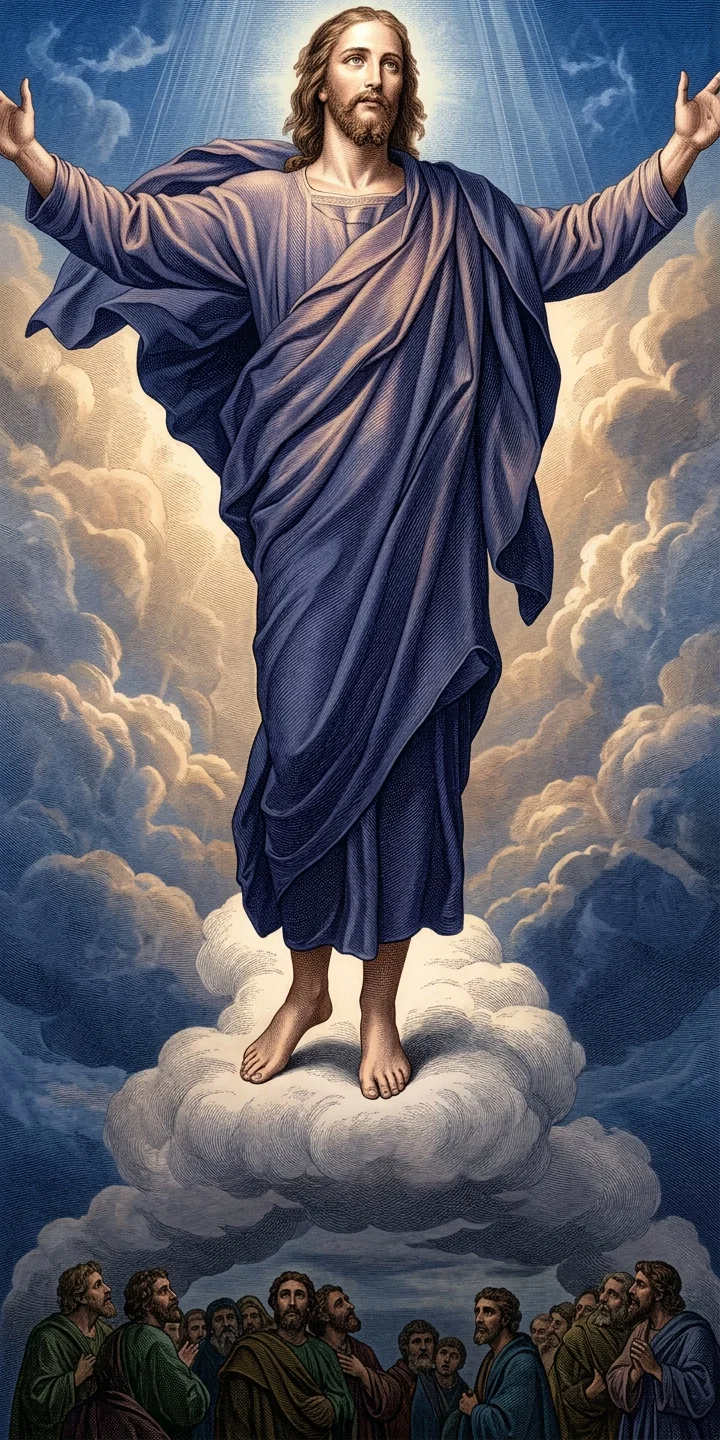
“With hands outstretched in blessing them, and as if in assurance of His protecting care, He slowly ascended from among them, drawn heavenward by a power stronger than any earthly attraction.”
Jesus led the way to the vicinity of Bethany. He then paused, and they all gathered about Him. Beams of light seemed to radiate from His countenance, as He looked with deep love upon His disciples. He upbraided them not for their faults and failures; but words of unutterable tenderness were the last which fell upon their ears from the lips of their Lord. With hands outstretched in blessing them, and as if in assurance of His protecting care, He slowly ascended from among them, drawn heavenward by a power stronger than any earthly attraction. As He passed upward, the awe-struck disciples looked with straining eyes for the last glimpse of their ascending Lord. A cloud of glory received Him out of their sight, and at the same moment there floated down to their charmed senses the sweetest and most joyous music from the angel choir.
While their gaze was still riveted upward, voices addressed them which sounded like the music that had just charmed them. They turned, and saw two beings in the form of men; yet their heavenly character was immediately discerned by the disciples, whom they addressed in comforting accents, saying, “Ye men of Galilee, why stand ye gazing up into heaven? this same Jesus, which is taken up from you into heaven, shall so come in like manner as ye have seen Him go into heaven.” These angels were of the company that had been waiting in a shining cloud to escort Jesus to His throne; and in sympathy and love for those whom the Saviour had left, they came to remove all uncertainty from their minds, and to give them the assurance that He would come to earth again.
All heaven was waiting to welcome the Saviour to the celestial courts. As He ascended, He led the way, and the multitude of captives whom He had raised from the dead at the time when He came forth from the tomb, followed Him. The heavenly host, with songs of joy and triumph, escorted Him upward. At the portals of the city of God an innumerable company of angels awaited His coming.
As they approached the gates of the city, the angels who were escorting the Majesty of Heaven, in triumphant tones addressed the company at the portals: “Lift up your heads, O ye gates; and be ye lift up, ye everlasting doors; and the King of Glory shall come in.”
The waiting angels at the gates of the city inquire in rapturous strains, “Who is this King of Glory?” The escorting angels joyously reply in songs of triumph, “The Lord, strong and mighty, the Lord, mighty in battle. Lift up your heads, O ye gates; even lift them up, ye everlasting doors; and the King of Glory shall come in.” Again the waiting angels ask, “Who is this King of Glory?” and the escorting angels respond in melodious strains, “The Lord of Hosts, He is the King of Glory.” Then the portals of the city of God are widely opened, and the heavenly train pass in amid a burst of angelic music. All the heavenly host surround their majestic Commander as He takes His position upon the throne of the Father.
With the deepest adoration and joy, the hosts of angels bow before Him, while the glad shout rings through the courts of heaven, “Worthy is the Lamb that was slain to receive power, and riches, and wisdom, and strength, and honor, and glory, and blessing.” Songs of triumph mingle with music from angelic harps, till heaven seems to overflow with delightful harmony, and inconceivable joy and praise. The Son of God has triumphed over the prince of darkness, and conquered death and the grave. Heaven rings with voices in lofty strains proclaiming: “Blessing, and honor, and glory, and power, be unto Him that sitteth upon the throne, and unto the Lamb forever and ever.”
He is seated by the side of His Father on His throne. The Saviour presents the captives He has rescued from the bonds of death, at the price of His own life. His hands place immortal crowns upon their brows; for they are the representatives and samples of those who shall be redeemed by the blood of Christ, from all nations, tongues, and people, and come forth from the dead, when He shall call the just from their graves at His second coming. Then shall they see the marks of Calvary in the glorified body of the Son of God. Their greatest joy will be found in the presence of Him who sitteth on the throne; and the enraptured saints will exclaim, My Beloved is mine and I am His! He is the chief among ten thousand, and altogether lovely!
The disciples returned to Jerusalem, not mourning, but full of joy. When last they looked upon their Lord, His countenance shone with heavenly brightness, and He smiled lovingly upon them. Those hands that had so often been stretched forth in the act of blessing the sick and the afflicted, and in rebuking demons—those hands which had been bruised by the cruel nails, were mercifully extended, as tho in the disciplesthey embraced the whole world, and called down a blessing upon all the followers of Christ. Beams of light seemed to emanate from those dear hands, and to fall upon the watching, waiting ones.
The most precious fact to the disciples, in the ascension of Jesus, was that He went from them into heaven in the tangible form of their divine Teacher. The very same Jesus who had walked and talked and prayed with them, who had broken bread with them, who had been with them in their boats on the lake, who had sought retirement with them in the groves, and who had that very day toiled with them up the steep ascent of Olivet,—had ascended to heaven in the form of humanity. And the heavenly messengers had assured them that the very same Jesus whom they had seen go up into heaven, should come again in like manner as He had ascended. This assurance has ever been, and will be till the close of time, the hope and joy of all true lovers of Christ.

Sunday in History

By J. O. Corliss
The controversy of ages over the authority for Sunday observance has, of late years, become one of wide-spread interest, and even of significance. All parties engaged in the discussion have delved, more or less, in history for confirmation of their positions, yet without settling upon a common ground of agreement.
It is, however, a matter of common knowledge that, from earth’s remotest history, the seventh day of the week was set apart by Jehovah to be observed as a Sabbath. It is also well understood that when the Hebrew people were rescued from Egyptian bondage, and brought into camp at the base of Sinai, there God spoke audibly to them, commanding the observance of the seventh day. This was to be in commemoration of the seventh-day rest Jehovah observed, immediately following the six days employed in creating and organizing the world’s forces. Ex. 20: 8-11; Gen. 2: 1-3.
Tracings of later sacred history clearly reveal-that God’s chosen people steadily adhered, at least in theory, to the observance of that particular day, whether quietly located in Palestine, or held captives in Babylon, or in their later wanderings over the world. So tenacious, indeed, have been that people regarding the Sabbath, under all circumstances, that the day of their rest has been ignominiously termed the “Jewish Sabbath.”
Christ, who came from heaven to earth, to unite in Himself all mankind, of whatever nationality, in the true service and worship of God, first appeared among the Jews, as the child of a devoted Jewish mother. He regularly observed the same day which the Jews esteemed heaven-born. Luke 4:16. His followers who became founders of the Christian church continued the Master’s practise, sacredly observing the seventh day even when the anointing of Christ’s body after His crucifixion was on hand, which might have seemed a highly commendable act for a Sabbath day service. Luke 23: 54-56.
The question then properly comes forward: Admitting as a fact that the divine Master and His disciples founded the church to be the “pillar and ground of the truth” (1 Tim. 3:15), and while they carefully, even sacredly observed the seventh-day rest, by what method, or through what process, was the first day, or Sunday, substituted for the God-given seventh day in the Christian church?
To answer this question fairly it will be necessary again to follow the trail of history. By this course alone may be discovered the origin of Sunday observance, and the object of its introduction as a weekly period of public worship. A general yet thoroly reliable statement as to its origin may be found in Webster’s “International Dictionary” as follows: “Sunday — so called because this day was anciently dedicated to the sun, or to its worship.”

The Universality of Sun-Worship

Worship of somebody or something has ever marked the trend of native mind. In all ages, sun-worship has been the prominent display of superstition, and has engaged the attention of nearly every race of earth’s inhabitants. The probable reason for this indigenous tendency is that men’s first conception of power was confined to the effect of the sun’s rays upon vegetation. So by permitting outward observation to overrule any faint throb of possible trust in an unseen Sovereign, the sun was adored as the great benefactor of mankind.
Even the Israelitish nation, notwithstanding its marvelous experience in God’s providential dealings with them, and their tenacity for the Sabbath, fell, to some extent, under the influence of this irrational worship. Whether this was because of their proximity to Egypt, Aram, Syria, and Phenicia, all of which were sun-worshiping nations, or whether it was the result of innate human tendencies, one may not too confidently affirm. But at all events, the Scriptures reveal that whenever they apostatized from their heaven-born faith in a beneficent Creator, they invariably turned to sun-worship, and the service of Baal, a common heathen deity.
This is directly verified by reference to 2 Kings 21: 3; 23: 5, 11; and other scriptures. This was not simply the proneness of common people, but was partially, at least, the result of priestly example; for in one certain prophetic vision, there were seen twenty-five priests who, while supposed to be engaged in regular sanctuary work, had their backs turned to the temple, as they looked eastward in their worship of the sun. In this sacrilegious act, these same men were said to “put the branch to their nose” (Eze. 8: 16, 17), supposedly as symbolic of their faith in the productive power of the sun.
True faith in the direct energy of Jehovah was, however, revived in the presence of the Lord Jesus, who did creative acts in healing the sick, recovering men’s sight, and in raising the dead. Such demonstrations of power were inducements to center the mind on a great first cause, above and beyond every physical object. But in time, as worldly policies were permitted to temper church administration, faith in heavenly power waned accordingly, and soon sun-worship, in modified form, entered the Christian church.

How It Entered

Mosheim, in his church history, hints at the way this was gradually grafted upon the Christian faith. In substance, he says that the slow growth of the church for a time, induced its leaders to modify requirements admitting members to its communion; and as a consequence, leading Romans who were not fully recovered from their early practise of sun-worship, were received freely into church fellowship. These finally influenced the rank and file of the church body to accept, as an added day of worship to the Sabbath, the day formerly devoted by these Romans to sun-worship.
This directing agency, coming as it did in the fourth century, shortly after the famous decree issued by the emperor Constantine, carried great weight in determining the final result upon the church regarding this question. The decree referred to here was put in circulation A.D. 321, and was as follows:
“Let all the judges and town people, and the occupation of all trades, rest on the venerable day of the sun; but let those who are situated in the country, freely and at full liberty attend to the business of agriculture; because it often happens that no other day is so fit for sowing corn and planting vines; lest, the critical moment being let slip, men should lose the commodities granted by heaven.”
It will be observed that this decree did not forbid the observance of the seventh day, but simply confirmed, by civil edict, the “venerable day of the sun,” in the minds of the masses, and lifted that day to the level of the Lord’s Sabbath. Seeing, however, that the Sabbath continued to be observed by conscientious church-members, the council of Laodicea, held in A.D. 364, decreed that “members of the church should not rest from work on the Sabbath like Jews, but should labor on that day, and preferring in honor the Lord’s day, then if it be in their power should rest from work as Christians.” (“Sermons on the Sacraments and Sabbath,” page 123.)
Thus by human decree, Sunday came to be called “Lord’s day;” and to guard it as a sacred period, the following edict was issued by the emperor Leo in A.D. 469:
“The Lord’s day we decree to be a venerable day, and therefore free it of all citations, executions, pleadings, and the like avocations. Let not the circus or theater be opened, nor combating with wild beasts be seen on it. . . . If any will presume to offend in the premises, if he be a military man, let him lose his commission; or if other, let his estate or goods be confiscated.”
Then, as tho he would correct that part of Constantine’s law which permitted agriculture on Sunday, the emperor added:
“We command therefore all, as well husbandmen as others, to forbear work on this day of our restoration.” (“Dialogues on the Lord’s Day,” pages 259, 260.)
Thus by church and civil decrees, the people of the early ages were forced to accept Sunday as their day of rest, in the place of the Lord’s Sabbath. This state of things should, however, have been corrected when, under the Reformation, the Protestants of the sixteenth century separated fromthe Roman communion. But in this they failed, and so the “venerable day of the sun” was brought over from paganism and papal sources to be planted in the Protestant creed, as a fundamental of church fellowship. No other valid reason can be given for its adoption, since the Bible nowhere lays any foundation for such a course.
Continue reading: A Study of the Sanctuary