VII. The Heavenly Sanctuary; the Appointed Time of Its Cleansing; the 2,300 Days
When called before the Roman governor to answer for his faith, the great apostle to the Gentiles “reasoned of righteousness, temperance, and judgment to come.” Never before had the haughty ruler listened to words like these. He had been accustomed to listen to words of flattery, such as upon this occasion had come from the proud Tertullus; but never had he been arraigned at the bar of divine justice; never had he stood face to face with the Judge of all the earth; never had he seen the corruption of his own life as it then appeared in contrast with the purity, the righteousness, of God’s holy law, by which he was eventually to be judged.
The divine certainty with which the prisoner pressed home the truth that his hearer would one day “stand before the judgment-seat of Christ,” that he must “give account of himself to God,” brought down the lofty spirit of the governor, and “Felix trembled” before the awful tribunal of eternal justice. Acts 24:25; Rom. 14:10, 12. It is evident that the apostle made the fact very emphatic that the great assize before which Felix was yet to be arraigned, was not in any wise uncertain, but was by fixed necessity, by divine appointment; and as the reality of that awful hour, when, instead of sitting in judgment upon another, he must himself stand before the judgment-seat of Christ, was impressed upon his heart by the Holy Spirit, he “was terrified, and answered, Go thy way for this time; and when I have a convenient season, I will call thee unto me.” Acts 24:25, A.R.V.
Upon another occasion the same apostle declared, “He hath appointed a day, in the which He will judge the world in righteousness by that Man whom He hath ordained; whereof He hath given assurance unto all men, in that He hath raised Him from the dead.” Acts 17:31. In the time of the apostles, therefore, the day of judgment had been appointed, but was then future.
In the book of Revelation, after portraying the scenes of conflict through which the righteous in the coming ages were to pass, the apostle John says: “I saw another angel fly in the midst of heaven, having the everlasting gospel to preach unto them that dwell on the earth, and to every nation, and kindred, and tongue, and people, saying with a loud voice, Fear God, and give glory to Him; for the hour of His judgment is come; and worship Him that made heaven, and earth, and the sea, and the fountains of waters.” Rev. 14:6, 7.
The Judgment Precedes the Coming of Christ
This is a very important declaration, and throws much light on the subject of the judgment, especially upon the time of its beginning. The angel was seen “having the everlasting gospel to preach unto them that dwell on the earth, and to every nation, and kindred, and tongue, and people.” In answer to the question of the disciples, “Tell us, when shall these things be? and what shall be the sign of Thy coming, and of the end of the world?” among other things Jesus said, “This gospel of the kingdom shall be preached in all the world for a witness unto all nations; and then shall the end come.” Matt. 24:3, 14. One of the prominent signs of the coming of the Lord and of the end of the world is the preaching of the gospel to “every nation, and kindred, and tongue, and people.” But with the preaching of the gospel message in all the world will be heard the solemn declaration, “Fear God, and give glory to Him; for the hour of His judgment is come.” Two angels were seen following the one with the judgment message. Then the prophet says: “I looked, and behold a white cloud, and upon the cloud One sat like unto the Son of Man, having on His head a golden crown, and in His hand a sharp sickle. And another angel came out of the temple, crying with a loud voice to Him that sat on the cloud, Thrust in Thy sickle, and reap; for the time is come for Thee to reap; for the harvest of the earth is ripe. And He that sat on the cloud thrust in His sickle on the earth; and the earth was reaped.” Rev. 14:14–16. “The harvest,” says Jesus, “is the end of the world.” Matt. 13:39. It is plain, therefore, that the message, “The hour of His judgment is come,” is to be proclaimed just prior to the coming of Christ, and while mercy is still extended to men.
The Investigative and the Executive Judgment
To such as have been accustomed to think of the judgment as taking place in connection with the coming of the Lord, the idea of its taking place in heaven prior to His coming may at first appear very strange. There are at least two phases of the judgment work—the investigative and the executive. This is in harmony with the principles of justice followed in earthly governments. Having been charged with a crime, the individual is brought before a tribunal, where the case is tried. All the evidence on either side having been presented, the case is submitted to the judge or jury for verdict. If the individual is found guilty of the crime with which he was charged, sentence is then pronounced against him. This is what we may call, for convenience, the investigative judgment. If justice is meted out to the criminal, there must follow the execution of the sentence, or the executive judgment.
The investigative judgment takes place in the holy of holies of the heavenly sanctuary, and constitutes the last work of our great High Priest. The executive judgment follows the close of Christ’s work as priest, and the beginning of His reign as king.
When the records kept in the sanctuary have been examined, the sins of the righteous “blotted out,” and their names confessed before the “Father, and before His angels” (Dan. 7:9, 10; Rev. 20:12; Acts 3:19; Rev. 3:5), the kingdoms of this world will then “become the kingdoms of our Lord, and of His Christ; and He shall reign forever and ever.” Rev. 11:15. The Lord of Glory will return to earth for His loyal subjects—the “heirs of the kingdom which He hath promised to them that love Him.” Those who have “died in faith, not having received the promises,” will hear His voice, and come forth glorified; and the living righteous will be “changed;” and all will hear “the King say unto them,” “Come, ye blessed of My Father, inherit the kingdom prepared for you from the foundation of the world.” John 14:1–3; James 2:5; Heb. 11:13; John 5:28, 29; 1 Cor. 15:42, 43, 51, 52; Matt. 25:34.
The Time of the Judgment
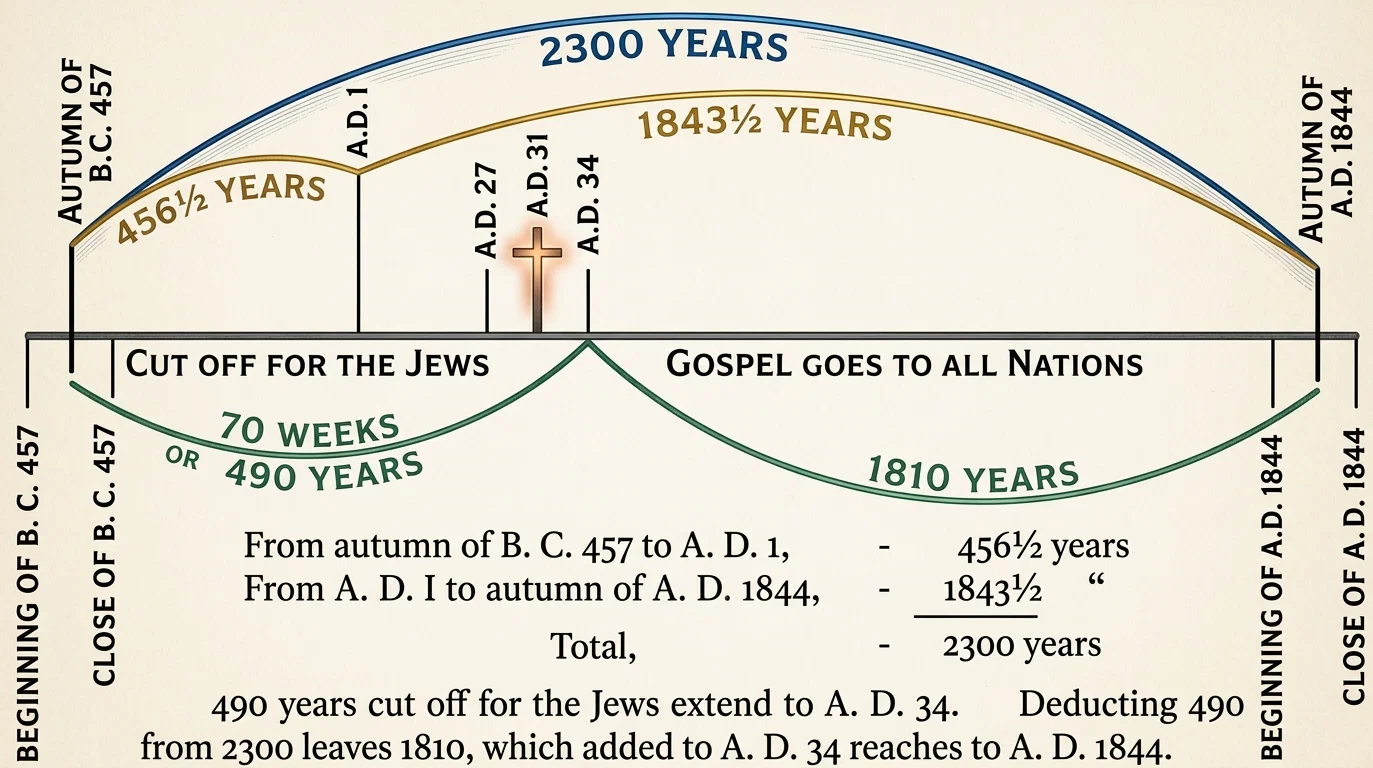
The apostle Paul said, “He hath appointed a day, in the which He will judge the world.” Acts 17:31. While Daniel was in vision, the angel said to him, “Unto two thousand and three hundred days; then shall the sanctuary be cleansed.” Dan. 8:14. This was evidently prophetic time; and as in prophecy one day represents a year (Num. 14:34; Eze. 4:6), this prophecy would cover a period of two thousand and three hundred years. In explaining to the prophet this time prophecy, the angel said: “Seventy weeks are determined upon thy people and upon thy holy city, to finish the transgression, and to make an end of sins, and to make reconciliation for iniquity, and to bring in everlasting righteousness, and to seal up the vision and prophecy, and to anoint the most holy. Know therefore and understand, that from the going forth of the commandment to restore and to build Jerusalem unto the Messiah the Prince shall be seven weeks, and threescore and two weeks: the street shall be built again, and the wall, even in troublous times. And after threescore and two weeks shall Messiah be cut off, but not for Himself.” Dan. 9:24–26. The Hebrew word chathak, here rendered “determined,” signifies to cut off. Seventy weeks—four hundred and ninety days or years—cut off from twenty-three hundred leaves eighteen hundred and ten. The time for the beginning of this period was said by the angel to be the “going forth of the commandment to restore and to build Jerusalem.” A copy of this commandment may be found in the seventh chapter of Ezra. It was issued in 457 B.C. “And they builded, and finished it, according to the commandment of the God of Israel, and according to the commandment of Cyrus, and Darius, and Artaxerxes king of Persia.” Ezra 6:14. Ezra arrived at Jerusalem in the autumn of 457 B.C. From this date 69 weeks, or 483 years, were to reach to the Messiah. This takes us down to the autumn of 27 A.D., when Jesus “was baptized of John in Jordan.” “And straightway coming up out of the water, He saw the heavens opened, and the Spirit like a dove descending upon Him.” Mark 1:9, 10, margin. The word “Messiah” means “Anointed.” John 1:41, margin. At His baptism, “God anointed Jesus of Nazareth with6power.” Acts 10:37, 38. Hence this portion of the prophecy met its perfect fulfilment at the baptism of Jesus, when He became the Anointed of God—the Messiah. “After threescore and two weeks shall Messiah be cut off, but not for Himself.” “And He shall confirm the covenant with many for one week: and in the midst [“half,” Leeser translation] of the week He shall cause the sacrifice and the oblation to cease.” Dan. 9:26, 27. Sixty-nine of the seventy weeks reached to the baptism of Jesus; and in the half or middle of the last week He was to be “cut off, but not for Himself.” This prediction was literally fulfilled in the crucifixion of the Saviour, in the spring of 31 A.D., exactly three and a half years from His baptism. The remaining three and a half years of the last week were devoted to the confirmation of the covenant through the apostles. Heb. 2:3. The entire period terminated in the autumn of 34 A.D. “At that time there was a great persecution against the church which was at Jerusalem; and they were scattered abroad,” and “went everywhere preaching the word.” Acts 8:1, 4.
DIAGRAM OF THE 2300 DAYS. (Symbolic Time.)
Thus far every feature of this wonderful time prophecy meets its exact fulfilment in the baptism and crucifixion of the Saviour, and in the apostles’ turning from the Jews to the Gentiles. When speaking to the Jews, Paul said: “It was necessary that the word of God should first have been spoken to you: but seeing ye put it from you, and judge yourselves unworthy of everlasting life, lo, we turn to the Gentiles.” Acts 13:46. 490 of the 2,300 years were now past, and 1,810 still remained. The 490 years ended in 34 A.D., hence 1,810 years more brings us to 1844. This marks the date of the termination of the 2,300 years, and reveals the time when, as the angel Gabriel declared, “the sanctuary shall be cleansed.” No earthly sanctuary then existed to which the word of the angel could apply, hence we look to the heavenly sanctuary for the fulfilment of the type. This prophecy definitely points out the time for the offering of the great antitypical sacrifice on Calvary, and the beginning of the ministry of our great High Priest in the first apartment of the heavenly sanctuary; also the time when He passed through the veil, and began His ministry in the second apartment, or most holy place, and the beginning of the work of cleansing the sanctuary—the final judgment.
The Holy of Holies Opened, and the Mystery of God Finished
The apostle John in vision beheld seven angels with seven trumpets. These angels sounded one after the other, and denote a series of events that were to take place from the close of the fourth century and onward to the time when the wicked are finally destroyed. Revelation 8, 9, 10, 11. “In the days of the voice of the seventh angel, when he shall begin to sound, the mystery of God should be finished, as He hath declared to His servants the prophets.” Rev. 10:7. The mystery of God is the gospel. Eph. 3:1–9; Col. 1:25–27; Rom. 16:25; 1 Tim. 3:16. The finishing of the mystery of God is to be accomplished early under the sounding of the seventh trumpet. The sixth trumpet ceased to sound with the loss of the independence of the Ottoman or Turkish power in August, 1840. This is susceptible of the clearest proof. The last three of the seven trumpets are called wo trumpets, and correspond to the fifth, sixth, and seventh trumpets. “The second wo is past,” said the angel; “and, behold, the third wo cometh quickly.” Rev. 11:14. A little period intervened between the close of the sixth trumpet in 1840, and the beginning of the seventh in 1844. When the seventh angel sounded, “the temple of God was opened in heaven, and there was seen in His temple the ark of His testament.” Rev. 11:15, 19. This, therefore, marks the beginning of Christ’s ministry in the most holy apartment of the heavenly temple. His work in that apartment is synchronous with the work of His people in the proclamation of the last message of mercy to all the world, “Fear God, and give glory to Him; for the hour of His judgment is come.”
The Standard of the Judgment
With the beginning of Christ’s work in the most holy place, the “ark of His testament” was seen. This article of furniture in the earthly sanctuary received its name from that which it contained—“two tables of testimony, tables of stone, written with the finger of God.” Ex. 31:18; 25:21, 22; Deut. 10:1–4. God’s ten holy precepts, found within the ark of His testament, beneath the mercy-seat in the heavenly temple, of which the law proclaimed upon Mount Sinai, and given to Moses, was but a copy, constitutes the standard of the judgment. Rom. 2:12, 16. By it every case will be decided for eternity. For more than sixty-eight years the judgment has been in progress in heaven. Soon it will close. God’s holy law enshrined beneath the mercy-seat, before which our Advocate pleads, speaks condemnation to the sinner, but righteousness and peace to the obedient.
The Final Scene
Once again we behold the judgment scene, not this time with the Roman governor alone standing tremblingly before the bar of God, but with the whole world arraigned before that awful tribunal; not now in prospect, but in the living present—“the hour of His judgment is come.” When Jesus ascended from Mount Olivet and took His place at the right hand of God as our Advocate and Saviour, and began His intercessory work at the throne of grace as our great High Priest, the world was all unconscious of that stupendous event, that God testified to the same by the outpouring of His Spirit on Pentecost, and His witnesses with great power proclaimed the message to all the world. So to-day the world is unconscious of the awful fact that the judgment is set, and the books are opened; that soon the final, irrevocable decision in every case will be reached, and the decree which will forever close the probation and fix the eternal destiny of all the world will be pronounced—“He that is unjust, let him be unjust still: and he which is filthy, let him be filthy still: and he that is righteous, let him be righteous still: and he that is holy, let him be holy still. And, behold, I come quickly; and My reward is with Me, to give every man according as his work shall be.” Rev. 22:11, 12.
Dear reader, you can not, with the natural eye, behold the judgment now in session in the heavenly court; but with the eye of faith you may behold it, and tho in truth you are guilty of the violation of God’s holy law, and are worthy of death, if you now commit your case wholly to your Advocate, trusting alone in the merits of His blood to cleanse you from all sin, and accept by faith the robe of His righteousness to cover the shame of your nakedness, you will stand before the throne of infinite justice without spot or wrinkle or any such thing, but perfect and complete in Him. If you have not done this, delay no longer. A more convenient season will never come. Haste, while mercy lingers, while its door is still open, to make your peace with God. “Behold, the Judge standeth before the door.” “Blessed are they that do His commandments, that they may have right to the Tree of Life, and may enter in through the gates into the city.” James 5:9; Rev. 22:14.
Awareness of Sin and Its Cure
It is not when we are conscious of our faults that we are most wicked; on the contrary, we are then less so. We see by a brighter light. And let us remember, for our consolation, that we never perceive and feel our sins till we begin to cure them.—Fenelon.
Surrendering Wrong Convictions
“WHEN convinced that your convictions are wrong, surrender them; consistency is not the highest virtue.”
The Unwarned
By Robert Bruce Thacher
By Robert Bruce Thacher
He stood bare-bodied, save a breechen clout,
And through blear eyes surveyed his plot. Without
A semblance of the image that began
In Adam's mold—a man, and not a man.
A swart-skinned type, crook-limbed and shallow-brained,
Calloused of hand and heart, and custom-stained;
His outlook on great life but meanly small;
His likelihood of using—none at all.
But there he is, and millions of his kind
Must bend beast bodies to the killing grind;
But work, and food, and sleep, and jot of play
Suffice for every day and every day.
You urge this son of gross simplicity
With quick but kindly hand to feel and see—
He snaps resentfully, as tho you stole
His life. And yet—and yet he has a soul.
Aye, there he stays, where all his fathers stayed,
Bold face to fearful doom, yet unafraid;
Unwarned of danger, unprepared for fate,
Serenely dense and brutish—obstinate.
Great God of Job and Jacob, grant us free
Patience with man, and victory with Thee!
Embolden us to pluck the fiery brands,
Altho they scorch severe the saving hands.
The All-Sufficiency of the Bible
BY many it is thought necessary to make a study of the various religions of the world, that from them may be obtained those truths, lacking in Christianity, which make up the whole truth. It has been suggested even that the Christian may find deeper and fuller truths in the other faiths than in Christianity, truths which lead to a deeper insight into spiritual things. To the believer in the word of God we know of nothing which represents greater impossibilities. Nothing could be more the opposite of the teaching of Christ, who is “the Way, the Truth, and the Life.”
That we may have before us the teaching of the Scriptures on this point, we will devote a little space to the consideration of the subject.
No Truth but God’s Truth
There is no truth which has not its origin in the Almighty One, and no truth which has not its fulfilment in Christ. Should we start with the creation, the psalmist exclaims, “Thy word is true from the beginning.” Ps. 119:160. And, again, “Thy word is settled in heaven.” The word of God, the revelation of the truth of God—“Thy word is truth”—is from eternity, is the revealed will of God, and in the words of David, “Every one of Thy righteous ordinances endureth forever.” The truth of God, like its author, is not only for to-day, but will be for to-morrow; even as it has been from God’s great yesterday. It never has changed, never will change, and is an absolute essential to Christian living.
In proof of the statement that God’s word is the source of all truth, we may read the following scriptures: “If ye continue in My word, . . . ye shall know the truth.” John 8:31, 32. “Thy word is truth.” John 17:17. “Howbeit when He, the Spirit of truth, is come, He will guide you into all truth.” John 16:13. “He shall teach you all things, and bring all things to your remembrance, whatsoever I have said unto you.” John 14:26. It is evident from these scriptures that our Saviour taught that the source of all truth lay in God’s word and in its revelation in His own life. “The Word was made flesh, and dwelt among us, . . . full of grace and truth.” John 1:14. And He Himself says, “No man cometh unto the Father, but by Me.” John 14:6. The source of truth is God; the revelation of truth, Jesus Christ and the word of God. Our duty in the search for truth is to seek it from the original source, from which the promise is given that if we seek we shall find—we shall know the truth. “In whom are hid all the treasures of wisdom and knowledge.” Col. 2:3.
It is very apparent from the scriptures quoted—and there are hundreds of others of like import—that the source of truth is God, that our hands hold the revelation in the word of God, and that if we would know the truth and be made perfect by it, we must study the Word. “All Scripture is given by inspiration of God, and is profitable for doctrine, for reproof, for correction, for instruction in righteousness; that the man of God may be perfect, thoroly furnished unto all good works.” These words being true—and to the Christian there can be no question—then the seeking of perfection in spiritual things is alone in the Word. Let none lead us from our assurance that in Christ Jesus are all things, and that the Bible is the rule of faith and doctrine.—The Oriental Watchman.
The Unrepentant Sinner Doomed to Die
1. What is the wages of sin?
“The wages of sin is death; but the gift of God is eternal life through Jesus Christ our Lord.” Rom. 6:23.
2. What does James say is the finished product of sin?
“But every man is tempted, when he is drawn away of his own lust, and enticed. Then when lust hath conceived, it bringeth forth sin; and sin, when it is finished, bringeth forth death.” James 1:14, 15.
3. What does God say, through the psalmist, that the wicked will bring upon themselves if they “turn not”?
“My shield is with God, who saveth the upright in heart. God is a righteous judge, yea, a God that hath indignation every day. If a man turn not, He will whet His sword; He hath bent His bow, and made it ready. He hath also prepared for him the instruments of death; He maketh His arrows fiery shafts. Behold, he travaileth with iniquity; yea, he hath conceived mischief, and brought forth falsehood. He hath made a pit, and digged it, and is fallen into the ditch which he made. His mischief shall return upon his own head, and his violence shall come down upon his own pate.” Ps. 7:10-16, A.R.V.
4. What false hope of receiving life have some promised to the wicked?
“Because with lies—ye have made the heart of the righteous sad, whom I have not made sad; and strengthened the hands of the wicked, that he should not return from his wicked way, by promising him life.” Eze. 13:22.
5. What sacrifice has God made to save man from death, which is the penalty for sin?
“For God so loved the world, that He gave His only-begotten Son, that whosoever believeth in Him should not perish, but have everlasting life.” John 3:16.
6. How completely will those be shut away from everlasting life who do not receive the Son of God?
“He that believeth on the Son hath everlasting life: and he that believeth not the Son shall not see life; but the wrath of God abideth on him.” John 3:36.
“And this is the record, that God hath given to us eternal life, and this life is in His Son. He that hath the Son hath life; and he that hath not the Son of God hath not life.” 1 John 5:11, 12.
7. Does the heavenly Father take any pleasure in the death of the wicked?
“Cast away from you all your transgressions, whereby ye have transgressed; and make you a new heart and a new spirit: for why will ye die, O house of Israel? For I have no pleasure in the death of him that dieth, saith the Lord God: wherefore turn yourselves, and live ye.” Eze. 18:31, 32.
“Say unto them, As I live, saith the Lord God, I have no pleasure in the death of the wicked; but that the wicked turn from his way and live: turn ye, turn ye from your evil ways; for why will ye die, O house of Israel?” Eze. 33:11.
My Prayer
By Ida M. Eggleston
By Ida M. Eggleston
Father in heaven, take not from me
The trials that lie before;
But give me strength to stand each test,
And grace to trust Thee more.
Take not from me a bitter cup
That I am called to drink;
But help me honor Thy dear name
In all I do or think.
Let me not be one to faint
Upon a Jordan's brink;
For if Thou callest me to cross,
Thou wilt not let me sink.
Purge Thou mine heart, and make it pure
Wherein it is not right;
Cleanse me, O Lord, from secret sin,
So hateful in Thy sight;
For Thou dost see my inmost heart,
Whatever is therein.
O, cleanse me with the precious blood
So freely shed for sin!
Thou knowest, Lord, it is my will
To glorify Thy name.
O, let not my professing Thee
Be unto Thee a shame!
My little boy was ill, one day,
As I was just before;
And as I saw his suffering,
It made my own heart sore.
And as his suffering reached my heart,
A lesson came to me:
“Touched with the feeling”—O, how true!—
“Of our infirmity.”
And I am glad God gave my boy,
That I His love might know.
For now I know God's heart is “touched,”
Because He loves me so.
But He can do much more for me,
Than I can for my boy;
In place of weakness, gives me strength,
And fills my heart with joy.
“Graves of Lust”
IN the journeyings of the children of Israel from Egypt to Canaan they lusted for flesh. See Numbers 11. As an outworking result many were slain, and the place was called Kibroth-hattaavah (pronounced, Kib-roth-hat-ta’-a-vah), meaning “graves of lust.” Num. 11:34, margin. The name was not a pleasant reminder to Israel; but it would ever serve to recall to them their sin, and thus lead them to humility.
“Graves of lust” is a very suggestive term. It may have a double meaning. It may mean to us, as to the children of Israel, that those who are therein buried were so wedded to their unholy lusts that they yielded all to them, and were destroyed, because every faculty and power of being was by these unlawful lusts debased and corrupted. A man himself becomes evil in such a case, and fitted only for destruction. The lesson to learn from such an example is to take warning betimes. “Now these things were our examples, to the intent we should not lust after evil things, as they also lusted.” 1 Cor. 10:6.
“Graves of lust” may become to us a better term. It is true that the carnal heart, the unregenerate old man, “is corrupt according to the deceitful lusts” (Eph. 4:22), that “the flesh lusteth against the Spirit, and the Spirit against the flesh” (Gal. 5:17); but it is also true that we may “through the Spirit” “mortify the deeds of the body” (Rom. 8:13); for “they that are Christ’s have crucified the flesh with the affections and lusts” (Gal. 5:24). Lusts have been crucified, or put to death; it is only the proper thing to do, to bury them forever. “Therefore we are buried with Him by baptism into death: that like as Christ was raised up from the dead by the glory of the Father, even so we also should walk in newness of life” (Rom. 6:4), as obedient children, not fashioning ourselves according to the former lusts in our ignorance, but following the Holy One, of whose Spirit we are partakers (1 Peter 1:14-16).
Thus baptism becomes to every truly converted man the grave of his unlawful lusts. They are buried there forever. And when the strong desire (for lust is overstrong, or unlawful, desire) for anything contrary to God’s holy will or the great Exemplar, asserts itself, by the power of God’s Spirit, through the grace of His gospel, we can there conquer, and bury the lust ere it bears fruitage in deeds. Such graves would then be tokens of God’s wondrous love and power. Let us be sure that our Kibroth-hattaavah cover not ourselves as children of lust, but our lusts alone.
The Bible and the Final Judgment-Day
By T.
PROFESSOR Paul Haupt, of Johns Hopkins University, recently made an address before the American Philosophical Society, in which he is reported to have taken the ground that there is no Biblical foundation for a final judgment-day. The following paragraph from his address was sent out through the press:
“The book of Zechariah, which Jews as well as Christians give as authority for the description of the last judgment, refers merely to a plan for municipal improvements laid out by the Maccabees. The language has been misinterpreted.”
Christians do not confine themselves to the book of Zechariah for the evidence of a general judgment-day, as the language of the professor would seem to imply. There are very many perfectly clear texts that speak in no equivocal or ambiguous language upon the subject. Read this text:
“Because He hath appointed a day, in the which He will judge the world in righteousness by that Man whom He hath ordained; whereof He hath given assurance unto all men, in that He hath raised Him from the dead.” Acts 17:31.
There is nothing difficult in the foregoing text. It needs no interpretation or explanation. It says in the simplest kind of terms that “He hath appointed a day, in the which He will judge the world in righteousness.” The text is taken from one of Paul’s discourses when he was at Athens in Greece. The great apostle seems to have had the habit of referring to the judgment-day in his discourses; for on a later occasion, when he was before the tribunal of Rome, and was making his plea before Felix, the Roman governor, it is said of him:
“As he reasoned of righteousness, temperance, and judgment to come, Felix trembled, and answered, Go thy way for this time; when I have a convenient season, I will call for thee.” Acts 24:25.
There was a power in Paul’s message that made the Roman governor tremble. And why should it not? The apostle reasoned of “righteousness” and the “judgment to come.” The Judge of that great court can not be bribed or deceived. Each one must stand or fall according to the deeds he has actually done. It is more than likely that Felix compared the standards held forth by Paul with his own trickery and lack of justice in dealing with men, and so his own heart trembled with fear at the thought of how he would fare when he was compelled to stand before that impartial tribunal of the great God.
The Master, when here in person, said upon the subject of the judgment:
“But I say unto you, That every idle word that men shall speak, they shall give account thereof in the day of judgment.” Matt. 12:36.
The Saviour does not speak of the judgment-day as something that needs to be proved, but on the contrary He refers to it as something that the people to whom He was talking would accept as a matter of course. He was addressing those who were familiar with the Old Testament; and by turning to that volume, we find many passages outside the book of Zechariah that speak plainly of the judgment. Solomon, the wise man, had taught:
“Rejoice, O young man, in thy youth; and let thy heart cheer thee in the days of thy youth, and walk in the ways of thine heart, and in the sight of thine eyes: but know thou, that for all these things God will bring thee into judgment.” Eccl. 11:9. “God shall bring every work into judgment, with every secret thing, whether it be good, or whether it be evil.” Eccl. 12:14.
These texts from the book of Ecclesiastes are plain enough. They need no comment. They clearly teach a judgment-day. But perhaps one of the most sublime texts in all the Bible, one that is filled with the sublimity of grandeur and awe, is the passage in which the prophet Daniel describes the calling of the world to the judgment-bar of the eternal God. This scripture reads:
“I beheld till thrones were placed, and One that was ancient of days did sit; His raiment was white as snow, and the hair of His head like pure wool; His throne was fiery flames, and the wheels thereof burning fire. A fiery stream issued and came forth from before Him: thousands of thousands ministered unto Him, and ten thousand times ten thousand stood before Him: the judgment was set, and the books were opened.” Dan. 7:9, 10.
Daniel was not confined, in his activities, to the work of a prophet. He was the greatest statesman of his time. He was prime minister to the king of Babylon when the empire was at its height, and he stood as an intelligent and strong opposer to the degenerating influences that were coming in, and which resulted finally in her overthrow.9
But when Babylon was overthrown, Daniel was still in his prime; and the conquering kingdom of the Medes and Persians regarded him so highly that he was held as prime minister, and was a power in the new kingdom. If we speak merely from the human standpoint, a man of such experiences and such abilities could not make the mistake of thinking he was describing “municipal improvements laid out by the Maccabees” when he used the language quoted from his prophecy. We must conclude that when the vision was brought before him, he was well aware of the fact that he was viewing scenes that would be enacted in a literal judgment. His language is so clear, so concise, and yet so simple that we know just what he means as we read his utterances. Possibly Paul read this remarkable passage from Daniel as he was reasoning before Felix. If so, it is no marvel that he caused the Roman potentate to tremble.
The view that John, in his visions of Patmos, had of the judgment scenes is thus presented:
“And I saw a great white throne, and Him that sat on it, from whose face the earth and the heaven fled away; and there was found no place for them. And I saw the dead, small and great, stand before God; and the books were opened; and another book was opened, which is the Book of Life: and the dead were judged out of those things which were written in the books, according to their works. And the sea gave up the dead which were in it; and death and hell delivered up the dead which were in them: and they were judged every man according to their works.” Rev. 20:11-13.
A person would need the imagination of a madman, as well as to be very forgetful of history, in order to get from these last-quoted verses the idea they referred to street improvements or any other kind of municipal work when the Maccabees were ruling in their section of the earth.
We have hardly made a fair beginning in quoting the plain texts of Scripture that unquestionably refer to the judgment-day of God at the end of this world. There are others that are just as plain in their teaching as the ones we have quoted. One of two things must be very apparent: people who say that the Bible does not teach a general judgment-day must be densely ignorant of what is in the Scriptures, or else they must presume that the people they are addressing are quite completely destitute of Bible knowledge. We should be intelligently sure of our ground when we announce that the Bible either does or does not teach some certain doctrine; for the texts quoted in the foregoing paragraphs very plainly tell us that we will have to meet all our life-work in the judgment. Hence we should be sure that it is sound. T.
True Courage
“THE old guard dies, but never surrenders,” the famous saying attributed to Napoleon’s trusted warriors, is considered by many almost sublime. It is the language of unswerving, uncompromising loyalty to a cause; and if that cause were true, the language would be sublime. It might be, however, the language of rashness and foolhardiness.
But there is a cause which has furnished greater examples of devotion and uncompromising loyalty than any cause earth ever knew; and that is the cause of God. We will take two illustrations, not from the inspiration of martial music, the heat of battle, and the enthusiasm of numbers, but from those who stood alone.
The first is the reply of the three young Hebrews to a king who had advanced them to posts of honor. He commanded them to fall down and worship the golden image, his apotheosis of Babylonian patriotism which he had set up, under penalty of being cast into the fiery furnace. They believed that God would deliver from the fiery furnace; “but,” said they, “if not, be it known unto thee, O king, that we will not serve thy gods, nor worship the golden image which thou hast set up.” Their faith, devotion, and loyalty were dominant in either life or death.
The second illustration is no less marked. It is that of an apostle who had been forewarned by a prophet that bonds awaited him at Jerusalem. His own brethren, who were very dear, endeavored to persuade him from going. Their strong appeals touch his heart, but they do not change his resolution nor swerve him from duty. Said he, “I am ready not to be bound only, but also to die at Jerusalem for the name of the Lord Jesus.”
This is the loyalty of the true soldier of Christ in all his conflicts with the enemy, in all calls of duty. History abounds in examples of such loyalty, beside which all mere human bravery pales into insignificance. This is the faith and loyalty demanded of the soldiers of Christ now.
The Great Sphinx Hoax
RECENTLY there was published in a reputable English periodical, the Sphere, and subsequently republished in many American journals, a circumstantial account, with illustrations, of the “remarkable discoveries” made by Prof. G. A. Reisner, the Harvard archeologist, within the Sphinx. Professor Reisner was represented as having “unveiled a series of hidden temples within the natural rock of which the Sphinx is formed,” one of them in the very head of the sculptured effigy.
It happens that at the time of the alleged “discoveries,” Professor Reisner was making archeological investigations in Dongola, remote from Egypt. In his own words, he “never excavated in or at the Sphinx, never intended to excavate in or at the Sphinx,” and has “no intention of doing so.”
His categorical denial brands the “Sphinx temple” story as the baseless fabric of a dream. But it will persist, like other exploded myths, and doubtless some day the very ritual in use in the temple to an unknown divinity will be published.
Where do such hoaxes originate? In what fertile imagination are they conceived, and by what means are they given currency until they take on the appearance of authenticity? Archeology, too, has its Munchausens who tell their tales of prehistoric anthropophagi; and considering the wonder tales archeologists themselves devise out of a sun-baked Babylonian brick or a few potsherds from a Cretan dust-heap, it is not astonishing that the public should accept fiction along with fact.—Thrice-a-Week World.