Your ShelfYour Projects

Signs of the Times, Vol. 30, No. 15.

LESSONS FROM THE STORY OF CORNELIUS.—II

Signs of the Times

Apr 13, 1904

Pacific Press Publishing Company · Oakland, California · Apr 13, 1904

LESSONS FROM THE STORY OF CORNELIUS.—II.

Peter's Experience.
BY MRS. E. G. WHITE.
IMMEDIATELY after the interview with Cornelius, the angel went to Peter, who, weary and hungry from journeying, was praying upon the housetop of his lodging-house in Joppa. While praying, he beheld a vision. He "saw heaven opened, and a certain vessel descending unto him, as it had been a great sheet knit at the four corners, and let down to the earth; wherein were all manner of four-footed beasts of the earth, and wild beasts, and creeping things, and fowls of the air. And there came a voice to him, Rise, Peter; kill, and eat. But Peter said, Not so, Lord; for I have never eaten anything that is common or unclean. And the voice spake unto him again the second time, What God hath cleansed, that call not thou, unclean. This was done thrice; and the vessel was received up again unto heaven."
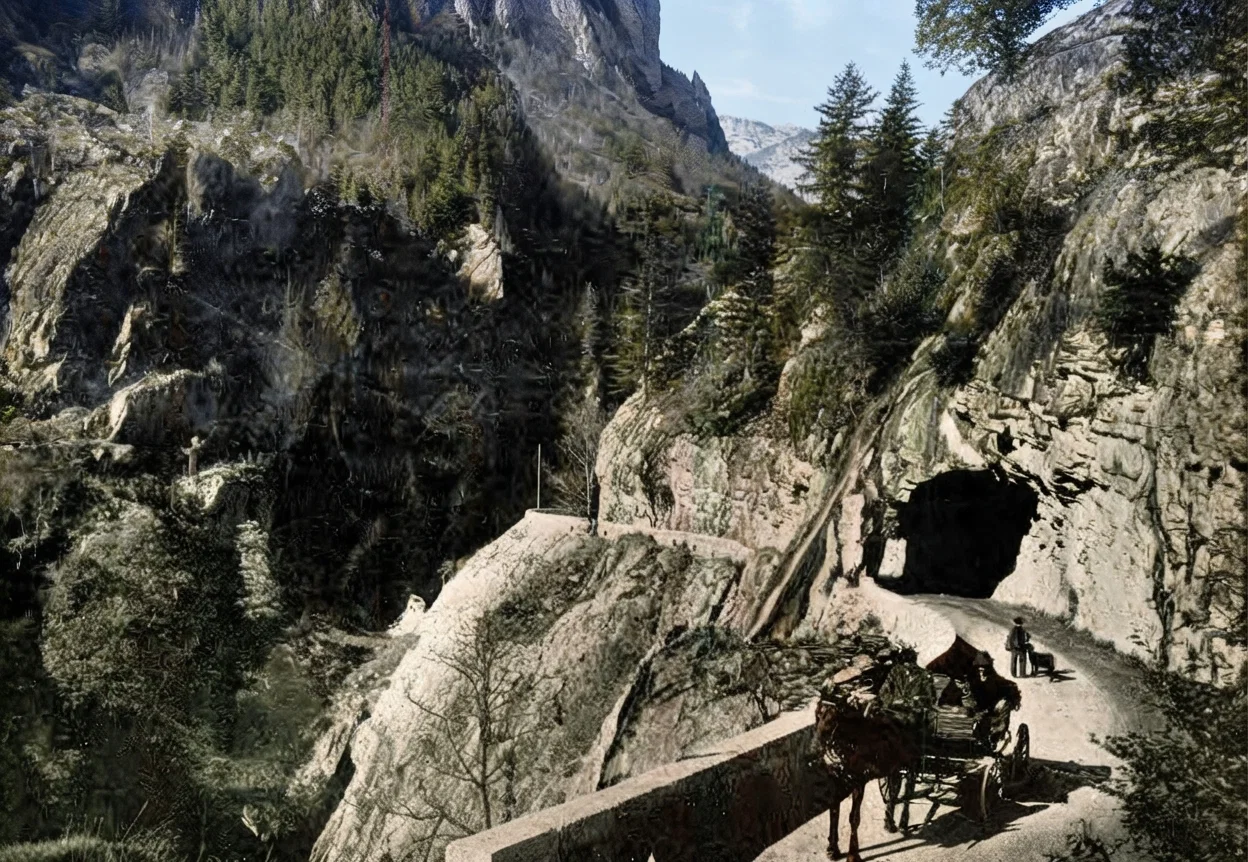
On the Grimzel Road, Swiss Alps.
Here we may perceive the working of God's plan to bring to pass events whereby His will may be done on earth as it is done in heaven. Peter had not yet preached the Gospel to the Gentiles. Many of them had been interested listeners to the truths which He taught; but in the minds of the apostles the middle wall of partition, which the death of Christ was to break down, still existed, excluding the Gentiles from the blessings of the Gospel. The Greek Jews had received the labors of the apostles, and many of them had become believers in Jesus; but the conversion of Cornelius was to be the first one of importance among the Gentiles.
By the vision of the sheet and its contents, let down from heaven, Peter was to be divested of his prejudices against the Gentiles. He was to be led to see that through Christ the heathen were made partakers of the blessings and privileges of the Gospel, and were thus to be benefited equally with the Jews.
The vision given Peter was an illustration presenting the true position of the Gentiles, showing that, by the death of Christ, they were made fellow heirs with Israel. It conveyed to Peter both reproof and instruction. His labors had heretofore been confined to the Jews; and he had looked upon the Gentiles as unclean, excluded from the promises of God. He was now being led to comprehend the world-wide extent of God's plan.
Notice how close the connections made in the working out of God's plan. While Peter was thinking about the vision, wondering what it meant, the men sent from Cornelius stood before the gate of his lodging-house, and the Spirit said to him: "Behold, three men seekthee. Arise therefore, and get thee down, and go with them, doubting nothing; for I have sent them."
To Peter this was a trying command; but he dared not act according to his own feelings. He went down, and received the messengers sent by Cornelius. They told him of their singular errand, and, according to the direction he had just received from God, he at once promised to accompany them on the morrow. He courteously entertained them that night, and in the morning set out with them for Cæsarea, accompanied by six of his brethren, who were to be witnesses of all he should say or do while visiting the Gentiles; for he knew that he should be called to account for so direct an opposition to the Jewish faith and teachings.

A Highway for Our God

"Prepare ye in the wilderness the way of Jehovah; make level in the desert a highway for our God. Every valley shall be exalted, and every mountain and hill shall be made low; and the uneven shall be made level, and the rough places a plain; and the glory of Jehovah shall be revealed, and all flesh shall see it together; for the mouth of Jehovah hath spoken it." Isa. 40 : 3-5.

SERVANTS AND MASTERS.

BY H. A. ST. JOHN.
1. HOW MANY kinds of servants are recognized in the Bible? Two, bond-servants and hired servants.
2. What does the New Testament enjoin upon all servants? That they be obedient to them that are their masters according to the flesh.
3. What kind of service should they avoid? "Eye-service, as men pleasers."
4. What kind of masters are to be thus obeyed? "Not only to the good and gentle, but also to the froward."
5. What things must the servant be careful not to do? "Not answering again; not purloining."
6. Why necessary to be so careful? "That the name of God and His doctrine be not blasphemed."
7. In fact, to whom is such obedience and service rendered? "With good will doing service, as to the Lord, and not to men."
8. What may such servants know? "Knowing that of the Lord ye shall receive the reward of the inheritance; for ye serve the Lord Christ."
9. What if the servant endure grief, and suffer wrongfully? "This is thankworthy; . . . this is acceptable with God."
10. Who is a true example of servants? "Christ also suffered for us, leaving us an example, that ye should follow His steps."
11. What kind of servant was Christ? He was the Servant of servants.
12. What shows the position of a servant to be a most honorable one? They may "adorn the doctrine of God our Saviour in all things."
13. What is it to adorn a doctrine? It is to live it, to exemplify it in all things.
14. Can a master, can any one, do more? There is no better nor higher life.
15. Who, only, are fit to be masters? Such as in some sense are servants.
16. What Master should every master have? "One is your Master, even CHRIST."
17. What would be an excellent motto in the office of every employer or master? YOU ALSO HAVE A MASTER.
18. If this grand truth was written in the heart, and drawn out in the life of the master, how would he regard and treat his servants? Just as Christ regards and treats him.
19. What great principle governs Christ, our Master, in dealing with us, His servants? The principle of unselfish and disinterested LOVE.
20. What, then, does Christ teach an employer, a master? You are a master; you have a Master; and the pattern of your authority is His authority.
21. What, then, is the supreme governing element in the mastership of Christ? Love for His servants.
22. But could a master make a living, and govern on that principle? Test it as long as you live, and see. But ever remember that making a life is far more important than making a living.
23. What should be regarded as the only true labor union? Co-laborers, or working together with God.
24. But such are not the views of the majority. One with God is a majority.
25. What does true Christianity consist of? Discovering which way God is going, and getting the obstacles out of the way.

HOW AN INFIDEL WAS CONVERTED.

SEVERAL years ago there lived in Iowa a Mr. T., a keen and intelligent man and a successful banker, but he was a blasphemous infidel. He did not have the slightest respect for the historical Christ, and would not acknowledge that such a man was anything more than an impostor, if, indeed, He ever existed. Finally, while Mr. Moody's sermons were being published by the New York Witness, shortly after his return from his first preaching tour in England, Mr. T.'s attention was drawn to a copy of that paper, which his wife was taking. She was not a Christian, but liked the paper, and her husband took it just to please her.
One day, while waiting for dinner, he took up the Witness to while away the time, when his attention was attracted to a sermon by Mr. Moody, which he read partly through, and in which he became considerably interested. Being called to his bank immediately after dinner, he could not then finish reading the sermon, but on returning to his house he was strongly desirous of finishing it, which he did in the hearing of his wife.
There was an illustration in the sermon which especially interested him. It was this: Mr. Moody spoke of five men who were in a certain prison, under sentence for some high crimes. They were pardoned by the governor of the state, but did not know anything about their being pardoned until they were called out, each by his own name, and told of the fact. Each responded to the call of his name, except the fifth one. His name was called the second time, but no response came from him. As there were several others in the room, and the condemned men were scattered among them, the chaplain, who called off the names, thought at first that the man might not be present; or, perhaps, if present, he might be deaf. It was soon ascertained, however, that he was so overcome by the good news that he could not speak.
God used this story to set Mr. T. seriously thinking about his own need of pardon. He reflected on the great truth that Christ had been offering him pardon for a long time and yet he would not accept it. The power of the Holy Spirit fell upon him, and he went into an adjoining bedroom and there pleaded with groanings that God would indeed pardon him. In a short time a glad sense of pardon was experienced, and a great change came over him. Since then he has given $1,000 to erect a church building in that place, and has been trying to save souls by preaching, as a layman, the Gospel of his Lord, in which way he has done much good.—C. H. Wetherbe.

IF HE SHOULD COME.

BY THOMAS GREGORY.
If He should come to-day He'd find The sheep on the hills away Where the wind, In the sleet and the biting rain grows cold. He would hear far up on the mountains high The fierce wolves draw to the lost lambs' cry. If He should come to-day He'd find The shepherd asleep by the empty fold.
If He should come to-day He'd see Out on the broad highway— Out in the Harvest standing white—and there He'd greet, No laborers gathering in the sheaves, And vineyard toilers bringing only leaves. If He should come to-day He'd see The sickles rusting in the golden wheat.
If He should come to-day He'd hear, In where the priesthood pray, The mobs cheer The temple-loungers mocking Him; and them, The money-changers, wrangling o'er their weights, The evil ones He once scourged from His gates, If He should come to-day He'd hear Again the Pharisees of dead Jerusalem.
If He should come to-day He'd see But few who hear Him say: "Follow Me. Confess My name. The watch arise and keep With Me." They sleep now in the twilight dim, And He hears the Peters denying Him.
If He should come to-day He'd see No crosses borne up dark Golgotha's steep.
If He should come to-day He'd find, Waiting the silver-gray Dawn behind The hills, few listeners for the call; few Passing bowed beneath the chastening rod— The purified in heart that shall see God.
If He should come to-day He'd find Few in the world's high-seats He ever knew.
Spokane, Wash.

TRUSTING THE WEAVER.

"God moves in a mysterious way," says Cowper's immortal hymn. Sit down by an Old World lacemaker for a few minutes. Fifty or a hundred bobbins, or spools, hang around a cushion in which there is a forest of upright pins. Every bobbin hangs by a thread that runs toward and among the pins. The onlooker sees the worker throw one bobbin over another as tho she were playing with them. But how she knows which bobbin to pick up, and where to toss it, is a mystery. Out of the great complex of threads and pins comes a wonderful lace pattern, orderly, regular, beautiful. So the divine Weaver takes one and another of us, ordering us here and there, but keeping us always attached, like the lacemaker's thread, to a definite purpose. As we look back over the past, we can see the wonderful pattern and perfect work of the Weaver. Just what He is working out, for us, and with us, now, we can not discern. But the lesson of the past is that the future will be good, and we can trust the Weaver of the infinite to do all things well.—S. S. Times.

THE BUILDERS

THE BUILDERS
THE BUILDERS
BY RODERICK S. OWEN.
(Concluded.)
I SHALL attempt to show you but one more room to-day, the one called His Glorious Appearing. Here it is, as you see, right in the center of my building, and every other room is directly connected with it. In fact, only for this room all the other rooms would fall to the ground. You see it is circular in form, and has a glorious high dome, clear as crystal, and like the dome of heaven. This chair of Faith in the center of the room is so constructed that one can recline in it, and look out through the dome; or, by readjusting it, one can look out through the passage ways into any one of the other rooms. For instance, if you take the Guide-book, and read for a time, the dome will be lit up with a glorious light which will penetrate every one of the other rooms. Let the eyes follow this light into the Sanctuary room, and there you will see Jesus, our great High Priest, sitting at the right hand of the Father, or standing by the ark of the covenant; or perhaps you will see Him laying aside His priestly garments, and putting on His kingly robes, while all the angels gather about Him, ready to come to the earth. Turn and look by the same light of the Glorious Appearing into the room, Estate of Man, and view the graveyard through the State-of-the-Dead window, and, lo! you will see it all illuminated with a light like the breaking of a glorious morning; you will see the graves open, and the dead in Christ arise. The Immortality window will be aglow with light, for God's people are raised immortal, and you will hear them shout, 'O death, where is thy sting? O grave, where is thy victory?' See 1 Cor. 15:53-55. It is a soul-inspiring shout of victory over everything corruptible.
'Sometimes most wonderful scenes appear in the dome itself, and in this connection I wish to relate a view which came to me at one time, and which left a deep impression. I had been reading in my Guide-book, when suddenly I heard a distant roll of thunder, and, looking up, I saw before me a vast plain upon which were many houses. Away in the distant horizon a dark cloud was seen spreading over the plain, and, as it approached, the air grew heavy and chill, and on all sides it soon appeared dark and threatening.
'As the storm came on, the inhabitants rushed out of, and began to examine, their houses. I then saw that they were the homes of the builders, and I even recognized my own among them. I noticed that there was a great deal of questioning and controversy among them about the foundations of their buildings, and also about the windows, Immortality and State of the Dead. Would they stand such a storm of wind as seemed to be coming? And the ten doors, were they all properly set, so that none would give way, nor be found to have a single defect? And again: About that fourth door,—which would prove to be the stronger, the old style or the new? This was a great question. 'O, that I had followed the Book of instruction more closely!' was the thought uttered or unexpressed by all.
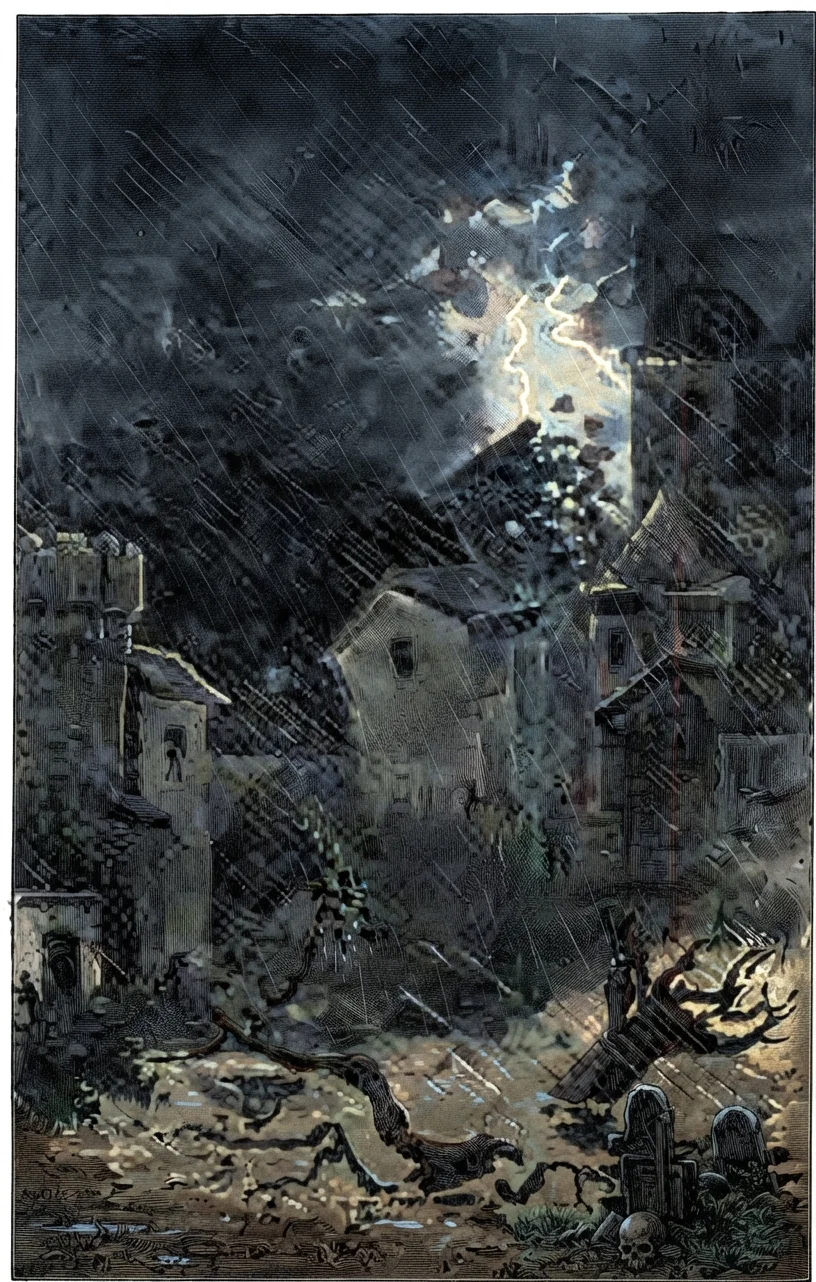
'Suddenly the storm burst upon them in all its fury. Matt. 7:27. The wind blew a terrific gale. The sand of the plain was picked up, and carried in clouds, producing a veritable simoon. O, how the buildings creaked and swayed in the wind! Domes were carried away, windows were crushed in, floors gave way, and some buildings were leveled to the ground. Then came the rain in a perfect torrent, which seemed as tho it would sweep everything before it. The houses where the domes or windows or doors had given way were soon filled with water, and began to crumble and fall. The sand of the plain was being washed away, and those houses whose foundations rested upon it soon went down, and were engulfed in the flood.
'There were some houses, however, which stood for a long time. They were the ones whose superstructure was correct, and whose foundations rested almost entirely upon the rock; but there were places where a little sand had been left beneath the walls. This the water gradually washed out, and left a place in the wall unsupported. Here one rock and there another fell until an opening was made; through this the floods rushed with great violence, and the building went down with a crash, the wreckage disappearing in the angry waters. As I looked over the storm-swept plain, how few houses were left standing!
'The storm passed away, the waters subsided, and there stood forth the true foundation stone, swept clean and bare, save for a few buildings still standing. Then there burst upon the plain a glorious light. O, how calm, how peaceful, how bright! Each building was radiant with the light of the new day. The plain seemed white and glistening. The glory of God now flooded it.
Suddenly the storm burst on them in all its fury.
'By a careful study of my Guide-book I found that the buildings are our characters; that the storm is the judgment; that our faith and practise will determine our destiny; that the Ten Commandments is the standard of judgment, and that our daily conduct must conform to these; that Jesus is the only foundation upon which a character can be built; that the fiery trials and the searching judgment will sweep away every character which does not conform in every detail to the instruction found in the Guide-book. O, my friend, study it faithfully, and follow it closely, and all will be well; for soon the opening skies will reveal our returning King, while all the heaven shall be filled with the radiant beings who are sent to gather God's children to meet the Lord in the air (1 Thess. 4:16, 17), and finally to take possession of the earth made new' (2 Peter 3:13; Rev. 1:1-7).
Shall you be there? Shall I be there?

MAN'S WHOLE DUTY THEN. WHAT PORTION NOW?

BY B. FRANKLIN RICHARDS, M. D.
NEARLY a thousand years before the birth of Jesus, the wise man, Solomon, wrote: "Let us hear the conclusion of the whole matter: Fear God, and keep His commandments; for this is the whole duty of man. For God shall bring every work into judgment, with every secret thing, whether it be good, or whether it be evil." Eccl. 12:13, 14. Since it was the whole duty of man then to glorify God by keeping His commandments (for He was going to bring every secret thing into judgment), has God changed His mind, and removed a portion of the responsibility from man, so that He will not now bring every secret thing into judgment, as He declared?
Our attention is called to two very important statements in the above scripture: First, the keeping of the commandments of God; and, second, the bringing into judgment every work and secret thing. The same thoughts are expressed in the first angel's message of Rev. 14:7: "Fear God, and give glory to Him; for the hour of His judgment is come; and worship Him that made heaven, and earth, and the sea, and the fountains of waters." This message is to every nation, and kindred, and tongue, and people on the earth (Rev. 14:6), and these words were written in A. D. 96, and had their special application before and since the middle of the nineteenth century. So we find it is man's whole duty now, 1904, A. D., to keep the commandments of God, the same as it was B. C. 977, when the scripture first quoted was written.
When Peter, James, and John were taken by Jesus up into a high mountain to witness the transfiguration of Christ, a bright cloud overshadowed them, and a voice was heard from the cloud, saying, "This is My beloved Son, in whom I am well pleased; hear ye Him." Matt. 17:5. It was God speaking from the cloud, telling us to give attention to all that Jesus said. So let us read in Matt. 19:16, 17, "Behold, one came and said unto Him, Good Master, what good thing shall I do, that I may have eternal life?"
Please notice it is eternal life that is in question. What good thing shall I do that I may gain it? Listen, with all attention, to the answer, for Jesus, the Son of God, the Lifegiver, is to give it, and whatever the answer is, fail not to obey; for remember, eternal life is within our grasp. Let ear, and eye, and heart be ready. "If thou wilt enter into life, keep the commandments." Will you? There is eternal life in doing it. Jesus said so, and God said, "Hear ye Him."
"To obey is better than sacrifice, the Lord hath said; To hearken when He commandeth than an offering made."
"What shall I do to inherit eternal life?" asked the lawyer of Jesus. He was given to understand that he could have his desires granted if he would keep the commandments. Undivided love to God, and loving our neighbor as ourselves, fully meet all the requirements. "Thou shalt love the Lord thy God with allthy heart, and with all thy soul, and with all thy strength, and with all thy mind; and thy neighbor as thyself." "This do and thou shalt live." Luke 10:25-28.
Did Jesus keep the commandments? "Hear ye Him." "I have kept My Father's commandments, and abide in His love." John 15:10. So the branch ought to do what the Vine did. "I am the Vine, ye are the branches; he that abideth in Me, and I in him, the same bringeth forth much fruit; for without Me ye can do nothing." John 15:5. We obtain eternal life through our knowledge of God, and Jesus Christ. "This is life eternal, that they might know Thee the only true God, and Jesus Christ, whom Thou hast sent." John 17:3.
But we learn to know God and Jesus through keeping the commandments. We can know that we know them beyond any possible shadow of a doubt. "Hereby we do know that we know Him, if we keep His commandments. He that saith, I know Him, and keepeth not His commandments, is a liar, and the truth is not in him." 1 John 2:3, 4. These words are very plain and easily understood.
God calls for a willing service, filled with love, and it is through this service and love we learn to understand the relationship existing between us. "Whosoever believeth that Jesus is the Christ is born of God; and every one that loveth Him that begat loveth Him also that is begotten of Him. By this we know that we love the children of God, when we love God, and keep His commandments. For this is the love of God, that we keep His commandments; and His commandments are not grievous." 1 John 5:1-3.
It was God's great love for us that moved Him to action. We were lost, undone, without hope or God in the world. It was our great need, our lost condition, that cried to Him louder than the voice of man. He saw us in that sorry plight. He had made for us a beautiful world, then created us in His image, after His likeness, and after He placed us in possession of this world, we sold it and ourselves to the devil. We would not keep the commandments of God; we forfeited every right to life, every claim on God; but the great love of God toward us caused Him to come to our rescue in the gift of His only-begotten Son, for us and to us. He came to this world and paid our penalty. He kept the commandments of God, and paid the demands of the law, and I hear Him saying, "To him that overcometh will I grant to sit with Me in My throne, even as I also overcame, and am set down with My Father in His throne." Rev. 3:21. He kept the commandments, and the record declares of Him that He "did no sin, neither was guile found in His mouth." 1 Peter 2:22.
After Adam committed sin he was driven from the Garden of Eden, lest he should eat of the fruit of the tree of life and live forever. Gen. 3:22-24. Since that time no man has had the exalted privilege of even tasting of that fruit, and will not again eat of it until he is inside the city of God. He will be there in person; but before reaching the center of the city, where the tree of life is (Rev. 22:1, 2), he must pass through one of the gates of pearl, that is, in the wall of jasper surrounding the city of God. But before he will be permitted to enter in through these gates, he will be called on to show his passport, which will be the guarantee that the holder has kept the commandments of God. "Blessed are they that do His commandments, that they may have right to the tree of life, and may enter in through the gates into the city." Rev. 22:14. "And, behold, I come quickly; and My reward is with Me, to give every man according as his work shall be." Rev. 22:12.
"The judgment has set, the books have been opened; How shall we stand in that great day When every thought, and word, and action, God, the righteous Judge, shall weigh?"
"I have called you friends; for all things that I have heard of My Father I have made known unto you." "Ye are My friends, if ye do whatsoever I command you." John 15:15, 14.

SEARCH THE SCRIPTURES

Exodus.

By F. D. Starr.
WHILE the account of creation is given us in Genesis, in the book of Exodus we have the story of redemption vividly portrayed in the deliverance of Israel from Egyptian servitude. 'What one nation in the earth is like Thy people, even like Israel, whom God went to redeem for a people to Himself?' 2 Sam. 7:23. 'Thou in Thy mercy hast led forth the people which Thou hast redeemed.' Ex. 15:13. So creation and redemption are closely associated in these early records.
The term 'Exodus' is from the Greek name, given this book in the Septuagint, and signifies a going out, referring to the departure of Israel from Egypt.
Some are inclined to look upon these early records as being of a fabulous or mythological nature; and while they allow for the New Testament the highest degree of accuracy and inspiration, yet they say the accounts of the books of Moses are not reliable. But it is interesting to notice that the events recorded in the Old Testament are so extensively mentioned and corroborated in the New.
Let us examine into this a little. In the first chapter of Genesis we find the account of the creation of all things in six days. Men may say that this is merely a Mosaic fable, but Paul, in Heb. 4:4, acknowledges the accuracy of the statement by referring to the fact that God rested from all His works on the seventh day; and if all was completed when the seventh day came, the work was all done in six days.
In Genesis 2 we have, among other things, the record of the creation of Adam before a woman was brought into existence. This account is rejected by those who advocate the teachings of evolution, but Paul confirms the account given by Moses. He says, in 1 Tim. 2:13, 'For Adam was first formed, then Eve.'
In Genesis 3 we have the record of the temptation of this same mother Eve by the serpent. This is by some unhesitatingly denounced as a myth. But if it were such, it would be just as much a New Testament myth as an Old Testament myth, for Paul says, 'The serpent beguiled Eve through his subtilty.' 2 Cor. 11:3.
So we might find, upon examination, something from nearly every chapter of Genesis acknowledged in the New Testament.
The same result is obtained if we examine the book of Exodus in this way. Chapter 1 tells of the conduct of the king 'which knew not Joseph.' Stephen tells us of the same incident. Acts 7:18.
In Exodus 2 we have an account of the early history of Moses, his being hid three months by his parents, his adoption by Pharaoh's daughter, his flight into the land of Midian, etc.
The same account is largely reproduced in Acts 7.
In Exodus 3 we find the interesting recital of the call of Moses to deliver Israel, the miracle of the burning bush, etc. That this is no fictitious account is seen by its being rehearsed also by Stephen, as found in Acts 7.
So we might go on from chapter to chapter in this inspired record with the same results.
The topics for study that are found in this interesting book of Exodus are far too numerous to mention in this article, but we will notice a few of them.
We read in Rev. 11:6 that it is in the power of God's two witnesses (the Old and New Testaments) to smite the earth with all plagues, as often as they will. This fact is most clearly demonstrated in the ten plagues that fell upon Egypt, as recorded in Exodus, chapters seven to twelve. These plagues seem naturally to be grouped together in pairs. The first two, the blood and the frogs, both proceed from the water. The next two, the lice and the flies, are from the insect world. The third pair, murrain and boils, are diseases, one affecting beasts, the other affecting people. The fourth couple of plagues is destructive of vegetation, the hail destroying a large part of the crops, and the locusts taking what was left. While all these foregoing plagues affect man in a material or physical way, the last two must have caused intense mental anguish,—darkness and death—what a dread combination!
Darkness is an apt symbol of death. What a shadow of death it must have been when the wretched victims saw not one another for three days, and endured a darkness that might be felt! What gloomy meditations and forebodings must have come to their minds as they sat in that terrible unbroken night of more than three-score hours' duration!
Then to end the awful series of disasters came that sad day when every Egyptian home was a house of mourning—the beloved first-born a corpse.
In close connection with this day of just retribution to the Egyptians we have the Gospel of forgiveness and mercy in Israel's Passover experience. What devout or thinking son of Abraham could fail to see in this wonderful deliverance the final pardon and blotting out of sin, that is insured in the blood of Him who is our Passover, whose blood was typified by the crimson on the lintel and sideposts of their doors? 'Who is a God like unto Thee, that pardoneth iniquity, and passeth by the transgression of the remnant of His heritage?' Micah 7:18. It is because the Lord passes by, or passes over, our transgressions, by virtue of the blood so freely shed for us, that we are not cut off. The remnant of His people, living at the time of the close of probation, when Rev. 22:11 will be fulfilled, will have a thrilling experience in this matter.
In one respect the book of Exodus furnishes us the most noteworthy event in this world's history since the fall. All eyes may well be turned to Exodus 20, and the sublime event therein recorded, and listen to the voice that then shook the earth. That was the giving of the Ten Commandments, which are acknowledged to be the infallible rule of conduct for the whole race, and were spoken by the living God in the hearing of all His people. 'He that hath ears to hear, let him hear.'
This book is full of themes of all-absorbing interest. The half has not been told, nor even referred to. The ratifying of the first covenant, the building of the earthly tabernacle (the type of the heavenly), Israel's apostasy in making the golden calf, Moses' long fast when receiving the tables of stone, etc., will richly repay thestudent for the time spent in examining the book.
Who can afford to omit the book of Exodus from his course of reading and study?
Continue reading: RESPONSIBILITY FOR THE GIFT OF LIFE