Signs of the Times, Vol. 40, No. 39.

The Patmos Life -

Signs of the Times

Oct 7, 1913

Pacific Press Publishing Association · Mountain View, California · Oct 7, 1913

The Patmos Life -

BY ELIZA H. MORTON
OUR God makes no mistakes, tho strange to us May seem the workings of His will. Upon The isle called Patmos, John, an exile, wept, And prayed and talked with Him who holds the sea Within His hands. Aye, strange it seemed to take One from a work that was to be world-wide, And mighty in its power — yea, one that loved The work, the Master, and the world. To him His hopes seemed blasted, and his plans as naught; And yet in Patmos came a service grand, Most wonderful — a wider service than The one beloved had ever dreamed. His heart And life were raptured by the scenes that love Revealed — the glorious visions of our God; And down to us have come those visions bright, The trumpet voices and the glimpses of a home Where hosts of angels dwell.
The Spirit waits To isolate our lives, to give us views More wide, to take us, as it were, afar To Patmos in its loveliness; for earth And earthly cares crowd out the Spirit's power, Prevent our eyes from seeing things unseen. But John had stood close by the cross of Christ, His head had touched the bosom of his Lord. Because of this, the visions on the isle Were possible; and so if we would know The blessedness and fulness of that joy, And see beyond the portals of this life, We too must bow before the cross, we too Must insulated be by His own power, And live the Patmos life. His Spirit then Through us will flow out to a weary world.
Portland, Maine.
“He leadeth me beside the still waters.”

Question Corner

"IF YE WILL INQUIRE, INQUIRE YE."
This Inquirers’ Department is conducted for the purpose of helping those who are studying the Bible. The answers are oftentimes only suggestive. They are never to be considered infallible, only as they agree with the infallible Word. The writer who may answer these questions does not consider that his opinion is infallible. He will simply give the best that he has, and plead with the inquirer to search the Word. Such questions only will be answered as, to the editors, seem to minister to the good of the readers and to the mission of the paper. We can not answer repeatedly in the same volume questions upon the same scripture. The name and address must accompany each question, not for publication, but as an evidence of good faith, and that answer may be made by letter if deemed advisable. No letters are answered which do not contain the name of the writer. It is well always to enclose stamp for reply.

4195 — Character—Gift or Growth

Is character a gift or a growth? That is, does one inherit certain characteristics or tendencies to either good or bad, and is that character in its finality the result of environment in the main? C. C.
Yes and No. Entirely apart from God, character is made up from what we inherit and from what we assimilate from our environments. Sometimes the environments are such as to overcome entirely the inherited tendencies, and sometimes inherited tendencies are so strong as to make environments. It is possible for a man to surround himself with an atmosphere of himself, and live within that, despite environments, as has been demonstrated again and again in the world’s history. But as regards Christian character, the only true character and the only character that will persist forever, it is primarily a gift. “Ye must be born again,”—literally, Ye must be born from above. “A new heart also will I give you, and a new spirit will I put within you.” The Lord Jesus Christ is able to take the soul, with every tendency toward evil, in the midst of the worst of environments, and to change that soul so that He shall be honored and glorified in the work and character of the one saved.
We know that there is very much said of environment. We know that with some it is the be-all and end-all of character. We know that there are those who are contending that unless government and society make environment right, man’s case is hopeless. But man’s case is not hopeless as long as there is a living God, heaven is open to him, and he will embrace the gifts that God will bestow. The city of Corinth was a fearfully wicked city. There were wicked influences on every side, that bred up a class of wicked people,—fornicators, idolators, adulterers, thieves, drunkards, revilers, and so on. The apostle mentions these classes in 1 Cor. 6:9, 10. He declares that such characters as these can not inherit the kingdom of God. He declares also to those Corinthian brethren whom he called “saints,” “And such were some of you; but ye are washed, but ye are sanctified, but ye are justified in the name of the Lord Jesus, and by the Spirit of our God.” And God is able so to surcharge His children with power from on high that they can live in the worst of environments, and still grow up in beauty in Him.
Consider the lily. How often it is that those who frequent country lakes and rivers will find growing through the ooze of the muddiest portion of the lake, which if stirred up with a paddle exudes a horrible stench and fills the water with mud and filth, the beautiful pond-lily, resting upon the surface with perfect whiteness, surrounded by its great, broad leaves of living green. The filthy waves wash over it, but it is still white, and its perfume is sweet and agreeable. So may God’s child, even if placed in wicked environments, gather so much of heaven’s atmosphere and power that it can form character amid the evil elements which surround it.

4196 — The Millions of Heathen

What will be the final end of the millions of Chinese who for hundreds of years had no opportunity to hear of Christ? Did God do all He might do for these people during all of these years? Could not these have been saved, had they had the living preacher, who will not now have eternal life? S. A. N.
There are in God’s great plan many things of which we know nothing, but we can not say that millions have lived in these lands without any knowledge of Christ. They might not hear of His particular name, they might not have had the theory of the gospel as we hold it; but the apostle Paul argues and declares in Romans 1, that they are without excuse, even those that had shut away the gospel from themselves. Rom. 1:20. And then he tells us the reason why they were without excuse,—for even though they may have been shut away from God’s living, human messengers and all printed messages or books which come to them, still “the invisible things of Him from the creation of the world are clearly seen, being understood by the things that are made, even His eternal power and Godhead; so that they are without excuse.” And in the 10th chapter of Romans, where the same thought is suggested, of the necessity of hearing the gospel, the apostle asks: “But I say, Have they not heard? Yes verily, their sound went into all the earth, and their words unto the ends of the world.” Rom. 10:18. But this is simply a quotation from Ps. 19:4. We recall the striking comment which Bishop Taylor, the one who did such noble work in Africa among its heathen tribes, made upon this. While reading Ps. 19:1-6, he commented something as follows: “The heavens declare the glory of God; and the firmament showeth His handiwork”—God’s great common school. “Day unto day uttereth speech”—God’s great day-school; “night unto night showeth knowledge”—God’s night-school. “There is no speech nor language, where their voice is not heard”—God’s great common school of the nations. “Their line is gone out through all the earth, and their words to the end of the world”—God’s great common, universal, day-and-night school. And then he told of natives that he had found right in the very heart of Africa, who had laid aside all their idols and had reached out after the living God, the God that made all things, and had simply given themselves to Him by speaking the name which they themselves used, saying, “I am your man.” Connect that with 2 Chron. 16:9, “For the eyes of Jehovah run to and fro throughout the whole earth, to show Himself strong in the behalf of them whose heart is perfect toward Him.” One single ray of light shining from the throne of God, cherished in the heart and dominating the life, will save. The life may be imperfect, the knowledge may be very limited; but if the dominating thought is the great thought of God and loyalty to Him, God requires no more. The Father will bring the added knowledge and the great illumination. All these things the heathen worlds have had, and there have been instances all the way through, among these heathen tribes, of those who have risen above all environments, and have thought out, through the aid of God’s Spirit and heavenly angels, the salvation and peace which come through Jesus Christ our Lord. The wickedest city that we have on record was Sodom; yet God saved Lot out of Sodom, and saving Lot, condemned the rest of Sodom, because every one in Sodom could have known, just as truly as Lot did, the way of salvation, if they had desired it. All these teachings which demand another probation for those who are lost are certainly anti-Biblical, contrary to the teachings of the apostles. God has done and will do everything that He can, and that man permits, with man’s free will, in order to save mankind. On the other hand, God will not do injustice to those who do not long for these things, or yield to the highest conception of good. Man has misused life; God simply takes it away from him, and man dies.

4197 — The Zeal of Thine House

John 2:17 reads: “And His disciples remembered that it was written, The zeal of Thine house hath eaten me up.” Will you please explain? E. F.
The verses which immediately precede John 2:17 tell of Christ’s coming into the temple and finding those who were selling oxen, sheep, and doves, and who were engaged in money changing. The same incident is also spoken of in Matt. 21:12; Mark 11:15; and Luke 19:45. The Master called their attention to the fact that “it is written, My house shall be called of all nations the house of prayer; but,” He added, “ye have made it a den of thieves.” Matthew, Mark, and Luke each give the same statement,—that they had made the Lord’s house a place of thievery.
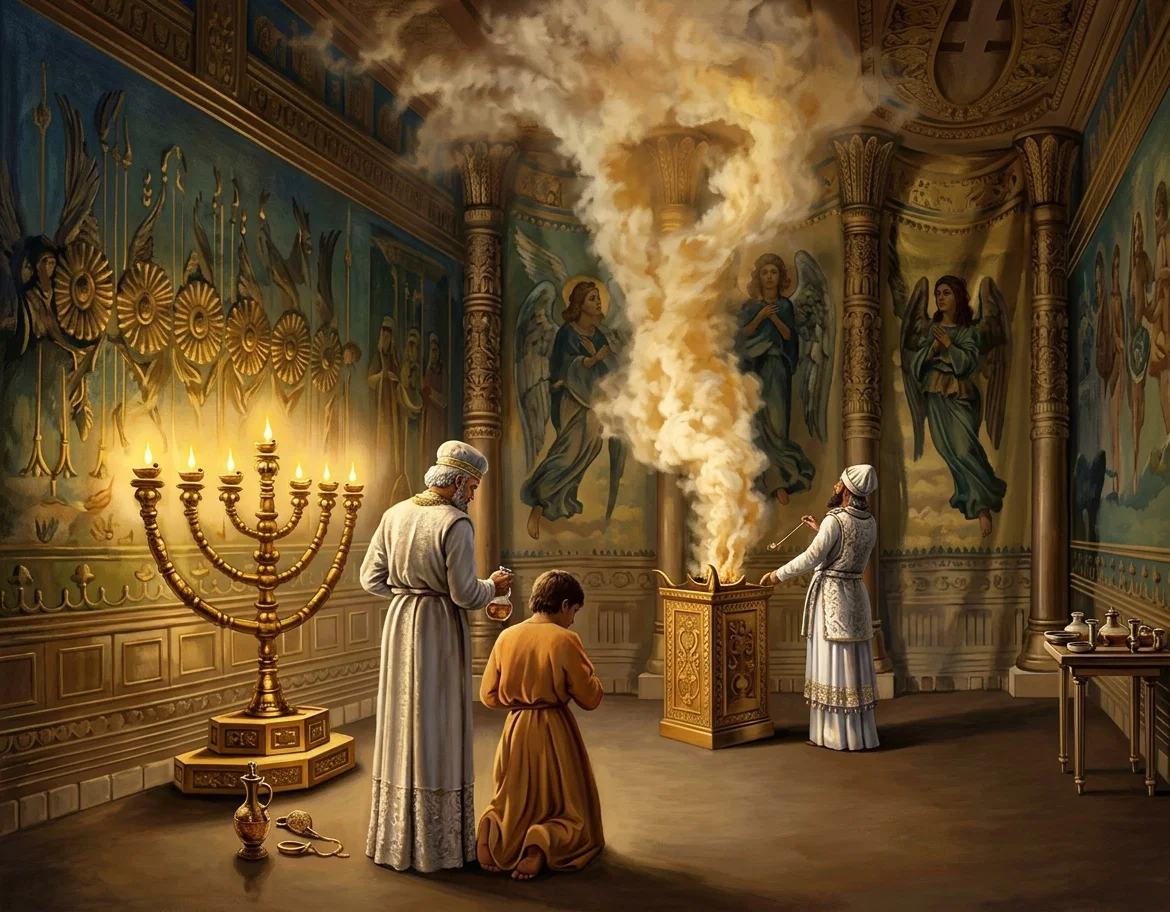
The most sacred memories clustered around the temple of Jehovah. It was in the holy of holies in this temple that the divine presence was manifested. These men had so far lost sight of the sacredness of the temple and the reverence due to the great Creator, that they had come into the very courts of that sacred edifice with the most common traffic. The Jewish people came to the temple from all parts of the world, for worship and to offer their sacrifices. Those from distant places had to bring the money of their country, and depend upon buying animals for their offerings on reaching Jerusalem. These shrewd money sharks that the Master called thieves, had taken advantage of this situation, and were charging exorbitant rates of exchange on the money, and then were also charging exorbitant prices for the animals that they were selling to the worshipers for them to offer as sacrifices. The One was there who was the Author of the temple and its service, and the spectacle presented before Him was so out of harmony with the purpose for which the temple had been dedicated, and so out of harmony with the plan of His Father, that it caused the divinity of His nature to flash through His humanity in a stern rebuke that gave those desecrators of the sacred precincts a vivid but miniature idea of judgment realities; and in this was fulfilled the statement in the 69th Psalm, that “the zeal of Thine house hath eaten me up.” The Revised Version translates the expression in John, “Zeal for Thy house shall eat me up.” The prophecy in the psalm would seem to show that while the Master would patiently endure all the personal reproaches that fell upon Him, yet when it came to the question of the desecration of His Father’s house and of the divinely appointed service that was for the purpose of showing the sinner the way of salvation, divinity must flash forth. The eternal life of men was at stake, and the Lord could not remain indifferent. Zeal for His Father’s house caused the emphatic display of divine power.

4198 — The Priests in Ezra

In Ezra 7:7 it says there were Levites among those that went up with Ezra to Jerusalem, and in chapter 8:15 it says he could find none. J. E. G.
But if you will read on in chapter 8 to verse 20, you will find that he obtained Levites after all. When he found there was none, he sent for Eliezer and others, and he sent them with a commandment to Iddo the chief, told them what they should say unto Iddo, and to his brethren the Nethinims, . . . that they should bring unto us ministers for the house of our God. And it tells us that they brought a man of understanding of the sons of Mahli, the son of Levi. So the statement in the 7th chapter and 7th verse is true, that they really joined that company after all.

Our Bible Band

Schedule for the Week Ending October 11, 1913

Day Month Date Book Reading
Sunday October 5 Mark 15
Monday " 6 " 16; Psalm 57
Tuesday " 7 Luke 1
Wednesday " 8 " 2
Thursday " 9 " 3; Psalm 60
Friday " 10 " 4; Psalm 61
Sabbath " 11 " 5; Psalm 62
The first two days of the week conclude the book of Mark, with Psalm 57. The latter part of the week includes the first five chapters of Luke, and Psalms 60, 61, and 62.
Luke was another one of the evangelists who was not an apostle. He is called “the beloved physician,” and from Col. 4:11, 14, seems to have been a Gentile. We are told that the Greek he wrote indicates that he was a physician, from the medical terms that he uses in the description of diseases. The story of the gospel seems to have been written with a special reference to a friend of his whom he calls “most excellent Theophilus.” He tells us, in the preface, that he had taken great pains to draw up a narrative of the matters that were believed among the Christians, to trace the course of all things accurately from the first. Some render the expression “from above,” rather than “from the first,”—that is, that God had given him direction from above, that the narrative might be written according to God’s own mind. Theophilus is supposed to have been a Gentile who lived in Italy. Luke’s Gospel presents Christ as the Saviour of men of every nation, giving greater prominence to His real humanity as “the Son of Man.” His Gospel alone narrates the events of chapters 1 and 2, the first rejection at Nazareth, the miraculous draught of fishes, the raising of the son of the widow of Nain, the anointing by the sinful woman, the mission of the seventy, and something like sixteen other events and parables which are not given in the other Gospels. It was written before the destruction of Jerusalem, and probably at Rome.

The Sons of Eli—No. 1

By Mrs. E. G. White
The sacrificial offerings were designed to prefigure the sacrifice of Christ, and thus to preserve in the hearts of the people an unwavering faith in the Redeemer to come.
As the sons of Eli advanced to manhood, and entered upon the duties of the priesthood, the evil effects of their early training became more apparent. Though engaged in so important and sacred a work, they were “sons of Belial; they knew not the Lord.” From childhood they had been familiar with the solemn, impressive services of the sanctuary. They had been faithfully instructed in the commandments and ordinances of the Lord. Intellectually, they had a knowledge of God; but their hearts had never yielded to the influence of divine grace. They loved not God’s character or His requirements.
Had these youth improved the privileges granted them, they might have become men of both intellectual and moral power. A faithful obedience to God’s requirements will have a surprising influence to elevate, develop, and strengthen all man’s faculties. Those who have in youth devoted themselves to the service of God, are found to be the men of sound judgment and keen discrimination. And why should it not be so? Communion with the greatest Teacher the world has ever known, strengthens the understanding, illuminates the mind, and purifies the heart—elevates, refines, and ennobles the whole man. “The entrance of Thy words giveth light; it giveth understanding unto the simple.”
Among the youth who profess godliness, there is a large class who may seem to contradict this statement. They make no advancement in knowledge or in spirituality. Their powers are dwarfing, rather than developing. But the psalmist’s words are true of the genuine Christian. It is not, indeed, the bare letter of God’s word that gives light and understanding; it is the Word opened and applied to the heart by the Holy Spirit. When a man is truly converted, he becomes a son of God, a partaker of the divine nature. Not only is the heart renewed, but the intellect is strengthened and invigorated. There have been many instances of persons who before conversion were thought to possess ordinary and even inferior ability, but who after conversion seemed entirely transformed . They then manifested remarkable power to comprehend the truths of God’s word, and to present these truths to others. Men of high intellectual standing have considered it a privilege to hold intercourse with these men. The Sun of Righteousness, shedding its bright beams into their minds, quickened every power into more vigorous action.
God will do a great work for the youth, if they, by the aid of the Holy Spirit, will receive His word into the heart, and obey it in the life. He is constantly seeking to attract them to Himself, the Source of all wisdom, the Fountain of goodness, purity, and truth. The mind which is occupied with exalted themes, becomes itself ennobled.
Those who profess to serve God, and yet make no advancement in knowledge and piety, are Christians only in name. The soul-temple is filled with desecrated shrines. Frivolous reading, trifling conversation, and worldly pleasure occupy the mind so completely that there is no room left for the entrance of God’s word. Worldliness, frivolity, and pride take the place which Christ should occupy in the soul.
To fix the heart’s best affections upon any finite object, any earthly good, degrades the souland weakens the intellect. God alone is worthy of man’s supreme devotion. The individual whose heart is placed on worldly gain becomes covetous, selfish, and even cruel, in his efforts to amass wealth. Living for himself, he becomes narrow-minded. All his thoughts and feelings are absorbed in promoting his own interests. Mind and heart are dwarfed to meet his low standard of excellence.
Those who seek as their chief good the indulgence of appetite and passion, are never good or truly great men. However high they may stand in the opinion of the world, they are low, vile, and corrupt in God’s estimation. Heaven has ordered that the mark of their depravity shall be written upon their very countenance. Their thoughts are of the earth, earthly. Their words reveal the low level of the mind. They have filled the heart with vileness, and well-nigh effaced therefrom the image of God. The voice of reason is drowned, and judgment is perverted. O, how is man’s entire nature debased by sensual indulgence! When the will is surrendered to Satan, to what depths of vice and folly will not men descend! In vain does truth appeal to the intellect; for the heart is opposed to its pure principles.
Eli’s sons chose the false, the sensual, the debased, instead of the true, the pure, and the holy. Thus they became sons of Belial, children of Satan. Standing, as they did, in sacred office, the chosen exponents of the divine will, mediators between a holy God and repentant sinners, the course of these wicked men brought temptation upon all Israel. Again the faith and devotion of the people were tested. Those who had cherished iniquity in their hearts, were inclined to unite with these vile men; and many excused their own sins, because those in high position led the way in transgression.
The typical service was the connecting link between God and Israel. The sacrificial offerings were designed to prefigure the sacrifice of Christ, and thus to preserve in the hearts of the people an unwavering faith in the Redeemer to come. Hence, in order that the Lord might accept their sacrifices, and continue His presence with them, and, on the other hand, that the people might have a correct knowledge of the plan of salvation, and a right understanding of their duty, it was of the utmost importance that holiness of heart and purity of life, reverence for God, and strict obedience to His requirements, should be maintained by all connected with the sanctuary.

A Willing Heart

“The Lord is not slack concerning His promise, as some men count slackness; but is long-suffering to usward, not willing that any should perish, but that all should come to repentance.” 2 Peter 3:9.
THE only Son of a King of a great universe was willing to leave that palatial home for the abode of the manger; willing to leave the parental board, spread with heavenly manna, for the long fast of the dreary wilderness; willing to leave the companionship of holy angels for the scoffs and scorn of murderous men; willing to do all of this for us, that we might not perish, but have eternal life.
Are we willing to surrender our beautiful and pleasant homes here for one in the kingdom? willing to train our appetites, that we may enjoy the delicacies of the marriage supper of the Lamb? willing to shun evil companions, that we may walk with Jesus?
“Except ye repent, ye shall all likewise perish.” Luke 13:3.
E. W. CATLIN.

Nature of God’s Salvation

By J. O. Corliss
GREAT and wonderful are the promises of our God. Great are they because their complete possession can be met only in the eternal continuance of a renewed life. They are wonderful, also, because they cover infinitely more than mortal mind can conceive. The climax can be reached only when one steps out from the bewildering disagreements of human sentiment, and lodges “under the shadow of the Almighty.”
This “shadow” is not, however, a murky cloud by which one’s enjoyment is darkened, but a strong defense against possible dissatisfaction in the choice of one’s life walk. And it is this, too, because the Almighty’s “shadow” is but the subduing and purifying sway of Jehovah’s mind, to tinge and protect the inner man, in anticipation of adverse occurrences. In other words, it is both a “sun and shield,”—a “hiding-place from the wind” under the protecting covert of God’s “wings,” thus proving to be a refreshing “shadow of a great rock in a weary land.”
This, and much more, is the promise to all who inhabit the “secret place of the Most High.” God’s “secret place” for the “hiding of His power” in behalf of His “chosen” is in His own tabernacle, or dwelling-place. There He actually hides men “in the secret of His presence, from the pride of man,” and quietly keeps them “in a pavilion from the strife of tongues.” Ps. 31:20. It was in this presence that Moses received the stamp of God’s countenance, so strongly marked that the men of his acquaintance could not look steadily in his face. 2 Cor. 3:13; Ex. 33:7-11.
But these were only earthly diversions, typical of invariable conditions held in reserve for those who live with God in the place of His secret musings. Not only does He promise to all such His visible protection from open enemies and hidden pestilence, but to those who revere Him He unreservedly discloses His secret being, and reveals His wondrous covenant of peace. Nor is this all; for those who call upon Him, He answers, and comforts in time of trouble; He rescues and elevates them in the sight of men. Ps. 91:2-15.
But even this does not cover the promise in full; for in due time the Lord comes to earth with a “recompense.” He then opens the blind eyes, and unstops deaf ears; He makes the lame leap as the stag, and the tongue of the dumb sing. Isa. 35:4-6. All tears are then dried, death has fled, sorrow and crying have ceased, and pain is unknown. Rev. 21:4. A highway is provided for these redeemed ones, over which no lion or ravenous beast can roam, but the ransomed walk there singing songs of everlasting joy. Isa. 35:9, 10.
What an incomprehensible provision is this! And yet it is graciously included in the promise of Jehovah. To him who wills to reach this state, God adds the following stipulation: “With long life will I satisfy him, and show him My salvation.” Ps. 91:16. Who can measure this pledge? Stop and think. How long must one live under the conditions assured to be really satisfied? Would a thousand years do it? Would a million?—No, indeed; no limit can be set to such a proposition. The enjoyment of that state must therefore be a “far more exceeding and eternal weight of glory.” 2 Cor. 4:17.
But what does this word “eternal” mean? Upon hearing sung the familiar words,
“When we’ve been there ten thousand years, Bright, shining as the sun, We’ve no less days to sing God’s praise, Than when we first begun,”
an infidel scoffed, saying, “Upon the face of it that is but a delusion of Christian theology.” But is it? Suppose one subtracts from eternity ten thousand years, or even ten million, would not the result be eternity?—It certainly would. Then why may not one rest in the eternal promise of Heaven permitting him to bask in the sunshine of God’s eternal glory? And why may not the reader enjoy this unspeakable gift?

The Unanswerable Argument on Immortality

By Alexander Ritchie

II. An Argument from Philosophy

In my first article was presented the argument from Bible teaching. But there are some who have not an implicit faith in the Bible as a supreme court of appeal. To such we would submit a philosophical argument, which we believe to be unanswerable, praying also that it may strengthen the faith of those who do believe.
The Bible is an ancient history, which none in search of merely historic truth can afford to spurn, as well as a revelation. Now the Bible tells of several cases where people were raised from the dead. And the philosopher who regards his reputation, dare not reject these testimonies merely because they are found in the Bible; for abundant corroborative evidence of both the possibility and the actuality of such things, may be discovered among the writings of historians of the early Christian era who make no pretense of inspiration. Their testimony, added to the Bible statements, surely ought to make the story credible to the honest doubter. Unbelief will never invalidate the testimony of scores of reputable eye-witnesses to the fact that dead people have repeatedly been raised to life.
And in these cases of resuscitation, we have a means at hand of solving the great problem of man’s condition after death. There was Lazarus, and the daughter of Jairus, and the widow of Nain’s son, all of whom were raised to life by Christ, in the presence of many onlookers. Besides these, other persons were subsequently raised from the dead by holy men in the early Christian church, over a period of at least two hundred years after our Lord’s ascension. That was an age of philosophic inquiry never surpassed. It was an age of literature, an age of investigation. Even Paul testifies to that, when he tells us that in his day, “all the Athenians and strangers which were therespent their time in nothing else, but either to tell, or to hear some new thing.”
Such an event as raising the dead to life, would create an unparalleled sensation anywhere on earth, at any time. “Much people of the Jews therefore knew that He [Christ] was there: and they came not for Jesus’ sake only, but that they might see Lazarus also, whom He had raised from the dead.”
That is a typical picture of what would happen anywhere, whenever any one was raised from the dead. The future state was a subject of absorbing interest then, as it is now. Does any thinking man believe that the philosophers and wise men of those days would neglect the rare opportunity of questioning those who had explored the realms of death?
It is a favorite maxim among men, that “seeing is believing.” What evidence could equal the testimony of an eye-witness of the spirit world? Would not the visitor to hades be a competent person to describe its sights and sounds, and his own sensations and experiences? And if these returned travelers to the spirit world could tell of friends they met, of memories revived, of new and thrilling experiences on “the spirit plane,” as our philosophers call it, how eagerly, how joyfully would the “doctors” of that bygone day have gleaned every grain of such precious information, and inscribed it on their enduring parchment, with their names attached as scribes, to hand it down to later generations as a precious heritage of demonstrated truth on the great subject of death and what it brings to men!
But—“be astonished, O ye heavens”—after ages of controversy on the subject; after the writing of books without number, to prove that the deathless spirit of man is conscious after death; after poets have celebrated man’s “never-dying soul,” and preachers have exhausted their vocabularies to extol the grandeur and immortality of the human spirit,—the unanswerable and undeniable fact remains, that out of all the number of those who have entered the portals of death, and had the opportunity to know by experience the thrill of conscious existence on “the spirit plane,” and afterward have returned to this life and resumed the current of their daily thought and activity among men—of all these, I say, NOT ONE has brought back one iota of information about the spirit world. Not one has uttered a word concerning their conscious existence there. Not one has left on record even a memory of the hours and days spent in death, to confirm the claims of our immortal philosophers. I say, It is the UNANSWERABLE argument. It is a demonstration of the divine sentence on sin, “Thou shalt surely die.” It is a nullification of Satan’s falsehood, “Ye shall not surely die: for . . . your eyes shall be opened, and ye shall be as gods.”
Inherent immortality is not only false and anti-christian. It is also unphilosophic and unscientific. For thought and spiritual emotions are the product of brains; and when a man dies, his brain dies with him. The brain is in the grave, with the rest of the dead body; and thought apart from the brain is an absolute impossibility. Therefore the word of God declares of the dying man, “His breath goeth forth, he returneth to his earth; in that very day his thoughts perish.”
Thought is consciousness, and consciousness apart from thought is impossible. Therefore as dead men do not think, they are not conscious. Again the Bible confirms the argument. “For the living know that they shall die; but the dead know not anything. . . . Also their love, and their hatred, and their envy, is now perished.” Love, hatred, and envy are purely thought. Men love, or hate, or envy, with the mind; and that is the thing that has perished when a man dies.
I beg of you to give the great Creator who made us all, the credit for knowing, better than any one else, the condition of man in death.
In closing, let me remind you, dear reader, that if any man who ever died in this world, would have the right and ability to be conscious in death, and to go immediately to heaven, and enjoy its pleasures, that man would be “the Man Christ Jesus.” But the Bible says, “He hath poured out His soul unto death.” Otherwise we should have had but a human sacrifice; for His soul was divine, but His body was human. Then after being dead and buried for at least thirty hours, when the Saviour rose, early on that first-day morning, He said to Mary, “Touch Me not; for I am not yet ascended to My Father.” From this we see that Christ had not been conscious in heaven, while He lay in the tomb. He had not been back to heaven since He left His glory there to enter human flesh as the Babe of Bethlehem. “He hath poured out His soul unto death,” and it took a glorious resurrection to unite soul and body again. It will take another resurrection to give every dead man a conscious existence.
The necessity of a resurrection is entirely due to the fact that death dismembers the human entity. For if the disembodied spirit of man is conscious, and capable of enjoying the intellectual pleasures of heaven, why should Christ come from heaven to restore that spirit to a body? Man is far beneath angels in physical capacity, in endurance, and in his hold on life. How vain and foolish, then, does it appear for the creature of mere flesh and blood to boast of possessing a deathless spirit, an immortal soul, when God, the Judge of all, declares that Lucifer himself—the prince of spirits, the fallen cherub who sinned amid the light and glory of the eternal throne, shall eventually die for his sin! “I will bring thee to ashes upon the earth in the sight of all them that behold thee. . . . Thou shalt be a terror, and never shalt thou be [or have being] any more.” Eze. 28: 18, 19.
Continue reading: What Constitutes a Christian?