GEORGIA is the Empire State of the South and has just taken the lead in a matter for far-reaching results of which it is difficult to forecast. A charter was recently granted to the Silk Culture and Manufacturing Company, with a capital stock of a quarter of a million dollars with the prospects of an increase to a million dollars in the near future. The purpose of the company is to introduce and foster the cultivation of raw silk in this country and to manufacture the raw material into the finished products. The headquarters of the concern is in Atlanta, and branch plants and colonies will be established in other parts of the State and in other States throughout the South. The first, located at Tallulah Falls, is now under way, 50,000 Mulberry trees, having already been planted. At Tallulah Falls the company already owns 2,500 acres of land, on which have been planted 50,000 Mulberry trees, which in a year or two will support the silk-worms. More land is to be bought in the near future, and it is all to be divided into twenty-five-acre farms. On each of these, five acres are to be planted in trees at once. Some French and Italian masters of industry are to be brought over and put on these farms, and every inducement is to be offered to farmers in the vicinity to set out trees also. This attempt to establish a new industry in this country could not have fallen into better hands or been undertaken with such promises of success as in the rich and enterprising State of Georgia, and that they will be eminently successful seems scarcely to admit a doubt.—Christian Work and Evangelist.
Life’s Sunshine and Shadows
“If all can not live on the piazza, every one may feel the sun,” says an Italian proverb. Life is full of sunshine for all who wish to absorb it, and full of gloom for those who take a morbid pleasure in dwelling in the shadows. Difficulties and troubles, if bravely met, make strong men and women, but anticipating and worrying about them make petty, weak ones.—Success.
Cheerfulness and Longevity
THE cheerful live longest in years, and afterwards in our regards.—Bovee.
A Wealth of Beauty for 8 Cents
WHITE STAR CLIMBER
Exquisitely fine foliage; dainty white flowers, very fragrant. Rapid grower, completely covering window in short time, forming a delicate, light-green curtain. Every one is delighted with this treasure. Blooms all winter in the house, and after being cut down in Spring and planted outdoors will grow fifteen feet over porch.
To introduce our new Catalogue will send this plant and Catalogue for only four 2-cent stamps (plant alone worth more than double). Special offer. Write to-day.
SEEDS THAT SUCCEED
BIG RETURN on a 25c Investment . . .
ENOUGH SEED TO PRODUCE
900 Heads of Cabbage . . Landreths’ Early Summer
1000 Roots of Radish . . Landreths’ White Lady Finger
1000 Roots of Beets . . Scarlet Tennisball
1000 Fruits of Cucumber . . Landreths’ First
2000 Heads of Lettuce . . Virginia Solid Header
500 Fruits of Watermelon . . Arkansas Traveler
500 Bulbs of Onion . . Bloomsdale Pearl
500 Plants of Tomato . . Landreths’ Earliest
Which Collection of Seeds for twenty-five (25) cents enclosed with the Order will be mailed post-paid. Elegantly Illustrated Catalogue for 1903, containing many new Novelties, mailed free upon application.
D. LANDRETH & SONS
JAMES VICK1217 Market St., Philadelphia
Formerly of Rochester, N. Y.
Manager Mail Order Department
PRICE FIFTY CENTS PER YEAR SAMPLE COPY FIVE CENTS
Each issue will contain 24 pages of intensely interesting and instructive reading matter. Published monthly.
PRICE FIFTY CENTS PER YEAR SAMPLE COPY FIVE CENTS
AddressPacific Health Journal, Oakland, Cal.
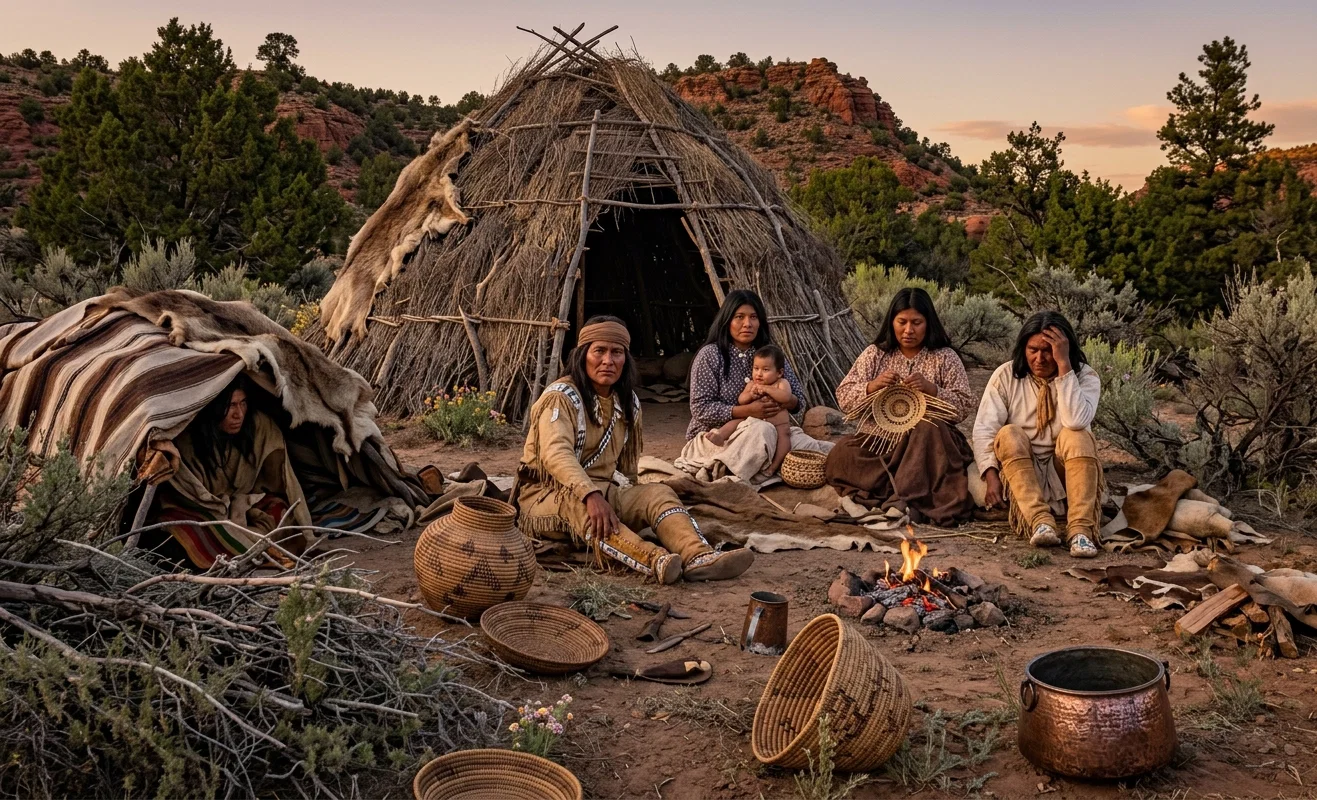
Pagan Apaches at Home in the Southwest.
SOUTH AMERICA.
By E. A. Dawson
[E. A. Dawson, in Christian Worker.]
The sometimes called (and rightly) the “neglected continent,” is indeed a great continent, lying to the south of us, reaching from ten degrees north of the equator to fifty south, a distance of some 4,800 miles. It is built up on more or less the same plan as North America: Triangular form, with the base lying toward the north, a great mountain range on the west, and great prairie and woodlands to the east.
It has all degrees of climate, from dry to wet, and from hot to cold. Its products are also as varied, comprising all kinds of fruits, roots, and grains.
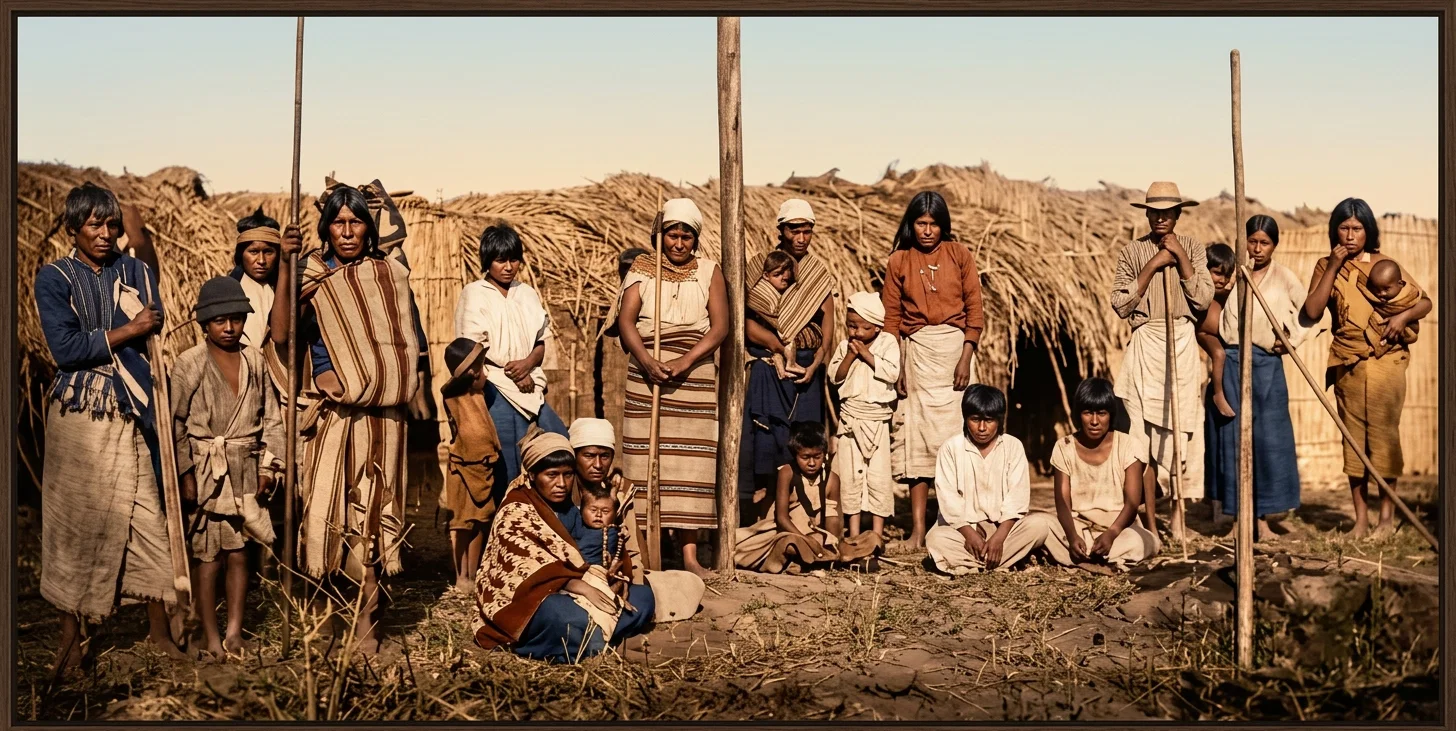
Chaco Indians of South America.
Politically, it is divided into ten republics and three small dependencies, each having its own president and senate. The population is many times underrated, and is about 36,000,000. Sixteen millions of these live in the great republic of Brazil, and are mostly of Portuguese descent. The remaining twenty millions inhabit the other and smaller republics, and are mostly of Spanish and native descent. There are, however, in this population, and scattered throughout the whole continent, about 5,000,000 Indians, speaking the native tongues. The Spaniards and native races have always been very warlike, and from the discovery up to the present time, they have continually been at war among themselves, some States indeed hardly having a year’s peace. It is only in religion that they apparently seem to be united, all being of the Roman Catholic faith, excepting a few Indian tribes, which, as yet, have not been brought under the baneful power of that system. This unity, however, is only seeming, as they hate each other with cruel hatred, and in the times of war they destroy each other’s temples, images, and saints, the priests taking part in invoking their patron saint against the other nation; brothers spilling each other’s blood upon the earth, and the saints warring in the heavens! Altho it is a land of great outward religious show and pretensions, a land of churches, of convents, of priests, of nuns, of crosses, of holy water (?), of images, of rosaries, and all the rest of the paraphernalia of priest-craft and idolatrous worship, at the same time it is a land of ignorance and sin. Gross idolatry and blind fanaticism there go hand in hand with stupid iniquity, murder, lying, thieving, and deceit, even in the very pretended temples of God and by the very priesthood who serve at their altars. The social and political life of the people is corrupted and rotten from the head to the foot, from the presidents and governors of States to the lowest slave of the common people, so that there is no trust, no public confidence, not even between father and son, priest and people. It is quite a common occurrence for priests to refuse to baptize an infant, or marry a couple, or give burial to the dead, without first receiving their charges, and often when they do trust so far as to perform these offices before receiving corresponding fee, they have to go to law to recover the same. I knew a priest in Chile who had at one time some twenty cases before the judge for the recovery of his fees. The people are very priest-ridden, and the church is sustained by the government, yet they charge their dupes for everything,—pay to be born, pay to marry, and pay to die; pay to get into purgatory, and pay to get out; in short, without money there is no salvation. This, therefore, is a picture of the social, political, and religious life of the people of South America, and now I ask, What evangelical Christian would ask such a question as “Why send them, the Gospel and missionaries?”
We send missionaries to India, Africa, China, and Japan, and they are needy fields, but let us not forget the Samaria at our own door. It is just as needy as any of the others, and, because of its situation, has even more demands on us than they. In all of that great continent to-day there is but one missionary to every 160,000, or in all, about 250 missionaries, while in North America we have one worker for every thousand of its inhabitants. Christian workers say they are not called to go to the mission-field, I would like to ask all such, Have you a call to stay at home? Do you not hear the Master’s voice coming to you down across the centuries, “Go ye into all the world, and preach the Gospel”? Would God have you stay at home, while the heathen perish for want of knowledge? Is God, therefore, partial toward the Saxon race, and is it His will to leave the rest of humanity to perish? There is no partiality with Him, and He does not desire the death of any, but that all should come unto Him and live.
Do you say, We have heathen enough at home? If we have, and I do not deny it, it is because they choose to be so, rejecting the light; but that does not excuse you nor me from our duty to give the Gospel as a witness to all mankind. This witnessing to the truth of the Gospel and the work of the Holy Spirit in our own lives, is our first duty as Christians. The acceptance of the message is a personal and individual responsibility which rests upon the hearers, who alone will be responsible to God, if we do our duty, but if we do it not, and obey not His clear command “Go,” then we shall be accountable. Has not God said in His Word, “I have set thee a watchman”? “When I say unto the wicked, O wicked man, thou shalt surely die: if thou dost not speak to warn the wicked of his way, that wicked man shall die in his iniquity; but his blood will I require at thine hand.” Will He not require it of us?—Yes, He will; and that right soon; then how shall we meet Him after twenty centuries of Christian truth, and light, and a dark heathen world all around us? Brother, sister, let us be up and doing while it is day, and let us help a little to hasten the day of our Lord’s return. Then shall we not be ashamed at His appearing. Behold, He cometh!
THE CHURCH AND THE LAW IN CHILE.
By H. F. Ketring
RELIGIOUS teachers who believe that the church has the right to rule in all things, civil and religious, sometimes place themselves in very unenviable positions before the people. This was strikingly illustrated recently in Chile. In that country the law provides that marriage must be performed by a civil officer authorized to perform such ceremonies. Those who believe in a religious ceremony have the privilege afterward of going before the priest or minister, and being married again; but the second marriage is in no way recognized before the law. Moreover, the law also provides that when two persons are united in marriage by the State, the union is for life. If the marriage proves to be an unhappy one, there is provision made for divorce, but not for after marriage to any other person. Both must live single lives until one or the other dies, when the survivor is at liberty to marry again.
This, however, is repudiated by the Catholic Church, which declares that persons married only by the State are not married at all, but are living in adultery; and Catholic priests will not grant absolution of sins to a person thus married. The following clipping from El Progreso, a Chilean paper, relates what would be an amusing anecdote, were it13not for the sad consequences to the persons concerned:—
A Curious Matrimony.
The subject of conversation among the social circles of Chilian is that of a young couple who were married by the civil law, and four days later were married religiously, after which they went to confession.
The bride declared to her confessor that in her marriage to her husband she had broken her engagement to her former lover, whom she had previously promised to marry.
The priest refused to grant her absolution, and commanded that she should go and ask the pardon of her former lover, repudiating her civil marriage, and be married to the man she had first promised.
The girl obeyed, and immediately went to the house where lived her former sweetheart. During this time her husband and his family were hunting her, and having found her, she was taken before the judge.
Here she made the same declaration that she had made to her confessor, and begged that she be taken to the monastery of the “Buen Pastor” (Good Shepherd), where she refused to speak to her husband and his family.
The disappointed lover then went before the judge, saying that the girl had been over-influenced, and asked that the marriage be annulled.
The priest, frightened by the consequences of his advice, has offered to interpose his influence in behalf of the re-establishment of the peace of the new marriage.
Chilian Society is much occupied with the matter.
Not only should this priest learn a valuable lesson from this experience, but all those who are following his example in meddling in civil affairs to the end of bringing them under the domination of the church.
Púa, Chile, So. America. H. F. KETRING.
HOW CAN I FORGET THEE!
By Benj. Phillips
Master, how can I forget Thee!
Thou hast led me out of night,
And didst show me boundless mercy,
Saw my footsteps placed aright;
Full bestowed Thy grace and friendship
On such sinful one as I—
How, O Lord, can I repay Thee!
Lead my way and hear my cry.
Father, how can I forget Thee!
Poor, unworthy, and alone;
Can such humble mortal serve Thee?
Can I ever be Thine own?
All I have is Thine, O Master;
Lend me power to sing Thy praise;
Would that I could serve Thee ever—
Serve Thee all my living days.
Master, how can I forget Thee!
I was wand’ring far from Thee,
Lost in wickedness and folly,
Light Thou gav’st and now I see.
Contrite o’er my great transgression,
Stricken at Thy feet I lie—
Give me strength to bear my sorrow,
Lead my way and hear my cry.
Seiad, Cal. BENJ. PHILLIPS.
A GRAND OPPORTUNITY WASTED.
By S.
ONE of the saddest stories of neglected opportunities is that brought out in the following bit of Indian history. A heathen nation was longing for the Gospel, and its doors were open to receive it. It sent out its emissaries to find and bring back a knowledge of the Way. The frontier trading post, now a great city, could not teach them the way, and it was not in harmony with the practice of the St. Louis priest to put the great Book in their hands, and teach them to read it. The story of the incident follows:—
One hundred years ago the Flatheads or Nez Perces held undisputed possession of a large area of country comprising portions of Montana, Idaho, and Oregon. They were the first to break away from the doctrine that there was no country to the east of the Rocky Mountains, and in the desire to learn more of the white man, a band of five chieftains was sent, in 1832, to St. Louis, the western trading point on the Mississippi River, to secure information about the God of the whites. They had heard that there was a Book owned by the white man that taught the way to the great happy hunting-grounds, where dead warriors were given seats of honor beside their chiefs. The journey was made on foot, and required a tramp of several months. The braves were given blankets, whisky, and shoes; but the great Book was not revealed. When ready to return home, the three chieftains who had survived the journey selected a spokesman, and thus addressed their friends:—
“I came over a trail of many moons from the setting sun. You were the friend of my fathers, who have gone the long way. I came with one eye partly opened for more light for my people, who sit in darkness. How can I go back with both eyes closed? How can I go back blind to my blind people? I made my way to you with strong arms through many enemies and strange lands, that I might carry back much to them. I go back with both arms broken and empty. The two fathers who came with us—the braves of many winters and wars—we leave by your great water and wigwams. They were tired in many moons, and their moccasins worn out. My people sent me to get the white man's Book of heaven. You took me where you allow your women to dance, as we do not ours, and the Book was not there; you showed me images of good spirits and pictures of the good land beyond; but the Book was not among them to tell us the way. I am going back the long, sad trail to my people.”
“You make my feet heavy with the burden of gifts, and my moccasins will grow old in carrying them; but the Book was not among them. When I tell my poor blind people, after one more snow in the big council, that I did not bring the Book, no word will be spoken by our old men or by our young braves. One by one they will rise up, and go out in silence. My people will die in darkness, and they will go on the long path to the other hunting-grounds. No white man will go with them, and no white man's Book to make the way plain. I have no more words.”
The Flathead missionaries returned from their long journey to get the white man's Book, and reported that there was no God that excelled the Great Spirit whom they worshiped. They resolved to wage a war of extermination on those who would try to rob them of their homes, and for almost a half-century this tribe was the most formidable opponent of Northwest civilization.
Not long ago an order was sent out from the government that these Indians cut their hair, and abandon the tribal blanket, and for some weeks it was feared that they would take up arms against the government. Their heathenish ghost dances were kept up for some time, and a bloody war barely avoided. How different might have been the story of these people, if the people of God had been awake to their opportunity—if Christ and His Word could always be found in those who profess His name! But while sorrowing over the opportunity which they let slip, let us not be found slumbering in the midst of the opportunities that come to us. S.
“BE ZEALOUS.”
By G.
The zeal of superstition, a zeal “not according to knowledge,” is well illustrated in all heathen religions. A letter from Mrs. J. N. Anderson, missionary in Hong Kong, China, to the Mission Board, gives an example. She remarks that it is a touching scene to see the poor Chinese, after the day’s work is done and the evening meal is over, sitting about or lying on their backs on a rush matting, beside two or three sticks of burning incense, and chanting prayers to Joss. “They seem so earnest in their worship of ‘they know not what.’ One man who is a Christian, but whose wife is still a heathen, says she often spends almost a whole night in religious exercises. When a member of the family is ill, she waits to implore or propitiate Joss; in times of prosperity she thanks him.”
Of all sad things in this sad world, one of the saddest is the hypnotic influence of the enemy of souls over the devotees of error. If all who profess the religion of Jesus Christ could be inspired with a like zeal for the truth, a like earnestness in the worship of God, a like desire to be at peace with Him, to exemplify His life, and thus advance His cause and kingdom in the earth, what a marvelous light would be thrown over the regions of darkness and superstition! The Lord is now saying to His people:—
“Arise, shine; for thy light is come, and the glory of the Lord is risen upon thee. For, behold, the darkness shall cover the earth, and gross darkness the people; but the Lord shall arise upon thee, and His glory shall be seen upon thee. And the Gentiles shall come to thy light, and kings to the brightness of thy rising.” Isa. 60:1–3.
“The zeal of the Lord of hosts” alone can accomplish His great work in the earth. May His people be more and more inspired with it. Only through such zeal as was manifested by the Master Workman, the great Head of the body, can His disciples hope to cope with the zeal of the enemy and come off victorious. “Be zealous therefore, and repent.”
G.
PROTESTANT SUCCESS IN THE PHILIPPINES.
GOD is preparing hearts in all lands for the reception of the Gospel message, and thousands are eager to emerge from their age-long darkness to the full light. The following extracts will show something of the opening doors and hearts in the Philippines:—
The Baptist Missionary Union has a petition from 7,000 Filipinos in one particular district of Panay, who have petitioned the union’s agents in the Philippines to come and labor among them. They live in seven villages clustered around the town of Janiway, which would be the center of operations should the union answer the petition in the affirmative. Unfortunately, Mr. E. Lund, who went from Spain to carry on the work among the Filipinos for the union, has been compelled to retire from the islands, owing to ill health. Both he, writing in the Missionary Magazine, and Rev. Chas. W. Briggs, writing in the Examiner, are most sanguine concerning the avidity and rapidity with which the Filipinos will embrace a purer form of Christianity than they have known hitherto.
The following from the Missionary Review of the World corroborates the above, and shows the readiness of that field for missionary effort:—
No mission of the church has received a more emphatic expression of Divine approval than that established [in the Philippines] on the first anniversary of the great victory in Manila Bay. The other churches have entered the field, there is room for all, and one Evangelical church has been established, the various missions having divided the archipelago among themselves, in the interests of harmonious co-operation. This gives to our church all of southern Luzon and one-half of the Visayan group. Our three stations at Manila, Iloilo, and Dumaguete are insufficiently manned, but the results are beyond what could be expected with such forces. Already we have enrolled three hundred and fifty-two communicants, two hundred and ninety-nine of them during the year, while hundreds more are requesting instruction and baptism. Our medical work there, as in all our fields, presents a magnificent evangelistic opportunity. The Philippines are in our hands for weal or woe; the character of American influence upon them will depend largely on the American Church. With our civilization goes much of evil. The church should see to it that there goes more of good. An intelligent people, having found their light but darkness, are looking to us [Protestant missionaries] for the true light of life.
The Baptists have sent to the Philippines a man who for twenty years had been a missionary in Spain, and with him a native Filipino who had been converted in Spain. They went to Jaro, where no other missionaries were laboring. The eagerness of the people to hear these two men in the Spanish and Visayan languages led them so to overcrowd the meeting house that another and larger one had to be built. There exists among some of the Philippine Islanders a legend like that which obtained among the Karens of Burma, “that the Supreme Being would some day send them religious teachers,” and it is said to be owing to this tradition that some of the missionaries are having such success among the Filipinos.
OUR WORK AND WORKERS.
AT Cheswold, Del., on the 8th ult., nine persons were baptized in the Choptank River.
MEETINGS held at Brownfield, Me., have resulted in six converts to the faith, and a Sabbath-school of twenty-one members.
THE NEW YORK Indicator says that good reports come in from all quarters of the State concerning the church-school work.
CHURCH-SCHOOLS have been started at Newberg and Parkersburg, W. Va., and a church of eleven members has been organized at Morgantown.
THE baptism of five candidates at Belize, British Honduras, is reported by Brother H. C. Goodrich. Seventy-five copies of the SIGNS are taken there.
THE Mission Board have invited Brother B. E. Connerly and wife, of Buffalo, N. Y., to engage in mission work in the West India Islands, and they expect to go to that field in a short time.
THE Review notes that a church of thirty-four members was organized at Twining, Mich., November 20, to be known as the Omer Church. The Sabbath-school has fifty-four members; and a church-school has been started.
ALL the California brethren who attended the late General Conference Council at Battle Creek, Mich., have returned to their homes. The delegation consisted of Brethren W. T. Knox, A. T. Jones, C. H. Jones, and W. C. White. One item decided was that of holding the General Conference session in California during the month of April next.
THE Pomona church writes us through its church clerk, Mrs. Lena A. Prickett, 140 South Gibbs Street, Pomona, that they very much desire to hear of the whereabouts of A. G. Anderson and Mrs. E. D. Lamberson. If not heard from soon, they will be considered as “lost members,” a thing greatly to be regretted. They really are lost now, and this is the last thing the church knows how to do to find them. If any one knows, let him kindly report to the above address.
PUBLICATIONS WANTED.
Signs and Sentinel for free distribution. Address, post-paid, Mrs. Lulu Wightman, St. Augustine, Fla., P. O. Gen. Del.
A SPLENDID OPPORTUNITY.
Read and See If This Does Not Mean You.
THE Correspondence School for Nurses connected with the Sanitarium Medical Missionary Training School, will begin a new class the first of January, 1903. Lessons are sent weekly to students who are unable to leave home duties in order to take a regular course at one of our Sanitariums. This is the fifth year this work has been carried on, and hundreds are availing themselves of it. Our pupils during the year of 1902 nearly doubled in number those of any previous year. Studies in eleven subjects are given, among which Christian Help Work and care and treatment of the sick are prominent. Our lessons have recently been revised and enlarged and are in every way improved.
The tuition fee is three dollars, which barely covers the cost of sending out the lessons, correcting the replies, and returning the reports to the pupil. The text-books required for this work are furnished at actual cost price. We shall organize a new class in January, which will continue one year (some finish in six months), and shall be glad to hear from all who are interested. A descriptive circular giving full particulars, also testimonials from those who have taken the course, will be sent free on application. Address, Correspondence Department Sanitarium Training School, Battle Creek, Mich.
Take a Tourist Car
—A Santa Fe tourist car—if you would enjoy your trip across the continent.
The cars are so comfortable, the route so interesting, the people so pleasant, the excursion manager so accommodating, the porters so obliging, and the meals so good, that you simply can't help being satisfied.
Personally conducted east and west three times a week—Mondays, Thursdays and Saturdays—to Chicago, Kansas City, Los Angeles and San Francisco.
Folder giving full information furnished on request by any Santa Fe Agent.
(1) “Bless Jehovah, O my soul. O Jehovah my God, Thou art very great; Thou art clothed with honor and majesty;
(2) Who coverest Thyself with light as with a garment; Who stretchest out the heavens like a curtain;
(3) Who layeth the beams of His chambers in the waters; Who maketh the clouds His chariot; Who walketh upon the wings of the wind;
(4) Who maketh winds His messengers; Flames of fire His ministers;
(5) Who laid the foundations of the earth, That it should not be moved forever;
(6) Thou coveredst it with the deep as with a vesture; The waters stood above the mountains.
(7) At Thy rebuke they fled; At the voice of Thy thunder they hasted away
(8) (The mountains rose, the valleys sank down) Unto the place which Thou hast founded for them.
(9) Thou hast set a bound that they may not pass over; That they turn not again to cover the earth.
(10) He sendeth forth springs into the valleys; They run among the mountains;
(11) They give drink to every beast of the field; The wild asses quench their thirst.
(12) By them the birds of the heavens have their habitation; They sing among the branches.”
QUESTIONS.
With what exhortation does this psalm open?
What general statement is then made concerning the being of Jehovah?
With what is Jehovah arrayed?
What serves as a robe for Him?
What has He done to the heavens?
Where has He built His chambers?
To what use does He put the clouds?
Upon what does He walk?
What does He use as His messengers?
What does He use as His ministers?
How permanently has He founded the earth?
With what was the earth at one time covered?
How high did the waters stand?
What caused the waters to recede?
For what reason did they speedily retire?
What changes took place in the surface of the earth?
What disposition was made of the waters?
How are they held in their appointed place?
What are they thus prevented from doing?
Where does Jehovah cause the waters to flow forth?
Where do they wend their way?
What need of the animal kingdom is thus supplied?
What animals are thus able to quench their thirst?
NOTES.
1. This psalm sets forth the greatness of Jehovah the Creator, the Provider, and the Ruler of the world. Its purpose is “to make man bow in lowly faith before God’s boundless wisdom, believing that He, whose power created, and whose providence rules, the whole order of nature, is no less wonderful in His governance of the moral world. He never mistakes.”
2. “The whole natural world is designed to be an interpreter of the things of God. . . . As the works of God are studied, the Holy Spirit flashes conviction into the mind. It is not the conviction which logical reasoning produces; but unless the mind has become too dark to know God, the eye too dim to see Him, the ear too dull to hear His voice, a deeper meaning is grasped, and the sublime, spiritual truths of the written Word are impressed on the heart. . . . God has, in the natural world, placed in the hands of the children of men the key to unlock the treasure-house of His Word. The unseen is illustrated by the seen; divine wisdom, eternal truth, infinite grace, are understood by the things that God has made.”
5. There is undoubted reference to the Flood in verses 6-9. Although the record states that “the fountains of the great deep [were] broken up, and the windows of heaven were opened,” and that the waters were assuaged by a wind which passed over the earth, yet it was none the less directly the personal act of God which brought the Flood, and it was at His rebuke that the waters fled. The so-called operations of nature are in truth the operations of God, and the so-called laws of nature are but the habitual methods of God’s working yet oftentimes perverted by sin. By studying the things which God has made, and observing the working of His power in upholding and caring for them, we may become acquainted with that power which is the essential feature of the Gospel. Rom. 1:16-20.