In the services of the sanctuary, as typified by the day of atonement, we find that there was no offering for sins after the day had commenced. How can this be harmonized with the day of atonement in the antitype? After the high priest has entered the most holy place, could the individual who had not, previous to this time, made the necessary offerings still have an opportunity to do so; and if not in the type how is it possible to do so in the antitype? G. M. A.
In the first place, it was impossible to prefigure the particulars of Christ’s work in the types of old. Heb. 7:23; 10:1. It took various offerings to typify the fulness of Christ’s sacrifice. In the type those who afflicted their souls were remembered in that offering. Doubtless that included confession of sin. The priest passes with that blood through the entire sanctuary. So in the antitype Christ’s blood avails for all who are truly repentant. Neither in type nor antitype is God’s mercy cut off from the truly penitent.
1532.—Observing the Sabbath, Baptism, Communion, Pastorates, Tithe-paying, Worldliness.
Will you please answer the following questions for me in the Question Corner of the SIGNS OF THE TIMES? (1) Why do you teach that there are Christian people in the other churches, when these people are not obeying God’s law by keeping holy the Sabbath day, and at the same time teach that those who do not keep the Sabbath day, but Sunday instead, receive the mark of the beast, for whom there is no show, but whose doom is the lake of fire? (2) Do you rebaptize those again who have been immersed, when they come into your communion? (3) Are you free, or close, communionists? (4) Do your churches stay in line as a rule, and keep the law, and pay their tithes, without a pastor? (5) What per centum of your membership pay their tithes? (6) Do your members in the city have a tendency to attend card parties, theaters, balls, and dress in the fashions, the same as the members of other churches? If so, what per centum? W. B. T.
It is not the outward deeds which make Christians, but the heart. “The eyes of Jehovah run to and fro throughout the whole earth, to show Himself strong in the behalf of them whose heart is perfect toward Him.” 2 Chron. 16:9. It is not perfect knowledge or wisdom that God requires; but a heart willing to do His will. Such a heart he can teach both knowledge and wisdom. There were good men of old who held to a plurality of wives, and had concubines. They did not see the sin of this, and God accepted them despite the sin, because it was in their heart to do God’s will. So there are thousands of Christians who have kept and are keeping Sunday, believing it to be ordained of God. God accepts the will for the deed, and blesses them despite their error. The “mark of the beast” is not mere Sunday-keeping, but it is the acceptance of a man-made institution, fathered and fostered by the apostasy, in opposition to the Sabbath of the Lord. It is falsely charged that we contend that mere traditionary Sunday-keeping is the mark of the beast. It involves more than this.
2. We re-baptize, or re-immerse, if the person desires. We never demand re-baptism. See Acts 19.
3. The Lord’s table is free; we do not believe that He has surrounded it with a cordon of ecclesiastical police. If one eats or drinks condemnation to himself after a clear statement of what it involves is made, he himself takes the responsibility upon himself.
4. Most of the churches among Seventh-day Adventists are without a pastor, and have always been. A good, wise pastor encourages, no doubt, the faithful performance of all duty. There are many churches that are visited by a minister not oftener than once a year, whose members are most faithful.
5. We do not know; the greater number who have an income. While we believe tithe-paying to be a duty, the paying is voluntary, and there is no special inquisition. The obligation lies between the soul and God.
6. There is little difference in the nature of men and women, it matters not what they call themselves. Temperaments differ, but it is the nature of humanity to seek its own selfish pleasures. We know of none of our members who attend card parties or balls. There are a few, largely among the young, who have never known the joy of the Master’s service, or have lost their first love, who have attended the theater. Some follow after the foolish, changing fashions, and develop a character like the things they follow. The words of Jesus in Matt. 24:12 are true. We can not give the per cent.
TROUBLOUS TIMES IN CRIPPLE CREEK DISTRICT.
By C. H. Bates
BY C. H. BATES.
“And there shall be a time of trouble, such as never was since there was a nation even to that same time; and at that time thy people shall be delivered, every one that shall be found written in the book.” Dan. 12: 1.
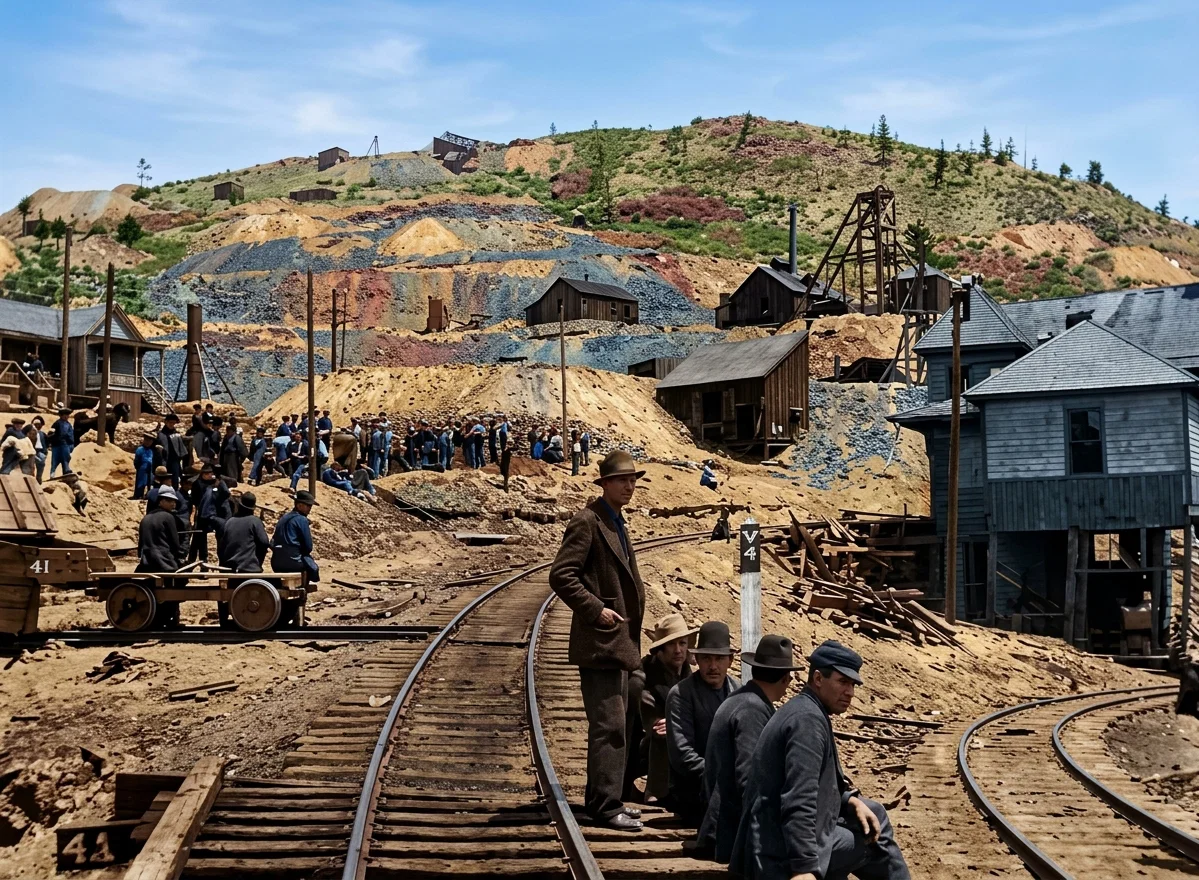
It seems evident, from the events that have taken place here in the district during the past week, that we are entering upon the time spoken of in the above verse. It seems almost impossible that so many events could transpire in the same length of time.
Scene of the Cripple Creek (Colo.) Explosion. Taken on the following day.
Monday, June 13, at 2:30 A.M. the people in the vicinity of Independence were startled by an explosion which was found, upon examination, to have caused the death of thirteen, and to have wounded six. The explosive was placed under the platform at the depot where the non-union miners were about to take the train for their homes. The infernal machine that set off the explosion was connected by a fine wire about 100 yards long, attached to the round of a chair by which it was pulled. There was a report as of a pistol shot, followed almost in the same instant by a deafening roar. Rocks began falling on the car that was then just pulling in to take the miners to their homes. Mr. Van Natta, a miner, arose from the grade, where he had rolled after being blown to the track within a few feet of the engine, about seventy-five feet from where the explosion took place, but was not badly hurt. Torches were lighted, and the conductor, engineer, and Van Natta went forward. The dead and wounded were lying everywhere. The night was intensely dark, and the bodies were discovered only as they were stumbled against, or revealed by the flickering torches. The scene was indeed heart-rending. Upon the arrival of the train at Victor with the dead and wounded, it was found that one man had been left. This man had been blown across the tracks and against the door of a near-by residence, the owner of which had taken him in and put him to bed.
In the afternoon a mass meeting of the people of the district was held at Victor, during which time many shots were fired between the soldiers and union miners, resulting in the death of two more.
Tuesday troops were called out, and Adjt. General Bell hastened to the seat of the trouble. On the same day resignations of city and county officers were demanded by the citizens.
On Wednesday martial law was declared. The sheriff and coroner were forced to resign, and anti-union successors were appointed. On the same day a battle took place between the soldiers and union miners at Dunnville, a small place about fifteen miles from Cripple Creek. One man was killed.
Thursday the Citizens’ Alliance decreed that no man who belonged to any union allied with the Western Federation of Miners shall be employed in the Cripple Creek District.
On Friday the jury, selected by the new coroner, began its investigation of the murders committed on Monday. On this same day ninety men were deported from the district on a militia-guarded train moving under sealed orders.
On Saturday the exiles are left on the prairie near Holly, Colo., a half mile from the line of Kansas. The same day witnessed the closing down of the Pride of Cripple Creek Mine and the Winchester Mine by the militia. Since that time other miners have been deported to New Mexico, making, all told, three car loads, or nearly two hundred miners.
The union stores, four in the district, have been closed. The union halls have been taken by the militia, and their contents seized and held for investigation.
And the end is not yet. Many are being held here, and will be tried soon on charges of murder. But what does all this mean?—It means that soon, very soon, our dear Saviour will come and put an end to all this trouble and strife that is now filling the hearts of the people with bitterness and woe.
What should be the attitude of the Christian at this time?—The true, and the only true attitude, is stated in James 5:7, which says: “Be patient therefore, brethren, until the coming of the Lord.” The only thing the brethren are asked to do at this time is to be patient. When the conflict rages sore on all sides of us, the above injunction is not so easily obeyed as at first might seem. We are apt, from the standpoint of the natural heart, to join hands either with one side or the other. But the Bible says plainly, “Say ye not, A confederacy, to all them to whom this people shall say, A confederacy; neither fear ye their fear, nor be afraid.” We have no one to fear at this time but the God who made the heavens and the earth. Then let the watchman on the walls of Zion give the trumpet a certain sound, and while there is left a little time of waiting, combine this with diligent working for the master, so that He can say to us, “Well done, thou good and faithful servant.” He will never say these words to any unless they have done well.
Cripple Creek, Colo.
TRIAL BY JURY DENIED TO THE FILIPINOS.
Article VI. of the Amendments to the Constitution of the United States provides that “in all criminal prosecutions the accused shall enjoy the right to a speedy and public trial, by an impartial jury of the state and district wherein the crime shall have been committed,” etc. The people of this republic are very tenacious about this constitutional right, so much so that, traditionally, at least, it has come to be deemed, not only inalienable, but virtually inherent. So the decision of the Federal Supreme Court that the right of jury trial does not apply to people living in the Philippine Islands strikes many people living in this country as somewhat unrepublican. Doubt as to the wisdom and justice of the decision is largely increased by the fact that four of the nine judges of the court strongly dissent from the opinion, which only holds by a majority of one.
In delivering the opinion of the majority, Justice Day said that the government of the Philippines had been expressly left by the treaty of Paris in the hands of Congress, and Congress, because of the incapacity of the people of the islands, had purposely withheld the right of trial by jury. It is further claimed that there is guaranteed to the Filipinos the right of the accused to be heard by himself and counsel; to have a speedy and public trial; to meet his witnesses face to face; and that no person shall be held to answer for a criminal offense without due process of law, or shall be twice put in jeopardy for the same offense. From this statement of fact the opinion of the majority of the court says, “It can not be successfully maintained that this system does not give an adequate and efficient method to preserve the rights of the accused.” Such an argument might just as reasonably apply to the home land as to distant possessions. If the omission of the right to a jury trial can give a system adequate to preserve the rights of an accused person in such a country as the Philippines, why not in the confessedly more enlightened home land? But our forefathers, with past experience before their eyes, did not see it in that light; and the people in this country would be loath to accept the proposition for themselves. It would be, admittedly, a going back on recognized fundamental principles. This departure from constitutional provision, if it be necessary in our republican province, has been made necessary by the popular ambition for territorial expansion, and national aggrandizement, even at the expense of other nations. It was popular clamor that brought on war with Spain, which in turn caused the conquest of the Philippines as a vicissitude of war, and their permanent holding as an imaginary consequent necessity. So, if this precedent should lead to further assumptions that the people’s rights can be adequately preserved by setting aside constitutional guarantees, and that the Supreme Court is the proper authority for eliminating9such guarantees, the people will only have themselves to blame.
We may not know specifically how further abridgements of constitutional rights may be deemed expedient, and be secured in like manner even in the home land, but we know from experience that the prevailing military spirit is cultivating that imperial tendency that must inevitably result in further encroachment on republican principles. Therefore it is certain that pretexts will arise calling for further digression from the principles upon which this government was founded, and upon which it attained its subsequent power, and that the present decision of the Supreme Court will be hailed as a convenient precedent. And it will be made to appear that the situation demands such measures, but the situation itself will be the result of previous departures from fundamental principles. This conclusion is clear in the light of the history of the past; in the light of our own national tendency during the past two decades; and especially in the light of prophecy, which shows that this republic will set up, or become, an image of the Roman church-and-state system.
The justices of the court who dissented from the opinion of the majority were Fuller (chief justice), Harlan, Peckham, and Brewer. As showing that the innovation is not a mere party measure, we note the fact that both the Republican and Democratic parties are represented in both the majority and minority opinions. Justice Harlan presented a most vigorous opposition to the opinion of the majority, saying that “the conclusion reached by the court is so obviously forbidden by the Constitution that I can not regard the judgment of this court otherwise than as an amendment to the Constitution by judicial action, when another mode of amendment is expressly provided for in that instrument.”
As specimen press criticisms of the decision, we present two, one favorable and one adverse:—
The Boston Transcript says: “The establishment of the system of jury trials before the mass of the Philippine people have as much as heard of it, might be productive of anything but justice. Several of the tribes that make up the Filipino people are in a condition to-day not very different from that of our ancestors in the pre-jury days, not because they are all more or less savages, but because they have been accustomed to other methods where they have advanced far enough to leave to courts the settlement of differences. . . . The Filipinos, being a people of marked natural intelligence, with the progress of American ideas, they may before very long be capable of understanding the jury system, its ends and purposes. At present, and for some time to come, the Philippine Government must feel the influence of war, and we must maintain the status of a garrison which defers the application of the laws and customs of the home country until such time as they can be introduced with the least friction, and the clearest apprehension of their meaning. If we try to Americanize everything, we shall Americanize very little.”
On the other hand, the Pittsburg Post says: “This decision is one which may well cause the people of the United States most serious cogitation. It certainly must open their eyes to the fact that we are ruling our island possessions with a most imperial sway, and that not their native inhabitants, but our own American-born citizens, temporarily resident in them, are equally its victims. If there is one thing above another that we have been proud of, it has been the trial by jury, and yet here we have the highest court of the nation denying it to men who are as much citizens of this country as are any of those who have resided in the United States proper continuously since their birth.”
ENFORCING THE SUNDAY LAW IN BUFFALO, N. Y.
We learn from the Buffalo News that a Hebrew dry goods dealer of that city was recently convicted in the Police Court of having kept his store open on Sunday. The prosecutors were the members of the Buffalo Retail Grocers’ Association. The defendant admitted the charge, but claimed extenuation on the ground that he had observed the previous day as the Sabbath. In giving his decision, the judge said:—
The great masses of the people observe the first day of the week. There are comparatively few who observe the last day. The Legislature, which has the power to name any day, has very properly named that day which the great mass of people desired. To say that any sect may traffic publicly on this day because they close their place of business on some other day, would mean that we should have no Sabbath at all in the end. It may mean a hardship for the defendant in this case, but it is a fundamental principle of organized society that the individual should sacrifice his personal interests and desires, if the same be necessary, for the welfare and benefit of the whole. And eventually the individual will receive his share of the benefit which accrues from any act for the general good.
No Christian can have other than the kindliest of feelings for that religion which served as a foundation of their own. The law of the land protects its adherents in the full exercise and enjoyment of their religious profession and worship, as it does all other sects without discrimination or preference. But the Sabbath is a civil institution, the observance of which as a day of rest, if for no other reason, is necessary for the best interests of the state, and the laws regulating the same must be observed in a reasonable manner. The defendant is convicted, and allowed to go on suspended sentence.
While such crude ideas of legislative “power,” of the “fundamental principle of organized society,” of Christianity’s “kindliest feelings,” and of the Sabbath institution, are entertained in courts of justice, we need not think it strange that the rights of men in the minority are ignored. As long as courts hold that a legislature may make any day a Sabbath that every one is obliged to observe, and that the Christian’s “kindliest feelings” may be manifested in prosecuting a neighbor for not observing that day, the way is wide open for all that is involved in enforcing a state religion, or the religion held by the majority. Moreover, the erroneous idea that the Sabbath is a “civil institution,” would preclude the possibility of keeping the day “holy.” If anything has not been made holy by Him who alone is competent to sanctify, it would be utterly futile for any one to assume to keep it holy.
“BACK TO THE LAND.”
[The following article we take from an editorial in the San Francisco Chronicle, of Sunday, June 19. Apart from the anecdote related,—which we do not believe to be true, which, if true, is in nowise a typical case, which would be repudiated by every devout, well-instructed Seventh-day Adventist, but which was probably born in the fertile, facetious imagination of the editor’s Catholic predilections,—the article contains rare good sense, which we commend to our readers.]
An Educational Institution Moves on to a Farm.
In the eyes of the world the Seventh-day Adventists seem rather simple-minded folks. Most of us think of them about as Christ and His disciples were probably regarded by the men of their generation. We see no reason to expect the early beginning of the millennium, and can not understand why any body of professing Christians should consider it an essential matter to observe the seventh instead of the first day of the week as a day of rest. Nevertheless, there are a good many who think the Seventh-day Adventists’ theology very much awry who yet rejoice to see still existing in the world real faith in anything, reverence for anything, and fidelity to conscience at whatever inconvenience. The model Christian is one fervent in spirit, diligent in business, serving the Lord. There is no doubt of the fervency of the spirit of the Adventists. Last autumn a lady, who thought herself a good Christian, stopped one Sunday on her way from church to talk with a woman whom she knew to be a good Adventist, and, who, having faithfully rested the day before, was picking up prunes with her children. Conversation happening to take a theological turn, the lady remarked that she had profound respect for all who lived according to their religious convictions, whether they agreed with her own or not, and added that she had some relatives who were Catholics, and that if, by any chance, the children of that family should come under her care, she should see to it that they were reared in the Catholic faith, altho she herself was a Protestant. “Well,” said the prune-picker, simply, “you will go to hell.”
There was the fervent expression of a conscientious belief, and it was respected as such by the lady to whom it was addressed, regardless of the unhappy fate predicted for herself. It was not spoken offensively, or even argumentatively, but simply stated as one of the eternal verities, of interest to whom it might concern, and particularly as a warning, which the fervent spirit of a Christian woman constrained her to give to one in the gall of bitterness and the bonds of iniquity. The fervency of spirit, however, which the Adventists possess is less obvious to the world than their diligence in business. That is patent to all men. Wherever they are, the Adventists are hard workers and thrifty. Their products, which they will on no account deliver on Saturday, are good, and their sanitariums are celebrated in all parts of the country. Whatever we may think of their theology, one must confess that they excel most people in plain common sense in business affairs, and in the art of getting on in the world by the non-speculative, and, therefore, unamerican methods of diligence in earning, and prudence in spending.
It is because the Adventists have such shrewd judgment in business affairs that their determination reached at their recent state conference in Oakland, to remove their state school from Healdsburg to a farm, deserves serious consideration. Healdsburg is a thriving, prosperous town, but the temptations of city life do not abound there to such a degree as to render it unsuitable for the residence of students. Nor is it so far removed from rural scenes as to beget indifference to their charms and dislike of their homely surroundings. The institution is to be removed to a farm in order that life in it may be simpler and cheaper, and opportunities for productive work more abundant. The level-headed men and women who control the affairs of the denomination, realize that the gospel of work is the true Gospel in worldly affairs, that the joy of accomplishment is the greatest earthly blessing, and that the sturdy independence, begotten of honest manual labor is the most certain assurance of earthly happiness and content. There are certain facts which we may as well face. The children who are brought up in habits of industry, who are not afraid of hard jobs, do not clamor for short hours, and don’t get them if they do clamor for them, and who absorb the vigor only to be required by daily contact with mother earth, will be, or become the parents of those, who, in the next generation will direct the affairs of mankind. In the main it has always been so. In the main it must always be so. Only by contact with the earth from which we sprang can the human race escape degeneration. It is noble to be a mudsill, for it supports the whole structure of society. This the Seventh-day Adventists perceive, just as Booker T. Washington perceives it in Alabama, and they are going back to the land.
THE WAR IN THE ORIENT.
Gradually the great armies in southern Manchuria are aligning their forces. The Japanese advance is slow, about six miles a day, and the two ponderous armies will soon be in touch all along their front. Small engagements are taking place daily between outposts, with losses on both sides. There is reported to be a Russian movement, southward, of a portion of their forces, as a feint, to prevent the junction of the two Japanese armies. One despatch states that on June 21 a force of 8,000 Russians, while traversing the ravine of Wafungko, was surprised by masked Japanese artillery which opened upon them with accurate fire and destructive effect. The Russian casualties are placed at 1,200. The Russian general extricated his men with considerable difficulty. On June 23, three Russian regiments and one battery of artillery, attacked the Japanese position near Saimak, but were defeated, and retired with considerable loss.
The Japanese forces in the vicinity of Port Arthur are gradually drawing nearer to the great stronghold, and have begun active operations against it, with long-range guns. In these bombardments the fleet also takes part from time to time. On June 23, the Russian war-ships at Port Arthur came out of the harbor, and an engagement followed, in which one large Russian battle-ship, the Peresviet, was sunk with her commander and 750 men. The battle-ship Sevastapol was disabled, and the cruiser Diana was so damaged that she had to be towed back to port. Several torpedo-boats are reported sunk with all on board. No loss is reported in the Japanese fleet.
Slocum Steamer Death Toll
The number of bodies thus far recovered from the steamer Slocum is 845, and 300 are still missing.
TALKING OF THINGS AND THEMES, AND NOT PERSONS.
By Mrs. L. D. Avery-Stuttle
BY MRS. L. D. AVERY-STUTTLE.
There being so many subjects of deep interest to talk about, and to engage the attention of both young and old, it is indeed strange that we should care to spend a moment of precious time in senseless gossip.
Occasionally we meet persons with whom it is a real pleasure to converse. When we leave them, we feel that we have learned something,—that something worth the while has been added to our store of useful knowledge. Is it not pitiful that people can spend a whole evening together in conversation upon the most trifling subjects—lighter than the foam of the sea—when events of the most tremendous import are constantly transpiring all about us?
“Well,” says one, “I have no time to read and keep intelligent regarding passing events, and if it is wrong to repeat any ill I have heard about my neighbors, really, there is nothing left to talk about, and so I don’t see but I must stop talking altogether.”
“Well, my friend, I think it would be well for you to do so,—pardon my plainness of speech. There are times, you know, when ‘silence is golden.’ O, if we could only learn to say nothing when we have nothing to say! If we could but train ourselves to talk about the many, many beautiful things, and wonderful things, which—if we will but keep our eyes open—we can see every day about us!”
The spring opens, warm and lovely. The earth is covered with a soft, mossy green carpet, with which the expensive carpets of the most elegant mansion can not compare.
Do you want music?—Listen to the orchestra of the grand old forests. The birds and insects are pouring forth their roundelays, until every flower and twig and blade of grass are a-quiver with music. “Nothing profitable to talk about?”—Go out into the warm, spring sunshine, and read a chapter from the open book of nature.
Summer comes on apace. The great red eye of the sun glares upon the earth. The drowsy hum of insects fill the air, and the scent of flowers is almost intoxicating. The green of the trees, and of the grass has taken on a deeper hue. Little children lie under the shade of the friendly trees, and the patient cattle stand contentedly in mid-stream. There is a peculiar beauty, even in the fervid heat of summer, which we do not find elsewhere.
Hard indeed must be the heart, and dull the senses which see not in all this beauty the loving Hand which created it.
“Nothing to talk about?”
Ah! “Day unto day uttereth speech, and night unto night showeth knowledge.”
Then, silently, slowly, almost imperceptibly, summer merges into autumn. The days become a little shorter, the night’s a little cooler. The maple trees by the gate are the first to give warning that Jack Frost has begun his nightly rounds, by hanging out his red and yellow banners. O, the glories of the forest now! What bewildering shades of red and gold and russet and brown and crimson and yellow! The great Master Artist is so lavish of His colors. What a sense of drowsy contentment and peace we feel, as our feet press the crisp, rustling carpet! As we look up into the heaven of yellow sunshine, we think of the rainbow about the throne, and vaguely wonder how heaven can be more beautiful than earth.
After a walk in the fields on such a day as this, who could bring himself to join in trivial gossip?
And old winter is not without his share of beauty. The song birds are flown, to be sure, but still the little sparrows, with their tiny, stockingless feet, hop upon the window-sill, to beg for a few crumbs in the name of the Master. The windows are draped with a more delicate tapestry than was ever spun by the hand of man. The carpet of snow reflects a thousand diamonds as the bright sun shines upon it, and the merry jingle of bells makes us forget that we are children no longer.
O, nature is so beautiful in all her phases! Can we find nothing interesting enough to engage our attention, and call forth our praise to a kind and beneficent Creator, in all this?
But, if in the seasons, with their varied and changeful beauty, with their birds and flowers and trees, with their soft zephyrs and brilliant foliage, or with stern winter’s fleecy mantle,—if there be nothing in these to call forth our songs of praise, and give us worthy subjects for conversation, let us step out-doors on some calm, bright night, and turn our eyes heavenward. What countless multitudes of systems and whirling planets! What myriad worlds! What blazing suns! What torches of the Eternal! Let our attitude be reverent, for we are in the presence of Him who counteth the stars, and knoweth them all by name.
Ah, how small we feel as we continue to gaze! How our petty cares and troubles and perplexities dwindle, as we turn our astonished eyes away from earth, to the royal gallery of heaven!
No time now for idle gossip,—but what a time for self-examination!
Sometime, if we live, we shall see strange sights in these same heavens. We shall see the “sign of the Son of man.” We shall watch the blaze of glory which surrounds Him, growing larger and higher as it nears our earth. What myriads of angels! Ah, they are gathering the harvest of earth. The sea is giving up its dead. Look, they ascend heavenward amid the clashing of rocks, and the wails of the ungodly.
“Nothing to talk about,” with such themes as these to engage our attention? Ah, we are a spectacle to men and to angels. For we may be sure that, if we turn our gaze often, and with interest, upward to the starry worlds above us, no less often, and with greater interest do the far-off dwellers of those sinless worlds regard with tender anxiety this—the one lost sheep.
Then, with the eyes of the universe upon us, and with the fast fleeting moments of probation rapidly passing, when we are on the very eve of such tremendous events as have fallen upon no other race, and upon no other people,—what a time is this for idle gossip and foolish conversation!
Shall we longer regard our words as “little things?” Believe me, they are mighty; for it is by them that we are to be justified or condemned in that day which hasteth greatly.