Your ShelfYour Projects

Signs of the Times, Vol. 30, No. 27.

BONDAGE TO FREEDOM

Signs of the Times

Jul 6, 1904

Pacific Press Publishing Company · Oakland, California · Jul 6, 1904

BONDAGE TO FREEDOM.

BONDAGE TO FREEDOM
BONDAGE TO FREEDOM
FREEDOM is the watchword of the Gospel of Christ. Liberty is the purpose of its promulgation. With the freedom that human laws vouchsafe there may go that most terrible bondage, the freedom of sin. In the liberty the Gospel gives, the chains are slipped from the soul as well as from the body. In fact, the soul may be gloriously free, while as yet the body is chafed and bruised and bleeding from the chains and scourgings of oppressive human laws.
Liberty flows out of the Gospel like water out of the riven rock, like the river of mercy from the throne of the Eternal One. Is there a righteous law on the statute books of earth? The way for it was chiseled through the rock of oppression by the very hands that to-day in heaven bear the cruel nail-prints of human oppression and bigotry. That precious privilege for which the martyrs died; that sent the pilgrims across the stormy seas to the unexplored land of the free, with all the ties of earth broken and flung to the pitying winds; that privilege for which every soul cries out when it has learned the lesson and the joy of true worship; that privilege—freedom to worship God—is a fundamental bequest of our crucified and risen Saviour.
But even before our Redeemer burst the shackles of the tomb, the machinery of Satanic malice was set in swifter operation to crush out more effectually that hope of the race. So we find the trembling disciples gathered behind closed doors “for fear of the Jews.” So we find that stalwart Christian, Stephen, paying with his life for the exercise of his Gospel-given freedom of worship. So we find the disciples and the early believers “scattered everywhere” by the persecution that raged in Palestine after the resurrection of Christ. And so we find Saul “exceedingly mad” and “breathing out threatenings and slaughter” against the believers in Christ, who chose to worship in accordance with their belief.
But that was the religion of ceremony, warring against the religion of soul; and wherever religion has deteriorated into form and ceremony it has found use for invective, hatred, “threatenings and slaughter,” with all the body-bruising accompaniments of thumbscrew, rack, fire, and dungeon. In proportion as the light of the Gospel of Christ has permeated the darkness of this world, those instruments of oppression and that unchristian spirit have slunkaway into the darkness, their native habitat.
Following the persecution of the early Christians by Jewish officials came that organized and legalized oppression of centuries under the iron monarchy of Rome, with occasional rifts of light followed by denser gatherings of the clouds of darkness. Then came that long, unrelieved, persistent campaign of a backslidden church with a formal religion to grind down, and, literally, in the language of God’s Word, “wear out” the company who clung to their God-given bequest of religious freedom. That was a terrible struggle—a long struggle in the darkness, out of which there come but faint sounds to tell of the cruel work that was being done. Then the dawn of a new day began to break, and O, what a record that long, pitiless night had made for itself! What myriads of human lives snuffed out in the name of religion because men, claiming to be Christian, would not hear the voice of Christ, would not heed the precepts which He enunciated, would not practise the principles which He in love pronounced!
In the dawning of that day God opened a door in another land—opened it and flung it wide, as wide as the great sea that rolled between the land of “civilized” savagery and the land of the untutored savage. That highway to liberty was lashed by no gale so fierce as the storms that surged over Europe, seeking to drive upon the rocks of death every mariner who sought to guide his bark into the true harbor of refuge. The wildest sea is merciful beside the wrath of him who pretends to sit in the place of God. If God had treated men as men have treated each other, the race would have perished in the ages agone. But because of the great love wherewith He loved us, He has given us over and over again the principles of love and justice and truth and mercy and liberty. He not only gave us those principles in written form, but sent One to us, to be with us and among us, who Himself was those principles incarnate. His mission was to free men in the kingdoms of this world and to save men out of the kingdoms of this world, so they might enter the kingdom of the eternal world; and incidental to that mission was the teaching of men, how to conduct themselves toward their fellow-men. His personally-illustrated principles of doing for another what we would have another do for us, is but the principle of Gospel liberty at work.
He taught men that, and some of them learned it. But some of those who sought liberty in the New World had not learned it. They would turn the shrine of spiritual, soul liberty into a shambles of corporeal oppression and soul imprisonment. They would shackle the soul and put a padlock on the door of the mind, and establish their own Dark Ages at the very portals of liberty. But God would not permit that thing to take root here. The waves of ecclesiastical domination over the conscience and the soul had reached the shore-line beyond which they might not pass.
When that new nation arose out of the soil of liberty-hunger, some had learned the lesson for that day; and in the same precious document, in which they declared their bodily freedom, are set forth the principles of equality and justice, which the Word of God made known to the world. “We hold these truths to be self-evident, that all men are created equal; that they are endowed by their Creator with certain unalienable rights; that among these are life, liberty, and the pursuit of happiness.” That the men who established this nation intended that “liberty” to cover the liberty of conscience is shown in the first amendment to the Constitution of the United States: “Congress shall make no law respecting an establishment of religion, or prohibiting the free exercise thereof.” That was the principle upon which the nation stood. That the states have not always recognized the principles laid down in the Declaration, nor practised those declared in the national Constitution, is a matter of deepest regret. When state laws have permitted the fining and imprisonment of men for the peaceful exercise of their religious faith, they have been following the example of ancient papal states more than the principles of their own great Declaration and Constitution. It is the justice of the great principles then announced to the world that makes the fourth day of July a day worthy of memory. Such principles are eternal. They will shine with undiminished splendor when the very memory of bigotry, oppression, and soul-slavery has perished from the rejuvenated universe.
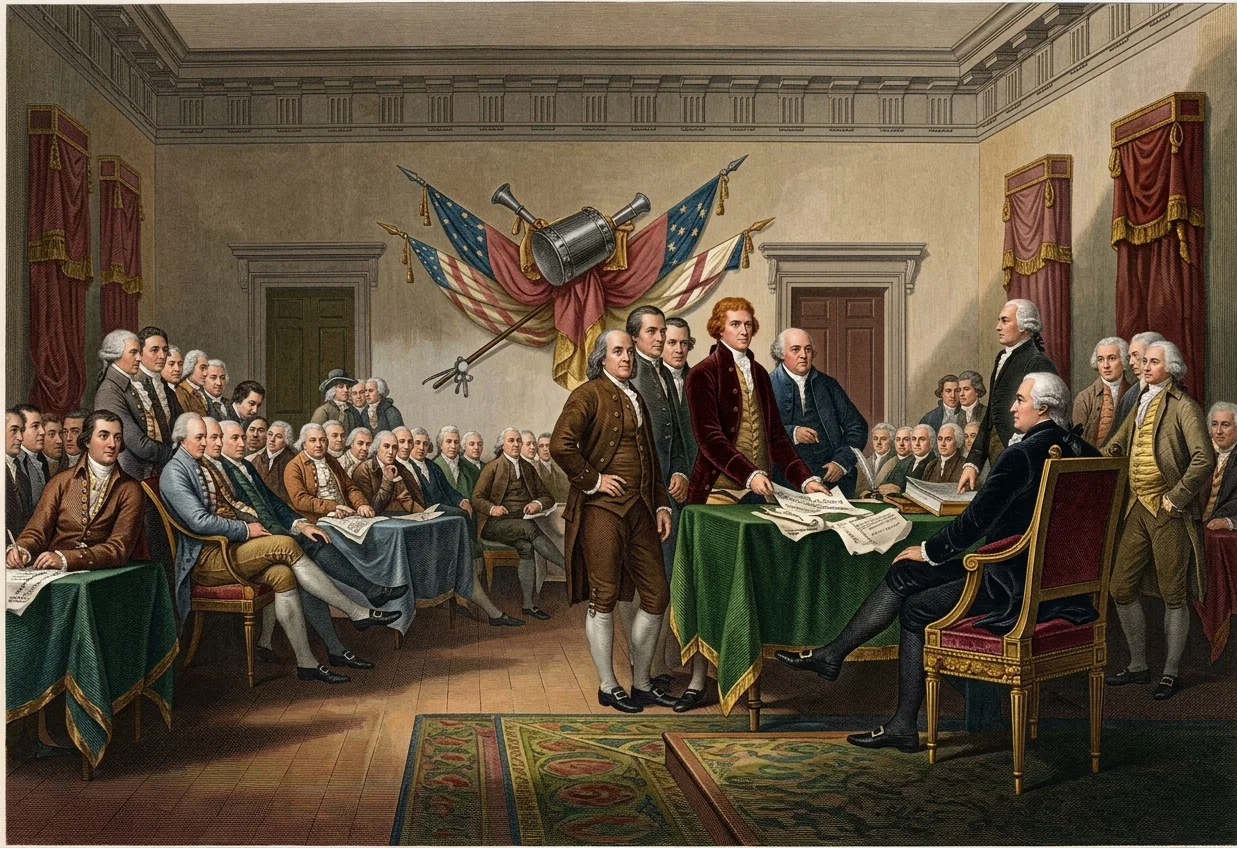
But there is a sad picture that presents itself before our eyes to-day. It is hinted at in the picture on the preceding page. It takes less than three hundred years to span the gulf between the thanks-giving pilgrims, who have found freedom on the New England shore and the embarkation of American troops to subjugate a race of people on a far foreign shore. Certain it is that the sun has turned backward on the dial, when America, the cradle of Liberty, rules a subject people in a foreign land, and takes from them the right of trial by jury—the very thing against which the Declaration of Independence protested to the world in 1776, and still protests—the very thing which the Constitution promised to all the people of the United States, and still promises.
The names of Washington and Jefferson and Lincoln are inseparably linked with the righteous foundation principles of the United States Government. On these principles they stood, and for them they labored. The nation can not repudiate the principles without repudiating also the memory of the men who gave their all in their defense.
The New World set before the Old a worthy example, a noble influence, in the matter of human rights; and that example and that influence have done much to ameliorate the conditions of the common people in the Old World; but the nation has drifted far from those righteous principles, and set its face toward the East, to follow the example of that other republic which ruled nations outside its borders and went down to ruin.
And in these latter days this same nation does in effect what its Constitution forbids,—establishes religion by ruling of its highest authority. That lowers the standard of the nation to that of the states in the matter of religious legislation. So we see a sweeping retrogression along both lines back to the principles that were dominant in the world before Columbia’s light was set upon its lofty tower. Does it mean a return of religious intolerance? There will come a time when this nation will “both speak, and cause that as many as should not worship the image of the beast should be killed.” Rev. 13:15. That is religious oppression, and that language is used concerning the nation in which we live. From oppression to liberty and back again is the prophetic outlook for this country, and the trend of events shows that the prophecy is true. It is a time for the Christian to have to exercise, and to teach, the principles of true liberty of body and soul as never before, that the world may see and choose which it will have, freedom or bondage, light or darkness, life or death. C. M. Snow.

THE ABIDING REST.

BY MRS. E. G. WHITE.
EVERYTHING in the world is in agitation. The signs of the times are ominous. Coming events cast their shadows before. The Spirit of God is withdrawing from the earth, and calamity follows calamity by sea and by land. There are tempests, earthquakes, fires, floods, murders of every grade. Who can read the future? Where is security? There is assurance in nothing that is human or earthly. Rapidly men are ranging themselves under the banner they have chosen. Restlessly they are waiting and watching the movements of their leaders.
An intensity such as never before was seen is taking possession of the world. In amusements, in money-making, in the contest for power, in the very struggle for existence, there is a terrible force that engrosses body and mind and soul. In the midst of this maddening rush, God is speaking. He bids us come apart and commune with Him. “Be still, and know that I am God.”
“Come unto Me,” Christ says, “and I will give you rest. Take My yoke upon you, and learn of Me: for I am meek and lowly in heart; and ye shall find rest.”
In the heart of Christ, where reigned perfect harmony with God, there was perfect peace. He was never elated by applause, or dejected by censure or disappointment. Amidst the greatest opposition and the most cruel treatment, He was still of good courage. But many who profess to be His followers have an anxious, troubled heart, because they are afraid to trust themselves with God. They do not make a complete surrender to Him, for they shrink from the consequences that such a surrender may involve. Unless they do make this surrender, they can not find peace.
The abiding rest—the consciousness thatGod is true—who has it? That rest is found when all self-justification is put away, and an entire surrender is made to Christ, to be and do only what He wills. Those who do not comply with these conditions can not find rest.
Let us turn aside from the dusty, heated thoroughfares of life to rest in the shadow of Christ’s love, and learn from Him the lesson of quiet trust. Not a pause for a moment in His presence, but personal contact with Christ, to sit down in companionship with Him,—this is our need. Many, even in their seasons of devotion, fail of receiving the blessing of real communion with God. They are in too great haste. With hurried steps they press through the circle of Christ’s loving presence, pausing perhaps a moment within the sacred precincts, but not waiting for counsel. They have no time to remain with the divine Teacher. With their burdens they return to their work.
These workers can never attain the highest success until they learn the secret of strength. They must give themselves time to think, to pray, to wait upon God for a renewal of physical, mental, and spiritual power. They need the uplifting of His Spirit. Receiving this, they will be quickened by fresh life. The wearied frame and tired brain will be refreshed, and the burdened heart will be lightened and encouraged.
“Rest in the Lord, and wait patiently for Him. He will be to you as the shadow of a great rock in a weary land. He will give you rest that the world can neither give nor take away. Come unto Me, He says, and your heart will be filled with the peace that passes all understanding.”
Nothing of the world can make sad those whom Jesus makes glad by His presence. In perfect acquiescence there is perfect peace. “Thou wilt keep him in perfect peace, whose mind is stayed on Thee; because he trusteth in thee.”
Our lives may seem a tangle; but if we commit ourselves to the keeping of the Master-worker, He will bring out the pattern of life and character that will be to His own glory.
As through Jesus we enter into rest, heaven begins here. We respond to His invitation, “Come, learn of Me,” and in thus coming, we begin the life eternal. Heaven is a ceaseless approaching to God through Christ. The longer we are in the heaven of bliss, the more and still more of glory will be revealed to us; and the more we know of God, the more intense will be our happiness. As we walk with Jesus in this life, we may be filled with His love, satisfied with His presence. All that human nature can bear, we may receive here. But what is this compared with the hereafter? “These are they before the throne of God, and serve Him day and night in His temple; and He that sitteth on the throne shall dwell among them. They shall hunger no more, neither thirst any more; neither shall the sun light on them, nor any heat. For the Lamb which is in the midst of the throne shall feed them, and shall lead them unto living fountains of waters; and God shall wipe away all tears from their eyes.”

THE LOVE OF JESUS.

BY LLEWELLYN A. MORRISON.
(All rights reserved.)
SING, ye saints, the love of Jesus! Praise unto His name prolong; Lift your hearts in adoration; Tell about Him in your song; Sing the love all love transcending, And the life He freely gave; Tell the joys of grace, unending, Since He came the world to save.
Sing the sovereign love of Jesus And the blessedness He brings! Magnify the condescension Of the Lord, the King of kings, Putting off His throne and glory; Show the love in all the plan; Tell the wonder of the story: “Found in fashion as a man.”
Sing for aye the love of Jesus! Tho the mortal pass away, He abides, divine, immortal,— They who love abide for aye. Sing! For sinful spirits shriven, And the resting after strife; Sing! For earthly fetters riven, And the everlasting life.
Toronto, Can.

LIFE BY THE SPIRIT.

BY WILLIAM COVERT.
MAN should be wholly under the control of God’s life. Physically, he is sustained by it. He should live morally and spiritually by the same life. It is not reasonable that the Creator should maintain forever that which is a dishonor to His name.
The Sustainer of the universe will not unalterably establish an irreconcilable condition of things. To enjoy the eternal benefits of life, every man must reach the condition where his spirit drinks in the moral nature which emanates from the great Source of life. The eternal witness of things calls for complete harmony. Without it there can be no eternal state.

Control over the Flesh.

Signing the Declaration of Independence, Philadelphia, Pa., July 4, 1776.
The apostle says, “To be spiritually minded is life and peace.” Rom. 8:6. In order to realize the true object of living, the flesh must eventually come under the control of the life which formed it. Through long-continued and oft-repeated transgression, it has become so defiled that the term “flesh” is used as a synonym for all that is evil: “If ye live after the flesh, ye shall die; but if ye through the Spirit do mortify the deeds of the body, ye shall live.” The Spirit of God must control the emotions of the flesh before righteousness can prevail. The two ways, the false and the true, are thus described: “For they that are after the flesh do mind the things of the flesh; but they that are after the Spirit the things of the Spirit.” Rom. 8:5.
Here is the condition of true sonship: “For as many as are led by the Spirit of God, they are the sons of God. For ye have not received the spirit of bondage again to fear; but ye have received the spirit of adoption, whereby we cry, Abba, Father. The Spirit itself beareth witness with our spirit, that we are the children of God.” Rom. 8:14–16.
Humanity, vitalized and mellowed by the Spirit of God, is free from the slavery of fear, and from the cowering condition which torments one under condemnation. It imparts to the Christian the same confidence and self-poise that is enjoyed by the child in the Christian home with his own parents.
In this is an ideal picture of true life. Love is bestowed, and love given in return. The child is free to ask, and the parent is glad to give. There is in this home a blending of spirits and a mingling of joys.
The home is, in a measure, made, arranged, and kept for the needs and comfort of the child; and the inborn nature of the child is to ask for favors. The first words it articulates are the equivalents for “father” and “mother.” Upon them it first learns to call. In them it naturally trusts.
But what is true regarding the proper relation between parents and children, is also true in a much greater degree in the relation which exists between the Lord and His people. Even the love of the fondest parents for their children, can but faintly represent the love which planned and executed the great work of redemption.
The heavenly Father desires to have the same Spirit in the hearts of His adopted children that is enjoyed by Jesus Himself. As Christ is in the freedom and enjoyment of love with the Father, so would the Father have His sons and daughters here in spirit before Him. “Thou art no more a servant, but a son, and if a son, then an heir of God through Christ.” Gal. 4:7.

An Illustration.

A motherless girl was taken into a home to live as if a daughter born in the family. In that home was a son who knew his proper relation, and fully enjoyed it. But the adopted child felt that she was a stranger in the place. What was designed to be a home, she regarded as a prison. She was suspicious of the kindest attentions, and by demonstrations of sadness made her life very unpleasant.
It required several days of wooing to impart to the child a spirit of confidence and trust. But finally the shade of sorrow departed like a cloud when it is rolled away, and in its stead was instantly born that spirit of kinship which makes a little one happy in the home of its parents.
As confidence came, her tears immediately dried, and with a beautiful smile she said, “Let us sing.” When asked what the song should be, she lovingly responded, “Sing, ‘There’s No Place Like Home.’”
This incident illustrates the scripture which says, “Because ye are sons, God hath sent forth the Spirit of His Son into your hearts, crying, Abba, Father.” Gal. 4:6.

The Only Real Life.

It is this home-feeling, which the life of God brings into the soul, that inspires the heart with boldness to pray. It is this life that drives out all tormenting fear, this indwelling power which takes away the spirit of bondage, and gives that rich experience of liberty and freedom known only by the children of God.
It is not the will of God that His children should feel as strangers in His presence, or that they should cower as criminals before Him. He would have them as free and at home as a son or daughter in the father’s house.
Living in sin, and constantly enduring the torments of a violated conscience, is not true life. It is only a prolonged death. In such a state forebodings of the end embitter all the sweets of life, and keep death ever present. But man is not compelled to wait until hereaches some other world to be happy. Joy comes now—yes, in this world, to the one who lets the Spirit of God rule in the life. The nature of true life is to give joy unalloyed.

How the Work Is Done.

That life which connects man with the eternal state “is holy, harmless, undefiled, separate from sinners, and made higher than the heavens.” It is fully and only received from God through Jesus Christ. In Christ “dwelleth all the fulness of the Godhead bodily.”
In the flesh of man there is life, but it is perverted life. It dwells there through physical generation, but it is not there incarnate by faith. It is in the flesh that the battle must be fought and won. The Spirit of life of God must live and reign in the flesh of the Christian.
By choice the Son of God, leaving heaven, plunged into the dark waters of death to save perishing men. There in the cold waves He laid the life-saving cable. He also carried the strong cords of life through the grave and around the world, and, rising heavenward, connected all again with the eternal throne.
He left the regions of light To rescue perishing men, And came to darkness and night To set the wandering right, And raise to heaven again.

Anchored to Heaven.

The Lord, in strong figure, spoke of Christ “as an anchor of the soul, both sure and steadfast, and which entereth into that within the veil, whither the Forerunner is for us entered.” Heb. 6:19, 20. Here is drawn a very beautiful picture, illustrating to Christian voyagers the certainty of a safe landing in the promised haven. Those bound for the country where Christ is gone, have an engagement with Him, specifying that they are to go where He is. They have gone aboard the ship of salvation, and all their interests are entrusted to His care. In the illustration the voyage is represented as complete, and the vessel moored safe within the harbor. As a forerunner for passengers and crew He has gone ashore in heaven, and made fast the cable there. And soon all on board shall enter the heavenly port.
One end of this life-line encircles the redeemed, while the Redeemer entwines the other around the eternal throne. The vitality of His righteousness, like an electric current, passes to every soul on the vessel, for they are connected with the anchor line. Their union with Him joins them to His life. They are animated with His being, and are made strong through His strength. They are severally clothed with His nature. Their life is an emanation from Him, and in them His will is wrought.
Continue reading: The Industrial Conflict in the Light of Revelation