Christian Science and Its Private Interpretation of the Word
By R.
(Concluded from last week.)
CHRISTIAN SCIENTISTS say, when they make changes in the Word, that thus they give the spiritual meaning. It is true that Scripture has a spiritual meaning. But the spirit is in accord with the form. The spiritual and the literal agree, and the real spiritual meaning can never deny the literal meaning. Otherwise, speech may mean whatever we choose to make it, even changing language to the opposite of what is really said.
Christian Scientists are writing letters to one another; they are writing to other people who are not Christian Scientists; and they do not expect anybody to read their letters and then misconstrue sentences throughout such letters into meaning exactly opposite what their written hand declares. To state that a sentence means inwardly, or spiritually, exactly opposite to what it says in speech, is an arbitrary interpretation, and makes the interpreter more than the language, and in fact puts the message entirely at the mercy of the interpreter. No one knows what a line may mean, what a sentence expresses, until such an interpreter tells us.
But this is all as consistent as the policy that Christian Scientists pursue in the matter of a material creation. They teach that if our senses deny the teachings of Christian Science, we are to discredit the evidence, by calling it an illusion. And if the Word denies the teachings of Christian Science, we are similarly to discredit the real meaning of the language, by calling it metaphor, a figure of speech. According to their belief, Christian Science is the one unchangeable truth; and if the Bible says something, or many things, that utterly deny the foundations of Christian Science9then the Bible must be privately interpreted, and in this way made to harmonize with Christian Science. And this they call getting the spiritual idea of the Bible; and similarly they get the spiritual idea of nature.
But when we find anything that seems to favor Christian Science, we are to accept that as infallible truth; and always and forever we are to take the assertions of Mrs. Eddy, without reference to any evidences, just the same as if she were infallibly true always.
It is very easy to talk of a spiritual meaning of the creation; but not one human being, Mrs. Eddy or the rest, could know anything about creation at all, were it not for the knowledge that comes from the material manifestation of nature, through the avenues of the bodily senses. Paul says, “Howbeit that was not first which is spiritual, but that which is natural; and afterward that which is spiritual.” 1 Cor. 15: 46. This is the order in which knowledge comes to us; and he shows, in the same connection, that the spiritual creation, or renewing of the creation, will not occur until the resurrection. Then, and then only, will our bodies be changed, in a moment, in the twinkling of an eye. And now the whole creation groans and travails, subject to bondage, waiting for that adoption.
Of course Christian Science claims to be the resurrection; and this is another case of spiritualizing the Scriptures, and that, too, with a vengeance.
While we are speaking of this question of natural and spiritual, let us not forget that the definition Mrs. Eddy gives to the spiritual is not by any means the true one. Whatever she may say, there is a spirituality not of God, for we are admonished to “believe not every spirit, but try the spirits, whether they are of God,” and we are given a test by which to try them. It is this: “Every spirit that confesseth not that Christ is come in the flesh is not of God: and this is that spirit of anti-Christ.” 1 John 4:1-3.
Tried by this confession, where must we place Christian Science? Not only does it deny that Christ came in the flesh, but it denies that there is any flesh in which Christ could come. According to the doctrines of Mrs. Eddy, to come in the flesh is to come in the illusion of mortal mind.
What says the Word?—“Forasmuch then as the children are partakers of flesh and blood, He also Himself likewise took part of the same.” Heb. 2:14. Are the children partakers of flesh and blood? This scripture affirms it, Mrs. Eddy denies it. Did Christ partake of flesh and blood? This scripture says that He partook of it just as humanity partakes of it, but Mrs. Eddy denies it.
The verse says “He . . . Himself;” it says that He partook “also . . . likewise,” and it was the “same” flesh and blood of which the children are partakers. How could language more strongly fortify the statement? Inspiration evidently knew that its truth would be challenged and denied. And herein lies the test. “Every spirit that confesseth not that Christ is come in the flesh is not of God.” Solemn statement! It needs no comment.
Something besides matter is the matter with this world. Flesh and blood is not man’s only or real enemy. We are to stand against the wiles of the devil. “For we wrestle not against flesh and blood, but against principalities, against powers, against the rulers of the darkness of this world, against spiritual wickedness in high (heavenly) places.” Eph. 6:12.
Here is a spirituality that is not of God. It is a spirituality we are to avoid. Back of man and his evil tendencies is the mighty and real source of sin, namely, spiritual wickedness. It is spiritual rebellion. R.
Illinois Mine Disaster
A fearful mine holocaust occurred November 12 in Illinois, in which several hundred miners were entombed and perhaps burned, the mine having caught fire from a smoldering bale of hay. It was thought that perhaps many of these might be rescued, but later despatches state that 300 or more in the St. Paul mine are dead, some of the bodies buried beneath thousands of tons of earth which have caved in upon them. It is doubtful if many ever can be recovered. Rescue work, which had been carried on night and day for forty-eight hours, was abandoned, because renewed fires in the mine made further attempts impossible. Efforts were put forth to drive fresh air into the mine through great fans, but these only served to increase the fires that were there burning, so that it became necessary to seal up the mouth of the mine in order to extinguish the flames. It is said that there are not less than 1,000 orphans and 200 widows as the result of this awful disaster. There were, as usual at such times, examples of wonderful bravery and daring. The sad thing is that they have been so little successful in connection with the awful catastrophe.
God’s Wisdom
By R.
Conditional immortality is a wonderful proof of the wisdom of God. Surely we could call it nothing but unwisdom if God were to create a class of people upon this earth, or in His universe anywhere, that are bound to persist regardless of character. And yet those who hold to the immortality of the soul, would have us believe that it is utterly impossible for man to cease to exist; that he is immortal and he must live, whether in happiness or misery; and if in wickedness and misery, forever to be a blasting curse and blot upon God’s universe. Surely it were unwisdom to create such conditions as that.
Not so did the God of the Bible create man. He created him a candidate for immortality; gave him the awful privilege of choosing for himself righteousness or sin, life or death. In choosing righteousness, he chooses life; and choosing sin, he chooses death. His acceptance of the righteousness and life of God, means an eternal existence in happiness; his rejection of that, means death forevermore, and the utter blotting out of sin from the universe of God. Consequently the very death of the wicked will demonstrate the wisdom, the justice of God; and the eternal life of the righteous will demonstrate His wisdom, His righteousness, His love. Nay, but it is His love that must destroy the wicked at last and banish from the universe those who would be miserable even in the very presence of personified Love. R.
The End of Sin
What a blessed thing it is to know that there is coming a time when there will be no more sin. More than this: not only will sin be forever banished, but Satan, in whom sin originated, will be utterly destroyed! The Son of God became one of us, and died, came to be nothing, for our sakes, in order that He might for our sakes destroy forever Satan and sin. “Forasmuch then as the children are partakers of flesh and blood, He also Himself likewise took part of the same; that through death He might destroy him that had the power of death, that is, the devil.” Heb. 2:14. And by the son of Buzi the Lord speaks: “I will bring thee to ashes upon the earth in the sight of all them that behold thee.” Then will God’s universe be free from the very root of evil.
How the Catholic Views It
THE Western Watchman of October 14, predicting the defeat of Judge Gaynor in New York by the Catholic vote, says:
“Protestants think that it is possible for an honest man to change his religion. Catholics believe so also, provided the change is from one Protestant sect to another, or from a Protestant sect to the Catholic Church. But Catholics not only believe, but know, with a knowledge as firm as the rock of Gibraltar, that the man who apostatizes from the Catholic Church is an unmitigated scoundrel, a renegade to every honest and honorable principle.”
Our Catholic friend goes further:
“People may call that bigotry. It matters not what it is called; there is not a Catholic in this world who would not prefer to see his mother or sister dead than turned Protestant. Speaking for ourselves we would rather see a relation of ours hanged than a renegade from his religion. . . . A Catholic apostate, if he dies in his apostasy, is damned as sure as Dives or Judas was damned. . . . As between a Catholic apostate and Beelzebub, give us Beelzebub every time for any office or employment.”
It is worth while to know how men stand.
Right to the Land
The Catholic press seemed to be highly pleased at the Portola festival, especially from the fact that the Roman Catholic religion was recognized in connection with the discovery of San Francisco Bay. Just as if that had anything to do with its present possession! If this doctrine be true, that the discovery of any land by Roman Catholicism is equivalent to a quitclaim deed to the church, what about the prior possessors of these lands? There were humans here when Gasper de Portola landed in San Francisco Bay. Their skins were copper-colored, that is true; they were what were considered heathens, that is true; and yet they had been here for years. What about their rights? Christopher Columbus found persons here when he discovered the eastern part of the country. Did they not have rights?
William Penn recognized the rights of the prior owners of this country. What lands he obtained he bought and paid for in an honorable way. In the general course of the rise and fall of government, California fell into the hands of the United States Government, a government professedly, and in its very origin, non-religious, regardless of discovery by any one of any religion. This state now belongs to this government; it has no right in its public functions or as a government to recognize any religion whatsoever. The earth itself belongs to God; He has given no religion, no people, no organization either deed or contract or lease to its territory. He sends His ambassadors, but those ambassadors are strangers and pilgrims in a strange land. The time that the Master will possess Himself of the rebellious dominion, will be when He shall Himself come again. It will not be through human might or force, but “the zeal of the Lord” will perform what He has promised.
The Critics Criticized.
—James Orr, D.D., professor of apologetics and theology at Theological College of the U. F. Church, Glasgow, has an article in the November Homiletic Review, entitled “Criticism in Troubled Waters,” in which he goes on to show that Prof. B. D. Eerdmans, a student of Kuenen, a critic of critics, and himself as revolutionary as was his master, who has long been an advocate of the theory of the composite authorship of Genesis, “now writes elaborately to announce that he breaks with this theory utterly;” that he definitely separates himself from the Graf-Kuenen-Wellhausen school, “and I contest the so-called newer documentary hypothesis generally.” And Professor Orr says that those who read his criticisms, while not endorsing the theories he proposes as a substitute, will agree that in the main he succeeds in his object, and clearly shows that the theory that Genesis is a patchwork of a half dozen different authors is untenable. But will the critics admit it?
Heathen Ceylon
Heathen Ceylon.— It is true still, as Bishop Heber says, that “tho the spicy breezes blow soft o’er Ceylon’s isle,” men still are vile. The devil-worshiping type of Buddhism still dominates the lovely island. There are over nine thousand villages unreached by any missionary agency. What a call this is for Christian benevolence.
Our London Letter
By W. T. Bartlett
[Mr. Bartlett, our correspondent, is an Englishman born and bred, and writes with a sympathetic as well as intelligent pen of matters British. He is the editor of a religious weekly, The Present Truth.—Editor S. of T.]
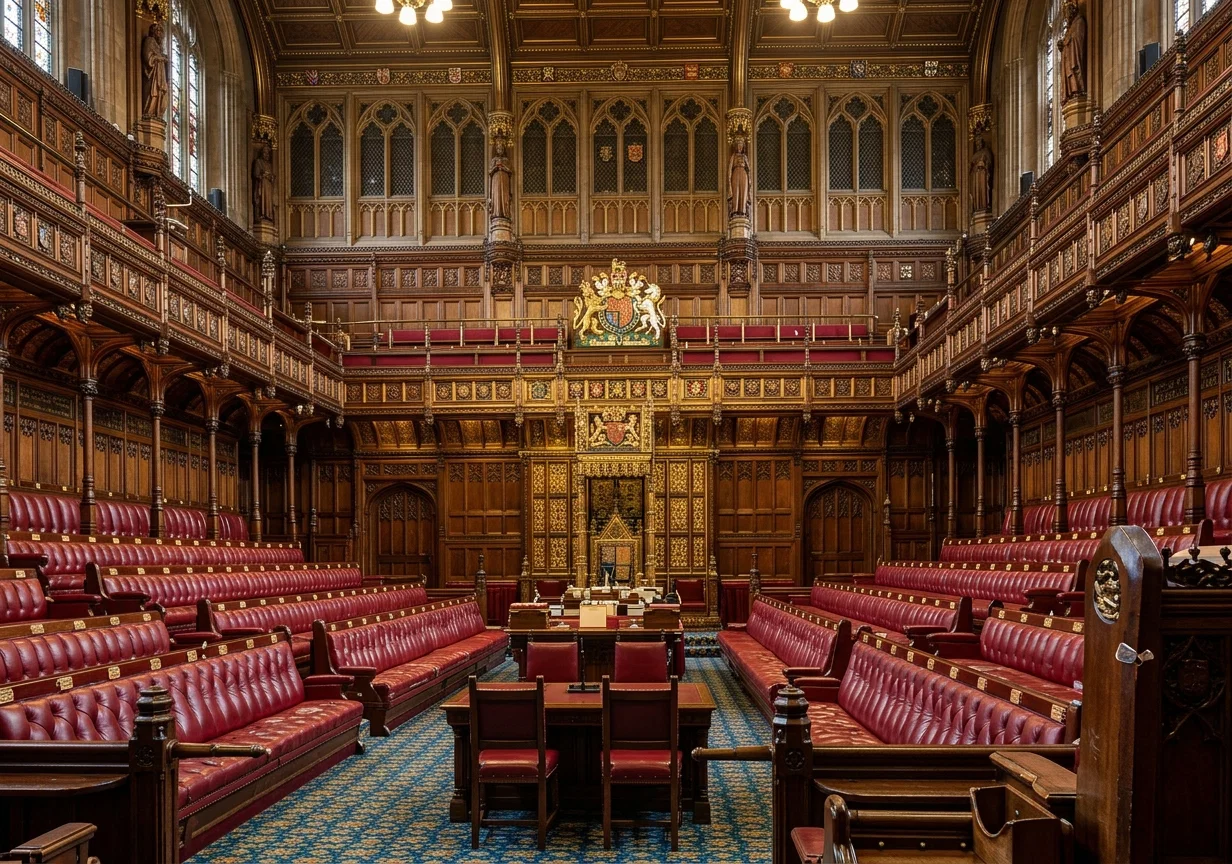
THE HOUSE OF LORDS
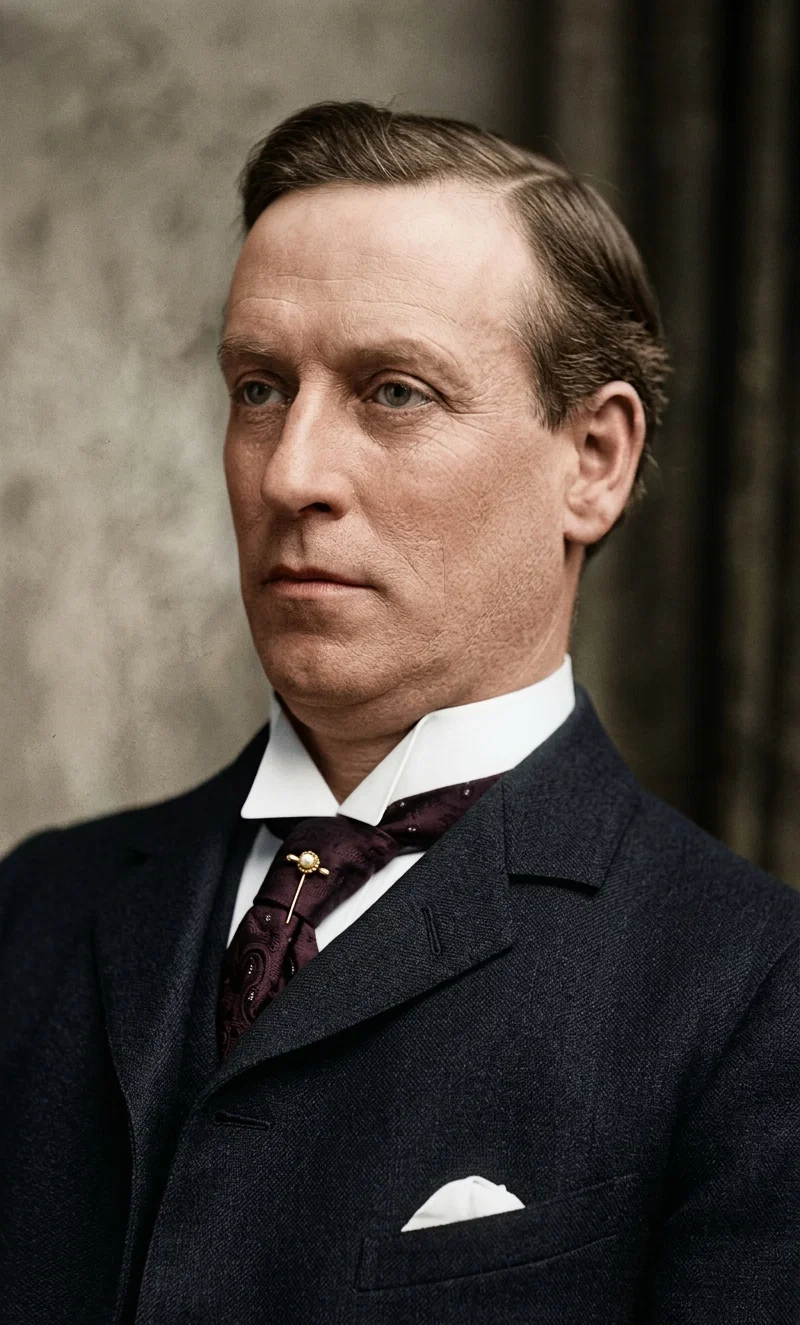
England's Premier, Rt. Hon. H. H. Asquith
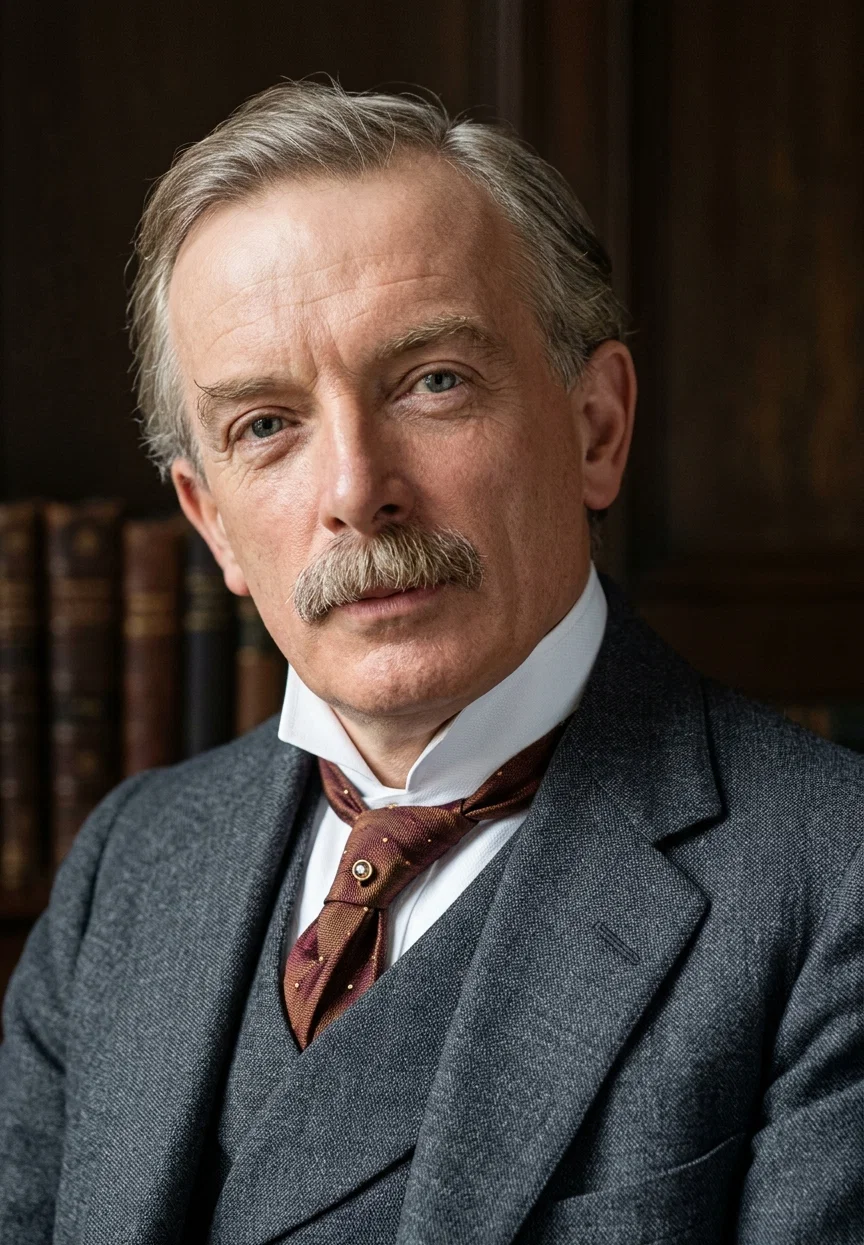
Chancellor of the Exchequer Lloyd-George
To all present appearances we are facing a grave constitutional crisis in England. If the House of Lords rejects the Budget of the Chancellor of the Exchequer, on which so much labor and time have been expended, the flood-gates of revolution will be opened, and no man can tell what the outcome will be. The existence of the House of Lords will be at stake, the throne itself may be challenged, and vast and radical changes from the present order of things will certainly come about before our governmental institutions resume a settled form. Unwonted bitterness is being imported into the political struggle. Mr. Balfour, the leader of the Opposition, a man who is credited with great personal charm, and Mr. Ure, occupying a responsible government position, have publicly denounced each other as a disgrace to their profession and to the country of their birth. It has been many years since such language was heard from responsible leaders of the great parties, but it is the general expectation that the struggle before us will be marked by extraordinary intensity of feeling. There is a strong conviction that a great battle is about to be fought between the forces of property and the masses of the people. There is no doubt that this is true. For generations past it has been tacitly accepted that the ownership of property carried with it the right to govern; but during the past few years there has rapidly grown up among the masses a feeling that their numbers give them the superior strength, and that, if they will, they may become masters of the political situation. Both the great parties have contributed to this educational process by their lavish promises of the benefits that will follow their own instalment in office. At the present time the chief argument put forward by the Liberals in their claim for public support is that the poor owe their old age pensions to Liberalism; while one of the chief arguments of their opponents is that their own return will mean cheaper beer for the people.
Parentalism in Legislation
As the supreme necessity of winning public favor has become more and more the guiding principle of modern statesmen, while this has meant more legislation in the interests of the poorer classes, it has also meant at the same time a departure from the old and once venerated principles of individualism and personal responsibility that necessarily underlie solid character. The bestowal of old age pensions upon all is pleasing, of course, to the recipients, but it must have a weakening effect upon the stimulus to personal exertion. It is right that the children attending the schools should not be allowed to go hungry, but the provision by the state of meals for these children is bound to remove some, at least, of the incentive to parental industry. The modern tendency is more and more in the direction of requiring the state to assume burdens that properly belong to the individual, and this tendency must inevitably weaken individual character. But those who dwell on this unfortunate phase of state aid are listened to with impatience. They are told that the philosophy they preach is out of date, irrefutable on paper but proved impracticable in human experience. While this may be true, the defect is not in the principles, but in the weakened character that finds them too exacting. Instead of seeking rather to build up character, politicians to-day are discarding the principles. Thus expediency is preferred to principle, and truth is set aside if it involves a struggle.
Old Bonds Dissolved
The appetite for state aid is one that grows on what it feeds upon. To the extent that men are relieved from the necessity of personal exertion, their resulting weakness will demand a continuance and increase of governmental assistance. Advancement along this line is likely to be increasingly rapid; and of course, in proportion as individual responsibility is shelved, personal freedom will disappear. In their eagerness to conciliate the spirit of the times, recent governments in this country have unchained forces that will not be easily contented. We have entered into a new era, in which the old bonds of society are largely dissolved, and in which the masses have conceived an idea that the property of the owners who have ruled them in the past is now subject to their will.
Sea and Air
The work of building up the naval armament still goes steadily forward. Giant cruisers and battle-ships are being launched in rapid succession; but public interest, apart from the political struggle, is fixed for the time being upon the wonderful feats which men are achieving in the air. It is now a common thing to read of flights of nearly a hundred miles, and of ascents to a height of seven or eight hundred feet. It is seen very clearly that these air-ships are no toys. They are able to fight their way through gales of wind blowing forty miles an hour, and to perform all kinds of evolutions under trying conditions. There is not the slightest doubt that in time of war the aeroplanes would be capable of doing a vast amount of mischief. It may be taken as a settled thing that the next great international conflict will certainly see these wonderful inventions employed as mighty agencies of destruction.
New Religion Demanded
In this new potentiality we have but one illustration of the tremendous forces that are to-day entering into the conditions and problems of civilization. Professor Frederic Harrison has just written:
“We are living to-day in one of the most tremendous eras of transition that our planet has seen. Steam, electricity, photography, instruments, steel, air-ships, science, learning, inventions, the filling up of the world and the consolidation of humanity, have transformed our material existence with incredibly rapid changes.
“The intellectual horizon has broadened as rapidly11too, and with it our whole moral outlook; and with both together, the profound religious structure, on which the old civilization reposed, has been shaken to the roots. This unparalleled revulsion in our material, intellectual, and moral life has brought new and abnormal difficulties and evils.
“Mankind will never shake itself free of them until it has gained a new religion, which is to be a compound of science, ethic, art, and love. Such a system, at once practical, moral, and religious, is in sight.”
As will be clearly seen from these words, the question whether civilization will prevail over the extraordinary evils of our time, or whether it is to be swallowed up by those evils, will, in Professor Harrison’s opinion, depend upon the value of the new religion which modern civilization has produced. If this shall fail, woe, then, to civilization.
The Lack in the New Religion
The new religion has borrowed from the old almost everything but the superhuman; it lacks nothing but God. It looks upon Jesus as the finest man who ever lived, but it will not allow Him to be divine. Thus it rejects the one saving element of religion. At almost every denominational conference which is held, the “new theology,” in a more or less diluted form, is brought to the front. A few ministers protest that this does not represent them, but the protest receives scant attention. Jesus is extolled, but only by way of tribute to the infinite possibilities and powers that reside in humanity.
Even Judaism Is Agitated
by a “new theology” of its own. Certain leaders of the Jewish community in London are proposing to build a synagog for those who desire to throw over the old traditions and create a modern, progressive form of Judaism. Among other anticipated reforms is the abolition of the custom requiring the separation of the sexes during services, also the abolition of the laws relating to clean and unclean. The outstanding feature of the agitation, however, is the proposal to hold Sunday services for those Jews who are occupied in business on the Sabbath, and can not get away to attend the synagog on that day. The promoters of this idea say emphatically that they do not want to destroy the historical Sabbath, only to make some provision for the enormous number of Jews who can not attend the Saturday services. The chief rabbi, however, views this scheme with strong disapproval. He says, “It is a menace to Judaism, calculated to undermine the Sabbath, the most sacred institution of our race.”
Another of the chief scholars and ministers in the Jewish community declares that the proposed remedy is a thousand times worse than the disease. He says:
“Mr. Montefiore claims that his presentation of Judaism will save those drifters who under modern conditions can not follow the traditions of the religion. Logically I think it will increase drifters, by making religion a convenience for them instead of a self-sacrifice. The Jewish Religious Union’s idea of Judaism is a Judaism without authority—without even the authority of the Bible.”
Sunday Observance Relaxing
While the Jews are thus in enormous numbers weakening in their observance of the Sabbath, Sunday observance is also rapidly disappearing. The five-cent theaters of American cities have lately made their appearance in this country, and are open a large part of the Sunday, drawing crowds of people. There are also said to be some twenty thousand shops open in London every Sunday. The people have not sufficient religious conviction to observe the day which they regard as a more or less sacred institution, and because of this many are calling for state aid to reinforce the public conscience. The Imperial Sunday Alliance has just held a conference at the Mansion House, the residence of the lord mayor of London, at which a resolution was passed calling for the introduction of a weekly rest-day bill into Parliament as a non-party measure. The Alliance is strongly supported by nearly all branches of the church, and its object is to secure legislation that will compel Sunday closing of shops and stricter observance of Sunday generally.
Farman's Aeroplane
Thus we have in active operation in this country most of the forces which Bible students in America recognize as signs of the times. These conditions are not local or accidental; they reveal the working out in different lands of one great controversy between truth and error. W. T. BARTLETT.
Naval Matters
ENGLAND recently launched her new cruiser Indefatigable. This cruiser is of the Indomitable type, but with a displacement of 19,000 instead of 17,000 tons.
AUSTRIA’S budget for the year has a deficit of $8,750,000 after allowing for new and increased taxation. With taxation as it now stands, the deficit would amount to more than $30,000,000. The new taxation includes a succession duty, a tax on bachelors, and a tax on mineral waters; while the income tax is increased. New Dreadnoughts do not come into this.
NOVEMBER 27 the German battle-ship Ersatz Boewulf, the third of the improved type of Dreadnoughts, was launched.
British Cruiser Indomitable
A SENSATIONAL trial began in Kiel, November 1, in which many officials of the imperial navy-yard, and several prominent merchants of Kiel and Hamburg, are charged with thefts amounting to more than $250,000. The offenses cover a period of ten years.
THE Delaware, America’s latest battle-ship, is the first of the Dreadnought type built in this country. She has a displacement of 20,000 tons, 35,000 horse-power in her engines, and a speed of 22¼ knots. She is said to be the fastest battle-ship on the sea. She mounts ten 12-inch guns, and is protected by 12-inch armor. There are ten turrets against four on any other ship, which means ten twelve-inch shells every minute in broadside from the decks. The great ship fires five tons of steel projectiles at every broadside. Dewey’s entire fleet at Manila fired only three. There are to be four battle-ships built of the Delaware type. $10,000,000 is the cost. The others are as follows: The North Dakota, a sister ship; the Florida and Utah, of 21,500 tons, now nearly half completed. These are to be followed by the Arkansas and Wyoming, of 26,000 tons, with twelve 12-inch guns. Congress is to be asked for two others, and there is talk that these will mount 14-inch guns, and perhaps be of 30,000 tons. The question is whether they will be 30,000 tons, mounting twelve 14-inch guns, or 25,000 tons, mounting ten 12-inch guns. What vast sums of money will be necessary to build them!
THE government of Chile has decided upon a naval expenditure of $20,000,000. This includes a 20-ton battle-ship, two ocean-going destroyers, and several submarines. Thus is fulfilled the prophecy of Joel, “Let the weak say, I am strong.”
Spinal Meningitis.
A news despatch states that spinal meningitis, one of the diseases that almost always proves fatal, is now in a fair way to be controlled by a new serum which has been developed in the Rockefeller Institute in New York. There has been a recent demonstration of that in Alameda, California; and it was said to be entirely successful. The physician who treated the child declares that it is the first case of the disease that he has ever seen cured.
Neither Sin nor Saviour.
— The Homiletic Review says regarding Dr. Eliot's new religion that if it is to be received as indicative of the future religion of men, then “the consciousness of sin is to disappear utterly. The prayer of the publican will be noted as a strained accent of a morbid imagination that has afflicted all mankind.” But it also truly remarks that all that can be gotten out of such a theory is “a comfortable philosophy.” “The religion of the common man has always been a religion of salvation from sin, because the common man is himself a sinner. And the only worth of any religion, we may remark, is that which will save man from his sins. The divine estimate of man does not classify; it does not place the moral professor on the one side, and the immoral saloon-keeper on the other. It declares that “all have sinned, and come short of the glory of God.” Jew and Gentile are both under sin, and the only Saviour is Jesus Christ. Dr. Eliot's religion recognizes neither sin nor Saviour.
Socialism in Germany.—
From the London Times we gather that the first ballots in the elections for the Saxon and Baden Diets, held on October 21, show an enormous Socialist increase, and these successes have been followed by a further Socialist victory in the Koburg by-election for the Reichstag. So also in Berlin the Socialists have been victorious in several divisions; indicating that there will be a substantial increase in the future composition of the German Parliament.
Severe Storm and Flooding in Jamaica
One of the most fearful storms that Jamaica has ever known, has swept over the island. After torrential rains lasting many days, serious floods occurred. All telegraph lines are down, and railroads have been badly washed out. Within a radius of ten miles of Port Maria, banana fields were entirely laid waste. The town of Annotto Bay was for a time three feet under water. Kingston fortunately suffered little.
The Papacy in Italy.
A religious exchange tells us that monasticism is reviving in Italy. A member of the Italian Parliament recently showed that about one hundred monasteries are being created each year. It does not bode well for the new Italian nation — this return of the monastic orders; “for even Roman Catholics who are both intelligent and patriotic,” we are told, “are offended at the sight of lazy mendicant monastics.”