Signs of the Times, Vol. 36, No. 47.

Calling the Angels In

Signs of the Times

Dec 1, 1909

Pacific Press Publishing Association · Mountain View, California · Dec 1, 1909

Calling the Angels In

(Author not known)
We mean to do it. Some day, some day, We mean to slacken this fevered rush That is wearing our very souls away, And grant to our goaded hearts a hush That is holy enough to let them hear The footsteps of angels drawing near.
We mean to do it. O, never doubt, When the burden of daytime toil is o’er, We’ll sit and muse while the stars come out, As the patriarch sat at the open door Of his tent, with a heavenward gazing eye, To watch for the angels passing by.
We see them afar at high noontide, When fiercely the world’s hot flashings beat; Yet never have bidden them turn aside, And tarry awhile in converse sweet; Nor prayed them to hallow the cheer we spread, To drink of our wine, and eat our bread.
We promised our hearts that when the stress Of the life-work reaches the longed-for close, When the weight that we groan with hinders less, We’ll loosen our hearts to such repose As banishes care’s disturbing din, And then — we’ll call the angels in.
The day that we dreamed of comes at length, When, tired of every mocking quest, And broken in spirit and shorn of strength, We drop, indeed, at the door of rest, And wait and watch as the day wanes on— But the angels we meant to call are gone.

OUR BIBLE BAND

Schedule for Week Ending December 11, 1909

Day Date Morning Evening
Su. Dec. 5 Dan. 1, 2 1 John 4
Mo. " 6 " 3, 4 " 5
Tu. " 7 " 5, 6, 7 2 John
We. " 8 " 8, 9, 10 3 John
Th. " 9 " 11, 12 Jude
Fr. " 10 Hos. 1, 2, 3, 4 Rev. 1
Sa. " 11 " 5, 6, 7, 8 " 2

Suggestive Notes

Our Old Testament lessons open with the prophecy of Daniel, covering that entire prophecy and eight chapters of the prophecy of Hosea. The name Daniel means “judge of God;” that is, one who judges in God’s name. He is mentioned in Ezekiel, in the 14th chapter, along with Noah and Job, as an exemplar of wisdom and righteousness. He held a high place at the courts of Nebuchadnezzar, Darius, and Cyrus, and this in spite of all the plots of malignant rivals. His education and wisdom seem to have far excelled his fellows’, not only in his school course in the university of Borsippa, but in his position as one of the king’s counselors.
The book of Daniel is written partly in Hebrew, partly in Aramaic. It is narrative interspersed with prophecy. In a series of visions the prophet is shown the world’s career from his own time to the time when God shall set up His everlasting kingdom. The effort to place it at a later date than Daniel is certainly more than met by the evidence of the book itself. Those who do this are those who do not regard the supernatural in the Word. Seemingly they can not believe that God knows more about the future than does man.
Hosea, whose name means “salvation,” is the last of the great prophets of the kingdom of Israel. His prophecy was written about 750 B.C. He predicts with more or less definiteness the coming captivity, and warns his people against wicked alliances. It is a very striking prophecy, full of hopeful remonstrance, tender expostulation, and earnest entreaty. There is in it also somewhat of prophecy of the future.
Our New Testament lessons begin with the 4th chapter of 1 John and close with Revelation 2. The second epistle of John is addressed to “the elect lady and her children,” which some think refers to a woman, and some to a church. It seems to us that it refers to a church (ecclesia); and the third epistle is a personal epistle to Gaius, or Caius, to whom the letter was sent. He is not identified with any person thus named in the New Testament. He seems, however, to be a real person, and one held in high esteem by John.
The Revelation, not “the Revelation of St. John the Divine,” but simply “The Revelation,” is the title of the last book of the Bible. What would be the better title is furnished in the first clause of the text, “The Revelation of Jesus Christ.” It was written probably about 95 or 96, and announces itself as a divine disclosure and prophetical book. It is one of the most wonderful if not the most comprehensive book in all the Bible, including within itself that which inevitably drives one, in its thoro study, to all the books of the Scriptures. It deals with the symbolism of the former prophets Daniel, Ezekiel, and Zechariah. The first chapter is an introduction; the second and third deal with the seven churches of Asia, typical of seven different conditions in the church from the first advent to the close of time.

Question Corner

A Word to Our Inquirers.—We wish to help you; help us to do it. (1) Write your question clear, plain, definite. (2) Do not ask for the explanation of a chapter or a book. State the point clearly upon which information is desired. (3) Avoid foolish questions. (4) We can not always answer questions at once. (5) We can not reply to the same question frequently. (6) If answer is desired by letter, members of the Bible Band will please enclose stamp; others will kindly enclose ten cents. Oftentimes this does not begin to meet expenses. (7) We answer no anonymous or unsigned correspondence. We will not publish the name, nor even the initials if we are requested not to do so.

2983.—The First Pope

Who was the first pope of Rome?
F. B.
If you were to ask the Roman Catholic, he would tell you at once, Simon Peter the apostle. But Peter did not so name himself. There is not a particle of evidence that he ever claimed to be pope in the sense in which the term is used now; or that he ever was the bishop of Rome. Dowling, in his “History of Romanism,” places Victor, the bishop of Rome, the first. He became bishop about the year 192. His term of office is marked by the dispute with the Eastern Christians about the time of observing Easter. Victor excommunicated them from fellowship with the church of Rome. This is the first instance on record of Romish tyranny and assumption; but his excommunication of the Eastern Christians was regarded by them as of no authority whatever. See Dowling’s “History of Romanism,” page 32. We quote:
“It is true that so early as before the conclusion of the second century, Victor, bishop of Rome, had attempted to lord it over his brethren of the East, by forcing them, by his pretended laws and decrees, to follow the rule which was observed by the Western churches, in relation to the time of keeping the paschal feast, to which, in later times, the name of ‘Easter’ was applied. The Asiatics did not observe this festival on the same day as the Western churches; and in order to make them conform to his wishes, Victor wrote an imperious letter to the churches in Asia, commanding them to observe it on the same day as he did. The Asiatics answered this lordly summons by the pen of Polycrates, bishop of Ephesus, who declared, in their name, and that with great spirit and resolution, that they would by no means depart, in this matter, from the custom handed down to them by their ancestors. Upon this, the thunder of excommunication began to roar. Victor, exasperated by this resolute answer of the Asiatic bishops, broke communion with them, pronounced them unworthy of the name of his brethren, and excluded them from all fellowship with the church of Rome. This excommunication, indeed, extended no further; nor could it cut off the Asiatic bishops from communion with the other churches, whose bishops were far from approving the conduct of Victor.”
The “Historians’ History of the World,” volume 8, page 503, notes several of those who occupied the office of bishop of Rome down to Victor I, A.D. 193, and says:
“The bishop of Rome is beginning to assume supremacy over other bishops. This is resented in some quarters.”
In 325, it declares:
“The authority of the metropolitan is distinctly recognized. The idea has been developing since the primacy of Fabianus and Cornelius.”
This was at the time when Constantine came in and had such a molding power upon the church. Fabianus’s date is 236; Cornelius’s, 251. It may be stated that the assumption began with Victor, but was really considered of but little account in the church itself until 325, when the apostasy had really become established.

2984.—Forgiveness of Sin in the Future

Does Matt. 12:32, last part, teach that some sins may be forgiven after this life?
A. L. M.
We do not understand that it does, except in this sense: Human beings are continually committing sins of ignorance. That has been true through all the ages. These are sins even tho they are sins of ignorance. This has been true on the part of those who have at times had a plurality of wives; and of some who have kept slaves. The age in which they lived, the dim light which they had, did not bring home to their consciences the sinfulness of their course. This has also been true with those who have transgressed God’s holy Sabbath and have kept Sunday in its stead. We understand that when their sins come up in the judgment, their motive will be considered. Having faithfully served God according to the light which they had, the atonement of our Lord Jesus Christ will avail for them in the sins which they have committed unwittingly in this life. But in the sense of the sinners’ sinning in that age to come and having their sins forgiven, we do not understand that the text applies. Our Lord is speaking of sins against the Holy Spirit. The Holy Spirit comes to a man to enlighten him regarding his transgressions, to convict him of sin; and when man sins against that conviction, his sin can not be called a sin of ignorance. God has enlightened him regarding it, and he has sinned against the light.

2985.—Laying on of Hands

We profess to contend for the faith once delivered to the saints. Acts 8:17, 18; 9:17; 1 Tim. 4:14; 5:22; 2 Tim. 1:6 seem to teach that the saints used the custom of laying on of hands for the reception of the Holy Ghost in connection with baptism.
C. B. W.
But these scriptures do not necessarily teach this. In the first scripture it was found that certain converts had not received the Holy Spirit when they were baptized. The apostles’ hands were laid upon them, and they received the Holy Spirit.
In the 10th chapter of Acts we read that the Holy Spirit was given before baptism, even while Peter was preaching. Verse 44. Verses 46-48 recite the fact that they were baptized after the Holy Spirit was given. Acts 9:17, 18 simply shows the miracle that was wrought upon the apostle Paul by Ananias in laying hands upon him. But it does not speak of his baptism until after this. The passages in Timothy evidently refer to the laying on of hands in the setting apart of elders in the church. So Timothy was set apart to the ministry of God. Timothy was also sent out to appoint elders, and ordain them for their work. We see nothing in the New Testament times which would indicate that laying on of hands was a general custom. In other words, it was practised only when the Spirit of God seemed to indicate. At the same time we see nothing whatever against it. Of this, however, we may be certain, that the mere carrying out of the form apart from faith will accomplish nothing, any more than the mechanical form of baptism, or the mere ceremony of the Lord’s Supper.

2986.—The Plagues of Revelation 16

Are the plagues of Revelation 16 being poured out now in those awful calamities and troubles which are coming upon the earth?
M. B.
No, they are not. The plagues of Revelation 16 are in a distinct class by themselves. There are other things called plagues as well as these. That is, judgments, persistent troubles, outgrowth of long transgression, and so on, may be truly called plagues. The consequences of long years of sin may be called judgments; but when the seven last plagues, mentioned in Revelation 15 and 16, are poured out, there will be no mercy mixed with them. Men have exhausted God’s mercy; nothing is left in that cup but wrath. We read in Ps. 75:8, “For in the hand of Jehovah there is a cup, and the wine foameth; it is full of mixture, and He poureth out of the same: surely the dregs thereof, all the wicked of the earth shall drain them, and drink them.” The dregs are what are left. It is to that that the third angel refers in Rev. 14:9-11. When men have utterly exhausted God’s mercy, there is nothing left them but wrath, justice; and the pouring out of the seven last plagues will be the beginning of the judgments of God, which will continue until sin is forever destroyed and God’s universe is clean. Those plagues begin with the close of probation and with the ushering in of the great day of God’s wrath. Their pouring out seems to occupy a year of time; “a day of vengeance, a year of recompense for the cause of Zion,” as stated in Isa. 34:8. Rev. 18:8 calls it a “day,” a prophetic day. The effect will continue throughout the day of God’s wrath.

Ministering Spirits

By Mrs. E. G. White
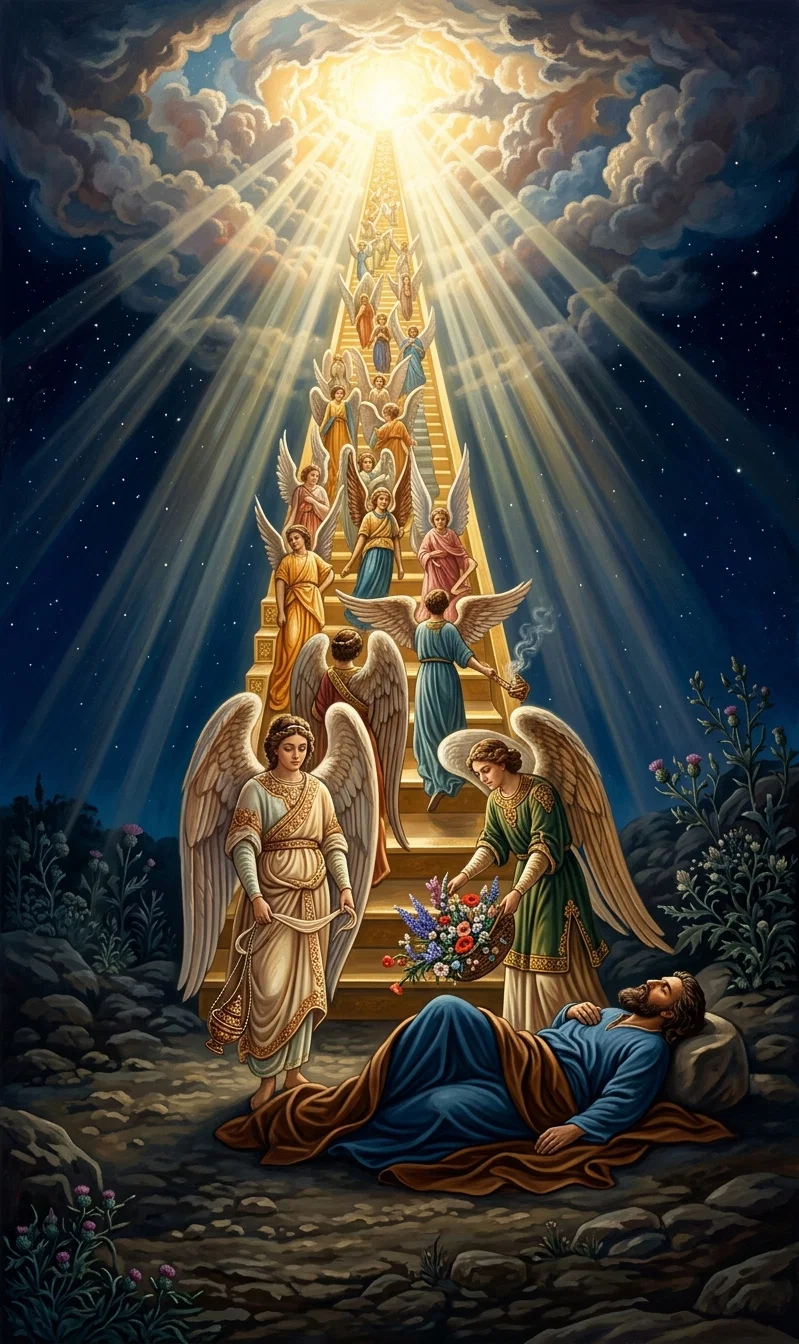
Jacob's dream showed under a figure of the ladder, representing Christ, how God's angels minister to His children. See Gen. 28:12; John 1:51.
The connection of the visible with the invisible world, the ministration of the angels of God, and the agency of evil spirits, are plainly revealed in the Scriptures, and inseparably interwoven with human history. There is a growing tendency to disbelief in the existence of evil spirits; while the holy angels that “minister for them that shall be heirs of salvation,” are regarded by many as the spirits of the dead. But the Scriptures not only teach the existence of angels, both good and evil, but present unquestionable proof that these are not the disembodied spirits of dead men.
Before the creation of man, angels were in existence; for when the foundations of the earth were laid, “the morning stars sang together, and all the sons of God shouted for joy.” After the fall of man, angels were sent to guard the Tree of Life, and this before a human being had died. Angels are in nature superior to men; for the psalmist says that man was made “a little lower than the angels.”
We are informed in Scripture as to the number and the power and glory of the heavenly beings, of their connection with the government of God, and also of their relation to the work of redemption. “The Lord hath prepared His throne in the heavens; and His kingdom ruleth over all.” And, says the prophet, “I heard the voice of many angels round about the throne.” In the presence-chamber of the King of Kings they wait—“angels, that excel in strength,” “ministers of His, that do His pleasure,” “harkening unto the voice of His word.” Ten thousand times ten thousand and thousands of thousands were the heavenly messengers beheld by the prophet John. The apostle Paul declared them “an innumerable company.” As God’s messengers they go forth, like “the appearance of a flash of lightning,” so dazzling their glory, and so swift their flight. The angel that appeared at the Saviour’s tomb, his countenance “like lightning, and his raiment white as snow,” caused the keepers for fear of him to quake, and they “became as dead men.” When Sennacherib, the haughty Assyrian, reproached and blasphemed God, and threatened Israel with destruction, “it came to pass that night, that the angel of the Lord went out, and smote in the camp of the Assyrians an hundred fourscore and five thousand.” There were “cut off all the mighty men of valor, and the leaders and captains,” from the army of Sennacherib. “So he returned with shame of face to his own land.”
Angels are sent on missions of mercy to the children of God. To Abraham, with promises of blessing; to the gates of Sodom, to rescue righteous Lot from its fiery doom; to Elijah, as he was about to perish from weariness and hunger in the desert; to Elisha, with chariots and horses of fire surrounding the little town where he was shut in by his foes; to Daniel, while seeking divine wisdom in the court of a heathen king, or abandoned to become the lions’ prey; to Peter, doomed to death in Herod’s dungeon; to the prisoners at Philippi; to Paul and his companions in the night of tempest on the sea; to open the mind of Cornelius to receive the Gospel; to despatch Peter with the message of the Gospel to the Gentile stranger,—thus holy angels have in all ages ministered to God’s people.
A guardian angel is appointed to every follower of Christ. These heavenly watchers shield the righteous from the power of the wicked one. This Satan himself recognized when he said, “Doth Job fear God for naught? Hast Thou not made a hedge about him, and about his house, and about all that he hath on every side?” The agency by which God protects His people is presented in the words of the psalmist, “The angel of the Lord encampeth round about them that fear Him, and delivereth them.” Said the Saviour, speaking of those who believe in Him, “Take heed that ye despise not one of these little ones; for I say unto you, That in heaven their angels do always behold the face of My Father.” The angels appointed to minister to the children of God have at all times access to God’s presence.
Thus God’s people, exposed to the deceptive power and unsleeping malice of the prince of darkness, and in contact with all the forces of evil, are assured of the unceasing guardianship of heavenly angels. Nor is such assurance given without need. If God has granted to His children promise of grace and protection, it is because there are mighty agencies of evil to be met,—agencies numerous, determined, and untiring, of whose malignity and power none can safely be ignorant or unheeding.
Not until the providences of God are seen in the light of eternity shall we understand what we owe to the care and interposition of His angels.
Celestial beings have taken an active part in the affairs of men. They have appeared in garments that shone as the lightning; they have come as men, in the garb of wayfarers. They have accepted the hospitalities of human homes; they have acted as guides to benighted travelers. They have thwarted the spoiler’s purpose, and turned aside the stroke of the destroyer.
Though the rulers of this world know it not, yet often in their councils angels have beenspokesmen. Human eyes have looked upon them, human ears have listened to their appeals. In the council-hall and the court of justice, heavenly messengers have pleaded the cause of the persecuted and oppressed. They have defeated purposes and arrested evils that would have brought wrong and suffering to God’s children.
Every one will some day understand the ministry of angels in his own life. The angel who was his guardian from his earliest moment; the angel who watched his steps, and covered his head in the day of peril; the angel who was with him in the valley of the shadow of death, who marked his resting-place, who was the first to greet him in the resurrection morning,—what will it not be to hold converse with him, and to learn the history of divine interposition in the individual life, of heavenly cooperation in every work for humanity!
One part of the ministry of heavenly angels is to visit our world and oversee the work of the Lord in the hands of His stewards. In every time of necessity they minister to those who, as coworkers with God, are striving to carry forward His work in the earth. These heavenly intelligences are represented as desiring to look into the plan of redemption, and they rejoice when any part of God’s work prospers.
Angels are interested in the spiritual welfare of all who are seeking to restore God’s moral image in man; and the earthly family are to connect with the heavenly in binding up the wounds and bruises that sin has made. Angelic agencies, altho invisible, are cooperating with visible human agencies, forming a relief-association with men. The very angels who, when Satan was seeking supremacy, fought the battle in the heavenly courts, and triumphed on the side of God; the very angels who shouted for joy over the creation of our world and its sinless inhabitants; the angels who witnessed the fall of man and his expulsion from his Eden home,—these very heavenly messengers are most intensely interested to work in union with the fallen, redeemed race for the salvation of human beings perishing in their sin.
Human agencies are the hands of heavenly instrumentalities; for heavenly angels employ human hands in practical ministry. Human agencies as hand helpers, are to work out the knowledge and to use the facilities of heavenly beings. By uniting with these powers that are omnipotent, we receive the benefit of their higher education and experience. Thus as we become partakers of the divine nature, and separate selfishness from our lives, special talents for helping one another are granted us. This is heaven’s way of administering saving power.
Is there not something stimulating and inspiring in this thought, that the human agent stands as the visible instrument to confer the blessings of angelic agencies? As we are thus laborers together with God, the work bears the inscription of the divine. The knowledge and the activity of the heavenly workers, united with the knowledge and power that are imparted to human agencies, bring relief to the oppressed and suffering.
Our acts of unselfish ministry make us partakers in the success that results from the relief afforded.
With what joy heaven looks upon these blended influences! All heaven is watching those agencies that are as the hand to work out the purpose of God in the earth. Such cooperation accomplishes a work that brings honor and glory and majesty to God. O, if all would love as Christ has loved, that perishing men might be saved from ruin, what a change would come to our world!

1. What class of spiritual beings is God using in the administration of His government?

Angels

1. What class of spiritual beings is God using in the administration of His government?

“And I saw, and I heard a voice of MANY ANGELS round about the throne and the living creatures and the elders; and the number of them was ten thousand times ten thousand, and thousands of thousands.” Rev. 5:11.
Note.—The word “angel” is a transferred Greek word meaning messenger. Sometimes it is applied to men, but almost invariably to those spiritual beings of which the Bible abundantly speaks, who are ministers of God to do His service. John speaks of them in number as ten thousand times ten thousand, and thousands of thousands. Ten thousand times ten thousand is a hundred million; but this is not all. He adds, “thousands of thousands.” We do not wonder that they are called in Heb. 12:22 “innumerable hosts of angels,”—not simply innumerable angels, but innumerable hosts; that is, there are innumerable companies of them. For God’s “armies in heaven” are, in the very nature of things, in perfect order and under perfect discipline, governed by the holy principle of love. Mentioning the same vast number, another prophet says, “Thousands of thousands ministered unto Him [the Ancient of Days], and ten thousand times ten thousand stood before Him,” ready to do His service. Dan. 7:10.
2. What is said of their responsiveness to His commandments?
“Bless Jehovah, ye His angels, that are mighty in strength, that fulfil His Word, harkening unto the voice of His Word. Bless Jehovah, all ye His hosts, ye ministers of His, that do His pleasure.” Ps. 103:20, 21.
3. Who is the chief of these angels?
“Michael the Archangel.” Jude 9.
Note.—Michael the Archangel is none other than Christ. He is often spoken of by men as entirely distinct from our Lord. Sometimes the term is used in the plural. The Bible, however, knows but one Archangel. The term “arch” means chief. When placed before a noun beginning with a vowel, or vowel sound, the “ch” takes the hard form; when placed before a consonant, the ordinary sound, as in “archbishop.” The Archangel is therefore the commander among the angels. “Michael” means “who is like God.” Therefore through all the past dispensation Christ is called “the Angel of Jehovah.”
From the reference in Jude it will be seen that He is the one that has to do with the raising of the dead. Turning to 1 Thess. 4:16, we learn that the dead shall be raised with the voice of the Archangel. By comparing this with John 5:28, 29, we further learn that the dead shall come from their graves with the voice of the Son of God, making the voice of the Son of God and the voice of the Archangel identical, and, therefore, identifying the Archangel Michael as Christ the Son of God. This also is confirmed by the angel Gabriel’s words to Daniel. Speaking to the prophet and his people, he calls the Archangel “Michael your Prince.” Dan. 10:21. Still further, in Ex. 23:21 Jehovah says of the Angel that shall go before the children of Israel, “Take ye heed before Him, and hearken unto His voice; provoke Him not; for He will not pardon your transgression: for My name is in Him.” And in Isa. 63:9 He is called the Angel of Jehovah’s presence, who in all the afflictions of Israel was afflicted, who by His love and pity redeemed them and bore them, and carried them all the days of old. This very thought is inspiring as we think of the Son of God giving Himself to men; in His humiliation passing down through the ranks of angels as well as men, and so filling every vacancy and bridging every chasm which sin had made, by the wonderful sacrifice of His love.
4. After our Lord’s exaltation, who takes His place as the chief of the angels?
Gabriel, whose name means “man of God,” sometimes called man, coming to men in the form of men. See Dan. 8:16; Luke 1:19, 26.
5. What is the relationship of the angels to men?
“Are they not all ministering spirits, SENT FORTH TO DO SERVICE for the sake of them that shall inherit salvation?” Heb. 1:14.
“The Angel of Jehovah ENCAMPETH ROUND about THEM THAT FEAR HIM, and delivereth them.” Ps. 34:7.
“See that ye despise not one of these LITTLE ONES: for I say unto you, that in heaven THEIR ANGELS do always behold the face of My Father who is in heaven.” Matt. 18:10.
6. Are these angels spirits of men?—No, for they existed before men.
“Where wast thou when I laid the foundations of the earth? Declare, if thou hast understanding. Who determined the measures thereof, if thou knowest? Or who stretched the line upon it? Whereupon were the foundations thereof fastened? Or who laid the corner-stone thereof, WHEN THE MORNING STARS SANG TOGETHER, and all THE SONS OF GOD shouted for joy?” Job 38:4-7.
7. They existed before any one died.
“So He drove out the man; and He placed at the east of the Garden of Eden the CHERUBIM, and the flame of a sword which turned every way, to keep the way of the Tree of Life.” Gen. 3:24. “Cherubim” are orders, or divisions, of angels.
8. What is said of the power of only one of these beings?
“And it came to pass that night, that THE ANGEL OF JEHOVAH went forth, and smote in the camp of the Assyrians a hundred four-score and five thousand: and when men arose early in the morning, behold, these were all dead bodies.” 2 Kings 19:35.
9. Revelation of truth is given through angelic ministry.
“The revelation of Jesus Christ, which God gave Him to show unto His servants, even the things which must shortly come to pass: and He SENT AND SIGNIFIED IT BY HIS ANGEL unto His servant John.” Rev. 1:1.
Note.—This seems to be invariably true. It is the revelation of God to Christ; Christ to His angel; His angel to men. So also we read in Daniel that the man Gabriel, Christ’s angel, made the revelation to him (Dan. 8:16; 9:21); and in the 10th chapter and 21st verse Gabriel tells the prophet, “There is none that holdeth with me against these, but Michael your Prince.” When God wished to reveal to Zechariah that a son of his would be the forerunner of the Messiah, He sent Gabriel. Luke 1:19. And when the virgin Mary was apprised that she should become the mother of the Son of God in His incarnation among men, the angel Gabriel was again sent. Luke 1:26, 27.
10. Angels have part also in conversion of souls.
“He saw in a vision openly, as it were about the ninth hour of the day, AN ANGEL OF GOD coming in unto him, and saying to him, Cornelius.” Acts 10:3. Read also the entire chapter. See article in editorial columns.
11. Angels have to do with the resurrection.
“And behold, there was a great earthquake; for AN ANGEL OF THE LORD DESCENDED FROM HEAVEN, and came and rolled away the stone, and sat upon it.” Matt. 28:2.
12. They have also to do with the gathering of the saints when our Lord shall come.
“And He shall SEND FORTH HIS ANGELS with a great sound of a trumpet, and THEY SHALL GATHER TOGETHER HIS ELECT from the four winds, from one end of heaven to the other.” Matt. 24:31.
13. When the great drama of redemption is finished and our Lord shall come to redeem His own, all the angels shall come with Him.
“But when the Son of Man shall come in His glory, and ALL THE ANGELS WITH HIM, then shall He sit on the throne of His glory.” Matt. 25:31. Read also the first article in this number, and also article in editorial columns.

“Casting All Your Care”

“But,” says one, “I must be anxious about the conversion of my unsaved relatives; how can I help being anxious about them? I pray continually day and night for them, but I see little or no change.” Yet Jesus calls you to “cast all your care upon Him,” even the care about the conversion of your friends; for in this, as well as all else, “He careth for you.” You may have been walking in the vain shadow of your own energy and anxiety, and disquieting yourself in vain. Ps. 39:6. He who gave His very life blood for those relatives, is not gone-away out of call. He is close by, waiting for you to trust Him. His word is, “Believe on the Lord Jesus Christ, and thou shalt be saved, and thy house.” And to believe is to enter into rest about them (Heb. 4:3), because Jesus, when trusted with them, makes their conversion His business.
But what if they resist? What if they will not come? Is not that the very consideration which has kept you wrestling in prayer, with your eye upon them all the time, and which is making you anxious now? But God says, “In nothing be anxious [therefore in this be not anxious]; but in everything by prayer and supplication with thanksgiving let your requests be made known unto God. And the peace of God, which passeth all understanding, shall keep your hearts and your thoughts in Christ Jesus.” R.V. Your hearts and your thoughts are not guarded in Christ Jesus while you are occupied about the resistance manifested by your dear ones.
You are in heart making something impossible for God, and you are taking upon you the part of the transaction which can only be regulated between them and God. Does God want them saved? Is Jesus at hand to understand it? Do you, when you pray, believe that you do receive their salvation, because God has promised it, and that without doubting in your heart? Mark 11:24. If so, you can no longer have a shadow of anxiety about the matter, because it has passed into the hands of the living God, and Jesus is close by to hear you whisper again and again, that you know it is safe with Him.
MRS. H. E. WARNER.
Continue reading: The Signs of the Times