Your ShelfYour Projects

Signs of the Times, Vol. 32, No. 30.

Praise the Lord
Earlier text: Praise the Lord

TO OUR READERS EVERYWHERE.

All our files were burned. We very much desire to get copies of all the great special numbers which we have issued, and the volumes of the SIGNS OF THE TIMES for the last twenty years. But especially do we desire the copies of the special numbers. We would not ask all who may have them to send them, but if there are any of our readers who have special numbers which may be of little use to them, but of great benefit to us, will they drop us a postal card and tell us what numbers they have, the subject matter of the number and the date? In that case we will write to those who can best spare them, if they will tell us, and so endeavor to complete our files. Kindly say whether the SIGNS files have an index. Please reply to this promptly, as it will be of very great value and accommodation to us.

Our Sabbath Service.

OUR SABBATH MEETING, JULY 21, 3 P. M.

Our church in this place has been using, since the Pacific Press built here, the office chapel. When the building was burned it left us without a place of worship. But as our boarding-house was spared and the weather was beautiful and balmy, we decided to meet on the porch and in front of the unburned building.
It was stated in the beginning by Elder M. C. Wilcox, who as elder in the church, had the meeting in charge, that we would not have a sermon, but talks from various persons. Some of our brethren were still throwing water on the fire, and a goodly number of the town people were present. The services were opened by singing, "Jesus lover of my soul, Let me to thy bosom fly." Fervent prayer was offered by Elder E. R. Palmer.
The second song was "The cross that He gave may be heavy, But it ne'er outweighs His grace." We epitomize the talks given, for we are sure they will be of interest to our readers.

Remarks by C. H. Jones, General Manager Pacific Press.

Little did we think when we left this place last night and went to our homes that we would come here to-day and see this building in ruins. We meet here to-day with hearts bowed down with sorrow and grief for the loss of this beautiful plant. The sun shines just as brightly as it ever did, yet it seems to me that a gloom is cast over it. Yet this is God's work, and though these material things have been destroyed, God's work will go on. We are God's servants and he has permitted this calamity to come upon us for some good reason. There may be several lessons for us to learn, and this is the way I have felt from the beginning. I wanted to search my own heart, study my own relation to God's work and see where I have been out of the way, and how I could better relate myself to His work. I feel like giving myself anew to the Lord.
The work is increasing. God is calling for laborers and there is something for everyone to do. God has given to every man, woman and child a work to do. We want to find that work.
We had a little meeting last night. We met at Brother Palmer's from 2 o'clock A. M. until 1 talking over what shall be done. We hope to be able to give something more definite to-morrow morning as we meet here at 8 o'clock. We do not want any of the employees to get discouraged or get alarmed and leave here. We want to talk with every one. We do not want one single employee to leave until we have a chance to counsel with you in reference to the matter. Now is the time that God wants men, men of courage, men of faith. This may have come to test our faith. It is a test of faith. Now shall we shrink back? No, now is the time for every man to stand at his post.
We cannot help but feel somewhat discouraged as we look upon these ruins, but we can look forward to the future. I do not dare to think of last night. There is more work for us to-day than there was yesterday. So brethren and sisters, and friends, and fellow laborers, let us take courage. Let us draw nearer and nearer together and near to God. Let us put our shoulders to the wheel, and with God's help, bring a blessing out of this calamity. I have faith to believe that this will be done. Let us take courage, every one of us. We want you to be thinking about these things. Let us never desert our post of duty in such a trying time as this.

Remarks by H. W. Cottrell, President of the Company.

The calamity that has befallen us this time caused by fire is far greater than the one which befell us as the result of the earthquake. This is apparent to all without stating it. We cannot understand it. It is not known by anyone why this should have been permitted to come to us, but in the language of the prophet, let us say each to the other, "Be of good courage." Institutions may burn. Men connected with institutions may die. Men and women connected with institutions or allied with the faith held by this denomination may denounce it and renounce it, but the truth stands. The truth cannot be burned. The truth will never deny itself. It remains the same yesterday, today and forever. For this, personally, I feel very grateful.
Let this be a time when our words are few and well chosen. Let us not judge or decide why this has come to us. God only knows. Out of all this, in the end, each will see and understand at least that God has turned the calamity to a great blessing to us as individuals and the cause of God at large. My sympathies are with you, but my faith is in God. I trust that yours will be as never before. To-day is the time for self humbling, for self-examination, for consecration of ourselves to be workers with God as never before. I am glad to know that the cause of God does not depend upon material things, upon institutions. There were no great institutions in the days of Christ. The greatest means for the spread of light and truth and the work of God in all this world is a man connected with God and imbued with the Holy Spirit. But with this and with the institutions still more may be done. May God help us, and unite us together as never before one in Him, and He the One.

From W. T. Knox, President of California Conference.
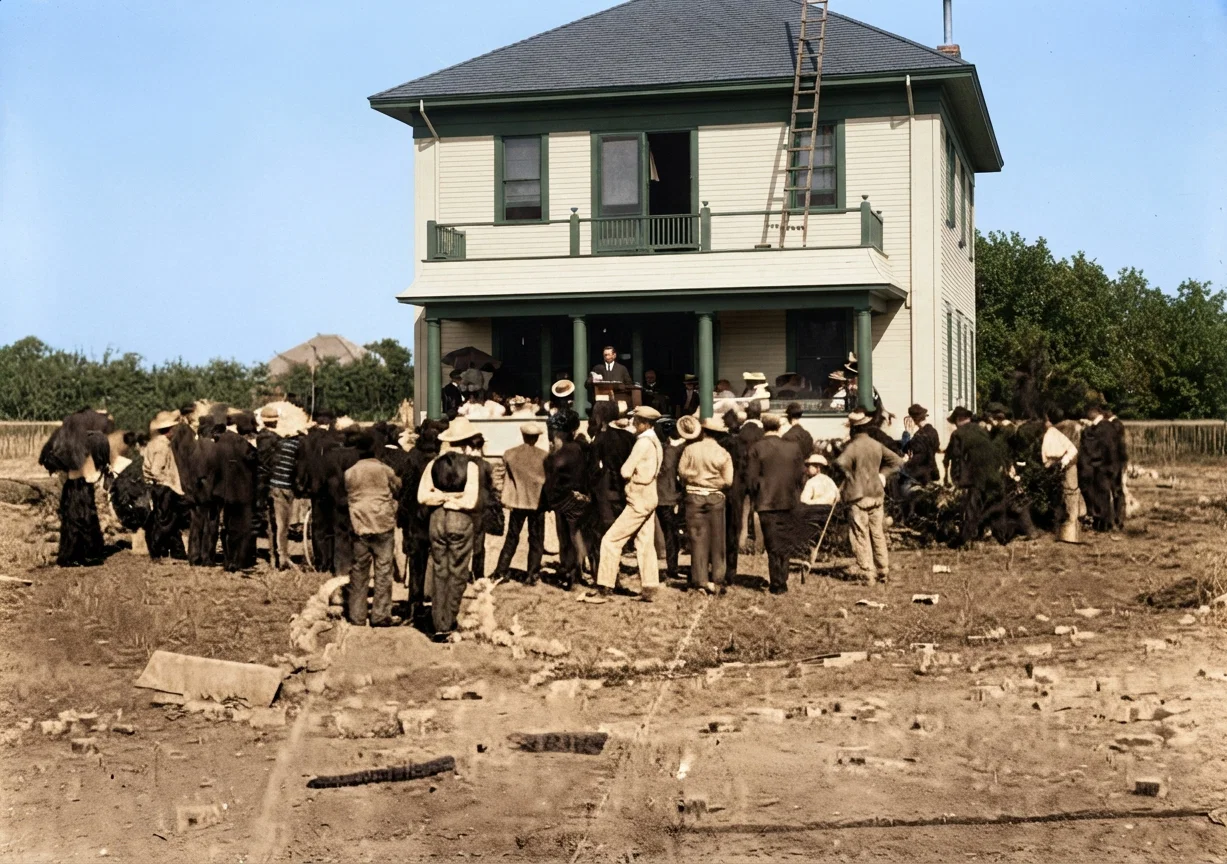
I do not know that there is anything that I can say in addition to what has already been said by the previous speakers. I heard of this terrible calamity, as it now appears to us, on the camp ground this morning. A few ministers were in a tent seeking the Lord when the messenger came to us from Mountain View, and when he spoke the few words that revealed to us this catastrophe, it seemed as though all my strength had passed from me. Even after the hours have intervened between then and now, it seems to me to be a terrible experience for the people of God to be called to pass through, and yet I look upon it now as an experience that has been permitted by a loving and merciful Father, one who cares far more for this little handful of people who are here this afternoon than for all his institutions throughout the whole earth. And while we cannot see except as through a glass darkly this afternoon we need not be staggered. He has a lesson in this for us to learn, and if we will learn it He will lead us into a broader field than He has ever led us before.
OUR SABBATH SERVICE, JULY 21, 1906
I want to say to you all that I feel for those who have been more intimately connected with the institution than I have. I know that your hearts must have been wrung during the past few hours, but I am sure, dear brethren and sisters, that God will use this to work good for us and honor to His own name and truth if we will relate ourselves to Him aright. If we will seek Him he will establish this institution upon a foundation of broader usefulness than it has ever been in the past. I do not feel this afternoon to multiply words, but only to say that my faith in God is strong to-day and I believe that He will lead us out of this difficulty.
The above remarks seemed to find a hearty response in all our force of employees. Nearly every one is willing to do anything or go anywhere, if so he can help the institution and the cause for which it stands.
Many of them are now scattered. Kind offers from other firms have called them away and given them employment for a time; but all are ready and anxious to return. May God guide and bless them all.

Remarks by E. R. Palmer, Secretary of the General Conference Publishing Committee.

"Nevertheless the foundation of God standeth sure, having this seal, The Lord knoweth them that are His."
Since I awoke from sound sleep at midnight last night and looked out upon that blazing building, I have been casting about for old anchorages whereby I might have my own heart steadied, that I might be fitted for service when it is needed, and I feel to-day more like listening than like talking. First of all I feel that I want to listen to the voice of God. God has been speaking to us, and it is our business just now, instead of trying to find out who was to blame for that calamity, to listen to what God has to say to us as individuals, that we may relate ourselves aright to the future.
I know this, that the work of God is a temple not made with hands. If every institution that we have built, and there are many throughout the wide world, were swept away to-day, the foundation of God would stand just as firmly as it did yesterday, and the work of God would go on as strongly in the future, provided that the sweeping away of institutions led to the strengthening and the uniting of the church of God which is made up of individuals, and not of institutions.
I think I have already narrated to you at one time, words that I heard a Methodist minister speak on board the steamer Oceanic when we were crossing the Atlantic ocean three or four years ago. He preached in the saloon on the question of personal service. Later we were talking together, and in referring to his sermon, I asked him, To what extent do you consider that great institutions are important in the work of God? His reply was very striking. He said, "Institutionalism and formalism are one and the same. When a man ceases his personal devotion, he establishes a form to take its place. When a congregation ceases its personal service for God, it erects a great institution to do the work for them. That is the reason why congregations, denominations, that are farthest away from God have the largest number of wealthy institutions. The church of God in the day of its greatest prosperity had no great institutions to which it could point, but relied directly upon God to carry forward the work which is God's.
I believe that God has given us institutions to carry forward His work, but as we labor in them from day to day we love them so much that God has to bring us back to our anchorage, and to learn to transfer our affections to that which is more enduring.
I was present when the Review and Herald publishing house was burned. That was the oldest of our publishing houses, and one that God had used for many years in carrying the message to many parts of the world. Through the sacrifice and the active work of our people that institution was financially strong but evils crept in until it seemed that it was necessary for God to remove that great institution and again throw His people more directly upon Him for help and blessing in carrying forward the work. There is this that we can look back to that in a great encouragement to me, since the day the Review and Herald went down, although $200,000 worth of property was destroyed, yet that publishing association has done a stronger and more effective work for God since that day than it had done before; and I believe to-day, although with you I feel chastised, I feel in my soul to-day that this experience will serve to draw us together in bonds that will be stronger than that institution ever was, and I believe that with this bond of union we can take up the work that we have in hand and go forward and do a greater work for God than we would have done if that institution had remained; but this depends upon how we relate ourselves to this experience. Personally I feel a great desire to get down at the feet of Jesus and listen to what He has to say. If we will touch shoulders and go forward with the work, picking up the broken cords, God will bring a great blessing out of this for us.

Remarks by M. C. Wilcox.

God wants men at this time—strong, four-square, upright men. The great three-fold message which this people is giving to the world has nothing of fanaticism in it. There was a time when the world believed that it had to some extent. The world is beginning to believe it no longer. It stands for good, practical, religious common sense. That is what it ought to stand for, that is what it ought to stand for in this period of trial. This is a period of trial. I could not believe it was so when Brother Floyd Jones awoke me in the middle of the night and told me that the Pacific Press was burning to the ground. As Brother Palmer said, we had begun to love it; and I thought of all things that were burned, of our bookmen in the field, the burning of our library. I thought of the precious manuscript, of all the various photographs and drawings that we had gathered from all parts of world, of the accumulated gatherings for twenty-five years, and yet when I thought past all that I felt that there was one book that was left that was worth more than all the other books, and that was the blessed Word, and in that Word was God's last great glorious message to man. I am thankful that that book remains.
I little thought that as we placed upon our Earthquake Souvenir Edition that text, "And after the earthquake a fire," that it would prove a prophecy in our own case. But I am looking beyond that; for "after the fire, a still small voice." I am listening to that voice to-day. I want to know what it has to say to me.
Let us remember this one thing, that the only unity that there is, the only true unity, the only unity that will remain, is everlasting living unity with our Lord Jesus Christ. Men may try to patch up unity, but the true unity between me and my brethren is true unity between me and Jesus Christ, my Lord. He is waiting to give that unity to all who do not know it, waiting to let His own spirit and life bind me to Him and you to Him, unity that no loss of institution can ever break, and that no calamity can ever sever. God wants us to come into that united relation to Him that will make us stronger than ever in the past. I am prepared to go even further than Brother Palmer did when he referred to the fire of the Review and Herald. God's entire work has gone as it never has gone before since the loss of that institution, and that institution is stronger.
One lesson that He wants all of us to learn is that men are stronger than institutions. The mightiest work that Jesus Christ ever did in this world was done when there were no institutions, by men clothed in the divinity of God in the first years of the gospel era. Then God worked mightily and far beyond what institutions have done.
There is a text that comes to me to-day, "If thou faint in the day of adversity, thy strength is small." We do not propose to faint, brethren; God lives. The very fact that distinguishes the Christian from other men is not the fact that the Christian will not have trials and troubles. God let trials and troubles come upon Job. The difference is not that there shall come no trials, no troubles, no afflictions to the Christians, but the difference lies in this, in the way that the Christian takes that trial home to his heart and rises from the trials stronger than ever. So God wants us to learn that lesson, to come down so low before Him that He can lift us up. You cannot destroy the Christian. Christ lives and His power fire cannot burn. It tunnels even the dark grave. Brother Palmer spoke of that text, "Nevertheless the foundation of God standeth sure, having this seal, The Lord knoweth them that are His." That is God's side of the seal. The reverse side is ours, "And let every one that nameth the name of Christ depart from iniquity." That is our part.
My own heart feels humbled. When I went to bed last night it seemed there was nothing between me and my Lord, but I bow before Him now, praying that He will teach me better than ever before to give myself to Him. I want to know how many there are among those who are here to-day who will join with us in giving themselves to God anew to-day to learn the lessons that God has for us, to look forward and not back, to look up and not down, to take hold of God as we have never taken hold of Him before. (In response to this request nearly all present manifested their desire to do this.)
It gives courage of heart, brethren, when we can know that we can touch shoulders and turn to the right and go forward. It is an old saying among the soldiers and sailors of the English army and navy, "England expects every man to do his duty." God expects that of us now. Let us throw our whole souls into the work and He will lead and strengthen us.

Onward and Upward.

"My son, despise not thou the chastening of the Lord, nor faint when thou art rebuked of Him; for whom the Lord loveth He chasteneth, and scourgeth every son whom He receiveth. If ye endure chastening, God dealeth with you, as with sons; for what son is He whom the Father chasteneth not?"
Whatever happens to the people of God is for their good. Never an apparent disaster comes to His cause—whether directed or merely permitted—that is not for a wise purpose. It may be for correction, or it may be as a trial of faith, or it may be both.
"We know that all things work together for good to them that love God, to them who are the called according to His purpose." This is a difficult lesson for us all. If we could better appreciate this great truth, and always be prepared to act upon it, we would be spared much worry. Then, if chastisement should come, our grief would not be because of material loss, but because of the slack morals that made the chastisement a necessity. All chastisement comes of moral dereliction, and trial of faith comes to all. The disaster that came upon Israel at Ai because of Achan's disobedience at Jericho was a chastisement to all who were influenced by his spirit, as well as a trial of faith to all—even to Joshua. But no catastrophe to the Lord's people or to His cause, no matter if apparently fatal, can shorten the arm of the Lord.
But even if Israel be smitten for his iniquity, God is able to lift him up and give him great victory in place of defeat—if he will repent and put away his sin. "The mercy of the Lord endureth forever." In the flush of prosperity Elijah weakened before the enemy and ran for his life. He fled to the wilderness and sought death, because he thought the cause of God had utterly failed. But the angel of God came to the discouraged servant, and nourished and encouraged him. Then he went to the mount of God and communed with Him.
While there, where God had promised to meet him, it seemed that the elements would overwhelm him. First, a whirlwind, then an earthquake, and then a fire; but God was not in any of these. After the earthquake and the fire, a "still small voice" spoke to Him. The prophet was strengthened for renewed service and sent back with a commission for a new campaign.
So as we look upon the smouldering embers, upon the ashes and the debris of our beloved institution, we reflect that at the mount of God there is that reassurance that will more than replace it all. Then in humility of heart and renewed confidence in the cause of Him who doeth all things well, we take up the work anew. God never yet permitted anything to burn that He could not do without or replace, when the hearts of His people were firmly set Zionward.
"Speak unto the children of Israel, that they go forward."

Primitive Christianity and Its Restoration.

GOD permits nothing to come to His children in either seeming blessing or calamity but that it has its lesson. If the lesson be not learned, the blessing will prove a curse. If learned, the seeming calamity will prove a blessing.
The work for which the Pacific Press plant stood is, we believe, the work of God. It stood professedly for primitive Christianity, and for the restoration of the ideals of primitive Christianity by the means of the Word of God and the Holy Spirit.
Primitive Christianity stood for separation from the world, from its methods, its selfishness, its scheming competition, its policies, its expedients. By this we do not mean that it stood for exclusive aloofness from the world; not at all. Its business was and is to stand in the world holding in its living principles the savor of eternal preservation of all that is good, and winning every longing-to-be-honest soul to the everlasting truth and righteousness which is in Christ Jesus.
Primitive Christianity stood for the largest charity toward all men, sinners and saints, irrespective of creed or work; but this is not to be perverted by the mingling of sin and righteousness in the work of God. All charity for the sinner, but no fellowship with the sin.
Primitive Christianity stood for unswerving fidelity to the standard of God's Word, for uncompromising righteousness and integrity. As soon as principle yielded to expediency or to policy, as soon as righteousness was compromised, Primitive Christianity failed. Ichabod was written over .... hallowed shrines, and the blackest apostasy the world ever knew was begun.
The great Master is endeavoring to teach His blinded and wandering children the road back to truth. He is pointing them to the highway of uncompromising holiness. He holds out before them the plentitude of God's open storehouse in the nail-pierced hands. In all the garnered love of eternity He pleads with them to return.
If they will not heed his voice in love He must chasten them. If they have learned some of the lessons, but are slow to learn others, He must correct them, if need be, punish them. If they count the means which He has bestowed, to do work for Him and humanity, as the end, the object, and set their affections upon material things, in His goodness He must remove the means, tho seemingly unseparable, and consume the material things.
So He did with Israel of old. They looked upon the beautiful temple, the ornate service, and the richly robed priests, and said, "The temple of the Lord, the temple of the Lord, the temple of the Lord are these," and yet their affections were set on the world, and their conduct and motives were like those of the nations around them. In mercy He tells them: "For I am with thee, saith the Lord, to save thee; tho I make a full end of all the nations whither I have sent them, yet will I not make a full end of them; but I will correct thee in measure, and will not leave thee altogether unpunished." Jer. 30:11. And their correction, their punishment, was the destruction by fire of their beautiful temple and city.
Blind, indeed, would he be who would claim that we have reached God's ideal; who would not admit that we have been slow to hear His voice, slow to follow His leadings, ready when expediency demanded to shade His principles of eternal righteousness.
What is the lesson, then? Turn to God with all the heart, with prayer and fasting. Stand for Him and His work, and His truth, whatever comes. Then will He fulfil to us His own word, to give us "beauty for ashes, the oil of joy for mourning, the garment of praise for the spirit of heaviness; that they might be called trees of righteousness, the planting of the Lord, that He might be glorified." "Then will He give the valley of Achor [trouble] for a door of hope," and all the other promised blessings will follow. Hos. 2:14-23.

Remarks by A. O. Tait, Business Manager of the “Signs of the Times.”

What we have known as the Pacific Press building is in ashes, but I thank God that the Pacific Press itself is gathering around this porch, and is still living and is still able to carry forward this work. A great many valuable manuscripts and books have gone up in smoke, but we have ability to make more manuscripts and more books. He who gives us this ability lives and ever will live. He has known of this thing for thousands of years. I do not believe that He did it, but He has permitted it. What we need now is courageous hearts. We need our faith exercised in going forward with this work. We need to be thinking what we can do now to spring into action and carry forward this cause as it should be done.
That building, looking at it from one standpoint, was quite a thing, but I would rather see that building lie there in ashes than to see any one of our faithful workers lying in death and we gathered in that building to attend his funeral. Not one of them could be spared.
God has a definite thing for every man and woman to do here who is a true Seventh-day Adventist. As Brother Wilcox has suggested, this is not a time for any one to be thinking, what shall I do next? how shall I make a living? "But seek ye first the kingdom of God and His righteousness, and all these things shall be added unto you." I thank God that He has the adding machine that can do his work. So let us stand right by the work and go forward. I believe there is this lesson for me to learn in connection with this disaster. God designs to have a perfect people to carry forward this message—people who have everlastingly forgotten how to find fault with each other and how to tear down each other's work. I believe every one of us should search our hearts, and should learn how to work in harmony and in perfect unison, so that in a very short time we shall see this work away beyond where it would have been if this thing had not occurred.

"Through Much Tribulation."

GOD does not promise to His people immunity from trouble or calamity in this world. On the other hand we are assured that it is "through many tribulations we must enter into the kingdom of God." Acts 14:16, A. R. V. And Jesus declares to His disciples: "In the world ye shall have tribulation." John 16:33.
On the other hand, the psalmist observed of the wicked, "They are not in trouble as other men; neither are they plagued like other men." "Their eyes stand out with fatness; they have more than heart could wish." Ps. 73:5, 7. It troubled the psalmist, as it troubles others to-day. "Surely in vain have I cleansed mine heart, and washed my hands in innocency; for all the day long have I been plagued, and chastened every morning." When the psalmist went into the sanctuary then he beheld their "latter end." Read Ps. 73. He saw that there was a life beyond this; and an eternal death for those who have lived a useless life.
Character is the result of trial; therefore God tries His people. Abraham was tried. Moses was forced to leave his all. David was tried again and again. For years after God anointed him for the throne, he was a fugitive for his life. The people were tried, and some of them went to violent death in their trial. Paul was tried,—stoned, whipped, beaten with rods, and at last died a martyr's death. And what shall we say of our blessed, righteous Lord and the whole great army of witnesses, "of whom the world was not worthy," who "had trial of mockings and scourgings, yea, moreover of bonds and imprisonment: they were stoned, they were sawn asunder, they were tempted, they were slain with the sword; they went about in sheepskins and goatskins; being destitute, afflicted, ill-treated, . . . wandering in deserts and mountains and caves, and the holes of the earth." Heb. 11:36-38.
Sad, terrible, awful, horrible, unjust, cruel, and dark many of these things were, but none of them were vain. They developed character. They separated the wheat from the chaff. They pressed out the pure wine of refreshing love and service for God. They burned away the dross from the gold of character. They were thus fitted for the "better thing," the everlasting inheritance, the immortal existence on before.
Therefore, "beloved, think it not strange concerning the fiery trial among you, which is upon you to prove you, as tho a strange thing happened unto you; but inasmuch as ye are partakers of Christ's sufferings, rejoice; that at the revelation of His glory also ye may rejoice with exceeding joy." 1 Peter 4:12, 13. And therefore, again, we "rejoice in our tribulations; knowing that tribulation worketh stedfastness; and stedfastness, approvedness; and approvedness, hope; and hope putteth not to shame; because the love of God hath been shed abroad in our hearts through the Holy Spirit which was given unto us." Rom. 5:3-5, A. R. V.
Beyond all the trial is enlargement and blessing and greater service for God and humanity.
The San Francisco relief fund would hardly have been so large had the people throughout the country supposed for a moment that they were donating to a fund of several million dollars to be exploited by what the world calls "graft." It is said that goods being transported from depositories to camps and hospitals have disappeared by the drayload. But a still larger draft on the fund is the array of highly-paid officials and assistants of all grades employed to do the distributing of the huge charity.
The unsanitary nature of the meat business is not confined to Chicago and London. Now comes a dispatch from Philadelphia telling of like conditions in that city. Twenty slaughter houses recently condemned by the board of health as unsanitary were permanently closed on the 24th ult. Sixteen other houses were improved by order of the board, and one proprietor who neglected to obey the order to improve his place was prosecuted. It is difficult to see how a slaughtering place could be made sanitary, or its products hygienic.

THY WILL BE DONE.

We see not, know not; all our way Is night—with Thee alone is day: From out the torrent's troubled drift, Above the storm our prayers we lift, Thy will be done.
The flesh may fail, the heart may faint, But who are we to make complaint, Or dare to plead, in times like these, The weakness of our love of ease? Thy will be done!
We take with solemn thankfulness Our burden up, nor ask it less, And count it joy that even we May suffer, serve or wait for Thee, Whose will be done!
Though dim as yet in tint and line, We trace Thy picture's wise design, And thank Thee that our age supplies Its dark relief of sacrifice, Thy will be done!
And if, in our unworthiness, Thy sacrificial wine we press; If from Thy ordeal's heated bars Our feet are seamed with crimson scars, Thy will be done!
If, for the age to come, this hour Of trial hath vicarious power, And blest by Thee, our present pain, Be Liberty's eternal gain, Thy will be done!
Strike, Thou the Master, we Thy keys, The anthem of the destinies! The minor of Thy loftier strain, Our hearts shall breathe the old refrain, Thy will be done! —J. G. Whittier.

Question Corner

[Not less than thirty questions in this department, about half of which was in type, were destroyed by fire. We shall have to ask some readers to repeat them if they desire answers. Let the questions be to the point and on subjects profitable. Do not merely ask that a certain text be explained. What is the particular thing on which explanation is desired.]

1880. Who Spoke to Adam?

Was it God or Christ that walked with Adam and spoke to him. Gen. 2:8 speaks of the "Lord God." M. S.
It was doubtless God the Son; but as truly God as though it was the Father. "No man hath seen God at any time; the only begotten Son, which is in the bosom of the Father, He hath declared Him." But the Son was truly Jehovah God. John 1:1-3; Heb. 1:4.
Continue reading: Denial of Christ