The Political, Social, and Religious Conditions in the Near East
REV. J. HENRY HOUSE, SALONICA, MACEDONIA
The principality of Bulgaria and the kingdom of Servia have made wonderful progress in the outward conditions of civilization in the last twenty-five years, since they obtained independence or autonomy under the Treaty of Berlin. In this respect they have left Macedonia far in the rear. It is to be feared, however, that no commensurate advance in morality and religion can be recorded. The simplicity and (to a great degree) purity in the family life, which tended toward remarkable thrift and fidelity in the home, have given place in a lamentable degree, in the larger towns especially, to what are called more modern and liberal views of family life, and in certain circles to a sad degree of intemperance, luxury, and profligacy.
In Macedonia the conditions which obtained in Bulgaria thirty to forty years ago still prevail. The khans (inns), for the most part and with only few exceptions in the larger towns, are miserable almost beyond belief. Travelers, in order to have the least comfort, are obliged to carry bedding and provisions with them. All the conditions of life are more like those which prevail in Turkey in Asia.
Socially, the Christian populations of Macedonia are, as a rule, far less attractive to travelers than their Turkish rulers. Many of the latter are courteous, especially to Europeans and Americans. They are men of more or less education, and some have traveled in Europe. Their position as rulers for so many hundred years has given them advantages over the subject races. They are the officials or the men of leisure of the country. The village Mohammedans, however, resemble in outward appearance the villagers of the subject races, only they are usually rather more ignorant. Their religion, however, gives them certain advantages before the government which often makes them a terror to their neighbors.
The Christian subjects of the Moslems in Turkey look upon themselves as in the most galling bondage. The tenets of the Mohammedan religion tolerate only those Christians who submit and pay tribute. To peoples who accept these conditions the Turkish government proffers a certain paternal care and freedom of action, especially in regard to religious beliefs and practices, which often strikes the European visitor as remarkable. The Turks themselves often claim that no other government in the world surpasses theirs in tolerance to other faiths. An intimate acquaintance, however, with the situation in Macedonia reveals the following unsatisfactory conditions:—
The Courts and the Prison System
In the courts, even if the judges were not corrupt (as unfortunately in many cases they are), the testimony of a Christian does not count as against that of a Mohammedan. For this reason the courts can never be satisfactory in cases between Moslems and Christians. On the other hand, in cases between one Christian and another, the venality of the judge, as a usual thing, gives no assurance of impartiality and justice.
In the criminal courts the dictum that obtains in practise is: The accused is to be treated as guilty until he can prove his innocence. Those arrested may be kept in prison for almost any length of time without a trial, and sometimes even without being informed of the nature of the accusation against them. So a man who has a spite against another may succeed in getting him imprisoned for an indefinite period by simply bringing a serious accusation against him. When the man proves his innocence (if he is able to do so), he has no means of obtaining redress for his unjust imprisonment. Now, this indiscriminate imprisonment of the innocent and the guilty has perhaps justly taken away the disgrace which in Western countries attaches to those who have been lodged within prison walls.
There are other considerations which make condemnation to imprisonment less of a terror to evil-doers than it ought to be. Before the culprit comes to trial, it is often quite possible to bribe his keepers so as to get himself free. The Turkish police and officers of the law seem less intent upon exercising the vigilance which will reduce crime than upon multiplying cases of arrest by means of which they may increase the possibility of their getting money from their victims. Even if an evil-doer is convicted and condemned, there is always the hope of imperial clemency, especially as it is customary to reduce the term of imprisonment of convicts at every birthday11of the sultan, or upon every anniversary of his accession to the throne. The longest sentence for murder is imprisonment for fifteen years, but by imperial clemency this is sure to be considerably reduced, so that murder becomes in the eyes of people of a low civilization a trivial crime.
One can see why crime is frequent, and the prisons filled with the innocent as well as the guilty.
In the civil administration the venality of all sorts of officials is too well known to be dwelt upon. There are most praiseworthy exceptions, especially among recent governor-generals. The present vali pasha of Salonica, Hassan Fehmeh Pasha, seems to be an upright man with the best of intentions. However, the power of such an official is small to stem the general tide of corruption which is all around him. Above him is the absolute rule of the sultan, without whose permission nothing important can be done, and who has his spies everywhere, and beneath him a great multitude of officials, many in places distant and inaccessible, and all skilled in ways of despoiling the people which can not easily be discovered.
Iniquitous Taxation
The trouble is with the system. The taxes are auctioned off to the highest bidder, and may be sold for more than they are worth, in which case the buyer must recoup himself with large interest upon his investment. But however this may be, the spahis (tax farmer) have purchased the taxes for gain, and not for the purposes of benevolent government. The normal tax is nominally a “tithe,” but it may be in fact any proportion up to a half. The latter proportion is said to be the tax upon rice in the district of Strumitza. There are many ingenious ways of making the taxes yield well. For example, a man has raised beans one year; he may be made to pay the same tax on beans the next year, although he may not have planted any that year. Again, an apple tree produced a crop last year, it may be taxed the same this year, although it has not yielded an apple.
Under these conditions it is not strange that agriculture and horticulture languish. The military tax levied on all males of the subject races furnishes another means of oppression. It is much less of a tax upon them than the military service is upon the Moslems, but it is unfortunately often collected in ways which produce exasperation. The whole amount is thrown upon a village in a lump sum. Now while efforts are made to add to the list all the new births of male children, on the other hand, it is often impossible to get the names of the dead taken off, and so the people are often forced to go on paying military taxes for the dead!
But one is not sure that the exorbitant but regular taxes of the government are not after all the least heavy of the burdens which the people bear. The government is always on the verge of bankruptcy. It would be interesting to know the actual per cent of the taxes collected that reaches the central treasury. It is all too little for the government expenses, and the pay of the lower officials is often months in arrears. This is the class of officials who come most in contact with the people. Left thus without pay for long periods, they still must live, and they are compelled to prey upon the communities which they are sent to protect; and it would often seem that they are expected to do this, and so do it with impunity. It is difficult for any one who does not live in the country to understand the exasperating levies which are made upon the people from this cause.
A still greater cause of hatred to their rulers is the danger to the honor of their women, to which the people are always exposed when the villages are visited by Turkish policemen and soldiers. When Miss Stone was carried off, the remark was more than once heard: “If such excitement is caused by the kidnapping of one woman, let the Americans think of our suffering, when so many of our wives and daughters are continually exposed to something far worse.”
All these things will show the reasons which the Christians of Turkey have for feeling bitterly the bondage to which they are subject. These evils are so widespread, and the misery of the villagers is so great, that any one of sympathetic nature finds it hard to go about among them and be compelled to hear the oft-repeated tales of suffering.
An Unsustaining Faith
We turn now from these outward conditions of the people to those moral and religious. The nominal Christians, for the most part, belong to an ancient Christian church which they call the Eastern Orthodox Church. This church is not able to meet these outward sufferings and miseries with any counterbalancing spiritual uplift. We must not, however, speak with too much haste or prejudice. It is difficult not to have a certain love and respect for a church whose traditions run back so many hundreds of years. The orthodox church has obtained a remarkable hold upon the affections and upon the imagination of these simple people. But no serious student of the Bible and church history can repeatedly and understandingly visit the services in the churches of Macedonia without being overwhelmed with sorrow. He seems to see a body from which the spirit has fled. He looks upon a barren desert of form and ceremony with hardly a scrap of living green to comfort the eye. Imagine a service three hours long, with usually not a word of instruction or comfort in it all, unless perchance a word or two of the portion of Scripture may have been understood. The liturgy is in the ancient Slavic language (or the ancient Greek), which is not understood by the people, and there is, as a rule, no preaching. And should there be found an enlightened priest who wishes to preach, he is soon stopped by the bishop if his sermons should show the least tendency toward evangelical truth. The prayers and services before the icona (holy pictures) of the virgin and the saints attribute to the creature the glory which only belongs to the Creator. Prayers to the virgin occupy the chief place in the liturgy, and are longer by far than those offered to the triune God. The attribute “most holy” is applied to the virgin, while that of “holy” is sufficient for God the Father and Christ, and she is appealed to to “save” them. These things, together with the prayers and offerings for the dead and a multitude of other superstitious observances, awaken the deepest sorrow in the mind of the intelligent student of the Word of God.
If now you turn from the church to the daily life of the people, you will find what you would naturally expect under such circumstances—that religion is an opus operatum, not a God-fearing life inspired by the indwelling of the Holy Spirit. A bad man may be in the eyes of the community a good orthodox Christian; a priest may be a bad man, but a good priest. Formalism reigns—a disease fatal to the life of any church. All the Biblical teachings of the church are either unknown or largely unheeded. The Bible, though not a forbidden book, is for the most part an unread book.
This, then, is the justification of evangelical missions among them. As Christians we must lift up a fallen brother before we go on to raise a fallen foe; in fact, the people often suffer as much from nominal Christians as they do from their Moslem rulers. Christians who occupy petty offices under the Turks are often the greatest agents of oppression, not to say anything about the narrow bounds which encircle commerce from the want of faith in one another.
Soil Ripe for Revolutionary Teachings
It is, then, in such a soil as this that the seeds of insurrection and revolution, when planted, most surely grow. The inception of the movement was doubtless largely due to Macedonians who had fled from their native land to Bulgaria. Many were educated in the schools of that freer land. Whether the first attempt to organize a revolutionary committee was made by such Macedonians as were unable to obtain employment in their adopted country, or by those who were moved only by patriotic motives, the committee, once formed, was a popular organization for the unemployed, and the cry for the freedom of Macedonia was a popular one to all Bulgarians from the predominance of Bulgarians in that province. Any one who opposed it seemed to be little better than a traitor.
This committee seems to collect taxes from all the Bulgarian inhabitants, rich and poor. A Macedonian Bulgarian put the case in a nutshell when he said: “We are now living under two governments, and both collect their taxes by violence.” The two governments were those of the Turks and the committee. It should be said here that there are two committees, the old and the new, or the so-called Centralists and Verhovists. The new committee appears to deprecate such deeds of violence as the kidnapping of women, bomb-throwing at foreigners,12and the like, but it must be said that the old committee, or the Centralists, seem to have the money and the influence in Macedonia.
The armed bands of this committee, traversing as they have for several years past with wonderful impunity all parts of Macedonia, must have collected large sums of money, and probably have hidden in the mountain fortresses large stores of guns and ammunition; at least, they are supposed to have done so, and some think that when the general insurrection takes place, they can put thousands of villagers into the field—villagers who are not without some drill in the use of firearms. It is difficult to know just how much truth there is in these reports. The committees, however, have already made the Turks much trouble, and have, in spite of the diplomats, brought about the present crisis in the near East. They seem to be fully decided not to yield to the demands of Russia and Austria, but to call out a general insurrection and fight to the bitter end for the autonomy promised them in the Treaty of Berlin.
This is the sad condition of this province, now absorbing so much of the attention of the world. The American Board has missions in European Turkey. As a result of this mission work, there are several thousands of Protestants in Bulgaria and Macedonia. Though small in numbers, these evangelical communities are a power for the moral and spiritual uplifting of the peoples of these provinces. It is hoped that the missionaries and Christians will not be in special danger unless the Turks should be allowed to invade and conquer Bulgaria, which does not seem likely, if we recall the history of the recent Greco-Turkish War. . . . Our duty is one of earnest prayer to God, not only for our brethren who are stationed in these provinces, but for all the distressed peoples of this unhappy region.
The population of Macedonia numbers, probably, something more than two million, of which we estimate the Bulgarians as about one half of the whole, the Turks one third, the Greeks one tenth, and Wallachians, Jews, Albanians, Servians, and Europeans make up the remainder. It should be noted here that Albania proper (the old Illyricum) and Thessaly are not included in Macedonia. The Bulgarians are more or less equally distributed over the northern, central, and western portions of the province, and in the west they extend as far south as Lake Kastoria. The Turks, while they are more or less numerous in all the cities, are especially strong in a large central strip of some breadth, which extends from the Gulf of Orfany in the southeast to the city of Uskub in the northwest.
There are also large colonies of Turks in the southeast, on the mainland to the north of the island of Thasos, and in the southwest extending from Lake Ostrovo toward the southeast as far as the River Bistritza, near the border of Thessaly. The Greeks occupy the extreme southwestern portion of the province, as well as the southern and southeastern seashores along the Egean.
The recent sufferings of the Macedonian Bulgarians, the reports of which often become exaggerated when published in the newspapers of the principality, have evidently awakened the greatest excitement and sympathy in Bulgaria, and this makes the preservation of peace more difficult. One can readily believe, however, that the Bulgarian government does not desire war. Turkey, on the other hand, seems to be deliberately preparing for war. She naturally feels deeply the provocation which the revolutionary committees have given her. She has gathered large armies in Thrace, to the east of Bulgaria, and in Macedonia, to the south. She may have as many as two hundred and fifty thousand or three hundred thousand men under arms, and seems only to be awaiting some overt, unfriendly act on the part of Bulgaria, that she may declare war. Probably the only thing that is keeping her back from a declaration of war is the knowledge that the great powers will not permit her to profit by victory.
The problem of government in these regions is rendered more difficult by the fact that every race keeps itself as far as possible distinct from every other. If autonomy should be given to Macedonia, an important part of the government would naturally fall to the Bulgarians, as being more numerous than any other one nationality there.
One thing seems reasonably certain, that no government not guaranteed by the powers will be able to meet the difficulties of the situation, and bring about contentment and peace. At present it is next to impossible to forecast the future. The strain upon the people living in these regions for the past few years has become so great, and the uncertainties for life and labor so continuous, that doubtless something must be done, and it may be that war, however much to be deprecated, would be considered by many as a sort of relief, and in the end it might clear the air.
One Reason for Moody’s Success
By Chas. T. Everson
CHAS. T. EVERSON
One day while conversing with the once noted evangelist, Mr. B. Fay Mills, who is now a Unitarian pastor, the topic of Mr. Moody’s success and its reason came up. Mr. Mills said that many looked upon Mr. Moody as an ignorant man, and that it is not generally known that Mr. Moody was earning three thousand dollars a year as a shoe merchant when only twenty-three years old. He went on to say that Mr. Moody was a man calculated to succeed in whatever he undertook; for he allowed nothing to stand in the way of his attaining the end that he sought.
Then, to illustrate this statement, he related an incident that happened the first time he met Mr. Moody. He said: “In a seaport town on the Atlantic coast there is a little church that because of its wealth generally succeeds in getting the leading ministers in the country to come and preach for them. I preached there one Sunday, and after the sermon I was asked if I had ever met Mr. Moody. To this I answered in the negative. Then they said I must remain till the following Sunday, for Mr. Moody would preach there, and I would be afforded the opportunity of meeting him. It was customary for the minister who preached for this church to speak on Saturday night for the fishermen, of whom there were many in that place. This service for the fishermen was held in a large flat building that had a sheet-iron roof. It was at this service that I met Mr. Moody, who was to address a large audience composed of rough and sturdy fishermen. But just at the beginning of the service it began to rain; it came down in torrents, sounding almost like thunder on that sheet-iron roof. Although only a very few in front could hear anything, yet Mr. Moody preached for about an hour at the top of his voice until his collar wilted, and he was covered with perspiration. And when he had finished speaking, he announced to the congregation, ‘After we sing a song Mr. Mills will speak.’ I spoke up and told him that it was of no value to speak with such a storm in progress. But he only reaffirmed that Mr. Mills would speak. Then while the congregation was singing, I said to Mr. Moody, ‘Tell the congregation that Mr. Mills will not speak, and then call those to the front who are especially interested, and deal with them directly.’ ‘No,’ said Mr. Moody, ‘Mr. Mills is going to speak.’ So I got up and ‘sawed’ the air for about three quarters of an hour. By the time I had finished speaking, the storm had ceased. Mr. Moody then got up and preached a regular sermon to the congregation, uninterrupted by the storm, and had a very successful meeting.” Mr. Mills concluded with the statement, “Now a man who will wear out a storm to gain his object is bound to succeed.”
This ability to hold on until success is assured in whatever is undertaken is recognized in the Bible as one of the most necessary qualifications for success. It is not he that begins, but “he that endureth to the end” that shall be saved. The enduring quality is the one that is necessary to success also in prayer, as we note from the parables of Jesus on the importunate widow and the man who came at midnight to ask bread for a friend. Also in another place we read, “Ye let go of the arm of the Lord too soon.” The ability to endure in prayer as “seeing him who is invisible,” and to work perseveringly, will bring success to even the apparently untalented. Success comes not to the specially talented, but to the persevering, who, as Wesley, value time more than money, and are more careful how they spend the former than the latter.
Timothy and the Scriptures
“TIMOTHY never would have been a companion of Paul if he had never been a student of the Scriptures.”
The Chinese World
By J. N. Anderson
J. N. ANDERSON
Numerically as well as geographically China is one of the great empires of earth. The Chinese as a race constitute not less than one fourth of the world's population. Like the English-speaking people, who, by their numerical strength, enterprise, and force of character, occupy a large and unique place in the affairs of earth, the Chinese race, which, though radically different in almost every respect, constitutes a leading factor in the make-up of the world. In a very important sense each of these two races must be looked upon as a world all by itself. In point of population and national antiquity,—dating from the time of Abraham,—the Chinese vastly outstrip all other races, while the geographical magnitude of the Middle Kingdom, extending from latitude eighteen degrees and ten minutes north to forty-eight degrees and ten minutes north and from longitude seventy-four degrees east to longitude one hundred and forty-four degrees and fifty minutes east, places it in the first rank of world empires. Some territory has been lost to China since the year 1840, when it was estimated that the Chinese emperor ruled over five million three hundred thousand square miles. In view of these facts, what wonder that China calls herself the “Middle Kingdom,” the “Celestial Empire,” in comparison to which, according to popular belief, all other nations are islands, petty border States, tributary indeed, but often in a so-called state of rebellion or insurrection against the rightful sovereignty of the great sovereign state, the Middle Kingdom.
In shape, the Chinese empire approaches a great rectangle whose circuit is fourteen thousand miles, or more than one half the circuit of the globe, embracing a third of the largest continent of the four world portions. The coastline is roughly stated at forty-four hundred miles, while her three great river systems are perhaps the most extensive and complete in the world.
This vast empire naturally divides itself into the three divisions of China Proper, Manchuria, and the colonial possessions (Tibet, Kokonor, Ili, and Mongolia). The last division, although one half the territorial extent of the empire, is of little importance, politically or otherwise, being barren and sparsely inhabited. Manchuria is the home of the present Chinese, or, rather, Manchu dynasty, which has held power for two and one-half centuries. This province, with its language and people, is in fact foreign to China, and has been and still continues to be the cause of no little friction; and as I write these lines, it is a bone of contention which may at almost any time plunge the leading world powers into an international war. China proper embraces the eighteen provinces, and almost universally answers to the term China.
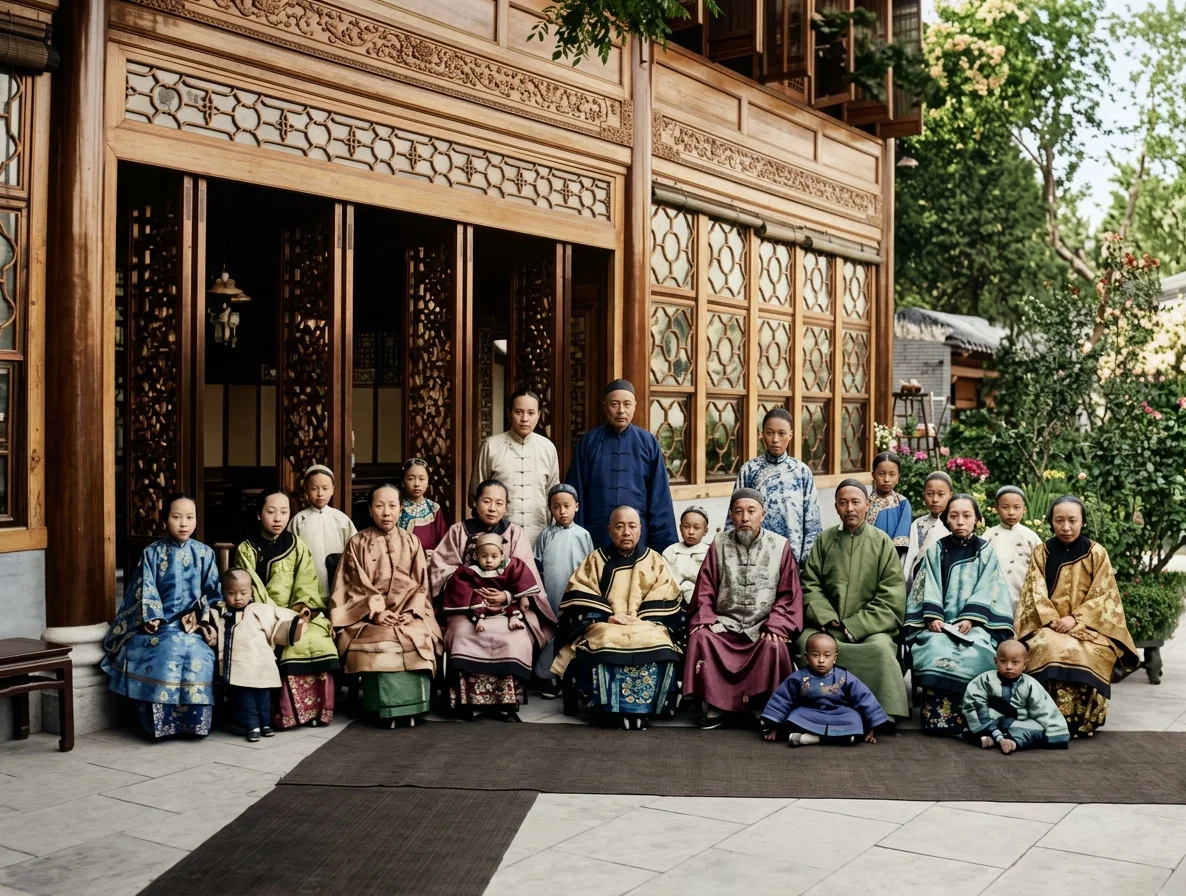
THE FAMILY OF A WEALTHY CHINAMAN
Unlike England, which in order to extend her dominions was forced to go beyond the seas, the Chinese race is in an important sense one, planted together in one continent, a mighty empire developed through not less than four millennia to its present magnitude from a roving, nomadic people who once inhabited what is now the province of Shen-si.
Yet it is a mistake, though general and deep-seated, to conceive of China as a well-organized and united empire. Her written word is indeed one, but her tongue is so diversified as to present as many and as great differences and divisions as the continent of Europe, though less perceptible and less definite. Again, the word China may mean, on the one hand, the great inert population for the most part gathered in villages, which, with the rural masses, constitute perhaps ninety-five per cent of the entire people; while, on the other hand, it may mean that relatively small but very important literary class constantly recruited from the general mass, from which any one may rise on the ladder of literary tests. This class, together with the political and military Manchu, not only rules China politically and civilly, but furnishes whatever public opinion it has, writes its books, its pamphlets, and conducts its ceremonies, its business, and most of its worship. This is at once China’s strength—and China’s weakness—a puzzle and a vexation to Western diplomacy.
But it must not be forgotten that China and the Chinese are by no means co-extensive. The allusion is not to the influence China may have exerted upon the world outside of herself, but rather to the many Chinese who, in spite of their superstitions, attachment to native land, and contempt for things foreign, have for centuries emigrated to other lands both near and remote. Considered from this point of view, the Chinese race, by its skill, enterprise, and industry, occupies the chief place in the Oriental world. Nor have the Chinese hesitated to enter the great labor markets of the Western world, where, by their intelligence, thrift, and industry, they have successfully competed. “They are equal to any climate, be it hot or frigid; all that is needed is teaching and guiding combined with capital and enterprise, to convert them into the most efficient workmen to be found on the face of the earth.”
In the United States, where the Chinese have received anything but fair treatment, and where there has been the most vigorous and unreasonable opposition to their presence, there are to be found at the present time over one hundred thousand. Canada has perhaps about one fifth of that number, most of whom, as in the United States, are to be found on the Pacific coast. Trinidad has from two thousand to three thousand Chinese, while Cuba, Porto Rico, and other West India Islands had in 1877 not less than forty-five thousand. Mexico has about three thousand of these Orientals. The South American States, especially those on the west coast, have a considerable sprinkling of Chinese, amounting in the aggregate to probably not less than seventy-five thousand or one hundred thousand. In 1893 the Sandwich Islands had a Chinese population of forty thousand, many of whom held good positions, including several lawyers.
Europe seems to have very little attraction for the Chinese, and very few are to be found there. Africa, however, where European capital has entered to develop the country and its resources, has a considerable number of this strange but misunderstood people. Ceylon and India also have some, and evidence is abundant to show that their presence in those parts dates from ancient times. In Burma they are numerous, and the opinion prevails that the future of that country belongs to the Chinese. The14trade of Rangoon is in a large measure in their hands, and the commercial towns up country, such as Mandalay, etc., have large numbers of these desirable immigrants who possess the very qualities which the Burmese and other indigenous races lack. Since the annexation of Burma by Great Britain, the tide of Chinese immigration has steadily increased, until they now number probably forty thousand. The same statement holds true, only in a more absolute sense, of Siam, Anam, and Cochin China. In the last place mentioned, the Chinese fairly swarm, not indeed as idle cumberers, but as patient, persevering, and intelligent traders and workmen. In and around the Straits Settlement there are said to be at least six hundred thousand Chinese, not counting those in Borneo, the Dutch colonies, or the Philippines. If all territory under direct British control be included, they slightly outnumber the children of the soil. There has been, and continues to be, a large influx of Chinese immigrants into Malaysia and all surrounding islands.
The Philippine Islands, it is estimated, have about one hundred thousand Chinese, and now that American capital and enterprise have entered to develop the country, the demand for Chinese laborers is increasing, despite American aversion to cheap labor. Since the war with Japan, very few Chinese are to be found in that land.
Australia, with a total population of four million, has about forty thousand Chinese, but owing to restrictive legislation this number is constantly decreasing. New Zealand has a small number of Chinese, but there, too, discriminating laws drive them from the country, and prevent further immigration.
To the far north in bleak Siberia, Russia's imperial penitentiary, the Chinese swarm along the banks of the Upper Yenisei River. In Vladivostok no less than thirty thousand reside, carrying on various businesses in a small but effective way.
It is thus seen that the Chinese are a most potential factor, especially in these Oriental parts, where they stand head and shoulders above other native races, whose business affairs they are laying hold upon in proportion to their superior skill, intelligence, and industry. In a political and military way, they count for almost nothing; but as laborers and tradesmen in any capacity, this people possess superior qualities, and the countries to which they come receive incalculable benefits from these unoffending, peace-loving, and industrious people.
This is the Chinese world—a great ancient empire—with abundant resources yet undeveloped, a population exceeding one fourth that of the entire race, thousands of whom are scattered to all parts of the Orient, and many to Western lands. With these facts before us, it is manifest that China, or the Chinese race, is one of the great, if not the greatest, missionary problem confronting us as a people. While God has marvelously opened to the message this great field, we do well to count seriously the cost, and lay our plans accordingly, remembering, on the one hand, that the work is God's, who is both able and willing to carry it forward, and, on the other hand, that he employs human agencies, and that to us has been committed this work.
Not that the work of giving the message to China's millions must be done by laborers from the home field. Were this method possible, it would require years and years, to say the least. The only way is to raise up and train native workers, who will be able to do the work quite as effectively, and with but a fraction of the outlay, both in time and money. But while it is true that a good proportion of the Chinese converts make earnest, intelligent evangelists, teachers, and Bible workers, it is equally true that the work of directing and superintending must ever devolve upon workers from the home fields. The situation requires scores of consecrated, intelligent workers, whose coming can not safely be long delayed.
China proper has eighteen large, populous provinces, each of which ranks in size with any State of the Union, and largely exceeds in population. Each one of these eighteen provinces is a mission field all by itself, which really needs a full corps of workers, both medical and evangelistic, who, with the aid of native helpers, can in a systematic and thorough way herald the message of Jesus and his coming.