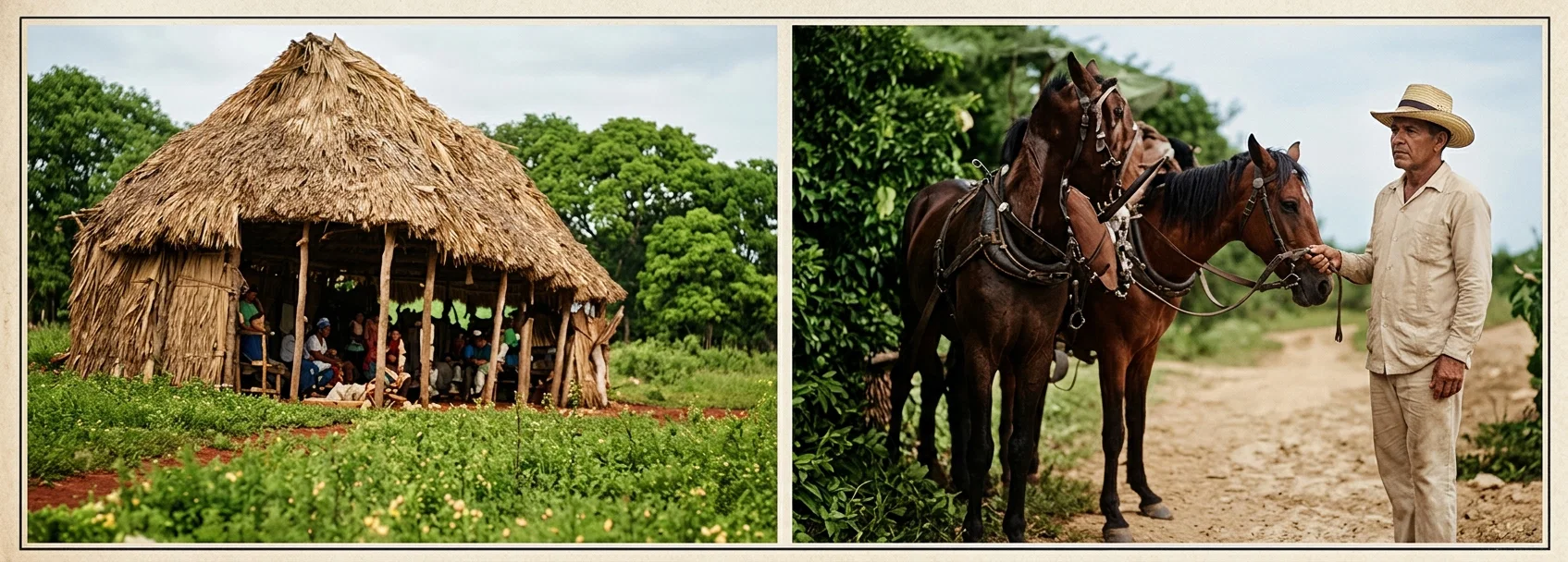
The provinces of Matanzas and Havana are the most prosperous in Cuba, as they have been most largely developed. This is the great sugar district. The cane stands higher and looks richer than any I saw in the lower islands of British Guiana. It was grinding time,—about the first of March,—and armies of laborers were carting the cane to the factories. Some of the large proprietors have built railways over their estates. The engineering work in the sugar factories is very largely in the hands of Americans. When the grinding begins, it is pushed forward day and night to the finish.
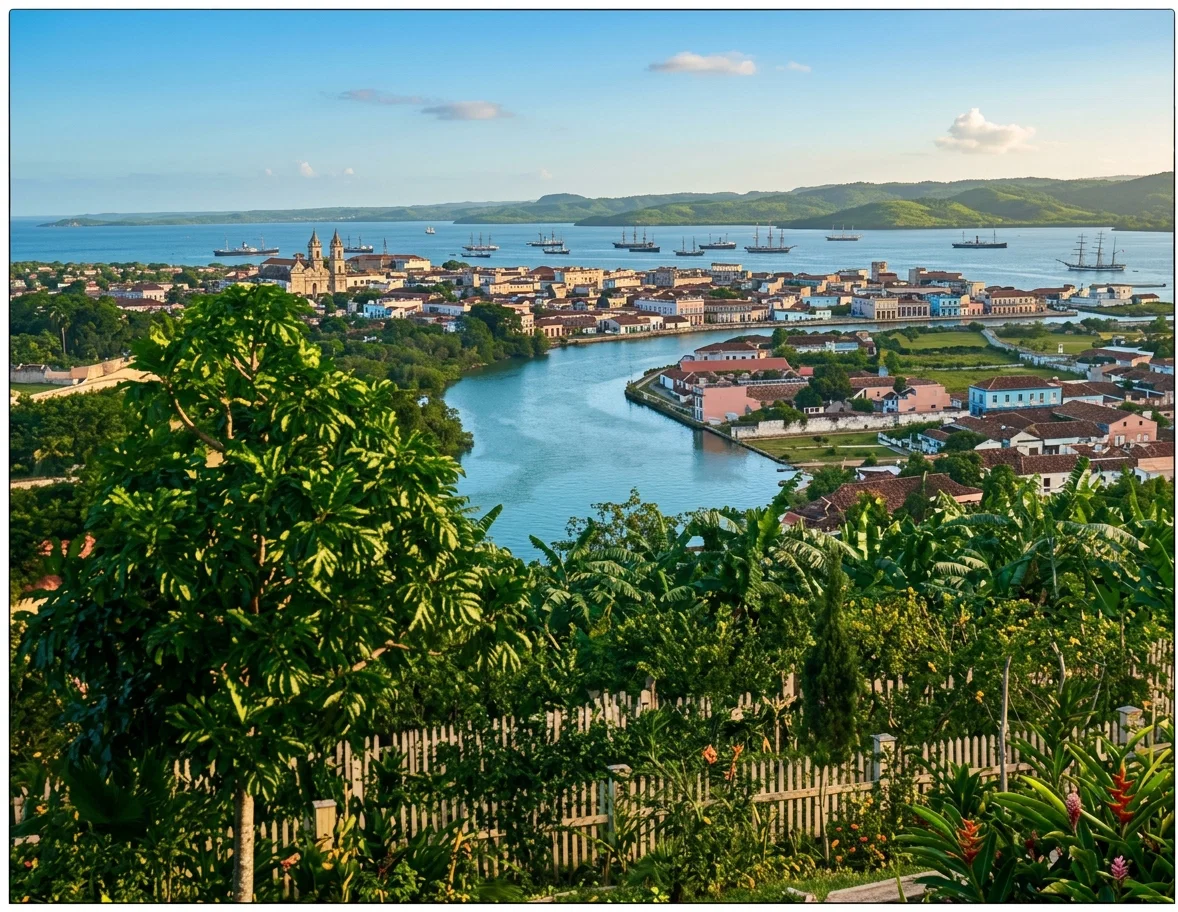
The city of Matanzas, beautifully and healthfully situated on the bay, is next to Havana as a commercial center. Portions of it along the riverside look like a bit of old Venice, the buildings rising directly from the water. The tinted walls and ornamental balconies and pillars would appear gaudy and overdone in America, but under tropical skies it seems perfectly fitting.
The Episcopal Church has long had a mission in Matanzas, and now the Methodists are pushing in successfully with their new missionary program.
Coming in from the east, the Havana railway terminus is at Regla, across the narrow bay from Havana. As one passes down with the crowd to the steam ferry-boat, in waiting for the train, he might easily fancy himself getting into New York from the Jersey City side. We passed close alongside the wreck of the battle-ship “Maine,” which still lifts its tangled mass of ironwork high above the water. Shipping from all the world is anchored in the bay. The population of Havana is about two hundred and forty thousand, and it is the great distributing center for the most populous parts of the country inland. It was carnival week, and Sunday was the high day in the mad revel. The evening was devoted to processions and balls. Grotesque masks and costumes helped the people to act the frivolous parts assigned to all. Next day business was resumed as usual. And Havana is a busy city. The docks are thronged, and the electric street-car system carries immense crowds to and fro. The old business streets are very narrow. In a printing office, on Obispo Street, I saw illustrated one characteristic Cuban institution, the eleven o’clock factory lunch hour. From the proprietor to office boy, all were gathered round the table for the common meal.
Along the water front, on the city side, is the old cathedral, where once Columbus’ dust was allowed a resting place. Here, too, is the old fort built by DeSoto, the conqueror of Florida and discoverer of the Mississippi. Within those walls his wife died, worn out with waiting for his return. Across the bay is the Cabanas fortress, the headquarters of the small Cuban army, and out on the point, facing the open sea, the famous Morro Castle guards the harbor entrance. In the dungeons of this old castle many a life has perished in the days now past, when the banner of Spain, red and yellow—the color of blood and gold—floated from the flagstaff where now the Cuban colors fly.
VIEWS IN CUBA
The Cuban government has made steady progress since the settlement. It has maintained and carried further the15public works inaugurated during the American occupation. For two years now, not a case of yellow fever has developed in Cuba, which once was quarantined against through all the fever season. Millions are being spent in sanitation and roads, and a good school system is growing up. Political factions are getting more sensible, and less inclined to work against the administration in the interests of pet programs. Many American tourists were in Havana. Business men and farmers were there, looking over the country, and nearly all gave good reports.
The pioneer evangelist in Havana is Dr. Diaz, a Baptist, who has labored for his Cuban people over twenty years. His mission headquarters is an old theater refitted as a church, near the main boulevards, and business center. It cost the Baptists about sixty thousand dollars. The troublous war times scattered his flock, but he has now about a thousand members in Havana and outlying parts. He told me that he often had congregations of twenty-five hundred at his quarterly revival services. Again and again, during these years, he has been arrested, and twice he was saved from execution only by the intervention of the United States authorities, inasmuch as he is a citizen of this country.
THE CITY AND HARBOR OF MATANZAS
As illustrating the administration of former times, take the following experience: Dr. Diaz, with three others, had been holding a meeting in a little town near Havana. They were arrested and brought before the local magistrate.
“Well, mister,” said he, turning to one of the preacher’s companions, “what have you been doing up there?”
“I have been reading the Bible,” was the answer given.
“Put him in jail for reading the Bible,” said the mayor.
“Now, sir, what have you been doing?” he said to the other.
“I have been praying and singing.”
“Put him in jail for praying and singing,” commanded the mayor.
“Well,” said he, turning to Dr. Diaz, “what have you been doing?”
“I have been preaching the gospel.”
“Put him in jail for preaching the gospel,” he ordered.
All this is now in the past. The gospel worker may now go freely about. The Methodists have a school in Vertudes Street, just off the Prado, the fashionable drive, with about two hundred children attending. They teach up to the eighth grade. Two Spanish teachers are kept, but some parents do not want their children taught any Spanish studies. They already have the language, of course. The school is mainly conducted in English, and the influence is Protestant and evangelical. It does not quite pay its own way. The Methodists own several houses in the block, for mission purposes, the work being supported by the Southern Methodist body. Congregational and Presbyterian churches in the city have some little mission work in hand, and other churches are also represented. As one worker told me, the people are learning that Protestants are not demons, as Romish teaching has sought to make out.
Only half the population of Cuba can read, and for this class the Havana booksellers supply a very poor article. Most of the literature is imported trash from Barcelona and Madrid, about as bad as it can be. I hope our own Spanish work will soon be producing a small, illustrated, and simple literature in Barcelona. Meanwhile we ought surely to pray the Lord to help us to get into Cuba with the Spanish and English literature that we have. The Lord is laying the burden of Cuba upon some hearts. If finances had permitted it, our Mission Board would surely have had a worker who knows Spanish in that field this summer. But we have to wait, and pray God to arouse us all to understand our times and the urgency of the message. Let us plan to have at least one witness in every unentered land without long delay. It will cost continual sacrifice; but we may pray for it in all assurance; for the Lord’s promise is that we shall quickly carry this message to every nation, and kindred, and tongue, and people. Cuba will not be left out.
Washington, D. C.
Entering Spain
By Frank Bond; Walter Bond
FRANK AND WALTER BOND
AFTER a pleasant journey through France, we reached the Spanish border about two o'clock, June 22. We had no difficulty in passing the Spanish customs, and in an hour's time we were wending our way through the Pyrenees toward Barcelona. Spanish trains are slow; for though it is only about one hundred miles, it took us almost five hours to make the trip.
En route we met a gentleman who was of much assistance to us in getting acquainted. All the better class here are very hospitable, and as a rule will sacrifice hours to accommodate a stranger. When Brother Wilkinson was in Spain, he met a man who seemed to take quite an interest in our work, and before coming here, his address was given me. The day following our arrival I called on him, and have since taken apartments in his home. After making a few inquiries, we engaged him to instruct us in Spanish. A few days later, at his request, we began Bible studies with him. This morning he encouraged our hearts by telling us that he believed the seventh-day Sabbath should be observed. We pray that his heart may be inclined to obey. He has been a minister for about fifteen years, and has taught several years in college. The general education in this country is at a very low ebb. It is estimated on good authority that seventy per cent of the people are unable to read. This, no doubt, will be a very great hindrance to the circulation of our books. And more than this, nearly all the people are very poor. Wages are so extremely small that it is a struggle for the great majority to get the necessaries of life.
Barcelona is considered the most important city of Spain. It has a population of about five hundred and twelve thousand. Hamilcar Barca, a Carthaginian, according to history, founded this city about the year 237 B. C. It has many beautiful drives and walks, but the majority of the streets are not more than ten or fifteen feet in width. The houses are almost all brick, plastered both inside and out, and are generally five or six stories high. The floor and roofs are usually made of brick also. The city is situated on the shore of the Mediterranean, and has a fairly good harbor. Barcelona is the capital of the province of the same name, which is one of the States of the Catalanian district. The common language of this district is very different from the Castilian. However, almost every one can understand and speak some Castilian. The climate16here so far seems quite like that of California.
The needs of the country are overwhelmingly manifest. This country, so long neglected, should surely be given attention. We would gladly accept a collection of Spanish tracts to use in our work here.
Barcelona, Spain.
North Michigan Conference Proceedings
By S. E. Wight; E. A. Bristol
The first annual session of the North Michigan Conference was held at Mancelona, Mich., on the camp-ground, Aug. 27 to Sept. 6, 1903. Nine meetings in all were held.
The treasurer’s and the auditor’s reports were presented, as follows, and adopted by vote:—
Report of Sec. and Treas. of North Michigan Conference of S. D. A., from Oct. 1, 1902, to June 30, 1903.
Church members ................................ 610
Reports returned ................................. 24
Letters written .................................. 66
Bible readings held ........................... 1,224
Letters received .................................. 19
Subscriptions for periodicals .................. 216
Periodicals distributed ...................... 3,483
Pages, books, and tracts distributed ....... 71,804
Fourth Sabbath donation .................. $12 60
Other donations received ................... 388 23
Paid out ....................................... 269 65
Resources
Merchandise inventory .................. $712 95
Cash ........................................... 6 96
Property ..................................... 250 00
Personal accounts ........................ 1,053 59
Petoskey cafe ................................ 453 43
T. & M. accounts ............................ 944 83
Sabbath-schools ................................ 9 42
Total ..................................... $3,431 18
Liabilities, July 1, 1903
First National Bank ........................ $ 3 21
North Michigan Conference .................. 439 24
“Christ’s Object Lessons” .................. 803 71
General fund for conference debt ............ 17 00
Bills payable, hired money .................. 500 00
Personal accounts payable ................... 202 55
T. & M. accounts ................................ 1 50
Unpaid bills for mdse. ...................... 392 64
Stock ........................................ 457 81
Net gain ..................................... 613 52
Total ..................................... $3,431 18
Receipts
Tithe .................................... $4,235 91
West Michigan Conference ................... 775 00
East Michigan Conference ................... 826 39
Donations, etc. ................................ 15 50
Total ..................................... $5,852 80
Disbursements
Labor and traveling expenses ........... $4,604 62
Expenses ................................... 263 67
Lake Union Conference ...................... 327 39
Property ................................... 210 90
Tract society bank .......................... 439 24
In First National Bank ........................ 6 89
Total ..................................... $5,852 80
E. A. BRISTOL,
Sec. and Treas.
This is to certify, That I have examined the books of the Treasurer for the year ending June 30, 1903, and find them correctly kept, and the ledger in balance. The deposits in the banks agree with the amounts demanded by the books of record. W. H. EDWARDS.
The following churches were received into the conference by vote: Alpena, with twelve members; Eastport, with twelve members; Omer, with thirty-one members; Rose City, with ten members.
The Chair was empowered to appoint the committees, and the following persons were named: On Resolutions, J. J. Irwin, C. A. Hansen, and A. J. Olsen; on Credentials and Licenses, W. R. Mathews, M. C. Guild, A. Maples, M. Stephens, and J. O’Reily; on Nominations, C. Wood, T. G. Lewis, J. L. Mann, J. A. Conklin, and F. Strickland.
The following recommendations and resolutions were adopted:—
1. That a Young People’s convention be held on these grounds, September 15-20.
2. That Young People’s Societies be organized in every church where there are young people.
3. That the aim held before the young people be the evangelization of the world in this generation.
4. We recommend that our young people who can not attend our schools be encouraged to take the correspondence course offered by the college at Berrien Springs.
5. That inasmuch as the Lord has given us light on missionary canvassing, it ever be held before our people, and that a special effort be made among our churches to circulate our small books this fall.
6. That the General Conference Association debt of $1,315.44, plus the interest ($65.77) for 1902, be apportioned among the churches, to be paid in four semiannual payments.
7. That the camp-meeting fund for 1904 be apportioned among the churches, to be paid in two semiannual payments, beginning with this year.
8. That our brethren be encouraged to cultivate portions of land, the proceeds of which to be used in the support of our church schools.
9. That the constitution be changed so as to have one delegate to each ten members, instead of fifteen.
10. That an investigation of our church records be made, and if satisfactory information concerning our absent members can not be obtained within one year, their names be dropped from the list.
11. That the title of canvassing agent be changed to field secretary.
12. That our people be encouraged to use the “Hymns and Tunes” in our meetings.
13. That all surplus money on hand belonging to Sabbath-schools be donated to missions, and that our Sabbath-schools set apart the donations of one or more Sabbaths in each quarter for the running expenses of the school, and that all the contributions of the remaining Sabbaths be given to missions.
It is understood that this does not affect the present plan of giving the Orphans’ Home two yearly donations.
14. That the committee be instructed to secure twenty tents for the next season.
The following officers were elected for the ensuing year: President, S. E. Wight; the Secretary and the Treasurer of the tract society and conference were left for the conference committee to choose; Sabbath-school and Educational Secretary, J. J. Irwin; Field Secretary to be left to the conference committee to17choose, or not to choose, as they think best; Executive Committee, S. E. Wight, W. R. Mathews, M. C. Guild, J. J. Irwin, Andrew Maples.
Ministerial credentials were given to S. E. Wight, W. R. Mathews, M. C. Guild, J. J. Irwin, C. Wood, C. A. Hansen; ministerial licenses to T. G. Lewis, E. A. Bristol; missionary licenses to A. J. Olsen, Mrs. M. M. Faulkner, E. Jennie Lane, Ethel Peters, Nellie Clough; canvassers’ licenses to S. Midgley, A. M. Byers, Bert Lewis, Frank Fenner, Fred Hoxie; church-school teachers’ licenses to Mabel Griffin, Nona Carr, Zona Carr, Mrs. C. J. Tolf, William Fenner, Kate Gudme.
The following recommendations were adopted at the Young People’s convention:—
1. That a Young People’s Society be formed where there are two or more young people who love Jesus and desire to associate for prayer and service for God.
2. That our young people take up the studies given in the Youth’s Instructor for Young People’s Societies.
3. That the young people of the North Michigan Conference undertake the raising of necessary funds to establish an industrial school in the conference.
4. That the offerings of the Young People’s Societies be paid to the conference treasurer once a month, and by him kept separate for the special work of the preceding resolution.
5. That the conference workers use their influence for the establishment of Young People’s Societies throughout the conference.
S. E. WIGHT, President,
E. A. BRISTOL, Secretary.
Worship of Heaven and Earth in China
The worship of heaven and earth is universal throughout China, and the officials all over the empire are obliged to conduct this worship. In the southern part of the city of Peking there is an altar to heaven, where it is the duty of the emperor to come annually to worship. He sometimes delegates this duty to a high official.
King Khama’s Simple Christian Counsel
On one of King Khama’s trips to Cape Town, South Africa, he was urged to make an address at a missionary meeting. The story is told that he refused at first, as he was not a public speaker, but on being urged, he finally yielded, and this is what he said: “I am going to Cape Town because the high commissioner has sent for me. I do not know what he wants, but I obey his summons. So you must obey the words of Jesus Christ.” An exchange, commenting on this, says: “How simple, yet how great, how thoroughly Christian!”
The Bible Alone in the Arctic
A MISSIONARY of the Church Missionary Society of England relates an experience which illustrates the power of the Bible alone, without comment or explanation. Having penetrated to a place called Rivetok, two hundred miles within the arctic circle, he found the Eskimos ready to hear him, and attentive to the Word. On inquiry it developed that seven years before a woman from the little village had visited a mission station, where she learned to read. She carried home with her a few Scripture portions, sharing her knowledge with her fellow villagers, and thus instilling into them a desire for a greater knowledge of the Word.
Mission Notes
AN eminent German statistician is authority for the statement that there are three thousand and sixty-four languages and dialects in the world, and its inhabitants profess more than one thousand religions.
Christian Silk Factory in Japan
A SILK factory in Japan conducted by native Christians has proved a great blessing to its employees. They not only enjoy a day of rest with Christian services, but have the privilege of a daily morning and evening devotional hour.
Hindu Tract Against Christianity
JACOB CHAMBERLAIN, missionary to India, tells of a tract which has been circulated everywhere, warning the people of the increasing influence of the Christian religion, and urging the importance of their taking immediate action toward its suppression. It was addressed to the Hindus.
The Maine Camp-Meeting
By H. W. Cottrell
The Maine camp-meeting was held in connection with the annual session of the conference, at Deering, a suburb of Portland.
There were about two hundred and fifty of our people in attendance, or nearly one half of the denominational constituency in the conference. The camp was located in an open field, where the warmth of the sun was appreciated by the people the greater portion of the time.
The interests of the various departments of the work—Sabbath-school, canvassing, medical, and educational—were all considered in their turn, and plans were laid for their more rapid development.
In addition to the laborers of the conference, there were present all, or a portion of the time, Elders Daniells, Franke, and Griggs, and the writer, also Dr. Nicola and Brother E. R. Palmer. The efforts of these brethren were highly appreciated by those in attendance. The truth due the world and the church of to-day, was clearly set before the people. Elder Daniells took special pains to place before our people some of the evidences of the Lord's directing hand in the removal of the headquarters of our work from Battle Creek to Washington, D. C. The people were anxious to learn these facts, and contributed liberally toward the establishment of that work.
They continued the support of a teacher in the union conference academy, which is very highly appreciated by us.
While the meetings were all good, the Lord seemed especially near to us the last Sabbath. It was manifest to all present that the Spirit of the Lord was there, and was doing a deep but quiet work in the hearts of many. It was a solemn occasion, and by many will never be forgotten. After the special effort was made for the unconverted and discouraged ones, almost the whole congregation renewed their consecration to God for actual service for him in the advancement of the work of the third angel's message. May this be an epoch in the finishing of the work in this generation.
Elder P. F. Bicknell was re-elected president of the conference, and Sister E. H. Morton was again chosen secretary and treasurer.
H. W. COTTRELL.
The Work in the Cumberland Conference
By O. C. Godsmark
WE are thankful to say that the blessing of the Lord has rested upon the work in the Southern field during the past year. The Cumberland Conference comprises the eastern two thirds of Kentucky and the eastern half of Tennessee. We have within our borders not only the wealth, learning, and intelligence of some of the largest cities and seats of education in the South, but also the dense ignorance, the family feuds, and illicit distilleries of the mountain regions.
The population is largely white, though we have within our borders many of the unfortunate colored race, whose needs are ever appealing to us, and whose claims we can in no wise ignore.
As a conference, we are looking largely to the needs of the colored race, and not only is considerable being done for that people, but we feel that the prospects for the future were never brighter than they now are. Perplexing as this color question is to all our conferences in the South, yet it does not present to us the still more difficult problem that the work for our poor whites in the mountain districts does.
Nestling in the very shadow of, and surrounded by, the mountainous districts, lies the wealthy and aristocratic blue-grass region of eastern Kentucky, where is still to be found the most perfect type of the aristocracy of ante-bellum days.
With all this diversity of conditions,—social, mental, and geographical,—this conference becomes at once one of the most interesting fields in the South.
This past year has been one of marked prosperity in the cause of present truth; our brethren have come forward nobly with their tithes and offerings, and have thus enabled the committee to push forward the work in a way that has been gratifying to all. Not only in tithes and offerings have the brethren been faithful, but we know their prayers and sympathies have also gone with us, and have been an encouragement to our brethren in the field.
It was decided to purchase another tent, so we have had two tents in the field, and toward the latter part of the summer a third one for our colored people, which has been managed by laborers of their own race.
Early in July a camp-meeting was held at Lexington for our people in eastern Kentucky, which was indeed a great blessing to them, and a source of much encouragement. This was a small meeting, but it was a beginning, and another year we expect a much larger attendance from our people in this part of the conference.
The latter part of August our camp-meeting for the benefit of believers in eastern Tennessee was held in Chattanooga, and was by far, the largest gathering ever held by our people in the South. At the same time a separate camp-meeting was held in another part of the city for our colored people. Both meetings were indeed a success, and another year we shall know much better how to plan for our colored work.
Since the close of these meetings, Brethren G. W. Wells and W. C. Wales, assisted by Brother J. W. Franklin, have been following up the interest with a tent effort. Brother J. F. Brice, our colored minister, has also followed up the interest created by the camp-meeting for his people. In both of the efforts, the Lord has blessed by bringing souls to the knowledge of the truth.
In eastern Kentucky Brother and Sister E. L. Sanford, with Brother J. W. Stein, assisted by Sister Maud Dortch, have been engaged in the tent effort at Winchester, Brother Stein having spent some time in the mountains near Moberly, while the others had also been doing successful work in Lexington. In Louisville Mrs. O. C. Godsmark has been carrying on, for some time, successful Bible work, while Sister L. Whitman has been devoting her time to the interests of the colored work. Brother E. W. Carey has also been located there in connection with the tract society office.
Our conference church school at Graysville is being taught by Brother Lewen A. Jacobs and Sister Minnie Hildebrand, and the one at Cleveland by Sister Clara L. Jacobs. These schools are both starting out well, and are doing excellent work. We expect soon to open a school at Sanford, where there is a prospect of a good school.
The canvassing work in our conference, under the careful management and encouragement of Brother V. O. Cole, has had a most successful year. Our canvassers are doing well, and indeed they should; for it is well known that this conference has within its borders the best canvassing territory of any to be found in the United States; and we expect to see this work come up on a still higher plain.
We are fortunately situated by having among us the Southern Training School at Graysville, and also the Lone Mountain Sanitarium. We feel very near to these institutions, and can only pray God that their management may be such that his blessing can rest upon them. Many students have gone out from this school to engage in the Lord's work; and the sanitarium, though struggling in its infancy, has been a blessing to this part of the field.
We ask an interest in the prayers of our brethren for the work here in this Southern field. O. C. GODSMARK, President of Cumberland Conference.
Scotland
By Alexander Ritchie
It is only three months since my wife and I landed in the town of Kirkcaldy. The same evening I preached my first sermon in the first tent set up in Scotland to proclaim the third angel’s message. Since that time we have had various experiences. A bitter attack was made upon our work, and especially upon Sister White, by the so-called Disciples,18Church of Christ. But by their bitter hatred and false teachings, they have plainly showed themselves to be of “the synagogue of Satan.”
There is a great deal of rain in Scotland, and some thought that it would be impossible to hold tent-meetings; but from the first, we have had excellent meetings, and the attendance has been good. More than once, scores have been unable to gain admission to the tent, and have stood outside and listened to the sermon.
We have carried on the tent work alone, with the exception of help one night a week from Elder Westworth, the superintendent of the Scottish mission field. But the dear canvassers, both brethren and sisters, have stood by nobly, helping to the utmost of their ability, and for their willing help and co-operation we most heartily thank the Lord. I never knew a place so stirred by the message as this place is. Everywhere, in the workshops and factories, in the churches and on the streets, people are discussing the Sabbath question. The newspapers have given liberal space to reports of our meetings, and have printed the arguments on both sides.
A number left the Disciples, and joined us. This stirred the dragon’s wrath, and they sent away for a man to come and oppose us. He challenged us to debate; I declined because of what the Lord has said on this point in the Testimonies. But we offered them our tent for one night to state their side of the question. This drew a large crowd. Our challenger started out by defaming us, and especially Sister White. The majority of the people were thoroughly disgusted. He closed his argument by challenging us to prove: first, that there were two distinct laws in the Bible; second, that the law was kept between creation and Moses; third, that the Sabbath was kept for three hundred years after Christ, before the first day of the week was observed as a Sabbath.
We found it easy to prove these three points, and prepared special charts presenting the Scriptural and historical proofs. Three evenings were spent in the consideration of these topics, and the large audience declared the points fully proved.
This attack upon the truth has increased the interest greatly. “Surely the wrath of man shall praise thee.” I have sold over twenty of Sister White’s small books. Up to the present (September 19), twenty-four persons have taken their stand on the side of truth, and are keeping the Sabbath of the Lord.
We have a Sabbath-school of twenty-four members, and our Sabbath meetings are attended by thirty or forty persons. The people have given liberally to help our work. The donations for three months amount to more than one hundred and thirteen dollars.
We praise the Lord for his prospering hand with us, and we know it is only by his blessing and the co-operation of holy angels that we have been able to accomplish anything. The Lord has given us a beautiful flock. They rejoice in the truth. We have presented the Scriptural teaching on the spirit of prophecy and tithing, and it was well received.
The climate of this country agrees with us, and we are both in fairly good health. Mrs. Ritchie is busily engaged in Bible work. If any of our friends in America would like to help us in our work, and have a share in bringing the truth to these dear Scotch people, they can not do better than to send us some tracts on the Sabbath and the second coming of Christ. Some of the little Words of Truth, tract No. 23, entitled “The Rest Day,” would be very suitable, also “Who Changed the Sabbath?” “Seal of God,” etc. We also ask the brethren and sisters in America to pray for us and the Lord’s work in this field.
ALEXANDER RITCHIE.
Kirkcaldy, Scotland.
Mississippi
By H. G. Thurston
September 8 we left Fresno, Cal., for Vicksburg, Miss. We found lodging in the hospitable home of Brother F. R. Rogers, who for several years has labored faithfully in the Southern field. His wife, also a competent teacher, has stood nobly by his side through persecutions and hardships. God has blessed their work, and has shown them many tokens of his constant and loving care. They have been closely associated with the Southern Missionary Society, which has already accomplished a grand work in Mississippi.
In this State, with more than one and one-half million human souls, there is a great work to be done. As yet there are but three organized churches, six companies, and some scattered Sabbath-keepers within the territory.
On account of the color line the expense of carrying on aggressive work is about twice as much as in most conferences, two tents and two companies of workers being necessary; and where companies are brought out, and schools established, it requires two schoolhouses, with teachers for each, and two church buildings. As much as some may wish otherwise, the color line must be observed by the workers, or their influence is gone. Before coming to Mississippi, we could not appreciate this as we do now. But notwithstanding all the difficulties, and the peculiar conditions, God is moving upon hearts; and we confidently expect a bountiful harvest of souls in the near future.
Several schools have been established, one of which is an intermediate school. The last mentioned was really started as a result of the donation of the citizens of Quitman, a small place in eastern Mississippi. One hundred and sixty acres of land and nearly five hundred dollars were given, and our brethren felt this to be an indication that a school should be started. A schoolhouse was built last year, and now a dormitory to accommodate about twenty students is being put up. After the donation of the people had been accepted, the only thing to do in order to show good faith on our part was to go ahead and build. Although money among the believers in Mississippi is scarce, yet hearts outside the conference are being touched, and so help comes. If the people of our strong conferences and churches could see the situation in the South, help would be sent, that with great haste the work might go forward. Any of our people who wish to assist a worthy enterprise in a needy field will please remember the Eshcol industrial school of Mississippi.
This field needs some faithful and efficient men to join those already here. The field is open, and has scarcely been touched. It is but the next-door neighbor to our strongest conferences, and do not the needs of millions of darkened souls appeal most touchingly for help? If workers are sent and supported by our sister conferences, will it be a hindrance to the home work, or a blessing both at home and abroad? Those who come must be men and women willing to sacrifice. They must expect to find inconveniences. They must expect to find a harder field than they leave; but they will find many honest souls who desire to learn. They will have some sweet experiences, and will be able to comprehend the sacrifice of Jesus as never before. Come, brother preachers, and help us—you who can endure hardness as good soldiers of Jesus Christ. We wish to see some strong white churches raised up. If our older conferences will send us men, and support them for a year or two, we may expect to see, in the near future, a good, strong conference where but a small beginning has been made.
There is also an excellent opportunity for canvassers, and there should be at least fifty in the State of Mississippi. The worker who must have conveniences and luxuries may be disappointed. Let workers come because the field is needy—and yet so near, just over the fence as it were. Let men come who will not be discouraged, men who have faith in God19and his message to mankind. Such men can do an excellent work canvassing in Mississippi. Such will succeed, and win stars in their crowns of rejoicing. Any one whom God shall impress to enter this field, or who may desire any information which we can give, will receive a prompt reply to any questions asked.
In closing, we might add, land is very cheap, good land selling in many places for a few dollars an acre. Lumber is also cheap, and country produce high. Rents in the cities are high.