Your ShelfYour Projects

Signs of the Times, Vol. 24, No. 45.

RUTH AND NAOMI

Signs of the Times

Nov 10, 1898

Pacific Press Publishing Company · Oakland, California · Nov 10, 1898

RUTH AND NAOMI.
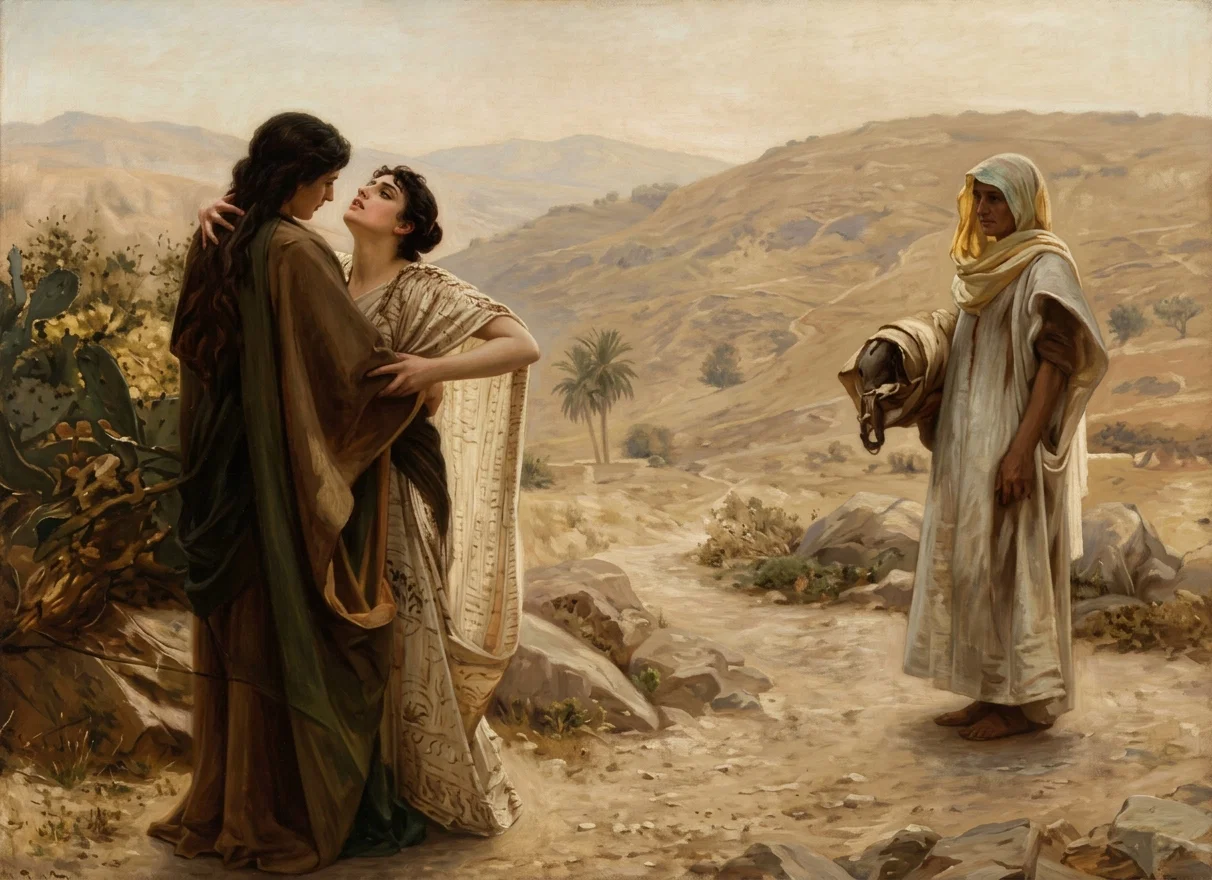
TRUTH, oftentimes, is stranger than fiction, and in many life histories is seen more real romance than is depicted by the pen of the imaginative novelist. Thus it is in the beautiful story of Ruth and Naomi.
“And Ruth said, Intreat me not to leave thee, or to return from following after thee; for whither thou goest, I will go; and where thou lodgest, I will lodge; thy people shall be my people, and thy God my God.” Ruth 1:16.
The recital begins at the little town of Bethlehem, the birthplace of our Lord, in the land of Judah. There is a severe famine in the land. A man by the name of Elimelech, with his wife, Naomi, and their two sons, Mahlon and Chilion, emigrate to the land of Moab, to the southeast of Judah, there to find sustenance. Sometime during this sojourn, probably in the early part, Elimelech dies. The two sons unite their life interests with two Moabitess women, Chilion, the younger, marrying Orpah, and Mahlon wedding Ruth, the chief and central figure in the narrative.
Shortly after the death of the father, the head of the household, the two sons likewise die, and Orpah and Ruth are left widows, together with their aged mother-in-law. Upon Naomi the bereavement comes as a threefold portion. In the death of her husband she had still the comfort of children as her support; but now, with all gone, no wonder that her broken heart turns with longing to her early home, to find in association with her old-time friends the comfort denied by the land and friends of her adoption.
Weeping for the last time over the tombs of her loved ones, with sorrowful heart she turns her face toward the western hills of Judah.
Shall she go alone? In the minds of Orpah and Ruth there is a question as to what is their duty to their aged mother, to whom they have become so greatly endeared by association and by their mutual afflictions. Can they leave their own blood relatives, their home, the gods of their fathers, and enter a strange land? Naomi, even in her great sense of loneliness, shows the unselfishness of her heart, softened and made tender by sorrow. She fears that if her daughters accompany her to the land of Israel, they will regret the step. With her larger experience, she counts the cost, the trial and hardship before them, and she tests their love by presenting to them the fact that there is no temporal advantage to be gained by them in husband or possessions. Orpah hesitates. She has been moved by feeling and sentiment, and not by genuine love and depth of principle; but Ruth has counted the cost; she will renounce her gods, her home, her friends, her all, and henceforth serve only the God of Naomi.
Orpah kissed her mother-in-law, and turned back again to the plains of Moab; “but Ruth clave unto her.” Again Ruth’s loyalty and strength of purpose are tested. “Behold,” says Naomi, “thy sister-in-law is gone back unto her people, and unto her gods; return thou after thy sister-in-law.” But Ruth said: “Entreat me not to leave thee, or to return from following after thee; for whither thou goest, I willlodge; thy people shall be my people, and thy God my God; where thou diest, will I die, and there will I be buried; the Lord do so to me, and more also, if aught but death part thee and me.”
Noble answer, showing strength of purpose, depth of devotion, and unswerving friendship. When Naomi “saw that she was steadfastly minded to go with her, then she left speaking unto her.” It can not be understood that Naomi was indifferent to the companionship of Ruth. In her sore perplexity and loneliness, she must certainly have appreciated such association; but she would guard Ruth against the disappointments of the future by so sifting her purpose as to demonstrate its real strength and its actuating motive.
The return of Naomi to her native town was an occasion for considerable stir and excitement. “All the city was moved about them, and they said, Is this Naomi?” The depth of her sorrow is indicated by her answer: “Call me not Naomi [that is pleasant], call me Mara [that is bitter]; for the Almighty hath dealt very bitterly with me.” It was evidently not the lack of faith that prompted this expression, but the oppressive, bitter sorrow of the soul which uttered itself in this lament.
The reduced circumstances of Naomi and Ruth required that immediate efforts be put forth to gain a livelihood; for the inheritance at one time possessed by the family of Elimelech must have passed to the hands of others, and thus Naomi was penniless in her own land.
The character of Ruth is again manifested in this experience. She goes into the harvest-field of a wealthy man named Boaz, to glean behind his reapers. In this occupation her discreet, modest demeanor, her filial affection for Naomi in supporting her by daily toil, became the subject of general and favorable comment, and all the people came to regard her as a young woman of virtue and uncommon worth. Boaz takes notice of her spirit, and instructs the reapers to favor her efforts at gleaning; he also takes pains to provide for her temporal necessities, by directing her to share the common meal, eating and drinking with his other maidens. And Boaz said unto her; “It hath fully been showed me, all that thou hast done unto thy mother-in-law since the death of thine husband; and how thou hast left thy father and thy mother, and the land of thy nativity, and art come unto a people which thou knewest not heretofore. The Lord recompense thy work, and a full reward be given thee of the Lord God of Israel, under whose wings thou art come to trust.”
That these comforting words of Boaz were not prompted by selfish motives is indicated by his relation as an employer to all engaged in his service. When he came from Bethlehem into his field, his salutation to the reapers was, “The Lord be with you,” and they answered, “The Lord bless thee.” A different relationship and a different feeling, truly, than ordinarily exist between employer and employee, especially in our own day, when the the prophecy of God indicates, and the facts prove, that the laborer is ground down by the men of power and wealth. What a lesson this kindly Christian courtesy, existing between Boaz and his reapers, furnishes!
Ruth soon learns from Naomi that Boaz is a near kinsman to her deceased husband. Naomi soon afterward proposes a plan to Ruth whereby she is to acquaint her employer of this fact, and learn from him if it is his purpose to fulfil the part of a kinsman toward her. The purpose of Boaz to do this had evidently not passed his mind; for he assures Ruth of his intentions according to the custom of the Israelites, to take her for his wife, purchasing back the inheritance of Chilion and Mahlon. But the priority of this privilege belongs to another kinsman who is of closer relationship to the family of Elimelech than is Boaz, and this right Boaz first accords to him. He refuses, and the way is opened for Boaz to make Ruth, the Moabitess, his wife.
“And Boaz said unto the elders, and unto all the people, Ye are witnesses this day, that I have bought all that was Elimelech’s, and all that was Chilion’s and Mahlon’s, of the hand of Naomi. Moreover Ruth the Moabitess, the wife of Mahlon, have I purchased to be my wife, to raise up the name of the dead upon his inheritance, that the name of the dead be not cut off from among his brethren, and from the gate of his place; ye are witnesses this day. And all the people that were in the gate, and the elders, said, We are witnesses. The Lord make the woman that is come into thine house like Rachel and like Leah, which two did build the house of Israel; and do thou worthily in Ephratah, and be famous in Bethlehem; and let thy house be like the house of Pharez, whom Tamar bare unto Judah, of the seed which the Lord shall give thee of this young woman. So Boaz took Ruth, and she was his wife.”
It is interesting to note in this connection that from this union sprang Obed, who was the father of Jesse and the grandfather of David, and of this line came Christ, the Saviour of men.
This is the story of the book of Ruth. Many are the lessons of practical value which may be gleaned from its perusal. The devotion of Ruth to Naomi, the mother of her husband, at this time an old woman, whose life had been saddened by sorrow, is indeed commendable.
Her purpose to accompany her mother-in-law to her own land, to labor and toil with her, and to care for her until she died, shows indeed the depth of a daughter’s true love. And all this, together with her subsequent decorous, modest conduct, makes her an illustrious example of decorum to every young woman in every age.
The influences of evil to-day are rapidly lessening the regard of the young for the aged and the infirm, and even for their own parents. With many of the young the practical duties of life are becoming positively distasteful. It is considered the prerogative of the father and mother to toil and labor, and the privilege of the child to spend freely the harvest of the toil.
The daughters may learn to play, to sketch, to do fancy work, to entertain callers; but, as many regard it, to the mother belongs the toil, the care, and the anxiety of the household duties. Nor are the children alone responsible for this estimate of the relative position of parent and child as held by many in the world to-day. While the parent has sought to give the child an education as pertaining to books, the practical work which should have been connected with the theoretical has been strangely neglected. They have failed to teach their children that physical labor was a Godsend instead of a curse, and that all kinds of honest occupations are honorable.
The reward received by Ruth in forsaking the gods of Moab, and turning to worship the true God, proved a justification of her practical faith. He who waits to engage in God’s service until some promise of temporal gain presents itself, is inspired at best only by selfish motives; but he who steps upon God’s naked promises demonstrates the loyalty of his love and the sincerity of his purpose; and, altho to that man there may appear many obstacles, and the road may seem dark before him, the end of the road will be lightened by the glory of God’s precious presence and the sunshine of His favoring grace. F. M. WILCOX.

THE CONVERSION OF PAUL.

In the conversion of Paul are given important principles which we should ever bear in mind. Many have received the idea that they are responsible to Christ alone for their light and experience, independent of His acknowledged followers in the world. But Christ’s manner of dealing with Saul at his conversion shows this to be an error.
Saul had reasoned that the believers in Christ were ignorant and poor; that they were possessed of little intellectual culture, and were lacking in the high moral endowments which would enable them to succeed in difficult enterprises. He claimed that they were sustained by no special authority. But God, who looks into the tiny seed which He Himself has formed, and sees wrapped within it the beautiful flower, the shrub, or the lofty, wide-spreading tree, saw the ignorance of Saul in regard to the mission and work of Christ. He saw that he was conscientiously bigoted; that he was blinded in his misunderstanding of Christ and of His followers; that he needed another kind of education.
Saul had an abundance of energy and zeal to work out an erroneous faith in persecuting the saints of God, confining them in prisons, and putting them to death. His hand did not do the work of murder; but he had a voice in the decisions, and zealously sustained them. He prepared the way, and gave the believers of the Gospel into the hands that took their lives.
In doing this work Saul honestly thought he was prosecuting an ignorant, fanatical sect. He did not realize that he himself was the deluded and deceived one, and that he was ignorantly following the banner of the prince of darkness. “Yet breathing out threatenings and slaughter” against the disciples of the Lord, Saul appealed, not to the lower, ignorant class, but to the highest religionists in the world, the men who had acted a part in putting Christ to death, who possessed the spirit and sentiment of Caiaphas and his confederacy. If, thought Saul, these great men had religious, determined helpers, they would certainly put down this little handful of fanatical men. So to the high priest Saul went, “and desired of him letters to Damascus to the synagogs, that if he found any of this way, whether they were men or women, he might bring them bound unto Jerusalem.” In reference to this zeal Paul himself says that he was “exceedingly mad against them.” “I persecuted this way unto the death, binding and delivering into prisons both men and women.”
But the miraculous revelation of Christ brought light into the darkened chambers of Saul’s mind. Jesus of Nazareth, against whom he was arrayed, was revealed to him as the Redeemer of the world. Then Paul saw his mistaken zeal, and cried out, “Lord, what wilt Thou have me to do?” Jesus did not there and then tell him, as He might have done, the work that He had assigned him. Paul was to receive instruction in the Christian faith, and move understandingly; and Christ sent him to learn of the disciples whom he had been so bitterly persecuting. The very men he had been purposing to destroy were to be his instructors in the religion he had despised and persecuted.
The light of heavenly illumination had taken away Paul’s eyesight, and Jesus, the great Healer of the blind, did not immediately restore it. To the question of Paul He said, “Arise, and go into the city, and it shall be told thee what thou must do.” Jesus could not only have healed Paul of his blindness, but He could have forgiven his sins and told him hisduty. From Christ all power and mercies were to flow, but He did not give Paul, in his conversion to truth, an experience independent of the church recently organized upon the earth.
Saul having been directed to go to Damascus, was led thither by the men who had accompanied him to help bring the disciples bound to Jerusalem. At Damascus he tarried with Judas, devoting the time to fasting and prayer. Here his faith was tested. For three days he was in darkness of mind in regard to what was required of him; and for three days he was without sight. In his uncertainty he cried earnestly to God. His pride was gone. A little before he had been self-confident, thinking he was engaged in a good work, for which he would receive a reward; but all was now changed. He was humbled to the dust in penitence and shame. His supplications for pardon were fervent.
Then an angel was sent to Ananias, directing him to go to the house where Paul was praying. The angel informed the servant of God that Saul had seen in a vision a man named Ananias coming in and putting his hand upon him, that he might receive his sight. “Go thy way,” said the angel, speaking in the name of Christ; “for he is a chosen vessel unto Me, to bear My name before Gentiles, and kings, and the children of Israel.”
Ananias obeyed the direction of the angel. Upon the man so recently filled with hatred toward the disciples he laid his hands, saying, “Brother Saul, the Lord, even Jesus, that appeared unto thee in the way as thou camest, hath sent me, that thou mightest receive thy sight, and be filled with the Holy Ghost. And immediately there fell from his eyes as it had been scales; and he received sight forthwith, and arose, and was baptized.”
Jesus might have done all this for Paul directly, but this was not His plan. Paul had something to do in the way of confession to the men whose destruction he had premeditated. Paul was to take the steps necessary in conversion. He was to unite himself to the people whom he had persecuted for their religion; and God had a responsible work for His servants to do in His stead.
Christ here gives all His people an example of the manner of His working for the salvation of men. The Son of God identifies Himself with His organized church. His blessings are to come through the agencies He has ordained, and He desires men to connect themselves with this channel of blessing.
The light and power and glory that had arrested Paul at his conversion did not cease its operations upon him after he was converted to believe in Christ as the first and the last, the Alpha and the Omega. He became an effectual missionary worker. He proclaimed the truth as it is in Jesus. He was a clear, eloquent speaker, and could meet his adversaries on almost any ground on which they chose to approach him. He met every class of people, from men of renown to the heathen idolaters, setting before them the evidences of Christianity. His religion came from God, and no power on earth could extinguish the light of Heaven.
Listen to the testimony of the persecutor, after his conversion. Addressing the church in Galatia he said: “I marvel that ye are so soon removed from Him that called you into the grace of Christ unto another gospel; which is not another; but there be some that trouble you, and would pervert the Gospel of Christ. But tho we, or an angel from heaven, preach any other gospel unto you than that which we have preached unto you, let him be accursed. . . . For do I now persuade men, or God? or do I seek to please men? for if I yet pleased men, I should not be the servant of Christ. But I certify you, brethren, that the Gospel which was preached of me is not after man. For I neither received it of man, neither was I taught it, but by the revelation of Jesus Christ.”
MRS. E. G. WHITE.

THE DECALOGUE.

Second Commandment.

“Thou shalt not make unto thee any graven image, or any likeness of anything that is in heaven above, or that is in the earth beneath, or that is in the water under the earth; thou shalt not bow down thyself to them, nor serve them; for I the Lord thy God am a jealous God, visiting the iniquity of the fathers upon the children unto the third and fourth generation of them that hate Me; and showing mercy unto thousands of them that love Me, and keep My commandments.” Ex. 20: 4-6.
In this commandment God gives His children a warning against taking the first step away from Himself, and tells us what the result will be if we depart from Him.
Very early in the history of our race men departed from God and worshiped the material things of earth. In about sixteen hundred years from the time that Adam was created, according to our English Bible, God destroyed the inhabitants of the world by a flood, because of their great wickedness. Had they always worshiped the invisible God, they would not have been destroyed. Since the flood we have frequent mention of idolatry in the Bible. Egypt was an idolatrous nation long before the children of Israel went to sojourn in that country. The Egyptians worshiped domestic animals and various other visible objects. When Aaron made a golden calf to worship, he was but perpetuating the idolatrous Egyptian worship of Apis. Ex. 32: 22-24. But what has been the effect of idolatry upon the world?—To-day less than one-fourth of its population worship the true God, or even profess to worship Him.
When man has formed a graven image, what has he in reality done?—He has simply put his own thoughts into tangible form so that he can see them. The worship, then, which he renders to that thing is self-worship. This could in no way be acceptable to the true God.
Again, when man makes an idol and bows down to it, he is bowing to a thing that is not equal to himself either in strength or wisdom. He would because of this soon be led to consider himself equal to, or even greater than, the God he worships. So Satan would have him believe; for Satan was cast out of heaven for considering himself equal with God, when he was not. Self-exaltation is one of the things God warns us against in the second commandment.
The intelligent Catholic will tell you that he does not worship the image that is before him, but that the image is there to remind him of the object he worships, adores, or whose aid he seeks; but even this is forbidden by the Lord. “Thou shalt not bow down thyself to them.” Bowing to an idol, or in its presence, is just as truly a violation of the law as to serve or worship it; both are forbidden.
As God is invisible, it is wholly inconsistent to connect with His worship a visible object of any kind; for the invisible God is greater than any visible thing which He has created, and to bow down before the created thing would soon lead us to place the less before the greater. Like begets like; therefore God well knew that man would become like that which was continually before his mind in worship. If he worships the invisible God, he will become like Him in character so far as he is able to understand that character; for by beholding we are “changed into the same image.” 2 Cor. 3: 18.
God says of those who go into idolatry that He will visit their iniquities upon them from father to son unto the third and fourth generation. Can we believe that God will work a miracle upon each individual of all these millions of idolaters, in order to punish them for their idolatry?—No; He visits their iniquities upon them by natural law. God has established in the nature of man certain laws, which, when violated, bring their sure result,—physical weakness. It is a well-established fact in medical science that the physical weaknesses of the father may appear in his children to the third and fourth generation.
But is it true that idolatry has led to physical degeneracy?—Certainly it is. The medical missionaries who have been sent into heathen countries are witnesses to this fact. In how many cases is it necessary first to heal the bodies of the people before we can teach them of the great Healer, who is able to heal the soul! All this is because by false systems of worship men have been led to violate, not only the moral law, but the law of God which has been written upon every muscle, bone, and nerve of their bodies. Paul, writing to the church at Rome, brings this clearly to view. Rom. 1: 21-27.
But this is only one phase of this great question. What would have been the result if all men had obeyed the second commandment of God’s law?—All men would have sought for the highest degree of physical culture to which they were able to attain in this mortal life. Being obedient to God’s moral law, they would also have been obedient to the laws He has written in their physical frame; for they would have understood that the better condition theywere in physically, the stronger they would be mentally and morally, and the better service they would be able to render to God. In the second commandment, then, we find a sure foundation for all health and temperance principles.
We can now understand why it is that, as God leads His people back to the keeping of His commandments, He will lead them to try to take proper care of their bodies, that they may be strong physically to work for Him. The man who knowingly violates natural law is knowingly violating the law of God. It is not God’s will that any of His servants should be sick; and when they learn to know His commandments and keep them, they will be full of health and vigor, and able to glorify God in their bodies, which are His. 1 Cor. 6: 20.
J. W. WATT.
(Concluded next week.)

MYSTERY

The height, the depth, the mystery of grace, Must thrice unfold when I shall see His face. How He beheld the fetters of my soul, That, chained with clustering bands, o'er which control Of mine had no more choice than power to sway The destiny of fruitless life a day. He saw grown in this rankest wilderness A field of death His tender care could bless— A place where thorns and thistles of the curse Had, seeding, flourished far to something worse. He, turning of these noxious boughs aside, Kissed all the dormant rootlets scattered wide, Like fire-seeds sleeping for the furnace glow Of deepest, smoldering heat, to overthrow The heavy coverlid of pressing earth, To bring their upturned faces into birth And life.
Transformed beneath this overshine, How beats the soul to richest rime Of light! Revivifying, it exalts To nameless visions of the upper vaults— Unknown to seraphs, who have sensed no sin, Which had the strength to bruise and cripple Him— To rise triumphant.
All unmeasured ill, How great is thy unraveled mystery still! How deeper yet this love; in mystery, Divinely sealed till I His face shall see!
H. P. B.
New Orleans, La.

“KNOW YE.”

EVERYTHING in this world is filled with uncertainty. Unrest and uneasiness exist everywhere. Men speculate, guess, and predict as to the probable outcome of events. Startling things are taking place about us. Ominous-looking clouds are visible, threatening a storm of unwonted power. Violence fills the earth, the harrowing details of which shock the tender sensibilities of the race. Dark forebodings fill the mind; a feeling of impending calamity exists. Men desire to know, but do not. Many thirst for a knowledge they do not possess.
To all such we are able to say, God bids you know. Knowledge is with the Most High, and He calls up the future, and lays it at our feet. “Behold, the former things are come to pass, and new things do I declare; before they spring forth I tell you of them.” Isa. 42:9. Not to know is death. “My people are destroyed for lack of knowledge.” Hosea 4:6. The antediluvians “knew not” (Matt. 24:39), and the result was that they were all swept away by the waters of the flood. The Sodomites did not know their city was to be destroyed. They might have known, for angels were there to tell them; and being accountable for the knowledge they might have obtained, but did not, they were removed as an example for those who would ever after be ungodly. When Jesus came into the world, manifested in human flesh, the world “knew Him not,” and finally hung Him on a cross between thieves.
And so it will be when the Son of man is revealed. There will be many who will be crying, “Peace and safety,” telling of a good time coming. On all such sudden destruction will come, “and they shall not escape.” 1 Thess. 5:3.
But there will be another class who will not be in “darkness” and overtaken as a thief. Verses 4, 5. They will know. Signs in all the heavenly bodies, in the earth and sea, in the political world, in the church, and in the hearts of men, are to appear as heralds of the second advent. Luke 21:25–27. And when these appear, the Lord says, “So likewise ye, when ye shall see all these things, know that He is near, even at the doors.” Matt. 24:33, margin. We are not to guess and speculate concerning the event, and babble about the probabilities of a millennium in the distant future, but to know that “He is near.” Yes, to “know” it, be perfectly sure beyond a peradventure, to have absolute knowledge of the fact. We are not to know the day nor the hour, for these are not revealed; but we are to know of its nearness, for this is revealed. We are told that when these things “begin to come to pass,” our redemption “draweth nigh” (Luke 21:28); not is nigh, but drawing nigh. But when these things mentioned are come to pass, then the Lord says, “know ye that the kingdom of God is nigh.”
Reader, these things commenced to come to pass over a century ago; to-day they have all come to pass, or are being fulfilled about us, and the end “is nigh.” Like the noble Bereans, let us search the Scriptures daily, whether these things are so. And let us search till we know.
G. B. THOMPSON.
Rome, N. Y.

WHY DOES HE RAGE?

INSPIRATION asks the question, “Why do the heathen rage?” Ps. 2:1. Perhaps this query might be answered somewhat after the order of the statement in John 10:13, “The hireling fleeth, because he is an hireling;” so the heathen rages because he is a heathen. He knows no better than to follow the natural impulses of his heathenish heart, and that is to rage and storm around whenever anything happens that is contrary to his ideas or wishes. Thus the heathen Naaman, the Syrian general, turned and went away in a rage when the prophet’s directions displeased him. 2 Kings 5:12. His rage was unreasonable, as is shown by the fact that his servants so easily brought him to see his folly. So is the rage of every person who rages an unreasonable thing.
But why does the Christian rage? Is such a question permissible? How can it be?—No, the Christian does not rage; he can not rage. The heathen rages because he is a heathen. But why can not the Christian rage?—Because his heart is so filled with love and tenderness that raging can find no place; because he has learned to forgive his enemies and those who may grieve or injure him. But do not Christians, after all, rage sometimes? Those who bear the name Christian sometimes do, but such freaks are marks of the old heathenism that is still in them. No, indeed; let it be repeated and emphasized, The Christian can not rage; the heathen rages, and that because he is a heathen. There is no other reason for a man to rage; for raging is an altogether unreasonable thing.
Unfortunately, King Asa of old, like the heathen king Herod, shut up a prophet of the Lord in prison because “he was in a rage with him,” and that because the prophet had reproved him for his faults. 2 Chron. 16:7-14. But the downward course of Asa from this time is shown by his oppression of the people, his subsequent recourse to (probably heathen) physicians instead of the Lord in his distress and disease, and his consequent untimely death. How unfortunate that he, like so many others, should relapse from following the Lord, into a heathenish rage, even tho it were but for a time! F. D. STARR.

EZEKIEL’S CITY AND RIVER.

THE prophet Ezekiel writes of a vision which was given him during the twenty-fifth year of Israel’s captivity in Babylon. In the view given, he was carried to the land of Israel and set upon a very high mountain, and there shown the frame of a city lying to the south from where he stood.
The city and all that pertained to it were things which seemed to be in prospect for Israel in Palestine after they should be restored to their own land. The description begins with the fortieth chapter, and continues to the conclusion of the book, embracing nine chapters.
A hurried reading of some portions of the vision, without studying the connection, may cause one to mistake the application. Some conclude from reading it that there must be a future age of probation in order to make way for its fulfilment. Others think that they find a description of the river of life in the forty-seventh chapter. But these conclusions are not warranted, and they would not be entertained if the whole nine chapters were studied together, and the whole relation of things was fully grasped.
By carefully studying the last seven verses of chapter 39, it is readily seen that the Lord had in store a glorious state of prosperity and favor for Israel, when they should return from Babylon. But their realization of this depended upon their faithfulness in representing the truth in the earth.
The prophet was given in vision the measure and plan of the city and temple which they were to prepare. The vision gave in detail the order and manner of sacrifices and burnt-offerings which were intended to prevail. Chapters 40:39; 43:18-27. It was only the typical Levitical worship. Chapter 40:46. It was to be in all its appointments a service of shadows, looking forward to a great offering yet to be made, and therefore could not have been intended for a time this side of the death of Christ, which was the true offering and antitype of all that was truly offered in the Levitical system.
It can not possibly apply in the perfect state—the time when death is to be no more, when sorrow, pain, and crying will not be known—for the vision gave advice about death, and concerning matrimony. It even speaks of the second marriages of the priests who were to serve in the time described.
The river described was to be a stream issuing from the threshold of the house or temple, and running thence eastward until it emptied into the Dead or Salt Sea.
Read verses 8 to 11 inclusive, of chapter 47, and see that the water was to so change the condition of the sea into which it was to empty, that it, the sea, would be a place in which things could live. It was no longer to be a dead body of water, but an element in whichthe fish, and of course other water animals, could subsist.
Water enough was to be thrown into the Dead Sea to raise its surface to an altitude that its border should reach to Engedi. The water level of the Dead Sea is now registered as 1,312 feet below the level of the Mediterranean Sea. The city of Engedi is located on the west side of the Dead Sea, about 400 feet above its level. This site places Engedi in the basin, which dips toward the Salt Sea, but some 900 feet below the level of the Great or Mediterranean Sea.
It would be possible to go up the valley of the river where Engedi stands, to a point 900 feet above, and from thence tunnel westward to the water of the Mediterranean. In this way, the water of the Great Sea could be thrown into the Dead Sea, and this would heal the Dead or Salt Sea, and perhaps increase its depth until the water margin would reach to Engedi. If this were done, then fish could live in it, and the fishermen could then make it a place to spread forth their nets and catch fish. It would certainly be a remarkable thing to see men netting where the city now stands, 400 feet above the water level of the sea.
But let the reader notice that the fish were to be caught, and great numbers of them too, and they in kind like the fish of the Great Sea—at the point where the river which the prophet saw in vision should unite with the sea. Certainly this can not be true of the River of Life, and its union with the sea where it shall deposit its living waters.
Had Israel proved faithful to their trust, the prosperity of the country and the city as described in the vision doubtless would have been seen; but believing the vision to have been a conditional prophecy, it will never be fulfilled, because the people proved unfaithful to their trust.
It can not apply in the future age, for then the people are not to marry, nor be given in marriage, nor will they die, nor will sacrifices then be offered. Jesus Christ is the only effectual sacrifice, and His offering is “once for all.” W. TREVOC.

THE SONG OF THE WAR FIEND.

Ha! ha! ha! ha! for the feast of blood, For the carnival of gore, When men shall fight by day and night, And slay on sea and shore. “Kill! kill! kill! kill!” is my order shrill, And the mind of man is mad; And the angel of Grace doth hide her face, And the soul of Peace is sad.
The powers of hell will aid me well, As I fiercely rise from sleep; Riches and skill shall obey my will, The harvest of Death to reap.
The joys that Peace in a hundred years Has earned, in a day I’ll take; I’ll gaily scream as the cannons gleam, And a million hearts shall break.
Yet what care I for the widow’s cry, Or the orphan’s feeble wail, When the ocean tide with blood is dyed, And the fire sweeps hill and dale?
And little I care for the mother’s prayer, When her son lies cold and stark; For deep is the death from the blasting breath, When the war dogs wildly bark.
And glassy eyes shall gaze at the skies, Mute lips to Heaven appeal, And the likeness of God be crushed to the sod, ’Neath the tramp of the war fiend’s heel.
Ha! ha! ha! ha! for the feast of blood, For the carnival of gore, When men shall fight by day and night, And slay on sea and shore.
—London Echo.

THEY ARE SILENT.

It is often said in the pulpit that when men die, they at once enter upon their reward in heaven. At funerals the virtues of the deceased are discoursed upon, and it is asserted that such persons are worthy of heavenly bliss. What is said of their good qualities may all be true. They may have worshiped God, and lived an exemplary life among men; but who said they immediately entered the courts above, to continue their praise and worship? God, through the inspired psalmist, says they are silent. Yes, even those who are in the habit of offering praise: “The dead praise not the Lord, neither any that go down into silence.” Ps. 115:17.
Surely the wicked would not be likely to praise God; praise is expected only of the people of God. Yet the Lord in speaking of them says they “praise not the Lord. Why?—Because they are silent, and can not. This certainly is sufficient reason.
Again, instead of going up, as is commonly taught, this passage says they go down into silence. This silence is the silence of the grave. “If I wait,” says Job, “the grave is mine house; I have made my bed in the darkness.” Job 17:13.
If the righteous are silent in the grave, what about the wicked? Again the psalmist answers: “Let me not be ashamed, O Lord; for I have called upon Thee; let the wicked be ashamed, and let them be silent in the grave.” Ps. 31:17.
Unconscious, like the sleeping man, of what is occurring about them, the dead rest quietly in their graves until their change comes. “But man dieth, and wasteth away; yea, man giveth up the ghost, and where is he? As the waters fail from the sea, and the flood decayeth and drieth up; so man lieth down, and riseth not: till the heavens be no more, they shall not awake, nor be raised out of their sleep.”
“His sons come to honor, and he knoweth it not; and they are brought low, but he perceiveth it not of them.” Job 14:10–12, 21.
T. E. BOWEN.
Newburg, W. Va.
Continue reading: REMEMBER THE DAY