Your ShelfYour Projects

Review and Herald, Vol. 87, No. 28.

Do You?

Review and Herald

Jul 14, 1910

Review and Herald Publishing Association · Takoma Park Station, Washington, D. C. · Jul 14, 1910

Do You?

Who of us know The heartaches of the restless crowds we meet Each day in passing on the busy street,— The anxious cares that ever round them press, Forebodings which their inmost soul distress,— Who of us know? Do you?
Who of us care To try to understand their pain and grief, And toil to bring to breaking hearts relief; To lessen much the burden of their care By cheering word, by kindly look, and prayer,— Who of us care? Do you?
Who of us strive To help these slaves in galling fetters bound,— The fallen, ruined, hopeless ones around, The human wrecks on deadly breakers tossed,— By pointing them to Him who saves the lost? Who of us strive? Do you?
— Razevei.

Fighting Sunday Laws

Read in this number of Liberty, “What Sunday Laws Involve” by C. M. Snow—also “A Historical Sketch of the Sunday Law in California.” Many other equally interesting features.
LIBERTY HALL.
LIBERTY HALL.
Each number of Liberty strikes a telling blow against the subtle effort which is continually being made to undermine the foundations of American liberty.
The true significance of seemingly harmless legislation is brought to view, and the principles of true liberty as laid down clearly in the Word of God are plainly outlined.
The latest number is one which every believer in true religious liberty should read. Some of the titles: “Undermining the Principles of American Liberty,” by A. J. S. Bourdeau; “What Sunday Laws Involve,” by C. M. Snow; “Teaching American Principles in Rome,” by W. A. Colcord; “The Boy and the Cigarette,” by Lucy Page Gaston; “Demonstrated Value of Prohibition;” “The Blue-Laws Defended;” “The King’s Oath—and Some Others;” “A Historical Sketch of Sunday Laws in California.”
Ten cents a copy; 25 cents a year. Special prices in quantities and to agents.

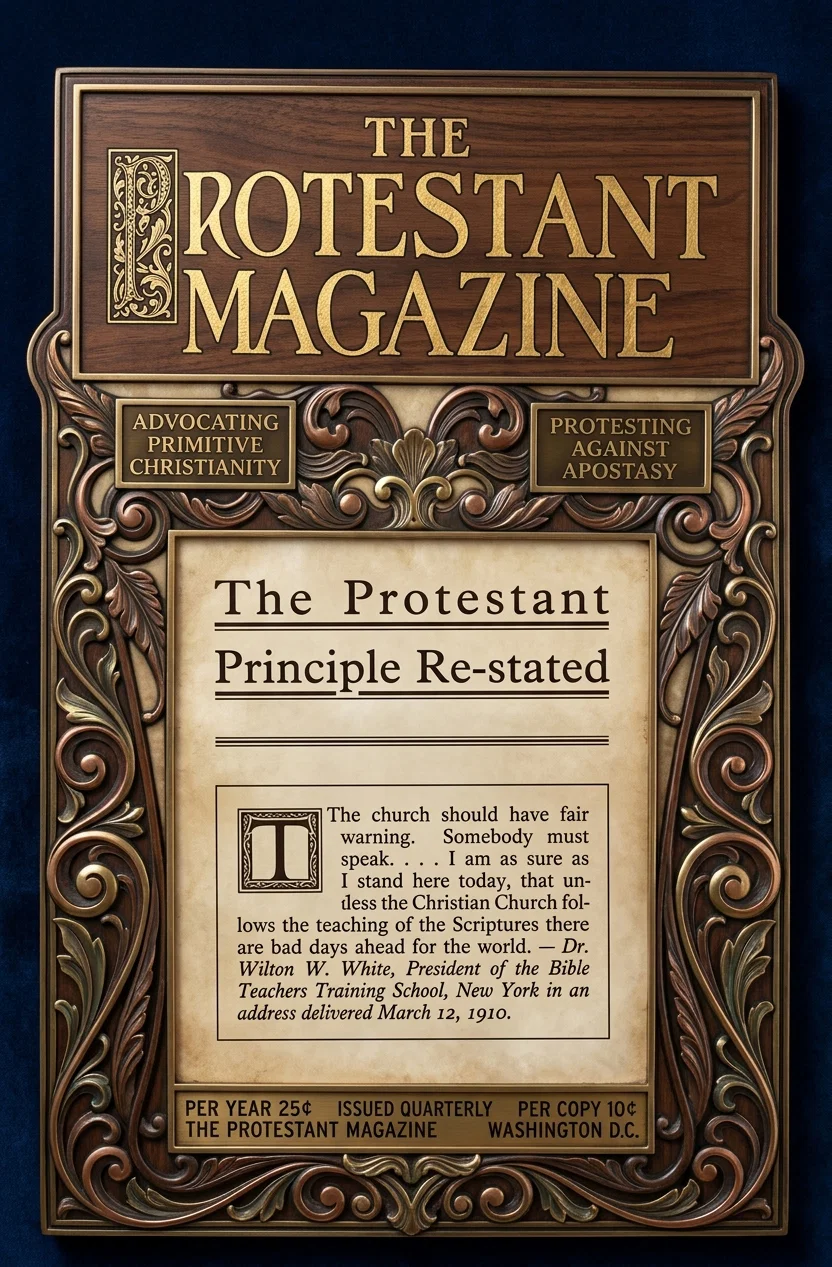
THE PROTESTANT MAGAZINE

The issue of Protestantism is as live to-day as it was six hundred years ago. There is a difference between the genuine and so-called Protestantism. The Protestant Magazine stands for genuine, present-day Protestantism.
Rome is reaching out daily for more power. Eventually, she will again rule the world. The Protestant Magazine tells when and why.
A sample issue gives the best published review of the Roosevelt-Vatican incident, discusses the recent wide-spread controversy over the Protestant oath in England, and contains, besides, a dozen other striking features.
The Protestant Magazine deals with principles, not personalities. It opposes Romanism only with the Word of God.
Four big issues every year. Send for a copy of the latest issue. Ten cents a copy; 25 cents a year. Ten or more copies one year, each, 15 cents.
Order from tract societies, or address —

“I Will Give You Rest”

L. D. SANTEE
Soon will the mists from the valley be lifted, That hide from our vision the home of the soul; The clouds that o'ershadow the earth will be rifted, That shroud the green pastures where life's waters roll. Heaven's sweet flowers are beyond our dull vision, Unseen are the angels, and pathways of gold; But faith reaches up to the gardens Elysian, Where the ransomed shall walk with a rapture untold.
We wait, and we wander through shadow-lands dreary, But, sweet as a smile from the home of the blest, Will come a repose to the souls that are weary, And hearts, heavy burdened, beat calmly at rest, When Christ, with his banner of love streaming o'er us, Gives welcome and rest to the nations forgiven, While glory-girt mansions gleam grandly before us, Reflecting the light and the splendor of heaven.
O that great jasper wall in the azure uprearing, That city of God with its freedom from toil, That home of the soul,—how its beauties are nearing,— Where sin can not enter, nor sorrow despoil. There shadowless isles in the sunlight shall glisten, And flowers that are fadeless gleam warm on the sight; To angelic songs shall the raptured ear listen, While harps thrill the air with a speechless delight.
There friends that we love, clad in heavenly splendor, Shall walk in their joy where life's bright waters roll. With fond, clinging hands, and with sweet faces tender, They'll welcome us there in that home of the soul. Then all of our sighing, our earnest endeavor, Our conflicts with evil, our sorrow and tears, Will soon be forgot in the joyous forever, The wonderful life amid heaven's bright years.
Moline, Ill.

Effectual Prayer

MRS. E. G. WHITE
The disciples were unacquainted with the Saviour's unlimited resources and power. He said to them, “Hitherto have ye asked nothing in my name.” John 16:24. He explained that the secret of their success would be in asking for strength and grace in his name. He would be present before the Father to make requests for them. The prayer of the humble suppliant he presents as his own desire in that soul's behalf. Every sincere prayer is heard in heaven. It may not be fluently expressed; but if the heart is in it, it will ascend to the sanctuary where Jesus ministers, and he will present it to the Father without one awkward, stammering word, beautiful and fragrant with the incense of his own perfection.
The path of sincerity and integrity is not a path free from obstruction; but in every difficulty we are to see a call to prayer. There is no one living who has any power that he has not received from God, and the source whence it comes is open to the weakest human being. “Whatsoever ye shall ask in my name,” said Jesus, “that will I do, that the Father may be glorified in the Son. If ye shall ask anything in my name, I will do it.”
“In my name” Christ bade his disciples pray. In Christ’s name his followers are to stand before God. Through the value of the sacrifice made for them, they are of value in the Lord’s sight. Because of the imputed righteousness of Christ they are accounted precious. For Christ’s sake the Lord pardons those that fear him. He does not see in them the vileness of the sinner. He recognizes in them the likeness of his Son, in whom they believe.
The Lord is disappointed when his people place a low estimate upon themselves. He desires his chosen heritage to value themselves according to the price he has placed upon them. God wanted them, else he would not have sent his Son on such an expensive errand to redeem them. He has a use for them, and he is well pleased when they make the very highest demands upon him, that they may glorify his name. They may expect large things if they have faith in his promises.
But to pray in Christ’s name means much. It means that we are to accept his character, manifest his spirit, and work his works. The Saviour’s promise is given on condition. “If ye love me,” he says, “keep my commandments.” He saves men, not in sin, but from sin; and those who love him will show their love by obedience.
All true obedience comes from the heart. It was heart-work with Christ. And if we consent, he will so identify himself with our thoughts and aims, so blend our hearts and minds into conformity to his will, that when obeying him we shall be but carrying out our own impulses. The will, refined and sanctified, will find its highest delight in doing his service. When we know God as it is our privilege to know him, our life will be a life of continual obedience. Through an appreciation of the character of Christ, through communion with God, sin will become hateful to us.
As Christ lived the law in humanity, so we may do if we will take hold of the Strong for strength. But we are not to place the responsibility of our duty upon others and wait for them to tell us what to do. We can not depend for counsel upon humanity. The Lord will teach us our duty just as willingly as he will teach somebody else. If we come to him in faith, he will speak his mysteries to us personally. Our hearts will often burn within us as One draws nigh to commune with us as he did with Enoch. Those who decide to do nothing in any line that will displease God, will know, after presenting their case before him, just what course to pursue. And they will receive not only wisdom, but strength. Power for obedience, for service, will be imparted to them, as Christ has promised. Whatever was given to Christ,—the “all things” to supply the need of fallen men,—was given to him as the head and representative of humanity. And “whatsoever we ask, we receive of him, because we keep his commandments, and do those things that are pleasing in his sight.” 1 John 3:22.

The Sin of Indifference

DANIEL NETTLETON
“If God abhors one sin above another of which his people are guilty, it is doing nothing in case of emergency. Indifference and neutrality in a religious crisis are regarded of God as a grievous crime, and equal to the very worst type of hostility against God.” Remember the word of the Lord concerning Meroz; “They came not to the help of the Lord.” Judges 5:23. They neglected to improve an opportunity to be coworkers with God. How shall we escape a similar condemnation if we neglect to become fellow workers with God in laboring for the salvation of lost souls?
This solemn responsibility was impressed on my mind by the following incident: An Adventist brother came West, took up a homestead, and began making a home for himself and family. Another man took up a claim next to his, and so our brother had a neighbor. Do you know Christ’s answer to the question, “Who is my neighbor?” If not, read Luke 10:30-37, and you will see that our neighbor is one who is in need of something we can do for him. Well, this neighbor was friendly, a good neighbor, but not a Christian; he was without hope and without God in the world. He had not found the pearl of great price; he was lost, unsaved.
Our brother felt impressed to visit this neighbor, to give him some tracts on the coming of Christ, to get him to read the Signs of the Times, to hold Bible readings with him, and in some way to interest him in present truth, and in securing a home in the soon-coming kingdom. But he was “so busy,” he had “so much to do,” that he could not find time for missionary work. Like Felix, he turned away from the call of the still, small voice, with, “Go thy way for this time.” He waited for a more convenient season, but it never came. Days, weeks, and months passed by; the harvest was over, the summer was ended, and his neighbor was not saved. He gave no heed to God’s admonition: “Whatsoever thy hand findeth to do, do it with thy might; for there is no work, nor device, nor knowledge, nor wisdom, in the grave, whither thou goest.”
Early one morning he was startled by a knock at his door. One of his neighbor’s children came in, and said, “Father died last night, and mother wishes you would come over and help us.” He went as requested; and as he helped perform the last sad rites, he longed with bitter tears and sad regrets for the time and opportunity that had passed, in which he might at least have made an effort to bring his neighbor to Christ. But alas! time and opportunity wait for no man. “A man hath joy by the answer of his mouth: and a word spoken in due season, how good it is!” Prov. 15:23. Jesus said, “I must work the works of him that sent me, while it is day: the night cometh, when no man can work.”
O, that all God’s people had a mind to work for lost souls! It is said of the people who rebuilt Jerusalem, “So built we the wall; and all the wall was joined together unto the half thereof: for the people had a mind to work.” Neh. 4:6. And we in this day are exhorted to have in us the mind which was in Christ Jesus, “who, existing in the form of God, counted not the being on an equality with God a thing to be grasped,”—held on to, retained,—while we are in need of a Saviour,—“but emptied himself, taking the form of a servant, being made in the likeness of men; and being found in fashion as a man, he humbled himself, becoming obedient unto death, yea, the death of the cross,” that he might save men. Shall not his example inspire us to follow in his steps? And if we do follow the footprints from the manger to the cross, we shall share with him in the joy that was set before him, the joy of a ransomed world.
“He was not willing that any should perish. Am I his follower, and can I live Longer at ease with a soul going downward, Lost for the lack of the help I might give? Perishing, perishing! harvest is passing; Reapers are few, and the night draweth nigh. Jesus is calling thee! Haste to the reaping! Thou shalt have souls for thy crowning on high.”
Port Townsend, Wash.

J. N. LOUGHBOROUGH

The Two Thrones—No. 6

J. N. LOUGHBOROUGH

Those advocating a kingdom on earth for one thousand years, in which there will be a more favorable time for men to serve the Lord than has been known in this life, make much of the fact that Satan is bound for that thousand years, and therefore mankind will be free from his temptations. For, they reason, does not the scripture say he is “bound,” that he “should deceive the nations no more, till the thousand years should be fulfilled”? Rev. 20:3. Let it be borne in mind that the ones whom Satan is hindered from deceiving are the very ones whom he has been deceiving. He is bound, that he should deceive them “no more, till the thousand years should be fulfilled.”
As we have already seen, Satan, as the being represented by the scapegoat in the Levitical service, bears the confessed sins of God’s people “unto a land not inhabited.” Roaming for a thousand years over a desolate earth, he finds no food for his “devouring.” He is thus bound—restrained—until the wicked are raised from the dead at the end of the thousand years. Then those whom he has deceived in this life, being again alive, he goes forth once more to deceive them. At that time his deception is to lead them to think that they can capture the camp of the saints and the beloved city; but, alas! both the deceiver and the deceived go to their destruction in the lake of fire and brimstone, rained upon them from God out of heaven.
The view of the future-probation advocates is that those who are to have this thousand years’ probation are such as have not had a fair chance in this world; and that in the thousand years, free from Satan’s temptations, these will more easily serve the Lord. Such reasoners forget that in this world it is the trial borne with grace, the temptation resisted, that develops stable Christian character. Peter reminds the Christian that the trial of his faith is much more precious than that of gold that perisheth; James admonishes, “Count it all joy when ye fall into divers temptations;” and Paul declares that “tribulation worketh patience; and patience, experience; and experience, hope.”
Let us consider the case of those who have met no temptations of Satan, have had no such experience, and are at once subjected to his fiercest attack. What would we naturally expect of such souls?—Naturally that they would all be led astray. What is the fate of those upon whom Satan is loosed at the end of the thousand years?—Every one of them, according to the prophecy, will go into the lake of fire. There is not an intimation that one soul of them will escape the deceptions of Satan in the end. Yet these age-to-come advocates call this “a glorious restitution.” A glorious restitution (?) forsooth! Restitution of what? Who can see any glory to God or man in such a supposed thousandyears of gospel labor, with such a destruction of the whole work at the end? The plain Bible doctrine respecting the thousand years is that Satan is bound, and that he will no more deceive those who have already yielded to his temptations, till the thousand years are finished. Then he, their leader, goes with his deceived ones to their final doom.
The mode of reasoning of the future-probation advocates, as stated by some of their teachers, is that when Christ comes, literal angels will go forth to preach to men; that their first work will be to convert the Jews; and that the Jews, having accepted Christ, will make the best of missionaries to proclaim him to the heathen world. Some have gone so far as to claim that all the present railroads, steamboats, and different means of communication will not be disturbed by the coming of Christ, but will be used in that future age for the promulgation of the gospel. In fact, some even claim that these things are tokens that the millennium has already had its “dawning upon the world.” They construe the scripture that speaks of Christ’s coming as a thief, to mean that he will come as silently as a thief; that he will thus come, and quietly take away the saints; and that when the people miss some of their good neighbors, angels will have to inform the world that the Lord has come. This is contrary to what Paul said, “Ye, brethren, are not in darkness, that that day should overtake you as a thief.”
While in England, there came into my hands a copy of a paper published by those advocating the foregoing theory in that country. This paper set forth that the angels would convert the Jews, the Jews would convert the world, and then would follow a work for the fallen angels, which would result in their conversion. Last of all, Satan himself would be converted, and restored to favor with God. To cap the climax, a request was made that every one who would “join the editor in praying the Lord to convert the devil,” would send his name and address to the editor of the paper. All this was based upon a false construction of what is involved in “the love of God,” and a failure to give heed to the plain statements that Christ passed through death that he might “destroy him that had the power of death, that is, the devil” (Heb. 2:14); and that he who was once the anointed cherub, and was in Eden, the garden of God, is at last to be brought “to ashes in the sight of all them that behold,” and never be any more. Eze. 28:14, 18, 19.
As I read this article, I said to those sitting by, “If I was going to give my name to pray for the devil, it would be that the Lord will hasten the time when Satan’s rule in this world shall cease, and he be reduced to ashes, as God has promised. To pray for him otherwise could have no foundation in faith, but would be the rankest presumption.”
*Lodi, Cal.

The Love of God

J. F. BAHLER
“GREATER love hath no man than this; that a man lay down his life for his friends.” John 15:13. When Jesus was suffering on the cross, he carried out the thought just presented. It was not possible for any being to do more for man than to give his life; therefore, when Jesus yielded to a shameful and cruel death, he manifested great sympathy and love for his creatures, and the Father did likewise. “For God so loved the world, that he gave his only begotten Son, that whosoever believeth in him should not perish, but have everlasting life.” John 3:16.
There is life eternal in the love of God. This can be had by believing in Jesus yielded to a shameful and cruel and amazement, looked upon the scene that took place when Jesus hung upon the cross, and wondered at the love he had for sinful man. Thank God, “love never faileth.” When the church shall have been saved, how much the love of God will be enjoyed, without any more separations caused by sin. Every man, woman, and child who enters the pearly gates of the New Jerusalem, must be endowed richly with the love which dwells in the heart of our Heavenly Father and in his Son, Jesus Christ. Has not God done everything that he could do for the salvation of man, to redeem him from the cruel grave? We ought, therefore, to show, in our very actions and being, that we appreciate his wonderful and mighty love.

Right Methods of Preaching

IVAN F. WITTING
The instruction of the intellect is not the only, nor indeed the principal, end of preaching, but its highest aim is to lead souls to God. To co-operate with the Holy Spirit in convincing of sin, of righteousness, and of judgment; to teach the love of Jesus; to build up in the Christian graces; to train souls for heaven,—all this is the work of the gospel minister. To this end he must know something of these things by experience. He should not stand as one on a lofty height, and cry: “Look! this is what you must aim at. Come up hither, where all is so bright and pure and happy.” No; let him say, instead: “Brethren and friends, let us try to get up higher together. I, with you, am but a toiler on life’s highway, but it is my duty and exceeding high privilege to stretch a helping hand to my fellow travelers. Shall we try?” For you will never lead souls heavenward unless you are climbing yourself; you need not be very far up, but you must be climbing.
Try always to be genuine in thought. Speak that which you know in spiritual things. Take care not to soar in your words into regions which you have never visited in your heart. Speak from actual experience. A high ideal, an exalted standard, a lofty aim—by all means; but no false sentiment about it, no high-pitched or misty language, which will not bear being placed side by side with the heart’s true experience. It is a good rule, if we speak about things higher than our own hearts have attained, to speak as if to our own hearts,—to tell others what we feel our own hearts desire to be told. Preach to yourself; then you will touch others also.
Be natural in manner. Do not aim much at manner: the best manner is that of entire unconsciousness. Be yourself. If you are naturally quiet, do not try to be fervid. If you are naturally warm and vehement, use the gift. Any manner will do, if all is true, and sincere, and meant,—but no “mannerism.” No manner is good with hollow words and heartless sentiments. Fluency is appalling if earnestness is lacking; and often halting, stammering words go straight home by the very force of the honest conviction of the speaker.
Be simple in style. “What are we better for a golden key, if it can not unlock what we wish to open? What the worse for a wooden key, if it can?” Beware of the abomination of “fine” language and neatly rounded sentences. You can preach almost as you would talk to a poor woman in a cottage, so far as language is concerned, and yet be truly eloquent. Use words that can be understood by all, high or low. One could easily make a long list of words to be avoided; but if you mingle freely with the people, your ear will be trained to detect “hard” words, and your own instinct will tell you what to avoid.
Never assume that your listeners are carrying your reasoning in their heads as you go on. Take nothing for granted. Explain what to you seems simple, and do not be afraid of repetition. Remember that every detail of the glorious truths you are presenting is utterly strange and peculiar in the ears of your audience. They must be builded up from the very foundation. Do not build on old ground; for you will find it treacherous. “No man putteth a piece of undressed cloth upon an old garment.” Bring out your points distinctly and clearly.
Be extremely tender to the ignorance and prejudices of the people. They require gentle leading. Remember how slowly and gradually your own beliefs and opinions were formed. You have before you representatives of the weakest generation of the world. “Lead them softly,” according as they shall be “able to endure.” Take as your motto, “If men should overdrive them one day, all the flock will die.”
Preach positively, not negatively. Christ always spoke in the most definite way. “For he taught them as one having authority, and not as the scribes.” Present what the Word of God teaches, as boldly as you like; but do not attack others, nor set up false arguments or untrue doctrines for the purpose of knocking them down. Build up; and do not go aside to pull down. Expose error by preaching truth.
Preach encouragingly. Do not be hard on the people. Poor souls! they need all the help you can give them. Their eyes are blind, their ears are dull and deaf. Speak gently; do not drive them, but lift them. Picture to them in compelling colors our Heavenly Father and his love.
Preach Christ and him crucified. No code of laws, however binding; no lines of prophecy, however important; no system of historical evidence, however vital to an understanding of the message; no profound philosophy, however comprehensive and satisfying, will save mankind. No, and again, no. We must preach Jesus, the same yesterday, and to-day, and forever. When you can make the people see Jesus, as he is, everything that is out of harmony with him will drop off, and they will accept the truth as it is in him.
The preacher who realizes that he is himself created for eternity; who is battling with the power of evil in his own heart; who is striving after true faith in the love of the Father, the mercy of the Son, the power of the Holy Spirit; in whom the sense of sin is ever deepening; who is ever working out a completer self-surrender, ever advancing in self-conquest and habits of devotion,—such a one will know how to speak to tempted souls. His manner may not be brilliant, his voice may not be melodious, his flow of words may not be ready, his style may be awkward, his sentences ill-arranged; yet his message will appeal to souls as no clever handling, no trim arrangement, no easy oratory, no display of profound learning, will appeal. Why?—Because he has sympathy.He feels that he, though a minister and servant of the Master, is a poor, struggling, judgment-bound sinner. He is a living soul speaking to living souls. He remembers that every one in the congregation is the purchase of Christ’s blood; that every upturned face is the face of a judgment-bound soul; and that he must meet that soul again before the judgment-seat of Christ. If preaching is to do any good, it must be based on sympathy. There must be heart first feeling for, and then speaking to, heart. This sympathy, which longs so ardently that the hearer should have the full fruition of the thoughts which are burning in the speaker’s inmost soul, is the secret of true eloquence.
College Place, Wash.

Who Are Israel?

JOHN H. NIEHAUS
At the time when Jacob wrestled until the breaking of the day for a blessing, the angel said: “Thy name shall be called no more Jacob, but Israel: for as a prince hast thou power with God and with men, and hast prevailed.” The rendering in the American Revised Version for the expression, “Hast thou power with God,” reads, “Thou hast striven with God.” Hence Jacob became a soldier for God, which is the true definition of the word Israel; and from that time God’s chosen people were called by that name.
When the subject of circumcision was brought before the leaders at Jerusalem, James said: “Simeon hath declared how God at the first did visit the Gentiles, to take out of them a people for his name.” As stated above, God gave Israel their name, and calls them his people; so if a people are taken out from the Gentiles, they drop that name, and, being adopted into the royal family of God, they assume the name Israel. Peter said: “Of a truth I perceive that God is no respecter of persons: but in every nation he that feareth him, and worketh righteousness, is accepted with him.” Why God visited the Gentiles, to take out of them a people for his name, is explained by the prophet Amos: “For, lo, I will command, and I will sift the house of Israel among all nations. . . . All the sinners of my people shall die by the sword. . . . In that day will I raise up the tabernacle of David that is fallen, and close up the breaches thereof; and I will raise up his ruins, and I will build it as in the days of old: that they may possess the remnant of Edom, and of all the heathen, which are called by my name.” In the book of Acts we find the expression, “And all the Gentiles, upon whom my name is called.” From these statements it is evident that there was a breach in the house of Israel, and that God calls upon the Gentiles to fill up this breach. “Through their [Israel’s] fall salvation is come unto the Gentiles.” Rom. 11:11.
The Saviour says to his followers, “I am the vine, ye are the branches,” and the office of the branch is to produce fruit. Since Christ is the True Vine, an unbeliever in him — a Gentile — can not work in harmony with him. He has no part in the living Vine; therefore the fruits of the Spirit are not developed in him. So with the unbelieving Jews. They were God’s chosen people; but, on account of their unbelief, they were as branches broken off. Rom. 11:17. The Christian is represented as the wild olive tree, grafted in among the natural branches, to partake of the riches of the vine, and then bear fruit for the Master. “And so all Israel shall be saved.” Rom 11:26.
Thus we become heirs of the kingdom, according to the promise, and partakers of the blessing promised to Abraham; but not through circumcision, for the blessing was promised to Abraham by faith before he was circumcised, the circumcision following as a mark, or sign, that he was walking with God. Rom. 4:11. To the Christian this circumcision is a spiritual purification, and must come from the heart. Rom. 2:28, 29. Then, as one in Israel, the many promises recorded in the Word of God for Israel are ours. A few of these are found in the following texts: Ex. 31:13, 17; 19:3-6; Deut 29:9-15; Rev. 22:14; compare 21:12. “O the depth of the riches both of the wisdom and knowledge of God! how unsearchable are his judgments, and his ways past finding out. . . . For of him, and through him, and to him, are all things: to whom be glory forever. Amen.”
Fort Wayne, Ind.

The Tekoites and Their Nobles

WALTER C. THOMPSON
“And next unto them the Tekoites repaired; but their nobles put not their necks to the work of the Lord.” It appears from this text that the noblemen of Nehemiah’s time were not unlike certain noblemen of other days, their chief characteristic being a constitutional aversion to work. They had, however, one claim to distinction—that of descent from an ancient and honorable family; this, they felt, gave them a certain prestige that demanded recognition. However, we will not dwell upon this point, but will notice another text: “The words of Amos, who was among the herdmen of Tekoa.” Amos 1:1. These herdmen of Tekoa were, no doubt, the ancestors of the Tekoite noblemen.
The chronology of this last scripture shows it to refer to a time about three and one-half centuries prior to the incident recorded in the first text. Amos, the most notable Tekoite of whom we have record, bears this testimony concerning himself: “I was no prophet, neither was I a prophet’s son; but I was an herdman, and a gatherer of sycamore fruit. And the Lord took me as I followed the flock, and the Lord said unto me, Go, prophesy unto my people Israel.” Amos 7:14, 15. At this time the Lord had need of a man; and Amos little dreamed, as he went faithfully about his menial pursuits, that his measure was being taken for a more responsible position. The incident calls to mind the words of Zech. 4:10: “Who hath despised the day of small things?”
The nobles of whom it was written that they would not put their necks to the work of the Lord, would have disdained to perform the humble duties that were the daily employment of their illustrious ancestor, before the Lord called him to a greater work. Looking back over the lives of men who have made up the favorable history of the world’s achievements, we find that they were men who made every occasion a great occasion. None of them were despisers of the day of small things. Many of them had greater advantages than Amos; but all applied themselves diligently to the work in hand, regardless of its nature.
Says the wise man, “Be thou diligent to know the state of thy flocks, and look well to thy herds.” Prov. 27:23. “Seest thou a man diligent in his business? he shall stand before kings; he shall not stand before obscure men.” Prov. 22:29, margin.
Evidently Amos was such a man. Gideon and David were other noteworthy examples of this same fidelity to the more humble pursuits of life. Here were young men who, though they evidently had high aspirations, still did with their might the humble tasks that came to their hands. They did not scorn to ply the flail, or to follow the herds, or to care for the flocks. What was the outcome?—The Lord called Gideon from his threshing-floor, and made him the deliverer of his people from the Midianites; he desired a messenger, and Amos was called from his herds to be a prophet; Israel needed a ruler, and David was anointed king.
There is a valuable lesson in these experiences for those who live at the present time. Are any gatherers of “sycamore fruit”? Faithfully perform your work. Are any followers of herds? Look well to their condition. Are any keepers of sheep? Be diligent to know their state. While you are engaged in these humble occupations, some one may be taking your measure for a more responsible position.
The question for each one is, Shall I emulate the Tekoites? or shall I follow the example of their nobles, who put not their necks to the work of the Lord? To do the former means efficiency in all positions, availability for higher work, a life of service, and a crown of reward; while the latter means a life of failure, and ultimate oblivion.
Let us not despise the day of small things, but make of every occasion a great occasion.
Tacoma, Wash.

Lives of Other Men

THE lives of other men should be regarded as a mirror, from which we may take example and a rule of conduct for ourselves.—Terence.

At Singing Time

I HAVE a little daughter, Who's scarcely half past three, And in the quiet twilight hour She climbs upon my knee, And snuggles down within my arms With, “Mother, sing to me!”
The light grows faint and fainter; The Sandman guards the door; My baby's boat drifts slowly Upon the slumber shore; But if the singing stops, she cries, “O mother! sing some more!”
I sing about the squirrels That frolic in the wood; About two furry kittens, One naughty and one good; And then some tender lullabies, Just as a mother should.
I'm sure no prima donna Adored from east to west, Feels half the satisfaction, Or is so truly blest, As I, when singing to my child Held closely to my breast.
Not all the fame and glory Of divas can compare With that deep thrill of pleasure Which is my humble share; For precious are the laurel wreaths That singing mothers wear!
—Anne P. L. Field.
Continue reading: A Birthday Party