“O MAMA!” cried little Ruth Lee, “next Thursday is my birthday! I’ll be ten years old. May I have a party, and a nice supper, and lots of presents, as Mabel Murray did?”
Mrs. Lee looked thoughtful for a moment, then said, “How would my little daughter like to have a Good Samaritan party?”
“What kind is that, mama?” But without waiting for a reply, Ruth clapped her hands, saying, “O, I know I shall like it! May I have one? When may I invite the girls?”
Mrs. Lee explained that this kind of party was different from any that Ruth had ever attended, and said she would make all the arrangements for it. A part of the plan was that Ruth should say nothing about it to any one else. Ruth found it pretty hard to keep from talking about it, as it was in her mind almost all the time. But she was happy in thinking how she would enjoy the company, and supper, and presents, when the time came.
On Thursday, Mrs. Lee made some nice biscuits, and some of Ruth’s favorite cookies cut in squares and diamond shapes, each with a little hollow in the center filled with bright-colored jelly. Then there were apples, oranges, and nuts, and a few pretty flowers.
“And here are the presents, Ruth,” said Mrs. Lee, uncovering a basket.
Ruth took out a pair of warm mittens, a gay-colored little shawl, a pair of warm house slippers, and a few other articles of clothing. In the bottom of the basket was a picture-book that Ruth had grown tired of.
“Why, mama, what do you mean?” and Ruth’s eyes filled with tears. “Where are the girls and my new presents? I do not need these things, and some of them are old.”
“Never mind, dear, we are not at the party yet. Get your hat, while I pack the supper and the presents in baskets, and then we will go.”
“O, it’s at some other house!” Ruth wondered, but brightened up, and they soon started. She said nothing when her mother turned down a narrow street, but walked close by her side; but when they stopped at a poor-looking house, she whispered, “Why, mama, the party isn’t here, is it?”
The door was opened by a pleasant-faced woman, who seemed very glad to see them. Lying on a cot was a little girl about Ruth’s age. Mrs. Lee went up to her and took her hand.
“How is Mary to-day?” she asked.
Mary’s mother said she thought her little girl was better, and added, “She gets so tired lying there with nothing to do.”
Ruth thought of the picture-book, and in a moment it was in Mary’s hands. In a little while the gay-colored shawl was around her shoulders, and some of the fruit, cakes, and flowers were on a low table near her. You could not have told which looked the happier, Mary or Ruth.
When Mrs. Lee and Ruth were again in the street, Ruth said: “This is a splendid party, mama. Where shall we go next?”
At the next place they stopped there was a poor woman sitting alone by the fire. Mrs. Lee called her “auntie,” and visited quite a while with her. Ruth was wondering what she had in her basket that would be nice for her, when a little boy came in and held his hands, blue with cold, over the fire to warm them.
Auntie said: “Johnnie is a good boy. He does all the chores for me. It’s pretty cold for his hands sometimes, but he is real brave.”
Ruth began at once to hunt for something in the basket of presents. She soon found what she was looking for, and with a bright smile she said, “Will these fit you?” Johnnie put the mittens on, and they did fit him just as if they had been knit for him.
“Do you suffer much with the cold, auntie?” said Mrs. Lee.
“Only my feet. The floor is so cold I can hardly keep them warm.”
Ruth knelt at her feet and in a moment the thin shoes were off and the warm house slippers on. Then she took a plate from the table, and piled it high with some of the dainties she had brought. The thanks of poor auntie and the smiles on Johnnie’s face made Ruth feel very happy.
They made several other calls, Ruth finding a place for all the things she had brought.
When they got home, Ruth threw her arms around her mother’s neck, saying, “You are the dearest mama, and this is the best kind of party that ever was.”
“My daughter, when Jesus was here on earth, he said something about giving and receiving presents. You can read about it in the last part of the twentieth chapter of Acts. See if you can find the verse.”
Takoma Park, D. C.
Dangers in School Life
By A. B. E.
It should be a matter of deepest gratitude to Seventh-day Adventist parents that a system of schools has been provided for the children and youth of the denomination, where they can receive not only an education and training in all branches of useful knowledge, but where they are in a large measure sheltered from the evils that permeate high-school and college life. The young man or woman who for four years runs the gauntlet of the modern high school, with its secret societies, its military organizations, which exact large outlay in time and money, its dances and late suppers, its disregard of high religious standards, with many other evils, may indeed have proved the possession of a character that can stand in the front of the battle; but what of the weaker youth, those who must needs be led on softly into the safe path if they shall enter it at all? A countless company of young people could give the sad answer to this question. It is unwise and unsafe to allow the feet of the youth to be set in the way of temptation, and especially in these days when, by every possible device, Satan is seeking to ensnare them and lead them to ruin. Rather should every safeguard of Christian home and Christian school be thrown around them, and especially during the habit-making, character-forming years of adolescence.
Dr. Francis E. Clarke, leader of the Christian Endeavor movement, has set forth some of the evils of modern high-school life in a recent number of the Christian Endeavor World. He especially arraigns the high-school dance, and says that “an appalling revelation could be written on this subject.” “Many girls not yet out of their teens,” he declares, “have been ruined body and soul, for time and eternity, by these dances.” He says, further, concerning8the conditions in high schools in general:—
“I formerly thought that girls were more easily reached by the appeals of religion than boys, that their consciences were more sensitive, and their higher natures more fully developed than their brothers’. I am coming to doubt that, especially with girls of the high-school age. On the cars and on the streets I see more vulgarity and rudeness of behavior, less respect for others, and more indifference to the general public welfare, among the high-school girls than among the boys; and it is often harder to find steadfast, earnest, Christian workers among them than among those of the other sex.
“Yet it is not the teachers or the pupils who are chiefly responsible for this condition in many of our high schools, but primarily the parents, who do not know enough or care enough to keep their children out of these secret societies, and who encourage the late hours, the dances, and the attendant dissipation for the sake of the supposed social advantages. Or, if they do not encourage them, they yield weakly to the importunities of their children; and the demoralizing results are the same.
“Many a father or mother has awakened with shame and contrition, when it was too late, to the results of such carelessness and overweening ambition, when the daughter has brought disgrace and confusion of face upon the family.
“I write about this because I have upon my heart particularly the boys and girls of this high-school age, the age of adolescence, the most critical, and in many respects the most important, period of human life. I know thousands of these boys and girls in our high schools of pure, noble, Christian characters. I know scores of teachers who are conscientious and watchful of the morals of their pupils. Alas that all are not of this type!”
When the greatest leaders and teachers of our day see and deplore the conditions in many of these schools, is it not time for Seventh-day Adventist parents to weigh carefully the advantages to be gained not only for the present but for the future by their choice of a Christian school for their children? A. B. E.
Not a Large Capital
Let no one be discouraged from trying to be helpful to others by the thought that he has only a few talents.
“What if the little Jewish lad
That summer day had failed to go
Down to the lake, because he had
So small a store of loaves to show?”
In an English town there lived an old woman past seventy years of age. She was poor and feeble. Her pastor preached a sermon on foreign missions which so interested her that she offered herself as a missionary to Africa. She was gently told that she could not go; but that, instead, she might pray for the cause and send her alms. So she began saving her pennies, anxious to do some thing in the missionary work.
In that same place lived a rich young nobleman, who cared more for his dogs than for religious enterprises. He heard about the old woman, and went to see her one day. He found her in tears, utterly disappointed and discouraged. She said that the people only laughed at her, and that all she had gathered together as the fruit of so much pains amounted to but a few shillings.
“My barley loaves are worthless,” was her despairing cry. That very night she died. The next day found the young lord sitting silently and alone, his head bowed in his hands. The Spirit of God was moving on his heart. The result was that he wrote a letter offering himself as a missionary to Africa.
Have not you one “barley loaf,” or two, or more, that you can offer to Jesus? What you bring he will bless to the feeding of the hungry multitude.—Selected.
Care of Children
The following excellent advice regarding the care of small children during the summer months is given by Dr. Woodward, health officer of Washington, D. C.:—
“Do not wean a child before he is ten months old, and do not begin to wean him just before or during hot weather unless advised to do so by your physician. At any other time, or as soon as the middle teeth have come, the baby may have one or two meals each day.”
“A child one year old, in addition to its diet of milk and bread, may have gradually added to its list of foods an occasional soft-boiled egg. Cereals cooked three hours, and strained, may also be given.”
“Do not give any child under two years of age cabbage, pickles, tea or coffee, bananas, berries, or other fruit except orange or prune juice and stewed or baked apple. Do not give any cake, candy, or ice-cream.”
“A baby needs plenty of pure air at all times. When the weather permits, it is best to keep him outdoors all the time. When it is too hot or too cold to do this, the baby should be kept in a well-ventilated room.”
“Always protect the baby's eyes from bright light.”
“Put the baby to sleep at regular hours each day. He should always sleep in a bed by himself. Never give a child soothing sirup.”
“In hot weather have the clothing light and cool.”
“Give the baby a tub bath every day in tepid water.”
“Wash the mouth at least twice a day with a soft cloth wet in a weak solution of baking-soda and water.”
“Mother's milk as an infant's food has no equal. Do not give the baby any other food before it is ten months old. A baby should be fed at regular hours. Do not feed him every time he cries. Until the baby is four or five weeks old, he should be fed every two hours during the day and once or twice during the night.”
“Bottle feeding, as ordinarily practised, increases tenfold the dangers of the baby's dying during infancy. If bottle feeding is necessary, it should be under the direction of a physician.”
“Milk should be Pasteurized before being given to the baby. Nature made cow's milk for the calf, not for the baby. To make it a suitable food for a young infant, it must be ‘modified’ by increasing or decreasing the amount of fat that it contains, or increasing or decreasing the amount of the substances that make up the curd, and in other ways.”
“Canned and bottled foods for infants are, as a rule, objectionable. All food should be given to the baby lukewarm. The milk left in the nursing-bottle after one feeding should be thrown out.”
“As soon as the nursing-bottle is emptied, rinse two or three times with tepid water, then clean thoroughly with baking-soda and hot water (one teaspoonful of baking-soda to a pint of water), using a bottle-brush. After rinsing again, put the bottle upside down on a shelf in a clean, out-of-the-way place. Boil the bottle immediately before filling it for the next feeding. The hands of the mother or nurse should always be thoroughly washed with soap and water before handling the baby's food or feeding apparatus.”
“Children need water to drink just as adults do. You may give the baby all the fresh water he wants, but never give ice-water.”
True Self-Defense
“Do you think it would be wrong for me to learn the noble art of self-defense?” asked a youthful Christian of his pastor.
“Certainly not,” replied the minister. “I learned it in youth myself, and I have found it of great value during my life.”
“Indeed, sir! Did you learn the English system or some other?”
“Neither; I learned Solomon’s system.”
“Solomon’s system?”
“Yes, you will find it laid down in the first verse of the fifteenth chapter of Proverbs: ‘A soft answer turneth away wrath.’ It is the best system of self-defense of which I have any knowledge.”
There are many who do not know that this is a brave method of defense; they actually think it is rather cowardly. Yet it often takes the brave heart to give the soft answer.—Selected.
Excellence and Industry
EXCELLENCE is never granted to man, but as the reward of labor. It argues, indeed, no small strength of mind to persevere in the habits of industry, without the pleasure of perceiving those advantages which, like the hands of a clock, whilst they make hourly approaches to their point, yet proceed so slowly as to escape observation.—Sir Joshua Reynolds.
Belgium and South England
By J. H. SCHILLING
J. H. SCHILLING
Belgium
ON March 24 of this year the General Conference Committee of the European Division passed the following recommendation:—
“Resolved, That we approve of the plan of the Latin Union to release French Belgium to the West German Union, and that we accept the proposal of the West German Union to separate Flemish Belgium from Holland, and recommend Belgium to be known as the Belgium Mission, beginning Jan. 1, 1911.”
In recognition of this motion, and in order that the brethren in the kingdom of Belgium might adopt it themselves, it was decided by the same committee that a general meeting for that field should be arranged, the same to take place in Brussels, May 4-8. This meeting is now a thing of the past, but it has left upon the minds of those who were in attendance a deep impression of the importance of our time and the vastness of our work.
Taking into consideration that there are only four companies, with about one hundred members, in this field, one could not expect a very large meeting. Comparatively speaking, however, the meeting was larger than such meetings often are in fields where the membership is much greater. Over Sabbath and Sunday there were sixty-five out of the one hundred present, which can be called very good for Belgium. The collection on the Sabbath for foreign missions amounted to sixty-eight francs, a little more than a franc for each person.
The new organization was accepted with joy. Every one believed that the step was the very best that could have been taken to develop the work rightly. The resolutions adopted by the meeting are very practical, and appropriate to the needs of the field. Although the brethren are all poor in worldly goods, they seem to be rich in grace and good works. They love the truth. Their tithe for 1909 amounted to over $1,000. This comparatively large tithe is a good index of how they stand toward the truth; for one who pays an honest tithe is, generally speaking, in harmony with all other points of the truth, and loves it sincerely.
Aside from the workers who are in the field, there were present Elders L. R. Conradi, R. G. Klingbeil from Holland, and the writer. The word imparted was received with eagerness. Elder G. Roth, the former director of the French work, was also present, and gave an interesting report of the development of the work in Belgium. We are certainly very sorry to lose Elder Roth, but since his health does not permit him to remain in this cold, damp climate, we bid him Godspeed in the field to which the Lord may call him.
THE CITY HALL AT BRUSSELS
The sermons and Bible readings were given in three languages, German, French, and Dutch. All left the meeting full of courage. With new strength they went back to their homes to fight the battle of truth more vigorously than ever before. The Lord, who blessed them so richly during the meeting, will be with them constantly, to sustain them in every trial.
The Belgium mission field has at present seven workers, one to each million of the inhabitants. The writer is the director. In his absence in other parts of the West German Union, Elder Jacob Wibbens will take charge of the work.
Three tents will be in the field this summer, one in Brussels, one in Antwerp, and the third in the French part. May the Lord abundantly bless in this dark part of the world, so that many precious souls may be saved.
South England Conference
Immediately after the meeting in Belgium, the writer had the privilege of attending the annual meeting of the South England Conference, which convened at Southampton, May 9-17. A workers’ meeting preceded the regular conference for the field. Among the workers were also the canvassers, so that the workers’ meeting took on the nature of an old-time canvassers’ institute, such as the writer used to attend in the early part of his experience in the truth. The spirit which should always prompt the canvasser in his work was fully awakened. Every difficulty confronting the canvasser was carefully considered, and the way to meet it fully explained. The Testimonies especially appropriate to the canvasser were studied, and every point which invariably proves a blessing to him when observed was emphasized. The brother who has the canvassing work in charge seems to have his whole soul in it. He is a canvasser himself, and has the confidence of his men.
The meeting was a feast, at which the canvassers were refreshed spiritually and mentally. Their weapons of warfare were sharpened, so that they can fight more effectively. May the Lord help them in every way.
A two-hour period each day was devoted by the conference workers to the study of how to bring more souls into the truth. The workers were all of the opinion that they had not worked hard enough in the past, else results would have been better. They felt that they had lacked especially in the house-to-house work. The president of the union reported that where a systematic house-to-house work had been done, many more souls had been the result of the labors put forth. One worker had developed quite a large church in a comparatively short time.
It was therefore decided that each worker should be furnished with a certain number of tracts by the conference, with which he could visit every home in a city, or district of a city, where he is working. The people must be warned, and if they do not come to the workers, the workers must go to them. The shortness of the time in which we have to do the great work committed to us demands of us the greatest diligence. We must be up and doing. “Forward! and hard work,” should be our motto.
Great Britain is not the hardest field in the world. It presents a few hard10problems, it is true, yet not more than are found in other fields. The brethren have come to the conclusion that each field is equally hard, and that from now on they will speak not so much of the difficulties as of the grand possibilities. May the Lord help that the good spirit for work which has been awakened during this workers’ meeting may truly cause each one to do his duty, and that many more souls may be brought out of darkness into the light of the third angel’s message in the South England Conference this year than ever before.
The conference proper was also a refreshing from the Lord. Aside from the regular conference workers, there were present Elder W. J. Fitzgerald, president of the union; W. H. Wakeham, from the school; W. T. Bartlett, editor of the Present Truth; and the writer. The word imparted brought new courage and spiritual strength to all. The Sabbath especially was a blessed time. The evening services were quite well attended by outsiders, and the interest awakened will be followed up, and, we believe, with results.
The conference sessions were interesting, and the resolutions presented timely. They were freely discussed and unanimously adopted. The tithe of the conference for 1909 amounted to about $11,144. The present membership is 640, with eighteen regular workers. Four tents will be in the field this summer. God grant that a good harvest of souls may be garnered during this season in this conference.
Uruguay, South America
By John V. Maas
JOHN V. MAAS
The work of the Uruguay Mission for last year has not accomplished all we had planned; still we hope in Him who out of nothing created the universe, and trust some day to see results from the efforts put forth.
We held an excellent general meeting at Colonia, Uruguay. A spirit of renewed consecration prevailed in the meeting, and many plans were laid, one being that the director of the Uruguay Mission should supervise the work of building our sanitarium at Diamante, Entre Rios, Argentina, during the absence of Dr. R. H. Habenicht, who attended the General Conference.
At this meeting we were greatly encouraged by the arrival of Sisters Meda Kerr and Frances Brockman, nurses, who brought with them a deep spirit of devotion to this cause. On account of their not knowing the Spanish, it was advised that they should attend our mission school in Entre Rios, Argentina, to obtain some knowledge of the language. This left only Brother Julio Ernst to hold the fort.
Soon there came an interruption in our work at the sanitarium. The provincial government prohibited Dr. A. L. Gregory, who was in charge of the medical work during Dr. Habenicht's absence, from practising, as he was not duly authorized. This cut off our last source of income. These were anxious hours. There were workers to be provided for,—two doctors (Dr. G. B. Replogle having just arrived), a nurses' class, and Brother Amando Hammerly and Miss Voris, the two head nurses.
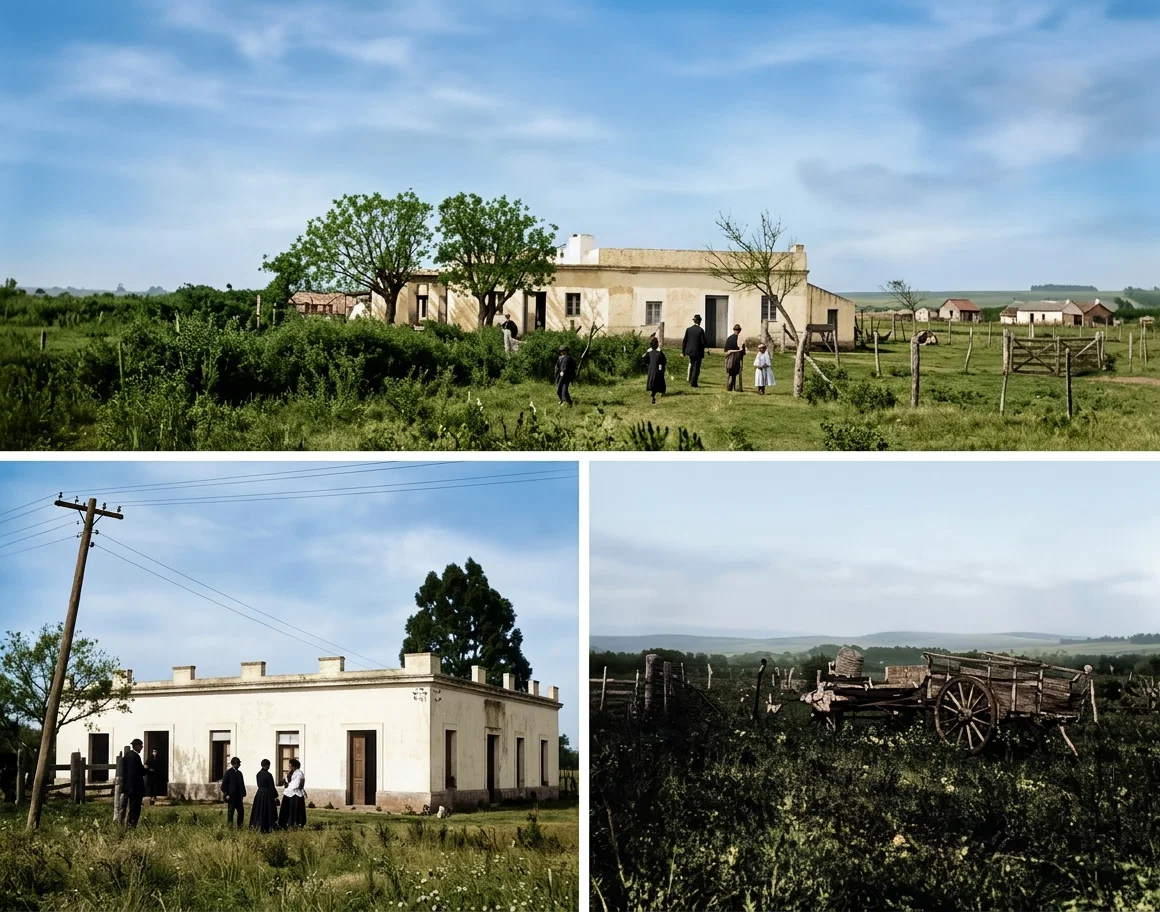
SCENES IN URUGUAY
It was suggested that the doctors take charge of the manual work, allowing me to return to Uruguay, taking Brother Hammerly with me to Montevideo, the capital city, with three hundred thousand inhabitants—one fourth the entire population of the republic. At that time this large city was without a living witness for the truth, so this move answered a crying need. Sisters Brockman and Kerr came with Brother Hammerly's family, arriving in Montevideo on April 29. They at once met opposition from a lady physician who is much prejudiced against our work; but the Lord turned even this to a blessing, and from the beginning these nurses have had a good degree of success. In his efforts for the poor, Brother Hammerly found those who would listen to the truth, and at present several persons are interested in the message, and we hope soon to see them take their stand with the people of God.
The writer then visited the churches and companies and isolated members, canvassing at the same time. Many thanked me for giving them an opportunity to buy our books. One merchant where I stayed overnight bought “Christ Our Saviour,” saying, “I am a Catholic, but I have no confidence in many things taught by the church.”
About this time we received word from Brother J. W. Westphal to resume the work of building the sanitarium at Diamante, so I returned the latter part of June, remaining until September 10. During this time Brother Ernst devoted his time to canvassing. Soon several students from the River Plate Academy came to spend the vacation in canvassing. These we accompanied for several weeks. Then, loading my cart with books, I again started to make a visit among the brethren, canvassing as I went. On this occasion I came again to the Catholic merchant, who at once invited me to remain overnight. He asked if I had any more books such as I had sold him before, as he wished to give one to his sister. When I showed him “Coming King,” he at once bought it with the other, saying, “The work you are doing is the need of the age.”
During the last eighteen months the Uruguay Mission has taken one thousand copies of our Spanish missionary paper, La Verdad Presente, arranging with a rural publishing company to send them to the addresses of their subscribers. In the first number we placed a supplement calling attention to the importance of the paper, and in the third number another, asking them to subscribe. Then we sent to other addresses for three months, the paper being a monthly. Thus in one year we reached four thousand families. This effort did not bring the desired result in subscriptions; but as one passes through the country, he notes the change in the attitude and feeling of the people toward our work.
At present we have three vacation canvassers. Prof. C. D. Lude, from our school in Argentina, is working in the interests of the Missionary Volunteer work and canvassing most of the time. The nurses are also doing an encouraging work with the new Spanish health paper, Salud y Vida.
Our most urgent need now is some equipment for our medical missionaries. It seems too bad not to be able to treat the sick, and demonstrate the divine principles of health which the Lord has given us, for lack of everything with which to do. We need three or four thousand dollars to put up a little home for our workers, with necessary treatment-rooms.
We earnestly ask an interest in the prayers of our brethren for wisdom and complete consecration.
Nueva Helvetia, Uruguay.
East Caribbean Mission
By H. C. J. WALLEKER
H. C. J. WALLEKER
I LEFT St. Thomas, March 1, in company with Elder U. Bender, president of the West Indian Union Conference. We first visited St. Croix, where we remained two days, holding meetings each evening with the brethren and friends of the cause in that island. While there, Elder Bender was taken down with the fever; but Thursday morning he had so far recovered that we were able to proceed on our journey. We crossed the island (sixteen miles) in the mail-wagon, and took the boat at Frederiksted for St. Kitts, arriving there Friday morning. We remained here only a few hours, yet this gave us opportunity to visit some of the believers. Leaving St. Kitts, we proceeded to Antigua, reaching the island Friday evening. We had a general meeting appointed for this place, and our brethren were waiting for us. Sabbath and Sunday were precious seasons to all. Eight were baptized, and we also celebrated the ordinances.
Sunday afternoon, March 6, we took passage for Dominica, where we arrived Monday morning, and met Elder P. Giddings and family. Elder Bender not feeling well, and having another appointment at Barbados, he continued on the same boat to that place, while I remained with the brethren at Dominica for ten days. We held meetings every night, and God blessed us with his presence. At this time some took their stand fully on the Lord's side.
Leaving Dominica, March 19, I stopped at Martinique a few hours to inquire about the conditions, and how we can best open work in these French islands. I found that no Protestant denomination is now working there, and that there is no import duty on literature. It seems that the time is ripe for entering these islands. I next stopped at St. Lucia a few hours, and met some of our people there. The next stop was Barbados, where I found Elder Bender waiting for me, and we proceeded on the same boat to Georgetown, Demerara, where we arrived March 25. The British Guiana Conference was to convene April 1, but on our arrival we began to hold meetings each evening, and were kept busy all the time we were there. Some changes were made in the organization of this field. It was decided by unanimous vote to turn it into a mission field, instead of operating it as a conference. Elder O. E. Davis was again put in charge of the field as superintendent.
April 5 we left Demerara, arriving in Trinidad on the seventh, and the South Caribbean Conference began its annual session two days later. Although both yellow fever and plague were raging here, we were made very comfortable at Elder E. C. Widgery's home, and enjoyed our stay very much.
On May 2, in company with Elder F. G. Lane and family, I left for Barbados. During my stay I spoke to the believers several times. It is indeed a pleasure to note the progress of the work in this island. The message is onward throughout the whole island field.
After an absence of two and one-half months, I arrived at St. Thomas, thankful to be home once more. I praise the Lord for his love and protecting care.
Danish West Indies.
A Contrast
A RETURNED MISSIONARY
While attending the funeral services of a child recently, my mind was carried back to another funeral,—also of a child. The contrast was so great that, for the benefit of those who may think it a rare privilege to go to a foreign mission field, I will call your attention to it.
A young widow with three little children was striving to care for and support her orphans, and do self-supporting missionary work in Mexico. Her parents owned a small farm in the tropics, but had gone to a large port city to engage in ship missionary work. The daughter (I will call her Sister L.), remained upon the farm, and in addition to her own little ones, cared for and taught five orphan American children.
Suddenly Mary, the oldest daughter, was stricken with the dreaded tropical fever, and in twenty-four hours was dead. The little boys had been sent to the Americans living in the settlement for help, and to send some one for a doctor. The natives came in when they heard of the child’s sickness, and began to prepare for a fiesta, as they usually do in case of a death. They could not or would not do anything to help care for the child, but simply shrugged their shoulders, looked pious, and said, “God’s will be done. Perhaps she has the evil eye, and nothing can cure that.”
As Sister L. left the death chamber, she found the yard swept as for a dance, and active preparations going on for a fiesta. On a mat at the door was a group gambling. Going to the leader, she told him kindly that it was not her custom to make feasts; and as her heart was very sad, would he please tell the crowd that she would rather be quiet and alone.
She was obliged to attend to all the arrangements for burial herself, and with her own hands place her child in the rude coffin, and cover it with flowers. The Mexicans crowded in to take a last look at the angelita, and to relate the wonderful stories she had told them of Jesus, and the sweet songs she had sung to them.
The sad mother thought of the precious promises to those who die in the Lord,—of the glorious resurrection, when she would again clasp her darling to her breast; but O, how hard it was to lay her away without a word of sympathy or comfort from one of like faith! “If it were only a song, I could bear it better,” she cried. Later, several American men and an old lady came in to offer their assistance. Our sister asked them each in turn if they would not offer a prayer at the grave, but all refused, saying they had never prayed.
Turning to the orphans for whom she was caring, she said, “Let us sing Mary’s favorite song,” and as their sweet voices rang out in the strains of “Never Alone,” one after another in the room sank to their knees. Kneeling by the coffin, with her hands on the still, white face, Sister L. poured out her heart in prayer to the Father, asking his blessing upon all those present, that they might be ready when their turn came. The rough cattlemen wiped their eyes as the coffin was closed, and placed upon the shoulders of the four Mexicans chosen to carry it to its last resting-place.
Two miles by a foot-path brought them to the little cemetery where was the newly-dug grave. As the clods fell upon the coffin, our brave sister began to sing, “God Be With You Till We Meet Again,” her two little ones clinging to her, awed into silence by the look on her face.
Much more might be said concerning her trouble, though this brief sketch will suffice to bring out the contrast between her affliction and that of those who are bereaved, among friends, with competent medical aid, loving hands to minister, others to carry the responsibility of the last sad hours, and comforting services by a servant of God.
It is indeed a privilege to be a foreign missionary; for we know that these light afflictions are but for a moment, and not worthy to be compared with eternal life with our Saviour. We know, too, that these nations must know of the coming King, and some one must tell them. Let us therefore pray earnestly for the workers in the Master’s vineyard.
Argonia, Kan.
Tibet, the Sealed Nation
TIBET is a Buddhist nation, that religion having been introduced into the nation nearly fourteen hundred years ago from western India. It is a religion intermingled with the Bompa faith,—a religion of demons, mysteries, and the grossest idolatry,—and the two popes, as the lamas may be called, employ all the power at their command to preserve it unchanged. The country is oppressed to the verge of ruin by this ecclesiastical system. There are thousands of monasteries, and ten thousands of monks. Eighteen thousand monks live in and around Lhasa, and in some parts of the country every seventh man is a monk, and must be provided for by others. Consequently the poverty of the common people is very great, and the state of morals is deplorable. Tibet has been known as the “sealed nation.” On account of the obstacles to be surmounted and the determined resistance of the Lamaic monks to the introduction of any new religions, it has been thus far impossible to secure a foothold for the gospel. There are several Protestant missions on the Tibetan frontier, and it is hoped that erelong the light will penetrate the spiritual darkness of that unhappy and neglected country.